Blinded to Syria
Patrick Lawrence 18 December, 2024, 00:00
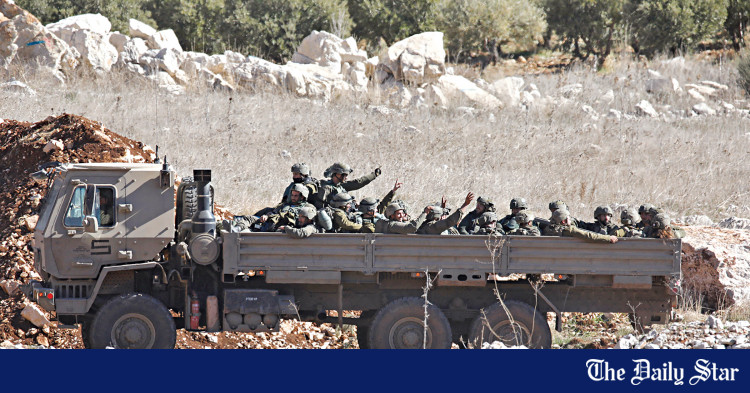
Israeli army infantry-fighting vehicles are deployed in the UN-patrolled buffer zone separates Israeli and Syrian forces in the Golan Heights on December 17. | Agence France-Presse/Jalaa Marey
I DO not know anyone who was not shocked by the lightning speed with which Damascus fell to expensively armed jihadist militias last weekend.
I know very few people who do not understand that another domino has just fallen in the ‘seven-front war’ Benjamin Netanyahu has boasted this year of waging across West Asia. I know very few people who do not recognise that terrorist Israel is well on the way to establishing itself as a dictatorial hegemon across the region.
I know very few people who do not understand that the longstanding project of the Zionist neoconservatives, who have more or less controlled US foreign policy for decades, ie, ‘remaking the Middle East,’ is the design behind all that has occurred since the Israelis launched their attack on Gaza on October 7, 2023.
I do not know anyone who has achieved the age of reason who does not recognize the US hand in the stunning sweep through Syria of Hay`at Tahrir al-Sham, long-recognised as a terrorist organisation. All one needs to grasp this is a little history.
But I know of no corporate or state-funded medium on either side of the Atlantic — the major dailies, the broadcast networks, NPR, PBS, the BBC — where you can read or hear about any of this.
Blinding us
MAINSTREAM media are doing exactly what they did as the US-led ‘regime change’ operation in Syria began in early 2012 at the latest and probably in the final months of 2011: They are making sure the events now unfolding in Syria are not quite illegible but nearly.
It is again a question of knowing the history. In the case of Hay`at Tahrir al-Sham and the other jihadists who knocked over the Assad regime as if it were made of Lego blocks, it is another exercise in dressing up a monster in a suit and tie.
The corporate press and broadcasters are now resolutely recasting the murderous fanatics who have seized control of Syria as legitimate ‘rebels.’ Rebels, rebels, rebels: This is the approved terminology.
I see they have left off describing these Sunni zealots as the ‘moderate rebels’ of yesteryear, that phrase having been hopelessly discredited last time around, but the drift is the same: These are civilised people out there trying to do the right thing.
My favourite in this line appeared in The Daily Telegraph several days before the Assad government collapsed: ‘How Syria’s “diversity-friendly” jihadists plan on building a state.’ I had to read this one twice, too.
Nowhere but nowhere in the west’s mass media can you find even a mention of the US-Turkish-and-probably-Israeli support that made possible the swift sweep of Hay`at Tahrir al-Sham and its ever-bickering allies from its seat in the Idlib governorate through Hama and other cities to the centre of Damascus.
This is, like the earlier years of the western-backed terrorist attacks on the Assad regime, and like the proxy war in Ukraine, and like the Saudis’ US–supported war against Yemen, and like the Israeli genocide against the Palestinians of Gaza, and like the Israelis’ attacks in Lebanon, sponsored military aggression we are not permitted to see without considerable effort to transcend official representations of reality.
Understanding who the Americans are
WHAT happened, what is happening, what will happen: I do not know anyone who is not asking these questions, too.
We must go back and back and back further to understand what has just occurred in Syria and to understand why, and finally to understand who Americans are and who they have been for all the decades since the 1945 victories.
It is logical to begin this pencil-sketch of the past with the famous coups of the 1950s. These occurred in Iran, where the CIA, working with MI6, deposed Mohammed Mossadegh as Iran’s prime minister in August 1953, and in Guatemala, where an agency operation forced Jacobo Árbenz from the presidency a year later.
It is striking today to consider a few of the features of these operations. Stimulating various social and economic antagonisms to foment public unrest and an appearance of political disorder was key in both cases. Both coups removed popularly elected leaders and installed repressive puppets.
There was violence in both cases, but by later standards these operations were something close to surgical. Mossadegh withdrew to his farm in the Iranian countryside; Árbenz, a Swiss pharmacist by background, spent his last years wandering dejectedly through Europe.
An appearance of propriety was important back then. Most Americans were unaware that the CIA had engineered the events in Tehran and Guatemala City. And in the Iranian case, something to note: Removing Iran’s first elected prime minister set in motion a wave of blowback that continues to break over US–Iranian relations; in Guatemala it led to a civil war that endured for 36 years.
The CIA considered the coup in Iran a useful model — Guatemala its next application. But in 1965 the agency began to do things very differently when it organised the coup that brought down Sukarno, independent Indonesia’s charismatic founding father and its first president.
The Jakarta model
VINCENT Bevins, a seasoned foreign correspondent, got this down better than anyone in The Jakarta Method: Washington’s Anticommunist Crusade and the Mass Murder Program that Shaped Our World. With the Cold War approaching its worst years, the Indonesian coup was the first, as Blevins’s subtitle indicates, to submerge an entire nation in prolonged violence.
There are various figures for the number of deaths that resulted as the agency installed the dictatorial, bottomlessly corrupt Suharto in the presidential palace in 1967. Blevins puts it at a million or more. Along with the deaths, the nation’s previously lively political culture was extinguished until Suharto fell 32 years later.
The Jakarta method was subsequently applied in various other circumstances, notably but not only in the 1973 coup that deposed Salvador Allende in Chile and installed Augusto Pinochet, a vicious dictator in the Suharto mould. Nine years later Zbigniew Brzezinski put a modified version to use in Afghanistan.
Blind to US support for jihadism
AS JIMMY Carter’s relentlessly anti-Soviet national security adviser, Brzezinski persuaded Carter to back the mujahideen then fighting the Moscow-backed regime in Kabul. The result was the well-armed, well-financed force named al-Qaeda, led by Osama bin Laden.
And so we come, via the campaigns of mass violence in Iraq and Libya and the proxy war in Ukraine, to the Syrian operation. People who rely on mainstream media still have a hard time accepting that the US and its trans-Atlantic allies backed al-Qaeda’s Syrian forces, the Islamic State, and their heinous offshoots in their war against the Assad regime.
There are no grounds whatsoever for this disbelief. The US operation in Syria is a straight readout of Brzezinski’s Afghanistan strategy. Sharmine Narwani, the tenacious Beirut-based correspondent and the founding editor of The Cradle, reported the American op first-hand as it unfolded. She recounted what she saw in an impressively detailed interview I published in 2019.
It wasn’t over
BY 2018-19, it was obvious that the CIA’s Syrian operation, in my judgment its largest since the Cold War’s end, had failed after several years of Russia’s bombing campaign against the Islamic State. Everyone making this judgment, myself included, forgot to add four essential words: It had failed for the time being.
Hay’at Tahrir al-Sham was founded at the start of the covert US intervention, in 2011-12. Its name translates as Organisation for the Liberation of the Levant.
Liberating the Levant is a very good idea, but HTS does not mean this the way anyone opposed to the western powers’ long and violent domination of West Asia would mean it. HTS shared with the Islamic State an ambition to establish a caliphate ruled by radical interpretations of Islamic law.
In May 2018 the State Department added HTS to its list of foreign terrorist organisations, FTOs in the parlance of the apparatchiks. It is a direct descendent of Jabhat al-Nusra, which was the worst of the worst among al-Qaeda’s shape-shifting affiliates operating in Syria.
By the time HTS made the list, Jabhat al-Nusra was already on it. They both remain on it as we speak.
HTS was founded by Abu Mohammad al-Jolani, a nom de guerre now all over the news: He has long led HTS and appears now to have plans to make himself Syria’s next president. When he spoke at a celebrated mosque in Damascus last week, he shed the public alias in favour of his real name, Ahmed al-Shara.
Jolani’s background is not to be missed. He was once an Islamic State commander who went on to found Jabhat al-Nusra and, after a violent split, HTS.
As the HTS leader, he was implicated in numerous cases of torture, violence, sexual abuse, arbitrary arrests, disappearances, and so on. Reflecting his singular malignity, the State Department had declared Jolani a ‘specially designated global terrorist’ as far back as 2013.
That designation still stood in 2021. Then something odd, and in hindsight very revealing, occurred.
Rehabilitating Jolani
IN APRIL of that year PBS broadcast the first interview with Jolani ever to appear in any western medium. It was conducted by Martin Smith, a longtime broadcast correspondent with a good reputation.
And there on camera was the specially designated terrorist in a blue blazer and a buttoned-down shirt, telling Smith he planned to build a ‘salvation government’ in Syria.
Smith was not shy, to his credit, in his review of Jolani’s horrific record. But he gave his interview subject ample airtime to make his that-was-then-this-is-now argument.
There was no talk of a caliphate, despite how HTS still named itself. It was about sound local governance. Yes, this would be according to Sharia law, but it would be a kind-and-gentle Sharia law.
The Martin Smith interview, it is now evident, was highly significant for its timing and its implications for US policy. It is almost certain that it signalled an already-in-train revival of the Syrian operation; certainly it marked the start of the preposterous reinvention of Jolani that is now ubiquitous in western media.
It is a long way from those first postwar coups — large in ambition and implications but small in scale as they look to us now. Since the Jakarta method was devised in the mid-1960s, mass murder programs have shaped our world just as Vincent Blevins insightfully put it.
Committed to mass violence
THE questions noted at the start of this commentary remain those we must ask: What happened, what is happening, what will happen. Clarity on these matters arrives by degrees — not by way of official accounts or the corporate press, but in independent media. For now, two conclusions.
One, the US and its trans-Atlantic allies are now thoroughly committed to mass violence. This means it is difficult to avoid concluding that the western powers and Israel will turn to Iran once Syria as a functioning polity has been thoroughly disabled.
What has prompted the US and Israel to exercise caution to date has been the risk of what would without doubt be a cataclysmic conflict that could tip into another world war.
With a six-decade history of mass violence behind them, these powers now appear willing to take this risk. There is little ground left to continue questioning this.
Two, we now witness the reinvention of a viciously intolerant terrorist given to waging holy wars as an acceptable presence at the head of what was a secular nation until earlier this month.
We must read this as the outcome — the successful outcome — of an eight-decade campaign to render the citizens of the western powers grotesquely ignorant of the world in which they live.
The New York Times and other major dailies continue to lie by omission about US support for Jolani and the organisation he leads, even as both are officially designated terrorists. But something worth considering here: These media ran interesting photographs with their initial stories on the militias’ sudden offensive, showing rocket launchers and armoured personnel carriers of obvious western manufacture. Here is one such picture and here is another.
I see these pictures and the accompanying stories as mirrors. They show us exactly who we are, what we have become — and also the extent to which we are encouraged not to see either.
There are no true surprises in what we witness now in Syria. It is an old story. We have been blinded to it, along with many other things to which we have been blinded. Most fundamentally we have been rendered blind to ourselves.
Patrick Lawrence, a correspondent abroad for many years, chiefly for the International Herald Tribune, is a media critic, essayist, author and lecturer. His new book, Journalists and Their Shadows, is out now from Clarity Press.
 Syrian Defense