☕ Support Us
[🇧🇩] - Reforms carried out by the interim/future Govts. | Page 4 | PKDefense

[🇧🇩] Reforms carried out by the interim/future Govts.

Reply (Scroll)
Press space to scroll through posts
G Bangladesh Defense
[🇧🇩] Reforms carried out by the interim/future Govts.
198
5K
More threads by Saif


Unveil roadmap to reform immediately

Anti-Discrimination Student Movement places their 5-point demand after Shaheedi March marking the one month of the fall of AL govt
students demand reform roadmap from interim government

1725603803993.png

Photo: Palash Khan

The Anti-Discrimination Student Movement today demanded that the interim government unveil a roadmap to reform the state immediately.

Abu Baker Majumder, a key organiser of the students' movement that spearheaded the protest against the AL-led government, announced the demand as part of their five-point demand from a rally held at the central Shaheed Minar.

Earlier, the students' movement held a mammoth procession, organised to commemorate one month of the fall of Awami League government.

The other demands include providing financial and legal assistance to the family of the martyrs, identifying the corrupt officials and collaborators of the ousted fascist government inside the administration and bringing them to book immediately.

They also demanded the arrest and punishment of the perpetrators of the mass killing. Athy demanded that the Gono Bhaban, the former official residence of Sheikh Hasina, to be declared as the July Memorial Museum.

Several thousand students and people from all walks of life participated in yesterday's 'Shaheedi March' that started from the base of the Raju Memorial Sculpture at the Dhaka University.​
 

‘Reforms are crucial to strengthen the Election Commission’

1725688997950.png


Badiul Alam Majumdar, secretary of SHUJAN: Citizens for Good Governance, speaks with Naznin Tithi of The Daily Star about the changes needed in our electoral system and related laws before the next election.

The chief adviser is supposed to present a roadmap for state reforms soon. What kind of reforms should be prioritised before the election, and how long should it take to implement them?

What I learned from the people who participated in the mass uprising is that they wanted justice for the criminal acts such as the killing of students and civilians, enforced disappearances, extrajudicial killings, violation of human rights, etc. They also wanted accountability for the financial crimes committed over the past 15 years. Another key demand of the students is state reform or raastro meramot. So, we are glad that the chief adviser is going to declare a roadmap after ongoing dialogues with the political parties. Once that roadmap is laid out, we will know what reforms they intend to undertake and how far they are willing to go.

Broadly speaking, I see two key areas where reform is required. One is the need to revise various laws, including those governing the appointment of members of the Election Commission (EC), the Anti-Corruption Commission, the Human Rights Commission, Information Commission, the local government, laws for appointing the judges, etc. These laws need to be updated and amended to reorganise both constitutional and statutory institutions. Another need is reforming the constitution, which is the most important and yet most difficult task.

Now, there are two alternative views. While some are opting for completely rewriting the constitution, others want changes in some key areas. These include bringing a balance between the powers of the president and the prime minister, reforming or abolishing Article 70, deciding on whether or not we should have a proportional representation system and bicameral legislation, establishing term limits for the prime minister, and setting the duration of the legislative term, etc. These are some of the major things that need to be addressed if we are not rewriting the constitution. We hope to get some sort of guidance on this from the chief adviser's forthcoming roadmap.

There are two ways to institute these reforms. One is by declaring the 15th amendment unconstitutional. In that case, the provision for referendums will come back. If that happens, it could be used for adopting some of the desired constitutional changes. Some laws could also be reformed, and the president could issue an ordinance to turn these into laws. But they will have to be approved in the first session of the parliament when it is formed. But you cannot change the constitution with an ordinance, so that will have to wait.

Now, the first round of dialogue is going on. There may be a second and even third round. After the chief adviser declares the roadmap, there will be further dialogues, through which an agreement among the political parties, government and other stakeholders can hopefully be reached. That agreement could be signed into a document, which can be called a National Charter. After the political parties sign the document, there could be a free and fair election. Then, whoever comes to power will be obliged to implement those reforms. However, our political parties don't have a good track record of keeping their commitments. So, there will have to be a body which will stand guard. I think our students could probably play this role.

But if we go for rewriting the constitution, then there has to be a constituent assembly through which a new constitution could be adopted.

What, in your view, can be a reasonable timeframe for polls?

The timeframe for the election will depend on what the political parties and the interim government agree on doing. It will depend on what milestones the interim government would like to achieve first. The good thing is that discussions are currently
The political parties have also proposed to hold the local government elections before the national polls.

Our local government system is in a bad shape. Also, some of the local government bodies that are very important for providing services to the people have been dissolved. So, elections to these bodies should be held as soon as possible for practical reasons. This will give the interim government, and a reconstituted EC, the experience required for holding the national election. The local elections will not be as contentious, because they will not cause changes in power. But before these elections are held, the local government laws should be reformed.

What kind of reforms are needed in our electoral system and in the Election Commission laws to make the system foolproof, so that the EC can hold elections independently in the future?

There is nothing we can do to make the electoral system foolproof because it does not depend fully on the EC, even though it is the biggest and most important stakeholder in case of elections. The other stakeholders are the political parties and their candidates, law enforcement agencies, bureaucracy, civil society, and media. If political parties and their candidates do not abide by the laws, and if the law enforcing agencies and bureaucracy are partisan, then the EC cannot really do much. Having said that, the EC can prevent/stop bad elections because its constitutional mandate is to hold an inclusive and competitive election.

However, there are quite a few areas where reform is vital to strengthen the Election Commission. First, we need to reform the law enacted in 2022 for appointing election commissioners. This law was basically recycled from the old circulars that the Awami League government used in the last few elections to appoint the commissioners of their choice. We need to do away with this law. Incidentally, the legality of the appointment of the now-former Election Commission is in serious question. Because the 2022 law calls for only political parties and professional bodies to propose names to the search committee for the appointment of election commissioners. But the search committee, in violation of the law, allowed all citizens to propose names, including their own. For example, Kazi Habibul Awal's name was proposed by the late Zafrullah Chowdhury. Although he was a distinguished person, he was not qualified as per law to nominate anybody. A similar thing happened in the case of other commissioners. Therefore, we need to reform this law to reconstitute the EC. However, because of the unusual situation caused by the mass upsurge, the interim government should be able to appoint a new EC without following the existing law or enacting a new one.

We also need to make quite a few changes in the Representation of the People Order (RPO). For example, according to section 90B of the RPO, political parties registered with the EC must not have provisions for associated and affiliated bodies in their constitutions. This was intended to disband such bodies. Our political parties removed such provisions from their constitutions but kept those affiliated bodies by terming them as "brotherly" organisations so as to use them as their lathiyal bahinis. Thus, our political parties adhered to the letter but not the spirit of the law. To remedy this, section 90B of the RPO needs amendment.

Moreover, the nomination trade has become a big concern as it allows people to buy nominations in exchange for money. Consequently, more than two-thirds of our parliamentarians were businessmen. As a result, we now have the "best" democracy money can buy. Redressing this will require amending section 90B of the RPO, requiring the nomination of candidates for parliament elections to be determined by the votes of the activists of each constituency.

In addition, a few more changes are needed with regards to the candidates' affidavits, which must be scrutinised. There must also be provisions for counter-affidavits so that one can challenge the affidavit of a candidate. Furthermore, the present outdated affidavit form needs to be updated, and election expenses should be scrutinised and monitored. All these must be included in the law.

Additionally, we need a constitutional change if we want a proportional representation system. We will need constitutional changes for women's representation in parliament, to hold direct elections for the women's seats, and to preserve at least a third of the seats for women. Constitutional changes will also be needed if we want to go for a bicameral legislature and set term limits for the prime minister.

What's your thoughts on the proportional representation system that some parties have suggested?

Proportional representation means that political parties will get the seats based on the proportion of votes they get. So, if a party gets 50 percent of the votes, it will get 50 percent of the seats. If we go for this system, it will prevent the monopoly and tyranny of the majority. In 2008, the BNP received about 33 percent of the votes but got only 10 percent of the seats. In a proportional system, the BNP would have had more seats. So, this system should be seriously considered.​
 

Don’t reform constitution, rewrite it
Speakers tell discussion

1725754049601.png


There is a need for a new constitution as merely amending the current one would not fulfil the aspirations of students or prevent the rise of future tyrants, said speakers at a roundtable yesterday.

Bangladesh Policy Discourse organised the event, held at Cirdap Auditorium in the capital, where participants called for significant state reforms and a constitution that ensures civil equality and balance of power.

"A one-party system was established in parliament. If the state fails to create strong institutions, the country will face destruction," warned Prof Robaet Ferdous of Dhaka University's mass communication and journalism department.

He accused the previous government of dismantling all constitutional institutions over the past 15 years. "We must move forward with the collective intellectual knowledge of the world, ensuring that the original spirit of any revolution is not compromised."

Kazi Abul Khair, secretary general of the Bangladesh Muslim League, echoed the call for a new constitution, saying it should reflect ideals of the student-led revolution to eliminate all forms of discrimination.

"If we want to liberate the nation, we must rewrite the constitution to establish a truly discrimination-free society."

Shahriar Iftekhar Fuad, chairman of Gonomukti Jote, highlighted the need for a people-centred constitution that guarantees economic, political, and religious freedom.

"In Bangladesh, groups loyal to dictators remain influential. The system that promotes political dynasties and class interests must be abolished to protect the people's rights," he said.​
 

Give us time to carry out reforms for a New Bangladesh
1725841725326.png

Asif Nazrul

The consecutive 15-and-a-half year rule of the Awami League government drew to an end on 5 August this year by means of a student-people’s uprising. On 8 August an interim government led by Dr Muhammad Yunus was formed. Professor of the Dhaka University law department, Asif Nazrul, was given charge as the advisor of the ministry for law, justice and parliamentary affairs, the ministry of expatriate welfare and overseas employment, and the ministry of culture. On the completion of the government’s first month at the helm, in an interview taken at the expatriates' welfare ministry in Eskaton of the capital yesterday, Saturday, he spoke at length to Prothom Alo’s deputy head of reporting Rajib Ahmed on the activities of the advisory council, reforms, the the tenure of the government, relations with India, and more

Prothom Alo : You were a member of the civil society. You were a critic of the government when it came to human rights, freedom of speech, rule of law, the courts, etc. Now you yourself are in the government. How do you feel about this new experience?

Asif Nazrul
: For the past 30 years I have been a critic of the different governments. Today I have been in the government for 30 days. It is not as easy to carry out this new responsibility as it was to criticise the negative actions of the government. I have had no experience. But this I can say, if a person has honest intentions, love for the country and will power, it is possible to carry out any task. I believe that within a month or two, I shall be quite adept at carrying out my government duties.

Over the past 15 years, each and every government institution has been destroyed, riddled with uncontrolled corruption, irregularities and politicisation, leaving behind a disastrous situation. This has made things extremely challenging.

Prothom Alo : The government has been at the helm for one month now. What achievements has the government made in this span of time? And what would you say has been unwarranted?

Asif Nazrul:
I would say that the first achievement is that it has successfully created confidence that this is the people’s government. The previous government treated the people as its subjects. We have managed as far as possible to give the people the belief that this is their government, it is here to serve them. You can criticise the government anytime as you please. This free environment has been created. The government has taken many measures to eliminate discrimination and deprivation. This may not be understood clearly from the outside. For example, government officials were deprived from promotions and postings on political considerations. Measures have been taken in that regard. People have been given the confidence that the killings of July will be brought to justice. The false cases filed by the past government centering the student movement have been withdrawn. Some false cases lodged under the Digital Security Act have also been dismissed.

The government has managed to carry out the preliminary steps required to restore discipline to the economic sector, to bring loan defaulters under the law, to bring back money siphoned out of the country. The government to an extent has managed to give the people the courage to dream again. Meetings, rallies, seminars are being held in the capital city. People are speaking out. All sorts of recommendations are being made. This is the type of country we wanted.

We have achieved this after so many years. Certain work regarding international norms for human rights and also signing the convention against enforced disappearances, are important achievements of the government. A commission has also been formed regarding enforced disappearances.

There are some things that may not be visible from the outside. There was an effort to destabilize the government. The government successfully thwarted a coup by the court, a move to use the ansars to create instability, efforts to create disorder in the labour sector and more.

There have been unwarranted incidents too. Cases are being filed here and there. Allegations have arisen that cases are being filed indiscriminately in the style of the previous government. Assaults have taken place on the court premises.

Prothom Alo : There is criticism about indiscriminate cases and accusations. What steps is the government taking?

We have looked into the matter and found that cases are forced to be taken. Actually during the rule of the previous government, the court and the police were seen as opponents of the people and were despised by the people. That is why they are now under pressure and are finding it difficult to gather moral strength. Even if they do not want to, they are being obliged to take up a mass of cases. Despite their good intentions, the police are unable to control the assaults taking place on the court premises. We are working on ways to resolve this. For example, a proposal was made to hold the hearing of certain prominent persons very early in the morning at an unpredictable time. That is why the assaults have stopped.

Concerning the cases, investigations will be carried out before taking case statements. Considerations are being made to bring about certain changes to the criminal code. Also, the government is giving out a message that recording a case statement does not mean arrest.

Prothom Alo : So we can say that the random allegations and indiscriminately making persons accused in various cases, is a problem and the government admits this is a problem.

Definitely. And the government is taking measures accordingly. However, this is a problem created by the past government. The Awami League government created a culture of fabricated cases. As a reaction to that, there have been certain incidents in some places. It is not possible, after all, to assuage people's anger overnight.

Prothom Alo : Now coming to the matter of advisors. Why did you choose to be law advisor?

I feel I understand the law a bit more than other matters. A lot of injustices and wrongdoings can be cleared up by means of the law ministry. Almost 50 per cent of the judges are my students or my acquaintances. These issues encouraged me to join the law ministry. When Dr Yunus asked me to take up the law ministry, I readily acquiesced. But the expatriate affairs ministry is a challenge for me. When I would travel abroad with Dr Yunus I would talk to him about the sufferings of the workers. Perhaps he had that in mind when he gave me this ministry. I want to work for the expatriates. But as you see, it is Saturday and I am here at this office. This is the third Saturday in the last 30 days. I had to attend office on two Fridays in one month.

Prothom Alo : Ensuring many of the aspirations that the people had in the student-people's uprising -- human rights, justice, rule of law, freedom of speech, voting rights, etc -- are to a great extent a part of the law ministry's work. That is a massive workload. How confident are you about completing these tasks?

Asif Nazrul:
Much of the past month has been spent on routine work such as withdrawing conspiratorial cases, releasing innocent persons arrested during the movement, freeing the attorney general's office of the previous government's influence, posting of officials who had been victims of discrimination, helping in various appointments, etc. There is a lot of other work too which a regular government does not have to address. That is why I have not been able to give time to reforms. But by December the initial process of reforms will be visible.

Prothom Alo : You were working on trying former prime minister Sheikh Hasina as well the party Awami League at the International Crimes Tribunal. Is that still on, or are there any other decisions?

The victims and their families are filing cases under the regular laws in various places. We cannot stop them. We do not have the right. However, the extent of the killings in July is huge. In that sense, it would be best for this trial to be conducted by the International Crimes Tribunal for the sake of justice. We have consulted local and foreign legal experts. This law contains the scope and capacity to duly try those who ordered the July killings. We have managed to explain the matter to the heads of foreign diplomatic missions and the representatives of the United Nations. They have some concerns over the definition of the law, certain problems in the rules of deposition, certain limitations in the accused seeking legal support, etc. We will address these issues and reform the law. Our aim is not vengeance, it is justice for the mass killings.

The concerned foreign quarters say that as the law has provision for death sentence, they cannot take part in the judicial proceedings directly. We said that the law will be reformed and they will have the scope to remain as observers. The accused persons will be able to retain foreign lawyers.

Prothom Alo : Will the International Crimes Tribunal retain the death sentence?

That is a major policy issue. We cannot simply change this all of a sudden. We have to look into whether Bangladesh has the correctional prison facilities and public culture to abolish the death sentence.

Prothom Alo : In an interview with the Indian news agency PTI, chief advisor Dr Yunus said he will ensure that the former prime minister Sheikh Hasina is tried. He will request India for her extradition. Will you expand on that?

Asif Nazrul:
Sheikh Hasina is the one who planned and ordered the killings of July. These killings will be brought to justice. If the trial is held, naturally the question of executing the matter will arise. That is why the request to India for extradition will arise. The chief advisor's words are a reflection of the people's expectations.

Prothom Alo : Do we have a prisoner exchange agreement with India?

Asif Nazrul:
Yes, we do. However, in some important instances, there is scope to use certain exceptional clauses. Discussions will be held with India to avoid these clauses being used.

Prothom Alo : We heard a statement of India's defence minister Rajnath Singh. He addressed the Indian armed forces, telling them to be prepared for future war. Does the Bangladesh government have any reaction to this?

The matter has not been discussed at an official level. From my own point of view I can say, India should understand that a government formed through a student-people's movement is in place in Bangladesh at the moment. This government has huge public support, respect and patriotism. The manner in which Rajnath Singh dragged in Bangladesh along with the issues of Ukraine and Palestine, indicates they have a lack of sensitivity and respect towards the change in Bangladesh. Indian policy has failed in each and every one of its neighbouring countries. I would request that India look into its own liability in this matter. Bangladesh will have relations with India, but as equals.

After such a huge massacre, who will say that they should be allowed to hold meetings and rallies right now? They are even conspiring to overthrow the government, to misguide the people.

Prothom Alo : The coordinators of the Student's against Discrimination are now a part of the government. This is a completely new chapter. What is your experience in this regard?

Asif Nazrul:
This is a great experience. I am amazed at their performance. The manner in which they speak at the advisory council, the way they work, is very good. I foresee them doing extremely well in the future. I see them as a gift from the Creator to the people of Bangladesh.

Prothom Alo : No rehabilitation until the fascists are brought to trial. The government will discourage any public programmes of the fascist party and alliance. Advisor Asif Mahmud Shojib Bhuyain made this statement at the end of the advisory council's meeting on Thursday. Would you elaborate on this?

Asif Nazrul
: After such a huge massacre, who will say that they should be allowed to hold meetings and rallies right now? They are even conspiring to overthrow the government, to misguide the people. Asif Mahmud's statement was based on the discussions of the advisory council. I feel that the extent of their crimes will be revealed by means of proper trial. In the amendment of the International Crimes Tribunal, Awami League themselves created scope to try any organisation.

Prothom Alo : The political parties say that the interim government should be given a reasonable amount of time. What do you think should be a reasonable amount of time?

Asif Nazrul
: Political parties may want an election. My question is, what sort of election do they want? Do they want an election as in Awami League times, do they want a government system that lacks accountability? Do they want police, a judicial system and an administration as in Awami League times? If they do not want that, if they have respect for the aspirations of the student-people's uprising, then they must give us time to carry out reforms to build a New Bangladesh. It is not possible to specify this time. It depends on how much cooperation we receive from the stakeholders.

Prothom Alo : An elected government has a role to play in turning the reforms of the interim government into laws. In the past we have seen that many things are changed. What guarantee is there that the new government will retain your reforms?

There are two reasons why I am confident. Firstly, never before has Bangladesh seen such a huge mass uprising, with so many people being killed. I believe the new government will not do anything against the aspirations of the people. Secondly, the reforms will be made keeping everyone as partners, so a sense of ownership is created.

Prothom Alo : Where do you want to see the country at the end of the present government's term?

I want to see the country for which the liberation war had been fought. I want a country free of discrimination, free of exploitation, free of suffering and sorrow, a country that can stand in dignity among the comity of nations. On a personal level, when I step down, I want no one to be able to say that I did anything wrong. I may make mistakes, but I will do no injustice.

Prothom Alo : Thank you.

Asif Nazrul: Thanks to Prothom Alo.

* This interview appeared in the print and online edition of Prothom Alo and has been rewritten for the English edition by Ayesha Kabir​
 

Govt to form commissions to reform 6 key sectors: Yunus

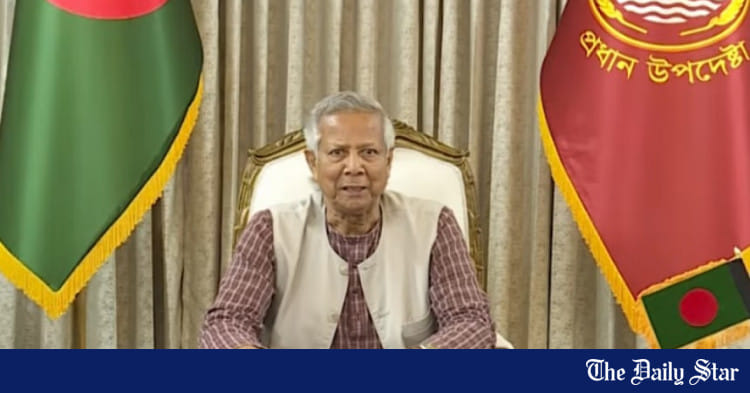
The interim government has decided to form six commissions to bring reform in six major sectors, Chief Adviser Prof Muhammad Yunus today told the nation in a televised speech.

The sectors are the elections system, police administration, judiciary, anti-corruption commission, public administration, and the constitution.

Badiul Alam Majumdar, secretary of Shujan, will lead the election system reform commission while Sarfaraz Chowdhury will lead the police administration reform commission. Justice Shah Abu Nayeem Mominur Rahman, a former judge of the Supreme Court, will lead the judiciary reform commission.

Iftekharuzzaman, executive director of Transparency International Bangladesh, will lead the anti-corruption reform commission; Abdul Muyeed Chowdhury, a former adviser to the caretaker government, will lead the public administration reform commission and Dr Shahdeen Malik, an advocate of the Supreme Court, will lead the constitution reform commission, he said.

The names of other members of the commission will be fixed upon talking with the chief of the commissions. Members of the advisory committee, and representatives of the movement -- students, general people, civil society, and political parties -- will be present at the discussions and meetings of commissions.

The commissions are expected to start their functions from October 1 and they are expected to complete their work within the next three months, he said.

The government will hold meetings with the main political parties on the basis of the reports of the commissions and the framework for the reform will be finalised upon holding a three-to-seven-day consultation meeting with the participation of the representatives' students, civil society, political parties and the government.

He also said that a hint will also be given on how the framework will be implemented.​
 
কোন খাত সংস্কারের নেতৃত্বে কে, জানালেন প্রধান উপদেষ্টা


Taskforce formed for banking reforms

The Bangladesh Bank yesterday formed a six-member taskforce to carry out reform initiatives in the country's banking sector.

The taskforce will mainly assess the current financial condition of the banking sector and estimate the amount of distressed assets.

It will also identify major risks and review financial indicators of weak banks, according to a press release of the central bank.

Besides, it has also been tasked with assessment of the actual condition of loans, provision deficit, net capital, actual value of assets and review of liquidity situation.

The taskforce members are Lutfey Siddiqi, special envoy on international affairs to the chief adviser, Muhammad A (Rumee) Ali, former deputy governor of the Bangladesh Bank, Meheriar M Hasan, chairman of BRAC Bank, Zahid Hussain, former lead economist of World Bank Group, Dhaka office, Prof M Zubaidur Rahman, vice-chancellor of the ZNRF University of Management Sciences, and Sabbir Ahmed, partner of Hoda Vasi Chowdhury & Co.​
 

Bangladesh interim govt chief unveils reforms plan
Bangladesh Sangbad Sangstha . Dhaka 11 September, 2024, 20:41

1726105200824.png

Bangladesh’s interim government chief adviser Professor Muhammad Yunus on Wednesday urges the people to cooperate with the interim government to accomplish reforms. | BSS photo

Chief Adviser Professor Muhammad Yunus on Wednesday announced the formation six commissions with appointment of six eminent citizens as their heads considering their experience in the respective fields.

‘We want reforms. It is our sincere request - please don’t go to the spectators’ gallery after bestowing the key responsibility of reform on us. Stay with us. We will do the reform together. It is the responsibility for all,’ he said in a televised address to the nation in the evening.

The chief adviser said six eminent citizens have been appointed to head these commissions. Badiul Alam Majumdar will act as the head of electoral system reform commission while Sarfraz Chowdhury as head of police administration reform commission, Justice Shah Abu Naeem Mominur Rahman as head of judiciary reform commission, Iftekharuzzaman as head of the anti-corruption reform commission, Abdul Muyeed Chowdhury as head of public administration reform commission and Shahdeen Malik as head of constitution reform commission.

The names of the other members of these commissions will be fixed through holding discussions with the heads of the commissions, he said.

After this, the government will continue the process of formation of commissions on various other issues, he added.

He expressed his belief that the reform of these institutions will also contribute to establishing a public ownership-based, accountable and welfare-oriented state system.

Yunus called upon all to bring reform to their own world too, saying bringing reform to a nation does not mean only reform of the government.

Yunus, who took the helm of the interim government following the fall of an autocratic regime in a student-people uprising, said the fascist government in Bangladesh has fallen in the face of the historic July uprising of students, workers and masses and the sacrifice of thousands of people.

It has become necessary to complete some national reforms in order to implement the aspirations and prevent the recurrence of fascism or autocratic rule in Bangladesh and introduce a state system based on people’s ownership, welfare-oriented and dedicated to public interest, he said.

The chief adviser said one of the central points of the reform plans is to establish a fair election system and good governance.

Yunus said the government is thinking of reforming the Election Commission and other institutions related to elections to eliminate these fears.

‘In addition, we feel the need for constitutional reforms to ensure the representation and interests of people from all walks of life and to reflect the message of the July mass uprising,’ he said.

Yunus said advisory council members, representatives of the movement of students, workers and masses and representatives of civil society and political parties will be present in the discussions and consultation meetings of the commissions.

Once fully constituted, he hoped, the commissions can begin works from October 1 and the works will be completed within the next three months.

The chief adviser said based on the commission’s report, the government will hold consultations with major political parties at the next stage.

At the final stage, the outline of reform plans will be finalized on the basis of a three-to-seven-day long consultation meeting with students’ community, civil society, representatives of political parties and the government.

It will also give an idea of how this outline will be implemented, he said.

He said the government believes that this event will make the whole nation strong and optimistic in the unity of implementation of the message of the July mass-uprising and aspirations of rebuilding the state.

He said that his government was committed to presenting an outline of democratic Bangladesh for the future generation.

‘We are committed to formulating an outline of a democratic Bangladesh for our children so that we don’t fall into the hands of any dictatorship and we can say we live in a democratic country...so that we all can claim that this country is ours - we’re working towards this goal,’ he told the televised address before the nation this afternoon.

Urging all not to take the law into their own hands, Professor Yunus warned that if anyone takes the law into his or her own hands and creates a chaotic situation in the society, he or she will definitely be brought to justice.

‘We (Bangladesh) are a nation of communal harmony. No one shall do any act that destroys religious harmony,’ he said.

At the onset of his speech, the chief adviser recalled the martyrs and the victims who participated in the student-people revolution against the fascist force.

He reiterated that the families of all the martyrs would be rehabilitated while the government will bear the entire expenditures for the treatment of all injured students, workers and commoners.

A complete list of martyrs and injured has been prepared for the long-term and costly treatment for the injured and looking after the families of the martyrs, he said, adding that updates of this list will be made.

The 2006 Nobel Peace Laureate said the government took an initiative to establish a foundation named ‘July Ganahattya Smriti Foundation’ to preserve the memory of the martyrs of the mass uprising.

‘Now this foundation has been established. This foundation is taking full responsibility of all martyrs’ families and families of victims along with providing best treatment to injured ones. We urge all people of the country and Bangladeshis living abroad to donate to this foundation,’ he said.

About law and order situation, Professor Yunus said his government is sincerely working to improve the law and order in the country.

Many people, he said, have been staging rallies and demonstrations to express their pains they suffered in the last 16 years and seeking its remedy, which created impediment to the movement of people.

‘I promise you that I will not forget your righteous plea. We are committed to giving remedy to all wrongs. We will try best to resolve all problems as much as possible within our responsibility. I again request you to refrain from disrupting your movement. The nation will be grateful to you,’ he said.

Referring to the allegations of workers in RMG and medicine industries, the chief adviser said the institutional structure is almost destroyed, while foreign exchange reserves have hit rock bottom.

‘We are trying to bring life into this economy. We are also getting response to our initiative. If our industrial plants are closed down and get non-operational at this time, the country’s economy will be hit hard. That cannot be expected in anyway,’ he said.

The chief adviser asked the factory owners to resolve their problems in consultation with workers and keep their factories operational, resulting in making the poor economy healthy.

Yunus said all should work together to build a society based on justice, while the criminal cases, except murder cases, filed from July 1 to August 5 to suppress the mass movement have been withdrawn and all those arrested in these cases have been released.

He said the interim government has embarked on major reforms in judiciary since taking of its office.

Appointment of the most qualified person as the Chief Justice has instilled new hope in people’s minds, he said, adding that appointment of Judges of Appellate Division, Attorney General and many important appointments have all been completed.

The false cases filed under the Anti-Terrorism Act and the Digital/Cyber Security Act to harass people are being withdrawn, the chief adviser said.

He said there are many black laws including the Cyber Security Act in Bangladesh and those black laws will be repealed and amended soon.

Professor Yunus said assistance is being provided for the investigation into and trial of the five much-talked-about murders, including the killing of journalist Sagar-Rony, on a priority basis and for settlement these cases at the earliest time.

The government, he said, recently signed an international convention to protect people from enforced disappearance and ‘as a result, we are committed internationally to ending the ‘the culture of disappearance’ established by dictatorship’.

‘We are also forming a separate commission to investigate every case of enforced disappearance during the 15 years of fascist rule,’ he said.

Aynaghor (Mirror house) has been closed and at the same time the story of the suffering and pain of families of the people disappeared by the fascist Hasina government is coming out, the chief adviser said.

‘We have our full eye on the education system to ensure a bright future for our young generation,’ he said.

‘Already, the present flawed curriculum from class I to class XII has been changed. The work of correcting and revising the textbooks is at final stage. This reform work will continue,’ he added.

In the first month, Professor Yunus said, the government started the process of appointing Vice-Chancellors and Pro Vice-Chancellors, who are acceptable to all, in every university.

As a result, an environment has been created to start work with new enthusiasm in all public and private universities, he said.

Claiming that the full freedom of press and expression has already been ensured, the chief adviser said the government is considering formation of a Media Commission so that the media can do their work smoothly.

He said to indentify the fake freedom fighters and skip the names of freedom fighters with age of less than 12.5 years during the liberation war from the list of freedom fighters, the government has taken an initiative to summit leave to appeal before the Supreme Court.

Measures have also been taken to recover the grabbed immovable assets of the Freedom Fighters’ Welfare Trust, he added.​
 

Education reforms to meet market needs, empower work force
Mohammad Shahidul Islam 12 September, 2024, 00:03

1726105822967.png


IN RECENT years, Bangladesh has been facing a critical issue, widening the gap between the education provided by its higher institutions and the actual demands of the job market. This mismatch is not just a concern for the career prospects of graduates but a pressing challenge that demands immediate attention. It could potentially stifle the nation’s economic growth, making it a matter of utmost importance. A significant factor contributing to this issue is the overwhelming emphasis on preparing for the Bangladesh Civil Service examination, often at the expense of technical and specialised training.

It is of utmost importance to balance academic pursuits and practical skills, ensuring that our youth are well-prepared for the challenges of the modern workplace. The BCS examination has become a central focus for many students across various disciplines. Traditionally centres of diverse learning, universities are now considered BCS coaching centres. This shift in focus has led to a concerning trend: students from fields like engineering, medicine, and science are abandoning their core subjects to prepare for the BCS or other public service recruitment exams. The allure of a secure government job with perceived social status and benefits has drawn thousands of students, turning university libraries into de facto BCS preparation hubs.

While the civil service is undoubtedly an essential pillar of the state, the current trend raises critical questions. Is this heavy emphasis on administrative roles undermining the potential of technically skilled professionals? With its growing industrial and technological sectors, Bangladesh urgently requires a workforce equipped with specialised engineering, technology, and healthcare skills. However, the overemphasis on BCS preparation risks creating a generation of ill-prepared graduates who cannot meet the demands of these sectors, thereby hampering the nation’s economic growth.

The disconnect between higher education and employment in Bangladesh is further exacerbated by the outdated curriculum and teaching methods, often disconnected from real-world applications. Many universities continue to teach in a theoretical vacuum, with little emphasis on practical skills or industry-relevant training. Graduates usually find themselves ill-equipped for the challenges of the modern workplace, leading to underemployment or the necessity to undergo additional training post-graduation. Moreover, the private sector in Bangladesh faces a shortage of skilled professionals, particularly in technical fields. According to a report by the International Labour Organisation, industries struggle to find qualified candidates to fill critical positions despite the high number of graduates each year. This has led to a reliance on foreign workers, further highlighting the skills gap in the domestic workforce.

The economic implications of this mismatch are profound. The private sector, which is crucial for driving economic growth and innovation, is hampered by a lack of skilled workers. This not only affects productivity but also limits the country’s ability to compete on a global scale. The overemphasis on BCS preparation also means that many of the country’s brightest minds channel their energies into administrative roles rather than contributing to sectors that desperately need their expertise. In addition, the BCS examination itself has become highly competitive, with the number of applicants increasing exponentially each year. This intense competition has led to many qualified candidates spending years attempting to pass the exam, often without success. This wastes valuable time and resources and leads to frustration and disillusionment among the youth.

Addressing this issue requires a multifaceted approach. Firstly, there needs to be a significant shift in the perception of technical and vocational education. These fields should be promoted as viable and prestigious career paths on par with civil service roles. This can be achieved through targeted campaigns, industry partnerships, and government incentives encouraging students to pursue careers in technology, engineering, healthcare, and other specialised fields. Secondly, universities must modernise curricula to align more closely with industry needs. This includes incorporating practical training, internships, and partnerships with the private sector to ensure graduates are job-ready. Developing specialised programmes and courses that cater to emerging industries, such as information technology and renewable energy, is also essential. Furthermore, the education system must promote innovation and entrepreneurship as viable career paths. The ability to innovate and adapt is crucial in a rapidly changing global economy. Encouraging students to think creatively and equipping them with the tools to start their businesses can help narrow the gap between education and employment.

The mismatch between education and employment in Bangladesh is a pressing issue that requires immediate attention. While the BCS examination has its place, it should not dominate the aspirations of an entire generation. We can empower the next generation to drive Bangladesh’s economic growth and innovation by rethinking our approach to education and employment. This will benefit the individuals involved and ensure the country remains competitive globally. A concerted effort from the government, educational institutions, and the private sector is required. By working together, we can create an environment where every graduate can thrive in their chosen field, contributing to a more prosperous and equitable Bangladesh.

Dr Mohammad Shahidul Islam is an assistant professor of marketing, BRAC Business School, BRAC University.​
 

BNP hopes Yunus’ reforms to be accomplished soon
Staff Correspondent 12 September, 2024, 15:47


1726190938566.png

Mirza Fakhrul Islam Alamgir | UNB photo

Bangladesh Nationalist Party on Thursday said that the party hoped that the reforms announced by the chief adviser Professor Muhammad Yunus would be accomplished quickly to get on the road to elections.

‘Yesterday the chief adviser addressed the nation and he talked about some reforms, he also announced the names of those responsible for the reforms. He has roughly outlined his vision of this interim government,’ BNP secretary general Mirza Fakhrul Islam Alamgir said at a press conference at the party’s Naya Paltan central office.

‘We think that the reforms are needed... democratic rights were absolutely destroyed. In that case, these reform works should be completed as soon as possible,’ he said.

‘We wish the success of this interim government. We think that the interim government is carrying out its work. We are committed to give them time and opportunity to do this,’ he said.

‘We hope that they will complete these works [reforms] in a short period of time and go to the polls as soon as possible,’ he said.

Fakhrul also said that this government has come through the movement.

‘We hope they will reflect the aspirations of the people. One thing needs to be clearly stated ... there is no alternative to democracy. Democracy is the only system which can reflect the aspirations of the people.’

That is why building democratic institutions in a democratic state is most important task, he said, adding that there should be public involvement in that work.

‘What the people want, how the people want to see things, should be there,’ he said, adding that his party hope that the current interim government will realise that.

‘It is our hope that those who have been given the responsibility will try to discharge their duties very smoothly and the people will benefit,’ he said.

On Wednesday, Yunus announced six reform commissions to reform election system, judiciary, police, Anti-Corruption Commission, civil administration and the constitution.​
 

Members Online

Latest Posts

Latest Posts