Bangladesh Defense
Saif
Senior Member
- Jan 24, 2024
- 21,100
- 9,688
- Nation

- Residence
- Axis Group

PM launches reform drive to ease business, attract investment
Prime Minister Tarique Rahman kick-starts a much-cherished reform drive to remove key bottlenecks to private sector and enhance ease of doing business with the cardinal goal of attracting fresh investment from home and abroad and accelerating job creation. The crucial move came at a high-lev
A much-hyped new govt move on economic front
PM launches reform drive to ease business, attract investment
Offshore finance mobilisation by businesses envisaged, FDI in banks, insurance to be allowed
Jasim Uddin
Published :
Apr 04, 2026 23:59
Updated :
Apr 04, 2026 23:59

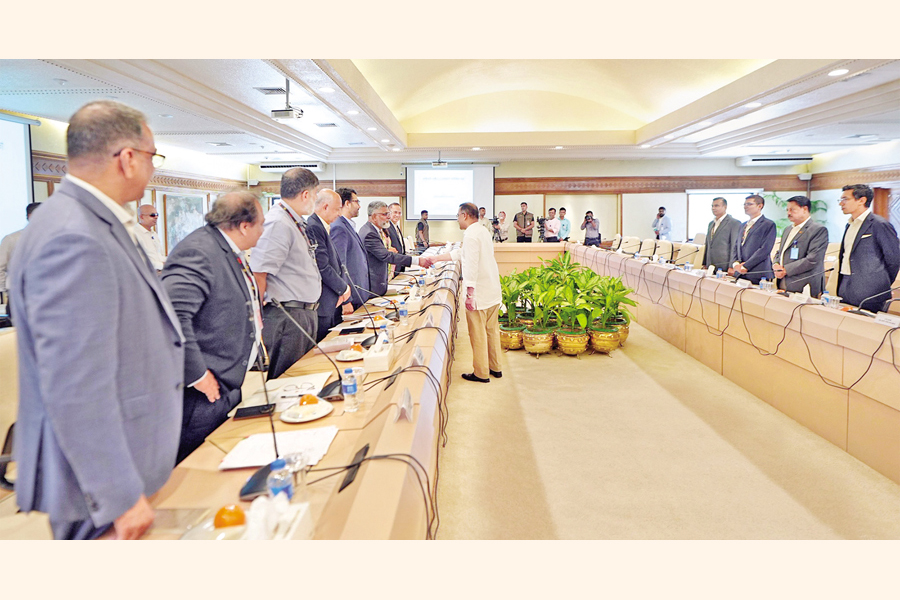
Prime Minister Tarique Rahman shakes hands with a business leader during a formal meeting with the country's leading businessmen at the PMO in the city on Saturday. — Focus Bangla
Prime Minister Tarique Rahman kick-starts a much-cherished reform drive to remove key bottlenecks to private sector and enhance ease of doing business with the cardinal goal of attracting fresh investment from home and abroad and accelerating job creation.
The crucial move came at a high-level meeting with Bangladesh's top business leaders at the Prime Minister's Office on Saturday, where the government also activated the Private-Sector Advisory Council (PSAC) to steer a time-bound reform agenda over the next two years.
Chaired by the Prime Minister, the council will serve as a platform to align policy with business needs and ensure implementation of reforms to improve competitiveness and the investment climate.
After the meeting was over, talking to The Financial Express, Pacific Jeans Managing Director Syed Mohammed Tanvir said the PSAC has been selected as a sounding board for the HPM to capture ground-level realities of manufacturing in Bangladesh from local companies.
"The purpose is to help reduce the gap between business and government. Areas discussed include policy reform and simplification, improving policy quality, timely implementation, and better governance. At the same time, the focus is on identifying ways to boost competitiveness, open up new sectors, create quality jobs, and improve human capital."
He says the meeting was the first to discuss cross-cutting issues such as regulatory bottlenecks, energy, human capital, the NBR, logistics, exports, FDI, branding, new technologies, and finance.
The newly formed PSAC is scheduled to meet every three months to monitor progress, he adds.
Talking to the FE, M. A. Jabbar, Managing Director of DBL Group and a council member, said the Prime Minister directly heard business leaders' concerns during the nearly two-and-a-half-hour-long meeting.
"The focus was on improving the business environment to attract both domestic and foreign investment and generate employment," he says.
He notes that businesses flagged persistent bottlenecks, including complexities in VAT, customs, and income-tax administration by the NBR, as well as hurdles in business registration and renewal.
Logistical and financial constraints -- such as deep-sea port operations, airport capacity, high lending rates, and land and utility issues in economic zones -- also came under discussion.
The meeting also discussed a proposal to raise readymade garment (RMG) exports to $70 billion over the next five years.
Business leaders proposed measures to boost exports and achieve greater self-sufficiency in raw materials, focusing on sectors such as active pharmaceutical ingredients (API), automobiles, semiconductors, agro-processing, and light engineering.
Jabbar adds: the Prime Minister issued on-the-spot directives to address several urgent issues, with others to be resolved in phases under the reform roadmap.
PM Office officials say the Prime Minister emphasised the need for urgent and measurable progress in addressing long-standing structural constraints, including complex taxation, high lending rates, and inefficiencies in port and logistics systems.
The government will conduct a comprehensive review of existing regulations across sectors to identify over-regulation and eliminate overlapping authorities, with a focus on simplifying procedures and reducing compliance burdens.
A key strategy involves benchmarking reforms against peer economies such as Sri Lanka and Indonesia, aiming to adopt proven solutions rather than designing new frameworks from scratch.
During the meeting, business leaders proposed a more structured engagement mechanism between the private sector and key regulatory bodies, including BIDA, the National Board of Revenue (NBR), Bangladesh Bank, IDRA, and BSEC.
They suggested involving industry representatives in policy formulation, allowing businesses to present ground-level realities and provide feedback before regulations are finalized.
According to attendees, Prime Minister Tarique Rahman, whose party espouses wide-ranging reforms in governance and economy, welcomed the idea, signalling a shift toward stronger public-private coordination in economic policymaking.
To improve access to finance, discussions included enabling offshore borrowing for local firms and reviving the domestic bond market.
Plans are also underway to attract foreign investment in banking and insurance, aiming to strengthen financial depth and stability.
A major pillar of the reform recipe is transforming the NBR from a revenue-focused agency into a trade facilitator. Proposed measures include shifting from trade-based taxes toward domestic taxation, such as personal and corporate income tax and VAT, with trade taxes projected to fall from around 28 percent to 7.5 percent by 2035.
The plan also envisions eliminating advance income tax (AIT) and tax deducted at source (TDS), while modernizing tax administration through digital systems to broaden the tax base and enhance transparency.
Business leaders also flagged logistics and infrastructure gaps. Bangladesh spends an estimated 15-20 per cent of GDP on logistics -- nearly double the global average -- undermining competitiveness.
The government plans to expand and modernize ports, develop railways via public-private partnerships, and accelerate renewable-energy adoption, including incentives for solar power and private-sector investment in clean-energy solutions.
The meeting has underscored a broader economic shift from low-cost labour to a skills-driven, diversified economy. A new workforce-development framework will focus on technical skills and industry-oriented training.
Export diversification is also a priority, targeting $100 billion in export by 2030, with emerging sectors like semiconductors, light engineering, and outdoor equipment complementing traditional industries.
Foreign direct investment (FDI) received special attention, with the Prime Minister emphasizing the need to improve the overall investor experience and benchmark the ease of doing business against competitors such as Vietnam, Cambodia, and India.
Measures include easing visa regimes, improving airport and entry procedures, and launching a global branding campaign under a "Build in Bangladesh" narrative.
The discussion also highlighted new manufacturing frontiers and strengthening existing clusters, such as Bogura's light-engineering industry.
Business leaders welcomed the reform agenda but stressed that consistent execution and inter-agency coordination would be critical for success.
Among others, leading industrialists, including Syed Nasim Manzur, Managing Director of Apex Footwear, Ziaur Rahman of Bay Footwear, Ahsan Khan Chowdhury, CEO of PRAN-RFL Group, Abdul Muktadir, Managing Director of Incepta Group, Hafizur Rahman Khan, Chairman of Runner Group, Sohana Rouf Chowdhury, managing director of Rangs Group, and Arif Dowla of ACI Limited were present at the meeting.
Representing the government were Finance and Planning Minister Amir Khasru Mahmud Chowdhury, Commerce Minister Khandaker Abdul Muktadir, Minister for Power, Energy and Mineral Resources Iqbal Hasan Mahmud Tuku, BIDA Executive Chairman Chowdhury Ashik Bin Harun, and Bangladesh Bank Governor Mostakur Rahman.
PM launches reform drive to ease business, attract investment
Offshore finance mobilisation by businesses envisaged, FDI in banks, insurance to be allowed
Jasim Uddin
Published :
Apr 04, 2026 23:59
Updated :
Apr 04, 2026 23:59
Prime Minister Tarique Rahman shakes hands with a business leader during a formal meeting with the country's leading businessmen at the PMO in the city on Saturday. — Focus Bangla
Prime Minister Tarique Rahman kick-starts a much-cherished reform drive to remove key bottlenecks to private sector and enhance ease of doing business with the cardinal goal of attracting fresh investment from home and abroad and accelerating job creation.
The crucial move came at a high-level meeting with Bangladesh's top business leaders at the Prime Minister's Office on Saturday, where the government also activated the Private-Sector Advisory Council (PSAC) to steer a time-bound reform agenda over the next two years.
Chaired by the Prime Minister, the council will serve as a platform to align policy with business needs and ensure implementation of reforms to improve competitiveness and the investment climate.
After the meeting was over, talking to The Financial Express, Pacific Jeans Managing Director Syed Mohammed Tanvir said the PSAC has been selected as a sounding board for the HPM to capture ground-level realities of manufacturing in Bangladesh from local companies.
"The purpose is to help reduce the gap between business and government. Areas discussed include policy reform and simplification, improving policy quality, timely implementation, and better governance. At the same time, the focus is on identifying ways to boost competitiveness, open up new sectors, create quality jobs, and improve human capital."
He says the meeting was the first to discuss cross-cutting issues such as regulatory bottlenecks, energy, human capital, the NBR, logistics, exports, FDI, branding, new technologies, and finance.
The newly formed PSAC is scheduled to meet every three months to monitor progress, he adds.
Talking to the FE, M. A. Jabbar, Managing Director of DBL Group and a council member, said the Prime Minister directly heard business leaders' concerns during the nearly two-and-a-half-hour-long meeting.
"The focus was on improving the business environment to attract both domestic and foreign investment and generate employment," he says.
He notes that businesses flagged persistent bottlenecks, including complexities in VAT, customs, and income-tax administration by the NBR, as well as hurdles in business registration and renewal.
Logistical and financial constraints -- such as deep-sea port operations, airport capacity, high lending rates, and land and utility issues in economic zones -- also came under discussion.
The meeting also discussed a proposal to raise readymade garment (RMG) exports to $70 billion over the next five years.
Business leaders proposed measures to boost exports and achieve greater self-sufficiency in raw materials, focusing on sectors such as active pharmaceutical ingredients (API), automobiles, semiconductors, agro-processing, and light engineering.
Jabbar adds: the Prime Minister issued on-the-spot directives to address several urgent issues, with others to be resolved in phases under the reform roadmap.
PM Office officials say the Prime Minister emphasised the need for urgent and measurable progress in addressing long-standing structural constraints, including complex taxation, high lending rates, and inefficiencies in port and logistics systems.
The government will conduct a comprehensive review of existing regulations across sectors to identify over-regulation and eliminate overlapping authorities, with a focus on simplifying procedures and reducing compliance burdens.
A key strategy involves benchmarking reforms against peer economies such as Sri Lanka and Indonesia, aiming to adopt proven solutions rather than designing new frameworks from scratch.
During the meeting, business leaders proposed a more structured engagement mechanism between the private sector and key regulatory bodies, including BIDA, the National Board of Revenue (NBR), Bangladesh Bank, IDRA, and BSEC.
They suggested involving industry representatives in policy formulation, allowing businesses to present ground-level realities and provide feedback before regulations are finalized.
According to attendees, Prime Minister Tarique Rahman, whose party espouses wide-ranging reforms in governance and economy, welcomed the idea, signalling a shift toward stronger public-private coordination in economic policymaking.
To improve access to finance, discussions included enabling offshore borrowing for local firms and reviving the domestic bond market.
Plans are also underway to attract foreign investment in banking and insurance, aiming to strengthen financial depth and stability.
A major pillar of the reform recipe is transforming the NBR from a revenue-focused agency into a trade facilitator. Proposed measures include shifting from trade-based taxes toward domestic taxation, such as personal and corporate income tax and VAT, with trade taxes projected to fall from around 28 percent to 7.5 percent by 2035.
The plan also envisions eliminating advance income tax (AIT) and tax deducted at source (TDS), while modernizing tax administration through digital systems to broaden the tax base and enhance transparency.
Business leaders also flagged logistics and infrastructure gaps. Bangladesh spends an estimated 15-20 per cent of GDP on logistics -- nearly double the global average -- undermining competitiveness.
The government plans to expand and modernize ports, develop railways via public-private partnerships, and accelerate renewable-energy adoption, including incentives for solar power and private-sector investment in clean-energy solutions.
The meeting has underscored a broader economic shift from low-cost labour to a skills-driven, diversified economy. A new workforce-development framework will focus on technical skills and industry-oriented training.
Export diversification is also a priority, targeting $100 billion in export by 2030, with emerging sectors like semiconductors, light engineering, and outdoor equipment complementing traditional industries.
Foreign direct investment (FDI) received special attention, with the Prime Minister emphasizing the need to improve the overall investor experience and benchmark the ease of doing business against competitors such as Vietnam, Cambodia, and India.
Measures include easing visa regimes, improving airport and entry procedures, and launching a global branding campaign under a "Build in Bangladesh" narrative.
The discussion also highlighted new manufacturing frontiers and strengthening existing clusters, such as Bogura's light-engineering industry.
Business leaders welcomed the reform agenda but stressed that consistent execution and inter-agency coordination would be critical for success.
Among others, leading industrialists, including Syed Nasim Manzur, Managing Director of Apex Footwear, Ziaur Rahman of Bay Footwear, Ahsan Khan Chowdhury, CEO of PRAN-RFL Group, Abdul Muktadir, Managing Director of Incepta Group, Hafizur Rahman Khan, Chairman of Runner Group, Sohana Rouf Chowdhury, managing director of Rangs Group, and Arif Dowla of ACI Limited were present at the meeting.
Representing the government were Finance and Planning Minister Amir Khasru Mahmud Chowdhury, Commerce Minister Khandaker Abdul Muktadir, Minister for Power, Energy and Mineral Resources Iqbal Hasan Mahmud Tuku, BIDA Executive Chairman Chowdhury Ashik Bin Harun, and Bangladesh Bank Governor Mostakur Rahman.