☕ Support Us
[🇧🇩] - Rich Bengal----Can it be revived? | PKDefense

[🇧🇩] Rich Bengal----Can it be revived?

Reply (Scroll)
Press space to scroll through posts
G Bangladesh Defense
[🇧🇩] Rich Bengal----Can it be revived?
3
98
More threads by Saif

Saif

Senior Member
Joined
Jan 24, 2024
Messages
15,861
Likes
7,986
Nation

Axis Group

Date of Event: Jul 21, 2025
Source : https://www.youtube.com/watch?v=Wsx38nQm4dY
Bengal used to be the richest region of the world in the past. It had the most modern and largest textile industry in the whole world. Bengal used to have 23% of world's GDP. Today, Bangladesh is strategically important to the USA, China and India. But it has lost its rich economy due to exploitation by the British East India Company for almost 200 years. My question is, can the rich Bengal of the past be revived?

 
Last edited:
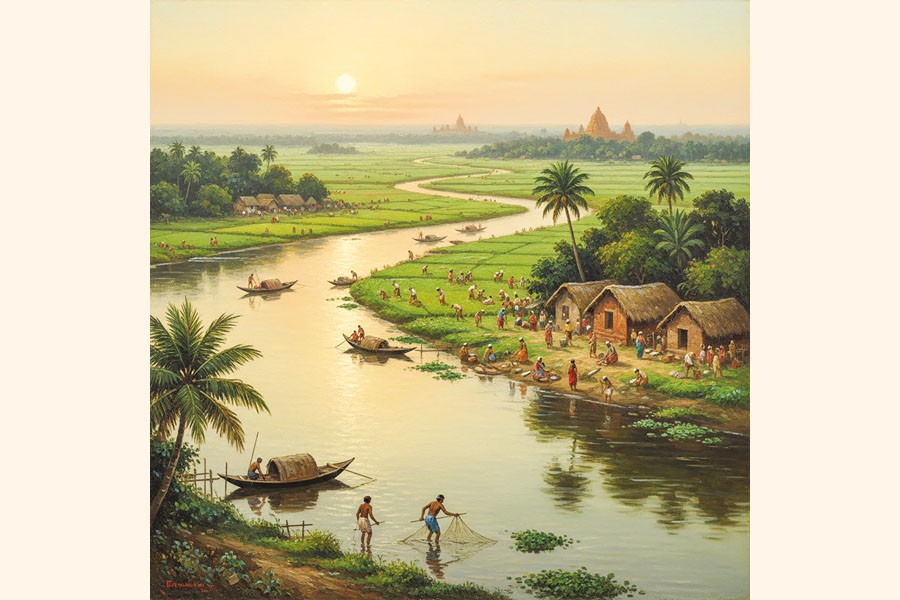
In the past, East Bengal (present-day Bangladesh) was renowned for its wealth and prosperity, particularly during the Mughal era and the Bengal Sultanate. It was a major center of trade and industry, with a thriving textile industry and shipbuilding. Historical accounts and Mughal emperors themselves described Bengal as a "Paradise of India".

Here's a more detailed look:
  • Mughal Era:
    Bengal became a highly valued province within the Mughal Empire, known for its fertile land, abundant water resources, and flourishing cotton textile industry. It was considered one of the richest regions in India, attracting European traders like the English East India Company.

  • Bengal Sultanate:
    The Bengal Sultanate, which preceded Mughal rule, was also described as a prosperous kingdom by contemporary visitors. The region was a major hub for trade, producing and exporting a variety of goods. Contemporary European and Chinese visitors described Bengal as a prosperous kingdom and the "richest country to trade with".

  • Textile Industry:
    Bengal's textile industry was particularly prominent, with the region being a major producer of fine cotton cloth and other textiles.

  • Economic Powerhouse:
    During the 18th century, Bengal's economy, particularly under the Mughals, was larger than that of any European empire.

  • Architectural Legacy:
    The Bengal Sultanate also left behind a significant architectural legacy, with examples of brick architecture and mosques.
 
In the past, Bengal, particularly the area encompassing present-day Bangladesh, was renowned for its thriving textile industry, especially its production and export of fine cotton muslins. This industry, flourishing for centuries, faced a decline during the British colonial period, marked by the East India Company's policies and the rise of industrialization in England.

Here's a more detailed look:
Flourishing Industry:
  • Ancient Reputation:
    Bengal's textiles, particularly muslins, were sought after as early as the first century AD by the Romans.

  • Global Demand:
    Foreign travelers from China, Portugal, Arabia, and Persia praised the delicacy and beauty of Bengal's fabrics.

  • Diverse Products:
    Bengal produced a wide variety of textiles, including cotton, silk, and mixed-thread fabrics, with muslins being particularly famous for their fineness and transparency.

  • Major Export Center:
    Bengal was a leading exporter of textiles, with Dhaka muslins reaching as far as Turkey and Persia during the Ottoman Empire.

  • European Trade:
    European traders, including the Portuguese, Dutch, and English, participated in the textile trade, initially engaging in inter-Asia trade before focusing on importing textiles to Europe.

  • Dhaka's Dominance:
    Dhaka emerged as the center of the global muslin trade during the 17th and 18th centuries.

  • Proto-Industrialization:
    Bengal's textile industry before British colonization is considered a period of proto-industrialization, with a strong craft-based economy producing goods for external markets.
Decline:
  • British Conquest:
    The British East India Company's conquest of Bengal in 1757 marked a turning point for the textile industry.

  • Suppression of Weavers:
    The Company's servants subjected weavers to oppression, leading to a decline in production and quality.

  • Unfavorable Policies:
    The colonial government's tariff policies in both England and India negatively impacted the industry.

  • Industrial Revolution's Impact:
    The industrial revolution in England led to the mass production of textiles at lower costs, making it difficult for Bengal's handloom industry to compete.

  • Loss of Markets:
    Bengal's traditional markets were disrupted, and the Company's monopoly over trade squeezed out other traders.

  • Decline in Production:
    The once-thriving industry experienced a significant decline, with many weavers losing their livelihoods.
Legacy:
  • Historical Significance:
    Despite its decline, Bengal's textile industry holds a significant place in history, showcasing the region's craftsmanship and contribution to global trade.
  • Renewed Interest:
    In recent times, there has been a growing interest in the history of Bengal textiles and the traditional handloom techniques.
 

From Bengal-partition to Bangladesh

Asjadul Kibria
Published :
Dec 13, 2025 23:08
Updated :
Dec 13, 2025 23:26

1765673200806.webp


Day after tomorrow, on Tuesday to be precise, Bangladesh will observe the 55th Victory Day, commemorating the final victory over the Pakistani occupation army in the nine-month bloody war of independence in 1971. On December 16, 1971, Bangladesh emerged as a sovereign country on the world map. The price was however high: three million sacrified their lives, two hundred thousand women were dishonoured by the occupying army and their local collaborators, millions got traumatised and widespread destruction caused to physical infrastructures. The nation began a new journey almost empty-handed while carrying the legacy of a blood-stained, troubled history.

Five and a half decades after independence, Bangladesh is still struggling to decode some critical events and aspects of its historical journey. On the eve of the 55th Victory Day, it is important to revisit the decisive turning points in the history of Bengal and the Indian subcontinent to understand the people's prolonged struggle for emancipation. The Bengal Partition (Banga Bhanga) is one such event that greatly influenced the region's future.

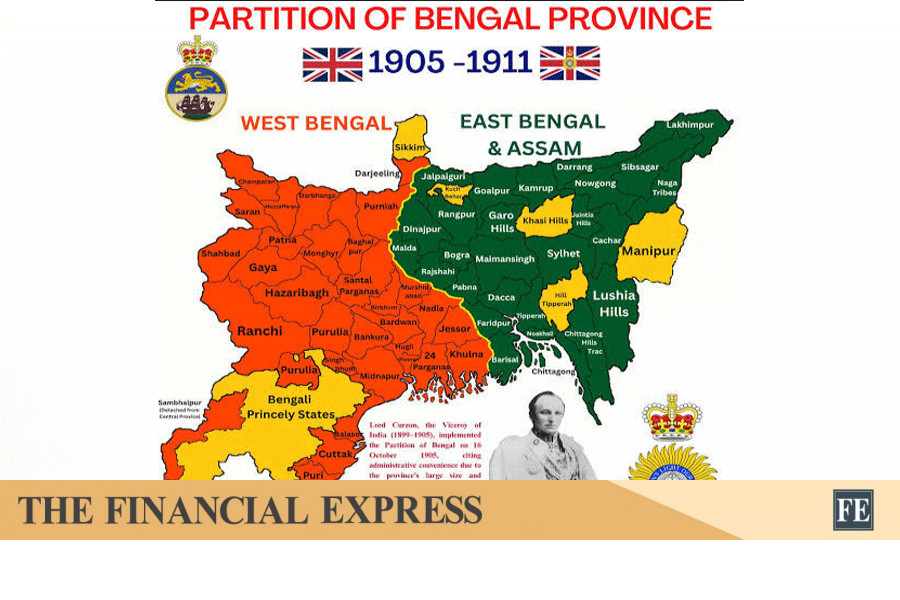
This year marks the 120th anniversary of the Bengal Partition, which led to the emergence of East Bengal and Assam as separate provincial states under British India by dividing united Bengal in 1905. Though it lasted only six years, the partition had a great impact, especially on the people of eastern Bengal, who were mostly Muslims, while the rest were largely low-caste Hindus.

Lord Curzon, the Governor-General and Viceroy of India (1899-1905), initiated the plan to divide the Bengal Presidency, mainly for administrative purposes. Bengal, which included Bihar and Orissa since 1765, was the largest province of British India. The British government officially disclosed the plan in 1904 to divide Bengal into two provinces - Bengal and East Bengal. West Bengal, Bihar and Orissa were retained under Bengal, while the remaining portion of Bengal and Assam formed Eastern Bengal and Assam. Calcutta, now Kolkata, remained the capital of Bengal, whereas Dacca, now Dhaka, was made the capital of the newly formed province. Demographically, West Bengal became a Hindu-majority state, while the eastern half remained Muslim-majority. The British India government announced the final decision in a resolution dated July 19, 1905, and the Partition of Bengal became effective on October 16 of the same year [Banglapedia, Online Version].

The formation of a new province with a Muslim majority annoyed upper-class and influential Hindu politicians, businessmen, and educated sections. A serious conflict with the British government sparked violence across Bengal. Muslims of Bengal also saw that Hindus were taking a position against their (Muslim's) interests to maintain Hindu dominance in eastern Bengal.

The Hindus of Bengal, who controlled most of the state's commerce, professions, and rural society, argued that the partition would force them to compromise with Muslims. As a new provincial capital, Dhaka would emerge as a competitor to Kolkata. They also feared the potential rise of Muslim political power in Bengal.

To cancel the partition, Hindus started protests and agitations and used religious tools. Mother-goddess-worshipping Bengali Hindus argued that the partition was identical to the disection of their 'Mother province' (Bong matar ango chhed). The Indian National Congress backed the movement, which became heavily communal. The anti-partition movement evolved into the Swadeshi movement, and Hindus began boycotting British products. Public displays of Hindu rituals like rakhi bandhan and arandha became key features. Muslims became more certain that Hindus did not want to share power and prosperity with them. They felt it was their duty to defend the newly formed province. The Muslim League was formed in 1906 in Dhaka under the auspices of Nawab Salimullah, which further angered Hindu politicians. As the movement turned violent, the Hindu nationalists continued to back terrorism.

To assuage the resentment of the assertive Bengali Hindus, the British government finally revoked the partition in December 1911 along with certain changes in the administration of India [Banglapedia, Online Version]. Though Bengali Hindu politicians, traders, and educated sections were delighted, they also found they had to make a sacrifice as the administrative capital of British India was transferred from Kolkata to Delhi.

Bengali Muslims were shocked and disappointed. However, they realised they had stakes in British India and retained strengths to influence the political direction. The strong wave of the nation-state concept had already arrived in India, and Muslim politicians were moved. The revocation of the Bengal partition gave them an opportunity to advance the greater interests of Muslims in India, particularly in Bengal, in an organised way.

The history of the next few decades was complex and turbulent, finally leading to the emergence of two independent states - India and Pakistan in 1947, ending two centuries of British colonial rule. East Bengal became part of Pakistan due to its Muslim-majority population and was later renamed East Pakistan. It was the same geographical territory, except Assam, that was created in 1905 as a separate province with Dhaka as the capital.

Geographical, cultural, ethnic, and social distances between East and West Pakistan, however, ultimately drove the struggle for freedom in the eastern wing further. Though the creation of Pakistan would not have been possible without the support of Bengali Muslims, who were the most vocal champions of the movement, they had become marginalised. The oppressive measures of Pakistani rulers based in Sindh and Panjab sparked protests among Bengalis demanding their rights. Another fight became unavoidable. Within 24 years, people of East Bengal were compelled to join the armed struggle against Pakistan. On the midnight of March 25, 1971, the Pakistani Army started a crackdown on sleeping Bengalis. There was no option but to take up arms for self-defence, which soon became the war of liberation. The nine months of bloodshed ended on December 16, 1971, proclaiming the victory of the Bengalis over Pakistan. The new nation with the green-red flag emerged on the world map.

The emergence of Bangladesh as a sovereign and independent country reaffirms that one of its root was in the first partition of Bengal in 1905, a turning point in the history of nationalism in India. Many believe Indian nationalism was born out of the travails of Bengal. For Bengali Muslims, it was also a reaffirmation of their unique, inclusive identity. That is why Muslim-majority independent Bangladesh accommodates other religious and ethnic minorities within its territory.​
 

Members Online

Latest Posts

Latest Posts