Donate ☕
201 Military Defense Forums
[🇧🇩] - Save the Rivers/Forests/Hills-----Save the Environment | Page 9 | PKDefense
Home Login Forums Wars Watch Videos
Serious discussion on defense, geopolitics, and global security.

[🇧🇩] Save the Rivers/Forests/Hills-----Save the Environment

Reply (Scroll)
Press space to scroll through posts
G Bangladesh Defense
[🇧🇩] Save the Rivers/Forests/Hills-----Save the Environment
523
13K
More threads by Saif

Stop disturbing the Sundarbans!​

Restrain traffic of ships through the forest

1711232731282.webp


It is deeply concerning that on top of projects, megaprojects, illegal occupations and deforestation ravaging the Sundarbans, traffic of ships through the forest has increased dramatically in recent years. A recent report sheds light on how ships, discharging harmful fumes and sound pollution, and often carrying toxic materials through the forest, have nearly doubled in a decade—from 357 trips monthly in 2012 to 837 trips in 2022, and 701 trips monthly so far this year.

Under the first Protocol on Inland Water Transit and Trade between Bangladesh and India, signed in 1972, lighter cargo vessels can operate between the two countries using the waterways mostly through the Sundarbans. A major route for these ships goes through at least 100 km of the river system inside the mangrove forest, which takes around eight hours for the vessels to travel. While any motor vehicle, including boats and ships, is strictly prohibited from operating through the forest after sunset till sunrise, ships continue to operate 24/7 unrestrained. The customs station in Angtihara, the entry point to the forest on this route, only logs the trips of the ships and does not monitor if any laws have been broken. While the customs and immigration in India close off at night, our customs office continues to operate throughout the night.
By allowing these activities, we are now destroying the Sundarbans from the inside. The toxic fumes and loud sounds greatly impact wildlife habitats and breeding environments. The propellers disrupt the marine ecosystem, and the waves cause severe erosions. For instance, the width of rivers on this route has increased from 20-30 metres to 50-60 metres. Most of the ships on this route contain fly ash, coal, and stones from India for our riverside cement factories. In the last seven years, at least 15 such ships have capsized inside the forest, spilling these harmful materials directly into the river.

Bangladesh has now become a land of lost forestlands and dead ecosystems. We have irredeemably destroyed a number of forests and major sources of biodiversity throughout this delta, and even in the hill tracts. The Sundarbans is the last hope for any unique and great population of wildlife to survive. The government must ensure that any activity harming this forest is halted immediately, and look for an alternative route for maritime trade with India as well as consider moving major power plants and factories from the area.​
 
Analyze

Analyze Post

Add your ideas here:
Highlight Cite Fact Check Respond

Developed countries failed to fulfil commitments on climate change: PM

1716334405847.png

Photo: PID

Prime Minister Sheikh Hasina today expressed frustration that the developed countries are not fulfilling their commitments on climate change issues.

The prime minister said this to visiting Australian Foreign Minister Penny Wong during a meeting at her official residence Gono Bhaban, according to PM's speech writer M Nazrul Islam.

"She was a bit frustrated (due to the non-fulfillment of developed countries commitment on climate change issue)," Nazrul said.

The premier told the Australian minister that the Bangladesh government has formed the Climate Trust Fund with its own resources.

To read the rest of the news, please click on the link above.
 
Analyze

Analyze Post

Add your ideas here:
Highlight Cite Fact Check Respond

Half of mangrove ecosystems at risk
Agence France-Presse . Geneva 22 May, 2024, 22:23
Half of the world's mangrove ecosystems are at risk of collapse due to climate change, deforestation and pollution, according to a study published on Wednesday.

The International Union for Conservation of Nature, known for its red list of threatened species, has for the first time taken stock of the world's mangroves, evaluating 36 different regions.

IUCN director general Grethel Aguilar said the assessment 'highlights the urgent need for coordinated conservation of mangroves — crucial habitats for millions in vulnerable communities worldwide'.

Mangroves are trees or shrubs that grow mainly in seawater or brackish water along coastlines and tidal rivers, in equatorial climes.

Released on the International Day for Biodiversity, IUCN said its findings show that '50 per cent of the mangrove ecosystems assessed are at risk of collapse' — categorised as either vulnerable, endangered or critically endangered.

According to the assessment, 20 per cent were at severe risk of collapse.

Mangroves are threatened by deforestation, development, pollution, and dam construction.

However, the risk is increasing due to sea-level rise and the greater frequency of severe storms associated with climate change.

To read the rest of the news, please click on the link above.
 
Analyze

Analyze Post

Add your ideas here:
Highlight Cite Fact Check Respond

Sea level rising, coast under threat
Partha Shankar SahaDhaka
Published: 24 May 2024, 17: 15

1716620890014.webp

Average rise in sea levelProthom Alo illustration

The sea level along Bangladesh's coast is rising at a rate higher than normal. This has been revealed in three different studies. The studies say that the rate at which the sea level is rising, there are apprehensions that further areas will be inundated or face excess salinity.

Around 8 to 15 per cent of land area of 4 coastal districts may go under water. Salinity in the coastal areas may see an abnormal rise too. This could have a harmful effect on the ecology, people's lives, agriculture, groundwater and infrastructure in the coastal regions.

These three studies were recently conducted by Bangladesh University of Engineering and Technology (BUET)'s Institute of Water and Flood Management (IWFM) and the government's Centre for Environmental and Geographic Information Services (CEGIS). The results of these studies were published on 8 May.

These studies were carried out at the initiative of the Bangladesh Department of Environment, with funds from the Climate Change Trust Fund project.

BUET carried out the study, 'Estimation of Sea Level Rise in Bangladesh Using Satellite Altimetry Data'. For the first time here the sea level rise was observed by means of satellite. The remaining two studies were carried out by CEGIS to determine the sea level rise and its possible future impact on water and agricultural infrastructure.

To read the rest of the news, please click on the link above.
 
Analyze

Analyze Post

Add your ideas here:
Highlight Cite Fact Check Respond

Fewer but fiercer since the 90s
Says DoE study

1716676361043.webp

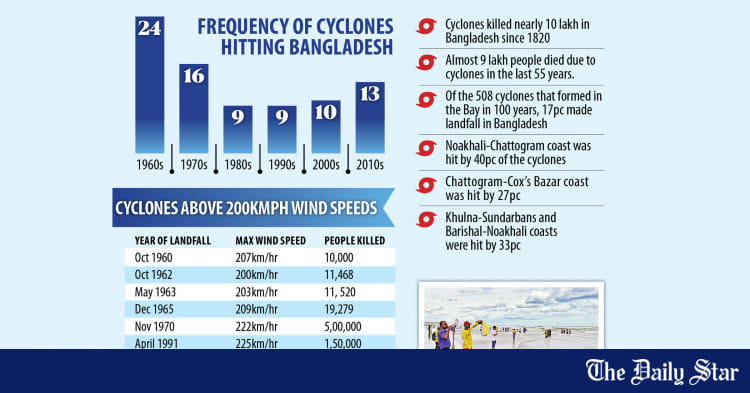
Though Bangladesh is experiencing fewer cyclones than in the 1960s, their intensity has increased, a recent study has found.

In the 1960s, the number of cyclones hitting the Bangladesh coast was 24, which came down to 13 in the 2010s, according to a study conducted by the Department of Environment with the help of the Center for Environmental and Geographic Information Services (CEGIS).

The country did not experience any super cyclones -- a cyclonic storm which at least packs wind speed of 222kmph -- between 1960 and 1989. However, between 1990 and 2020, at least three of them hit the coast.

"We had a general conception that the number of cyclones has been increasing in the Bay due to climate change. But it is the harshness or intensity of the cyclones that is increasing, not the numbers," said BUET Professor Rezaur Rahman after reviewing the study titled "Projection of Sea Level Rise and Development of Digital Elevation Models in Support of SLR Decision Making".

To read the rest of the news, please click on the link above.
 
Analyze

Analyze Post

Add your ideas here:
Highlight Cite Fact Check Respond

Sundarbans cushions blow
Remal makes landfall near Khepupara

1716769253327.webp

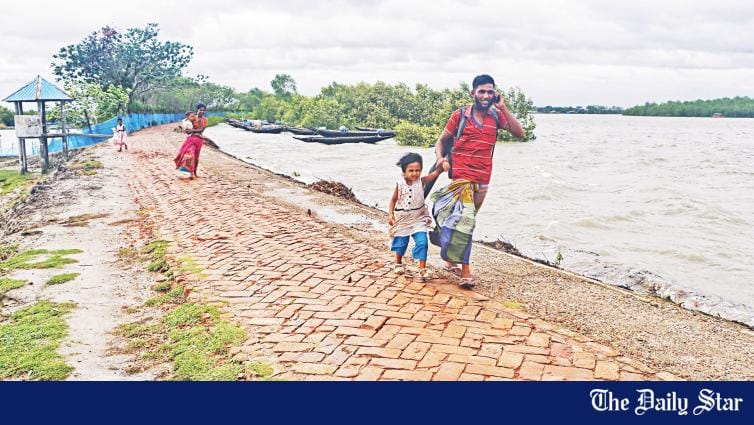
Locals of Gabbunia village in Khulna's Koyra upazila were going home to collect necessary items before heading to shelters as Cyclone Remal was hurtling towards the southwestern coast yesterday. People in the coastal areas were asked to take precautions ahead of the storm's arrival. Photos: Habibur Rahman and Sohrab Hossain

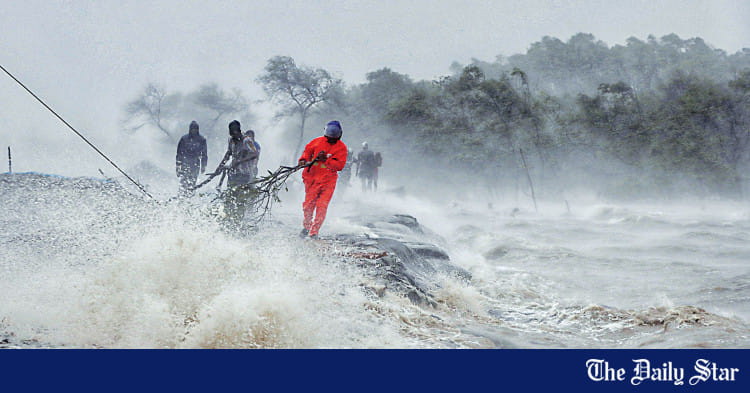
Cyclone Remal battered the coastal region at wind speeds that might have reached 130kmph, and lost much of its strength while sweeping over the Sundarbans, Met officials said.

"As predicted, the centre of the severe cyclone fell between Khepupara in Patuakhali and Sagar Island in West Bengal," said Abul Kalam Mallik, a meteorologist at Bangladesh Meteorological Department.

He said Bangladesh was on the east of the cyclone's eye which means Bangladesh took the main blow because the east side of a cyclone always causes more damage than the west side in the sub continent.

To read the rest of the news, please click on the link above.
 
Analyze

Analyze Post

Add your ideas here:
Highlight Cite Fact Check Respond
⤵︎

Latest Posts

Latest Posts