
☕ Support Us
[🇧🇩] - Save the Rivers/Forests/Hills-----Save the Environment | Page 5 | PKDefense

[🇧🇩] Save the Rivers/Forests/Hills-----Save the Environment

Reply (Scroll)
Press space to scroll through posts
G Bangladesh Defense
[🇧🇩] Save the Rivers/Forests/Hills-----Save the Environment
493
12K
More threads by Saif


Developed countries failed to fulfil commitments on climate change: PM

1716334405847.png

Photo: PID

Prime Minister Sheikh Hasina today expressed frustration that the developed countries are not fulfilling their commitments on climate change issues.

The prime minister said this to visiting Australian Foreign Minister Penny Wong during a meeting at her official residence Gono Bhaban, according to PM's speech writer M Nazrul Islam.

"She was a bit frustrated (due to the non-fulfillment of developed countries commitment on climate change issue)," Nazrul said.

The premier told the Australian minister that the Bangladesh government has formed the Climate Trust Fund with its own resources.

To read the rest of the news, please click on the link above.
 

Half of mangrove ecosystems at risk
Agence France-Presse . Geneva 22 May, 2024, 22:23
Half of the world's mangrove ecosystems are at risk of collapse due to climate change, deforestation and pollution, according to a study published on Wednesday.

The International Union for Conservation of Nature, known for its red list of threatened species, has for the first time taken stock of the world's mangroves, evaluating 36 different regions.

IUCN director general Grethel Aguilar said the assessment 'highlights the urgent need for coordinated conservation of mangroves — crucial habitats for millions in vulnerable communities worldwide'.

Mangroves are trees or shrubs that grow mainly in seawater or brackish water along coastlines and tidal rivers, in equatorial climes.

Released on the International Day for Biodiversity, IUCN said its findings show that '50 per cent of the mangrove ecosystems assessed are at risk of collapse' — categorised as either vulnerable, endangered or critically endangered.

According to the assessment, 20 per cent were at severe risk of collapse.

Mangroves are threatened by deforestation, development, pollution, and dam construction.

However, the risk is increasing due to sea-level rise and the greater frequency of severe storms associated with climate change.

To read the rest of the news, please click on the link above.
 

Sea level rising, coast under threat
Partha Shankar SahaDhaka
Published: 24 May 2024, 17: 15

1716620890014.png

Average rise in sea levelProthom Alo illustration

The sea level along Bangladesh's coast is rising at a rate higher than normal. This has been revealed in three different studies. The studies say that the rate at which the sea level is rising, there are apprehensions that further areas will be inundated or face excess salinity.

Around 8 to 15 per cent of land area of 4 coastal districts may go under water. Salinity in the coastal areas may see an abnormal rise too. This could have a harmful effect on the ecology, people's lives, agriculture, groundwater and infrastructure in the coastal regions.

These three studies were recently conducted by Bangladesh University of Engineering and Technology (BUET)'s Institute of Water and Flood Management (IWFM) and the government's Centre for Environmental and Geographic Information Services (CEGIS). The results of these studies were published on 8 May.

These studies were carried out at the initiative of the Bangladesh Department of Environment, with funds from the Climate Change Trust Fund project.

BUET carried out the study, 'Estimation of Sea Level Rise in Bangladesh Using Satellite Altimetry Data'. For the first time here the sea level rise was observed by means of satellite. The remaining two studies were carried out by CEGIS to determine the sea level rise and its possible future impact on water and agricultural infrastructure.

To read the rest of the news, please click on the link above.
 

Fewer but fiercer since the 90s
Says DoE study

1716676361043.png

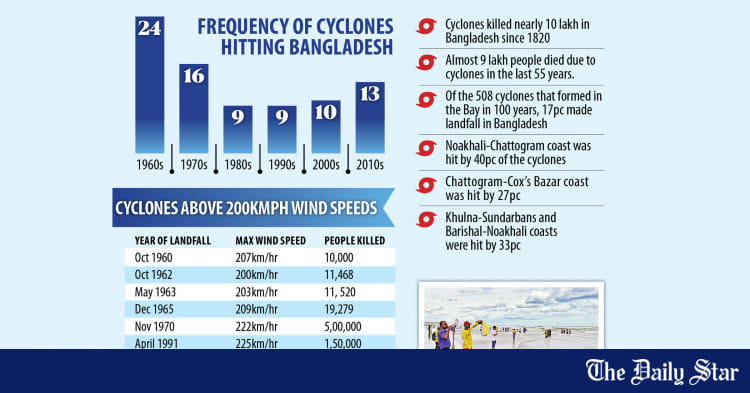
Though Bangladesh is experiencing fewer cyclones than in the 1960s, their intensity has increased, a recent study has found.

In the 1960s, the number of cyclones hitting the Bangladesh coast was 24, which came down to 13 in the 2010s, according to a study conducted by the Department of Environment with the help of the Center for Environmental and Geographic Information Services (CEGIS).

The country did not experience any super cyclones -- a cyclonic storm which at least packs wind speed of 222kmph -- between 1960 and 1989. However, between 1990 and 2020, at least three of them hit the coast.

"We had a general conception that the number of cyclones has been increasing in the Bay due to climate change. But it is the harshness or intensity of the cyclones that is increasing, not the numbers," said BUET Professor Rezaur Rahman after reviewing the study titled "Projection of Sea Level Rise and Development of Digital Elevation Models in Support of SLR Decision Making".

To read the rest of the news, please click on the link above.
 

Sundarbans cushions blow
Remal makes landfall near Khepupara

1716769253327.png

Locals of Gabbunia village in Khulna's Koyra upazila were going home to collect necessary items before heading to shelters as Cyclone Remal was hurtling towards the southwestern coast yesterday. People in the coastal areas were asked to take precautions ahead of the storm's arrival. Photos: Habibur Rahman and Sohrab Hossain

Cyclone Remal battered the coastal region at wind speeds that might have reached 130kmph, and lost much of its strength while sweeping over the Sundarbans, Met officials said.

"As predicted, the centre of the severe cyclone fell between Khepupara in Patuakhali and Sagar Island in West Bengal," said Abul Kalam Mallik, a meteorologist at Bangladesh Meteorological Department.

He said Bangladesh was on the east of the cyclone's eye which means Bangladesh took the main blow because the east side of a cyclone always causes more damage than the west side in the sub continent.

To read the rest of the news, please click on the link above.
 

Cyclones now last longer
Experts say this causes more rain

1716851151331.png

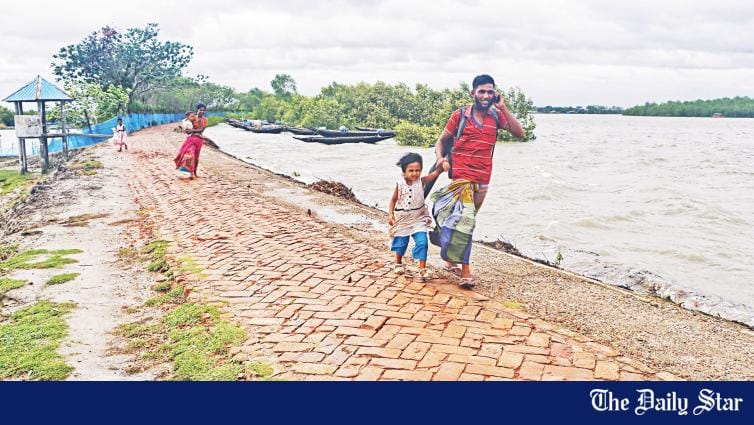
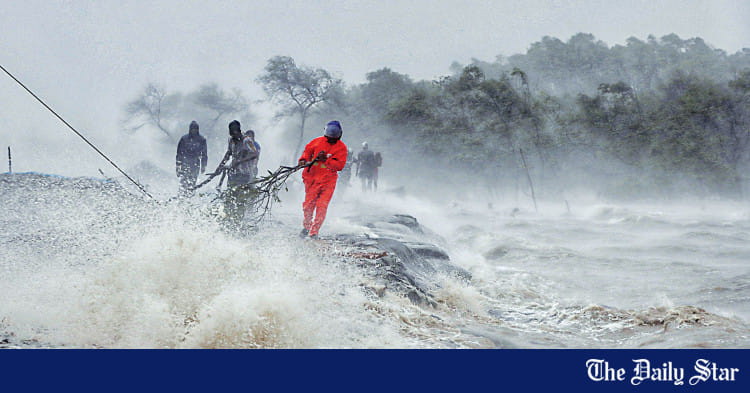
Man Versus nature... Braving the ferocity of Cyclone Remal, social workers give it their all trying to protect an embankment on the Kapotakkho river in Khulna's Koyra upazila yesterday afternoon. PHOTO: HABIBUR RAHMAN

Remal was part of a new trend of cyclones that take their time before making landfall, are slow-moving, and cause significant downpours, flooding coastal areas and cities.

Even though Remal started battering the Bangladesh coast since Sunday afternoon, its effects on the country's weather will remain until at least this afternoon, said the Bangladesh Meteorological Department.

This means the storm will be hovering over Bangladesh for at least 45 hours. Cyclone Aila in 2009 hung around for 34 hours before disappearing.

Meteorologists and experts said a trend is being seen in the cyclones that hit Bangladesh. They are sluggish, long-lasting and tend to inundate more areas.

To read the rest of the news, please click on the link above.
 

40 Sundarbans animals found dead, 17 rescued hurt
Rashad Ahamad 29 May, 2024, 00:23

1716938460327.png

A man holds an injured fawn at Katka sanctuary in Sundarbans on Tuesday as cyclone Remal takes a toll on the mangrove forest. | Focus Bangla photo

The forest department officials on Tuesday said that so far they found 39 dead deer and a pig in the Sundarbans after the severe cyclone Remal that hit the forest on Sunday.

Primarily they have estimated infrastructural damage of Tk 6.27 crore in the forest while the total damage, including animals and plants, could not be calculated yet.

Officials said that the cyclone with over 100-kilometre per hour speed hit the forest hard on Sunday after noon with 8-10 feet high tidal surge inundating all 80 freshwater ponds in the forest.

The tidal saline water drained out after 48-hours stay in the forest which the officials estimated the record longest stay of salt water in the mangrove forest in the recorded history of 17 years.

They feared a huge impact on animals this time after cyclone Sidr in 2007.

'We could not calculate total damage of the forest yet. Forest officials could not enter into the forest as the Bay of Bengal still very rough,' said Mihir Kumar Doe, Khulna circle conservator of forest.

They feared more losses of flora and fauna in the forest because of the unusual duration of flooding and crisis of freshwater.

Officials estimated that they would need at least four more days to assess the situation.

Officials feared that they were going to count the worst damage in the Sundarbans in terms of its wildlife.

Saltwater entered into the world's largest mangrove forest around 12:30pm on Sunday and drained out around 11:30am on Tuesday.

They said that usually saline water drained out from the forest within three-four hours in the past cyclones.

Wild animals turned vulnerable for the long-time stay of saline water at a high level in the forest, they said.

Sundarbans is the house of huge diversity that shelters 40 species of mammals, 260 species of birds and 35 species of reptiles. Royal Bengal Tiger is the signature animal of the rainforest.

Mihir Kumar Doe said that there are only eight shelters for animals in the forest which is very insufficient.

Mihir said that due to the tidal surge, all the 80 ponds which are the sources of freshwater for wild-animals in the forest were inundated.

'No freshwater source now exists from where animals can drink,' said Mihir.

To read the rest of the news, please click on the link above.
 

Is Bangladesh prepared for a major earthquake?

1717110642848.png


A 5.5 magnitude earthquake on the Richter scale rattled Bangladesh on the evening of May 29, sending tremors through major cities like Dhaka, Sylhet, and Chattogram according to Bangladesh Meteorological Department. The epicentre was located roughly 439 km east in neighbouring Myanmar.

Bangladesh, a nation teeming with life, sits precariously on a geological fault line. While tremors are frequent, a powerful earthquake looms large, threatening to unleash catastrophic destruction. Are we ready to face this inevitable reality? The answer, unfortunately, is a resounding no. Despite an established vulnerability, our preparedness remains woefully inadequate.

Bangladesh's geological formation and tectonic arrangement are intricate, with the Bengal Basin being a dynamic deltaic depositional complex. The country is situated at the confluence of Indian, East Asian, and Burmese tectonic plates, with the Eurasian plate currently moving north at a speed of 2 cm per year above the Indian plate, while the Indian plate is currently moving northeast at a speed of about 6 cm per year. Along the boundary between Meghalaya and Bangladesh, there is also the 300 km Dauki fault, the 150 km long Madhupur fault, and the 300 km long Surma basin fault. Bangladesh has 13 earthquake-prone areas spread across the Bogura, Tripura, Shilong Plateau, Dauki, and Assam fault zones. Extreme risk zones include Chattogram, Chittagong Hill Tracts, and Jaintiapur of Sylhet. These areas are 100 km away from Dhaka, but a magnitude 7-8 earthquake could cause a large-scale disaster in the capital, as revealed in a study by Dhaka University and Columbia University, USA.

Over the past 485 years, Bangladesh has experienced 52 earthquakes of mild, moderate, and severe intensities within its territory, with 17 of them occurring in the last year alone, according to the earthquake observation centre of the geology department at Dhaka University. In the last12 years, eight earthquakes have been recorded in Dhaka and the surrounding areas. On February 6, 2023, a 7.8-magnitude earthquake in Turkey caused over 50,000 deaths, significant damage to around 230,000 buildings, and a financial loss of $100 billion. Unplanned urbanisation, poor construction materials, insufficient inspection processes, and illegal construction were the primary causes of the destruction. These factors are also prevalent in urban development and building construction practices in Bangladesh.​

To read the rest of the news, please click on the link above.
 

Earth: Our only home, our responsibility

1717284948271.png

Photo : REUTERS

The fragile beauty of Earth is a poetic reminder of the intricate balance that sustains all life on our planet. From the expansive oceans to the verdant forests and majestic mountains, every facet of our natural world contributes harmoniously to the symphony of existence. The intricate ecosystems brimming with a diverse array of flora and fauna underscore the resilience and interconnectedness of all living organisms.

However, the swift pace of human activities, which are causing deforestation, pollution, and climate change, poses a severe threat to Earth's delicate beauty. It is crucial for us to acknowledge that our actions have profound consequences on this planet, and to assume responsibility for preserving and safeguarding this irreplaceable home for future generations.

Environmental conservation transcends mere moral obligation; it is an essential prerequisite for the survival of our planet and its inhabitants. The well-being of humanity is directly linked to the health of our ecosystems, encompassing clean air, water, and fertile soil for agriculture. Through the preservation of biodiversity and protection of natural habitats, we ensure that the delicate balance within our ecosystem remains undisturbed, enhancing resilience against environmental perils such as climate change.

Moreover, environmental conservation plays a pivotal role in securing the ability of future generations to flourish on Earth. By taking proactive measures to curb pollution, conserve resources, and mitigate habitat destruction now, we are investing in a sustainable future for all life forms on this planet. Each individual endeavour towards environmental conservation contributes significantly towards fostering a more symbiotic relationship between humankind and the natural world—one that prioritises reverence for the environment and ensures enduring prosperity for all living entities.

Amid mounting evidence showcasing the undeniable impacts of climate change, we must acknowledge the urgency surrounding this global crisis. Rising sea levels, extreme weather phenomena, and ecological shifts are no longer distant anticipations but tangible realities confronting us today. The accelerated pace at which environmental degradation is unfolding necessitates immediate action from individuals, communities, and nations alike.

To read the rest of the news, please click on the link above.
 

Members Online

Latest Posts

Latest Posts