Home Watch Videos Wars Login

[🇧🇩] Save the Rivers/Forests/Hills-----Save the Environment

[🇧🇩] Save the Rivers/Forests/Hills-----Save the Environment
524
13K
More threads by Saif

G Bangladesh Defense

Blocking sun to fight climate change
SYED FATTAHUL ALIM
Published :
Jan 06, 2025 21:45
Updated :
Jan 06, 2025 21:45

1736215653935.webp


To *&*&*&*&*&*& the process of human-induced global warming, the concerned UN bodies have been working hard to prevail upon nations to limit their levels of carbon emission. But despite commitments and promises from the main contributors to global warming, cooperation from the developed and fast growing developing nations is not forthcoming as expected. But scientists are not sitting idly by, while the politicians are taking the world to the brink of self-destruction. Some of these climate scientists are working on a novel idea of cooling the earth by spraying large amounts of aerosol into the stratosphere, the layer of the atmosphere that lies approximately 10 km to 50 km above the surface of the earth. These scientists hold that if this chemical substance is sprayed for long enough, it can reflect sunlight and cool the atmosphere. So, this can be a recipe for combating global warming.

This idea is part of solar geoengineering, a set of technologies that aims to manipulate earth's climate to mitigate the impact of climate change. Interestingly, these set of technologies are gaining traction among lawmakers, academics and even the UN bodies like IPCC (Intergovernmental panel on climate change) that assesses climate change and provides related scientific information to policymakers. However, there are also strong opponents of this idea who consider it a dangerous gamble on a planetary scale, since no one knows what would be the long-term effect of spraying aerosol, a suspension of liquid or solid particles in a gas such as air. Suspended chlorofluorocarbon (CFC) and Hydro chlorofluorocarbon (HCFC) particles that constitute aerosol, if sprayed into the atmosphere, will rise up to the ozone layer, which is part of the stratosphere. The chlorine in the chlorofluorocarbon, once released from the aerosol container, reacts with ozone gas and depletes it. The proponents of the method of aerosol spraying believe that by this means sunrays can be blocked from reaching the earth and thereby lower earth's temperature. Used over a long period of time, the method at a stage would bring down earth's temperature to the pre-industrial level, proponents of this process of Solar Radiation Management (SRM) or geoengineering believe.

This approach is obviously acceptable to the fuel oil producing countries and the businesses in this sector. Industries dependent on fossil fuel will also welcome the process. But the opponents think, here lies the real danger. Because by creating a hole in the ozone layer and expanding it further by continuously spraying CFC into it, ultraviolet (UV) rays, as generally believed, would flood the earth destroying plant and animal life. This is a common fear among scientists that led to banning of the use of CFC-rich aerosols in 1994 in the USA. And ultimately, the ban was introduced across the globe. Small wonder that, the proposal of using geoengineering like SRM as an answer to global warming has been greeted with such controversy among the scientific community. Even so, the SRM is being given serious consideration by many scientists including those in the IPCC. The reason is, the reduction of the solar heat being trapped by the earth at the expected level is not possible by the method of Carbon Dioxide Removal (CDR) now in use. In fact, the energy imbalance the earth is experiencing is approximately 1 watt per square metre of the earth's surface area. This is more than 25 times the amount of energy humans use globally. In that case, the target of limiting global temperature rise to 1.5 degrees Celsius above the pre-industrial level by 2050 does not appear to be an achievable one. Hence is this present focus of climate scientists on SRM as a possible tool of climate action.​
 
Analyze

Analyze Post

Add your ideas here:
Highlight Cite Fact Check Respond

Dhaka needs to urgently prepare for a major quake
Say experts

1736293279569.webp

File Design / STAR

Having experienced two earthquakes in the span of a single week, an obvious question looms – are we taking this silent threat seriously enough?

Luckily, none of the two earthquakes -- one on January 3 with a moderate magnitude of five that originated in Myanmar and another yesterday morning with a 7.1 magnitude originating in Tibet -- were close enough to affect us.

Yesterday's quake had its epicentre near the Nepal-Tibet border and reportedly killed at least 126 people. Dhaka residents woke up to the tremors early in the morning, content with the thought that the quake was not big enough in the country.

Experts, however, say that Dhaka sits precariously on a seismic time bomb.

Research indicates that the Indo-Burma subduction zone, encompassing Sylhet and Chattogram, is accumulating strain capable of generating a significant seismic event, with the capability of releasing the energy of up to a magnitude of eight.

Another very active zone is the Dauki fault, which has been associated with several large earthquakes. It is believed to have ruptured three times in the past millennium, with significant events occurring in 840, 920 and 1548 and possibly the 1897 Assam earthquake, which had a magnitude of eight or more.

Smaller tremors occur in this region regularly -- 550 earthquakes with a magnitude of four or above have struck within 300km of Bangladesh in the past decade. This comes down to an average of 55 quakes per year, or four per month. On average, there are earthquakes near Bangladesh every six days.

Experts say these small seismic events can be a warning sign of a bigger earthquake in regions with active faults, such as the Dauki fault or the Indo-Burma subduction zone.

The Great Assam Earthquake of 1897 shook the Indian subcontinent, reaching parts of Dhaka. More than a century later, experts warn that the region is overdue for another seismic event -- one that could have devastating consequences for the Bangladesh capital's 22 million residents.

As one of the world's most densely populated cities, Dhaka is alarmingly ill-prepared to face such a disaster.

While minor tremors have been felt over the years, the city's collective response has been nothing more than a fleeting concern. It is no longer a question of what will happen if an earthquake hits, but when it hits.

With dense urbanisation and poorly enforced building codes, the city is at risk of catastrophic damage in the event of a major quake.

Dhaka is more vulnerable to earthquakes due to its geological location, and human and economic exposure. According to the earthquake disaster risk index, the capital tops the list of the 20 most vulnerable cities in the world.

Even though Bangladesh achieved remarkable success in disaster management, especially managing events like cyclones and floods, the scenario would be different in case of a catastrophe in Dhaka and require meaningful government attention.

According to experts, the government should conduct extensive mass awareness programmes among citizens with regular earthquake drills; enhance children's education about natural disasters using digital platforms; ensure volunteer training; and form a coordination platform with government and non-government agencies for rescue operations.

Also, as part of long-term measures, the government must enforce the proper implementation of the National Building Code. If needed, the code should be updated by incorporating a proper implementation plan.

We can no longer afford to be complacent.

The risk grows with every single day of delay. Earthquake drills, stricter building codes, and public awareness campaigns are no longer optional -- they are a necessity.

The time to prepare is now, before it's too late.​
 
Analyze

Analyze Post

Add your ideas here:
Highlight Cite Fact Check Respond

Season’s longest cold wave likely next week, temp may fall below 10°C
Special Correspondent
Dhaka
Published: 07 Jan 2025, 20: 30

1736297674007.webp


Working people wrapped in warm clothes brave the cold as they head out for work on a three-wheeler. The photo was taken from the Manoharpur area of the Pabna-Ishwardi highway on 6 January 2024. Hasan Mahmud

The shivering cold is set to return with dense fog as a fresh spell of cold wave is likely to hit the country the next week, according to the weather office.

Daytime temperature is likely to drop by 1 to 2 degrees Celsius across the country on Wednesday, and it may gradually lead to a cold wave in different parts of the country within a few days, particularly in the northern region.

In the northernmost region, Tentulia in Panchagarh, temperatures have already reached cold wave levels. The meteorological department forecast that cold may intensify in the coming days and persist throughout the next week.

The capital city experienced a respite from cold in the last few days due to a steady rise in temperatures, ranging between 1 or 2 degrees Celsius daily. It is expected to decline consistently in the next five to six days. Minimum temperatures may fall below 10 degrees Celsius across more than half of the country, inviting a bone-chilling cold.

The cold wave might be the longest one of the current season.

While talking to Prothom Alo, a meteorologist of the Bangladesh meteorological department (BMD), Omar Faruk, said the cold air flow has strengthened, and the volume of fog is rising rapidly. “As a result, both fog and cold may intensify over the next few days and continue until 14 January.”

According to meteorologists, the cold air is being driven by a western low-pressure persisting over the Kashmir region of the Himalayan mountains in northwestern India.

It is moving eastward through the central and northeastern states of India and is expected to reach Bangladesh by Wednesday morning. Therefore, cold air accompanied by fog is likely to flow over the country from tomorrow.

Among the districts, those of Rangpur, Rajshahi, and Khulna divisions are likely to suffer the most from the cold wave. Besides, the Sylhet division may experience an intense cold.​
 
Analyze

Analyze Post

Add your ideas here:
Highlight Cite Fact Check Respond

Stop illegal extraction of natural resources
Combined public-private initiatives can prevent such practices

1736381180771.webp

VISUAL: STAR

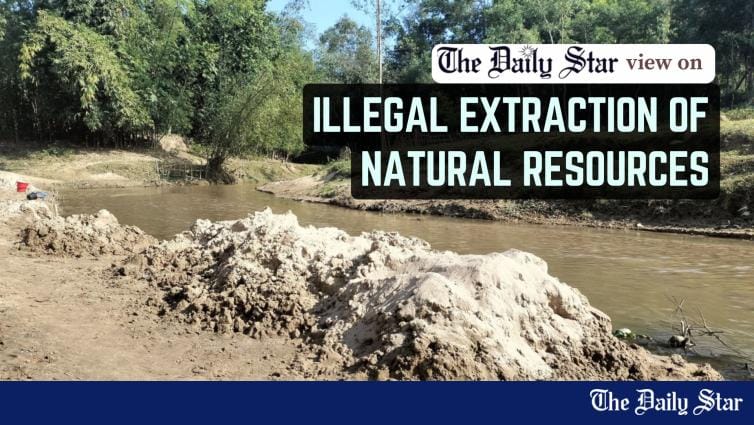
We are concerned about the rampant illegal sand extraction reported at the Barachhara canal in Sharsharshee village of Sreemangal, Moulvibazar. According to a report by this daily, the extraction has continued unabated despite a High Court order banning sand mining in the area, causing parts of a sluice gate to sink. Built to provide irrigation water to local farmers, the gate's functionality is now compromised, jeopardising agricultural activities and the livelihoods of around 25,000 farmers in surrounding villages. Furthermore, several sinkholes have appeared in the nearby Dinarpur Tea Garden, while roads have been severely damaged by heavy vehicles transporting the sand.

Locals allege that an influential group, led until recently by a Jubo League leader who is now on the run, is behind this operation. Even though his two-year lease for sand extraction has expired, there has been no let-up in sand extraction. Who, then, is doing it in his absence? The local administration is apparently in the dark about this. We have seen a similar trend in Sylhet's Companyganj where two hillocks have been stripped bare since August 5 through illegal stone quarrying. There, too, the local administration's role has left a lot to be desired.

In Bangladesh, we have no shortage of laws, regulations, and court orders prohibiting illegal and destructive resource extraction. Yet, enforcement has remained woefully inadequate. Even with a non-political government in place, the entrenched political-administration-business nexus continues to wreak havoc on our precious environment and ecology. This needs to change.

We expect the environment adviser, herself a prominent environmental activist, and her ministry to use their authority and experience to stop all illegal operations in extracting natural resources. Given the scale of the problem, it may not be possible for the government to guard every canal, hill, or natural resource on its own. However, community-based initiatives can play a crucial supportive role. Locals can be educated, empowered, and included in the protection and maintenance of these resources. The idea of community policing, supported by local administration and environmental groups, should also be pursued to curb these activities. Only collective efforts can help protect our natural resources on which the livelihoods and well-being of countless citizens depend.​
 
Analyze

Analyze Post

Add your ideas here:
Highlight Cite Fact Check Respond

What will it take to end the brick kiln menace?
984 kilns operating in breach of regulations in Rangpur division

1736552010493.webp

VISUAL: STAR

The number is quite staggering, and it's frustrating that such numbers exist even when there is a pro-environment government in place. According to a report citing officials at the departments of environment and agricultural extension in Rangpur, the division has 984 brick kilns—set up on farmlands across its eight districts—operating in violation of government regulations. These kilns use fertile topsoil to make bricks in a process that causes significant damage to the local environment, livelihoods, and health. While the proliferation of such kilns, owned or operated mostly by people with political connections, was understandable under the Awami League regime, their continued operation now questions the ability and sincerity of the interim administration.

The situation is by no means unique to Rangpur. Similar operations also continue in many other areas, ravaging topsoil and burning bricks with impunity. Not long ago, we highlighted the case of Brahmanbaria where, according to a Prothom Alo report, 56 kilns operate illegally. Many of them, including one set up by a former Awami League lawmaker, have no valid documents such as environmental clearance or the permit for brick burning. Many were set up on agricultural lands and even wetland areas. In Lalmonirhat, according to another recent report, 36 brick kilns are operating without a clearance certificate. Although there is no central database on the number of illegal or non-compliant brick kilns in the country, the above reports portray a grim picture.

The question is, what is the interim government doing? To be fair, the environment ministry did take some encouraging steps, including the development of a National Air Quality Management Action Plan in early November to tackle sources of air pollution and enhance enforcement mechanisms. More recently, it has overseen a number of drives through mobile courts targeting illegal kilns, shutting down quite a few by demolishing their chimneys while ordering the closure of multiple others. These measures, however, are proving to be inadequate to address the menace of brick kilns.

We, therefore, urge the government to step up its efforts. Given the massive impact of brick kilns, having legal papers or not, it is no longer enough to just go after a few illegal ones without enforcing compliance across the sector or addressing the heavy reliance on topsoil or traditional bricks. What's at stake here is not just the health of our environment or local communities. The livelihoods of farmers, and by extension the nation's food security, are also at risk. So, the government must explore options to replace traditional brick-making in a way that eventually reduces topsoil and fuel consumption.​
 
Analyze

Analyze Post

Add your ideas here:
Highlight Cite Fact Check Respond

Members Online

No members online now.

Latest Posts

Back
 
G
O
 
H
O
M
E