Bangladesh Defense
Saif
Senior Member
- Jan 24, 2024
- 21,011
- 9,685
- Nation

- Residence
- Axis Group

Bay of Bengal’s slow death threatens our future
Marine fish populations have plummeted at a rate scientists describe as catastrophic.
Bay of Bengal’s slow death threatens our future

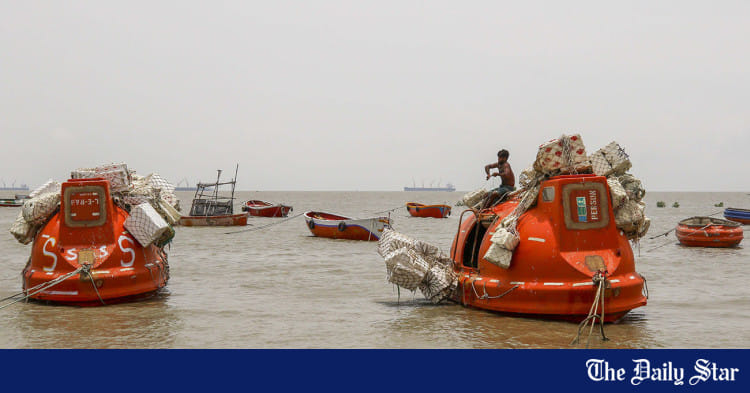
Allowing illegal trawlers to operate, letting industrial vessels destroy sea beds, and ignoring scientific warnings will only lead to the Bay of Bengal's slow death. FILE PHOTO: RAJIB RAIHAN
Bangladesh woke up this week to one of the most alarming environmental findings in its recent history. According to a report in The Daily Star, marine fish populations inside the country's exclusive economic zone in the Bay of Bengal have plummeted at a rate scientists describe as catastrophic. In just seven years, nearly four-fifths of the bay's fish that live in the pelagic zone—neither close to the sea-bed nor the shore—have vanished. This is not a routine decline. It is a collapse—rapid, severe, and potentially irreversible.
To grasp the magnitude of this collapse, consider that global fisheries scientists sound alarms when stocks fall by 30 to 40 percent. A 50 percent decline signals a crisis. But an 80 percent drop in less than a decade suggests a system on the edge of ecological failure. Collapses of this speed and scale have devastated fisheries in Canada's Newfoundland, the United States's California, and Peru in South America—regions where recovery took decades and, in some cases, never fully occurred. Bangladesh is now facing a similar possibility, and the consequences will be far-reaching if urgent action is not taken.
The news report attributes the collapse to several causes: overfishing, illegal fishing, and destructive fishing practices. These represent real, daily patterns of exploitation that have pushed the bay to exhaustion. Industrial trawlers—both legal and illegal—scrape the seabed with gear that destroys marine habitats, kills juvenile fish, and leaves entire zones barren. Many vessels routinely under-report their catch, operate in restricted zones, or violate seasonal bans. Meanwhile, small-scale artisanal fishermen, who are the backbone of coastal economies, are now forced into deeper and more dangerous waters because nearshore fish have been depleted.
Bangladesh's regulatory framework is simply not equipped to handle this level of pressure. The country authorises far more industrial trawlers than its marine ecology can sustain. Monitoring is inadequate. Enforcement is sporadic. Coast guard resources are overstretched. Illegal operators often escape accountability through political protection or bribery. Scientific research capacity remains thin, leaving policymakers without accurate stock assessments or long-term ecological modelling.
The collapse in fish stock will not only affect marine biodiversity; it will shake the foundations of national nutrition and coastal economies. Marine fish supply makes up nearly 15 percent of Bangladesh's total animal protein intake. A sharp decline will raise food insecurity, increase protein deficiency, and widen nutritional inequality. For crores of coastal residents—from fishers and boatmen to traders, processors, and transport workers—marine fisheries are the primary source of income. A collapse in marine stocks means declining catch, lower earnings, rising debt, and a slide into deeper destitution. Coastal districts, already battered by cyclones, erosion, and salinity, will face additional economic hardship.
There is also a geopolitical dimension. As fish stocks decline, cross-border tensions over marine resources in the bay may intensify. Countries around the Bay of Bengal—India, Myanmar, Sri Lanka—are also grappling with declining fish populations. Competition for dwindling resources often leads to arrests of fishermen, maritime disputes, and escalations that strain diplomatic relations. Bangladesh cannot afford to let ecological collapse feed into geopolitical instability.
The nutritional consequences are equally serious. Bangladesh is already dealing with rising food inflation, reduced dietary diversity, and a growing burden of non-communicable diseases linked to a poor diet. Marine fish—comparatively affordable, accessible, and protein-rich—have long been a nutritional anchor for the poor. When fish disappear, households will be forced to shift to inferior protein sources or go without, accelerating hidden hunger, childhood stunting, and micronutrient deficiency.
This crisis reflects decades of policy neglect, political interference, weak enforcement, and an absence of a long-term vision for marine governance. Bangladesh possesses marine laws on paper, but laws do not protect oceans—institutions do. Without sustained political commitment, transparency, and science-based decision-making, no legal framework can prevent ecological collapse.
Two options are open for Bangladesh. The first is the continuation of the status quo, a path of slow death for the bay: allowing illegal trawlers to operate, letting industrial vessels destroy sea beds, ignoring scientific warnings and pretending that fish stocks will replenish themselves. If Bangladesh chooses this path, the collapse will deepen, and the bay may reach a point where recovery becomes impossible within a generation. The poor will suffer first and most, but eventually, urban consumers, national nutrition, and geopolitical stability will also be affected.
The other path is one of urgent recovery that demands political courage and institutional reform. First, Bangladesh must dramatically reduce the number of industrial trawlers. Many countries have implemented trawler buy-back programmes to reduce pressure on marine ecosystems; Bangladesh may need to consider similar policies. Second, enforcement must be strengthened, with modern vessel-tracking systems, real-time monitoring, and a fully empowered coast guard. Third, scientifically guided seasonal bans and no-take zones must be enforced without exception. Breeding grounds and nursery habitats have to be protected if the bay is to heal.
Fourth, Bangladesh must invest in marine science. The country needs updated stock assessments, habitat mapping, and ecosystem modelling to craft policies based on evidence rather than intuition. Finally, coastal communities must be supported with alternative livelihoods—aquaculture, eco-tourism, value-added fish processing—so that conservation does not come at the expense of human survival. In all of this, timing is crucial. The window for action is narrowing quickly.
Bangladesh has shown resilience in many areas of national life. Whether that resilience can be reactivated—decisively, intelligently, and urgently—will determine not only the future of the ocean but the future of crores of people who depend on it. The Bay of Bengal is a living asset, not an inexhaustible warehouse. Once its life collapses, no policy can bring it back quickly.
This generation has a choice to make. It can allow the bay to die slowly, its fishery wealth drained by neglect and exploitation; or it can act decisively by protecting, restoring, and managing the ocean with the seriousness the crisis demands.
Dr Abdullah A Dewan is professor emeritus of economics at Eastern Michigan University in the US and a former physicist and nuclear engineer of Bangladesh Atomic Energy Commission.
Allowing illegal trawlers to operate, letting industrial vessels destroy sea beds, and ignoring scientific warnings will only lead to the Bay of Bengal's slow death. FILE PHOTO: RAJIB RAIHAN
Bangladesh woke up this week to one of the most alarming environmental findings in its recent history. According to a report in The Daily Star, marine fish populations inside the country's exclusive economic zone in the Bay of Bengal have plummeted at a rate scientists describe as catastrophic. In just seven years, nearly four-fifths of the bay's fish that live in the pelagic zone—neither close to the sea-bed nor the shore—have vanished. This is not a routine decline. It is a collapse—rapid, severe, and potentially irreversible.
To grasp the magnitude of this collapse, consider that global fisheries scientists sound alarms when stocks fall by 30 to 40 percent. A 50 percent decline signals a crisis. But an 80 percent drop in less than a decade suggests a system on the edge of ecological failure. Collapses of this speed and scale have devastated fisheries in Canada's Newfoundland, the United States's California, and Peru in South America—regions where recovery took decades and, in some cases, never fully occurred. Bangladesh is now facing a similar possibility, and the consequences will be far-reaching if urgent action is not taken.
The news report attributes the collapse to several causes: overfishing, illegal fishing, and destructive fishing practices. These represent real, daily patterns of exploitation that have pushed the bay to exhaustion. Industrial trawlers—both legal and illegal—scrape the seabed with gear that destroys marine habitats, kills juvenile fish, and leaves entire zones barren. Many vessels routinely under-report their catch, operate in restricted zones, or violate seasonal bans. Meanwhile, small-scale artisanal fishermen, who are the backbone of coastal economies, are now forced into deeper and more dangerous waters because nearshore fish have been depleted.
Bangladesh's regulatory framework is simply not equipped to handle this level of pressure. The country authorises far more industrial trawlers than its marine ecology can sustain. Monitoring is inadequate. Enforcement is sporadic. Coast guard resources are overstretched. Illegal operators often escape accountability through political protection or bribery. Scientific research capacity remains thin, leaving policymakers without accurate stock assessments or long-term ecological modelling.
The collapse in fish stock will not only affect marine biodiversity; it will shake the foundations of national nutrition and coastal economies. Marine fish supply makes up nearly 15 percent of Bangladesh's total animal protein intake. A sharp decline will raise food insecurity, increase protein deficiency, and widen nutritional inequality. For crores of coastal residents—from fishers and boatmen to traders, processors, and transport workers—marine fisheries are the primary source of income. A collapse in marine stocks means declining catch, lower earnings, rising debt, and a slide into deeper destitution. Coastal districts, already battered by cyclones, erosion, and salinity, will face additional economic hardship.
There is also a geopolitical dimension. As fish stocks decline, cross-border tensions over marine resources in the bay may intensify. Countries around the Bay of Bengal—India, Myanmar, Sri Lanka—are also grappling with declining fish populations. Competition for dwindling resources often leads to arrests of fishermen, maritime disputes, and escalations that strain diplomatic relations. Bangladesh cannot afford to let ecological collapse feed into geopolitical instability.
The nutritional consequences are equally serious. Bangladesh is already dealing with rising food inflation, reduced dietary diversity, and a growing burden of non-communicable diseases linked to a poor diet. Marine fish—comparatively affordable, accessible, and protein-rich—have long been a nutritional anchor for the poor. When fish disappear, households will be forced to shift to inferior protein sources or go without, accelerating hidden hunger, childhood stunting, and micronutrient deficiency.
This crisis reflects decades of policy neglect, political interference, weak enforcement, and an absence of a long-term vision for marine governance. Bangladesh possesses marine laws on paper, but laws do not protect oceans—institutions do. Without sustained political commitment, transparency, and science-based decision-making, no legal framework can prevent ecological collapse.
Two options are open for Bangladesh. The first is the continuation of the status quo, a path of slow death for the bay: allowing illegal trawlers to operate, letting industrial vessels destroy sea beds, ignoring scientific warnings and pretending that fish stocks will replenish themselves. If Bangladesh chooses this path, the collapse will deepen, and the bay may reach a point where recovery becomes impossible within a generation. The poor will suffer first and most, but eventually, urban consumers, national nutrition, and geopolitical stability will also be affected.
The other path is one of urgent recovery that demands political courage and institutional reform. First, Bangladesh must dramatically reduce the number of industrial trawlers. Many countries have implemented trawler buy-back programmes to reduce pressure on marine ecosystems; Bangladesh may need to consider similar policies. Second, enforcement must be strengthened, with modern vessel-tracking systems, real-time monitoring, and a fully empowered coast guard. Third, scientifically guided seasonal bans and no-take zones must be enforced without exception. Breeding grounds and nursery habitats have to be protected if the bay is to heal.
Fourth, Bangladesh must invest in marine science. The country needs updated stock assessments, habitat mapping, and ecosystem modelling to craft policies based on evidence rather than intuition. Finally, coastal communities must be supported with alternative livelihoods—aquaculture, eco-tourism, value-added fish processing—so that conservation does not come at the expense of human survival. In all of this, timing is crucial. The window for action is narrowing quickly.
Bangladesh has shown resilience in many areas of national life. Whether that resilience can be reactivated—decisively, intelligently, and urgently—will determine not only the future of the ocean but the future of crores of people who depend on it. The Bay of Bengal is a living asset, not an inexhaustible warehouse. Once its life collapses, no policy can bring it back quickly.
This generation has a choice to make. It can allow the bay to die slowly, its fishery wealth drained by neglect and exploitation; or it can act decisively by protecting, restoring, and managing the ocean with the seriousness the crisis demands.
Dr Abdullah A Dewan is professor emeritus of economics at Eastern Michigan University in the US and a former physicist and nuclear engineer of Bangladesh Atomic Energy Commission.