New Tweets

[🇧🇩] Sea Ports/Air Ports/River Ports/Bridges/Mega Projects

G Bangladesh Defense
[🇧🇩] Sea Ports/Air Ports/River Ports/Bridges/Mega Projects
202
9K
More threads by Saif


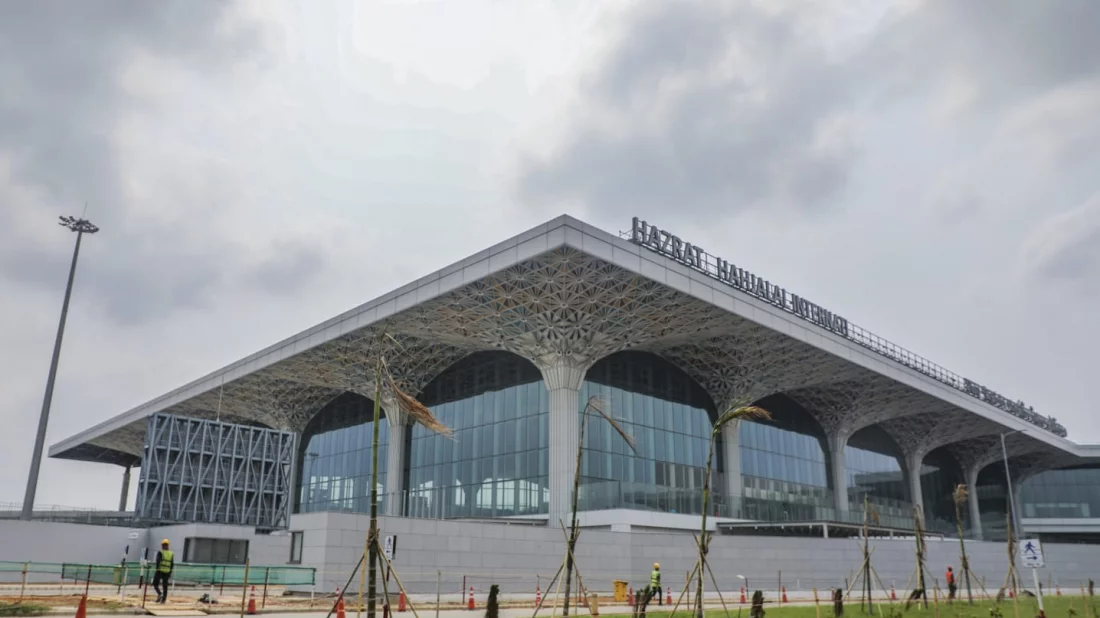
Bangladesh discusses Dhaka airport third terminal with Japan

bdnews24.com
Published :
Mar 13, 2026 21:34
Updated :
Mar 13, 2026 21:34

1773446954719.webp


The Bangladesh government and a Japanese delegation have held a high-level meeting to discuss the operation and maintenance of the third terminal of Shahjalal International Airport in Dhaka.

In the meeting held at the conference room of the Ministry of Foreign Affairs on Friday morning, the Japanese delegation made a proposal on the operation and maintenance of the third terminal.

Embarkation fees, upfront fees, and revenue sharing were on the agenda, according to a media statement from the Civil Aviation Authority of Bangladesh (CAAB).

The meeting, however, could not indicate exactly when the terminal will be fully operational.

On Wednesday, State Minister for Civil Aviation and Tourism M Rashiduzzaman Millat said the facility could become operational within nine months.

During the latest meeting, Civil Aviation Minister Afroza Khanam Rita said the government is working to inaugurate the third terminal soon, ensuring maximum convenience for passengers.

State Minister Millat urged the Japanese delegate to quickly submit a revised proposal for the terminal.

Chaired by Foreign Minister Khalilur Rahman, the meeting was also attended by his deputy, Shama Obaed Islam, and Prime Minister’s Advisor on Foreign Affairs Humayun Kabir, among others, from the Bangladesh side.

The Japanese delegation was comprised of officials from the Japanese Embassy in Dhaka, an assistant vice-minister and representatives of a Japanese consortium.

Prime Minister Tarique Rahman held a meeting on Feb 22 to review progress on the long-delayed terminal and directed officials to complete preparations for its launch.

The project to build the terminal was initiated in 2017 by the former Awami League government. Construction formally began on Dec 28, 2019, with an estimated cost of about Tk 213.98 billion.

Ousted prime minister Sheikh Hasina partially inaugurated the terminal on Oct 7, 2023. At the time, the CAAB had expected the facility to become fully operational in 2024, but that deadline passed without completion.​
 
Analyze

Analyze Post

Add your ideas here:
Highlight Cite Respond

Padma Bridge earns Tk 132m in first 3 days of Eid

Staff Correspondent
Dhaka
Published: 20 Mar 2026, 19: 44

1774052731140.webp

Padma Bridge File photo

In celebration of the holy Eid-ul-Fitr, a total of 119,682 vehicles crossed the Padma Bridge over three days (from 17 to 19 March).

During this time, toll collection amounted to Tk 13 crore 21 lakh 51 thousand 800.

Compared to the same period during last year’s Eid-ul-Fitr, both the number of vehicles crossing and the toll collection have increased.

This information was provided in a press release from the Public Relations Office of the Bangladesh Bridge Authority today, Friday.

The Bridge Authority mentioned that during Eid-ul-Fitr last year, 108,002 vehicles crossed the Padma Bridge over three days, with a toll collection of Tk 12 crore 78 thousand 400.

All types of vehicles are required to pay a toll to cross the Padma Bridge. Different toll rates are determined for motorcycles, private cars, buses, trucks, and various types of vehicles.

Connecting Munshiganj and Shariatpur, the country's longest Padma Bridge links the southern and southwestern regions with the capital. People from 21 districts in these regions benefit from this bridge.

Electronic Toll Collection (ETC) systems are established at the toll plazas on both ends (Mawa and Jazira) of the Padma Bridge. This system allows for automatic toll payment without stopping the vehicle, reducing the time vehicles spend waiting at toll plazas.

By collecting tolls automatically through Radio Frequency Identification (RFID) cards, travel has become faster and more convenient.

A record 51,584 vehicles crossed the Jamuna Bridge in one day.

The Bridge Authority further reported that on 18 March, a record 51,584 vehicles crossed the Jamuna Bridge in a single day, with a toll collection of Tk 3 crore 51 lakh 82 thousand 600.

Last year during Eid-ul-Fitr, a daily maximum of 48,368 vehicles crossed this bridge, with toll collection amounting to Tk 3 crore 46 lakh 27 thousand 850.​
 
Analyze

Analyze Post

Add your ideas here:
Highlight Cite Respond

Chattogram port can no longer delay green transition
29 March 2026, 10:00 AM
Ahamedul Karim Chowdhury


1774834712496.webp

‘Ports are far from environmentally neutral spaces as they concentrate emissions, noise, wastewater discharge, oil pollution, and solid waste.’ VISUAL: ANWAR SOHEL

The growing influence of weather and climate science on economic infrastructure deserves closer attention. Ports sit at the frontline of this relationship. Rising temperatures, changing rainfall patterns, sea-level rise, and extreme weather events increasingly shape how ports operate, plan investments, and manage risks. Climate and environmental data are becoming central to how ports compete and remain resilient in the global maritime economy.

For Bangladesh, as it prepares to graduate from Least Developed Country (LDC) status, protective cushions such as preferential market access, concessional financing, and regulatory flexibility will gradually diminish. In their place will emerge a more demanding global trade environment where environmental performance, carbon accountability, and sustainability credentials increasingly influence access to markets, finance, and investment. In this changing landscape, an important question arises: is the Chattogram Port Authority (CPA) institutionally prepared for this future?

During my 28 years of professional experience at Chattogram Port Authority (CPA), I have never seen a dedicated environmental protection department, a sustainability cell, or even a designated environmental professional responsible for long-term environmental planning and compliance in the CPA. This absence is no longer a minor administrative gap. It is becoming a strategic vulnerability at a port that handles more than 80 percent of Bangladesh’s seaborne trade and remains the country’s primary maritime gateway.

Ports are far from environmentally neutral spaces. They concentrate emissions, noise, wastewater discharge, oil pollution, and solid waste. Ships burn fuel at berth, trucks queue for hours around the port city, and cargo-handling equipment operates around the clock. Despite this reality, environmental impacts at Chattogram Port remain largely unmeasured and unmanaged in any systematic way.

Globally, port authorities have learned a simple truth: what is not measured cannot be managed. Modern ports routinely conduct emissions inventories, monitor air and water quality, measure carbon output, and conduct environmental audits. Many now deploy digital systems to monitor air pollution, water quality, and noise levels in real time across port areas. At Chattogram Port, however, such practices remain limited and fragmented. Environmental management is still treated largely as an external compliance obligation rather than a core governance responsibility.

However, after LDC graduation, Bangladesh will face increasing scrutiny from trading partners, international lenders, insurers, shipping lines, and global supply chains. Environmental compliance will increasingly become a condition of doing business rather than simply a donor requirement. Ports will be assessed not only on efficiency and capacity but also on carbon intensity, pollution control, energy efficiency, and climate resilience. Green shipping corridors, emission disclosure rules, and environmental performance-linked port charges are gradually becoming global norms. If Chattogram Port fails to adapt, it risks losing competitiveness, investment opportunities, and credibility in the evolving maritime economy.

Therefore, environmental sustainability cannot remain an “additional duty” scattered across departments within the CPA. It urgently needs a formal environmental protection and sustainability cell reporting directly to senior management. Such a unit should oversee environmental planning, emissions monitoring, regulatory compliance, audits, and coordination with regulators, development partners, and research institutions. Otherwise, without clear institutional ownership, sustainability initiatives will remain fragmented and reactive.

Shipping itself is undergoing a major transformation, and ports are central to that shift. Around the world, port authorities promote greener shipping through incentive schemes such as reduced port charges for low-emission vessels, priority berthing for environmentally compliant ships, and penalties for heavy polluters. These measures influence shipping behaviour far more effectively than policy statements. However, for such frameworks to work, they must be supported by reliable environmental data.

Deploying monitoring systems for air emissions, water quality, and noise levels across berths and terminals would allow CPA to move from perception-based compliance to measurable environmental performance. Continuous data could help the CPA provide tariff incentives and priority berthing, linking reduced charges to verified environmental performance rather than self-declared vessel characteristics. CPA already has the authority to design such schemes. What it currently lacks is emissions data, performance benchmarks, and in-house environmental expertise.

Another important intervention is shore power supply, allowing ships to switch off auxiliary engines while at berth and connect to onshore electricity. This can significantly reduce air pollution and carbon emissions in port cities. For a densely populated city like Chattogram, the public health benefits alone justify serious attention. Yet, shore power remains largely absent from CPA’s long-term planning.

There is also a major opportunity in renewable energy. CPA operates container freight stations, warehouses, sheds, and administrative buildings—many with large rooftop surfaces suitable for solar panels. Solar power could reduce long-term energy costs, cut emissions, and demonstrate a practical commitment to sustainability. International experience shows that renewable energy initiatives often work best through public–private partnership (PPP) models, allowing ports to benefit from private investment and expertise while focusing on core operations.

Some argue that the shift toward a landlord port model or donor-funded infrastructure projects will automatically address environmental concerns. This assumption is misleading. Global terminal operators are accountable for individual terminals, not cumulative port-wide impacts such as air pollution, emissions, traffic congestion, or the broader city-port interface. Donor safeguard mechanisms are also project-specific and temporary. They cannot replace permanent institutional capacity. Environmental sustainability, therefore, must be institutionally embedded. This is not an argument against port expansion but for responsible and future-ready development. That is why the Ministry of Shipping, CPA leadership, policymakers, port users, and development partners must recognise that environmental sustainability now sits at the heart of port governance, trade competitiveness, and public health.

Climate science is no longer only about forecasting storms. It also helps critical infrastructure prepare for an uncertain future. The coming decade will determine whether Chattogram Port evolves into a credible gateway in a carbon-constrained global economy—or struggles to keep pace with a rapidly transforming maritime industry. For Bangladesh, the message is clear: environmental intelligence and climate awareness must now guide port governance. Choosing leadership in environmental sustainability today will cost far less than correcting institutional neglect tomorrow.

Ahamedul Karim Chowdhury is adjunct faculty at Bangladesh Maritime University and former head of Kamalapur inland container depot and Pangaon inland container terminal under the Chittagong Port Authority.​
 
Analyze

Analyze Post

Add your ideas here:
Highlight Cite Respond

Latest Posts

Back
PKDefense - Recommended Toggle