[🇨🇳] China vs USA

Afghanistan Albania Algeria Andorra Angola Antigua Austria Azerbaijan Bahamas Bahrain Bangladesh Barbados Canada China Egypt Finland Germany India Iran Israel Japan Lebanon North Macedonia Pakistan Palestine Qatar Russia Syria Turkey Ukraine United Kingdom United States Yemen
[🇨🇳] China vs USA
228
9K
More threads by Saif

G   Chinese Defense

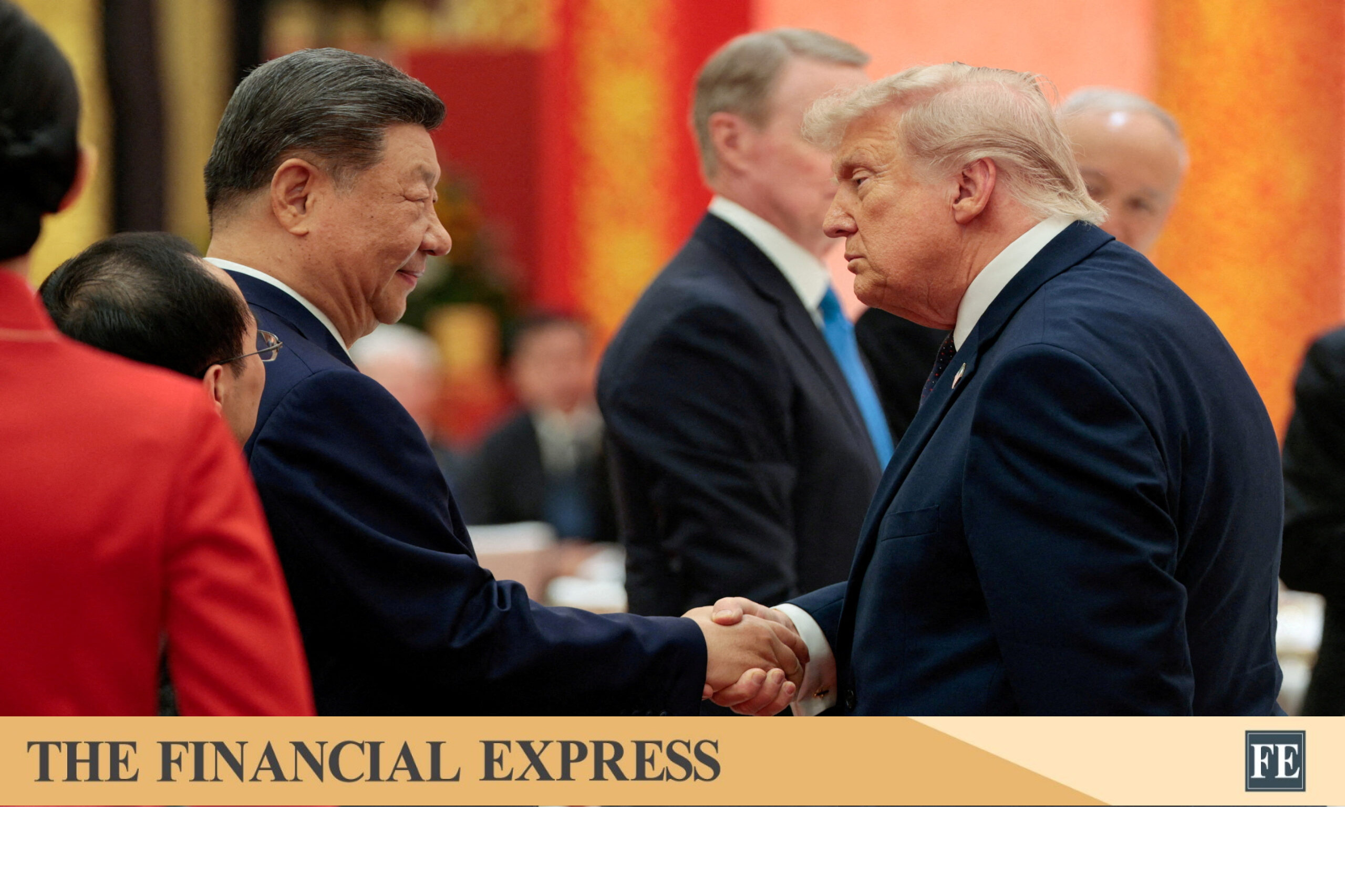
Trump's not so triumphant visit to China

Hasnat Abdul Hye

Published :
May 19, 2026 23:57
Updated :
May 19, 2026 23:57
1779234154048.webp


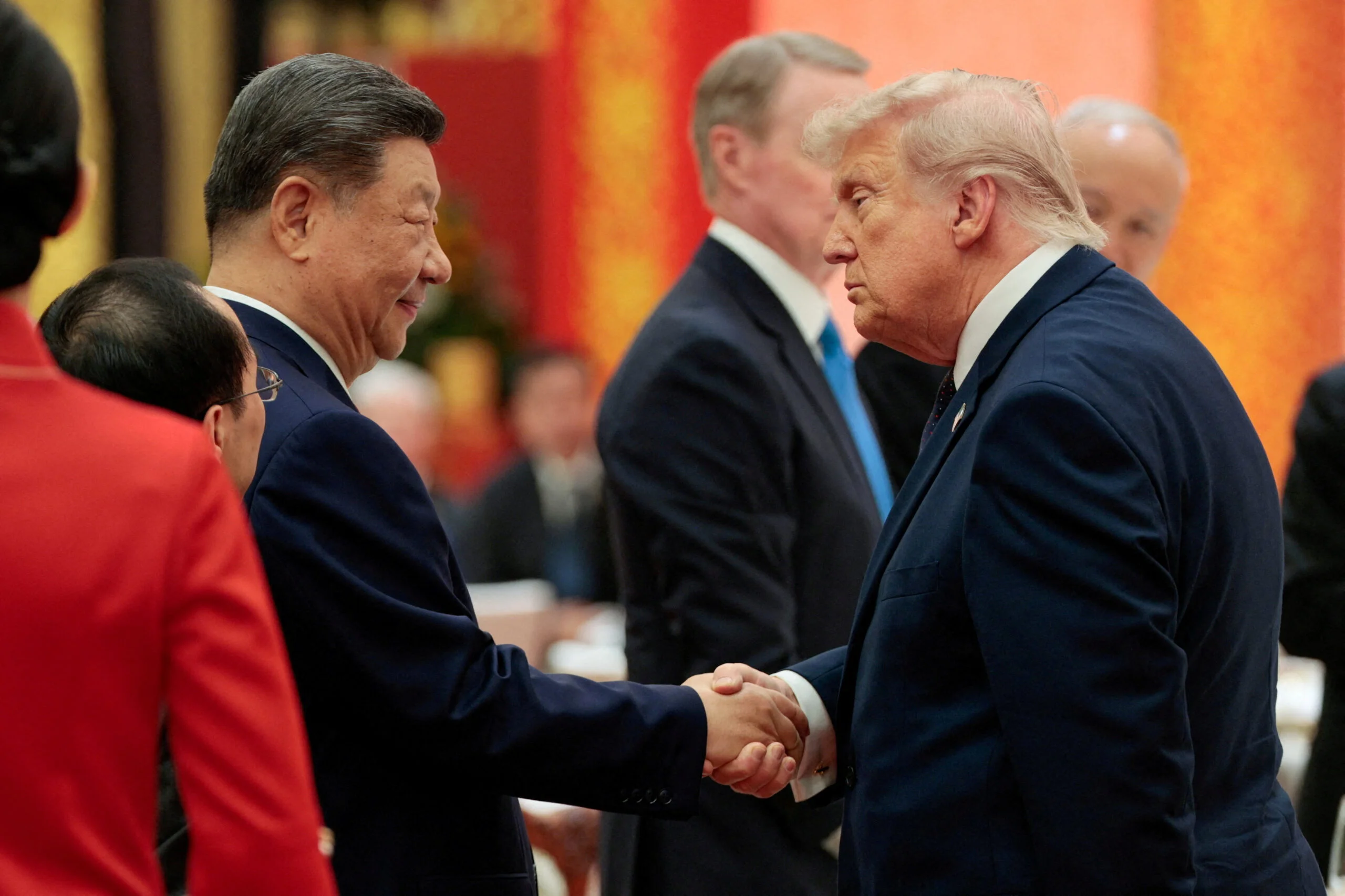
Unarguably, Donald Trump's just concluded visit to China has not been redolent of legendary veni, vidi, vici vintage. Some commentators have described it as a pathetic disaster and a landmark diplomatic faux pas the like of which has not been seen in recent years. The sound bites accompanied by the sights of Trump delegation dumping the gifts received from their Chinese hosts reveal the lack of savoir fair in the much vaunted deal making style of Trump administration. If there was any doubt about the gross, uncouth and hubris demeanour of the present occupant of White House, the gesture of his delegation desecrating the gifts removes it decisively.

The outcome of President Trump's visit to China and his summit meeting with President Xi Jinping should be measured by what was in the agenda for discussion and the covert objectives of the visit. The state visit was at the request of president Trump and took place in the backdrop of a deteriorating relation caused by tariff war. In addition, there has been growing tension over Taiwan, the island state claimed by China as its territory and supported and armed by America as an independent entity. To these two issues was added the closure of the Strait of Hormuz by Iran following American- Israeli war against Iran.

The tenor of the summit was revealed by the reception given to president Trump on his arrival when he was greeted by the vice president of China. This was a deliberate departure from the protocol of a head of state being received by the head of state of host country. In the summit President XI preempted President Trump when he pointed out that the world was watching them, implying that Trump should not say or do anything that will disappoint observers around the world. With this opening condescending statement he immediately assumed an upper hand, cautioning Trump that he should behave responsibly and not shoot from the hip as is his wont. Then he bluntly told president Trump that he should be beware of falling victim to Thucidides Trap, a direct reminder of the Greek historian's prediction about a rising power routing an incumbent great power. By debunking the Trap thesis, he directly accused President Donald Trump of promoting an adversial relation with China on the basis of an imaginary demon.

By implication, he hinted that as in Thucydides's Greece Troy became fearful of the Greek state, America has become apprehensive of China's rise as a great power. He assured and declared that America and China should work together as partners. Through these opening remarks President XI directly placed President Trump into a defensive position and that sealed the fate of the summit. Already alienated by its traditional western allies because of his unilateral decisions and actions, President Trump faced a treatment in China which was by any reckoning humiliating. On Taiwan, President XI drew a red line and bluntly told Trump that sending arms and supporting independence of the island would directly bring their countries into conflict, the shorthand for war. In response, far from reiterating America's support for Tarwan, President Trump merely said he would take a decision about sale of arms to Taiwan later.

In respect of trade, there was no discussion on retaliatory tariff and nothing was decided. Instead there was a declaration of intent from China to buy Soybean and 200 Boeing jets from America. The sale of rare earths material by China and imports of chips and semi conductors from America were discussed but no decision was made indicating that China's drive to become self-sufficient in chip making will proceed full steam. Even the inclusion of Chinese born CEO George Huang of American tech giant NVIDIA in the American delegation could not make any difference to make a breakthrough in the impasse. The war in the Middle-East figured prominently in the Summit. President XI agreed that the Strait of Hormuz should be opened, quipping ' Iran closed it and you closed it ', implying that before the war the Strait was open. Continuing on the subject, he said the Strait should not be militarised, a covert reference to America's policy regarding Panama canal. Regarding import of oil from Iran, China insisted on its right to do so, agreeing to import from America also. On the immediate issue of sale of weapons of arms to Iran, China assured that it will be complied with. The only unequivocal declaration was that Iran should not have nuclear weapons. Insignificant as the declarations were, their consequences are uncertain as no official agreements were signed. This must have been a rare summit where no official communiqué was issued on agreements reached. In the event all the ' agreements' reached in the summit, discussions are no more than declaration of intent lacking legal binding.

President Trump is fond of boasting about his genius as a dealmaker. During his second term as president there has been not a single deal worth mentioning, unless the kidnapping of president Maduro of Venezuela is considered as a deal. His most important visit to China and the summit meeting there with the Chinese counterpart is such a travesty of interrelations that it is destined to go down in history as trivial as a pleasure trip.​
 

Pentagon chief sounds 'alarm' over China's buildup, urges allies to boost defence spend

REUTERS

Published :
May 30, 2026 18:01
Updated :
May 30, 2026 18:01

1780184467387.webp


US Defence Secretary Pete Hegseth urged Asian allies on Saturday to ramp up military spending to counter China’s growing power and prevent its dominance in the region, warning of “rightful alarm” over its rapid military buildup.

Hegseth, speaking at the Shangri-La Dialogue in Singapore, Asia’s premier forum for defence leaders, militaries and diplomats, said a stronger, more self-reliant network of allies is essential to deter aggression and preserve the balance of power.

“There is rightful alarm regarding China’s historic military buildup and the expansion of its military activities in the region and beyond,” he said.

“A Pacific dominated by any hegemon would unravel the regional balance of power,” Hegseth said. “No state, including China, can impose its hegemony and hold the security or prosperity of our nation and our allies in question.”

The US expects its Asian allies and partners to increase defence spending to 3.5% of GDP as it pledged a $1.5 trillion investment in its military, the Pentagon chief said.

“Less Shangri-La, more ships, more subs,” Hegseth said, stressing that the region needed greater defence capability than conferences. Allies want stability, not escalation, he said.

“What they want, and what the United States delivers, is strength that is disciplined, resolve that is steady, and leadership that is confident enough to speak and walk softly while carrying a big stick.”

Hegseth also struck a measured tone on US-China ties, saying relations are “better than they have been in many years,” with more frequent military-to-military engagement helping to manage tensions.

“We are meeting more frequently with our Chinese counterparts by maintaining open lines of military-to-military communication.”

Zhou Bo, a senior fellow at Tsinghua University and retired People’s Liberation Army senior colonel who was part of the Chinese delegation, described US-China relations as “complicated.”

Nonetheless, he said Hegseth struck “a much better tone” this year than last, attributing the shift to Trump’s visit to China.

“Both sides have open channels of communication, the situation is not as exaggerated as the outside world makes it out to be,” Zhou said.

China, whose defence minister is skipping the dialogue for a second consecutive year, accused Hegseth last year of making “vilifying” remarks.

“NO FREELOADING”

Hegseth echoed President Donald Trump’s long-standing demand that allies shoulder more of their own defence costs. Trump has pointedly said European and NATO partners should reduce reliance on Washington.

“The era of the United States subsidising the defence of wealthy nations is over,” Hegseth said. “We need partners, not protectorates,” he added. “We don’t have a strong alliance unless everyone has skin in the game. No freeloading.”

Hegseth praised contributions from allies including South Korea, the Philippines, Australia, Singapore, Malaysia and Thailand, and said Japan was taking concrete steps to bolster its defences.

Tokyo and Washington “must each pull our weight to strengthen the US-Japan alliance,” he said.

READY TO RESTART STRIKES ON IRAN

On the Middle East conflict, Hegseth said the United States stands ready to resume strikes on Iran if diplomacy fails, as negotiators from Washington and Tehran work to bridge major differences blocking a deal.

“Our ability to recommence if necessary...we are more than capable,” Hegseth said. He added that Trump remains “patient” and is seeking a “strong deal” to ensure Iran does not obtain a nuclear weapon.

Trump said on Friday he would convene advisers in a secure White House setting to make a “final determination” on a proposal to end the Iran war.

Hegseth also pushed back on concerns the conflict would distract from Asia-Pacific priorities.

“We can do two things at one time.”

ARMS SALES DECISION TO TAIWAN IS TRUMP’S CALL

In his speech, Hegseth made no mention of Taiwan, a hotspot in relations between the US and China.

When asked about arms sales to the island during questions that followed, Hegseth downplayed concerns that a multi-billion-dollar package could be affected as the United States draws down its weapons stockpiles amid the Middle East conflict. “We feel very good about our stockpiles and how we use them,” he said.

Taiwan, which China views as its own territory, has been waiting for the US to approve an arms sale that Reuters reported could be worth up to $14 billion.

Trump sowed uncertainty in Taipei by saying, after meeting China’s President Xi Jinping this month, that he was undecided on whether to approve the package.

Any decision on future arms sales would rest with President Trump, Hegseth said, signalling no shift in Washington’s longstanding approach despite recent engagement with Beijing.

“Those decisions will depend on the president and the nature of that relationship,” Hegseth said. “There’s been no change in our status.”​
 

Why the US can no longer contain China

Faridul Alam

Summitry in an age of strategic afterthought

By the time Donald Trump and Xi Jinping met again after nearly a decade, the world’s guiding metaphor had already shifted from Noah’s Ark to Neurath’s boat. This transition reflected the ongoing unmaking of the international order the United States had helped forge in the aftermath of the Second World War. If Noah’s Ark symbolized a stable, hierarchical, and teleological vision of Western order moving toward a secured horizon—amid Spenglerian anxieties of civilisational decline in the West—Neurath’s boat captures a radically different condition: a world without fixed foundations, compelled to rebuild itself while already adrift at sea.

The paradox is that the postwar American order, set in motion through globalisation, technological acceleration, and the diffusion of power, helped dissolve the very predictability and centredness upon which its hegemony hinged. The very processes that expanded American influence simultaneously dispersed power, multiplied centres of agency, and transformed the conditions under which order could be sustained. This dynamic has been further amplified by the emergence of what has often been described as a post-American world marked by the rise of new centres of economic and geopolitical influence.

Viewed in retrospect, the Trump–Xi summit did not, and perhaps could not, resolve the structural antagonisms underpinning the relationship between the world's two largest powers. At best, it briefly managed tensions that remain resistant to durable settlement.

Retrospective assessments in the United States, including those associated with the Council on Foreign Relations, converged on the view that the summit amounted to a “decent peace” — an uneasy détente in which strategic success consists not in resolution but in preventing immediate deterioration. Beijing interpreted the same encounter differently, portraying it as evidence that strategic competition can be rendered manageable through a framework of “constructive strategic stability”. This framing treated the summit not as the settlement of rivalry but as the institutionalisation of a more predictable architecture in which cooperation, competition, and disagreement could be jointly sustained.

The contrast is revealing. Washington celebrated the absence of immediate deterioration; Beijing emphasized the possibility of structured coexistence. Yet the two narratives converge at a deeper level. Both implicitly acknowledge the same structural reality: neither side can achieve its objectives through containment, and neither can withdraw from the infrastructures through which its power is exercised.

Containment, in this sense, no longer operates as a coherent governing strategy but survives primarily as diplomatic fiction—an inherited vocabulary masking a structural transition toward openly managed rivalry under conditions of deep interdependence.

1781827975306.webp

Trump and Xi at the Great Hall of the People in Beijing, May 14, 2026. Photo: Reuters

What is emerging is not empire in the classical territorial sense but a more diffuse infrastructural formation: a system of power exercised through control over supply chains, computational architectures, financial circuits, energy chokepoints, and technological standards. This emergent configuration does not require formal annexation. It operates instead through asymmetries of access, dependency, and systemic leverage. Its authority lies less in occupation than in its capacity to condition the terms under which others operate within an interconnected global order.

Yet this formation unfolds alongside an already entrenched imperial architecture historically anchored in American military reach, financial primacy, and institutional design. What is unfolding is not the succession of one empire by another but their uneasy coexistence within a reluctantly shared system. This condition—an established power confronting an emergent one within deep interdependence—recalls, in transformed guise, the dynamics associated with the Thucydides Trap. Yet the analogy strains, for neither side can disengage without destabilising the very system through which its power is exercised.

From containment to managed rivalry

The first Trump presidency fundamentally altered the vocabulary of American policy toward China. What had long been framed through the liberal assumptions of engagement and managed interdependence gave way to strategic competition expressed through tariffs, export controls, technology restrictions, and supply-chain securitisation. Under Joe Biden, much of that architecture persisted, confirming that rivalry had become baked into bipartisan doctrine.

Yet the summit revealed that this doctrine has outlived its conceptual clarity. Containment presupposed a world in which adversaries could be geographically, economically, or ideologically bounded. That world no longer exists.

The United States and China remain deeply entangled across rare-earth supply chains, semiconductor production, artificial-intelligence ecosystems, financial markets, and advanced manufacturing. Mutual dependence has not dissolved antagonism; it has reorganised it into a more unstable form.

Interdependence no longer moderates rivalry; it intensifies and restructures it. The impossibility of full disengagement transforms competition into a condition of permanent strategic entanglement in which each attempt at insulation generates new exposure elsewhere in the system.

Viewed in retrospect, the Trump–Xi summit resists stabilization into a single interpretive meaning. The conditions under which it is being read continue to shift, ensuring that every retrospective judgment remains provisional. What appears alternately as tactical de-escalation or “decent peace”, and as “constructive strategic stability”, reflects not contradiction but the instability of the system itself, whose components remain in motion.

The summit's limited outcomes underscored precisely this condition. The most plausible objective was never reconciliation but tactical stabilisation: preserving communication channels, extending temporary arrangements, and producing symbolic agreements while leaving the underlying architecture of competition intact.

For American observers, this outcome resembled a decent peace. For Beijing, it represented constructive strategic stability and an implicit recognition that the relationship had entered a phase in which neither side could compel the other through unilateral pressure alone. The summit thus became an exercise in interpretive asymmetry. The same encounter was narrated through different strategic vocabularies, yet both vocabularies pointed toward the exhaustion of containment.

Trade, technology, and recursive competition

Trade dominated the summit agenda, though not in the form of resolution. Tariffs continued to function simultaneously as economic instruments and symbolic performances of political strength. Yet the deeper transformation lies elsewhere.

Economic interdependence has become securitised. Supply chains are no longer merely economic networks; they are geopolitical infrastructures. Dependence is increasingly read as exposure.

Rare earths and semiconductors reveal this transformation most clearly. China's dominance in mineral processing grants it structural leverage that Washington cannot easily replicate in the short term. Conversely, American restrictions on advanced chips represent one of the most ambitious technological containment strategies in recent history.

Artificial intelligence extends this logic into recursive acceleration. Each technological advance generates pressure for further advances, producing a self-reinforcing cycle of innovation and restriction. Competition no longer stabilises; it reproduces itself.

The summit exposed the limits of diplomatic management once rivalry migrates into infrastructures upon which contemporary economic life depends. Agreements may temporarily slow friction, but they do not alter trajectory.

Interdependence no longer moderates rivalry; it intensifies and restructures it. The impossibility of full disengagement transforms competition into a condition of permanent strategic entanglement in which each attempt at insulation generates new exposure elsewhere in the system.

Bargaining geometry: Taiwan and Iran

If managed rivalry describes the macro-structure of contemporary US–China competition, its operational logic becomes visible in its bargaining geometry: the distributed set of pressure points through which interdependence is converted into leverage.

Two sites now define this geometry: Taiwan and Iran.

Taiwan occupies the centre of global semiconductor production and advanced manufacturing. Iran anchors the system through energy circulation and the Strait of Hormuz, one of the world's most consequential maritime chokepoints.

Read together, Taiwan and Iran form a single field of interdependence: one centred on computational-industrial capacity in East Asia, the other on energy circulation in the Persian Gulf. Disruption in one reverberates through the other, producing a unified field in which localised shocks immediately acquire systemic consequences.

Containment reveals its exhaustion precisely in this configuration. Neither Washington nor Beijing can stabilise one node without generating instability elsewhere. Bargaining no longer occurs between discrete actors but within a shared infrastructural system that neither can fully control nor abandon.

Hormuz and the reversal of strategic geometry

Recent developments suggest that this bargaining geometry is itself undergoing reconfiguration. A prospective memorandum of understanding between Washington and Tehran, involving the reopening of the Strait of Hormuz and the lifting of reciprocal restrictions, signals an extraordinary possibility: the de-escalation of one of the world’s most consequential geopolitical chokepoints without Chinese mediation or leverage.

This development reveals an unexpected inversion. Iran, previously understood largely as an object through which energy pressure reverberated across the wider architecture of US–China competition, increasingly appears as an autonomous strategic actor capable of reshaping the geometry of interdependence itself.

1781828105813.webp

Photo: Reuters

For Washington, such an arrangement lowers energy risk and reduces military burdens. Yet it simultaneously exposes the limits of coercive statecraft. A strategy designed to constrain Iran through sanctions and pressure increasingly appears to require negotiated accommodation with the very actor it sought to isolate.

For Tehran, the optics are markedly different. The Islamic Republic can portray negotiations as evidence that maximum pressure failed to compel capitulation. Strategic resilience, rather than defeat, becomes the dominant narrative—an interpretation reinforced in commentary such as Robert Kagan’s widely discussed Atlantic essay, which framed the United States as effectively “checkmated” in its confrontation with Iran.

The implications extend to China. Earlier assessments frequently assumed that Washington would require Beijing's cooperation to stabilise Gulf energy flows because China remains one of the principal beneficiaries of Hormuz's uninterrupted operation. Yet direct accommodation between Washington and Tehran suggests otherwise.

From Beijing’s vantage point, the movement from coercive pressure to negotiated accommodation may appear less as American humiliation than as an implicit acknowledgment of the structural limits of unilateral power under conditions of deep interdependence. It may also register as a learning moment for China, sharpening its understanding of how leverage and accommodation are redistributed within an interdependent global order.

Taiwan and the limits of escalation control

Taiwan remained the summit's silent gravitational centre—less an agenda item than a structuring absence revealing the limits of negotiation.

Xi framed reunification as historical necessity. Washington treated Taiwan as central to Indo-Pacific balance and technological security while preserving strategic ambiguity.

Crisis-management mechanisms defer escalation but do not resolve it. Stability is not achieved; it is suspended.

Taiwan thus condenses nationalism, military strategy, technological dependence, and symbolic sovereignty into a single pressure point. Incremental shifts accumulate systemic risk precisely because war itself would threaten the infrastructures through which both powers generate prosperity and project influence.

What emerges, therefore, is neither equilibrium nor transition, but a more constrained condition of world politics: managed rivalry sustained by negotiated vulnerability, in which interdependence does not resolve conflict but continuously reorganises its limits.

The limits of interpretation under conditions of interdependence

Viewed in retrospect, the Trump–Xi summit resists stabilization into a single interpretive meaning. The conditions under which it is being read continue to shift, ensuring that every retrospective judgment remains provisional. What appears alternately as tactical de-escalation or “decent peace”, and as “constructive strategic stability”, reflects not contradiction but the instability of the system itself, whose components remain in motion.

This instability is not merely empirical but conceptual. The categories through which such developments are conventionally understood—containment, rivalry, stability, escalation—no longer map cleanly onto a world in which interdependence and competition operate within the same infrastructural field. Interpretation no longer follows structure; it is folded into it, as each account is exposed to revision by subsequent developments without ever being fully invalidated.

Across trade, technology, and energy—from semiconductors and artificial intelligence to Taiwan and Hormuz—a consistent pattern emerges: interdependence simultaneously intensifies rivalry and constrains the capacity to resolve it through coercion. Even highly securitised chokepoints ultimately require negotiated accommodation, revealing the limits of unilateral power under conditions of systemic entanglement.

In this context, familiar strategic metaphors shift from explanatory devices to diagnostic limits. The Thucydides Trap no longer captures an inevitable slide toward war, but instead signals the compression of strategic options under deep interdependence, where neither escalation nor disengagement can be pursued without significant systemic cost. The problem is no longer conflict as destiny, but the narrowing field of available action within a shared structure of constraint.

Neurath’s boat, in turn, does not merely describe a world rebuilding itself while in motion. It more precisely captures the absence of any external standpoint from which such reconstruction could be planned or stabilised. All actors—including those attempting to steer the system—are already fully embedded within its movement, unable to step outside it to verify direction, coherence, or final meaning.

What emerges, therefore, is neither equilibrium nor transition, but a more constrained condition of world politics: managed rivalry sustained by negotiated vulnerability, in which interdependence does not resolve conflict but continuously reorganises its limits.

Dr. Faridul Alam, a former academic, writes from New York City.​
 

US leads int'l concern after China test-fires missile into Pacific
Agence France-Presse . Washington 07 July, 2026, 07:50

1783391240952.webp

The national flag of the United States. | File photo

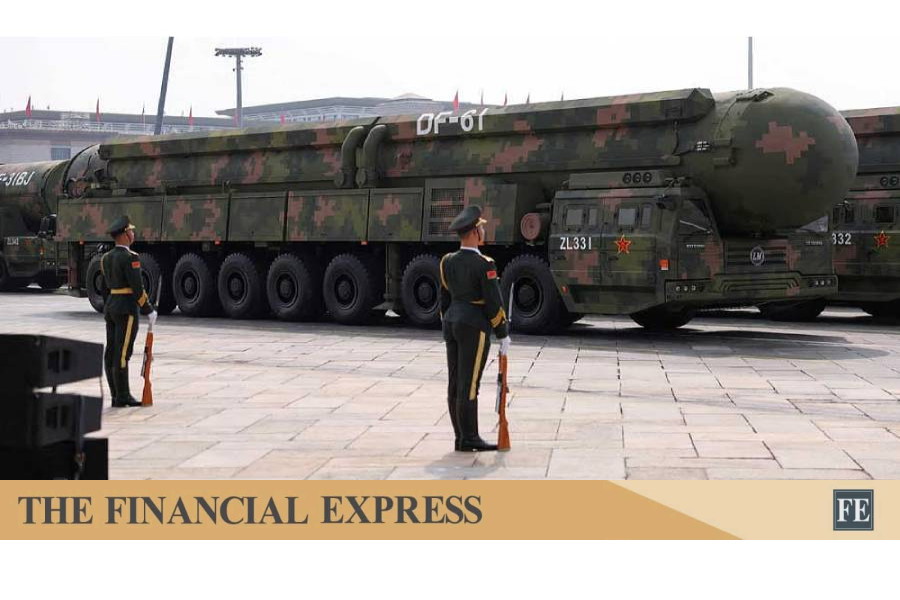
The United States voiced alarm Monday over Beijing's nuclear program after China test-fired a dummy warhead into the Pacific Ocean, the latest move in its rapid military modernization.

Monday's test came two years after China fired an intercontinental ballistic missile into the waters near French Polynesia, in what had been the first launch of such a missile over international waters in more than 40 years.

Analysts said that the test demonstrated growing Chinese capacity to strike the mainland of the United States, which sees the Asian power as its top adversary despite a reconciliation drive under President Donald Trump.

'At a time when the United States is working harder than ever to prevent nuclear proliferation, China is doing the opposite,' State Department spokesman Tommy Pigott said.

'Beijing's rapid and opaque nuclear weapons buildup is of great concern to the region and the world,' he said in a statement.

The United States in February allowed the expiration of New START, the last major arms control pact with Russia, as it insisted on a new agreement that also includes China.

The overtures have been rebuffed by China, whose nuclear arsenal is much smaller than Russia's but has been rapidly growing.

The State Department urged China to 'engage in meaningful arms control discussions and commit to a regularized notification arrangement for all intercontinental-range ballistic missile and space launches.'

New Zealand said that the test took place two hours after China informed Pacific nations of the missile launch, but it was unclear if China gave notice to the United States.

Chinese navy spokesperson Wang Xuemeng said in a statement shared on WeChat that the test launch was 'a routine arrangement of China's annual military training,' and that 'relevant countries were informed in advance.'

Monitors said that the rocket fired from a nuclear submarine appeared to land near the Solomon Islands, the South Pacific nation that forged a secretive security deal with China in 2022 which a new government is reviewing.

Lyle Morris, a senior fellow at the Asia Society Policy Institute, said that the missile demonstrated that China had growing options beyond firing from land.

'A test of this length is a major development and would indicate that China is moving toward a significantly more survivable and longer-range sea-based nuclear deterrent capability,' he said.

It shows that China's navy 'is capable of targeting the continental United States from bastions close to Chinese waters.'

The show of Chinese military might came the same day that Australia and Fiji signed a major defense treaty, part of US ally Canberra's efforts to regain the advantage against China following the controversial Solomon Islands treaty.

Analysts, however, doubted a direct connection, saying that such tests are likely planned well in advance.

Australian Foreign Minister Penny Wong said that the Chinese test was 'destabilizing to the region.'

Japan, which said it was informed in advance of the launch, said it had strongly urged China to reconsider and voiced 'serious concerns' over Beijing's growing military activity.

The relationship between Beijing and Tokyo has become more turbulent since Japanese Prime Minister Sanae Takaichi suggested in November that a potential future attack on Taiwan -- the self-ruled island claimed by China -- could warrant Japanese military involvement.

Russia, a Chinese ally, defended Beijing's test-firing as its 'sovereign right' and said that China 'is not threatening anyone in the world.'​
 

Is the West better than China?

Robert Atkinson

Published :
Jul 08, 2026 23:56
Updated :
Jul 08, 2026 23:56

A quarter century ago, few predicted that China would become as powerful as quickly as it has and is today. Indeed, the 2000 Central Intelligence Agency (CIA) Global Trends 2015 report argued that China would fail to sustain high economic growth, “the influence of Communism and authoritarianism weakens,” the Chinese Communist Party (CCP) might give in to domestic pressure for political reform, and that by 2015 China’s “new leaders will be even more firmly committed to developing the economy as the foundation of national power and that resources for military capabilities will take a secondary role.”

To be sure, prediction is hard. The CIA hedged its outlook with the caveat that “estimates of developments in China over the next 15 years are fraught with unknowables.” But the CIA and the experts it convened should have gotten quite a bit closer to the mark.

How did we get here: The reason the CIA got it wrong in 2000 was probably because virtually all the experts they consulted likely bought into the dominant Francis Fukuyama End of History narrative that the world was converging around United States (US) values. The CIA report envisioned 2015 to be something like this: “The networked global economy will be driven by rapid and largely unrestricted flows of information, ideas, cultural values, capital, goods and services, and people: that is, globalization. This globalized economy will be a net contributor to increased political stability in the world in 2015.”

At around the turn of the century, virtually all American policymakers drank this Kool-Aid on the unstoppable triumph of US-led globalization and democracy. In his 1999 book The Lexus and the Olive Tree, Thomas Friedman assured us all countries wanted Lexuses and the only way to get them was to become democratic free-market globalists. In a 2000 speech, President Bill Clinton said, “if you believe in a future of greater openness and freedom for the people of China, you ought to be for this agreement” to let China in the World Trade Organization (WTO), at the time viewed as the apogee of such victorious globalisation.

What a wonderful, hopeful, and uplifting vision. Imagine a world today where this came true. But, alas, it did not. And the deep, raw disappointment among Western, and especially US, elites cannot be overstated. Imagine believing that integrating China into the world order would produce almost a global utopia, only to gradually realise it was not to be and instead there would be a 40- to 50-year new Cold War, with China aggressively trying to outstrip the West’s techno-economic power. America’s belief that it is the shining city on the hill, with a mission to bring that freedom to the rest of the world, and the belief that the rest of the world not only wants it, but will achieve it, has caused no end to foreign policy problems for the US, including the current dilemma the US and the West face with China.

This messianic view is why the skeptics and realists have always been ignored. Bernstein and Ross H. Munro’s The Coming Conflict with China (1997) argued that the US and China were on a collision course, that China aimed to dominate Asia, and that an America-as-enemy posture and a “grand plan” were already in place. Yet, like antibodies against a virus, the foreign policy establishment reviled it. There was no attempt to argue it out; to have blue-team, red-team exercises to see who was right. Rather, as it largely remains today, the elite consensus was ruthlessly enforced.

But Bernstein and Munro, among others, were right. Just as Stalin made clear that his goal was global communism, China’s former paramount leader Deng Xiaoping in the 1979 Four Cardinal Principles made clear that party leadership and the socialist road were non-negotiable and never to be repudiated. The doctrine of “comprehensive national power” was a stated goal of the Chinese polity since the 1980s, a long-term strategy of relative-power competition written in plain sight. Three decades later, China’s Document No. 9 names seven existential threats it wanted to combat, including Western constitutional democracy, “universal values,” civil society, and neoliberalism. The same year, Xi Jinping proclaimed that “socialism will inevitably defeat capitalism.”

This and vastly more information was there for anyone with a modicum of curiosity to see. But the foreign policy establishment chose to be willfully ignorant because embracing that reality meant giving up on their utopian dreams.

Can we talk: Some elites hold on to the hope that China will change. Others hold that we should just negotiate more and better with the People’s Republic of China. But the reality is that there is nothing the West can do to get China to modify its more egregious behaviours in technology exchange and global trade. That window closed at least a decade ago. In the late 2000s, the CCP instituted its indigenous innovation policies that discriminated against Western products.

Coordinated pushback by the European and US corporate communities and governments caused the CCP to at least partially retreat. CCP leaders knew that they could not afford to alienate the West too much at the time and still needed its investment and technology. It no longer needs the West as much now, and so the West, especially given how divided it is, poses significantly less threat to the PRC.

To be fair, the Chinese aren’t alone in hegemonic aspirations. The United States, especially in its current us-against-the-world mode, inherited the textbook on this. But despite what the anti-American left, both in the US and around the world, says, US power was not used to dominate other nations, but rather to free them. Unlike what Trump wants, this does not mean national autarky. But it does mean allied supply chains.

Alas, the odds of this happening appear low. A key reason is that Washington is still not alive to the full extent of the threat. Few Washington elites believe that China is set to or able to dominate most advanced and emerging industries, and they don’t appreciate the fundamental shift in global power if that happens.

Techno-industrial needs a more active state: As hard as it is for the globalists and China engagers to hear, it is time to create a world economy where the West insulates itself, by bifurcation where it must, from any predatory use of global trade by China to create dependencies among its importers on its exports and ultimately its power.

At the same time, not to sound like I agree with Franklin Delano Roosevelt’s theory of convergence between the US and the Soviet Union, we need some movement toward convergence of techno-industrial policy with China. There are many aspects of the Chinese system that the West would be wise to emulate or expand, particularly the overriding focus on techno-industry development and competitiveness.

Validating China’s success means we need a more active state. If the China challenge is real, we need a national techno-industrial policy. For free-market advocates, this is the worst possible sin. “We don’t want to become like China. Even if the US is a hollowed out, Jeffersonian-like economy, at least we will be free,” they might think. Perhaps, but not free from China calling the global shots.

For a large share of the left, green and social justice are the top priorities. Add on top of this the fact that both sides of the political spectrum have become averse to any kind of job loss from technology, something that will be required to raise needed productivity, makes the challenge even harder. Overall, given this refusal to see reality and embrace this challenge, the picture is quite pessimistic in terms of Washington taking action in time.

So, the most likely scenario is that the United States and the West will be good enough in some areas to keep some production capabilities, but that China will take over a growing share of the global advanced industry market. Perhaps the West just isn’t better, after all.

The piece is excerpted from www.hinrichfoundation.com. The Hinrich Foundation is an independent Asia-based philanthropic organization dedicated to advancing mutually beneficial and sustainable global trade​
 

Latest Posts

Back