New Tweets

[🇧🇩] Should the president be removed for lying about Hasina's resignation

G Bangladesh Defense
[🇧🇩] Should the president be removed for lying about Hasina's resignation
30
1K
More threads by Saif


Will form revolutionary govt if needed
Says Chhatra Odhikar Parishad


1729727625047.webp

Photo: Sirajul Islam Rubel

Demanding the immediate resignation of President Mohammed Shahabuddin, Bangladesh Chhatra Odhikar Parishad President Bin Yamin Mollah today said they will form a revolutionary government if necessary.

He made the comment at a press conference at the Madhur Canteen in Dhaka University.

"Students and people have no trust in Mohammad Shahabuddin as he made the controversial comment on Shiekh Hasina's resignation. We want to give a two-day ultimatum to the president to resign from his post. After his resignation, if necessary, we will form a revolutionary government," said Bin Yamin Mollah.

Chhatra Odhikar Parishad held the press conference demanding the resignation of the president and the banning of Awami League and its associate organisations.

They arranged the emergency press conference after a video clip was posted on social media today.

In the video, a group of alleged Chhatra League leaders were seen gathering in front of Madhur Canteen, wrapping up their faces with black clothes, and chanting slogans in favour of AL.

Addressing the interim government, Mollah said, "We have been demanding the ban of Awami League and its associate organisations, as they were involved in terror activities in the past 16 years."

"However, the interim government did not take steps in this regard. So the question arises -- do they want to rehabilitate the Awami League? We will not let it happen," he added.​
 
Analyze

Analyze Post

Add your ideas here:
Highlight Cite Respond

Bangladesh protesters call for political consensus on president's removal
Staff Correspondent 23 October, 2024, 23:58

1729728915230.webp


Student Movement Against Discrimination and Jatiya Nagarik Committee on Wednesday jointly called for national unity for the removal of the president and the cancellation of the constitution, while a small group on the day demonstrated in front of the Ganabhaban.

The Bangladesh Nationalist Party, however, said that it was not in favour of the president’s removal at this time as it could delay the democratic transition as well as the national election.

Party’s standing committee member Salahuddin Ahmed spoke about his party’s position on the matter following a meeting with the chief adviser, Muhammad Yunus, in the afternoon.

Student Movement Against Discrimination and Jatiya Nagarik Committee, meanwhile, called for unity of all parties on the matter at a joint press conference held at the Central Shaheed Minar in the evening.

Contradicting the BNP statement that said removal of the president at this moment would trigger political and constitutional crisis, Jatiya Nagarik Committee convener Muhammad Nasiruddin Patwary said that political crisis would rather occur if the president would be allowed to continue in office.

Having called the 1972 constitution as the Awami constitution, he stressed the formulation of a new constitution that would reflect people’s true aspirations.

The five-point demand from the Student Movement Against Discrimination is the charter for transforming the mass uprising to revolution, said its convener Hasnat Abdullah.

They said that they were calling on all political parties except Awami League, Jatiya Party, Awami League-led 14-party alliance and other parties that were associated with Awami League in establishing fascism to forge unity.

Fascism was not fully eradicated, Hasnat said, adding that many political parties still wanted to see Mohammed Shahabuddin as president.

He said that after meeting with the chief adviser, various political parties wanted to retain Shahabuddin for the sake of the constitution.

Those who were in favour of popular uprising could not be in favour of the 1972 constitution, he said.

He also brought into attention the recent statement of BNP vice chairman Samsuzzman Dudu that restoring democracy was not possible without removal of the president.

Samsuzzman Dudu made the remark at a programme in front of the National Press Club.

Questioning the two different statements of the two BNP leaders on the issue, Hasnat said that BNP high-ups should make clear their position in this regard and then the next course of the discussion would be fixed.

He said that the existing constitution should be cancelled immediately and a new constitution should be formulated in the context of the 2024 mass uprising.

He said that Awami League’s student front Chhatra League should be banned for life as a terrorist organisation within this week and president Shahabuddin must be deposed within this week.

Calling upon the political parties, he said that a permanent solution should be found to the Bangladesh issue and national unity should be forged for this purpose.

‘If any political party does not join the national unity, we will exclude them and build unity with the people and solve it on the streets against fascism. We still see a fascist in Bangabhaban. We are calling for greater unity for the repeal of the constitution and the removal of the president for the greater good of the country and people,’ Hasnat said.

Some protesters on Tuesday tried to intrude the Bangabhaban premises by breaking security barricades, prompting the law enforcement personnel to explode sound grenades which, in turn, instigated some protesters to attack the police.

On Wednesday law enforcement agencies, particularly the Bangladesh Army and Armed Police Battalion beefed up Bangabhaban’s security with several groups seen demonstrating near the entrance for the second day, demanding the president’s resignation.

A few people resumed a sit-in programme there on Wednesday morning with crowds growing around them over the day.

The group later in the evening announced their platform’s name as Phasibader Dosor Mukti Committee (committee for liberation from the aides of fascism).

The platform’s spokesperson Al Amin Atia told reporters that they would continue their ‘peaceful’ demonstration until the president resigned.

In the afternoon, around 50 members of Ziaur Rahman Samajkalyan Parishad rallied around the Bangabhaban area.

1729728959087.webp


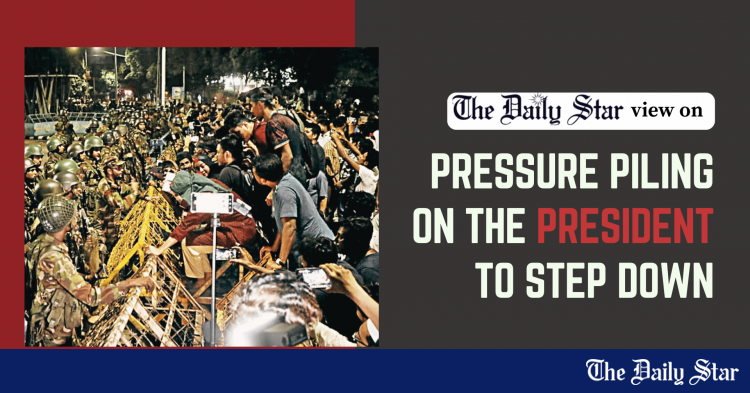
Army personnel stand guard behind barbed fences set up on the way towards Bangabhaban in Dhaka against the backdrop of students’ demand for the removal of president Mohammed Shahabuddin. — Sony Ramani

Information adviser to the interim government and student leader Nahid Islam, meanwhile, at the Secretariat told reporters on the day that a decision regarding the president’s removal could be reached through political discussions and national unity, rather than following legal or constitutional means.

He also called on everyone to remain calm and cautious.

‘We have received the message from the people, and the interim government is consulting all stakeholders. A decision may be forthcoming after these discussions,’ he said.

‘At this moment, the president’s staying in office is not a legal or constitutional matter, it is a political decision,’ he stated.

‘In making the decision regarding the president, we are prioritising stability, security, and discipline within the state,’ he added.

He said that there was no need for demonstrations in front of Bangabhaban or elsewhere.

‘We have heard the people’s message, and a decision must be reached through discussion,’ he asserted.

Nahid also mentioned that there were conspiracies both at home and abroad, urging student protesters to remain vigilant and calm in this context.

In response to another question, Nahid said, ‘The students have issued an ultimatum. We are currently engaged in discussions on our end, though there is no specific timeline for this process. We will continue our efforts and once we reach a logical decision, we will inform everyone.’

Nahid stressed that the decision must prioritize the state and its citizens.

At a media briefing, meanwhile, the chief adviser’s press secretary Shafiqul Alam said that the interim government affirmed that no decision had yet been reached regarding the president’s removal, adding that the media would be informed in due time if any decision was taken.

‘Political parties are our stakeholders. This [Wednesday’s meeting with BNP] is part of an ongoing dialogue with political parties. You will know in due course of time if there is any decision,’ he said.

Amid the controversy triggered by a remark by president Mohammed Shahabuddin that he had no documentary evidence of ousted prime minister Sheikh Hasina’s resignation, the student’s platform on Tuesday announced a five-point demand.

The five-point demand includes—immediate repeal of the constitution and formulation of a new constitution in the context of the 2024 mass uprising; banning of Chhatra League for life as a ‘terrorist organisation’ by this week; resignation of president Shahabuddin by this week; ‘Proclamation of the Republic’ in the light of the ‘July Revolution’ within this week; Declaration of the 10th, 11th and 12th parliamentary elections in 2014, 2018 and 2024 respectively as illegal and confiscation of the assets of those elected in these three elections and banning them for life from contesting in any elections.

1729729006877.webp


Convener of the Students Movement Against Discrimination central committee Hasnat Abdullah, among others, attends a press conference, calling for the national unity for the removal of the president and the cancellation of the constitution, at the Central Shaheed Minar on Dhaka University campus on Wednesday. — New Age photo​
 
Analyze

Analyze Post

Add your ideas here:
Highlight Cite Respond

Constitution will be no obstacle if there’s political consensus
MA Matin
Published: 23 Oct 2024, 13: 48

1729730876277.webp

Retired justice MA MatinProthom Alo

The previous dictatorial government attempted to quash the student movement by armed means in July and August. Hundreds lost their lives, and thousands were injured. Former Prime Minister Sheikh Hasina fled the country on 5 August in the face of the student-led mass uprising. At that time, the president informed the nation that the prime minister had resigned, and he accepted this resignation.

The president then sent a reference to the Supreme Court under Article 106 of the Constitution, seeking constitutional clarification on the formation of a new government. In this reference, he stated that the prime minister had resigned and sought guidance from the Supreme Court on how to proceed in this situation.

The Supreme Court rendered opinion that, since the prime minister had resigned, there was no option but to form an interim government under the circumstances. Consequently, the government was sworn in under the leadership of the Chief Adviser.

The president’s remarks that he did not receive the prime minister's resignation letter—made two and a half months after the formation of the government—are being widely discussed. His statements have sparked angry reactions from both the interim government and the student agitators, who are now protesting and demanding his resignation. This raises the question: what is the constitutional or legal process for the removal or resignation of the president?

The solution is that the order from the current interim government should be validated by the next elected parliament. I believe that not only the removal of the president but also all actions taken by the government will need to be ratified by the new parliament
According to the Constitution, the president can be impeached (removed) by parliament while it is in session. However, there is currently no parliament in place, which means there is no possibility of impeachment according to the constitution.

If the president breaks his oath or becomes unfit for office, he can resign on his own. But what happens if he does not take that step?

It should be noted that a special situation is prevailing in the country at present. Following the popular uprising, an interim government has taken over the administration. When a popular uprising succeeds, it creates its own legitimacy, rendering the existing constitution, customs, or laws ineffective.

In such cases, new methods can be employed instead of adhering to old ones. Those in power may choose to accept or reject the existing constitution, either in whole or in part. It is under this framework that the interim government has been established and is functioning.

The same applies to the removal or resignation of the president. If he does not resign voluntarily, the interim government has the authority to issue an order dismissing him.

Whether any questions arise regarding the legal validity of ordering the resignation of the president is a matter for consideration. In this case, the solution is that the order from the current interim government should be validated by the next elected parliament. I believe that not only the removal of the president but also all actions taken by the government will need to be ratified by the new parliament.

For this reason, the government will have to negotiate with political parties, and a political consensus will be necessary. If there is a political consensus, the constitution or the law will not pose a hindrance or obstacle to any actions taken. There are historical examples of such incidents in Bangladesh. This is how the 11th and 12th Amendments to the Constitution were enacted.

* MA Matin is a retired justice of the Appellate Division of the Supreme Court​
 
Analyze

Analyze Post

Add your ideas here:
Highlight Cite Respond

'Demand for president’s resignation political, not legal'
Says Rizwana on interim govt's view

1729811695225.webp

Mohammed Shahabuddin

Environment, Forest, and Climate Change Adviser Syeda Rizwana Hasan today said the interim government views the growing demand for the president's resignation as a political issue rather than a "legal and constitutional" one.

She indicated that any decision on the matter would be reached through political consensus.

Briefing the media at Foreign Service Academy in Dhaka today, the adviser said there is demand for the resignation of the president, which is getting stronger.

"It's a political issue. Discussions are underway with the political parties," Rizwana said.

The adviser also said political parties need to make their stance clear in this regard.

The adviser said issues related to the president were discussed at the meeting of the Council of Advisers with Chief Adviser Prof Muhammad Yunus in the chair.

Regarding the decision of the age-limit for government jobs, she said it might take three-four days to issue a gazette following the relevant process.

Chief Adviser's Special Assistant Mahfuj Alam and Press Secretary Shafiqul Alam were also present at the media briefing.​
 
Analyze

Analyze Post

Add your ideas here:
Highlight Cite Respond

Urgency for change must not lead to hasty decisions
Critical decisions on presidency or constitution must keep long-term impact in mind

1729812236424.webp

VISUAL: STAR

We are concerned about the tendency, as evidenced by some recent events, to apply high-pressure tactics to hasten important decisions that otherwise need careful deliberation based on diverse and informed perspectives. The latest incident occurred on Tuesday evening, when several hundred protesters tried to break through security barriers in front of Bangabhaban demanding the resignation of President Mohammed Shahabuddin. The ensuing clash left five people with minor injuries, as police resorted to baton charges and tear gas to disperse the crowd. Last week, the same tendency was on display when student leaders led a protest on the Supreme Court premises demanding the resignation of "pro-Awami League fascist judges", forcing a decision that should have been reached following due process.

The controversy surrounding the president began after he claimed, in an interview with Manab Zamin, that he had only heard about Sheikh Hasina's resignation but found no "documentary evidence" of it. This, from a man whose retention after the fall of Awami League was deemed a constitutional necessity, sparked heated reactions as well as demonstrations in Dhaka and other districts. At the Central Shaheed Minar earlier on Tuesday, leaders of the Anti-Discrimination Student Movement issued an ultimatum to meet their five-point demand, including the president's removal, by the end of this week. Their other demands include annulment of the 1972 constitution, a permanent ban on Chhatra League, declaration of a "Proclamation of the Republic" to govern post-2024 Bangladesh, and invalidation of the 2014, 2018, and 2024 elections.

All these issues, we must say, have profound legal and political implications that cannot be taken lightly. Any forced decision risks not only creating new crises down the line but also weakening or disrupting the ongoing reform drive of the government. It cannot be denied that some of the demands raised by protesters have merit, having arisen from a backdrop of sustained grievances over decades. The power of mass mobilisation to effect change cannot be denied either, especially after the mass uprising. But the current political landscape is different. The interim government, born out of that uprising, has a mandate to reshape the nation's future through proper reforms, and it must be given constructive support—not threats or ultimatums—to do that since rushing through critical decisions could result in half-baked policies that fail to address the deeper issues plaguing the country.

The president's removal, for example, is a decision that needs political consensus which cannot be forced upon. If or when it happens, it must happen in a judicious, fully-thought-through manner that serves our long-term interests. The same goes for any decision related to the constitution. We have a nine-member reform commission currently reviewing the constitution. Demanding its instant annulment while such a body of experts is in place undermines the purpose of this process. If protesters push for immediate actions without regard for due process, what is the point of having all such commissions?

We, therefore, urge protesters, especially student leaders, to show the same maturity they did during the uprising. The current period, with so many actors of competing interests around, calls for caution and collaboration with the government to ensure the reform drive remains on course. If real, meaningful change is what we want, there is no alternative to constructive engagement.​
 
Analyze

Analyze Post

Add your ideas here:
Highlight Cite Respond

President's resignation: Govt seeks solution thru political consensus
Special Correspondent
Dhaka
Published: 25 Oct 2024, 13: 00

1729904095917.png

Chief Adviser Dr Muhammad Yunus chaired a meeting of advisory council on 24 October, 2024Press wing of CA

The interim government does not want to take any hasty decision regarding the resignation of President Md Shahabuddin. The government is looking for a solution through discussions with political parties. The Students Against Discrimination and Jatiya Nagorik Committee are adamant in their demand for the resignation of the president.

President Md Shahabuddin, in a recent interview with a national daily, said there was no document of the resignation of former prime minister Sheikh Hasina, who was ousted from power in the face of the uprising of students and people. The president’s comment also sparked harsh criticism from some of the advisers.

In this context, the advisory council of the interim government raised the issue for the first time in their meeting held on Thursday. In the meeting, the council decided to resolve the matter through discussions with the political parties.

Speaking to Prothom Alo, adviser for environment, forest and climate change Syeda Rizwana Hasan said the government started discussions with the political parties on whether the president should remain in the post or not. The government would take the final decision on the basis of a consensus of the political parties.

Two other advisers said the students demand the resignation of the president. At the same time, some of the political parties are saying the president’s resignation will lead to a constitutional crisis, which they don’t want right now. The overall situation was discussed in the advisory council meeting. The government feels the decision needs to be taken on the basis of discussions with the political parties.

It was the first time that the issue of the president's resignation was officially discussed in the advisory council meeting.

Earlier on Monday, law adviser Asif Nazrul said, “The president said that he did not receive the resignation letter of former prime minister Sheikh Hasina. This is a lie and akin to violating his oath of office.”

Amidst various discussions over this, three central leaders of BNP met the chief advisor on Wednesday. They said their party didn’t want the president’s resignation right now. BNP feels it will lead to a constitutional and political crisis.

Decision on the basis of consensus

Environment adviser Syeda Rizwana Hasan spoke to the newspersons regarding decisions of the advisory council meeting at a press conference yesterday.

1729904151641.png

Adviser for environment, forest and climate change Syeda Rizwana Hasan addressed a press conference held at the Foreign Service Academy on Thursday PID

She said the decision regarding the president’s resignation would not be delayed. It will not be a hasty decision either. The final decision will be taken very soon.

Addressing the press conference held at the Foreign Service Academy, Syeda Rizwana Hasan said, “What the President said has been taken into our account and the ongoing movement demanding removal of the President is being considered.”

Rizwana Hasan said, “Some political parties are talking about a potential constitutional crisis. Some leaders of a political party said the president's resignation would create a constitutional vacuum. Some leaders of that party also said that there would not be any political crisis. We discussed that in the advisory council meeting.”

Adamant with the demands

Meanwhile the Students Against Discrimination set an ultimatum to realise their five-point-demand, including the resignation of the president. The Jatiya Nagorik Committee also supported them. The second of the five-point-demand was to ban the Bangladesh Chhatra League (BCL). The interim government already accomplished that.

In such a situation, the BNP leaders said their party did not want any state, constitutional and political crisis in the country at the moment centering the post of president.

1729904200128.png

BNP standing committee member Nazrul Islam Khan speaks to the media after meeting chief adviser to the interim government Dr Muhammad Yunus at the state guesthouse Jamuna on 23 October 2024. Prothom Alo

Meanwhile, the Students Against Discrimination and the Jatiya Nagorik Committee are not happy with BNP’s stance. They held a joint press conference mainly to respond to the BNP’s opinion. There, they urged the political decisions to not rush any decision.

The Students Against Discrimination and Jatiya Nagorik Committee is considering holding discussions with the political parties as the BNP cited a potential ‘constitutional crisis’ in this regard.

Speaking to Prothom Alo, Student Against Discrimination member secretary Arif Sohel said they still demand the resignation of the president. They will hold a meeting on Friday to set the next course of action.​
 
Analyze

Analyze Post

Add your ideas here:
Highlight Cite Respond

President’s fate: Decision only after political consensus
Govt starts talking to parties, says there’d ‘neither be delay nor haste’

1729988489745.webp


The government is considering the demand for President Mohammed Shahabuddin's removal, and it would make a decision only after the political parties reach a consensus.

It has already initiated discussions with the parties to determine the president's fate, several advisers said following an advisory council meeting, presided over by Chief Adviser Muhammad Yunus at his office yesterday morning.

"The president's issue was discussed at the meeting," an adviser told this newspaper.

Briefing reporters last night, Environment Adviser Syeda Rizwana Hasan said the demand for the president's resignation was getting stronger.

She added that some political parties have voiced concern that the resignation may lead to a constitutional crisis.

"Then one or two senior political leaders said there would be no constitutional crisis.

"It's now a people's demand … We're hopeful we'll be able to reach a decision on the basis of a consensus amongst the political parties," she told reporters at the Foreign Service Academy.

1729988560550.webp


"Since the demand [for the president's resignation] has come from the people, and our government is the result of a mass uprising, will it be possible to accept every aspect of the constitution literally?"— Environment Adviser Syeda Rizwana Hasan

"Political parties should make their stances clear … ."

Asked about how long it would take to reach a consensus, Rizwana said it depended on the parties.

"What kind of conversations do we have with them? What are the fears of the political parties? Are they realistic at all? It can't be said that we're in a hurry, but at the same time, we don't have any scope for delaying things."

She said no one wants to be in uncertainty over the matter for a long time.

The adviser further said the government sees the issue as a political one, not a "legal and constitutional" one.

About the process of the president's resignation, she said, "At the moment, we're talking about how we'll deal with the demand for the president's resignation … Since the demand has come from the people, and our government is the result of a mass uprising, will it be possible to accept every aspect of the constitution literally?"

The demand for the president's removal cropped up after daily Manab Zamin's political magazine "Janatar Chokh" on Sunday published an article where the president said he heard Sheikh Hasina had resigned as the prime minister, but he did not have any documentary evidence.

"I tried [to collect the resignation letter] many times but failed. Maybe she did not have the time," he was quoted as saying.

The next day, Law Adviser Asif Nazrul said the president lied, and it was akin to misconduct. He questioned the president's mental capacity to serve.

Later, the Anti-Discrimination Student Movement demanded the removal of the president.

On Tuesday, several hundred protesters, under the banners of Raktim July 2024 and Shadhinota-Sharbobhoumotto Rokkha Committee, attempted to break through the security barriers in front of the Bangabhaban.

After a meeting between a BNP delegation and Prof Yunus on Wednesday, the party said a vacancy in the president's post at this moment would create a constitutional vacuum, which "the nation does not want".

Meanwhile, the Anti-Discrimination Student Movement and the Jatiya Nagorik Committee at a press briefing yesterday evening called for national unity for the scrapping of the 1972 constitution and the removal of the president.

POSSIBLE BAN ON AL?

Replying to a question about banning the Awami League, Rizwana said there were no discussions in this regard at yesterday's meeting.

"The language of the movement and our language should not be the same."

At the briefing, Mahfuj Alam, special assistant to the chief adviser, said, "We've received proposals from political parties [on banning the AL]. The government is considering it like any other issue.

"It's about dialogue. It's about the consensus of the political parties. The government will decide on the matter after discussions with all the parties."

BAN ON BCL

Rizwana said the reason behind banning Chhatra League was clearly stated in the gazette, adding that the media reported that BCL activists, wearing helmets and police uniforms, were involved attacking protesters.

BCL played the roles of goons during all student movements since the 2018 road safety movement.

"People in responsible positions had said the Chhatra League was enough to punish the protesters. It [the AL student wing] was used to suppress the movement.

"Another reason for banning them [BCL] was that they did not stop even after the July genocide," Rizwana said.

"None can forget the killing of Abrar Fahad and Biswajit. There's no scope for the government to sit and watch the activities of a terrorist organisation."

Mahfuj said BCL is now a banned organisation.

"There are legal barriers against publicising anything regarding Chhatra League. Those of you who are in the media should take note of this so that you don't play any role in publicising propaganda of the terrorist organisation."​
 
Analyze

Analyze Post

Add your ideas here:
Highlight Cite Respond

President removal uncertain as BNP yet to decide
Ahammad Foyez 26 October, 2024, 23:30

1729989227428.webp

President Muhammed Shahabuddin.

The decision regarding the issue of the president’s removal appears to have become uncertain as the Bangladesh Nationalist Party on Saturday took time to discuss the matter in its own forum, while a delegation of the Student Movement Against Discrimination and the National Citizens’ Committee placed the demand to the party.

Student Movement Against Discrimination led the July-August mass uprising that culminated in the overthrow and fleeing of then prime minister Sheikh Hasina, while the National Citizens’ Committee was formed with many of the organisers of the movement who are not currently student.

On Saturday, at a meeting with the BNP they discussed about their demands of removing president Muhammed Shahabuddin, proclamation of the second republic and political consensus for national unity.

The meeting was held at the BNP chairperson’s Gulshan office with party secretary general Mirza Fakhrul Islam Alamgir, standing committee member Salahuddin Ahmed and joint general secretary Shahid Uddin Chowdhury Annie attending from its side.

From the protesters’ side, Student Movement Against Discrimination convener Hasnat Abdullah, member secretary Arif Sohel, spokesperson Umama Fatema, lead organiser Abudl Hannan Masud, National Citizens’ Committee convener Nasiruddin Patwary, member secretary Akhter Hossain, spokesperson Samanta Sharmin and member Ariful Islam Adib attended the meeting.

Emerging from the meeting, Hasnat told reporters that BNP top leaders heard the demands but did not announce their decision.

‘The BNP leaders said that after discussing the issues, including the president’s removal, in the party forum, they will announce their decision,’ he said.

A BNP leader, however, confirmed New Age that they did not give any specific time to the protesters in this regard.

Hasnat said that they called for national unity on October 23 for removing president Shahabuddin saying that he was an obstacle to the complete abolition of fascism.

‘We ensured Hasina’s overthrow fighting our way towards abolishing fascism. It was our primary victory. Now her [Hasina] appointed president Chuppu [Shahabuddin] must go,’ he stated.

‘We are discussing with the political parties about our new political settlement. We discussed with the BNP today. We have discussed three issues there,’ he said, adding that the first issue was proclamation of the second republic, the second issue was the president’s removal and the third one was forging a national unity to run the government.

Hasnat also said that they already held meetings with Bangladesh Jamaat-e-Islami and Islami Andolon Bangladesh in this regard.

He said that Jammat and Islami Andolon agreed on the issue of the president’s removal.

Hasnat also said that meetings will be held with the Ganatantra Mancha, the 12-party alliance and the Gono Odhikar Parishad today.

Nasiruddin said, ‘Chuppu [Shahabuddin] must go and there should be a second republic declaration. We are not fixing any timeframes, but it should be done in the interest of people. We will be on the field with the demands.’

The Student Movement Against Discrimination and the National Citizens’ Committee on Wednesday jointly called for a national unity for the president’s removal and the cancellation of the constitution, while a small group on the day demonstrated in front of the Bangabhaban, office-cum-residence of the president.

The BNP, however, said that it was not in favour of the president’s removal at this time as it could delay the democratic transition as well as the national election.

The demand for the president’s removal comes into the fore after in a special interview with Manab Zamin editor Matiur Rahman Chowdhury on October 19, president Shahabuddin said that he did not have ‘any documentary evidence’ of the former prime minister’s resignation.

Later on October 21 in a press release sent from the president’s press wing, Shahabuddin urged all to refrain from destabilising or embarrassing the interim government centring on ‘media publicity’ by quoting him regarding the resignation of former prime minister Sheikh Hasina.

‘The clear statement from the president is that all the questions that have arisen in the public mind regarding the resignation and departure from the country of the prime minister in the face of the student-people uprising, the dissolution of the parliament, and the constitutional validity of the incumbent interim government are answered in the order of the Appellate Division of the Supreme Court in the Special Reference No-01/2024, dated August 8, 2024,’ said the release.

On Thursday, the government decided to make a decision on the demand for the president’s resignation based on political consensus as it considered it as a political issue, rather than a constitutional one.

The cabinet made the decision at its meeting with chief adviser professor Muhammad Yunus in the chair at his Tejgaon office, the government’s spokesperson and environment adviser Syeda Rizwana Hasan told a press briefing.​
 
Analyze

Analyze Post

Add your ideas here:
Highlight Cite Respond

Members Online

No members online now.

Latest Posts

Back
PKDefense - Recommended Toggle