Home Login Watch Videos Wars

[🇧🇩] Smart Flood Management for Bangladesh

[🇧🇩] Smart Flood Management for Bangladesh
55
2K
More threads by Saif

G Bangladesh Defense

To check prolonged flooding, we must restore our waterbodies
The plight of a canal in Habiganj calls for proper interventions

1730250362092.webp

VISUAL: STAR

Irrespective of where a canal or river is located in the country, hardly any waterbody has managed to escape the reach of land grabbers, especially those with political connections. The story of a canal within the haor region of Habiganj's Lakhai upazila is no exception. Over the last 20 to 25 years, nearly 15km of this 20km canal has been filled in and overrun with shops, houses, and other structures. This has compromised the natural drainage system of the haor, which connects to the Sutang River, causing waterlogging and inundating adjacent croplands for prolonged periods.

According to a report in this daily, most of those who encroached on this canal are local Awami League leaders and their cronies. The former chairman of the Lakhai upazila parishad, currently a fugitive following Sheikh Hasina's fall on August 5, had even built an approach road to his house occupying part of the canal. Unfortunately, when it comes to the encroachment of waterbodies and other natural resources, there seems to be hardly any difference between AL and BNP, with the names of two BNP men and their relatives coming up among the alleged grabbers.

However, with a non-political government now in place and Syeda Rizwana Hasan, an environmentalist of considerable repute, serving as the adviser for environment, forest, and climate change, there is renewed hope that the authorities will take drastic actions to restore the canal, and all such bodies, by evicting the occupiers and removing illegal structures. Influential individuals sometimes exploit the vulnerability of locals as a pretext for encroaching on waterbodies, but such excuses should not impede eviction drives. In a climate-vulnerable country like Bangladesh, restoration of water bodies such as canals is becoming increasingly crucial. The prolonged flooding witnessed this year in the eastern region, where clogged and encroached waterbodies prevented floodwaters from draining, should serve as a warning call for us.

So, we urge the government to take urgent steps to restore these local waterbodies. However, a proper eviction process with sufficient notice issued to the occupiers must be followed. At the same time, ensuring post-eviction monitoring to prevent grabbers from reoccupying the canal area—a practice observed frequently under the previous regime—is also crucial.​
 
Analyze

Analyze Post

Add your ideas here:
Highlight Cite Fact Check Respond

Bangladesh needs to rebuild its disaster management system

1733208634187.webp

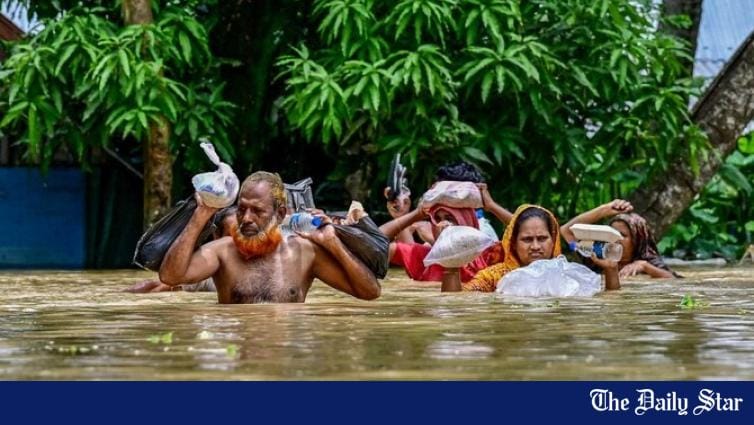
People carrying relief materials wade through flood waters in Feni, in south-eastern Bangladesh, on August 24, 2024. FILE PHOTO: AFP

This year's UN Climate Change Conference, COP29, ended in a controversial deal. After much bargaining, rich countries have promised to provide a mere $300 billion annually to adapt to weather extremities, which is much less than expected by the struggling nations. This has left the heads of these affected countries highly disappointed.

Prof Muhammad Yunus, the Chief Adviser to the Interim Government of Bangladesh, also participated in this conference. He expressed disappointment during an interview with an international media outlet, stating that COP is not a fish market to bargain for climate funds. The emitter countries are responsible for the frequent natural disasters that occur in developing nations and therefore should compensate them.

While the head of the interim government expressed his anger in Baku, his government, on the other hand, has not been able to rehabilitate the people affected by a major flood in the southeastern part of Bangladesh after three months of its occurrence, which is disappointing too. According to a recent media report, the work of rehabilitation is still underway and will take more time, whereas already one crop season has passed.

Bangladesh is one of the world's most climate-vulnerable countries, ranking seventh globally in the 2021 World Climate Risk Index. About 50 million people in this country live under the risk of climate hazards. On October 6, a press conference of the Centre for Policy Dialogue (CPD) revealed that the damage caused by floods in the southeastern region this year amounted to Tk 14,421 crore. Of this, agriculture and forest sectors suffered the most—approximately Tk 5,169 crore. According to data from the Feni Department of Agricultural Extension (DAE), the recent flooding damaged crops worth Tk 524 crore in this district. But the government has reimbursed only Tk 20 crore 71 lakhs to them.

On November 17, the Feni Department of Agriculture Office informed that the number of farmers affected by the Feni flood was almost 158,000. However, only 35,000 of them have got incentives so far. The affected farmers received a small amount of vegetable seeds, paddy seeds, and fertilisers as incentives for Boro seasons which is completely inadequate compared to the damage.

According to the 2024 Feni District Relief and Rehabilitation Office Report, the damage to the fisheries was more than Tk 100 crore but the relief allocation was only Tk 22 lakhs. The number of listed damaged households is 8,659 but the local administration has received only 400 bundles of tin and Tk12 lakh cash as aid. Besides, the Bangladesh Army and some national and international NGOs are also working separately to rehabilitate the affected people. The flood crisis occurs every year because the government never goes beyond the conventional bureaucracy to help.

Severe heat waves, droughts, river erosion, frequent devastating floods, and cyclones are a reality worldwide. Frequent natural disasters are the result of excessive carbon emissions in developed countries. But the common people of our country who are affected think only nature can be blamed for these losses. Therefore, they are not eager to go to the government with their just demands.

However, as the heads of developing countries are demanding compensation from developed countries at international conferences, the people of Bangladesh should now demand compensation from the government too. Farmers should demand compensation for the crops that they have lost due to untimely floods. In an interview with Arab News, Shawkat Ali Mirza, director of Climate Change and International Conventions at the Department of Environment, who attended the recently concluded COP29, said that the Bangladesh government spends $3 to $3.5 billion annually to combat the effects of climate change. Bangladesh, amongst other countries, expects at least $1 billion annually from this COP29 to combat the effects of climate change.

The government must first be accountable to the people of the country. To do this, it must develop a completely new disaster management system without relying too much on bureaucracy, so that those affected can be rehabilitated very easily and quickly.

Mostafa Shabuj is a journalist at The Daily Star.​
 
Analyze

Analyze Post

Add your ideas here:
Highlight Cite Fact Check Respond

The breach in Dhaka’s flood defenses
Water retention ponds shrinking due to urban sprawl

1733553312062.png

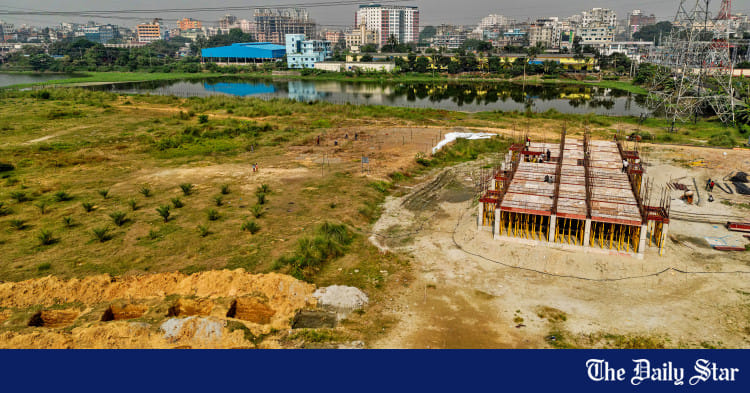
Illegal structures now stand at the Kalyanpur retention pond area. Retention ponds like this are essential to prevent waterlogging, but unchecked urbanisation, jurisdictional overlaps, and negligence threaten their survival, endangering Dhaka’s resilience against floods. Photo: Rashed Shumon

Once the lifelines of Dhaka, the city's canals are now mere shadows of their former selves—clogged with pollution, suffocated by encroachment, and neglected due to flawed urban planning. In this seven-part series, The Daily Star explores the current condition of the capital's canals, botched restoration attempts, and how the sorry state of these waterways is exacerbating the city's waterlogging woes. Together, these stories reveal what it will take to bring Dhaka's dying canals back to life. Here is the third part of the series:

Designed to rescue Dhaka from floods, water retention ponds are now in need of rescue themselves. These basins, meant for stormwater management, are shrinking rapidly due to encroachments, unplanned urbanisation, and government neglect.

Just like the capital's canals, these lifelines are now being choked, one illegal grab at a time.

WHAT ARE RETENTION PONDS?

Retention ponds serve as reservoirs for stormwater runoff, preventing flooding and downstream erosion while maintaining water quality. By acting as buffers, they ensure that urban areas can cope with heavy rainfall, particularly during the monsoons.

Retention ponds act like giant bowls that collect and store excess rainwater during downpours, preventing nearby areas from flooding.

Imagine this: during a storm, instead of rainwater overwhelming streets and homes, these ponds hold the water temporarily. Over time, they release it slowly into nearby rivers or canals, reducing the risk of sudden flooding.

For example, in Dhaka's Mirpur area, stormwater from nearby roads, homes, and markets flows into the Kallyanpur retention pond through Kalyanpur main canal and its branch canals, which is then pumped out to the Buriganga river, said a Wasa official. If this pond didn't exist, the water would pool on the streets, causing severe waterlogging.

Retention ponds also improve water quality by filtering out pollutants from the runoff before it reaches rivers.

"Retention ponds are indispensable for reducing Dhaka's flood vulnerability. Protecting them is critical for the city's sustainability," said Akter Mahmud, a member of the advisory council of the Bangladesh Institute of Planners.


1733553380236.png

Photo: Rashed Shumon

WESTERN RETENTION PONDS

The western part of Dhaka is home to three key pump stations – Kalyanpur, Goran Chatbari, and Dholai Khal – each designed with designated retention ponds. However, over the years, these ponds have been encroached upon, drastically reducing their capacity.

At Dholai Khal, a box culvert constructed in the 1990s by the Dhaka city corporation destroyed the retention area. The pumping station, which requires at least 105 acres for optimal operation, now has just 3.5 acres.

There are three pumps at the Dholaikhal station, each with a capacity of 7.4 cubic metres per second. They are struggling to manage the growing burden.

At Kalyanpur, the situation is equally dire.

A study by the Japan International Cooperation Agency in 1990 recommended a pumping station with a 20 cumec capacity and 514 acres of retention pond area. However, in over three decades, the government has managed to acquire only 53.004 acres, far short of the requirement.

Despite acquiring only 53.004 acres, the DNCC has designated 178.82 acres as retention space. This includes 98.35 acres owned by BADC, 6.36 acres by WDB, 11.40 acres of government khash land, and 62.71 acres belonging to Dhaka Wasa. A substantial part of this land is under encroachment.

The BADC recently attempted to fill 11 acres of retention land for a four-storey tissue culture building, violating the Environment Conservation (Amendment) Act 2010. Although legal challenges have stalled the construction, environmentalists warn that the area remains at risk.

"The government's failure to acquire the required land when it was affordable has made the situation worse," said a WASA official. "What could have been done for Tk 50 crore then would now require an exponentially higher budget."

When asked about BADC filling up 11 acres of land, Md Mahmudul Hasan, administrator of Dhaka North City Corporation, said BADC still owns significantly more land than what has been filled. BADC uses the land as seed beds.

Rajuk has designated the area as a waterbody in the Detailed Area Plan.

Meanwhile, Goran Chatbari's retention pond, once 619 acres, has also lost 40 acres to the Road Transport and Bridges Ministry to implement one of their projects. Although additional pumps have been installed to compensate, the loss of retention area has strained the system.

EASTERN RETENTION PONDS

Dhaka's eastern retention ponds are also struggling to survive.

Two critical areas – one at the confluence of the Gobindopur and Bouthar canals at the Uttar Khan and Dakkhin Khan areas on the bank of Balu River, and another at the ending points of the Dumini and Norai canals at Nagdarpara and Kayetpara – are also being filled up in the name of housing projects.

"These areas are earmarked in the Drainage Master Plan, Dhaka Metropolitan Development Plan (DMDP), and Detailed Area Plan (DAP)," said Akter Mahmud.

Without intervention, the government risks losing these crucial areas, jeopardising future drainage projects, he said.

WHO IS TO BLAME?

Encroachment, negligence, and a lack of coordinated government action are at the heart of the crisis, according to experts.

Overlapping jurisdictions between Wasa, DNCC, and the Ministry of Agriculture have resulted in a lack of accountability and enforcement, they added.

"The government must take immediate steps to protect these areas," said Iqbal Habib, an urban planner. "Canals and retention ponds are integral to the city's drainage system. Any disruption could lead to a total collapse."

Despite the grim outlook, there are, however, some promising initiatives.

DNCC Chief Engineer Brig Gen Md Moin Uddin revealed plans for a hydro-eco park at Kalyanpur. The project envisions a retention pond surrounded by trees to increase water-carrying capacity while maintaining ecological balance.

However, a large portion of BADC's land is essential for this project.

Meanwhile, administrator Mahmudul said both the DNCC and LGRD Ministry support the project, but an inter-ministerial decision is required for the land.​
 
Analyze

Analyze Post

Add your ideas here:
Highlight Cite Fact Check Respond

Dhaka’s disappearing flood-flow zones
How the city buried its natural water channels, wetlands in the name of development

1733616769029.webp


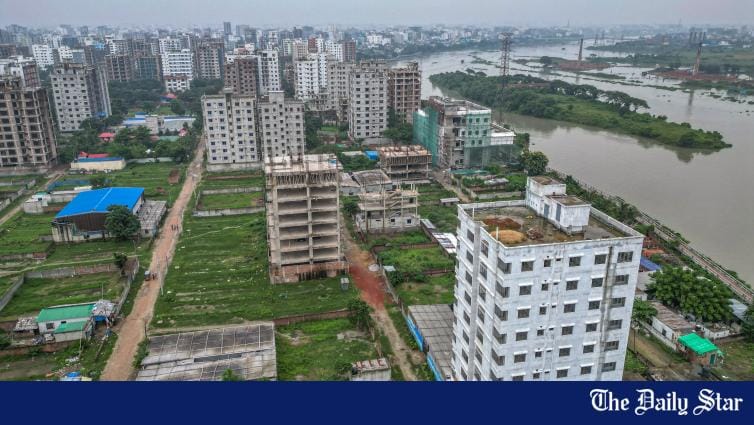
High-rise buildings and smaller establishments occupy a designated flood-flow zone in Bosila. below, the Detailed Area Plan 2010 shows the place was supposed tp be all green and free from establishments for flood retention, a vision, that has been disregarded over the years. Encroachments like this are eroding Dhaka’s natural defences against waterlogging and floods. Photo: Rashed Shumon

Once the lifelines of Dhaka, the city's canals are now mere shadows of their former selves—clogged with pollution, suffocated by encroachment, and neglected due to flawed urban planning. In this seven-part series, The Daily Star explores the current condition of the capital's canals, botched restoration attempts, and how the sorry state of these waterways is exacerbating the city's waterlogging woes. Together, these stories reveal what it will take to bring Dhaka's dying canals back to life. Here is the fourth part of the series:

Flood-flow zones, crucial for maintaining Dhaka's ecological balance, are rapidly vanishing, leaving the city increasingly vulnerable to waterlogging, loss of groundwater recharge, and potential flooding.

Experts and urban planners blame rampant encroachment, questionable policies by the Rajdhani Unnayan Kartripakkha (Rajuk), and a culture of impunity that has legitimised illegal land use.

FLOOD-FLOW ZONES: A CRITICAL RESOURCE
Flood-flow zones are designated low-lying areas meant to retain water during monsoons, preventing urban flooding and aiding groundwater recharge. Historically, these zones ensured that excess water from rivers like the Buriganga had natural outlets, reducing the risk of flash floods and waterlogging.

However, Dhaka has lost vast swathes of these zones due to unplanned urbanisation.

According to a 2019 study by the Bangladesh Institute of Planners (BIP), the city lost 1,072 acres (57 percent) of its 1,879-acre flood-flow zones in metropolitan areas within a decade.

Till 2019, since the publishing of the gazette on the previous master plan (DAP-2010), the city lost 3,440 acres out of 9,556 acres of flood-flow zones, water retention areas, and water bodies.


1733616881125.webp


POLICIES FUELING ENCROACHMENT

The Detailed Area Plan, approved in 2023, has drawn severe criticism for legalising residential developments in previously conservable flood-flow zones.

While the DAP imposes penalties for unauthorized construction under the Building Construction Rules, these penalties remain negligible, with no substantive action against encroachment.

"This is a glaring weakness of Rajuk and the DAP," said Fazle Reza Sumon, former president of BIP. "This legalisation benefits certain quarters, encouraging others to encroach upon flood-flow zones with the hope of eventual regularization," he said.

Rajuk has further divided flood-flow zones into "open flood-flow zones" and "general flood-flow zones".

While development is restricted in open zones, conditional development is now permitted in general zones, reducing the total flood-flow area by 23 percent.

"Rajuk has effectively legitimised encroachments and now has the power to alter land use based on individual or other considerations," said Iqbal Habib, vice president of Bangladesh Paribesh Andolon. "This will reduce Dhaka's flood-flow zones to a mere 26 percent of their original size."

CONSEQUENCES FOR DHAKA'S ENVIRONMENT
The gradual loss of flood-flow zones has dire implications for the city. Without sufficient floodplains, rivers like the Buriganga face reduced inflows, endangering their ecological health.

"When houses are built on elevated flood-flow zones, roads are also raised, creating low pockets that trap water," explained Iqbal Habib. "This leads to severe waterlogging in areas like Kalabagan, Kathalbagan, Rayerbazar, Matikata, and the DND region."

Mohammad Azaz, chairman of the River and Delta Research Centre (RDRC), highlighted how Dhaka has transformed from a wetland city into a concrete maze.

"Dhaka should have been a sponge city, retaining water during rains. But unplanned urbanisation and inadequate town planning have buried natural water channels and wetlands, leaving the city defenseless against flooding."

Adil Mohammad Khan, president of BIP, added, "Flood-flow zones were once restricted for farming and water retention, ensuring natural flood mitigation. Now, the absence of penalties for encroachments has made the current DAP toothless."

Iqbal Habib warned, "Without sufficient flood-flow zones, Dhaka will face increased flash floods and river flooding. Vulnerable areas along the Buriganga's banks and other low-lying pockets will suffer the most."

HOUSING PROJECTS: GOVT, PVT CULPRITS
Government agencies have played a leading role in this crisis by developing large housing projects on wetlands, such as Uttara phases 1, 2, and 3, Purbachal, Jheelmil, and Baridhara J Block, according to experts.

Private developers followed suit, with Jahirul Islam's Banasree and Eastern Housing becoming models for indiscriminate wetland encroachment, said Azaz.

"Even local housing societies are now filling wetlands and flood-flow zones for new projects," added Iqbal Habib.

The Drainage Masterplan 2016 by Dhaka Water Supply and Sewerage Authority (Wasa) revealed that many back swamps, depressions, and natural channels have already been filled in Dhaka, exacerbating the city's drainage issues.

THE WAY FORWARD
Experts emphasise that protecting flood-flow zones require strict enforcement of existing regulations and meaningful penalties for encroachment. Developing Dhaka's town planning with a focus on ecology and sustainability is also crucial.

"The government must prioritise ecological and social considerations over mere land use," said Azaz. "Dhaka's survival depends on its ability to balance urbanisation with environmental preservation."

Stressing the need for proper protection of flood-flow zones, Adil said any type of development should be completely restricted in the flood-flow zones around Dhaka.

He said main flood-flow and sub-flood flow zones should be merged in the DAP to prohibit any types of development in these areas as they are imperative for water retention and protecting biodiversity, he added.

"Vested interest groups that were involved in the destruction of flood-flow zones for housing, industry, or other activities, should be identified and penalised accordingly. Culpable officials of Rajuk, DoE, water development board, DC office, and other government offices should be punished as well for their misconduct," Adil said.

Adil said environmental laws should be modified and amended to increase the punishment for encroachers of flood-flow areas.

"Connectivity between different canals, waterbodies, and water channels should be restored. Appropriate demarcation of flood-flow zones is necessary as well and community engagement is also required to conserve these areas," he said.

Unless urgent action is taken, the city risks losing its remaining flood-flow zones, leaving its population exposed to unmanageable water crises in the years to come, experts warned.​
 
Analyze

Analyze Post

Add your ideas here:
Highlight Cite Fact Check Respond

Flood victims need better support to rebuild lives
Government’s rehabilitation initiatives fall woefully short

1736897296699.webp

VISUAL: STAR

We are disappointed by the news of the lack of adequate support for those affected in recent floods, particularly in Noakhali and Feni. Reportedly, many people in these districts continue to live in uncertainty, with most of those who lost their homes yet to receive government assistance for rebuilding. According to data from the DC offices, over 90 percent of the population in Feni and Noakhali was impacted by the August floods last year. A study by the Centre for Policy Dialogue (CPD) estimated the damage caused by the floods at approximately Tk 14,421.46 crore. Among the affected regions, Noakhali bore 29.07 percent of the total damage, followed by Cumilla at 23.51 percent, Feni at 18.61 percent, and Chattogram at 11.63 percent. Without a comprehensive post-flood rehabilitation plan and increased budget allocation for relief, the suffering of these communities will only deepen.

In Noakhali alone, some 1,28,300 houses were damaged, incurring losses of Tk 309.60 crore. In Feni, on the other hand, some 8,659 families lost their homes; among them, 1,798 houses were completely destroyed, while 6,941 were partially damaged. Despite these staggering figures, the government's rebuilding initiatives fall woefully short. Reports suggest that only 90 houses are being built in Noakhali and 110 in Feni under government programmes. While various national and international organisations have provided cash assistance, the scale of support is nowhere near sufficient to meet the overwhelming need.

As a result, many villagers are resorting to borrowing money from neighbours, NGOs, and banks to rebuild their homes. Many farmers, facing the dual loss of homes and crops, have been forced to abandon farming and take up day labour due to the lack of financial support for post-flood cultivation. Those attempting to re-cultivate their land are also struggling with the costs, with no government aid to ease their burden. Similarly, small business owners were also hit hard. Burdened by loans taken for rebuilding, farming or restarting businesses, flood victims are unsure how they will repay their debts.

We, therefore, urge the government to strengthen its post-flood assistance and rehabilitation efforts. It must provide financial aid to all who lost their homes, crops, and businesses due to the floods. Given their importance in ensuring the nation's food security, special attention should be given to farmers so that they can resume cultivation. The floods not only destroyed crops but also left farmlands covered in sand and saline water, rendering them infertile. Providing farmers with salinity-tolerant seeds suited to current conditions is thus imperative. The authorities must ensure that their support and intervention match the devastation wrought by the floods, and only then can all the affected communities rebuild their lives and livelihoods.​
 
Analyze

Analyze Post

Add your ideas here:
Highlight Cite Fact Check Respond

Members Online

Latest Posts

Back
PKDefense
G
O
 
H
O
M
E