☕ Support Us
[🇧🇩] - Telecommunication Industry in Bangladesh | Page 8 | PKDefense

[🇧🇩] Telecommunication Industry in Bangladesh

Reply (Scroll)
Press space to scroll through posts
G Bangladesh Defense
[🇧🇩] Telecommunication Industry in Bangladesh
73
4K
More threads by Saif

Joint effort needed for quality telecom services: Taiyeb

UNB
Published :
Dec 29, 2025 22:44
Updated :
Dec 29, 2025 22:44

1767055244744.webp

Chief Adviser's Special Assistant for the Ministry of Posts, Telecommunications and Information Technology Faiz Ahmad Taiyeb on Monday urged the concerned authorities to work together to ensure uninterrupted and improved telecommunication services.

He made the call while inspecting the Third Submarine Cable Laying (2nd revised) Project and the associated landing station of Bangladesh Submarine Cables PLC (BSCCL), aimed at expanding the country’s international telecommunications network.

During the visit, he was briefed on the project’s progress, technical capabilities, operational management, and future plans. He also toured key facilities of the landing station and exchanged views with officials and employees, said a hand out.

Faiz Ahmad Taiyeb said the submarine cable project plays a crucial role in strengthening the nation’s digital infrastructure.

“Through the implementation of the SMW-6 project, the country’s internet bandwidth capacity will increase, along with enhanced international telecommunication facilities, which will indirectly contribute to socio-economic development and the creation of a prosperous Bangladesh,” he added.

He urged the officers and employees of Bangladesh Submarine Cables PLC to work with professionalism, dedication, and sincerity to ensure uninterrupted and quality telecommunication services.

The third submarine cable (SMW-6) will extend from Cox’s Bazar to Singapore on one side and France on the other, enabling connectivity to major data centers in Singapore, India, Djibouti, and France through the core cable.

After the inspection, Faiz Ahmad Taiyeb planted Thai longan saplings on the premises of Bangladesh Submarine Cables PLC. Bangladesh Submarine Cables PLC Managing Director Md Aslam Hossain and other senior officials were present.​
 
2025 telecom reset: Policy rewritten, but fault lines remain

1767057578184.webp

As 2025 draws to a close, Bangladesh's telecommunications sector stands at a pivotal juncture, reshaped by a wave of policy interventions that have altered how connectivity is regulated, owned and governed.

Over the year, the government rolled out sweeping reforms to telecom licensing, amended decades-old surveillance laws, fast-tracked the entry of satellite internet through Starlink and revived plans to block unauthorised handsets through the National Equipment Identity Register (NEIR).

Faiz Ahmad Taiyeb, special assistant to the chief adviser for telecom and ICT, who led much of the reform drive, has argued that under the previous regime the sector had descended into what he described as "anarchy".

According to him, thousands of licences were issued on political considerations, while intermediaries extracted large sums without adding meaningful value.

Industry leaders and policy experts broadly agree that reform was overdue. But many warn that several provisions risk undermining competition, discouraging investment and entrenching the dominance of large multinational players.

Telecom expert Abu Nazam M Tanveer Hossain said the changes were being pursued without a coherent long-term roadmap. "There should first be a national telecom policy with a 10-year vision, followed by revisions of the act and then the licensing guidelines, rules and regulations."

NEW LICENSING ARCHITECTURE, OLD FEARS

The centrepiece of the year's reform agenda was the new Telecommunication Licensing Policy, approved in September.

The policy dismantles a patchwork of over 20 licence categories and replaces it with four core licence types: access networks, national infrastructure, international connectivity and non-terrestrial networks. Telecom-enabled services will require registration rather than licensing.

Mobile, internet and satellite service and submarine cable operators, are to be brought under this framework. Existing licences -- such as for international internet gateway, interconnection exchange, national internet exchange and internet gateway -- will be allowed to expire naturally, with most set to lapse by 2027.

"We have already drafted guidelines accordingly, and these guidelines are awaiting government approval," said Bangladesh Telecommunication Regulatory Commission Chairman Maj Gen (retd) Md Emdad ul Bari.

Yet the policy has triggered unease within the industry, particularly over ownership rules. It caps foreign equity in mobile operators at 85 percent, effectively requiring at least 15 percent local ownership.

Among private mobile operators, only Grameenphone already meets this threshold. Malaysia-based Axiata holds 61.82 percent of Robi, India's Bharti Airtel 28.18 percent, while Banglalink is fully foreign-owned by Dubai-based VEON.

Shahed Alam, Robi's chief corporate and regulatory affairs officer, warned that mandating a 15 percent local share offload "may concern investors who have already invested billions with long-term plans."

Taimur Rahman, Banglalink's chief corporate and regulatory affairs officer, welcomed provisions for active network and spectrum sharing, but warned ownership mandates could discourage foreign investment.

Critics, meanwhile, also point to another asymmetry: multinational companies with up to 65 percent foreign direct investment can obtain cross-layer licences, while similar opportunities remain constrained for local firms.

Sumon Ahmed Sabir, deputy managing director of Fiber@Home, said this could marginalise domestic entrepreneurs and entrench market dominance.

Policy expert Tanveer Hossain added that weak cross-ownership limits could distort competition.

SURVEILLANCE LAW REFORM

Another major development came with the approval of the Bangladesh Telecommunication (Amendment) Ordinance, 2025. It bars state-led internet shutdowns and introduces limited transparency and accountability measures in lawful interception.

Under the amended framework, interception requests will be overseen by a three-member quasi-judicial council composed entirely of executive officials, with the minister of law, justice and parliamentary affairs as chair. It must document all decisions, allow appeals and file complaints over unlawful interception.

Unauthorised interception or misuse of data will carry penalties of up to five years' imprisonment, a fine of Tk 1 crore, or both. Budgetary sanctions of up to Tk 99 crore may be recommended against offending agencies.
Tanveer Hossain said although safeguards that were absent in the 2010 law have been introduced in the ordinance, the council's composition may not ensure independent assessment.

The National Telecommunication Monitoring Centre will be abolished and replaced by a Centre for Information Support under the home ministry. Lawful interception will be limited to national security, law and order, emergencies, judicial or investigative needs, and cross-border matters.

Crucially, the amendment restores some balance between the ministry and the regulator. The ministry will approve only nationally significant licences, while the BTRC regains authority over others.

Even so, BTRC Chairman Bari has cautioned that certain accountability provisions may still encroach on regulatory independence.

THE NEIR STALEMATE

Few telecom initiatives have generated as much controversy as the launch of NEIR. Revived again in 2025, NEIR was announced amid strong resistance from small handset traders, prompting authorities to retreat from immediate enforcement.

Although the system is designed to block unauthorised mobile phones, enforcement has been deferred until late March next year in the face of continued protests. The BTRC has extended the deadline for registering unauthorised devices until year-end, and no handsets will be disconnected before enforcement begins.

The system aims to curb illegal handset imports in a market where grey-channel phones account for an estimated 50 to 60 percent of sales.

STARLINK CHANGES EQUATION

The arrival of Starlink added a new dimension to Bangladesh's connectivity landscape. The satellite internet provider received fast-track approvals through a three-month accelerated process.

Starlink obtained its operating licence on April 29, began test operations on May 8, and officially launched on May 20. Residential packages were priced at Tk 6,000 and Tk 4,200. Gateways were established in Gazipur, Rajshahi and Jashore, supported by local data centres and fibre partners.

Commercial momentum increased after Robi Axiata PLC and Bangladesh Satellite Company Limited signed reseller agreements worth $2.5 million.​
 
Mobile phone import, manufacturing taxes lowered

BSS Dhaka
Updated: 01 Jan 2026, 21: 52

1767315547227.webp

Chief Adviser Professor Muhammad Yunus chaired the Council of Advisers' first meeting of the year at his office in Dhaka's Tejgaon area on 1 January 2026. PID

The Council of Advisers today, at its first meeting of the year, approved the draft National Urban Policy 2025 and decided to significantly reduce customs duties and overall tax incidence on mobile phone imports and local manufacturing.

The government made the decisions aimed at boosting planned urban development and strengthens the domestic mobile industry and making handsets more affordable for consumers.

Chief Adviser Professor Muhammad Yunus chaired the meeting at his office in the city's Tejgaon area on Thursday.

Later, Chief Adviser's Press Secretary Shafiqul Alam briefed the media about the meeting at the Foreign Service Academy here this afternoon.

He said 33 per cent of the country's total population lives in urban areas, who contribute 62 per cent to the GDP.

Therefore, the government approved the draft National Urban Policy 2025, marking an important step toward planned, inclusive and sustainable urban development to ensure expected living standard for urban people.

About tax reduction for mobile phone, Shafiqul Alam said the customs duty on imported mobile phones has been reduced from 25 per cent to 10 per cent.

For locally manufactured mobile phones, he said, the customs duty, which was previously 10 per cent, has been cut to 5 per cent.

1767315582797.webp

A student checks her HSC result in mobile phone on 16 October 2025 Dipu Malakar

As a result, the overall tax incidence on imported mobile phones will come down from 61.80 per cent to 43.43 per cent, the press secretary said, for locally manufactured phones, the tax incidence will also decline significantly.

The government expects these measures would expand Bangladesh's mobile phone industry, attract more investors into local manufacturing, reduce prices, and discourage the inflow of used and refurbished phones from abroad, which often harm consumers and deprive the government of revenue, he said.

Shafiqul Alam said the Council of Advisers also discussed the state-arranged funeral and burial of three-time former Prime Minister and national leader Begum Khaleda Zia.

The adviser expressed gratitude to all concerned authorities for ensuring security and managing the large-scale arrangements with dignity and state honors.

About the Bangladesh Labour (Amendment) Ordinance, 2025, the press secretary said some complaints have been raised regarding certain provisions of the recently enacted labour law.

To address these concerns, the Council of Advisers formed a review committee, he said, adding that the names of the committee members would be disclosed soon.

The committee will examine the law thoroughly, identify any inconsistencies, and submit a report to the Council of Advisers within quickest possible time, Shafiqul Alam said.

Noting that the Council of Adviser also discussed Hajj management, he said it was observed that there are no significant complaints from pilgrims going under government management, while some issues persist in the private Hajj agency system.

Therefore, the press secretary said, the council of advisers discussed to explore ways to improve overall Hajj management, including bringing the people, show negligence in Hajj management, under the law.

Deputy Press Secretary Mohammad Abul Kalam Azad Majumder and Senior Assistant Press Secretary Foyez Ahammad were present at the briefing.​
 
RUCKUS CENTERING NATIONAL EQUIPMENT IDENTITY REGISTER ROLLOUT
Mobile-phone users startled finding myriad devices under each NID
Concerns boils about use by frauds in criminal gangland, govt rep assures remedy


FE REPORT
Published :
Jan 03, 2026 00:17
Updated :
Jan 03, 2026 00:17

1767401474694.webp


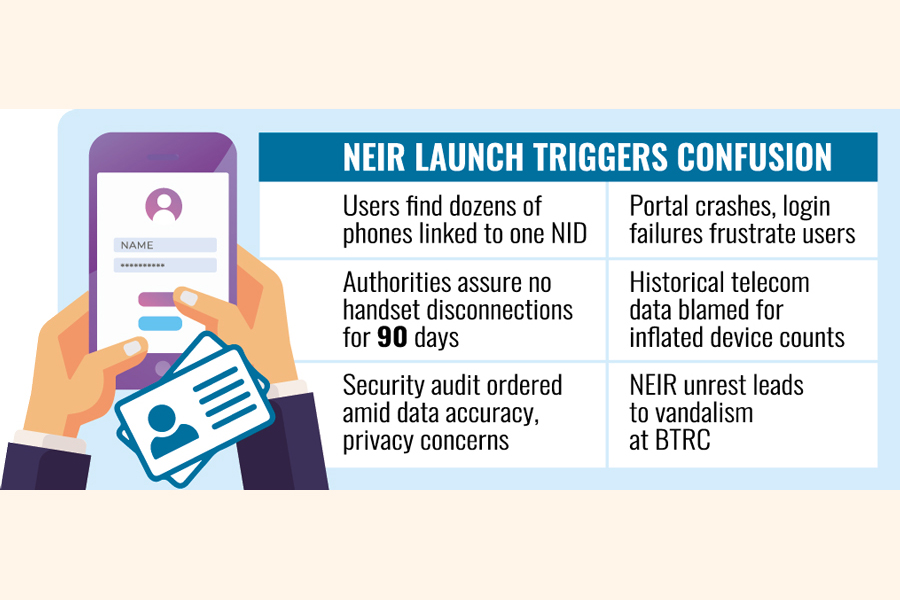
A ruckus centering the National Equipment Identity Register (NEIR) rollout has ensued and a weird revelation of umpteen devices surreptitiously connected with each NID startled mobile-phone users.
FE


The bizarre finds stoke concerns among the users as to whether their sets were being used by frauds in criminal gangland.

"I logged in just to check my handset, and suddenly I saw 47 phones registered under my name," says Nabiul Islam, a private employee from Mirpur. "I have only used two phones in my entire life. I thought someone had stolen my identity."

Similar experiences have been shared widely on social media since the system went live, with users reporting that 10, 50, or even hundreds of mobile handsets are showing up against a single National Identity (NID) number.

In another case, Sharmeen Akter, a university student from Mohammadpur, failed to access the portal despite trying for hours. "The website kept crashing. When it finally opened, it showed devices that I have never owned. It was frightening," she recounts.

Screenshots circulating online show large discrepancies in the number of handsets linked to individual NIDs. One user, Masum Billah Bhuiyan, claims 53 handsets having appeared under his name, with 42 registered in December alone.

He says in his facebook post that he has lived in Malaysia for four years.

Amid growing concern, Faiz Ahmad Taiyeb, special assistant to the chief adviser of the interim government for Posts, Telecommunications and Information Technology, urges the public not to panic, assuring that no mobile phone will be disconnected over the next 90 days, despite the launch of NEIR.


He says telecom operators had submitted more than three billion datasets, including historical records, which explains why many users are seeing unusually high numbers of devices linked to their NIDs.

"Since the migration date is being reflected as the current date, people are seeing inflated figures. This will gradually be corrected as historical data is archived in the background."

According to him, the Bangladesh Telecommunication Regulatory Commission (BTRC) and mobile operators are jointly working to resolve the techno conundrum.

Users have also reported repeated difficulties accessing the NEIR portal, with frequent timeouts and login failures.

Taiyeb acknowledges these problems, saying that heavy traffic following the launch caused temporary system instability.

"These technical issues are expected during the early phase of a new platform. They will be resolved soon," the post-uprising government functionary assures of correcting the flaws in the troubleshooting drive.

He says although a Vulnerability Assessment and Penetration Testing (VAPT) has been conducted earlier, a fresh security audit has now been ordered. Measures such as secure digital tokens, rate limiting and stricter API controls have also been implemented.

Explaining the unusually high handset counts, Taiyeb says Bangladesh previously allowed one person to use up to 20 SIMs, which was later reduced to 15 and is now being brought down to 10.


"As a result, historical data is showing higher numbers of devices under many NIDs."

He notes that the system would ultimately help citizens identify whether any SIMs or devices registered in their names are being misused for crimes such as mobile financial fraud or online gambling.

The NEIR rollout has also sparked unrest. A Dhaka court has sent 45 persons to jail in connection with an attack Thursday on the Bangladesh Telecommunication Regulatory Commission (BTRC) headquarters in Agargaon.

According to police, protesters vandalised the premises and a staff bus, causing damages estimated at Tk20 million. Authorities allege the violence was premeditated and aimed at creating public panic following the NEIR launch.

Law-enforcement agencies say investigations are ongoing to identify both direct participants and instigators.

While authorities insist the system will stabilise over time, many users remain anxious.

"I just want to know which phones are actually mine," says Mahmud Hasan, a small business owner from Narayanganj. "Until this is fixed, people will keep worrying."

For now, the NEIR rollout-intended to strengthen digital security-has instead left many citizens confused, frustrated and waiting for clarity.​
 

Members Online

Latest Posts

Latest Posts