Home Watch Videos Wars Movies Login

[🇧🇩] Telecommunication Industry in Bangladesh

[🇧🇩] Telecommunication Industry in Bangladesh
77
4K
More threads by Saif

G Bangladesh Defense
Mobile phone import, manufacturing taxes lowered

BSS Dhaka
Updated: 01 Jan 2026, 21: 52

1767315547227.webp

Chief Adviser Professor Muhammad Yunus chaired the Council of Advisers' first meeting of the year at his office in Dhaka's Tejgaon area on 1 January 2026. PID

The Council of Advisers today, at its first meeting of the year, approved the draft National Urban Policy 2025 and decided to significantly reduce customs duties and overall tax incidence on mobile phone imports and local manufacturing.

The government made the decisions aimed at boosting planned urban development and strengthens the domestic mobile industry and making handsets more affordable for consumers.

Chief Adviser Professor Muhammad Yunus chaired the meeting at his office in the city's Tejgaon area on Thursday.

Later, Chief Adviser's Press Secretary Shafiqul Alam briefed the media about the meeting at the Foreign Service Academy here this afternoon.

He said 33 per cent of the country's total population lives in urban areas, who contribute 62 per cent to the GDP.

Therefore, the government approved the draft National Urban Policy 2025, marking an important step toward planned, inclusive and sustainable urban development to ensure expected living standard for urban people.

About tax reduction for mobile phone, Shafiqul Alam said the customs duty on imported mobile phones has been reduced from 25 per cent to 10 per cent.

For locally manufactured mobile phones, he said, the customs duty, which was previously 10 per cent, has been cut to 5 per cent.

1767315582797.webp

A student checks her HSC result in mobile phone on 16 October 2025 Dipu Malakar

As a result, the overall tax incidence on imported mobile phones will come down from 61.80 per cent to 43.43 per cent, the press secretary said, for locally manufactured phones, the tax incidence will also decline significantly.

The government expects these measures would expand Bangladesh's mobile phone industry, attract more investors into local manufacturing, reduce prices, and discourage the inflow of used and refurbished phones from abroad, which often harm consumers and deprive the government of revenue, he said.

Shafiqul Alam said the Council of Advisers also discussed the state-arranged funeral and burial of three-time former Prime Minister and national leader Begum Khaleda Zia.

The adviser expressed gratitude to all concerned authorities for ensuring security and managing the large-scale arrangements with dignity and state honors.

About the Bangladesh Labour (Amendment) Ordinance, 2025, the press secretary said some complaints have been raised regarding certain provisions of the recently enacted labour law.

To address these concerns, the Council of Advisers formed a review committee, he said, adding that the names of the committee members would be disclosed soon.

The committee will examine the law thoroughly, identify any inconsistencies, and submit a report to the Council of Advisers within quickest possible time, Shafiqul Alam said.

Noting that the Council of Adviser also discussed Hajj management, he said it was observed that there are no significant complaints from pilgrims going under government management, while some issues persist in the private Hajj agency system.

Therefore, the press secretary said, the council of advisers discussed to explore ways to improve overall Hajj management, including bringing the people, show negligence in Hajj management, under the law.

Deputy Press Secretary Mohammad Abul Kalam Azad Majumder and Senior Assistant Press Secretary Foyez Ahammad were present at the briefing.​
 
Analyze

Analyze Post

Add your ideas here:
Highlight Cite Respond
RUCKUS CENTERING NATIONAL EQUIPMENT IDENTITY REGISTER ROLLOUT
Mobile-phone users startled finding myriad devices under each NID
Concerns boils about use by frauds in criminal gangland, govt rep assures remedy


FE REPORT
Published :
Jan 03, 2026 00:17
Updated :
Jan 03, 2026 00:17

1767401474694.webp


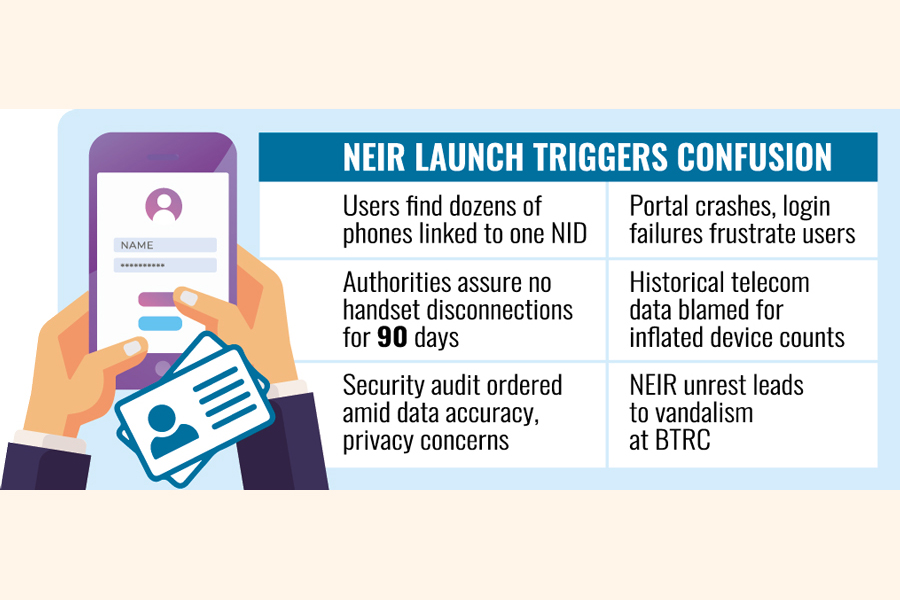
A ruckus centering the National Equipment Identity Register (NEIR) rollout has ensued and a weird revelation of umpteen devices surreptitiously connected with each NID startled mobile-phone users.
FE


The bizarre finds stoke concerns among the users as to whether their sets were being used by frauds in criminal gangland.

"I logged in just to check my handset, and suddenly I saw 47 phones registered under my name," says Nabiul Islam, a private employee from Mirpur. "I have only used two phones in my entire life. I thought someone had stolen my identity."

Similar experiences have been shared widely on social media since the system went live, with users reporting that 10, 50, or even hundreds of mobile handsets are showing up against a single National Identity (NID) number.

In another case, Sharmeen Akter, a university student from Mohammadpur, failed to access the portal despite trying for hours. "The website kept crashing. When it finally opened, it showed devices that I have never owned. It was frightening," she recounts.

Screenshots circulating online show large discrepancies in the number of handsets linked to individual NIDs. One user, Masum Billah Bhuiyan, claims 53 handsets having appeared under his name, with 42 registered in December alone.

He says in his facebook post that he has lived in Malaysia for four years.

Amid growing concern, Faiz Ahmad Taiyeb, special assistant to the chief adviser of the interim government for Posts, Telecommunications and Information Technology, urges the public not to panic, assuring that no mobile phone will be disconnected over the next 90 days, despite the launch of NEIR.


He says telecom operators had submitted more than three billion datasets, including historical records, which explains why many users are seeing unusually high numbers of devices linked to their NIDs.

"Since the migration date is being reflected as the current date, people are seeing inflated figures. This will gradually be corrected as historical data is archived in the background."

According to him, the Bangladesh Telecommunication Regulatory Commission (BTRC) and mobile operators are jointly working to resolve the techno conundrum.

Users have also reported repeated difficulties accessing the NEIR portal, with frequent timeouts and login failures.

Taiyeb acknowledges these problems, saying that heavy traffic following the launch caused temporary system instability.

"These technical issues are expected during the early phase of a new platform. They will be resolved soon," the post-uprising government functionary assures of correcting the flaws in the troubleshooting drive.

He says although a Vulnerability Assessment and Penetration Testing (VAPT) has been conducted earlier, a fresh security audit has now been ordered. Measures such as secure digital tokens, rate limiting and stricter API controls have also been implemented.

Explaining the unusually high handset counts, Taiyeb says Bangladesh previously allowed one person to use up to 20 SIMs, which was later reduced to 15 and is now being brought down to 10.


"As a result, historical data is showing higher numbers of devices under many NIDs."

He notes that the system would ultimately help citizens identify whether any SIMs or devices registered in their names are being misused for crimes such as mobile financial fraud or online gambling.

The NEIR rollout has also sparked unrest. A Dhaka court has sent 45 persons to jail in connection with an attack Thursday on the Bangladesh Telecommunication Regulatory Commission (BTRC) headquarters in Agargaon.

According to police, protesters vandalised the premises and a staff bus, causing damages estimated at Tk20 million. Authorities allege the violence was premeditated and aimed at creating public panic following the NEIR launch.

Law-enforcement agencies say investigations are ongoing to identify both direct participants and instigators.

While authorities insist the system will stabilise over time, many users remain anxious.

"I just want to know which phones are actually mine," says Mahmud Hasan, a small business owner from Narayanganj. "Until this is fixed, people will keep worrying."

For now, the NEIR rollout-intended to strengthen digital security-has instead left many citizens confused, frustrated and waiting for clarity.​
 
Analyze

Analyze Post

Add your ideas here:
Highlight Cite Respond
No place for lawlessness in telecom sector

Published :
Jan 04, 2026 00:36
Updated :
Jan 04, 2026 00:37

1767506822134.webp


The launch of National Equipment Identity Register (NEIR) at the start of the new year constitutes a long-overdue step to curtail the chaos and illicit trade that have defined much of Bangladesh's mobile handset sector. For years the sector has functioned with a large grey zone where illegal imports and tax evasion were widely acknowledged yet seldom confronted. NEIR seeks to correct this by linking every new handset to a verifiable identity before it can fully function on a mobile network. The move has been deliberately cautious rather than abrupt. Existing handsets will continue to function, traders were given sufficient time to regularise stock through IMEI submission and new devices are granted a three-month registration window. Expatriates returning home have also been accommodated through special provisions. These measures indicate an effort to introduce order without causing panic or disruption, even as the state asserts its regulatory authority. To further allay public concern, the government has clarified that NEIR lacks the capacity to monitor private communications such as calls or messages, with data protection safeguards embedded in the amended Telecommunications Ordinance and strict penalties prescribed for any misuse.
FE

Despite these assurances, resistance to NEIR has taken a violent turn recently with the vandalism of the BTRC headquarters in Agargaon. Such an attack on a regulatory institution is unacceptable and must be condemned without reservation. While constructive dialogue and the expression of concerns are pillars of a democratic society, the destruction of public property falls far outside the bounds of legitimate protest. This resort to aggression is even more difficult to justify given the government's sustained efforts to accommodate stakeholder concerns through meaningful policy adjustments. Such actions only serve to undermine the credibility of genuine grievances within the trading community and divert attention from the merits of the policy to mere questions of law and order.

Contrary to alarmist claims circulating in some quarters, the government has introduced NEIR alongside concrete measures to safeguard market stability and affordability. Customs duties on imported mobile phones have been reduced from 25 per cent to 10 per cent, while duties on locally manufactured handsets have been halved from 10 per cent to 5 per cent. These decisive cuts directly address concerns about price inflation and honour the government's prior commitment to rationalise taxes before implementing the new register. By making legal imports more affordable and the registration process transparent, the policy actively removes the incentive for smuggling and tax evasion. This matters because the scale of illegal imports is far from marginal. Industry estimates suggest that majority of handsets sold in the country enter through illegal channels, costing the government billions of taka in lost revenue each year. NEIR also strengthens the domestic mobile manufacturing sector, which has grown in recent years with many global brands producing devices locally. However, illegal imports have long constrained these industries from operating at full capacity.

The resistance from a segment of traders, therefore, seems driven less by genuine concern and more by a desire to protect a profitable network of illegal activity. The illicit handset trade is closely linked to fake SIM registrations, smuggling, tax evasion and even online fraud, and by ensuring that every device is verifiable, NEIR reduces the risks these practices pose to consumers. Systems like NEIR exist in many countries precisely to curb such illegal practices. Given these factors, the government must remain resolute in implementing NEIR to secure long-term economic and social benefits while ensuring that channels for dialogue remain accessible to address legitimate concerns through formal and lawful means.​
 
Analyze

Analyze Post

Add your ideas here:
Highlight Cite Respond
Govt publishes white paper on telecom sector

The task force formed in April last year prepared the white paper

1767662505539.webp

An AI-assisted infographic

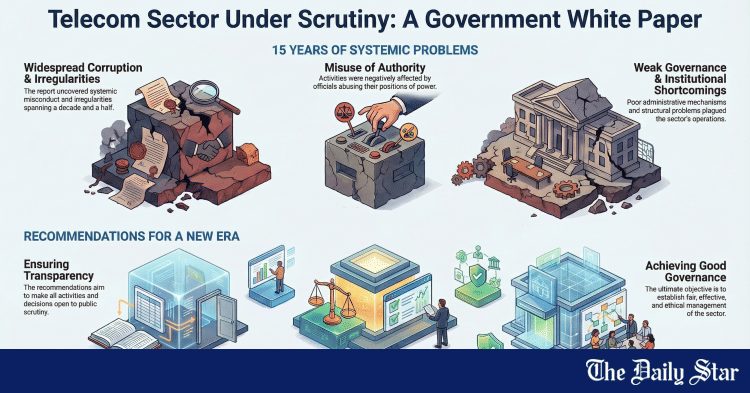
The government today published a white paper on the telecommunications sector, outlining corruption, irregularities, administrative weaknesses, and structural problems over the past 15 years.


The white paper was prepared by a task force formed in April last year with the approval of the chief adviser to review and analyze allegations of corruption and misconduct within the posts and telecommunications ministry.


Following months of investigation and evaluation, the task force submitted the report in its final form, according to an official government statement.

The document noted that various activities of the Posts and Telecommunications Division during the last decade and a half were affected by systemic irregularities, misuse of authority, weak governance mechanisms, and institutional shortcomings.


It also includes a set of recommendations aimed at ensuring transparency, accountability, and good governance in the future.

The government hopes the findings and recommendations outlined in the white paper will serve as an important guideline for institutional reforms, strengthening anti‑corruption measures, and ensuring more efficient and citizen‑friendly services in the telecommunications sector, the statement added.

According to the white paper, Bangladesh's telecom sector is suffering from entrenched corruption, systemic irregularities, and a governance breakdown that has weakened regulatory credibility, distorted markets, and wasted public resources.


Prepared by a seven‑member committee headed by Professor Kamrul Hasan of Bangladesh University of Engineering and Technology, the white paper also paints a bleak picture of a sector structurally misaligned, operationally compromised, and failing to deliver trusted, affordable connectivity.

It found that policy neglect, unchecked favoritism, politicized appointments, and procurement manipulation had accumulated over the years.

The document, based on a forensic review of 10 key entities under the PTD, exposes a systemic "governance capture" that has crippled regulatory authority, bled state‑owned enterprises, and defrauded the public.

From the highest regulatory body to project implementation cells, the sector operates on favoritism, bypasses competitive processes, and treats public resources as a vehicle for patronage.

"These structural deficiencies produce systemic risks to meritocracy, institutional credibility, service delivery, and long‑term sector reform."

At the heart of the crisis is the Bangladesh Telecommunication Regulatory Commission (BTRC), the agency tasked with regulating the sector.

The white paper found the BTRC itself to be a primary source of irregularity, with its credibility shattered by its own actions.


The commission was accused of "non‑competitive recruitment, misclassification of candidates, excessive age relaxations, improper absorption of project‑funded staff, re‑employment of retirees, and conflicted commissioner appointments."

By blurring the lines between regulator and employer, the BTRC created a self‑serving system.

"BTRC's practices have eroded institutional integrity and diminished the credibility of sector oversight," the report said.

The irregularities at the top set a precedent for the entire ecosystem.

The malaise spread through state‑owned enterprises like Bangladesh Telecommunications Company Limited and Teletalk, where boards became instruments of governance capture and politicized board‑level decision‑making.​
 
Analyze

Analyze Post

Add your ideas here:
Highlight Cite Respond
Telecom reforms gain pace, but investment challenges remain
Says Grameenphone CEO Yasir Azman


11 January 2026, 00:00 AM

By Mahmudul Hasan

1768180509399.webp

Yasir Azman

After years of inertia, Bangladesh’s telecom sector has begun to move again under the interim government, reopening long-stalled reform pathways even as deep structural problems continue to weigh on investment and innovation, according to Grameenphone (GP) CEO Yasir Azman.


“There were a lot of ups and downs,” Azman told The Daily Star in a recent interview, noting that the industry has gone through “substantial change in terms of how the future will be defined.”

1768180544256.webp


He said the past year saw sustained work on long-delayed reforms, including drafting a comprehensive telecom licensing policy, preparations for the auction of the 700 MHz spectrum, issuance of a new quality of service directive and the enactment of a new telecom law.

These developments, he noted, brought both opportunities and fresh challenges.


He also pointed to a series of regulatory decisions that eased operational constraints, such as approving the sale of network-locked or SIM-locked handsets, withdrawing cap on the number of service packages, permitting voice over Wi-Fi, and enabling access to leased dark fibre.

Despite many headwinds and volatility, the GP CEO said he sees the developments through an optimistic lens. That optimism, however, was tempered by sharp criticism of the financial and regulatory environment.

The chief executive of the country’s largest telecom operator identified tax burden as the biggest obstacle for the industry. “There are 40 percent corporate tax, 15 percent VAT, 20 percent supplementary duty, 1 percent surcharge, 5.5 percent revenue share, 1 percent SOF and then licence and spectrum fees.”


“Unless these issues are resolved, investors’ appetite will remain extremely limited. This is not a concern unique to Grameenphone; it affects all operators,” he added.

Besides, he complained that operators are not only heavily taxed but also locked in unresolved disputes with the regulator. “In our 28 years of operation, not a single annual audit dispute has been resolved. So, we have not been able to get clear of financial disputes from inception to this day.”


He said this uncertainty directly undermines investor confidence, noting that GP has “Tk 12,500 crore stuck in financial disputes with the regulator”.

“All three private telecom operators are (fully or partly) owned by foreign investors. How will they decide to continue to invest heavily?” he said.

As a way forward, Azman suggested pursuing international arbitration. Otherwise, he warned, the disputes could remain stuck in court for another decade, increasing pressure on operators.

The GP CEO informed that discussions were underway with the Bangladesh Telecommunication Regulatory Commission (BTRC) to initiate arbitration.

On service quality, Azman rejected criticism that network performance has deteriorated, claiming that the latest regulatory report on the matter was flawed. The report identified frequent call drops, blurred video calls and no indoor network coverage in several locations across the country.

Azman said both operators and the regulator had agreed to dispute the weaknesses in the report’s methodology.

He countered the report’s findings with performance data, noting that the call drop rate now stands at 0.15 percent, far below the 2 percent threshold. He also said data speeds have improved significantly, with operators now delivering “more than 15 Mbps,” while they struggled to reach 5 Mbps a few years ago.

He, however, acknowledged persistent coverage gaps. Elevated expressways, hospitals and other strategic locations still experience service drops.

“There are more than 200 spots in Dhaka where it’s very difficult,” he said, adding that operators often lack permission to install infrastructure. These remain operational challenges the industry must “take on our shoulders”.

On pricing, he said recent changes in charging structures have altered how customers perceive costs. From the user’s perspective, he acknowledged, “price is going up,” but said company data showed otherwise.

“Our ARPU (average revenue per user) has not increased… Data price per MB has gone down by another 11 percent,” he said.

He attributed the disconnect to changing consumption patterns, as customers shift from short-duration packs to monthly combo offers. “If you buy 2 kilogrammes of rice for Tk 100 and 5 kg for Tk 150, you feel you paid more, but per kg it’s cheaper,” he explained.

He argued that customers are now buying larger data volumes with longer validity, increasing total spending while reducing per-unit costs. He said it would take three to six months for users to fully adjust to this transition.

Azman also criticised regulatory constraints on competition and innovation, particularly for GP as a significant market power (SMP) operator.

“We need approvals for every product and service we launch… it takes years,” he said, noting innovation is difficult under such conditions.

On 5G, he urged caution, arguing that expectations were ahead of reality. “5G is not for (individual) customers, it’s for industries,” he said, noting that there are only “5 percent to 7 percent 5G devices” in the market.

Everything is possible with 4G, provided that the speed is good, he said, emphasising the need to strengthen indoor coverage and address rural gaps before pushing for widespread 5G deployment.

Asked why GP has not applied for a digital banking licence while rivals Robi Axiata and Banglalink have, Azman said it was not a strategic priority. “We are experts in telecom; we should focus on our telecom.”

He also addressed concerns over data security and SIM-related fraud, calling cybersecurity and privacy “the topmost priority”.

While he cited steps such as shutting down thousands of suspicious retail points, he acknowledged that the ecosystem remains difficult to fully control.

Smartphone affordability, he said, is another structural constraint. Restrictions on SIM-device bundling and limited access to consumer credit have slowed smartphone adoption. Only recently, he noted, had SIM-locking been permitted, which could accelerate penetration.

Azman repeatedly linked the health of the telecom sector to broader national development.

“Without strong connectivity, we will not be able to progress,” he said, pointing to digital services across health, education and business.

Asked about expectations from the new government after the upcoming election, he said a predictable business and regulatory environment is needed, where business can be conducted fairly and transparently.

“This is not about benefiting the operators; it’s about benefiting the customers. If we can bring that perspective, all the problems will be solved,” he said.​
 
Analyze

Analyze Post

Add your ideas here:
Highlight Cite Respond

BTRC to seek govt nod for Starlink’s bandwidth export

Bangladesh Telecommunication Regulatory Commission (BTRC), the country’s internet regulator, is taking a cautious approach to Starlink Services Bangladesh Ltd’s proposal to export unfiltered internet bandwidth to neighbouring countries via local cable providers, and will seek the government’s opinion before approval.

After extensive internal discussions, technical reviews, and exchanges of letters with the company and international terrestrial cable companies that operate in the country, the BTRC will submit the matter to the Posts and Telecommunications Division, according to official documents.

Unfiltered bandwidth, unlike filtered connections, bypasses network controls like firewalls, deep packet inspection, or application blocking, which governments or operators use to restrict access, slow traffic, or monitor data. Industry experts say such unfiltered Internet Protocol (IP) transit is essential for exporting data internationally.

Two international terrestrial cable licensees, Summit Communications Limited and Fiber@Home Global Limited, have applied to the commission for permission to provide Starlink with unfiltered IP transit, which the company plans to use exclusively for customers outside Bangladesh.

Starlink has requested 40 Gbps of committed bandwidth, scalable up to 400 Gbps as needed.

Technology expert Sumon Ahmed Sabir told The Daily Star, “If approved, the arrangement could make Bangladesh a regional data hub and earn foreign currency for local operators.”

“No country would accept bandwidth that has already been filtered by another country,” he said, adding that neighbouring countries like Bhutan and Nepal require unfiltered connectivity for quality service.

Starlink received its licence from the BTRC on April 29, 2025, to provide non-geostationary satellite orbit services. The company launched in May and officially began operations on August 8, currently sourcing 80 Gbps of bandwidth from two international internet gateway operators for domestic use.

STRICT CONDITIONS FOR EXPORTING BANDWIDTH

In mid-August, Starlink applied to use international private leased circuit connections and unfiltered IP transit from Bangladeshi operators to carry internet traffic for users in neighbouring countries.

The BTRC instructed the company to ensure that this bandwidth serves only foreign customers, not Bangladeshi users or foreigners in Bangladesh.

The commission also required Starlink to demonstrate, through strong technical measures, full separation of domestic and foreign data traffic, including detailed network diagrams and monitoring tools for real-time verification.

Starlink said foreign traffic could pass between its points of presence (PoPs) in Bangladesh and overseas locations like Singapore and Oman via leased circuit links without carrying Bangladeshi data.

At a later meeting, the BTRC set conditions clarifying whether roaming foreign users in Bangladesh would be served through local ground stations, ensuring strict traffic separation and effective monitoring systems as regulatory safeguards.

On December 15, 2025, the BTRC held a high-level technical meeting with Starlink, the National Telecommunication Monitoring Centre (NTMC), and senior officials to review Starlink’s operations, monitoring, reporting, and on-site inspections, especially at its Kaliakoir PoP.

In a January 13 letter, Starlink informed the commission that it had submitted updated network diagrams, responded to queries, applied to Summit Communications and Fiber@Home for unfiltered IP transit, and met NTMC’s lawful interception requirements.

The company also provided a “Compliance API (application programming interface)” giving the regulator direct access to Bangladeshi customer data.

Before seeking government approval, the BTRC noted past precedent: between 2020 and 2025, Bangladesh Submarine Cable Company PLC supplied up to 20 Gbps of unfiltered IP transit to India’s BSNL under various arrangements, showing that exporting unfiltered bandwidth across borders is not entirely unprecedented, according to the BTRC document.​
 
Analyze

Analyze Post

Add your ideas here:
Highlight Cite Respond

Members Online

Latest Posts

Back
 
G
O
 
H
O
M
E