New Tweets

[πŸ‡§πŸ‡©] Terrorist BSF is pushing Indian Nationals into Bangladesh

G Bangladesh Defense
[πŸ‡§πŸ‡©] Terrorist BSF is pushing Indian Nationals into Bangladesh
63
2K
More threads by Saif


48 Rohingyas registered in India pushed into Bangladesh
Tanzil Rahaman 12 June, 2025, 00:14

1750641120631.webp


The Border Security Force of India has recently pushed at least 122 Rohingyas, including 48 registered by the United Nations High Commissioner for Refugees in India, into Bangladesh.

The Office of the Refugee Relief and Repatriation Commissioner said that they could detect 117 Rohingyas, including 43 registered by the UNHCR in India, who were pushed into Bangladesh by the BSF, in different camps in Cox’s Bazar until May 25.

The Armed Police Battalion and the Office of the RRRC identified five more Rohingyas registered by the UNHCR in India at a camp in Teknaf on June 10.

The five were pushed into Bangladesh by the Indian authorities through the Tentulia border point in Panchagrah district on June 4, according to RRRC officials.

Pushing refugees registered in one country into another one is unlawful and a violation of the norms of International relations, academics said.

India began pushing people into Bangladesh on May 7 through different bordering points and it continued until June 10, according to the officials of Border Guard Bangladesh.

According to an RRRC letter sent to the disaster management and relief affairs secretary on May 27, the RRRC has recently detected 117 Rohingyas from India in 33 camps of Ukhia and Teknaf in Cox’s Bazar.

Of them, 43 are registered with UNHCR in India, 47 are registered with UNHCR in Bangladesh and 27 do not have any registration anywhere, it said.

β€˜We have identified that these 117 Rohingyas were pushed into Bangladesh by India recently. They, after the push-in incidents, took shelter in different camps in Ukhia and Teknaf. All of them were pushed by the Indian BSF,’ RRRC top official Mohammed Mizanur Rahman said on Wednesday.

Mizanur, however, said that the actual number of such Rohingyas might be higher than the data they collected as it was a compilation of the data collected until May 25.

Asked about checking Rohingya intrusion from India, RRRC chief Mizanur said that it was BGB’s task to check such intrusions.

Neither the BGB director general Major General Mohammad AshrafuzzamaSiddiqui nor its deputy director general for communications Colonel Mohammad Shariful Islam could be reached for comments despite several attempts over the phone. They also did not respond to text messages from New Age.New age fashion

Over 1.3 million Rohingyas fled to Bangladesh amid atrocities by the Myanmar military since 2017, according to government data.

In a letter to RRRC in April, the UNHCR pressed for ensuring accommodation of 1.13 lakh more Rohingyas who entered Bangladesh between November 2023 and April 27, 2025.

Dhaka University’s former international relations professor Imtiaz Ahmed said that pushing refugees registered in one country into another country instead of sending them to their homeland was unlawful.

β€˜According to my knowledge, Indian law does not allow such incidents. Human rights activists from India and Bangladesh should raise voices over push-ins,’ he said.

He also urged the government to conduct a survey of people pushed into Bangladesh from India for the sake of national security.

He stressed the need to engage experts in such a survey as the government seemed to have failed to manage the issue through diplomatic channels.

Dhaka University international relations professor ASM Ali Ashraf said that India, by pushing refugees into Bangladesh, was throwing the vulnerable community into more vulnerable conditions.

Asked whether India’s push-ins would create a security threat for Bangladesh, he said, β€˜India is pushing Bangladeshis, Rohingyas and Indian nationals into our country. If they were trained to create instability in Bangladesh, it might be a further threat to our country.’

According to a report in the New York Times published online on May 17, the United Nations has called for an investigation into β€˜credible reports’ that Indian authorities rounded up Rohingya refugees and expelled them.

A press release issued by the BGB on May 15 said that the BGB-22 Battalion detained five of a Rohingya family registered with UNHCR in India from the Natunhat Bazar area under Bhurungamari upazila in Kurigram on May 7.

The release said that the BSF pushed them into Bangladesh. The family that went to India from Myanmar two years ago used to live in the Matia Refugee camp in India’s Assam, it said.

The number of people pushed into Bangladesh by India since May 7 has reached 1,336 amid tight security measures taken by the BGB and the police along the border.

Bangladesh government has sent official letters to India over the push-in incidents.

The BGB also lodged verbal and written protests to their Indian counterpart BSF and held flag meetings over the issue.​
 
Analyze

Analyze Post

Add your ideas here:
Highlight Cite Respond
  • Like (+1)
Reactions: Bilal9

India keeps pushing people into Bangladesh
Staff Correspondent 13 June, 2025, 00:06

1750641236327.png

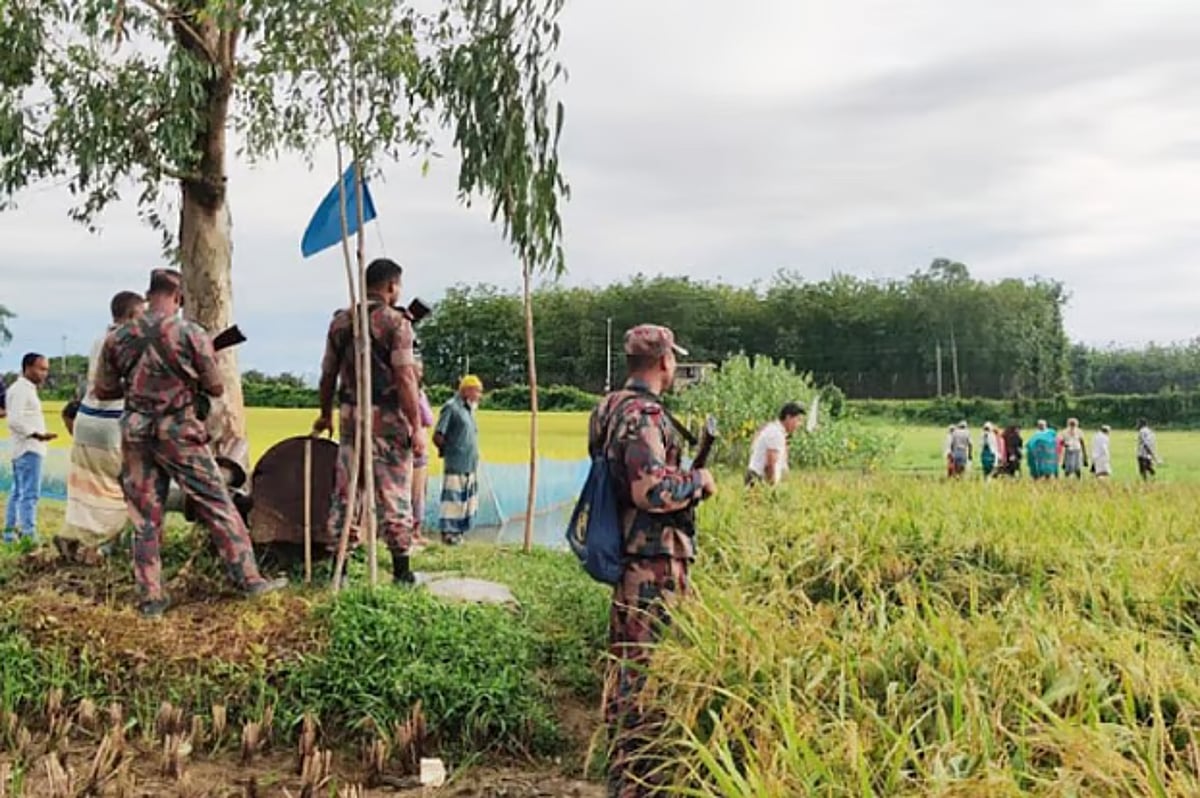
Border Guard Bangladesh members stand by the individuals pushed into Bangladesh by the Indian Border Security Force in Sylhet on Wednesday. | Focus Bangla photo

India continued to push people into Bangladesh as the Border Security Force pushed 77 more people into Bangladesh through different border points in Sylhet, Sunamganj and Lalmonirhat districts on Thursday.

With the latest push-ins, the number of people pushed into Bangladesh by India since May 7 reached 1,413.

India began pushing people, including Rohingyas and Indian nationals, on May 7 when a war-like situation prevailed between India and Pakistan, raising concerns over human rights violations and potential strains on cross-border relations.

Of the fresh push-in incidents, 70 people were pushed into Bangladesh through different border points in Sylhet and Sunamganj districts and seven of a family were pushed through a border point in Lalmonirhat, according to the BGB.

New Age staff correspondent in Sylhet reported that 53 people were pushed into Bangladesh through three border points under Jaintapur and Companiganj upazilas in Sylhet district and 17 other people through a border point under Chhatak upazila in Sunamganj.New age fashion

BGB-48 Battalion commanding officer Lieutenant Colonel Md Nazmul Haque said that 18 women, 30 children, and 22 men were pushed into Bangladesh through different border points under the battalion between 1:30am and 4:30am on Thursday.

He also said that the 70 individuals were detained immediately after they were pushed into Bangladesh by the BSF and they were handed over to the respective police stations at around noon.

β€˜Among the detainees, 43 are residents of Kurigram district and 27 of Lalmonirhat district. They went to India in different times in the past and were working in different parts of India, including Delhi,’ the BGB battalion commander said, referring to the detainees.

The police said that sending the detainees to their respective families was under process.

Bangladesh government has sent official letters to India over the push-in incidents, BGB-48 Battalion commanding officer Lieutenant Colonel Md Nazmul said, adding that the BGB also lodged verbal and written protests to the BSF and held flag meetings over the issue.

New Age correspondent in Lalmonirhat reported that the BSF pushed seven people into Bangladesh through the Durgapur border under Aditmari upazila in the district.

BGB 15 battalion commanding officer Lieutenant Colonel Mehehdi Imam said that the BGB detained the seven people early Thursday.

β€˜The detainees said that they are Bangladeshi and entered India with the help of brokers three years ago,’ he said.

They were handed over to the police and the police would take necessary action after verifying their identities, added the BGB official.

The BSF, meanwhile, attempted to push another 12 people through the Patgram and Hatibandha bordering points, BGB officials said.

According to Bangladesh authorities, Bangladesh has 4,156 kilometres of border with India, of which some 180 kilometres fall on different water bodies and 79 kilometres on the Sundarbans.​
 
Analyze

Analyze Post

Add your ideas here:
Highlight Cite Respond
  • Angry (-3)
Reactions: Bilal9

Dhaka must talk push-in globally, Indians should also raise voice
16 June, 2025, 00:00

INDIA’S Border Security Force pushing people into Bangladesh not only furthers Delhi’s unneighbourly conduct but also appears a deliberate policy decision. This blatantly contravenes international laws, bilateral agreements and established border management norms. Since May 7, Indian guards have pushed at least 1,511 individuals into Bangladesh. While the majority of them had for long resided in India, a significant number of them of Rohingyas, many registered with the UNHCR in India, and even some Indians. In the latest spate on June 14, Indian guards pushed at least 54 people through five border points. Twelve Rohingyas were forced through a border point in Moulvibazar. With this, the Indian border guards have pushed at least 147 Rohingyas, mostly women and children who include 50 registered with the UNHCR in India, into Bangladesh. Sixteen more, including four Indians, were pushed in through two border points in Panchagarh, 23 through a point in Thakurgaon and 3 through a point in Lalmonirhat, as the Border Guard Bangladesh and the police say.

Bangladesh authorities have formally urged the Indian counterparts to stop push-in operations. They have further assured India that they are prepared to take back any Bangladeshis living illegally in India but only through proper legal channels and due procedures. Despite this, India appears to have ignored the overtures, showing no willingness to co-operate and continues with the push-in. This unlawful action places additional strain on already tense bilateral relations, which have been under pressure because of persistent issues, notably the continued killings of Bangladeshis along the frontiers. While Indian authorities routinely profess a commitment to honouring international laws and bilateral agreements, including the use of no-lethal weapons on the border, Indian guards have routinely violated the principles, instead following a shoot-to-kill policy. As a result, the Bangladesh-India border has become one of the deadliest in the region. According to rights group Odhikar, the Indian guards killed more than 1,300 Bangladeshis in 2000–2023. Compounding the issue, Indian border guards have recently made attempts to erect fences at several points on the no man’s land, which is a violation of bilateral agreements. The provocative acts, which occur intermittently, further erode the foundation of neighbourly relations.

Given that the actions constitute serious violations of the international law and diplomatic norms, Dhaka must take up the issue with both international and regional forums. Right-thinking citizens in India should also speak out against such aggressive and unlawful practice and call on their government to abandon such antagonistic policies.​
 
Analyze

Analyze Post

Add your ideas here:
Highlight Cite Respond
  • Like (+1)
Reactions: Bilal9

Is 'push-in' another manifestation of Delhi’s hostile policy?
Khawaza Main UddinDhaka
Published: 17 Jun 2025, 15: 27

1750641450701.webp

Indian border forces BSF wanted to push in 14 persons over the Roumari border at Kurigram. Border Guard of Bangladesh (BGB) thwarted them. 17 May, Boraibari border Collected

No matter what history says, today’s India is forcing a section of its own population to enter into another country through land border illegally, due only to their religious belief and identity.

Muslim men and women from the neighbouring country are being pushed in to no other land than Bangladesh, where more than a million Rohingya Muslim people evicted from another neighbour, Myanmar, have been given shelter.Thus, India’s internal issue is turning into a cross-border dispute apart from the treatment of the Muslims as hostage in its domestic politics.

It cannot be believed that such a move by India’s central government of Hindu nationalist Bharatiya Janata Party (BJP) ahead of the crucial elections in states of West Bengal and Assam that have significant percentage of Muslim voters, is appreciated by democratic, progressive and conscientious people there?

In this phase, Delhi has taken the move to send some Indian Muslims to Bangladesh territory – it all is happening after the political changeover through the July 2024 revolution. There is no reason that the Bangladesh people will not understand that such a move conforms to Delhi’s hostile policy towards Dhaka.

New Delhi has first imposed visa restrictions for the Bangladesh people and at one stage cancelled the transshipment facility through India for Bangladesh businesses.

The Indian godi media (pro-ruling party propaganda) has also launched a campaign to spread rumours and cynicism terming as terrorist or militant activities a successful student-mass revolution that has overthrown a ruler who killed democracy. Earlier, Sheikh Hasina who fled Bangladesh in the face of popular demonstrations, was given shelter in nowhere but Delhi, without showing any sensitivity to the sentiment and emotion of the people of Bangladesh.

In such circumstances, is there any likelihood that the most critical bilateral issues such as sharing of waters of transboundary rivers, border killing, trade imbalance, and smuggling and drug trafficking will remain completely out of sight of Bangladesh?

There is no reason to believe either that the pundits outside of India and Bangladesh, or even the global citizens having a minimum level of common senses, would not be able to read mindset of the Delhiwalas and understand the objectives of their activities.

India now wants to say the people who were being pushed in are actually nationals of Bangladesh and even if many of them have been living in India for many years, they are legally not citizens of India. On making its own citizens stateless, foreign media including the BBC have run reports naming and quoting individual victims and confirmed that the Muslims who were pushed in to Bangladesh are in fact Indian nationals.

If a few of them are found to be Bangladeshi nationals travelling to India, they could have been deported lawfully with due respect. But. Dhaka has no legal obligation to accept the Indian citizens as Bangladeshis only because they are Muslims. Is Indian premier Narendra Modi’s friend Donald Trump welcoming illegal Indian immigrants to the US?

By using its minority population as pawn of chess in domestic and external policies, India as a state and civilization proves its bankruptcy and its leaders and policymakers are doing so, as part of a conscious policy decision.

The attitude of Delhi and a major section of the Indian media towards the Yunus government seemed to be attacking and demeaning when the rest of the world shows high level of respect to the Nobel Peace Price winner.

It seems that Delhi is nowhere near self-realisation about correctness of the action to push Bangladesh towards an unwanted situation, let alone making self-criticism. Rather, India’s standpoint, as well as tactics vis-Γ -vis Bangladesh such as maintaining hardly any communications with Professor Y8unus-led government at the state level, exposes certain anger, which has originated from the fall of a subservient ruler.

There is no logical ground for India’s anger against the Bangladesh people, instead of the possibility of the opposite. Sheikh Hasina with Delhi’s overt and covert patronisation for more than one and a half decades, had deprived the people of this country of their democratic and human rights; furthermore, the Indian authorities had made all attempts to glorify the one who was a fascist ruler.

One cannot ignore the fact that the aggrieved Bangladeshis had begun β€˜boycott Indian goods’ movement immediately after the 2024 parliamentary polls Hasina won with Indian blessings, months before the demonstrations that ousted the iron lady. In such a context, Delhi’s anger against the Bangladesh people can be equated with that of an angry loser. Delhi should have rather had more anger against nuclear Pakistan and a more powerful China, the two neighbouring countries with which India had engangled into border clashes recently.

Showing flexibility to powerful countries and aggression to non-nuclear neighbour is the reflection of Chanakya Kautilya’s policy of Matsanaya according to which big fishes eat up small ones.

The rulers of Delhi have been obsessed with old policy of pre-Christ era, at a time when they should have extended olive branch to the people of Bangladesh so that there is a thaw in the deadlock in bilateral relations.

Japan, Germany and South Africa had sought apology to aggrieved parties for the misdeeds of their earlier rulers; they have not lost anything at all for their gesture.

New Delhi has no moral ground to justify the repressive acts of Hasina in the past one and a half decades. Indian authorities cannot deny that some Bangladeshi victims of enforced disappearance had been discovered in India.

The stories of enforced disappearance, mass murder and extra-judicial killing, and torture have been documented in the reports of the United Nations and human rights organisations. The world had seen what kind of national elections the Hasina regime had held in Bangladesh in 2014, 2018 and 2024.

As written in the book by former Indian president Pranab Mukherjee and reported during the Bangladesh tour of the then Indian external affairs secretary Sujatha Singh days before the 2014 elections, India’s naked interference into the domestic politics including electoral affairs of Bangladesh in favour of Hasina had hurt and humiliated political elements and conscious people in this country.

The moment Hasina’s repressive rule came to an end, India’s reaction to the political changeover in Dhaka was different from those of other countries of the civilized world. Later on, the attitude of Delhi and a major section of the Indian media towards the Yunus government seemed to be attacking and demeaning when the rest of the world shows high level of respect to the Nobel Peace Price winner ruler of Bangladesh.

Unfortunately, even during the Hasina rule – the honeymoon period of Delhi’s desired relations with Dhaka – India had not extended her support to Bangladesh – neither on the ground during the Rohingya influx into Cox’s Bazar, nor during the vote at the United Nations.

In that case, some people may draw conclusion that India does not consider Bangladesh as a friendly neighbour, unless it remains subservient to Delhi. And in accordance with Kautilya’s formula, if my enemy’s enemy is my friend, what does Iran’s status as the enemy of India’s close ally Israel stand or America’s as the enemy of Russia as a friend of India? Or, Turkey as friend of archenemy Pakistan or Bangladesh when it is a friend of China?

Both success and negative effects of ill move like human trafficking in the pursuit of foreign affairs policy are well known to India’s diplomatic and strategic analysts. That is also not unknown to the friendly countries, who are further aware of India’s relations with her South Asian neighbours.

By pushing her minority Muslim citizens in to Bangladesh, India not only sets before the global community the instance of minority repression, Delhi has also confirmed that the formation of Pakistan for the Muslim population in 1947 and Bangladesh later on – which was described by proponents of a greater post-colonial India – was justified.

When Bangladesh is heading for a truly free and fair elections, institutionalisation of democracy, completion of reforms to rebuild state institutions broken during the fascist rule, concluding the trial of the culprits of major crimes such as massacre, extrajudicial killing, enforced disappearance, detention, repression, corruption, extortion, and money laundering and efforts are on to turn Bangladesh into a dignified country at the glonal stage, India has distanced herself from constructive engagement and dialogue with Bangladesh.

Despite certain pressure of public opinion and a pledge made by the interim administration to make public some of the presumably unequal treaties and agreements contrary to Bangladesh’s national interests, Dhaka has so far refrained from revealing them, perhaps to prevent further deterioration in bilateral relations.

Diplomacy demands reciprocity and it is not just any secret affair or something that is described as half-truth; if Delhi gives an idea in a loud and clear manner to Dhaka of what kind of relationship it wants to build and maintain in the coming days, the new era of bilateral relations may begin immediately.

* Khawaza Main Uddin is a journalist.​
 
Analyze

Analyze Post

Add your ideas here:
Highlight Cite Respond
  • Like (+1)
Reactions: Bilal9

Amnesty Urges India Not to Push Rohingya into Bangladesh. Instead of pushing the Rohingya into Bangladesh, the Indian government should send the Rohingya back to Myanmar where they belong.


Analyze

Analyze Post

Add your ideas here:
Highlight Cite Respond
 
Analyze

Analyze Post

Add your ideas here:
Highlight Cite Respond

Amnesty Urges India Not to Push Rohingya into Bangladesh. Instead of pushing the Rohingya into Bangladesh, the Indian government should send the Rohingya back to Myanmar where they belong.


Hindutva Indians are the most selfish inhuman people in the planet. They need a lesson in humility.
 
Analyze

Analyze Post

Add your ideas here:
Highlight Cite Respond
Hindutva Indians are the most selfish inhuman people in the planet. They need a lesson in humility.
India has a huge business in the Gulf countries and Bangladesh which helps their economy but they support Israel instead of Palestine and Iran. The less I talk about India's behavior with Bangladesh the better.
 
Analyze

Analyze Post

Add your ideas here:
Highlight Cite Respond
  • Like (+1)
Reactions: Bilal9

Latest Posts

Back
PKDefense - Recommended Toggle