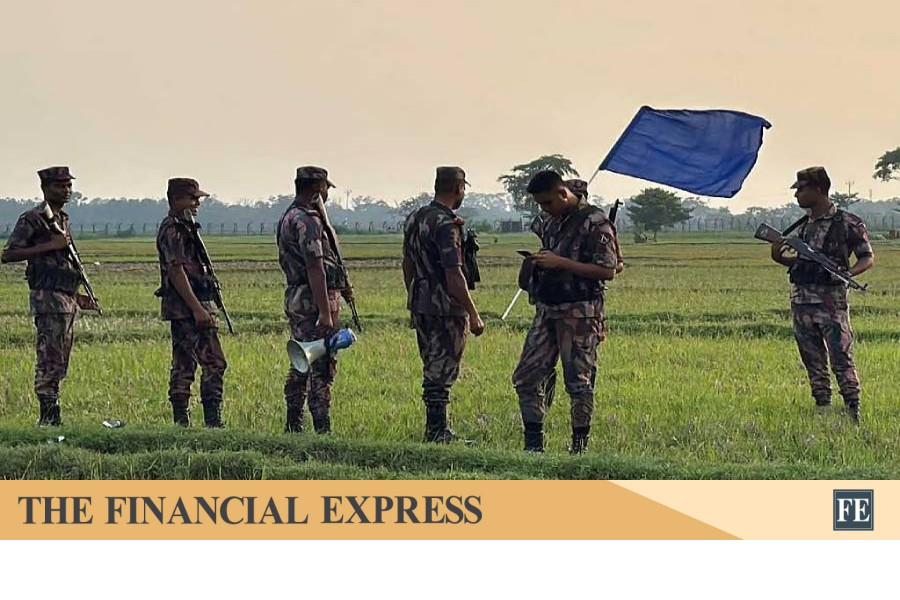
[🇧🇩] Terrorist BSF is pushing Indian Nationals into Bangladesh

[🇧🇩] Terrorist BSF is pushing Indian Nationals into Bangladesh
77
2K
More threads by Saif

G Bangladesh Defense

West Bengal Muslims crowding border, eager to enter Bangladesh: IAB
United News of Bangladesh . Dhaka 29 May, 2026, 19:29

1780187603624.webp


Islami Andolan Bangladesh’s joint secretary general and spokesperson Maulana Gazi Ataur Rahman has said that after the BJP came to power in the Indian state of West Bengal, it has spread extreme religious hatred.

In a statement on Friday, he alleged that the new West Bengal government is using the state and federal administration against Muslims.

He also alleged that social hostility toward Muslims has been incited.

As a result, he claimed, the number of persecuted people gathering at the Bangladesh border in West Bengal has increased, as many want to leave India.

He expressed strong condemnation and concern over what he described as ethnic hatred and displacement in this era of modern civilization.

He said that, until 1947, West Bengal and present-day Bangladesh were part of the same country. Even after the partition, there are many people on both sides whose roots and histories remain connected across the border. ‘This is an unavoidable reality of partition.’

Displacing people on the excuse that they once had an address in Bangladesh is neither lawful nor humane, he said.

He further alleged that the BJP government in West Bengal was carrying out such actions. He urged the Bangladesh government to raise the issue in the international arena, saying Bangladesh cannot become a victim of anyone’s political ambitions.

Referring to the ongoing Rohingya crisis, he said that Bangladesh is already burdened with endless challenges and does not have the capacity to take in new refugees.

He called for the matter to be discussed internationally and for resistance to be built against what he termed the inhuman act of displacing people.​
 

BSF attempts to ‘push in’ 13, including women and children, through Jashore border

Jashore Office
Published: 01 Jun 2026, 23: 01

1780360175554.webp

BSF tries to push 13 people into Bangladesh across Sadipur border in Sharsha Upazila, Jashore on 1 June 2026Prothom Alo

India’s Border Security Force (BSF) has attempted to push 13 people, including women and children, into Bangladesh through the Sadipur border in Sharsha upazila of Jashore.

However, the Border Guard Bangladesh (BGB) said the group was unable to enter the country due to heightened vigilance along the frontier.

The 13 individuals are currently stranded in the no-man’s-land between Bangladesh and India. Neither country has allowed them to cross the border. As of Monday evening, they were seen remaining under the open sky in the border area.

A flag meeting at deputy commander level between the BGB and BSF was held at the Sadipur border on Monday evening following the incident.

Lieutenant Colonel Saiful Alam Khan, commanding officer of the Jashore-49 BGB Battalion, told Prothom Alo, “The BSF attempted to push at least 13 people into Bangladesh last night. We will not allow them to enter Bangladesh. We made our firm position clear during the flag meeting.”

He added, “We have informed the BSF that if they are Bangladeshi citizens, they should be sent through the proper state-to-state process, in which case we will accept them. Otherwise, we will not tolerate attempts to push them across the border illegally. We will not allow anyone to cross Bangladesh’s zero line unlawfully.”

According to BGB sources, the BSF opened a gate in the border fence in the Jayantipur border area of India’s North 24 Parganas district on Sunday night and attempted to send several women, men and children into Bangladesh. They were gathered near the Sadipur border area along the Benapole frontier.

Sensing the move, a BGB patrol team that had already been on alert quickly reached the spot and foiled the attempt.​
 

10 stranded in no-man’s-land after BSF ‘push-in’ attempt

bdnews24.com

Published :
Jun 02, 2026 20:08
Updated :
Jun 02, 2026 20:08

1780443840367.webp


Ten men, women, and children have remained stranded in the India-Bangladesh zero line for two days after being allegedly pushed in by India’s Border Security Force (BSF) through the Benapole border

A flag meeting between the Border Guard Bangladesh (BGB) and BSF held on Monday evening failed to resolve the situation.

As a result, the group has been forced to stay under a tree in the no-man’s-land between the two countries, unable to move in either direction.

Lt Col Golam Mohammad Saiful Alam Khan, commander of the 49 BGB Battalion, visited the Benapole border on Tuesday.

Speaking to reporters afterwards, he said: “We have informed the BSF that if they are Bangladeshi citizens, they should be sent through the proper state process and we will accept them.

“We will not accept any attempt to send people across illegally. We will not allow anyone to cross into Bangladesh through the zero line in this manner.”

According to the BGB, the group was allegedly pushed towards Bangladesh through a barbed-wire gate late on Monday night.

After learning of the incident, BGB personnel blocked their entry.

The force said the first attempt was made through the Jayantipur border in Benapole. That effort failed after intervention by BGB members.

The BSF later allegedly opened several other border gates during the night and made multiple attempts to send the group across, but those efforts were also thwarted by BGB personnel and local residents.

The BGB claimed that border searchlights near the gate used in the alleged push-in attempt had been switched off beforehand.

Following the incident, the BGB said security and vigilance had been increased along the Benapole border and adjoining areas.

Public awareness announcements have also been made in border villages.​
 

India’s push-in attempts risk derailing thawing ties

Established procedures must be followed to manage border crossings

1780450956030.webp

VISUAL: STAR

Recent developments along India’s border with Bangladesh have become a critical issue with the potential to escalate into a diplomatic crisis. The latest statement by State Minister for Foreign Affairs Shama Obaed that “the BGB has firmly resisted three to four push-in attempts” confirms reports of a surge in efforts by Indian border authorities to push so-called illegal migrants into Bangladesh. Such actions are not only unacceptable but also violate international laws and protocols governing cross-border movement.

Since the Bharatiya Janata Party’s (BJP) recent electoral successes in the state legislative elections in West Bengal and Assam, anti-migrant rhetoric has taken on a more aggressive tone. In West Bengal, Chief Minister Suvendu Adhikari announced a policy of “detect, delete, and deport” to deal with alleged “illegal infiltrators” and called for the establishment of so-called “holding centres” across districts. Reports suggest that attempts to deport undocumented individuals have intensified in line with this campaign. Even more concerning are reports indicating that some individuals whose names have been removed from voter rolls on various grounds fear detention in these centres. As a result, some are reportedly attempting to cross into Bangladesh illegally.

Earlier, Assam Chief Minister Himanta Biswa Sarma triggered diplomatic tensions with Bangladesh through a series of controversial remarks on border control and illegal migration. In one instance, Sarma claimed that his government routinely transported alleged illegal migrants to the border and left them inside Bangladeshi territory at night. The statement prompted Bangladesh’s Ministry of Foreign Affairs to summon the Acting Indian High Commissioner Pawan Badhe, and lodge a formal protest. Dhaka described Sarma’s comments as “disparaging” to bilateral relations.

Whether through forced push-ins or individuals fleeing across borders without valid travel documents, such actions violate established procedures governing migration and border management. These practices also pose risks to our national security. In this context, State Minister Shama Obaed’s assertion that the Border Guard Bangladesh (BGB) will continue to resist push-in attempts is both justified and appropriate. She is also correct in emphasising that Bangladesh cannot accept any individual without proper verification of nationality, particularly given past instances in which India’s Supreme Court found that the Border Security Force (BSF) had wrongfully pushed Indian nationals into Bangladesh.

It is also worth noting that New Delhi’s complaints regarding delays in the nationality verification process often overlook practical constraints such as limited consular access, legal requirements, and discrepancies in identity records. These factors can significantly slow the process and should not be interpreted as unwillingness on Bangladesh’s part to cooperate.

The developments unfolding along the border appear inconsistent with New Delhi’s recent efforts to improve relations with the new government of Prime Minister Tarique Rahman after bilateral ties suffered considerably following the fall of Sheikh Hasina. It is therefore incumbent upon India’s central government and BJP leadership to ensure that state-level authorities refrain from inflammatory rhetoric and adhere to established international norms in addressing undocumented migration. Failure to do so risks transforming an already sensitive issue into a full-blown diplomatic crisis.​
 

India ramps up push-in bids after BJP win in WB

Bangladesh for nationality verification: HM

Staff Correspondent 02 June, 2026, 23:47

1780451754167.webp

Members of Border Guard Bangladesh, led by 49 BGB commander Lieutenant Colonel Golam Mohammad Saiful Alam Khan, patrol the Benapole border at Sharsha in Jashore on Tuesday after 10 men, women and children allegedly pushed into Bangladesh by India’s Border Security Force remained stranded at the border’s zero line for a second day. | Star Mail photo

India keeps making fresh bids to push people into Bangladesh unlawfully after India’s ruling Bharatiya Janata Party’s landslide election victory in the West Bengal state in early May.

  • 2,463 pushed into Bangladesh in a year
  • HM says no repatriation without verification
  • Border tensions rise after West Bengal polls
  • 34 Bangladeshis killed along border in 2025

The Border Guard Bangladesh recently foiled several Indian push-in attempts while the Indian Border Security Force has reportedly gathered many people along the border to force them into Bangladesh as its nationals without verification.

Besides push-ins, other hostile incidents -- including the rise in border killing by the BSF, installing poles within 150 yards in the no-man’s-land, tensions between Bangladeshis and the BSF -- have risen following the BJP election victory in West Bengal.

On Monday, BGB members foiled several attempts by the BSF to push more than 100 people into Bangladesh through the Benapole border in Jashore district.

The BSF assembled the people, including men, women, and children, on the Indian side of the border along Benapole Land Port in Jashore, reported New Age Jashore correspondent quoting BGB-49 Battalion commanding officer Lieutenant Colonel Saiful Islam Khan as saying.

Of them, 10 people, including a 9-month infant, spent two nights under the open sky at a bushy place along the Indian frontier as they were pushed into the zero-line area after removing the iron fence erected by the Indian authority.

On May 27, tensions erupted between the BGB and the BSF over an attempted push-in of 14 individuals into Bangladesh at the Boraibari border in Rowmari upazila of Kurigram district.

According to New Age statistics, 2,463 people were pushed into Bangladesh by Indian authorities, mostly the BSF, from May 7, 2025 to May 8, 2026.

Of them, at least 223 were Rohingyas, including 50 registered with the United Nations High Commissioner for Refugees in India.

But BGB headquarters data reveal that India pushed 2,344 people, including 126 Indian nationals, into Bangladesh between May 7, 2025 and January 26, 2026.

BGB officials, however, claimed that no push-in incident took place from India after January 26 this year.

On May 8, the BSF pushed 10 more people, including children and women, into Bangladesh through a Kulaura upazila border point in Moulvibazar district.

Home minister Salahuddin Ahmed on Tuesday said that Dhaka was against any kind of illegal push-in or push-back while the BGB was now on alert along the border.

He was responding to a question from a journalist at the secretariat over the BSF’s mobilisation of people along border to push them into Bangladesh claiming them to be Bangladeshis.

‘If any Bangladeshi citizen has gone to India for any reason and if Indian authorities have conducted NID verification and the central government has made a list and sent it to the Bangladesh foreign ministry, the foreign ministry would follow the repatriation process according to legal procedure,’ said Salahuddin.

He hastened to add that no such list was pending with the Bangladesh government.

‘We would have addressed it legally if such a list was pending with Bangladesh earlier,’ the home minister added.

Meanwhile, the 57th four-day director general-level talks between the BGB and the BSF are scheduled to be held in New Delhi from June 8 to June 11.

Killing of Bangladeshis by the BSF along the border, pushing people into Bangladesh unlawfully, and repatriating illegal migrants would be high on the agenda in the talks, according to BGB headquarters officials.

Despite repeated pledges by the neighbouring country to bring the number of border killings down to nil, the killing of Bangladeshis by the BSF and Indian citizens along the border in 2025 marked the highest point in the past five years.

According to human rights organisation Ain O Salish Kendra’s yearly human rights report, 34 Bangladeshis were killed by the BSF in 2025. Of them, 24 were killed in BSF firing and 10 others died after suffering physical torture by the BSF.

The ASK data show that the number of border killings was 30 in 2024, 31 in 2023, 23 in 2022, and 18 in 2021.

According to Bangladesh authorities, Bangladesh shares 4,156-kilometre-long border with India, of which some 180 kilometres fall on different water bodies and 79 kilometres on the Sundarbans.

On May 24, the West Bengal government handed over an initial 75 acres of land to the BSF to raise fences along 27 kilometres of the international border between India and Bangladesh, reported The Times of India on May 25.

West Bengal chief minister Suvendu Adhikari, who had earlier promised to start the land handover process after the BJP government assumed office, said that the completion of the critical, long-pending fencing along the India-Bangladesh border would be crucial to national security, added the report available online.

Of the 75 acres of land, 43 acres were directly purchased while 32 acres were vested property.​
 

What can stop India's push-ins?

Jannatul Naym Pieal

On 24 May, loudspeakers crackled across the paddy fields of Brahmanbaria as dusk settled. Residents were told to stay alert. Report suspicious movements. Watch the riverbanks.

It was an unusual instruction for a border that has long been defined by its permeability — by history, by family, by labour. But Border Guard Bangladesh’s public awareness campaign in the frontier villages of Brahmanbaria was a direct response to the new political reality unfolding on the other side.

In West Bengal, a new BJP government had just taken power with a single dominant message: detect, delete, deport. Within days, authorities began setting up holding centres and intensifying enforcement, triggering panic among people lacking proper identification documents.

By late May, hundreds of people had gathered at key crossing points such as the Hakimpur checkpoint in North 24 Parganas, with reports of long queues as they attempted to “return” to Bangladesh.

The seismic shift in West Bengal

For years, the most significant structural obstacle to India’s anti-immigration agenda along the Bangladesh border was West Bengal. Under Mamata Banerjee’s Trinamool Congress government, the state repeatedly clashed with the Centre — refusing to hand over land to the Border Security Force for fencing, declining to implement the National Register of Citizens, and publicly rejecting what Banerjee described as the criminalisation of Bengali-speaking people.

The human cost is already well documented. In late 2025, Bangladeshi authorities recovered 14 people in Chuadanga who claimed to be residents of Odisha, not Bangladesh. They alleged that Indian police had confiscated their Aadhaar cards and ration documents before forcing them across the border.
That friction is now gone.

On 4 May, the Bharatiya Janata Party swept the West Bengal Assembly elections, securing 207 of 294 seats and ending fifteen years of TMC rule. On 9 May, Suvendu Adhikari — the former TMC leader-turned-BJP strongman who had campaigned vigorously on driving out “infiltrators” — was sworn in as the state’s first-ever BJP Chief Minister at Brigade Parade Ground in Kolkata. Prime Minister Narendra Modi and Home Minister Amit Shah attended the ceremony, signalling strong central backing for the new regime.

The pace of change that followed was striking.

In its very first cabinet meeting, the Adhikari government committed to transferring land to the BSF for border fencing within 45 days — a move the previous administration had resisted for over a decade. Progress was swift: by 20 May, land for a 27-kilometre stretch had been handed over. By 27 May, the total had reached 142.79 acres, with work on outposts and barbed-wire fencing already underway. The government also transferred over 120 hectares in the strategically vital Siliguri Corridor to the Centre.

Simultaneously, all 23 district magistrates were directed to establish holding centres for suspected undocumented migrants on 24 May. Within a week, at least 386 detainees were being held across 13 such centres in eight border districts.

Unlike Assam, where suspected foreigners are supposed to be produced before Foreigners’ Tribunals, West Bengal’s new policy reportedly bypasses court proceedings for many detainees prior to deportation. Chief Minister Adhikari was explicit: those falling outside the purview of the Citizenship Amendment Act “will be treated as infiltrators” and handed over to the BSF.

Bangladesh’s response

Remarkably, Bangladesh has not remained passive.

At the operational level, the Border Guard Bangladesh (BGB) acted swiftly. The 60th Battalion launched public awareness campaigns using loudspeakers in frontier villages of Brahmanbaria district, urging residents to report suspicious movements and stay vigilant along riverbanks. Patrols were intensified across multiple sectors, and intelligence monitoring was expanded.

1780534937489.webp

BGB steps up surveillance along the Jashore border to prevent push-ins and rawhide smuggling.

In a notable incident at the Sadipur border in Benapole on 31 May, 2026, BGB personnel foiled an alleged attempt by members of the Indian Border Security Force (BSF) to push 13 people — including women and children — into Bangladesh by opening a section of the border fence. The BGB immediately placed the entire border on maximum alert. A flag meeting was held, but no immediate resolution was reached, leaving the stranded individuals in no-man’s land.

According to BGB data, 2,479 people were pushed into Bangladesh from India during the eight-month period from 7 May last year to 26 January this year. Not all were Bangladeshi nationals; at least 120 were later identified as Indian citizens, while some were also Rohingya refugees. Bangladeshi authorities have protested such instances, describing them as violations of bilateral border management agreements and international human rights norms.

On 12 May, 2025 Bangladesh sent a detailed diplomatic note to New Delhi, reaffirming that it has consistently repatriated verified Bangladeshi nationals through formal channels. The note highlighted India’s own delays — including restricted consular access to jails, name mismatches on deportation lists, and procedural lapses — as key contributors to the backlog of 2,868 unresolved nationality verification cases cited by India’s Ministry of External Affairs.

In response to the recent push-in attempts, State Minister for Foreign Affairs Shama Obaed was categorical: “We will in no way accept push-ins of people.” She reminded New Delhi of assurances given after the West Bengal elections that further push-ins would not occur — a commitment Dhaka is now publicly holding India to. “If not,” she warned, “we will discuss it at a political and diplomatic level.”

The broader stakes

To grasp the full significance of this border crisis, it is essential to look beyond day-to-day operations and examine the deeper structural forces at play.

First, there is the political economy of push-ins. India’s shift from judicial deportation to administrative “pushbacks” — formalised under the Immigration and Foreigners Act 2025 — was deliberately designed to be faster, cheaper, and less accountable than court-supervised repatriation. With no FIR, no court hearing, and often no proper nationality verification, the system carries an inherent risk of error. Those errors are effectively exported to Bangladesh.

The people most at risk — and the hardest to assist — are those trapped in legal limbo, unable to prove their nationality on either side. Take 20-year-old Abdul Sheikh, for instance. Born in Kolkata to Bangladeshi parents, he holds no valid documents for either country. He represents tens of thousands in similar situations: neither readily deportable under Bangladesh’s rules nor protected under India’s. For them, the crisis offers no clear bureaucratic exit.
The human cost is already well documented. In late 2025, Bangladeshi authorities recovered 14 people in Chuadanga who claimed to be residents of Odisha, not Bangladesh. They alleged that Indian police had confiscated their Aadhaar cards and ration documents before forcing them across the border.

Even more emblematic is the case of Amina Begum, a 68-year-old woman from Barpeta, Assam. Despite her entire family being recognised as Indian citizens, she was declared a foreigner by a tribunal and pushed into Bangladesh under cover of night. A year later, she struggles to walk without support and lives in constant fear of rearrest. Her story is not an outlier — it is symptomatic of a systemic issue.

Second, there is the question of whom this crisis truly serves politically and whom it harms structurally. The BJP’s “Bangladeshi infiltrators” rhetoric has been explicitly framed around religious identity. Undocumented Hindu migrants are often treated as refugees eligible for protection under the Citizenship Amendment Act (CAA), while Muslim migrants are labelled infiltrators subject to deportation. Thus, this is less about neutral border management and more about demographic politics — with Bangladesh positioned as the pressure valve.

Third, there is the regional and geographical dimension. The India–Bangladesh border stretches over 4,000 kilometres, weaving through rivers, farmland, and densely populated villages. Roughly 860 kilometres remain unfenced. The new West Bengal government is now aggressively pursuing border fencing, handing over land that the previous TMC administration had withheld for more than a decade. Bangladesh has objected, citing the 1975 bilateral border guidelines, which prohibit defence structures within 150 yards of the boundary. The fencing issue alone holds the potential for prolonged confrontation along the frontier.

What will really happen at the border?

In the near term, pressure along the border is likely to intensify before any easing occurs.

The new West Bengal government has made clear its intention to escalate enforcement. Home Minister Amit Shah is expected to visit the state’s border districts in June to review security arrangements personally. Holding centres are being rapidly expanded, and there are active discussions in Indian political circles about bypassing these centres altogether and directly handing over detainees to the BSF for immediate transfer. Such a move would eliminate virtually all remaining administrative safeguards.

1780534990933.webp

Border Guard Bangladesh (BGB) thwarted an alleged attempt by India’s Border Security Force (BSF) to push around 10 to 12 people, including women and children, into Bangladesh through the Sadipur border in Benapole on 31 May 2026.

On the Bangladeshi side, the BGB has signalled that it will continue to physically resist push-in attempts, as it has already done on multiple occasions. However, guarding every stretch of the 4,000-kilometre border is practically impossible — particularly along riverine sections where, as one BSF official admitted to AFP, “it is not difficult to cross”. The likely outcome is a persistent cycle of attempted push-ins: some foiled at the fence, others slipping through, with each incident adding to the growing tally of diplomatic protests and grievances.

The people most at risk — and the hardest to assist — are those trapped in legal limbo, unable to prove their nationality on either side. Take 20-year-old Abdul Sheikh, for instance. Born in Kolkata to Bangladeshi parents, he holds no valid documents for either country. He represents tens of thousands in similar situations: neither readily deportable under Bangladesh’s rules nor protected under India’s. For them, the crisis offers no clear bureaucratic exit.

The June 8–11 talks: What to expect

The 57th Director General-level BGB-BSF conference, scheduled for 8–11 June in New Delhi, comes at a particularly critical juncture. It is the first such meeting since Bangladesh’s new BNP government under Prime Minister Tarique Rahman took office in February, and the first since the BJP strengthened its hold across India’s eastern border states.

Dhaka is sending a high-powered 15-member delegation — unusually heavyweight for a routine border management meeting. Alongside senior BGB officers, the team includes representatives from the Prime Minister’s Office, the Ministries of Home Affairs, Foreign Affairs, and Shipping, the Land Survey Department, and the Joint Rivers Commission. The composition signals that Bangladesh intends to raise issues that go well beyond standard border security matters.

The formal agenda includes border fencing, cross-border crimes, and the handover of irregular migrants. However, three issues are expected to dominate Bangladesh’s interventions.

The first is push-ins. Bangladesh will press India to commit to formal, bilaterally agreed repatriation procedures — rejecting court-bypassing tactics, overnight forced crossings, and deportees left stranded in no-man’s land. Given India’s clear preference for administrative speed over judicial oversight, a binding commitment is unlikely. Still, the language in the joint record of discussions (to be signed on 11 June) will be important. A firm reaffirmation of existing bilateral protocols could at least create a useful diplomatic paper trail.

None of this will be quick or guaranteed. But the alternative — a hardening border defined by fear, loudspeakers, and midnight river crossings — is a crisis destined to outlast any election cycle.
The second issue is border killings. Rights group Ain O Salish Kendra documented at least four Bangladeshis killed by BSF firing in the first four months of 2026. Meanwhile, Manabadhikar Shongskriti Foundation reported that in May alone, four Bangladeshis were killed by the BSF — three by gunfire and one through torture. It also recorded the recovery of the bodies of a fisherman and an unidentified woman, as well as the stabbing death of a young man near the frontier, bringing the total number of Bangladesh–India border-related deaths in May to seven. Between 2009 and 2023, the total number of Bangladeshi fatalities along the border stood at 594. The BGB has stated that it will “strongly raise” the issue. Past DG-level meetings have repeatedly produced commitments to reduce such incidents, yet measurable progress has been limited.

The third is the longstanding nationality verification backlog. While India’s Ministry of External Affairs claims that Bangladesh has failed to provide an “actionable response” to 2,868 pending cases since September 2020, Bangladesh, as noted earlier, has its own counterargument. Both sides agree that a lasting solution requires a joint verification mechanism with clear timelines, but neither has yet put forward a concrete proposal.

The talks are expected to end with a measured joint statement affirming cooperation, pledging to reduce killings, and reiterating commitment to formal repatriation channels. Whether these words translate into meaningful changes on the ground — especially in West Bengal — will ultimately depend on political will in New Delhi, which has so far been conspicuously absent.

Is there a solution in sight?

The honest answer is that a solution is not imminent.

India’s sharpened domestic migration politics, now energised by the BJP’s sweeping victory in Bengal, and the absence of a comprehensive bilateral repatriation framework with clear legal safeguards and verification procedures are major hurdles to a solution.

On the Indian side, the incentives point away from compromise. The “detect, delete, deport” slogan was never mere campaign rhetoric — it has become active policy in West Bengal, Assam, and at the Centre.

1780535053295.webp

India pushed 300 people across the border in three days in 2025, raising security concerns in Bangladesh.

On the Bangladeshi side, the new BNP government under Prime Minister Tarique Rahman has displayed greater resolve than its predecessor. Still, it must also manage a delicate reset in relations with New Delhi. Dhaka seeks practical cooperation on trade, water-sharing, transit, and the Teesta River. Escalating the migration issue into open confrontation could jeopardise these broader interests. Bangladesh’s carefully calibrated response — firm in principle, measured in tone — reflects the tightrope it is walking.

Nevertheless, a narrow path to partial resolution does exist. It rests on three essential steps.

First, the establishment of a jointly agreed nationality verification mechanism with clear, fixed timelines. This would allow the backlog of cases to be cleared systematically and prevent new cases from piling up. It is technically feasible and would deliver verified repatriations for India while providing procedural protections for Bangladesh.

Second, a formal bilateral protocol — preferably elevated to a binding agreement — that prohibits pushbacks that bypass judicial processes. India’s own Supreme Court has ruled that deportations require proper legal oversight. Leveraging this through sustained diplomatic pressure and international attention remains Bangladesh’s strongest source of leverage.

Third, consistent international engagement. Organisations such as Human Rights Watch, Amnesty International, and UN human rights experts have already criticised India’s deportation practices. Sustained global scrutiny, including at forums in Geneva, can impose reputational costs that bilateral talks alone cannot achieve.

None of this will be quick or guaranteed. But the alternative — a hardening border defined by fear, loudspeakers, and midnight river crossings — is a crisis destined to outlast any election cycle.

However, the upcoming talks in New Delhi represent a significant opportunity for Bangladesh — perhaps the best in years. Whether India is prepared to listen is the question that the 8–11 June talks will begin to answer.

Jannatul Naym Pieal is a Dhaka-based writer, researcher and journalist.​
 

Latest Posts

Back