Global apparel buyers on Monday expressed concern over the Internet connection, which is still slow after the restoration of a weeklong cutoff during the violent anti-quota movement. They urged sector leaders and suppliers to ensure timely goods shipments and restore high-speed Internet and broadb
thefinancialexpress.com.bd
Internet woes hit garment exports as buyers fret
Global fashion brands sound alarm over BD supply chain disruptions
Monira Munni
Published :
Jul 30, 2024 09:31
Updated :
Jul 30, 2024 10:21
Global apparel buyers on Monday expressed concern over the Internet connection, which is still slow after the restoration of a weeklong cutoff during the violent anti-quota movement.
They urged sector leaders and suppliers to ensure timely goods shipments and restore high-speed Internet and broadband connections to enable effective communication with their headquarters, according to sources.
At a meeting with the Bangladesh Garment Manufacturers and Exporters Association (BGMEA) leaders at BGMEA headquarters in Dhaka's Uttara, the buyers also appealed to authorities and sector leaders to take proactive steps to prevent the ongoing situation from jeopardising Bangladesh's eligibility for GSP plus benefits in its largest export market, the European Union.
Ziaur Rahman, regional country manager of Swedish fast fashion clothing company H&M, Shwapna Bhowmick, regional head of British multinational retailer Marks and Spencer (M&S) and representatives from Inditex and Bestseller attended the meeting.
BGMEA President SM Mannan Kochi, vice-presidents Syed Nazrul Islam, Arshad Jamal Dipu, Abdullah Hil Rakib and Miran Ali were also present.
The BGMEA and buyers' forum pledged mutual support to mitigate the impact of recent disruptions, meeting sources said.
Speaking anonymously after the meeting, a buyer representative told The Financial Express that communication with headquarters remained problematic despite the Internet resumption on 24 July following a week-long blackout.
"Even during previous crises like Covid-19 and other political turmoils, the readymade garment industry was exempt from restrictions and high-speed Internet was available. But this time, the full cutoff of the Internet resulted in no communication," the representative said, adding that the overall communication breakdown could damage the country's image.
Another representative informed the meeting of difficulties in shipping containers to ports as rail communication is yet to resume.
Meeting sources said the GSP plus issue was also discussed, with participants urging BGMEA leaders to work closely with the government.
After the meeting with international retailers and brands, BGMEA President SM Mannan Kochi said the retailers and brands assured them that they will not seek any discount, air shipment or cancellation of work orders because of the latest spell of violence and suspension of production.
Earlier, he requested the buyers for the same issues.
Mr Kochi informed the meeting about BGMEA's engagement with the government to restore stability in the industry and added that they lost significant production and shipment during the closure, causing severe financial and supply chain impact at their end.
He said he assured the buyers that they were committed to meeting their expectations and doing everything within their limits to mitigate the impact of the recent disruptions.
"I urge them all to consider the extraordinary circumstances and show understanding towards their suppliers," he said, adding that any measures due to unexpected delay would only exacerbate challenges they were already facing.
When asked, H&M Regional Country Manager in Dhaka Ziaur Rahman said that H&M would not seek discounts for delays caused by factory closures and port congestion due to the Internet outage.
Meanwhile, local exporters and suppliers are now travelling to export destinations to reassure buyers of timely production and shipments following the reopening of factories and other services.
Talking to the FE, several exporters said buyers were concerned about the current and future situation, expressing worries about timely garment shipments due to violence and port delays.
Shovon Islam, managing director of Sparrow Apparels Ltd, told the FE that buyers were worried about the current situation and future developments.
He said he would travel to the US next week mainly to meet with two major buyers who had been silent about new work orders.
"I was expecting to see an increase in their orders, but they have not said anything specific. So I will fly over to convince them, as there were no delays in their previous shipments," he said.
Another exporter said a $1.5 million shipment from 14 July was still stuck at Benapole port due to customs clearance issues. They had sent an official to India to meet with a buyer who sourced about $25 million from their company.
American fashion companies are actively diversifying their apparel- sourcing base and exploring opportunities especially in India amid growing risks and market uncertainty in Bangladesh, says a latest US study. It cites shipping delays and supply-chain disruptions and 'managing geopolitics and oth
thefinancialexpress.com.bd
US cos shifting from BD in apparel sourcing
Monira Munni
Published :
Jul 31, 2024 01:04
Updated :
Jul 31, 2024 01:04
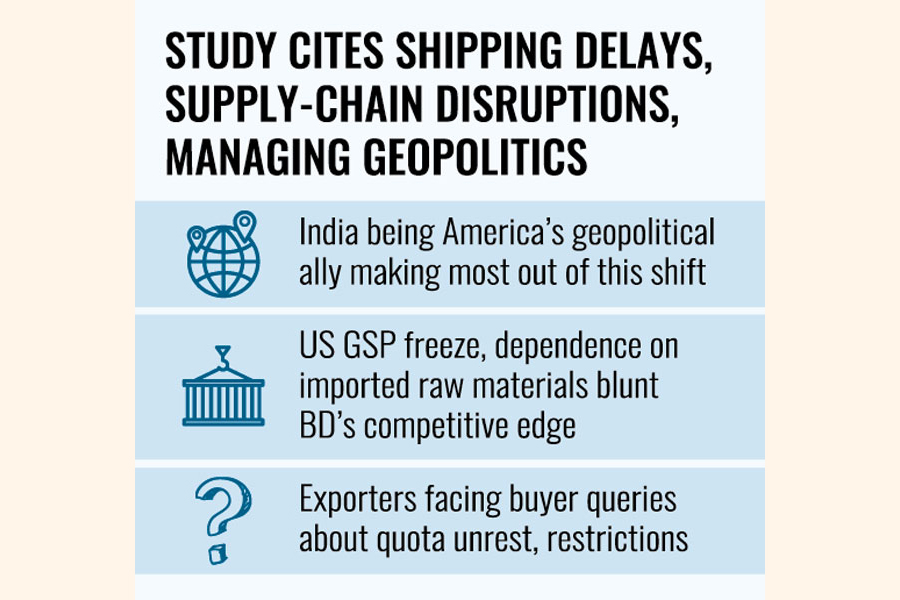
American fashion companies are actively diversifying their apparel- sourcing base and exploring opportunities especially in India amid growing risks and market uncertainty in Bangladesh, says a latest US study.
It cites shipping delays and supply-chain disruptions and 'managing geopolitics and other political instability' related to sourcing which have newly emerged among US brands and retailers as top five concerns in 2024.
They consider India as more competitive than most other Asian suppliers regarding vertical-integration capability, manufacturing flexibility, and agility.
"While China (100-percent utilization rate) and Vietnam (89-percent utilization rate) still lead, for the first time since 2014 we conducted the survey, more respondents reported sourcing from India (89-percent utilization rate) than from Bangladesh (86 per cent utilization rate)," reads the report.
India in 2024 ranked second from fourth in 2023 while Bangladesh ranked down to fourth position from third last year.
Titled '2024 Fashion Industry Benchmarking Study', the study report also reveals that nearly 60 percent of respondents plan to expand apparel sourcing from India over the next two years, exceeding the planned expansion from any other Asian country.
By leveraging its more advanced local textile-manufacturing capability, India's apparel exports to the United States relied much less on imported components than economically developed countries such as Bangladesh, Cambodia, and Vietnam, according to the report.
Additionally, as India is elevated as a strategic partner with the United States, sourcing from there "is perceived as involving relatively lower geopolitical risks".
On the other hand, about 48 per cent of respondents expressed an interest in expanding apparel sourcing from Bangladesh over the next two years, down from 52 per cent in 2023 and 58 per cent in 2022.
"The high social-compliance risks involved in sourcing from the country remained a key concern for respondents."
Citing example, it says the high-profile labour protests over the minimum wage increase in late 2023 brought Bangladesh's social- responsibility record in the garment sector back into the news headlines.
The report has quoted one respondent as commenting, "We monitor the situation closely. Meanwhile, as an apparel-sourcing base, Bangladesh is well-known for its price competitiveness. However, the country's export potential has been constrained by its limited product diversification beyond basic cotton items and knitwear."
Findings of the eleventh edition of the survey, jointly conducted by the United States Fashion Industry Association (USFIA) and the University of Delaware, were released Monday.
It surveyed executives from 30 leading fashion brands, retailers, importers, and wholesalers, including some of the largest brands and retailers in the country, from April to June 2024.
The report shows that a higher percentage of respondents sourced from Cambodia and Indonesia (each 75 per cent utilization rate) and Pakistan (61 per cent utilization rate) this year, with the gaps in their utilization rates compared to the top tier significantly narrowing.
"The results reveal that US fashion companies have been diversifying their sourcing base beyond China, Vietnam, and Bangladesh, even though companies are not necessarily leaving Asia."
In comparison, almost all respondents, 97 per cent, to be specific, say at least 40 per cent of their total sourcing value or volume now comes from Asian countries other than China.
Specifically, respondents commonly placed about 11-30 percent of their sourcing orders in large-scale apparel-supplying countries such as Vietnam, Bangladesh, and India.
Limited by manufacturing capability, other smaller-scale Asian countries such as Cambodia, Indonesia, and Pakistan typically accounted for 1-10 percent of a fashion companies' total sourcing value or volume.
Asked about the buyer shift, Fazlul Hoque, former president of Bangladesh Knitwear Manufacturers and Exporters Association (BKMEA), said it is concerning that Bangladesh is losing business to its competitors like China, Vietnam, India and Pakistan mainly because of high cost of production fuelled by high utility charges with severe shortage of energy, especially gas.
"Bangladesh competes only offering competitive prices whereas its competitors like China, India and Pakistan offer lowest price aggressively as they have their own raw materials," he said.
Local industry is facing high cost due to high gas and electricity prices while there is no adequate supply of energy while wages have been increased and interest rate goes up. All these erode their competitive edges.
"Even there is no prediction that the situation might improve and we have no options to minimize costs," he said, adding that situation is getting worse during last one year.
Another exporter says US big buyers are interconnected with their political parties and geopolitics matter in their sourcing patterns. And Bangladesh gets no duty benefit there.
Both the exporters expressed concern over the ongoing situation as they are getting queries from buyers over the present situation marked by anti-quota movement and violence-taming curfew.
Official figures from the Office of Textiles and Apparel (OTEXA) show that Bangladesh's readymade garment (RMG) exports to the US totalled $7.28 billion in 2023 in a 25.07-percent drop compared to the $9.72 billion earned in 2022.
Data showed that 2022 apparel earnings were almost double the 2013 earnings of $4.94 billion when the USA suspended its GSP facility for Bangladesh-made exportable goods on grounds of poor labour and safety standards immediately after the Rana Plaza building collapse.
Local RMG, however, does not enjoy the US GSP facility.
Bangladesh shipped clothing items worth $7.13 billion during January-December 2021, according to OTEXA data.
Bangladesh's apparel exports to the United States sustained a double-digit decline of 12.31 per cent in the first five months of 2024, reaching $2.90 billion.
On the other hand, India witnessed a 2.06-percent negative growth to earn US$2.08 billion during January-May period of 2024. Similarly, US apparel imports from India in 2023 had experienced negative growth of 21.42 per cent, reaching $4.46 billion. The figure was $5.69 billion in 2022, according to OTEXA data.
Bangladesh Textile Mills Association (BTMA) has called on the government to provide lower interest rate loans and suspend loan instalments for six months to help the industry recover from significant losses caused by the recent unrest. In a letter addressed to Finance Minister Abul Hassan Mahmood
thefinancialexpress.com.bd
Textile millers urge govt for loan relief amid financial crisis
FE Online Desk
Published :
Aug 01, 2024 19:41
Updated :
Aug 01, 2024 19:41
Bangladesh Textile Mills Association (BTMA) has called on the government to provide lower interest rate loans and suspend loan instalments for six months to help the industry recover from significant losses caused by the recent unrest.
In a letter addressed to Finance Minister Abul Hassan Mahmood Ali, BTMA highlighted the severe impact of the unrest on the export sector. The letter noted that garment factories have faced extensive closures during the two weeks of instability, leading to the cancellation of purchase orders, reduced production, worker absenteeism, and raw material shortages, reports UNB.
The garment factory owners are struggling to stay afloat amid these challenges, the letter said. With the monthly payroll for July due, the situation is dire, it said.
BTMA proposed a one-year bank loan at a maximum interest rate of 2.0 per cent to cover the current month's salaries. They warned that without this financial support, there could be disruptions in paying workers' wages and allowances.
In addition to salary support, BTMA requested similar loan terms for paying July's gas and electricity bills.
The association also demanded a suspension of existing loan instalments, arguing that the heavily affected export-oriented industry cannot bear the burden of term loan repayments. They urged the government to make all term loans interest-free for the next six months and to suspend instalment payments.
The deepening political crisis in the country has exacerbated the woes of apparel industry, with exporters facing difficulties in operating factories, shipping goods, and booking work orders.
www.thedailystar.net
Deepening political crisis adds to RMG woes
The deepening political crisis in the country has exacerbated the woes of apparel industry, with exporters facing difficulties in operating factories, shipping goods, and booking work orders.
Garment exporters fear that if their workers join the ongoing movement across the country, it will further dent the sector, which was hamstrung for four days when factories were completely shuttered due to violence in mid-July.
The sector also suffered serious repercussions two weeks ago because of a five-day internet blackout, which hindered communications between garment suppliers and international retailers and brands, meaning they could not make business deals or hold meetings.
Last week, international retailers and brands expressed concern at a meeting with the leaders of the Bangladesh Garment Manufacturers and Exporters Association (BGMEA), flagging the difficulties in communication with their headquarters and local suppliers.
They also pointed out that thousands of consignments were stuck at the Chattogram port for around a week.
Additionally, factories have been experiencing difficulties in booking work orders.
July, August and September are the peak months for the shipment of goods to be sold during the Christmas season. It is also when exporters book work orders for the following summer and spring seasons.
But because of the unrest that has persisted over the past two weeks, buyers are following a go-slow policy, which may continue in the near future.
For instance, the European Union (EU), Bangladesh's largest export destination, has already said it will not further negotiate with Bangladesh on a cooperation agreement in light of the present situation, which saw the deaths of at least 204 people, including students.
"We are apprehensive that garment workers may also be called to be involved in the movement," said former BGMEA President Md Shafiul Islam Mohiuddin.
Adding that hundreds of shipments could not be delivered on time, Mohiuddin said: "Altogether, we are in bad shape."
The garment sector, which was already struggling to recover from the severe fallouts of the Covid-19 pandemic, Russia-Ukraine war, Red Sea crisis and historic inflationary pressures on Western consumers, is now facing a domestic political crisis, he added.
Many have had to opt for expensive air shipments and provide discounts as they failed to ship goods timely due to a disruption in production following the internet blackout and shutdown of factories, he added.
"The biggest loss is the damage to the reputation of Bangladesh as a good supplying country. The country is now perceived as weak by international retailers and brands," said a European garment buyer, asking not to be named.
However, he added that his company was still booking work orders for upcoming seasons as factories are still operational.
He also said his company faced a shipment crisis as operations at the Chattogram port were moving at a snail's pace due to the internet disruption but added that shipments were now taking place smoothly.
He added that they would face further difficulties in shipment and placing work orders with local suppliers if the situation does not improve.
"My officers were sent to Chattogram to monitor the shipment problem as production was delayed, but they cannot return now in Dhaka," said a medium-level garment supplier, asking not to be named.
"The situation of booking work orders for next season is quite bad since I could not communicate with my buyers during the internet blackout," the factory owner added.
Arshad Jamal (Dipu), chairman of Tusuka Group, said the garment business is between two seasons as it is the peak time for the booking of work orders for next summer and spring as well as the peak time to send shipments ahead of Christmas.
He added that buyers were not willing to compromise on lead times.
Furthermore, the Red Sea crisis has also created a barrier to the timely shipment of goods.
Since October last year, international commercial vessels have had to travel an additional 3,500 kilometres around the Cape of Good Hope in Africa because of Houthi attacks along the Suez Canal, the main waterway between Asia and Europe.
This increased freight costs for international clothing retailers and brands.
American fashion companies are actively diversifying their apparel- sourcing base and exploring opportunities especially in India amid growing risks and market uncertainty in Bangladesh, says a latest US study. It cites shipping delays and supply-chain disruptions and 'managing geopolitics and oth
thefinancialexpress.com.bd
US cos shifting from BD in apparel sourcing
Monira Munni
Published :
Jul 31, 2024 01:04
Updated :
Jul 31, 2024 01:04 View attachment 7223
American fashion companies are actively diversifying their apparel- sourcing base and exploring opportunities especially in India amid growing risks and market uncertainty in Bangladesh, says a latest US study.
It cites shipping delays and supply-chain disruptions and 'managing geopolitics and other political instability' related to sourcing which have newly emerged among US brands and retailers as top five concerns in 2024.
They consider India as more competitive than most other Asian suppliers regarding vertical-integration capability, manufacturing flexibility, and agility.
"While China (100-percent utilization rate) and Vietnam (89-percent utilization rate) still lead, for the first time since 2014 we conducted the survey, more respondents reported sourcing from India (89-percent utilization rate) than from Bangladesh (86 per cent utilization rate)," reads the report.
India in 2024 ranked second from fourth in 2023 while Bangladesh ranked down to fourth position from third last year.
Titled '2024 Fashion Industry Benchmarking Study', the study report also reveals that nearly 60 percent of respondents plan to expand apparel sourcing from India over the next two years, exceeding the planned expansion from any other Asian country.
By leveraging its more advanced local textile-manufacturing capability, India's apparel exports to the United States relied much less on imported components than economically developed countries such as Bangladesh, Cambodia, and Vietnam, according to the report.
Additionally, as India is elevated as a strategic partner with the United States, sourcing from there "is perceived as involving relatively lower geopolitical risks".
On the other hand, about 48 per cent of respondents expressed an interest in expanding apparel sourcing from Bangladesh over the next two years, down from 52 per cent in 2023 and 58 per cent in 2022.
"The high social-compliance risks involved in sourcing from the country remained a key concern for respondents."
Citing example, it says the high-profile labour protests over the minimum wage increase in late 2023 brought Bangladesh's social- responsibility record in the garment sector back into the news headlines.
The report has quoted one respondent as commenting, "We monitor the situation closely. Meanwhile, as an apparel-sourcing base, Bangladesh is well-known for its price competitiveness. However, the country's export potential has been constrained by its limited product diversification beyond basic cotton items and knitwear."
Findings of the eleventh edition of the survey, jointly conducted by the United States Fashion Industry Association (USFIA) and the University of Delaware, were released Monday.
It surveyed executives from 30 leading fashion brands, retailers, importers, and wholesalers, including some of the largest brands and retailers in the country, from April to June 2024.
The report shows that a higher percentage of respondents sourced from Cambodia and Indonesia (each 75 per cent utilization rate) and Pakistan (61 per cent utilization rate) this year, with the gaps in their utilization rates compared to the top tier significantly narrowing.
"The results reveal that US fashion companies have been diversifying their sourcing base beyond China, Vietnam, and Bangladesh, even though companies are not necessarily leaving Asia."
In comparison, almost all respondents, 97 per cent, to be specific, say at least 40 per cent of their total sourcing value or volume now comes from Asian countries other than China.
Specifically, respondents commonly placed about 11-30 percent of their sourcing orders in large-scale apparel-supplying countries such as Vietnam, Bangladesh, and India.
Limited by manufacturing capability, other smaller-scale Asian countries such as Cambodia, Indonesia, and Pakistan typically accounted for 1-10 percent of a fashion companies' total sourcing value or volume.
Asked about the buyer shift, Fazlul Hoque, former president of Bangladesh Knitwear Manufacturers and Exporters Association (BKMEA), said it is concerning that Bangladesh is losing business to its competitors like China, Vietnam, India and Pakistan mainly because of high cost of production fuelled by high utility charges with severe shortage of energy, especially gas.
"Bangladesh competes only offering competitive prices whereas its competitors like China, India and Pakistan offer lowest price aggressively as they have their own raw materials," he said.
Local industry is facing high cost due to high gas and electricity prices while there is no adequate supply of energy while wages have been increased and interest rate goes up. All these erode their competitive edges.
"Even there is no prediction that the situation might improve and we have no options to minimize costs," he said, adding that situation is getting worse during last one year.
Another exporter says US big buyers are interconnected with their political parties and geopolitics matter in their sourcing patterns. And Bangladesh gets no duty benefit there.
Both the exporters expressed concern over the ongoing situation as they are getting queries from buyers over the present situation marked by anti-quota movement and violence-taming curfew.
Official figures from the Office of Textiles and Apparel (OTEXA) show that Bangladesh's readymade garment (RMG) exports to the US totalled $7.28 billion in 2023 in a 25.07-percent drop compared to the $9.72 billion earned in 2022.
Data showed that 2022 apparel earnings were almost double the 2013 earnings of $4.94 billion when the USA suspended its GSP facility for Bangladesh-made exportable goods on grounds of poor labour and safety standards immediately after the Rana Plaza building collapse.
Local RMG, however, does not enjoy the US GSP facility.
Bangladesh shipped clothing items worth $7.13 billion during January-December 2021, according to OTEXA data.
Bangladesh's apparel exports to the United States sustained a double-digit decline of 12.31 per cent in the first five months of 2024, reaching $2.90 billion.
On the other hand, India witnessed a 2.06-percent negative growth to earn US$2.08 billion during January-May period of 2024. Similarly, US apparel imports from India in 2023 had experienced negative growth of 21.42 per cent, reaching $4.46 billion. The figure was $5.69 billion in 2022, according to OTEXA data.
Indian companies can win a few one-off apparel orders because of unrest in Bangladesh, but they are structurally incapable of serving larger and more established buyers like H&M etc. in the longer term.
I won't go into the many reasons but we can discuss if there is interest.
There are Indian companies sitting in Bangladesh with established factories in fact.
A veritable tug-of-war ambiance over seizing market share in Bangladesh's one of the biggest sea routes stokes up concerns among the users, especially clothing exporters, about cost and time escalations. This route carries importance for the shipment from Bangladesh as it facilities four-day lead
thefinancialexpress.com.bd
Sharing tussles over major sea route worry exporters
Some foreign shippers desert Colombo-West transshipment route following rules tightening
Jasim Uddin Haroon
Published :
Aug 04, 2024 00:21
Updated :
Aug 04, 2024 00:26
A veritable tug-of-war ambiance over seizing market share in Bangladesh's one of the biggest sea routes stokes up concerns among the users, especially clothing exporters, about cost and time escalations.
This route carries importance for the shipment from Bangladesh as it facilities four-day lead time for the clothing exporters, in particular.
The fights between Bangladesh-flaged vessels and foreign ships began soon after the issuance of a rule under the Bangladesh Flag Vessels Act 2019 sometime in 2023 by the government of Bangladesh, sources in the shipping circles said.
The Chattogram-Colombo route leading to major markets handles more than 40 per cent of goods belonging to Bangladesh. The country's total external trade is believed to be worth US$120 billion.
The major international shipping route connects Bangladesh with its trading partners across the globe. After reaching Colombo, Sri Lanka, the cargos are loaded onto big vessels bound for different destinations in America and Europe.
When the government's implementing agency concerned, named MMD, enforced the rule tightly through showcases and penalties on foreign vessels, many foreign vessels withdrew from the route.
The rule provides for waiver certificate from the MMD for transporting goods belonging to Bangladesh. The certificate should have been taken 15 days earlier despite the fact that the one-side voyage needs to be completed in 3-4 days.
Before such execution of the rule called flat protection or protection of interests, there were more than 20 vessels, mostly foreign feeder vessels, plying the transshipment route.
Now it is trimmed to around 12 vessels, mostly Bangladesh-flagged vessels.
One of world's shipping giants -- CMA-CGM of France -- Tokyo-based ONE, Doha-based MALIHA and Dubai-based Unifeeder left the route. Many shipping executives blame the tussle between the local and foreign shipping companies for the situation.
The Flag Protection Act was enacted with the aim of transporting 50 per cent of the country's merchandise on domestic vessels, including the state-owned Bangladesh Shipping Corporation (BSC) ships.
"But the BSC does not have any single-container ship and, as such, it is impossible to transport 50 per cent of goods by domestic ships," says one of the trade sources.
One local flag-vessel company, HR Line, now dominates the cargo-haulage route.
Contrarily, one leading foreign line, X-press Line of Singapore, is struggling to survive on the route despite the fact that the relevant UN body is in favour of maintaining a level playing field for all.
As per the UNCTAD, 40 per cent can be protected for the local vessels, 40 per cent belong to the trading-partner vessels and the remaining 20 per cent to be kept open for grabs.
As the foreign vessels are leaving the route, port-users apprehend "monopoly" from local shipping companies on the vital part of the country's foreign-trade processing.
Garment manufacturers that employ more than 5.0 million people, mostly women, in the jobs-scant economy, raised their voice few times against the execution of the rule, arguing this will impact their shipments.
Syed Nazrul Islam, a first vice president of BGMEA, the apex body of garment producers, told the FE that they had expressed their concern many times on the issue as they believe their goods delivery may be affected once there be shortage of vessels meant for the Ctg-Colombo route.
"We produce clothing for different seasons, and once there are delays in reaching the goods, the buyers will not pay as we had contracted them."
Mr. Islam notes that once they fail due to poor number of vessels on the route, delivery of goods will be impacted and buyers will not give them orders for the next season.
He mentions that this route is very much important for them as they enjoy 4-day lead time.
One senior official at HR Line, when met its Dhaka office, told the FE correspondent that they are still having a much lower share than they should have enjoyed under the rule.
"Actually we don't get any special privilege," he said.
Asked about the penalties imposed on the foreign ships, he said that the penalties should have been much more.
The shipper, however, informed that Unifeeder was their own agency and they requested them to withdrew as there is no good business for the line there.
The World Shipping Council issued another letter urging the government to amend some sections of the rule, on a note of concern over the fist-tightening.
The Singapore office of the Washington-based navigation organisation called for relaxation of several terms and conditions laid down in the law. It referred to the provision of obtaining waiver certificate in 15 days prior schedule.
President of BCSA or Bangladesh Container Shipping Association Mr. Fayaz told the FE that many internationally reputed shipping companies left the route.
He said local HRL has only 8.0-9.0-percent share. "In future any big shipping company will not come."
Captain Sabbir Mahmood, principal officer of the MMD, could not be contacted after reaped attempts for his comment on what looks like a tug-of-war ambiance over the seafaring.
A veritable tug-of-war ambiance over seizing market share in Bangladesh's one of the biggest sea routes stokes up concerns among the users, especially clothing exporters, about cost and time escalations. This route carries importance for the shipment from Bangladesh as it facilities four-day lead
thefinancialexpress.com.bd
Sharing tussles over major sea route worry exporters
Some foreign shippers desert Colombo-West transshipment route following rules tightening
Jasim Uddin Haroon
Published :
Aug 04, 2024 00:21
Updated :
Aug 04, 2024 00:26
A veritable tug-of-war ambiance over seizing market share in Bangladesh's one of the biggest sea routes stokes up concerns among the users, especially clothing exporters, about cost and time escalations.
This route carries importance for the shipment from Bangladesh as it facilities four-day lead time for the clothing exporters, in particular.
The fights between Bangladesh-flaged vessels and foreign ships began soon after the issuance of a rule under the Bangladesh Flag Vessels Act 2019 sometime in 2023 by the government of Bangladesh, sources in the shipping circles said.
The Chattogram-Colombo route leading to major markets handles more than 40 per cent of goods belonging to Bangladesh. The country's total external trade is believed to be worth US$120 billion.
The major international shipping route connects Bangladesh with its trading partners across the globe. After reaching Colombo, Sri Lanka, the cargos are loaded onto big vessels bound for different destinations in America and Europe.
When the government's implementing agency concerned, named MMD, enforced the rule tightly through showcases and penalties on foreign vessels, many foreign vessels withdrew from the route.
The rule provides for waiver certificate from the MMD for transporting goods belonging to Bangladesh. The certificate should have been taken 15 days earlier despite the fact that the one-side voyage needs to be completed in 3-4 days.
Before such execution of the rule called flat protection or protection of interests, there were more than 20 vessels, mostly foreign feeder vessels, plying the transshipment route.
Now it is trimmed to around 12 vessels, mostly Bangladesh-flagged vessels.
One of world's shipping giants -- CMA-CGM of France -- Tokyo-based ONE, Doha-based MALIHA and Dubai-based Unifeeder left the route. Many shipping executives blame the tussle between the local and foreign shipping companies for the situation.
The Flag Protection Act was enacted with the aim of transporting 50 per cent of the country's merchandise on domestic vessels, including the state-owned Bangladesh Shipping Corporation (BSC) ships.
"But the BSC does not have any single-container ship and, as such, it is impossible to transport 50 per cent of goods by domestic ships," says one of the trade sources.
One local flag-vessel company, HR Line, now dominates the cargo-haulage route.
Contrarily, one leading foreign line, X-press Line of Singapore, is struggling to survive on the route despite the fact that the relevant UN body is in favour of maintaining a level playing field for all.
As per the UNCTAD, 40 per cent can be protected for the local vessels, 40 per cent belong to the trading-partner vessels and the remaining 20 per cent to be kept open for grabs.
As the foreign vessels are leaving the route, port-users apprehend "monopoly" from local shipping companies on the vital part of the country's foreign-trade processing.
Garment manufacturers that employ more than 5.0 million people, mostly women, in the jobs-scant economy, raised their voice few times against the execution of the rule, arguing this will impact their shipments.
Syed Nazrul Islam, a first vice president of BGMEA, the apex body of garment producers, told the FE that they had expressed their concern many times on the issue as they believe their goods delivery may be affected once there be shortage of vessels meant for the Ctg-Colombo route.
"We produce clothing for different seasons, and once there are delays in reaching the goods, the buyers will not pay as we had contracted them."
Mr. Islam notes that once they fail due to poor number of vessels on the route, delivery of goods will be impacted and buyers will not give them orders for the next season.
He mentions that this route is very much important for them as they enjoy 4-day lead time.
One senior official at HR Line, when met its Dhaka office, told the FE correspondent that they are still having a much lower share than they should have enjoyed under the rule.
"Actually we don't get any special privilege," he said.
Asked about the penalties imposed on the foreign ships, he said that the penalties should have been much more.
The shipper, however, informed that Unifeeder was their own agency and they requested them to withdrew as there is no good business for the line there.
The World Shipping Council issued another letter urging the government to amend some sections of the rule, on a note of concern over the fist-tightening.
The Singapore office of the Washington-based navigation organisation called for relaxation of several terms and conditions laid down in the law. It referred to the provision of obtaining waiver certificate in 15 days prior schedule.
President of BCSA or Bangladesh Container Shipping Association Mr. Fayaz told the FE that many internationally reputed shipping companies left the route.
He said local HRL has only 8.0-9.0-percent share. "In future any big shipping company will not come."
Captain Sabbir Mahmood, principal officer of the MMD, could not be contacted after reaped attempts for his comment on what looks like a tug-of-war ambiance over the seafaring.
There is no tug of war. We can't let foreign cargo carriers have unfair preference over our own flag vessels. If needed, we will buy/lease more container carrier ships (quite easy to do) and ship our own stuff. Money remains in Bangladesh. CMA/CGM and other container carrying shipping lines can find their own business in other countries.
We should give business preferentially to Bangladeshi shipping companies like HR, they are our taxpayers. Some foreign company Dalals are raising a big hoo-haa because their roti-kapra is being affected. No Dalali allowed anymore against national interest.

 Bangladesh Defense