[🇧🇩] Textile & RMG Industry of Bangladesh

[🇧🇩] Textile & RMG Industry of Bangladesh
480
21K
More threads by Saif

G Bangladesh Defense

Apparel exports to US surge to $4.25b in first six months of the year

Published :
Aug 08, 2025 15:20
Updated :
Aug 08, 2025 15:20

1754700469613.webp


From January-June this year, the US witnessed a modest increase in apparel imports, reaching $38.16 billion globally, reflecting a 6.74 per cent rise from the previous year.

Noteworthy changes in the number of units include a 4.26 per cent growth in SME and a 2.37 per cent increase in unit price.

Particularly, imports from Bangladesh surged to $4.25 billion, displaying a substantial growth rate of 25.12 per cent compared to the same period in 2024, according to a UNB report.

In the year 2025 May, Bangladesh's export to the US was US $547.42 million and on June 25 it is US $723.08 million, meaning growth is 32.09 per cent from May to June 2025, said Mohiuddin Rubel, former director, Brand BGMEA.​
 

Tariff math favours Bangladesh in shifting US trade landscape
The shift of the USA to reciprocal tariffs has shaken global trade. But for Bangladesh, it’s opened a rare window of opportunity


1754706832115.webp


When US President Donald J. Trump burst back onto the global trade stage, he brought with him a term that's now rattling old-school trade economists: reciprocal tariff. Think of it as "you charge us this much, we'll charge you the same"—a tit-for-tat pricing game that bypasses the World Trade Organization (WTO), the traditional referee of global trade rules.

While this move has left WTO purists in a daze, for some countries—Bangladesh included—there is a silver lining.

1754706875848.webp


After lengthy negotiations with the United States Trade Representative (USTR), the American government's chief trade negotiation body, Bangladesh has secured a 20 percent reciprocal tariff rate on its exports to the US. Add that to the existing 16.5 percent average US import duty, and you get a new effective tariff rate (ETR) of 36.5 percent, according to the Bangladesh Garment Manufacturers and Exporters Association (BGMEA).

Sounds high? Perhaps. But it's all about comparison. In a world where competitors are being slapped with tariffs as high as 50-60 percent, 36.5 percent starts to look like a discount.

A COMPETITIVE EDGE

In 2024, Bangladesh held 9.3 percent of the $85 billion US apparel market, a figure that could now rise significantly. Why? Because the reciprocal tariff system affects different countries in dramatically different ways, and for Bangladesh, it happens to be largely favourable.

The government and local private-sector entrepreneurs are optimistic. The new tariff rate is much lower than what other competing countries such as Vietnam, India, and China are facing. They have already noted that the new ETR will help boost Bangladesh's exports to the US, as American clothing retailers and brands will prefer Bangladesh as a sourcing destination due to its competitive tariff edge.

AK Azad, managing director of Ha-Meem Group, a major garment exporter to the USA, said the reduction of the tariff is a relief for him.

However, his American business partners are demanding a share of the additional tariff burden, which is squeezing his profit further. "It will take more time to absorb the additional tariff by the importing companies in the USA," he said.

Mahmud Hasan Khan, president of the Bangladesh Garment Manufacturers and Exporters Association, is also hopeful that exports from the country will rise because of the tariff benefit.

"If the local suppliers are not aware, the international retailers and brands may put pressure on them to share a certain portion of the additional tariff," he said.

1754706937091.webp

Photo: Rajib Raihan

HOW WE FARE AGAINST COMPETITORS

Vietnam, Bangladesh's close competitor in the global apparel market, currently enjoys an 18.9 percent share of the US market and faces a similar 20 percent reciprocal tariff. But the devil is in the details.

Vietnam's export portfolio to the US consists largely of high-end, synthetic garments (activewear, skiwear, and outerwear), which already attract an average 32 percent US duty. Add the reciprocal tariff, and the effective tariff rate could easily exceed 50 percent.

Moreover, President Trump imposed an additional 40 percent tariff on garments found to be transshipped through Vietnam to avoid Chinese duties. Since Vietnam's garment sector relies heavily on Chinese raw materials, investment, and supply chains, this adds another layer of complexity and cost, potentially eroding its competitiveness.

India, another major competitor with a 5.9 percent market share in the US, has been hit the hardest. Trump slapped a staggering 50 percent rate on the country due to its continued import of Russian oil. That is the highest tariff rate among all countries in this new regime. Considering India's average tariff on garment items to the US, its ETR now stands at 66.5 percent.

Then there's China. The world's largest apparel supplier, with a 20.8 percent share of the US market, is facing a steep 55 percent ETR, which may climb higher as US-China tariff negotiations remain unresolved.

The East Asian economic superpower has been steadily losing ground in the American market since 2018, when Trump launched a trade war during his first term in office. Since then, countries like Bangladesh, Vietnam, Cambodia, Indonesia, Pakistan, and India have begun carving out bigger shares.

Indonesia faces a 19 percent reciprocal tariff, resulting in a 35.5 percent ETR, giving the country a comparatively advantageous position over Bangladesh.

1754707016553.webp


BANGLADESH'S SECRET WEAPON

What gives Bangladesh the edge? Cotton.

Its five top garment exports—trousers, knitted polo shirts, woven shirts and blouses, sweaters, and underwear—together account for 80 percent of its total apparel exports to the US. The concentration of cotton fibre in all these items is particularly high. And in the US tariff regime, cotton garments are treated far more leniently than synthetic ones.

This puts Bangladesh in direct contrast with Vietnam and China, who are more dependent on non-cotton and high-tariff products.

There's more. Under Trump's executive order, if an export item contains 20 percent US-origin content, such as American-grown cotton, the 20 percent reciprocal tariff is waived on that portion of the product's value.

Here's what that means: A $10 shirt made in Bangladesh using 20 percent US cotton will have the 20 percent reciprocal tariff applied to only $8 of its value, not the full $10. Some Bangladeshi exporters are already using up to 40 percent US cotton, meaning they'll enjoy even lower ETRs.

In the near future, there is a possibility of using more US content as Bangladesh has already agreed to import more American cotton and build warehouses for American cotton.

Exporters expect exports from Bangladesh to the US to grow because of this competitive edge.

THE ELEPHANT IN THE ROOM

Even with this competitive edge, a cloud looms over the celebrations: the US apparel market itself is shrinking.

"Just a few years ago, the US imported $105 billion worth of apparel annually. In 2024, that number dropped to $85 billion. And now, it could fall further, to $75 billion due to the higher tariff rate," said Mohammad Abdur Razzaque, chairman of the Research and Policy Integration for Development (RAPID).

No matter how favourable Bangladesh's tariff rate is, it won't matter if there are fewer orders coming in.

Before the introduction of the reciprocal tariff, the US's average import duty was 2.2 percent. The leap to 20 percent overnight is likely to fuel inflation, affecting consumers' purchasing power and leading to reduced spending.

The tariff burden, ultimately, falls on the consumer. Importers pay it initially, but it shows up in the price tag. As costs rise, American shoppers may scale back. And when retailers cut orders, even countries with favourable deals, like Bangladesh, feel the pain.

So where will all the surplus go?

The obvious answer is Europe. But that presents a new challenge: oversupply.

"Too many suppliers will compete in the same markets, and the European buyers may ask for price cuts because of unhealthy competition by the supplying countries," said Razzaque.

WHAT BANGLADESH TRADED FOR THE DEAL?

The reciprocal tariff agreement didn't come without strings attached.

Currently, the trade gap between the two countries is $6 billion, whereas Bangladesh exports goods worth $8.2 billion and imports goods worth $2 billion from the US.

To win a lower ETR, Bangladesh had to agree to a shopping list of US demands during negotiations, including buying more American goods—such as aircraft, wheat, soybeans, cotton, and other agricultural exports—to reduce the trade gap.

Bangladesh also agreed to open up its domestic market to US dairy, meat, and poultry industries, where local producers, especially small and medium enterprises, will now face stiff competition.

During the negotiation, the USTR also asked Bangladesh to reduce its dependence on China for procuring industrial raw materials—a tall order, considering China is the largest trading partner of Bangladesh. Local entrepreneurs import nearly $20 billion worth of goods a year from China.

Bangladesh is also set to undertake significant policy and regulatory reforms, including removing foreign ownership restrictions, streamlining investment approvals, and improving transparency for American investors.

The pending agreement is expected to broaden this engagement beyond apparel, into sectors such as agriculture, energy, aviation, and infrastructure.

Bangladesh will have to ratify several international agreements, including the Berne Convention (copyright), the Brussels Convention, the Budapest Treaty (patents), the Marrakesh Treaty (accessible books), the Singapore Treaty, the WIPO Copyright Treaty, the Patent Law Treaty, the Hague Agreement, and the Paris Convention, among others.

But the mood in Bangladesh is optimistic so far.

"This is a very good negotiation, and it is expected that the shipment of goods from Bangladesh will increase as the country has comparative tariff benefits over other countries," said Commerce Secretary Mahbubur Rahman, who was an integral part of the negotiation.

Apart from garments, the export of other goods—such as shoes and leather and leather goods—will also increase to the USA because of the lower tariff benefit, he also said.

The new reciprocal tariff regime of the world's largest economy presents a new phase of global economic diplomacy. In the end, it's a very delicate balancing act. Bangladesh has managed to turn a turbulent moment in US trade policy into a potential advantage. But it's a narrow path. The tariff rate may be lower, but the stakes are higher than ever.​
 

EXIT ROUTE ALLOWS US TARIFF DEDUCTION
Apparel exporters eye 'first sale' rule to boost competitiveness
Rule allows importer to pay 15-20pc lowered landed duty on product value


Jasim Uddin
Published :
Aug 12, 2025 00:41
Updated :
Aug 12, 2025 00:41

1754959398059.webp


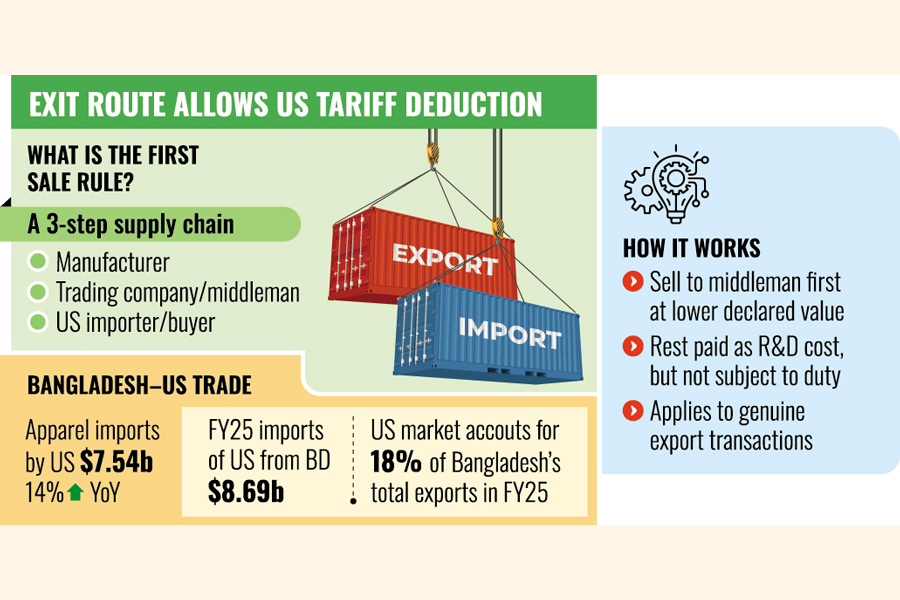
Bangladeshi apparel exporters are exploring the 'First Sale' window of opportunity in the United States to help their buyers and retailers secure lower tariffs and thus enhance their export competitiveness on the high-duty US market.

In the American customs law, the first-sale rule allows an importer to pay 15-to 20-percent lowered landed duty through declared lowered value of goods based on the manufacturer's price through a multi-tiered transaction -- such as manufacturer to middleman to US importer -- rather than the final price paid by the US buyer.

Garment exporters in the know say this rule helps them avoid high tariffs. The rest of the price is paid as a research and development cost to the manufacturers, but this requires the involvement of another entity.

In a letter to the Ministry of Commerce, Bangladesh Garment Manufacturers and Exporters Association (BGMEA) has noted that the first-sale method is becoming increasingly popular among US buyers. The letter also mentions that a recent survey found major retail groups, such as PVH, VF, Kontoor Brands, AEO, Kohl's, and JCPenney, source a significant portion of their total purchases through this duty-deduction conduit.

All top American retailers are using this first-sale marketing programme, according to a source. "It includes all of the retailers like Calvin Klein, GAP, Levi's, C&A, American Eagle, Ann Taylor, and so on. Walmart, Costco, and a few others also use it."

Industry leaders mention that among the high-value-product exporters to the US market, Sparrow Group, Hameem Group, Viyellatex Group and Standard Group are doing business under these rules.

Industry-insiders say this approach can significantly reduce the declared customs value, which in turn cuts import duties and landed costs for US buyers.

For example, if a manufacturer sells goods to a trading company at $10 per unit, and those goods are sent

through another entity of the manufacturer, the US government allows them to reduce duties under the first-sale rule, which would be calculated on $8 instead of $10.

The remaining $2 would be calculated and paid as a research and development cost. They note that the resulting duty savings can make US retail prices more competitive, improve importers' profit margins, and free up working capital.

However, they also caution that the first-sale option comes with strict requirements under US Customs and Border Protection (CBP) regulations.

The first sale must be a genuine transaction for export to the United States, and the buyer and the seller must be independent or demonstrate that the price reflects market value. Goods must remain essentially the same after the first sale, aside from minor handling or repackaging, and exporters must maintain a clear documentation trail, including contracts, invoices, payment records, and shipping documents, to prove eligibility.

The strings binding the duty benefit also provide that first-sale value must also be declared at the time of import, with supporting papers available for CBP review.

Exporters believe with proper documentation and transaction structuring, Bangladeshi manufacturers can leverage the first-sale rule to strengthen partnerships with US buyers and potentially secure more orders on the price-sensitive American retail market.

Talking to the Financial Express, Shovon Islam, Managing Director of the Sparrow Group, said, "We have been doing business for the last 12 years under First Sale rules. This helps our buyers to be more competitive as it allows them to pay a lower rate of landed duty."

Islam adds that all of their large and reputable buyers are doing business under First Sale rules. "However, the product should be a high-value item," he explains. "For example, the FOB price should be above $8."

He notes that companies with multinational operations can do this easily, with the rest of the value being paid as an R&D cost.

"Lowering the product landed duty depends on the product category and its value. Generally, 10 per cent to 15 per cent is standard, and 20 per cent is the absolute maximum slab," he mentions.

"It's being audited by USA customs and top 3rd-party Accounting Firms regularly," says Shovon Islam, a former director of BGMEA.

BGMEA raises concern over cash incentives for 'first-sale' exports

The BGMEA letter to the trade body carries concern over cash incentives for exports under the First-Sale method. It states that the main condition binding this process is that the factory receiving the purchase order must produce the goods in another factory before exporting.

President of BKMEA Mohammad Hatem told the FE that one of their largest exporters faced difficulties getting cash incentives after exporting under First-Sale rules, even though those goods were produced in another unit of that company.

The goods were manufactured in another unit after getting buyer's approval, he said, adding: "We urged the government to allow such exporters for cash incentives."

Hatem adds: the government should clarify the rules for getting cash incentives on first-sale exports, especially when an exporter has to produce goods in another unit of the company. "Otherwise, trading companies will try to get cash incentives."

According to the latest data from the Export Promotion Bureau (EPB), Bangladesh's total exports to the United States came to $8.69 billion during the past July-June period -- a notable increase from $7.60 billion a year earlier. Apparel exports to the US in the last fiscal year were worth $7.54 billion, representing a 14-percent year-on-year growth.

The US market accounted for over 18per cent of Bangladesh's total export earnings of $48.28 billion in FY25.​
 

Should incentives continue for RMG sector?

FE
Published :
Aug 12, 2025 23:00
Updated :
Aug 12, 2025 23:00

1755043778817.webp


It cannot be denied that the country's highest hard currency earner through export, the Readymade Garment (RMG) sector, has, of late, come up against certain unforeseen headwinds. The recent tariff war launched by the US President Donald Trump is definitely one. However, after negotiations with the number one global economic and military power, the government's trade delegation could bring down, to some extent, the high tariff the US first imposed on its imports from Bangladesh. Even the reduced rate of tariff will still be way higher than what was before the imposition of this new US tariff regime. Needless to say, it is the apparel products that are to endure the impact of such tariff hike from a major export destination of the country's exports. But it is not only the US tariffs, the uncertainties due to the wars in the Middle East and in Ukraine in Europe, which is the largest destination of Bangladesh's apparel as well as other products, have added to the challenges. Various tariff and non-tariff barriers recently raised by the neighbouring India on Bangladesh's external trade have also been playing their part in putting Bangladesh's chief exportable items through their paces. Also, the post-2024 cuts on general export incentives of 1.0 per cent, local yarn incentive of 3 per cent and the cash incentives of 0.5 per cent to 20 per cent of export value provided to different sectors including the RMG, together militated against the competitiveness of the RMG products in the global market.

Now, what challenges the post-graduation realities would pose to the exports are raising new concerns. That is because, the preferences Bangladesh had so far been enjoying as one of the least developed countries (LDCs) from the Western importers may not apply when the country joins the developing nations' club after graduation. The good news is, recognising the domestic and external challenges that the RMG sector is currently facing, the interim government has decided to maintain the existing export incentives and cash assistance programme for 43 sectors from July to December of the current fiscal year (FY 2025-26). However, a central bank's circular issued on July 10 to this effect specified that the rates for export incentives and cash support provided to products in question shipped between July 1 and December 31 would vary from 0.30 per cent to 10 per cent depending on product category. Of course, this is lower than the maximum rate of 20 per cent that the same category of products had been enjoying pre-2024. Even so, the question remains whether these export incentives including cash assistance would continue during the second half of FY 26, that is from January 1 to June 30 of the next calendar year.

It is against this backdrop that the leaders of the RMG sector recently met with the finance ministry officials to reiterate their demands for restoring pre-2024 cash support, local yarn incentive and general export incentive until 2029 in accordance with the World Trade Organization (WTO) provisions. Being the premier export sector of the country, the apparel industry leaders' demands have definitely their merits. And the successive governments have also been extending various incentives and assistances so they can remain competitive in the international market. While being sensitive to their cause, it is also important to understand the limitations of any government to continue propping up a particular business sector indefinitely.

It is time the apparel sector came of age and stayed competitive in the global market on its on strength. Meanwhile, the government should also extend necessary policy as well as financial support to other prospective export sectors, if only to diversify the country's export basket.​
 

BGMEA seeks clarity on US raw material usage formula for duty waiver

FE Online Report
Published :
Aug 13, 2025 22:22
Updated :
Aug 13, 2025 22:22

1755133711126.webp


The Bangladesh Garment Manufacturers and Exporters Association (BGMEA) on Wednesday sought clarification on the formula for calculating US raw material usage and mechanisms to ensure transparency and traceability throughout the supply chain to get the recently announced duty waiver on American raw materials usage.

It also discussed the possibility of establishing a warehouse near Chattogram Port to expedite cotton imports from the United States.

The requests were made when a delegation from the US Embassy in Dhaka met with BGMEA President Mahmud Hasan Khan at his BGMEA Complex office in Dhaka city, according to a statement.

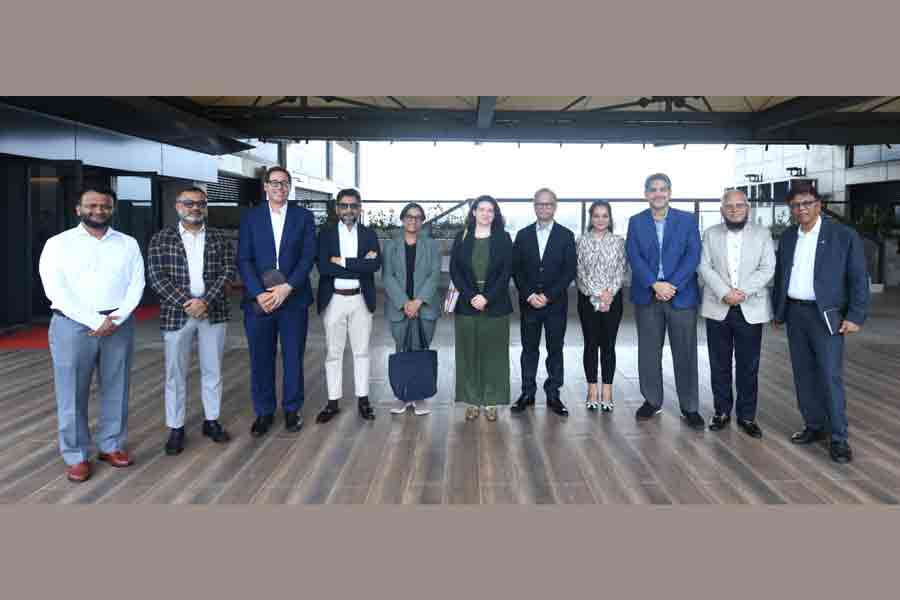
The US Embassy delegation included Labour Attaché Leena Khan, Foreign Commercial Service Attaché Paul G Frost, Foreign Agricultural Service Attaché Erin Covert, and Economic Officer Richard Rasmussen. From BGMEA, Senior Vice President Inamul Haq Khan, Vice President Md Rezwan Selim, Vice President (Finance) Mijanur Rahman, Vice President Vidiya Amrit Khan, and Directors Mohammad Abdur Rahim, Faisal Samad, and Sheikh Hossain Muhammad Mustafiz attended the meeting.

A key topic of the meeting was a recent US executive order that allows garments exported from Bangladesh to be proportionately exempt from a newly imposed additional 20 per cent duty, provided that at least 20 per cent of the raw materials used in these garments are sourced from the United States, the statement added.

Welcoming the initiative, BGMEA President Mahmud Hasan Khan said that the Bangladesh apparel industry is highly interested in utilising this facility.

The meeting also discussed the possibility of setting up the warehouse as a Bangladeshi initiative, a US initiative, or a joint venture, saying that it would help reduce lead time in the garment industry.

In addition to cotton, the BGMEA leaders expressed interest in importing man-made fiberes such as polyester and nylon from the United States (if produced by the US textile sector). They requested more detailed information on this from the US Embassy.

During the meeting, various issues of mutual interest were discussed, with a particular focus on strengthening bilateral trade relations between the United States and Bangladesh, centring around increasing exports of Bangladeshi ready-made garments (RMG) to the US market and enhancing overall economic cooperation.

In response, Foreign Commercial Service Attaché Paul G Frost said they would talk to relevant US government departments and provide further details.

The meeting also discussed potential collaboration between BGMEA and the US Cotton Council.

Paul G Frost mentioned that the embassy would discuss this with the US government's textile department and provide feedback to BGMEA.

Issues regarding the domestic gas and electricity situation were also discussed.

BGMEA leaders expressed hope that Bangladesh would be able to import LNG gas from the United States in the future. The issue of labour rights also received due attention during the meeting.

BGMEA President Mr Khan said that maintaining stable labour conditions in the garment sector is a top priority.

He informed the US delegation that since taking office, his board has engaged in dialogue with 81 workers' federations to establish harmonious industrial relations.

He also briefed the delegation on the progress of legal reforms aimed at ensuring labour rights and welfare.

The US delegation emphasised that aligning Bangladesh's labour laws with international standards is an international expectation, supported by the ILO, the European Union, and others.

BGMEA leaders stressed the importance of maintaining close communication with the US Embassy on labour-related matters to ensure clarity and avoid any misunderstandings.

The US side encouraged BGMEA to participate in SelectUSA, a major US investment promotion event scheduled to take place in May 2026, as an avenue to expand exports and build networks with American buyers.

Both parties expressed optimism about strengthening future economic partnerships and mutual cooperation between the two countries.​
 

Prospect bright for Bangladeshi MMF-based RMG exports to US, say exporters

Monira Munni
Published :
Aug 14, 2025 10:00
Updated :
Aug 14, 2025 10:00

1755218378716.webp


Bangladeshi manmade fibre (MMF)-based garment exports to the US, which remained almost static during the last two years, will get a boost amid the duty tension among the major producing countries, provided local challenges are addressed, industry insiders said.

They said now is the right time to invest in the backward linkage textile sector, especially MMF-based garment manufacturing.

Bangladesh is currently in an advantageous position with a 20 per cent additional duty for exporting to the US and can grab a larger share of work orders shifting from China and India, they also said.

They further added Vietnam is not increasing its garment production capacity, while Bangladesh has the capacity and can further enhance it if the required policy support is provided.

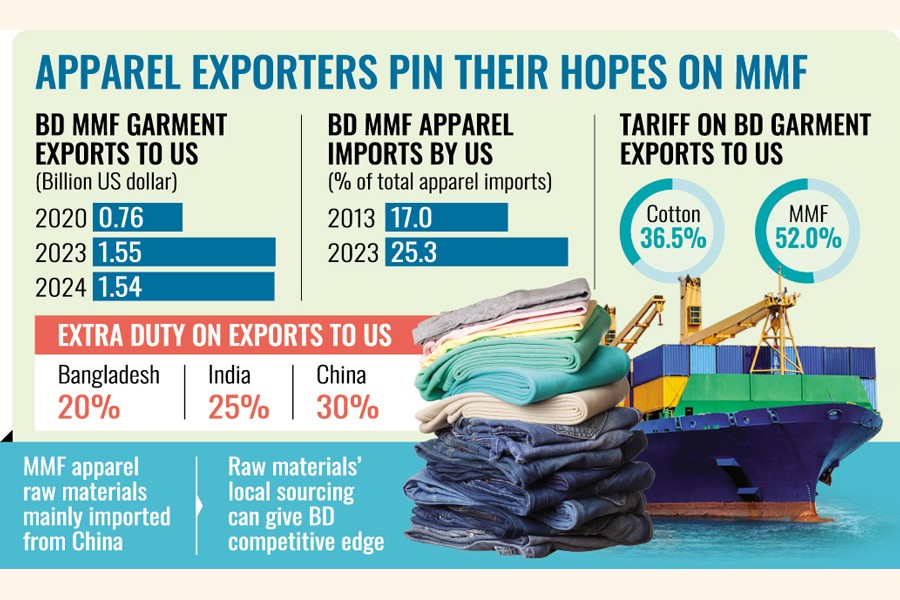
According to data compiled by the Bangladesh Garment Manufacturers and Exporters Association (BGMEA), Bangladesh exported MMF-based garments worth $1.54 billion to the US in 2024, which was almost the same - $1.55 billion - in 2023.

Such exports were only $764.92 million in 2020.

Abdullah Hil Nakib, deputy managing director of Team Group, told The Financial Express MMF-based apparels account for $1.2-1.3 billion of the $7.50 billion Bangladeshi garments exported to the US on average.

Most of the required raw materials to make such clothes are imported mainly from China, he said.

Due to the trade and duty war between the US and China, orders from the latter will shift to other destinations, he said.

"Now we have a scope to choose and go for high-value-added items made with MMF."

He said his company's exports of MMF apparel items like jackets and outerwear have been increasing for the last couple of years.

Nakib, however, said MMF garments are mostly exported to the European Union (EU).

The EU imposes one regulation after another, including ESG and other due diligence requirements, and this encourages local exporters to diversify their destinations, he said.

Though sourcing raw materials from China may have some disadvantages for exporting products to the US, he said it is high time Bangladesh prepared itself by handling the least developed country (LDC) graduation challenges.

The US cut the additional duty on Bangladesh's exports to 20 per cent from 35 per cent, which is now equal to, or on a more equal footing with, the major competitors.

The rate is lower than China's 30 per cent and India's 25 per cent.

Bangladeshi garment exports to the US will face tariffs of 36.5 per cent and 52 per cent for cotton-based and MMF-based items, respectively.

The rates include 20 per cent reciprocal tariff on top of the existing 16.5 per cent and 32 per cent tariffs, respectively.

Shovon Islam, managing director of Sparrow Group, said Bangladesh could gain a competitive edge in MMF garment manufacturing if raw materials are sourced locally.

Sayeed Ahmed Chowdhury, director at Square Denim, said they mostly blend MMF with other materials, such as cotton, due to the absence of local raw materials despite huge demand.

He, however, said a good number of entrepreneurs are investing in the MMF segment to grab a share of the growing global demand.

Bangladesh Textile Mills Association (BTMA) President Showkat Aziz Russell said following the successful reciprocal tariff negotiations with the US, Bangladesh is now in a stronger position.

As a result, local exporters are receiving more queries from buyers, he said.

"There is optimism about future business, and we want to invest further. Now is the high time to invest in the textile sector," he added.

BTMA former president A Matin Chowdhury, however, stressed diversification in the textile sector to manufacture blended, as well as MMF- and non-cotton-based, yarns and fabrics to sustain business in the long run and face the emerging challenges.

According to industry insiders, Bangladesh's synthetic yarn industry is small and cannot meet the domestic demand for MMF yarns.

That is why the country imports most of the manmade yarns and fibres used in apparel exports, they said.

Till 2023, Bangladesh had 19 synthetic spinning mills, including eight acrylic ones, they added.

The synthetic yarn industry commonly imports pellets for mixing and blends synthetic fibres with natural ones to create blended yarns.

Insiders expect that the demand for such yarns will increase in the future.

To meet this demand, they are working on increasing the domestic supply of MMF yarns and seeking the required policy support from the government.

With respect to fibre types, cotton garments account for the majority of US imports by value and share, although the product mix between cotton and synthetic garments changed gradually between 2013 and 2023, according to a United States International Trade Commission report.

In 2013, MMF garments made up 17.0 per cent of the US apparel imports from Bangladesh. By 2023, the share grew to 25.3 per cent, the report said.​
 

11th Yarn, Fabrics & Accessories Show kicks off in Dhaka

FE Online Desk
Published :
Aug 14, 2025 18:17
Updated :
Aug 14, 2025 18:17

1755218613488.webp


The 11th Bangladesh Yarn, Fabrics & Accessories Show 2025 has begun today (Thursday) at the International Convention City Bashundhara (ICCB).

The four-day international trade show is bringing the country’s RMG sector an opportunity to source their requirements of yarn, fabric and garment accessories from international suppliers showcasing at the show, according to a media release.

The 11th edition of this show, organised by ASK Trade & Exhibitions Pvt. Ltd, features participation from over 100 overseas companies showcasing their latest collections of yarn, fabrics and accessories to the RMG sector of Bangladesh.

The event is targeted at garment manufacturers and exporters, buying houses and fabric importers, enabling them to source from overseas suppliers right at their doorsteps, the release says.

The inauguration ceremony was graced by Mohammad Hatem, President of the Bangladesh Knitwear Manufacturers and Exporters Association (BKMEA), as the chief guest.

Also present at the event were Md. Shahriar, President of the Bangladesh Garments Accessories and Packaging Manufacturers and Exporters Association (BGAPMEA); Kazi Mizanur Rahman, Director of the Bangladesh Garment Manufacturers and Exporters Association (BGMEA); and Tipu Sultan Bhuiyan, Managing Director of ASK Trade & Exhibitions.

At the event, Mohammad Hatem emphasised arranging such exhibitions more frequently to showcase the capabilities of Bangladesh’s textile sector to global buyers.

He also remarked, “With stalls of various international companies under one roof, such fairs allow buyers to select products directly from suppliers without any 3rd party. As a result, high-quality products can be purchased at comparatively lower costs.”

Tipu Sultan Bhuiyan, Managing Director of ASK Trade & Exhibitions Pvt. Ltd said, “Fabric sourcing being a dynamic activity, access to new innovation and new suppliers is always vital to the exporters, and the 11th edition of the International Yarn, Fabrics & Accessories Sourcing Show is aimed at achieving this objective.”

A wide range of yarns, coloured spun yarn, blended yarns for the manufacture of woven and knitted garments, the latest collections in knitted and woven fashion fabrics, plush fabric, TR suit fabric, wool suit fabric, fashion printed fabric, knitted sports functional fabric, home fabric, toy fabric, and post-process hot stamping, embroidery, composite, film, flocking and garment accessories are on display at the show, the release adds.

The show is open to all business visitors between 11 am to 7 pm.​
 

First 6 months of the year
Bangladesh emerges as top T-shirt exporter to the US market

Published: 14 Aug 2025, 14: 47

1755220813209.webp


Despite the pressure of reciprocal ¬tariffs, Bangladesh has emerged this year as the top exporter of T-shirts to the US market. For the first time, Bangladesh has overtaken leading T-shirt exporters such as Nicaragua, Honduras and China to claim the top position.

According to the United States International Trade Commission, in the first six months of the current year, the US imported T-shirts worth a total of USD 3.52 billion from 117 countries. Of this, T-shirts worth USD 373.2 million came from Bangladesh. In the same period, Nicaragua, last year’s top exporter, shipped T-shirts worth USD 361.2 million.

Bangladesh had never before been the leading exporter of T-shirts to the US market. For 36 years (1989–2024), the market had been dominated by T-shirts from Honduras, Nicaragua, Hong Kong, Jamaica, Mexico and China. Except for China and Hong Kong, most of these top-ranking countries had enjoyed tariff benefits due to trade agreements with the US. But this changed at the start of the year.

On 2 April, the Trump administration imposed an additional minimum 10 per cent tariff on imports from all countries. This meant that Nicaragua and Honduras, despite their previous tariff advantages, also had to pay at least the minimum tariff on T-shirts. Managing to tackle this first wave of tariff pressure, Bangladesh's T-shirts have risen to first place in the US market.

Meanwhile, from 7 August, Trump’s reciprocal tariffs at varying rates for different countries came into effect. The impact of these tariffs is not yet known. However, exporters believe that even after the implementation of the reciprocal tariffs, Bangladesh remains in a favorable position compared to its competitors. They point out that the retaliatory tariff on Bangladeshi products is 20 per cent, the same as Vietnam’s.

In contrast, India’s tariff rate is 50 per cent and China’s is 30 per cent, making Bangladesh’s rate lower than both. Nicaragua, a competitor in the T-shirt market, now has to pay an 18 per cent retaliatory tariff as well. This means that, having lost its duty-free advantage, Nicaragua must now compete to export to the US.

Asked whether Bangladesh would be able to hold on to the top spot in T-shirt exports, Mahmud Hasan Khan, president of the Bangladesh Garment Manufacturers and Exporters Association (BGMEA), told Prothom Alo: “It is good news for us that in the first six months of the year, Bangladesh has risen to the top in T-shirt exports to the US market. However, after the reciprocal tariffs came into force on 7 August, there is a risk that this position could change. While Bangladesh’s standing is relatively good compared to competing countries, if consumer demand in the US falls, our exports could be negatively affected.”

The US is Bangladesh’s single largest export market. According to the National Board of Revenue (NBR), the country exported goods worth USD 8.76 billion to the US in the 2024–25 fiscal. Bangladesh ships a wide variety of apparel items to this market, including T-shirts.

Beyond the US, Bangladesh also leads its competitors in T-shirt exports to many countries, including Germany, Spain, France, the United Kingdom, Poland, Italy, Denmark, Canada — and even neighboring India.

Competitive pricing
There are two types of T-shirts depending on the fabric: cotton T-shirts and those made from synthetic fibre. Typically, synthetic fibre T-shirts are more expensive. Prices also vary depending on quality. Even so, data from the United States International Trade Commission offers an idea of the average export price per T-shirt by country.

According to this data, in the first six months of the current year, each T-shirt exported from Bangladesh fetched an average of USD 1.76. In the same period, Nicaragua, last year’s leader, exported each T-shirt at USD 1.65. This means Bangladesh has taken the lead by exporting T-shirts at a higher average price than Nicaragua. From Honduras, the average was USD 2.10 per T-shirt; from Vietnam, USD 2.68; from India, USD 1.81; from China, USD 1.63; and from Pakistan, USD 1.50.

Based on these average prices, Bangladesh’s per-piece export price is higher than that of China, Nicaragua, and Pakistan, but lower than those of competitors such as Vietnam, Honduras, and India.

Global exports and Bangladesh’s position
According to the United States International Trade Commission, last year the global T-shirt export market was worth USD 56.82 billion, covering shipments from one country to another. Bangladesh ranks just after China in global T-shirt exports. Among all categories of apparel Bangladesh exported worldwide last year, T-shirts topped the list.

According to the National Board of Revenue (NBR), in the last fiscal year Bangladesh exported T-shirts worth USD 7.45 billion to 158 countries. After Germany and Spain, the United States was the third-largest export destination.

Beyond the US, Bangladesh also leads its competitors in T-shirt exports to many countries, including Germany, Spain, France, the United Kingdom, Poland, Italy, Denmark, Canada — and even neighboring India. Now, based on figures from the past six months, the US has joined this list.

Top T-shirt export destinations
Germany is the largest single destination for Bangladesh’s T-shirts. In the 2024–25 fiscal, Bangladesh exported T-shirts worth USD 1.05 billion there. Spain ranked second, importing T-shirts worth USD 890 million, while the United States ranked third with imports worth USD 850 million. In the last fiscal year, Bangladeshi exporters shipped T-shirts to 158 countries, with the US accounting for about 11 percent of total exports.

According to NBR data, 811 factories and companies exported T-shirts to the US in the last fiscal year. The largest exporter was GAB Limited of Savar, which shipped USD 155 million worth of T-shirts to the US. In second place was another Savar-based company, SDS International, with exports worth USD 71.8 million. Ayesha Clothing Co. ranked third, exporting USD 46.7 million worth of T-shirts.

Other companies in the top ten were: Knit Asia Ltd. of Savar (USD 37.5 million), Divine Intimates of Chattogram (USD 16.2 million), Ratul Apparels of Gazipur (USD 13.4 million), Taqwa Fabrics (USD 12.5 million) and JM Fabrics (USD 10.1 million), Impress-Newtex Composite Textiles of Tangail (USD 9.4 million), and York Fashion of Chandpur (USD 9.1 million).​
 

Latest Posts

Back