Home Watch Videos Wars Movies Login

[🇧🇩] Textile & RMG Industry of Bangladesh

[🇧🇩] Textile & RMG Industry of Bangladesh
435
17K
More threads by Saif

G Bangladesh Defense

Apparel exporters seek swift action on pending cash incentives: BGMEA

FE ONLINE REPORT
Published :
Feb 04, 2026 21:55
Updated :
Feb 04, 2026 21:55

1770277676467.webp


Leaders of the Bangladesh Garment Manufacturers and Exporters Association (BGMEA) on Tuesday called on the finance ministry to expedite the release of pending cash incentives and provide other policy support to keep apparel exports running smoothly amid mounting challenges.

The BGMEA delegation, led by Vice President Md Shehab Udduza Chowdhury, included Vice Presidents Md Rezwan Selim, Mizanur Rahman, and Director Faisal Samad.

During the meeting, the delegation highlighted that the sector is facing a critical phase due to global economic uncertainty and multiple domestic challenges. As a result, garment export growth declined by 2.43 per cent during the first seven months of the current fiscal year. Moreover, in the October–December 2025 quarter, apparel export growth fell by an average of 9.43 per cent compared to the same period last year.

BGMEA leaders informed officials that nearly 400 garment factories have shut down over the past year due to rising production costs, declining product prices, and shortages of work orders, while many more factories are at risk of closure.

The delegation also drew attention to upcoming operational constraints, noting that February and March will see significantly fewer working days due to the national election, government holidays, and Eid-ul-Fitr. Factories may remain operational for only around 35 days during this 60-day period, yet will be required to pay nearly double wages, including regular salaries, bonuses, and advance payments. Small and medium-sized enterprises, they warned, would be particularly vulnerable without timely banking support, potentially leading to wage delays, disrupted production, and broader economic instability.

In this context, BGMEA urged the government to speed up the settlement and disbursement of pending cash incentive applications currently with lien banks and Bangladesh Bank to ease factory cash-flow pressures. They also requested emergency financial support, including soft loans or low-interest credit facilities equivalent to six months’ wages, to ensure the timely payment of workers’ salaries, allowances, and bonuses ahead of Eid and the post-election period.

The delegation emphasised that swift and effective government intervention is crucial to sustain the country’s leading export-earning sector.

Finance Secretary Dr Khairuzzaman Mozumder listened to the proposals and assured the delegation that the government would take positive measures to address the emerging challenges.​
 
Analyze

Analyze Post

Add your ideas here:
Highlight Cite Respond

RMG exports to major destinations plunge
Staff Correspondent 10 February, 2026, 00:27


1770687819717.webp

Representational image. | New Age file photo

Bangladesh’s ready-made garment exports to the major destinations plunged further in the first seven months of the current financial year 2025–26 amid persistent domestic and global challenges.

According to detailed country-wise export data from the Export Promotion Bureau, Bangladesh exported RMG items worth $22.98 billion in the July-January period of FY26, marking a 2.43 per cent decline from $23.55 billion earned in the same period of FY25.

The RMG manufacturers said exporters faced domestic issues, including political tensions that eroded buyers’ confidence in Bangladeshi manufacturers.

Moreover, shipments have continued to decline due to weak global demand, fewer buyer inquiries, and intense competition, particularly in European markets.Bangladesh cultural tours

The downturn was more pronounced in the United States, European Union, non-traditional markets, and other destinations, although shipments to the United Kingdom and Canada narrowly avoided negative growth.

Fazlee Shamim Ehsan, executive president of the Bangladesh Knitwear Manufacturers and Exporters Association, said RMG exports have remained in negative territory mainly due to weak global demand.

Moreover, the new US tariff regime has caused significant upheaval in global export markets and has affected Bangladesh’s exports to the US and Europe.

Weak global demand, intense competition in EU markets, and domestic political tensions forced buyers to place fewer orders, which affected overall exports, he added.

He also said the situation might continue for the coming months and could rebound if fair and free elections are held and an elected government is formed.

During July–January of FY26, Bangladeshi exporters recorded a 3.98 per cent decline in shipments to the EU—the largest destination for Bangladesh’s apparel exports—to $11.34 billion, down from $11.81 billion in the same period of FY25.

Export earnings from the EU accounted for more than 49 per cent of Bangladesh’s total RMG export revenues during the period.

Exports to major EU countries such as Germany, France, Denmark, and Italy declined in the first seven months of FY26, although narrow to moderate growth was recorded in Spain, the Netherlands, and Poland.

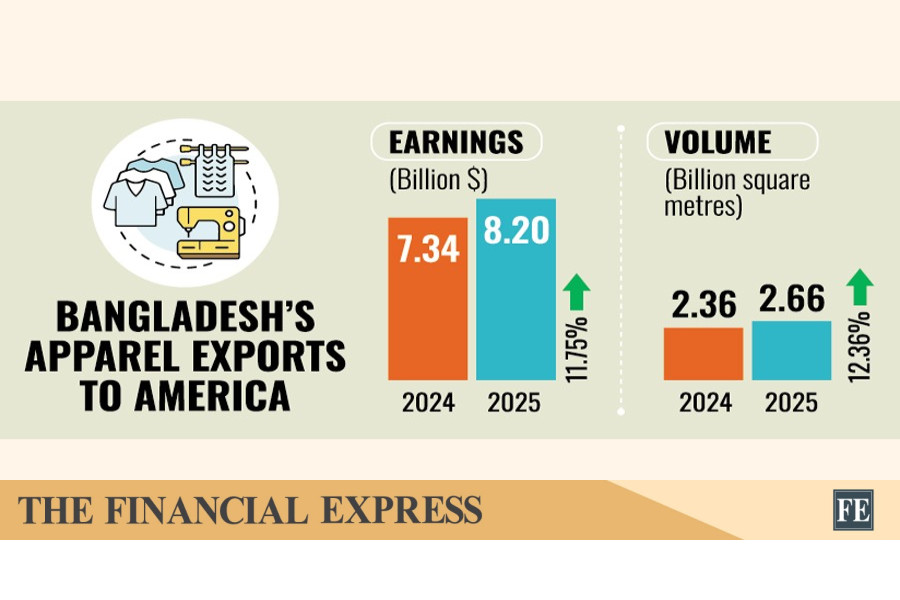
Export earnings from the United States declined for the second consecutive month by 0.3 per cent to $4.471 billion in July–January FY26, compared with $4.472 billion in the same period of FY25.

The US, the largest single-country destination for Bangladeshi apparel, accounted for around 19 per cent of total RMG export earnings, according to EPB data compiled by the Bangladesh Apparel Exchange, a private initiative promoting the country’s apparel and textile industry.

RMG exports to the UK grew 2.55 per cent to $2.61 billion in the first seven months of FY26, up from $2.55 billion in the same period of FY25.

From Canada, RMG industry bagged $784 million during the reporting period, up 4.42 per cent from $751 million in the corresponding period of the previous financial year.

Among major EU markets, exports to Germany declined by 10.9 per cent to $2.65 billion in July–January FY26, compared with $2.97 billion in the same period of FY25, EPB data showed.

In the first seven months of FY26, exports to France fell by 9.87 per cent to $1.15 billion from $1.28 billion, while exports to Italy declined by 5.49 per cent to $890 million from $941 million during the same period.

However, exports to Spain stood at $2.14 billion, while shipments to the Netherlands and Poland amounted to $1.27 billion and $1.05 billion, respectively, all of which posted low to moderate growth in the July-January period of FY26.

In the apparel trade, the US, Canada, the UK, and the EU are considered traditional markets, while other destinations are classified as non-traditional.

Major non-traditional markets include Japan, Australia, Russia, India, China, South Korea, the United Arab Emirates, Malaysia, Brazil, and Mexico.

Despite hope, export earnings from non-traditional markets have declined since October.

During July–January FY26, exports to non-traditional destinations fell by 4.99 per cent to $3.76 billion, compared with $3.96 billion in the same period of FY25.

Non-traditional markets accounted for 16.4 per cent of Bangladesh’s total RMG exports during the period.

Regarding nontraditional markets, Mohiuddin Rubel, former director of the Bangladesh Garment Manufacturers and Exporters Association, said Bangladesh is lagging behind due to a lack of innovation, research and development, and technology adoption.

Moreover, due to US tariffs, competitors aggressively shifted their exports to nontraditional markets, including Bangladesh.

‘Because, we label them as nontraditional, but Vietnam considers Japan as one of their major destinations, which impacted our exports,’ he added, saying that Bangladesh still focuses on the EU and US, urging market diversification.

Regarding the national election scheduled for February 12, Rubel said that, as businesspeople, they expect the incoming government to provide an environment of the rule of law, a stable law-and-order situation, and business-centric policies.

Exports to Japan declined by 2.84 per cent to $701 million in the July-January period of FY26, down from $721.5 million in the same period of FY25.

Exports to Australia plunged by 13.26 per cent to $445 million, while shipments to India declined by 8.13 per cent to $393 million. Exports to Mexico fell sharply by 17.39 per cent to $172 million, EPB data showed.

Exporters also expressed optimism that exports could rebound from the coming months if a fair election restores political stability and buyers’ confidence. In FY25, the RMG sector earned $39.35 billion from global markets.​
 
Analyze

Analyze Post

Add your ideas here:
Highlight Cite Respond

Garment exports to EU rise 6% in 2025
Star Business Report

Bangladesh’s apparel exports to the European Union (EU), the largest export destination in terms of trade bloc, grew 5.97 percent year-on-year to €19.41 billion in 2025.

Readymade garment (RMG) exports to the block stood at €18.32 billion in 2024.

The 2025 growth was driven by a 10.20 percent surge in volume despite a 3.84 percent decline in unit prices, according to data released by Eurostat, the official statistical office of the EU.

Bangladesh maintained its position as the EU’s second-largest clothing supplier after China, benefiting from increased demand across the bloc.

However, December 2025 figures revealed emerging challenges, with year-on-year declines of 12.05 percent in value and 11.50 percent in unit prices, signalling potential headwinds.

The EU’s total apparel imports grew 2.10 percent year-on-year to $90.00 billion in 2025, propelled by a 13.78 percent increase in volume as average unit prices fell 10.27 percent across all suppliers.

China reinforced its dominance with $26.58 billion in year-on-year exports to the EU, up 1.17 percent.

The East Asian country achieved an 11.64 percent volume increase with a 9.38 percent decline in unit prices amid US market uncertainties.

Vietnam recorded 9.66 percent growth, reaching $4.38 billion, with a 4.51 percent increase in unit prices.

India, Pakistan, and Cambodia also posted gains.

Turkey bucked the trend with a 10.73 percent year-on-year drop to $8.34 billion, making it the only major supplier to experience declining exports to the European market during the period.​
 
Analyze

Analyze Post

Add your ideas here:
Highlight Cite Respond

Rethinking future of textile

1771118909078.webp

Bangladesh Sangbad Sangstha

FOR decades, Bangladesh’s economic success has rested on one central pillar: low-cost textile and garment manufacturing. This model delivered employment, export growth and global integration. But it is now approaching its structural limits. Rising competition, pressure on wages, compliance costs and slowing value addition are exposing the fragility of an industry still dependent on volume rather than innovation. If Bangladesh is serious about sustaining industrial growth in the coming decades, it must move decisively beyond traditional manufacturing. Smart textiles offer one such pathway.Bangladesh cultural tours

Smart textiles represent a fundamental shift from conventional fabric production to technology-enabled, high-value manufacturing. These textiles integrate sensors, conductive fibres and embedded electronics, allowing fabrics to monitor, respond to, or adapt to environmental conditions and user needs. Globally, smart textiles are being used in healthcare monitoring, occupational safety, sports and fitness, defence, fashion and industrial applications. The question is no longer whether smart textiles matter, but whether Bangladesh can position itself within this rapidly evolving value chain.

Smart textiles are commonly categorised into passive and active systems. Passive smart textiles respond to external stimuli such as temperature or moisture, while active smart textiles incorporate embedded systems capable of sensing, processing data and responding in real time. Health-monitoring garments, wearable fitness devices and protective clothing fall within this category. Their development requires close collaboration between materials science, electronics, data processing and design — disciplines that have traditionally operated in silos within Bangladesh’s industrial ecosystem.

Globally, the smart textile market is expanding faster than conventional textile segments, driven by demand for wearable technologies, advances in flexible electronics and growing investment in Internet of Things applications. For a major apparel exporter such as Bangladesh, participation in this market is not merely an opportunity for diversification; it is a strategic necessity. Countries that remain locked into low-margin manufacturing risk losing competitiveness as automation, nearshoring and technological upgrading reshape global supply chains.

Bangladesh does not start from zero. The country has built a vast manufacturing infrastructure, a skilled production workforce and deep integration into global apparel supply networks. Core competencies in weaving, knitting, dyeing and finishing can form the industrial base for smart textile production. What is missing is not capacity, but integration — the ability to combine textile expertise with electronics, software and advanced materials engineering.

Demography also offers an advantage. Bangladesh’s young workforce presents an opportunity to transition from labour-intensive production to knowledge-intensive manufacturing. With targeted investments in technical education and vocational training, workers can move into higher-value roles in product development, quality assurance, system integration and design. Such a shift would not only improve productivity but also enhance job quality and wage outcomes across the sector.

The economic case for smart textiles is compelling. Products with embedded functionality command significantly higher prices, increasing export earnings without proportional increases in volume. Entry into niche segments such as medical wearables, safety equipment and performance apparel would reduce overreliance on basic garment exports. At the same time, smart textiles stimulate innovation ecosystems by encouraging collaboration between industry, universities and research institutions. This knowledge spillover effect is precisely what Bangladesh’s industrial policy has long struggled to achieve.

Employment patterns would also evolve. While smart textiles may not replicate the sheer scale of traditional garment employment, they generate demand for engineers, technicians, designers and entrepreneurs. This transition is essential if Bangladesh is to avoid the middle-income trap and create sustainable, high-quality employment for its growing educated population. Moreover, smart textile applications can meet domestic needs by improving healthcare monitoring, workplace safety and environmental sensing, particularly in resource-constrained settings.Bangladesh cultural tours

Yet the barriers are substantial. Smart textile production requires precise engineering, embedded electronics and advanced materials management — capabilities that remain underdeveloped in Bangladesh’s current industrial landscape. Equipment for integrating sensors, conductive yarns and flexible circuits is limited and skilled professionals in electronics, data analytics and systems integration are scarce. Without deliberate intervention, these gaps will persist.

Research and development remains a critical weakness. Innovation in smart textiles depends on sustained research and development investment, access to testing and prototyping facilities and strong industry–academia collaboration. While Bangladesh has expanded higher education, targeted investment in advanced textile and wearable technologies remains inadequate. High upfront costs further discourage private investment, as firms face significant risks without clear incentives or shared infrastructure.

Regulatory and standards frameworks also require urgent attention. Smart textiles used in healthcare, safety, or data-driven applications must comply with strict international standards on performance, safety and data protection. Bangladesh’s regulatory institutions must be strengthened to support certification, testing and compliance if local products are to gain acceptance in global markets.

Unlocking the potential of smart textiles therefore requires coordinated policy action. Smart textiles should be explicitly integrated into national industrial and innovation strategies, supported by fiscal incentives, research grants and dedicated technology parks. Education and training systems must adopt interdisciplinary curricula combining textiles, electronics, wearable systems and digital design. Public–private partnerships can play a central role in aligning skills development with industry needs.

Establishing specialised research and development and innovation hubs would lower entry barriers by providing shared facilities for prototyping, testing and certification. Collaboration with international research institutions can accelerate technology transfer and reduce learning costs. Finally, aligning national standards with global benchmarks will enhance credibility and export readiness.

Bangladesh stands at a crossroads. Its industrial base, workforce and global linkages provide a solid foundation, but inertia carries real risks. Without a deliberate move toward value-added manufacturing, the country may find its flagship industry trapped in diminishing returns. Smart textiles are not a silver bullet, but they represent a realistic and strategic step toward innovation-led industrialisation. The decision is not whether Bangladesh can afford to pursue smart textiles, but whether it can afford not to.

Dr Nasim Ahmed is an associate professor of public policy at the Bangladesh Institute of Governance and Management.​
 
Analyze

Analyze Post

Add your ideas here:
Highlight Cite Respond

Members Online

Latest Posts

Back
 
G
O
 
H
O
M
E