New Tweets

[🇧🇩] Textile & RMG Industry of Bangladesh

G Bangladesh Defense
[🇧🇩] Textile & RMG Industry of Bangladesh
444
19K
More threads by Saif


Bangladesh to host textile research confce on Oct 31
Staff Correspondent 27 February, 2026, 23:42

Bangladesh is going to host the 7th Textile Research Conference 2026 on October 31 at the BGMEA University of Fashion and Technology, marking another significant step in strengthening research, innovation, and digital transformation in the textile and apparel sector.

The conference will be jointly organised by the Centre for Research and Innovation in Science, Arts and Technology and BUFT, with Fashion Business Journal serving as the organising partner.

According to a press release issued by the Fashion Business Journal on Friday, following a recent virtual discussion event, the collaboration aimed to enhance industry-academia engagement and promote research-driven development across the sector.

The TRC 2026 will feature key academic and creative segments, including the 5 Minutes Research Competition, the Research Poster Competition and a Digital Fashion Catwalk Competition.

These initiatives would be designed to encourage young researchers and innovators while showcasing the integration of fashion, technology and digital advancement. Sadat Sayem, founder of CRISAT, said that the TRC 2026 would be a research ecosystem platform that strengthens collaboration between academia and industry through impactful, solution-oriented research.

Professor Ayub Nabi Khan, acting vice-chancellor of BUFT, said that BUFT would remain committed to supporting quality research and global academic engagement.

Hosting the TRC 2026 would reflect the dedication to advancing sustainable and innovative practices in textile education and industry, he added.

Akhi Akter, editor of Fashion Business Journal, said that the TRC 2026 would represent an important opportunity to bridge research and industry through structured dialogue and knowledge sharing.

As organising partner, Fashion Business Journal is committed to amplifying innovative research, encouraging young talent, and ensuring meaningful industry participation in this growing research platform, she added.

Ehsanul Karim Kaiser, convener of the interim committee of the Institution of Textile Engineers and Technology, emphasised the importance of professional collaboration and institutional support in advancing textile engineering and research excellence.

The TRC 2026 is expected to bring together researchers, academicians, industry leaders and policymakers to exchange knowledge, present research findings, and contribute to the sustainable growth of Bangladesh’s textile and apparel industry, the organisers said.

Experts, academicians, representatives from various government and private agencies were also present at the virtual event.​
 
Analyze

Analyze Post

Add your ideas here:
Highlight Cite Respond

How garment makers can manage the Middle East logistics shock

5 March 2026, 00:13 AM
Mostafiz Uddin

1772758291443.webp

Birds fly near a boat in the Strait of Hormuz amid the US-Israeli conflict with Iran, as seen from Musandam, Oman on March 2, 2026. PHOTO: REUTERS

Bangladesh’s garment exporters are facing a fresh logistics shock as the escalating Iran crisis is now leading to operational restrictions by ocean carriers and airlines. On March 3, Denmark’s shipping and logistics company Maersk confirmed it has suspended all new bookings between the Indian subcontinent, including Bangladesh and the Upper Gulf markets, with immediate effect, citing the “evolving situation” in the Middle East. The suspension covers the UAE, Bahrain, Qatar, Iraq, Kuwait, and Saudi Arabia’s Dammam and Jubail.

This move is one of the clearest signs yet that the crisis is now disrupting commercial cargo flows, not just raising risk premiums. At the same time, shipping and insurance markets are reacting to rising threats around the Strait of Hormuz after Iran issued warnings to vessels and multiple ships reported damage in the wider area. Reuters said at least 150 ships were stranded around the strait till Monday, while major marine insurers moved to cancel war risk cover effective from March 5 in parts of the Gulf. This is sharply pushing logistics costs higher.

For Bangladesh’s exporters, the crisis splits into two problems. The first is the disruption to direct trade to Gulf destinations, including the UAE, which functions as both a consumer market and a regional distribution hub for apparel. The second is a wider network disruption. Even if a shipment is bound for Europe or North America, carrier rerouting, higher fuel costs, reduced schedule reliability, and container equipment imbalances can still feed into longer lead times and higher costs.

I believe Maersk’s wording is important. It is suspending “new bookings” for the corridor, which means exporters may still be moving previously accepted cargo, but with a higher risk of delays and schedule changes as networks adjust. Maersk also separately flagged restrictions on certain cargo types, including “reefer, dangerous or special cargo acceptance” in and out of multiple Gulf countries, which might affect garment accessory supply chains. Exporters selling into the Gulf should assume that even when a carrier continues to “accept cargo,” space may be limited, routing may change at short notice, and surcharges can be introduced with little notice.

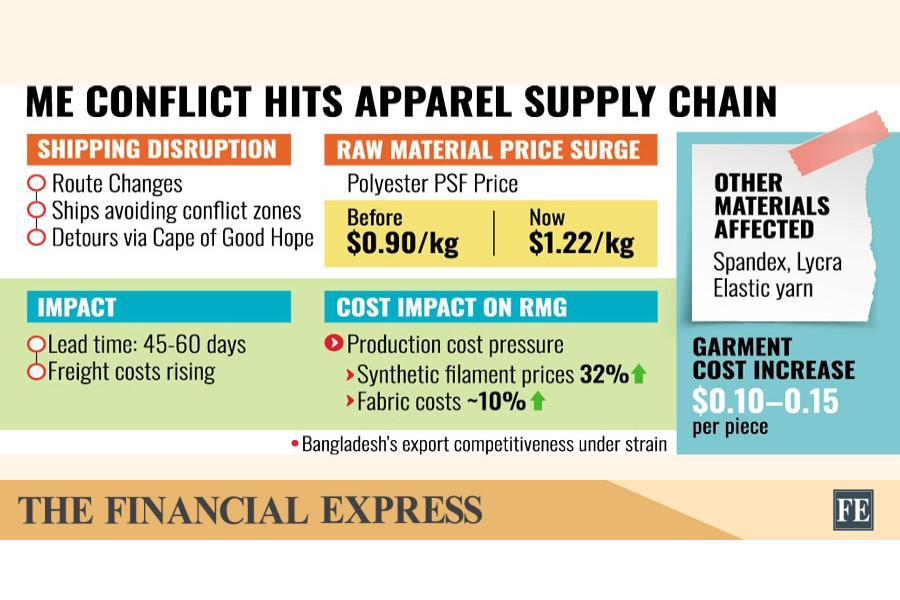
However, Bangladesh’s biggest apparel volumes head to Europe and the US, not the Gulf. And the Iran crisis arrives amid an already fragile Red Sea. Container lines had been tentatively assessing a return to the Suez Canal corridor, but new security concerns are pushing carriers back towards longer routings around the Cape of Good Hope. The Wall Street Journal says the Middle East crisis has significantly delayed the return of container shipping to Suez, reinforcing the industry shift back to diversions around Africa. In practice, that means longer and less predictable transits between Asia and Europe.

For Bangladesh, exporters should plan for possible delays, even where the scheduled transit time is unchanged. When ocean schedules become volatile, brands often push urgent top-ups by air or at least move samples and approvals by air. But air is also being hit. Widespread regional airspace disruption is reported, with key hubs including Dubai and Doha affected, and airlines resuming only limited operations, including select cargo and moving flights. Bangladeshi exporters that route urgent cargo through Gulf hubs should not assume air capacity is available at normal notice periods or normal prices. Where air freight is unavoidable, exporters may need to secure uplift earlier, accept longer routings, or use alternative hubs outside the most disrupted air corridors.

The crisis is also feeding directly into shipping costs via insurance and security surcharges. Reports suggest war risk insurance is being withdrawn or repriced rapidly, and we are seeing sharp increases in premiums within days as risk assessments change. There are also concerning reports of major insurers cancelling war risk cover in the Gulf starting March 5, with freight rates on some lanes jumping sharply over the weekend. Separately, rising oil prices are critical for apparel logistics because bunker costs tend to flow through into carrier fuel mechanisms.

The combined effect is that Bangladeshi exporters may face both higher freight bills and a higher probability of “unplanned” cost items appearing after contracts are signed, including emergency surcharges and insurance-related fees. While our garment exporters cannot control geopolitics, they can prepare and communicate. The most practical response is to treat the next few weeks as a lead time management exercise.

Exporters can start with mapping exposure by shipping lane rather than by customer. If they supply the Gulf directly, they should identify which orders are on the Maersk-affected corridor, which are already gated in, and which are still in production. They would also be wise to assume that new bookings to the listed Upper Gulf markets may need alternative carriers, alternative routings, or revised delivery dates.

As for shipping to Europe, buyers will still judge manufacturers on whether orders arrive on time. But right now, the bigger problem is that shipping times are unpredictable. Manufacturers should allow extra time between finishing production and booking the shipment, especially for ranges where a two- to three-week delay would cause real commercial damage. If the schedule is already tight, manufacturers should start producing the most time-critical styles first, so they are ready earlier. Manufacturers should also talk to their forwarder and carrier representative now, even if they are not shipping this week. They should ask which services are being rerouted, which transhipment hubs are under pressure, and where equipment shortages may emerge. Where possible, they should lock space earlier than usual and confirm cut-off times in writing.

They may also need to revisit commercial terms for surcharges. Some exporters will be able to pass certain surcharges through to the buyer under contract terms. Others will not. Either way, they should get clarity early and document what is agreed. If unsure, take legal advice before relying on force majeure or similar clauses. Many problems arise because buyers hear about delays too late. Manufacturers should update buyers early with a clear explanation that this is a fast-moving security and logistics issue, and that carriers are already restricting bookings on certain Middle East corridors.

The shipping industry is reacting in real time. When insurers change cover terms, carriers often respond immediately with new safety rules, booking restrictions, or surcharges. What we are now seeing is how quickly those decisions can hit Bangladesh directly, even when Dhaka is not at the centre of the conflict.

The key point for buyers and manufacturers is that you can’t plan logistics around one “normal” route right now. Both parties should plan for different outcomes instead, and should also expect occasional restrictions, last-minute changes in space and services, and ongoing swings in insurance and fuel costs until the situation calms down.

Mostafiz Uddin is the managing director of Denim Expert Limited. He is also the founder and CEO of Bangladesh Denim Expo and Bangladesh Apparel Exchange (BAE).​
 
Analyze

Analyze Post

Add your ideas here:
Highlight Cite Respond

War may push up logistics costs for apparel: DCCI

Star Business Report


1773278101677.webp


Export-driven industries in Bangladesh, particularly the readymade garment (RMG) sector, face rising logistics costs, supply chain delays, and shipping risks due to the ongoing US-Israel war on Iran, the Dhaka Chamber of Commerce & Industry (DCCI) said yesterday.

In a press release, the chamber expressed grave concern, noting that the tension is already causing turbulence in global energy markets, trade routes, and financial systems. As a highly import-dependent economy, Bangladesh is vulnerable to these external shocks.

International oil prices recently surged beyond $100 per barrel before dropping below $90, as supply disruptions hit the Middle East.

The DCCI estimated that every $10 increase in global oil prices could raise Bangladesh’s monthly import bill by approximately $70-$80 million, further widening the trade deficit.

The conflict has also disrupted major shipping routes, especially the Strait of Hormuz, which handles nearly 20 percent of global oil and gas supply. Prolonged interference here could significantly increase freight rates, insurance premiums, and delivery times for Bangladeshi trade.

Domestically, exports have been declining for the past seven months due to political and economic challenges.

While short-term relief has come with over 10 vessels carrying LNG, LPG, diesel, and other fuels arriving at Chattogram Port recently, the DCCI warned that the situation remains highly unpredictable.

If the conflict escalates, the chamber predicts a series of macroeconomic challenges, including higher electricity production costs, inflation driven by transport hikes, and potential interruptions in remittance flows from the Middle East.

To mitigate these risks, the DCCI urged the government to build strategic fuel reserves, diversify energy import sources, and maintain close coordination between financial institutions and the business community.​
 
Analyze

Analyze Post

Add your ideas here:
Highlight Cite Respond

USDA cuts Bangladesh’s cotton import forecast

Star Business Report

1773363728708.webp


The United States Department of Agriculture (USDA) has lowered its projection for Bangladesh’s cotton imports, citing reduced domestic use of the key raw material for the textile industry.

The US agency said imports of cotton by Bangladesh, the world’s second-largest apparel exporter, would be 79 lakh bales in the August-July period of the marketing year (MY) 2025-26, down from its projection of 80 lakh bales forecast last month.

The country will use 80 lakh bales of cotton in MY26, down from the USDA’s previous estimate of 81 lakh bales for the year, according to the agency’s report on world cotton markets and trade published on Monday.

The downward revision comes at a time when Bangladesh has registered a decline in garment exports. The country, which brings more than 80 percent of its annual export earnings through apparel, recorded a 3.73 percent year-on-year drop in shipments to $25.79 billion in the July-February period of the fiscal year (FY) 2025-26.

Of that, knitwear exports fell 4.5 percent to $14.34 billion, while woven garment shipments dropped nearly 3 percent to $12.45 billion during the same period.

Mohiuddin Rubel, additional managing director of Denim Expert Ltd, said several interconnected factors are behind the USDA’s recent downgrade of Bangladesh’s cotton import and consumption projections, primarily originating from sluggish retail demand in key EU and US markets.

“As international export orders slow down, garment manufacturers have reduced their local yarn procurement, leaving domestic spinning mills burdened with an estimated Tk 12,000 crore ($1 billion) in unsold stockpiles,” he said.

Strikingly, this massive inventory buildup persists even as severe natural gas and electricity shortages have already forced textile mills to slash their operating capacities to between 40 and 70 percent, he added.

The USDA revised the global production outlook upward by over 11 lakh bales to 1.21 crore bales, as larger crops in Brazil and China more than offset a smaller crop in Argentina.

It said global consumption is forecast to fall by more than one lakh bales to 1.18 crore bales due to reduced demand in Pakistan, Bangladesh, Mexico, and Vietnam.​
 
Analyze

Analyze Post

Add your ideas here:
Highlight Cite Respond

Over 50.17 lakh people working in garment sector in Bangladesh: state minister
Staff Correspondent 23 June, 2024, 21:39

1773364794495.webp


There are over 50.17 lakh workers working in garment factories in the country and 55.57 per cent of them are women, state minister for labour and employment Nazrul Islam Chowdhury told Jatiya Sangsad on Sunday.

The state minister gave this information in response to a question of ruling Awami League lawmaker Nurunnabi Chowdhury from Bhola-3.

According to the information of the Bangladesh Garment Manufacturers and Exporters Association, there are 33 lakh 17 thousand 397 workers in the garment factories in Bangladesh, the state minister said.

Among them, 52.28 per cent are women workers, the minister said, adding that the number of women workers is 17.34 lakh.

On the other hand, according to the Bangladesh Knitwear Manufacturers and Exporters Association data, there are 17 lakh workers in the knitwear sector, of which 62 per cent – 10.54 lakh are women.

In total, there are 50.17 lakh workers in the garment industry in the country, of which 55.57 per cent—27.88 lakh are women workers, the minister said.

Citing data collected from the Bangladesh Bureau of Statistics, the state minister said that according to the 2022 labour force survey, the total workforce in the garment sector is 43,16,000, of which 37.51 per cent meaning 16.19 lakh are women.

In reply to another query, the state minister for commerce Ahsanul Islam Titu said that due to the adverse impact of the Covid-19 pandemic, the effect of the Russia-Ukraine war, global economic recession and price inflation in America and Europe, the main export markets of Bangladesh, the slow pace of export earnings was being observed.

Bangladesh’s main export product, manufactured garments, has decreased in demand in the world market, resulting in a decline in export growth, he added.

In countries such as the United Kingdom, France, Spain, Canada and Japan, the trend of export earnings from this sector, however, continues to grow, the minister also said.

Responding to a question from AL lawmaker Morshed Alam, Ahsanul said that the FY2022-23 saw the highest inflation in the past 12 years.

He added that Inflation in this financial year was 9.02 per cent.

According to the information placed by the state minister, the inflation rate was 8.69 per cent in 2011-12 fiscal, 6.78 per cent in 2012-13 fiscal, 7.35 per cent in 2013-14, 6.41 per cent in 2014-15, 5.92 per cent in 2015-16, 5.44 per cent in 2016-17, 5.78 per cent in 2017-18, 5.48 per cent in 2018-19, 5.65 per cent in 2019-20, 5.56 per cent in 2020-21, 6.15 per cent in 2021-22 and 9.02 per cent inflation rate in 2022-23.

In response to AL lawmaker Samil Uddin Ahmed, the state minister for commerce said that currently Bangladesh had business transactions with 210 countries of the world.

Among the countries, Bangladesh has a trade deficit with 82 countries, the minister said.

According to the information placed by the state minister, Bangladesh has the largest trade deficit with China which is $17,149.2 million.

According to the statistics of 2022-23, the total trade deficit of Bangladesh is $15,239.55 million.

In response to the question of independent lawmaker Abul Kalam from Natore-1, Ahsanul Islam Titu said that there is a trade deficit with countries other than Sri Lanka and the Maldives among the SAARC countries.

In response to the question of AL lawmaker SM Ataul Haque of Satkhira-4, State Minister for Disaster Management and Relief Mohibbur Rahman said that the amount of damage in the whole country due to cyclone Remal was around Tk 7,482 crore.

In response to the question of Mahbubur Rahman from Chattogram-1, the state minister said that the death toll in Remal was 20 while the number of affected people was 3.83 lakh people.

In response to the question of AL lawmaker Parveen Zaman from the reserved seat, state minister for expatriates’ welfare Shafiqul Islam Chowdhury said that in the past 15 years from 2009 till June 11, 2024, 11.14 lakh women workers had gone abroad for jobs.

The state minister said that most of the women workers had gone to Saudi Arabia.​
 
Analyze

Analyze Post

Add your ideas here:
Highlight Cite Respond

Members Online

Latest Posts

Back
PKDefense - Recommended Toggle