Wars 2026 02/28 Israel-Iran War 3.0

Wars 2026 02/28 Israel-Iran War 3.0
164
2K
More threads by RayKalm

G War Archive

US war in Iran has cost $25b so far: Pentagon official
Reuters
Washington

1777506645101.webp

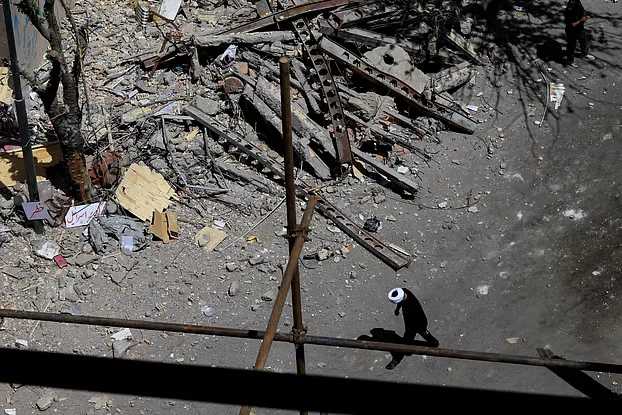
A cleric walks near a residential building damaged by a strike on March 4, in Tehran, Iran, 14 April 2026.

A cleric walks near a residential building damaged by a strike on March 4, in Tehran, Iran, 14 April 2026.Reuters
The United States' war in Iran has cost $25 billion so far, a senior Pentagon official said on Wednesday, providing the first official estimate of the military's price tag for the conflict.

With just six months before mid-term elections in which Trump's Republicans may face an uphill battle to keep their House majority, Democrats are riding high in public opinion polls as they attempt to link the unpopular Iran war with affordability.

Jules Hurst, who is performing the duties of the comptroller, told lawmakers on the ⁠House Armed Services Committee that most of that money was for munitions.

Hurst did not detail what that cost estimate included and whether it took into account the projected costs of rebuilding and repairing base infrastructure in the Middle East damaged in the conflict.

Rep. Adam Smith, the top Democrat on the House Armed Services Committee, responded to Hurst: "I'm glad you answered that question. Because we've been asking for a hell of a long time, and no one's given us the number."

The United States started carrying out strikes against Iran ⁠on Feb.28 and the two sides are currently maintaining a fragile ceasefire. The Pentagon has poured tens of thousands of additional forces into the Middle East, including keeping three aircraft carriers in the region.

Thirteen U.S. troops have been killed in the conflict and hundreds wounded.

Disruptions in shipments of ⁠oil and natural gas since the war started have caused a run-up in U.S. gasoline prices and agricultural products such as fertilizers, on top of the long list of other high consumer ⁠prices.

Trump's popularity has taken a beating since the U.S. and Israel launched a war against Iran on February 28 that has led to a surge in gasoline ⁠prices.

Just 34 per cent of Americans approve of the U.S. conflict with Iran, down from 36 per cent in mid-April and 38% in mid-March, a recent Reuters/Ipsos poll found.​
 

Iran war could push 30m people into poverty: UN

AFP
Paris, France
Published: 29 Apr 2026, 20: 49

1777507101375.webp

The United Nations File photo

The US-Israeli war on Iran, which has sent the price of energy and fertiliser soaring, could plunge more than 30 million people into poverty, the head of the UN Development Programme said Wednesday.

"It's development in reverse," Alexander De Croo told AFP on the sidelines of a G7 development meeting in Paris.

"It took decades to build stable societies, to develop local economies, and it took only several weeks of war to destroy that," he added.

"We did a study after six weeks of war and estimated that even if the conflict ended at that point, 32 million people would be pushed into precarity in 160 countries," said De Croo.

The war has led to closure of the Strait of Hormuz, through which a fifth of the world''s oil and liquefied natural gas flows in peacetime.

Gulf nations are also important for many oil products and feedstocks to make fertiliser.

A shortage of supplies and high prices has led to countries in Africa and Asia imposing a range of measures that include fuel rationing and shortening the work week to reduce consumption. Other countries have reduced fuel taxes to cushion the impact on consumers.

The UNDP says the war will have a profound impact on Sub-Saharan African countries as well as certain countries in Asia such as Bangladesh and Cambodia.

Developing island nations will also be particularly hard hit.

High "energy costs, a lack of fertiliser, will have an enormous impact in the months to come" on people in these countries, said De Croo, a former prime minister of Belgium.

He also warned of "political instability and a drop in remittances from abroad because a lot of people working in the Gulf countries send money home".

To avoid poverty taking hold, the UNDP estimates that around $6bn "is needed in subsidies to support those most vulnerable to high food and energy prices", he added.

De Croo said discussions were already underway within the IMF and World Bank.

"You can say that six billion dollars is a lot -- the war cost nine billion dollars per week," he added.

The crisis comes as development aid is at a historic low, having dropped by more than 23 percent last year, primarily due to cuts by major donors led by the United States.​
 

Iran's supreme leader says US suffered 'disgraceful defeat'

AFP
Published: 30 Apr 2026, 18: 27


1777594454218.webp

Iranians wave Irans national flags during a rally to show their solidarity and support to the new Iranian supreme leader Ayatollah Mojataba Khamenei in Tehran, on April 29, 2026. AFP

Iran's supreme leader Ayatollah Mojtaba Khamenei said in a written message on Thursday that the United States had been defeated in its war with the Islamic republic, as the Iranian leadership defied President Donald Trump's warnings of a prolonged blockade.

"Today, two months after the largest military deployment and aggression by the world's bullies in the region, and the United States' disgraceful defeat in its plans, a new chapter is unfolding for the Persian Gulf and the Strait of Hormuz," said Khamenei in the message read on state television.

The message by Khamenei, who has yet to appear in public since his appointment on March 9 as Iran's new supreme leader, came on the annual national celebration of "Persian Gulf" day in Iran.

Mojtaba Khamenei became supreme leader after the US and Israel launched a massive campaign of strikes on Iran on February 28, killing his father and predecessor Ali Khamenei.

Last week, the New York Times citing several unnamed Iranian officials said the younger Khamenei was "gravely wounded" in the strikes but has remained "mentally sharp."

In his Thursday message, he said US bases in the region "lack even the capacity to ensure their own security, let alone provide any hope of securing their allies."

He hailed what he called Iran's "new legal framework and management" of the strategic Strait of Hormuz, a key energy chokepoint, as a means to bring "comfort and progress" for countries in the region.

Bright future
The strait has become a major flashpoint since the outbreak of the Middle East war, with Iran allowing only a trickle of ships to pass through the waterway.

Last week, a senior lawmaker said Tehran has received the first revenue from tolls it imposed on the strait.

1777594502275.webp

A member of the Iranian police stand guard on a motorbike during a rally to show solidarity and support to the new Iranian supreme leader Ayatollah Mojataba Khamenei in Tehran, on April 29, 2026 AFP

Khamenei predicted a bright future for the Gulf without the United States and condemned what he described as "outsiders", saying those who interfere from thousands of kilometres away "have no place there except at the bottom of its waters".

He also lauded the people of Iran who he said "consider all national capacities -- identity, spiritual, human, scientific, industrial, and advanced technologies from nano and bio to nuclear and missile -- as their national capital".

Earlier Thursday, Iran's President Masoud Pezeshkian had said a US naval blockade imposed in retaliation against Iran's action in Hormuz was "doomed to fail".

Pezeshkian added that such measures would "not only fail to enhance regional security, but are in fact a source of tension and a disruption to lasting stability in the Persian Gulf".

Other figures have also struck a tone of defiance, with navy commander Shahram Irani signalling that Iran will deploy "in the very near future" naval weaponry which it has recently developed.​
 

Trump administration says its war in Iran has been ‘terminated’ before 60-day deadline

AP

Published :
May 01, 2026 23:33
Updated :
May 01, 2026 23:33

1777678978102.webp

President Donald Trump speaks to reporters in the Oval Office of the White House, Thursday, April 30, 2026, in Washington. Photo : AP

The Trump administration is arguing that the war in Iran has already ended because of the ceasefire that began in early April, an interpretation that would allow the White House to avoid the need to seek congressional approval.
FE

The statement furthers an argument laid out by Defense Secretary Pete Hegseth during testimony in the Senate earlier Thursday, when he said the ceasefire effectively paused the war. Under that rationale, the administration has not yet met the requirement mandated by a 1973 law to seek formal approval from Congress for military action that extends beyond 60 days.

A senior administration official, who spoke on condition of anonymity to discuss the administration’s position, said for purposes of that law, “the hostilities that began on Saturday, Feb. 28 have terminated.” The official said the U.S. military and Iran have not exchanged fire since the two-week ceasefire that began April 7.

While the ceasefire has since been extended, Iran maintains its chokehold on the Strait of Hormuz, and the U.S. Navy is maintaining a blockade to prevent Iran’s oil tankers from getting out to sea.

While the ceasefire has since been extended, Iran maintains its chokehold on the Strait of Hormuz, and the U.S. Navy is maintaining a blockade to prevent Iran’s oil tankers from getting out to sea.

Richard Goldberg, who served as director for countering Iranian weapons of mass destruction for the National Security Council during Trump’s first term, said he has recommended to administration officials that they simply transition to a new operation, which he suggested could be called “Epic Passage,” a sequel to Operation Epic Fury.

That new mission, he said, “would inherently be a mission of self-defense focused on reopening the strait while reserving the right to offensive action in support of restoring freedom of navigation.”

“That to me solves it all,” added Goldberg, who is now a senior adviser at the Foundation for Defense of Democracies, a hawkish Washington think tank.

During testimony before the Senate Armed Services Committee on Thursday, Hegseth said it was the administration’s “understanding” that the 60-day clock was on pause while the two countries were in a ceasefire. Sen. Tim Kaine, D-Va., who had asked Hegseth about the timeline, later told reporters that the defense secretary “advanced a very novel argument that I’ve never heard before” and “certainly has no legal support.”

Katherine Yon Ebright, counsel at the Brennan Center’s Liberty and National Security Program and an expert on war powers, said that interpretation would be a “sizeable extension of previous legal gamesmanship” related to the 1973 law.

“To be very, very clear and unambiguous, nothing in the text or design of the War Powers Resolution suggests that the 60-day clock can be paused or terminated,” she said.

Other presidents have argued that the military action they’ve taken was not intense enough or was too intermittent to qualify under the War Powers Resolution. But Trump’s war in Iran would certainly not be such a case, Ebright said, adding that lawmakers need to push back against the administration on that kind of argument.​
 

Iran activates air defences as Trump faces congressional deadline

UN chief Guterres calls Hormuz closure ‘strangling the global economy’

AFP, Tehran

1777681134093.webp


Photo: Collected

Tehran's air defences were activated to counter small aircraft and drones yesterday, as the White House signalled that it will not be reined in by a congressional deadline on the Iran war.

The Tasnim and Fars news agencies reported that air defence systems, heard in some parts of the Iranian capital, were activated for around 20 minutes "to counter small aircraft and reconnaissance drones" but that the situation had returned to "normal".

US President Donald Trump's administration faced a looming midnight deadline to secure congressional authorisation for the war against Iran, setting up a clash between the White House and Congress.

The Trump administration argued that the 60-day clock to seek authorisation was effectively paused by a ceasefire announced last month.

"For War Powers Resolution purposes, the hostilities that began on Saturday, February 28 have terminated," a senior administration official told AFP late on Thursday, noting that there has been no exchange of fire between the United States and Iran since the April 7 ceasefire.

'Shameful defeat'

Earlier yesterday, Iran's supreme leader declared that the United States had suffered a shameful defeat, defiantly rejecting a warning from Trump that an economically punishing US naval blockade could be enforced for months to come.

Oil prices hit a four-year high, then fell back slightly before Mojtaba Khamenei issued a written statement read on state television declaring that Iran was now in the driver's seat in the crisis.

"Today, two months after the largest military deployment and aggression by the world's bullies in the region, and the United States' disgraceful defeat in its plans, a new chapter is unfolding for the Persian Gulf and the Strait of Hormuz," he said, hailing Iran's control over shipping in the strait.

He went on to predict a bright future for the Gulf without the United States, saying those who interfere in the region from afar "have no place there except at the bottom of its waters."

Khamenei was wounded in the initial US-Israeli strikes that killed his father, Ali Khamenei, and has not been seen in public since being named his successor as supreme leader in March.

The United States imposed a blockade on Iran's ports two weeks ago, while the Islamic republic has maintained its stranglehold over the strategic Strait of Hormuz since the start of the Middle East war at the end of February.

Washington is now seeking to assemble an international coalition of allied states and shipping firms to coordinate safe passage through Hormuz -- while maintaining its blockade of ships serving Iran, a State Department official told AFP.

Trump threatened Thursday to withdraw US troops from Italy and Spain, extending similar warnings already made against Germany, after lambasting the NATO allies for failing to support US-Israeli operations against Iran, including in the Strait.

'Act again'

Israeli Defense Minister Israel Katz warned meanwhile that it was "possible that we may soon have to act again" against Iran to achieve the war's objectives.

But the commander of the Iranian Revolutionary Guards aerospace force, Majid Mousavi, said even a "short and tactical" enemy operation would be met "with painful, prolonged, and extensive strikes."

Tehran residents speaking earlier to AFP journalists in Paris described a sense of despair that the Islamic republic government was clinging to power and that negotiations had stalled.

"From the Islamic Republic still being in place to the innocent people whose lives were destroyed in this war, everything is so disappointing," one 28-year-old IT worker told AFP via messaging app from the Iranian capital.

'Intolerable'

Trump has reportedly told oil executives and national security officials this week to prepare for a prolonged US blockade designed to force Tehran to surrender its nuclear programme.

US Central Command said Wednesday it had redirected a total of 44 commercial vessels to violate the blockade as part of its blockade of Iran.

Iranian President Masoud Pezeshkian said the blockade of his country's ports was effectively an "extension of military operations" by Washington, despite the ongoing ceasefire.

"Continuation of this oppressive approach is intolerable," he added.

Oil prices struck a four-year high yesterday. International benchmark Brent crude soared more than seven percent to $126 a barrel before easing in afternoon trading in London.

UN chief Antonio Guterres said the closure of Hormuz was "strangling the global economy," and International Energy Agency chief Fatih Birol told a meeting at his Paris headquarters: "The world is facing the biggest energy crisis in history."

"The consequences of the Middle East crisis grow dramatically worse with each passing hour... Now is the time for dialogue, for solutions that pull us back from the brink," Guterres wrote on X today.

US urges Israel-Lebanon talks

Violence has continued on the war's Lebanese front, with the US embassy in Lebanon on Thursday urging a meeting between Lebanese and Israeli leaders.

Israeli and Lebanese representatives have met twice in Washington in recent weeks -- the first such meetings in decades -- after the Iran-backed Hezbollah group drew Lebanon into the Middle East war on March 2.

Trump has said he hopes to host Lebanese President Joseph Aoun and Israeli Prime Minister Benjamin Netanyahu "over the next couple of weeks."

Israeli strikes on southern Lebanon killed at least 15 people, the Lebanese health ministry said Thursday, while the Lebanese army said a separate strike on a home in the south killed a soldier and multiple members of his family.​
 

Latest Posts

Back