Home Watch Videos Wars Movies Login

[🇧🇩] The U.S.A.---A Strategic Partner of Bangladesh

[🇧🇩] The U.S.A.---A Strategic Partner of Bangladesh
143
7K
More threads by Saif

G Bangladesh Defense

'Irresponsible and utterly unfounded': China fires back at US ambassador’s remarks

Ambassador Christensen earlier raised concerns over potential risks of closer China ties

By Star Online Report

1769131702534.webp


China has urged the US to be more aware of its responsibilities and to focus on actions conducive to Bangladesh’s stability, development, and regional cooperation, following remarks by the newly‑appointed US Ambassador Brent Christensen.

During a media interaction in Dhaka on Wednesday, Christensen expressed concerns about China’s broader influence in South Asia and said he was committed to clearly articulating the risks of involvement with China in certain areas should Bangladesh choose that path.

Responding today, the Chinese embassy in Dhaka issued a statement calling the US ambassador’s comments “irresponsible and utterly unfounded”.

The embassy highlighted that over the past 50 years, since the establishment of diplomatic ties, China and Bangladesh have consistently supported each other, treated one another as equals, and engaged in win‑win cooperation.

“The China‑Bangladesh cooperation has delivered benefits to and received broad support from the people of both countries. It is conducive to the development and stability in the region,” the statement said.

It further stressed that cooperation between China and Bangladesh is a matter solely between the two countries and their people.​
 
Analyze

Analyze Post

Add your ideas here:
Highlight Cite Respond

Growing visa restrictions: A wake-up call for Bangladesh

Atiqul Kabir Tuhin
Published :
Jan 24, 2026 22:27
Updated :
Jan 24, 2026 22:27

1769301073840.webp


The United States has temporarily suspended immigrant visas for applicants from Bangladesh and 74 other countries. Effective from January 21, the restriction has been imposed citing concerns that a large number of immigrants from these countries rely on government benefits instead of entering the workforce. While the policy aims to reduce dependence on US public assistance, its immediate impact is far more personal. It has placed the American dream of thousands of families on hold.

Non-immigrant visas such as student, tourist, and work visas are not affected by the immigrant visa suspension. However, B-1 (business) and B-2 (tourist) visas under the non-immigrant category for citizens of Bangladesh and 37 other countries now fall under a newly expanded visa bond requirement. Under this policy, applicants are required to deposit a refundable bond of $5,000 to $15,000 as a financial guarantee that they will comply with visa conditions and not overstay their authorised period of stay. The exact bond amount is determined during the visa interview and is refundable if the holder adheres to visa rules.

Bangladeshis are facing tighter visa regimes not only in the United States but also across many other overseas destinations. Australia has placed Bangladesh in its highest-risk category for student visas, citing "emerging integrity issues" and concerns over fraud. Canada, meanwhile, has sharply reduced visa approvals after placing Bangladesh on its high-risk or "red list," with official data showing a 61 percent decline in approvals in recent months. Some countries in Europe, the Middle East, and Asia are reportedly imposing informal restrictions on the issuance of visas to Bangladeshi nationals. What compounded the problem is India's visa restriction as several European countries do not have embassies in Dhaka. Their visas are issued through embassies in New Delhi. Despite the government's effort, there has been no progress in relocating European visa centres in Dhaka.

As a growing number of countries impose visa restrictions or tighten entry procedures, the consequences extend far beyond individual travel inconvenience. It is a direct blow to the country's brand value and global credibility. It undermines investor confidence and constrains higher education opportunities, labour mobility and foreign trade.

So, why is this happening? Why the gateway to the world is getting increasingly narrow for us?

Foreign Affairs Adviser Touhid Hossain recently said, "First and foremost, we must put our own house in order." He indicated that the widespread practice of forging documents, a manpower export process riddled with malpractice and exploitation, and a culture of flouting visa rules abroad have been largely responsible for creating a negative image of Bangladeshis.

The widespread tendency towards forgery and non-compliance has also resulted in the weak international standing of the Bangladeshi passport. According to the January 2026 edition of the Henley Passport Index, it has once again been ranked the seventh weakest globally, allowing its holders to travel to only 37 out of 227 destinations without a prior visa.

It is therefore essential for the relevant authorities to address this issue with urgency. Taking exemplary action against recruiting agencies that send people overseas through illegal means and fake papers is of paramount importance. Political stability and a return to elected government may improve bilateral relations with some countries, but restoring global confidence requires structural reforms and good governance. After the upcoming parliamentary elections, one of the main tasks of the new government would be rebuilding Bangladesh's international reputation. There must be a robust digital mechanism to verify the authenticity of documents submitted either by outbound workers or students. Every act of forgery or malpractice not only damages the country's reputation but also limits the opportunities of those aspiring to study or work abroad.​
 
Analyze

Analyze Post

Add your ideas here:
Highlight Cite Respond

US not to take sides, ready to work with any elected govt: US ambassador

Staff Correspondent Dhaka
Published: 28 Jan 2026, 15: 14

1769647619276.webp

Newly appointed United States ambassador to Bangladesh, Brent Christensen, talks to the media after a meeting with the Chief Election Commissioner AMM Nasir Uddin at the election commission building in Agargaon, Dhaka on 28 January 2026 Prothom Alo

The newly appointed United States ambassador to Bangladesh, Brent Christensen, has said that the US will not take sides in Bangladesh’s forthcoming parliamentary election.

He further said his country is prepared to work with whichever government is elected by the people of Bangladesh.

The US ambassador made the remarks while speaking to newspersons after a meeting with Chief Election Commissioner (CEC) AMM Nasir Uddin at the election commission building in Agargaon, Dhaka on Wednesday afternoon.

Ambassador Christensen led a delegation to the meeting with the CEC. This was his first meeting with the Chief Election Commissioner since assuming his duties as the US ambassador to Bangladesh.

Speaking to journalists, Christensen said the meeting with the CEC had been constructive. Discussions focused on the 12 February election, and the Chief Election Commissioner briefed him in detail on the policies, preparations and processes undertaken by the interim government as part of election preparations.

1769647662391.webp

Newly appointed United States ambassador to Bangladesh, Brent Christensen, arrives at the election commission building in Agargaon, Dhaka for a meeting with the Chief Election Commissioner AMM Nasir Uddin on 28 January 2026 Prothom Alo

The US ambassador also said that as he had stated during his confirmation hearing in the United States Senate, he is enthusiastic about Bangladesh’s upcoming election and is keen to see its outcome.

Christensen also referred to his meeting last week with the chief adviser of Bangladesh’s interim government.

Regarding that meeting, he said the chief adviser had expressed hope that the election would be festive in nature.

The ambassador added that he, too, hopes the election in Bangladesh will be conducted in a festive atmosphere.​
 
Analyze

Analyze Post

Add your ideas here:
Highlight Cite Respond

Bangladesh commits to $18.5b US farm, energy imports

Reciprocal trade deal with US will see Bangladesh import $3.5b in farm goods, $15b in energy


1770772697838.webp


Bangladesh will buy $3.5 billion worth of US agricultural products and $15 billion of energy under a broader reciprocal trade agreement with Washington, signed on Monday.


The energy imports will take place over 15 years. The overall value of the deal will rise further if the planned purchase of 14 Boeing aircraft by state-owned Biman is included, according to a joint statement issued by Bangladesh and the USA after the signing.

Earlier this week, the interim government said it would sign an agreement with Boeing to buy 14 aircraft valued at around Tk 30,000 to Tk 35,000 crore ($2.46-$2.87 billion).

“Bangladesh commits to provide significant preferential market access for US industrial and agricultural goods, including: chemicals; medical devices; machinery and motor vehicles and parts; information and communication technology (ICT) equipment; energy products; soy products; dairy products; beef; poultry; and tree nuts and fruit,” the White House said in a statement issued yesterday.

Under the agreement, the US will cut reciprocal tariffs on Bangladeshi goods to 19 percent from 20 percent, with some products qualifying for zero-tariff treatment.

A separate mechanism will allow a specified volume of Bangladeshi textiles and apparel to enter the American market duty-free, linked to the use of American cotton and man-made fibres, according to the statement.

The agreement was signed after negotiations spanning more than nine months from April last year. In that month, Washington imposed a 37 percent reciprocal tariff on Bangladeshi exports.

The US is the largest single-country export destination for Bangladeshi products.

According to the joint statement, the deal builds on a long-standing economic relationship between the two countries, including the US-Bangladesh Trade and Investment Cooperation Forum Agreement (Ticfa) signed in 2013.

As per the reciprocal tariff deal, Dhaka has also pledged to lower non-tariff barriers by recognising US vehicle safety standards and Food and Drug Administration certificates for medical devices and pharmaceuticals, and by lifting restrictions on remanufactured goods.

Besides, Bangladesh said it will digitalise its customs procedures, allow cross-border data flows, and improve regulatory practices.

“The agreement commits Bangladesh to strengthen labour protections, enforce environmental laws, and adopt robust intellectual property standards, including provisions on geographical indications to safeguard US producers of cheese and meat.”

The statement said that Washington, meanwhile, will consider financing investment in critical sectors through institutions such as the Export-Import Bank and the International Development Finance Corporation.

“Bangladesh commits to a robust standard for intellectual property protection and enforcement, including ratifying or acceding to and fully implementing certain international intellectual property treaties,” the statement said.

Regarding the deal, Commerce Adviser Sk Bashir Uddin and Commerce Secretary Mahbubur Rahman later briefed reporters at the commerce ministry.

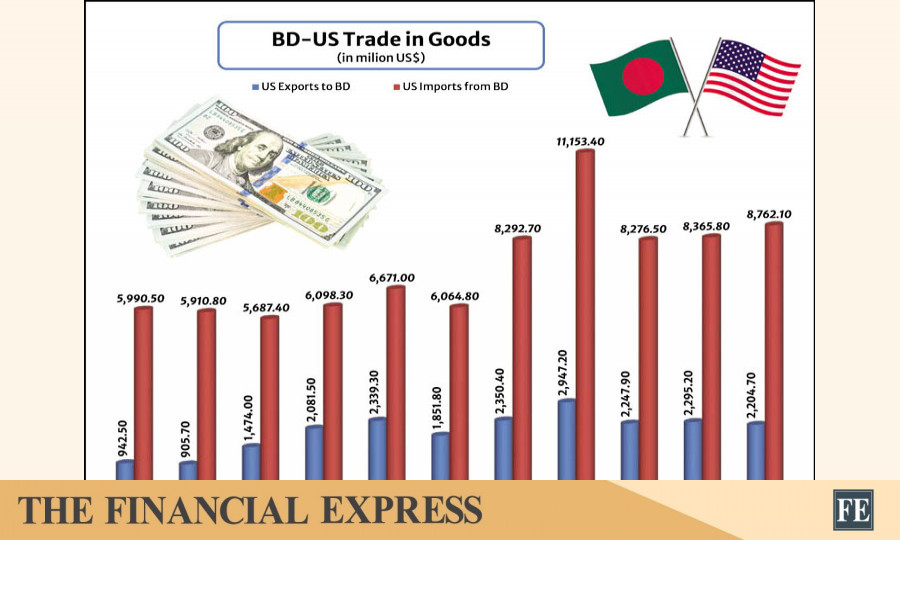
Bashir Uddin said Bangladesh had little choice but to sign the deal, as the US remained its largest export market and the trade balance favoured Bangladesh by more than $6 billion, or around Tk 1 lakh crore, each year.

Protecting national interests, therefore, required signing the agreement, as other major trading partners had already done, said the adviser.

He added that Bangladesh stood to gain significantly, as more than 86 percent of its exports were garments. The US has agreed to grant zero-duty access for apparel made using US cotton or man-made fibres.

If local exporters use 70 percent US inputs in garment production, that portion will be exempt from the 19 percent reciprocal tariff, he said.

However, existing tariffs will continue to apply, as the reciprocal tariff is additive to the Most Favoured Nation (MFN) rate.

The adviser said only around 10 percent of Bangladeshi exports to the US were likely to face the 19 percent tariff, as some 2,500 products, including pharmaceuticals, plywood, fisheries and food items, would also qualify for zero-duty access.

Bangladesh had sought a free trade agreement with the US, but this was not possible because the Trump administration was unwilling to pursue such a deal, said Bashir Uddin.

He added that local textile and spinning mills would benefit, as exporters would need to follow a double-stage transformation process to qualify for duty-free access.

The agreement is also expected to encourage higher imports from the US. Bangladesh usually imports food worth about $15 billion a year, and purchases of American cotton, soybeans and wheat have already risen since negotiations began last year, owing to competitive prices and quality.

During the talks, Bangladesh focused mainly on boosting garment exports, Bashir Uddin said.

Mahbubur Rahman said both the economic partnership agreement with Japan and the reciprocal tariff deal with the US would take effect once formal notifications were issued by all sides.

Bangladesh has offered substantial market access for US goods across its tariff schedule, including phased tariff reductions over five or ten years, an approach the commerce ministry said was uncommon in comparable agreements.

The deal also includes commitments on labour, environment, transparency and governance, along with an exit clause proposed by Bangladesh.

Either side may withdraw from the agreement with two months’ notice, the secretary said.

The Bangladesh Garment Manufacturers and Exporters Association (BGMEA) yesterday welcomed the agreement.

In a statement, BGMEA said, “We believe this provision will further enhance Bangladesh’s access to the US market. However, to effectively utilise this opportunity, it will be essential to ensure proper valuation and traceability of US-origin raw materials used in production.”

Syed Ershad Ahmed, president of the American Chamber of Commerce in Bangladesh, said the US remained one of Bangladesh’s most important export destinations, especially for ready-made garments, and that the deal would provide greater predictability for exporters while preserving competitiveness.

He added that the zero-tariff provision for products made with US inputs could deepen supply chain integration, encourage value addition and strengthen backward linkages between US producers and Bangladeshi manufacturers.​
 
Analyze

Analyze Post

Add your ideas here:
Highlight Cite Respond

US moves to counter China in Bangladesh, plans to pitch defence alternatives

Reuters
Updated: 11 Feb 2026, 23: 42

1770859103591.webp

Illustration shows 3D-printed miniature model of U.S. President Donald Trump, Bangladesh flagReutuers

The United States is concerned about China's expanding presence in South Asia and is planning to offer Bangladesh’s next government U.S. and allied defence systems as alternatives to Chinese hardware, Washington's ambassador to Dhaka told Reuters.

Bangladesh votes in a general election on Thursday after a Gen Z-led uprising toppled India-allied premier Sheikh Hasina in August 2024. She has since taken refuge in New Delhi, allowing China to deepen its influence in Bangladesh as India’s presence wanes.

China recently signed a defence agreement with Bangladesh to build a drone factory near the India border, worrying foreign diplomats.

Bangladesh is also in talks with Pakistan to buy JF-17 Thunder fighter jets, a multi-role combat aircraft jointly developed with China.

"The United States is concerned about growing Chinese influence in South Asia and is committed to working closely with the Bangladeshi government to clearly communicate the risks of certain types of engagement with China," U.S. Ambassador Brent T. Christensen said in an interview on Tuesday.

"The U.S. offers a range of options to help Bangladesh meet its military capability needs, including U.S. systems and those from allied partners, to provide alternatives to Chinese systems," he said without offering further details.

China's foreign ministry said that as comprehensive strategic partners, China and Bangladesh have cooperated in political, economic and security fields, benefiting both countries.

"Our mutually beneficial and friendly cooperation is not directed against any third party, nor will we tolerate interference from any third party," the ministry said in a statement to Reuters.

Christensen also said that President Donald Trump's administration would "like to see a good relationship between Bangladesh and India to support stability in the region".

New Delhi-Dhaka relations have nosedived since Hasina fled, badly affecting visa services and cricket ties between the two neighbours.

Commercial diplomacy is priority

Christensen said many U.S. businesses were looking at potentially investing in Bangladesh but would want the next government to show early and clear signs that it is "open for business".

"Commercial diplomacy is one of our top priorities, and we look forward to working with the new government to build on progress made with the interim government, particularly in strengthening commercial, economic, and security ties," he said.

Energy producer Chevron has been in Bangladesh for decades but not many other U.S. companies are visible in the densely populated country of 175 million people, as high taxes and difficulties repatriating profits have created some hurdles.

There are no Starbucks or McDonald's outlets in Bangladesh.

The envoy said Washington would work with "whichever government is elected by the Bangladeshi people". The race is between two coalitions led by former allies, the Bangladesh Nationalist Party (BNP) and the Islamist Jamaat‑e‑Islami, with opinion polls suggesting the BNP holds an advantage.

Aid for Rohingya refugees

Regarding the 1.2 million Rohingya refugees sheltered in Bangladesh, the ambassador said the United States remained the largest contributor to humanitarian operations.

"The U.S. remains the largest contributor to the Rohingya refugee response and continues robust health programming in Bangladesh," he said, noting a recent $2 billion worldwide funding framework signed with the United Nations to improve the effectiveness of such assistance, including in Bangladesh.

He urged other international donors to take on a greater share of the burden.

"The U.S. cannot sustain the bulk of the effort alone. International partners need to increase their support for the Rohingya response," he said.

In recent years, the U.N. refugee agency has been struggling to raise sufficient funds to support the Rohingya community, leading to cuts in their rations and the closure of some schools for them.​
 
Analyze

Analyze Post

Add your ideas here:
Highlight Cite Respond

Bangladesh cannot sign trade deals with nonmarket countries without US consent

Syful Islam
Published :
Feb 12, 2026 07:24
Updated :
Feb 12, 2026 07:28

1771029776285.webp


Bangladesh's reciprocal trade-tariff deal with the United States is bound with strings that bar it from signing any free-trade deal or preferential economic deal with "non-market" countries, including China and Russia, without US consent.

The US has officially listed 12 countries as non-market: China, Russia, Vietnam, Belarus, Armenia, Azerbaijan, Georgia, Kyrgyzstan, Moldova, Tajikistan, Turkmenistan, and Uzbekistan.

"If Bangladesh enters into a new bilateral free-trade agreement or preferential economic agreement with a non-market country, it undermines this Agreement. The United States may, if consultations with Bangladesh fail to resolve its concerns, terminate this Agreement and re-impose the applicable reciprocal tariff rate set forth in Executive Order 14257 of April 2, 2025," the deal document reads.

Bangladesh is in talks with many countries on signing bilateral free-trade agreements (FTAs) and preferential economic deals ahead of leaving the club of least-developed countries (LDCs) in November next.

Feasibility study on Bangladesh-China FTA was completed in July 2024, and in March last year, the two sides agreed to open negotiations. Also, Bangladesh is exploring ways to sign preferential trade deals with CIS (Commonwealth of Independent States) countries to boost trade with the breakaway former Soviet states.

A top fellow at the Centre for Policy Dialogue (CPD) told The Financial Express Wednesday that the oncoming new government would have to renegotiate the Bangladesh-US reciprocal trade deal since it contains scores of conditions that severally hinders interests of the country.

"Through this deal, the US has bound Bangladesh hand and foot on economic, trade and political fronts," he said, preferring not to be quoted by name.

Also, in case of signing any deal on agriculture front with any country, Bangladesh will have to take clearance from the US to ensure that the deal would not disadvantage US exports to such third countries.

"Bangladesh shall not enter into agreements or understandings with third countries that include non-scientific, discriminatory, or preferential technical standards; include third-country SPS measures that are incompatible with US or international standards; or otherwise disadvantage US exports to such third countries," mentions the reciprocal tariff deal.

It also says Bangladesh shall provide non-discriminatory or preferential market access for US agricultural goods. And the country has to ensure that its sanitary and phytosanitary (SPS) measures are science-and risk-based and do not operate as disguised restrictions on bilateral trade, and shall remove unjustified SPS barriers in areas that undermine reciprocity.

On the labour front, the deal mentions that Bangladesh has to adopt and implement a prohibition on the importation of goods mined, produced, or manufactured wholly or in part by convict labour or forced or compulsory labour, including indentured labour and indentured child labour.

Dr Zahid Hussain, a former lead economist at World Bank's Dhaka office, says the total cost-benefit analysis of the reciprocal tariff deal has yet to be done.

He notes that the benefit offered under this deal is 19-percent reciprocal tariffs and zero reciprocal tariffs on goods made and exported by using US cotton.

"The tradeoff of this deal is price certainty in US market," he told The Financial Express.

Mr Hussain also mentions that Bangladesh has given up some policy autonomy which means some limits have been imposed on the country's doing international trade.

"But there is option. You can always exit from the reciprocal deal if it is found against the interest of the country," he says.​
 
Analyze

Analyze Post

Add your ideas here:
Highlight Cite Respond

Trade pact or template for control over Bangladesh?

M G Quibria
Published :
Feb 15, 2026 22:47
Updated :
Feb 15, 2026 22:47

1771203556659.webp


The cloak of secrecy has finally been lifted. The non-disclosure agreement that kept the Bangladesh-US "reciprocal tariff" deal hidden from public scrutiny has been pulled back, and Bangladeshis can now see what was negotiated in their name. On first reading, this does not look like an agreement between sovereign equals. It reads like a document drafted in Washington and handed over for signature. If Bangladesh had trade lawyers and economists at the table, they were either absent or overruled. The result is deeply concerning.

What emerges is not "reciprocity" in any meaningful sense. It is a framework of conditionality backed by enforcement: Bangladesh commits to sweeping changes across trade regulation, digital policy, agriculture, procurement, and even security alignment, while the United States (US) retains the ultimate lever-a tariff snapback mechanism that can be triggered if Washington decides Bangladesh is not "complying."

The following highlights some of the features of the trade agreement.

THE TARIFF THREAT THAT NEVER GOES AWAY: Here is how it works: The US agrees to reduce its tariff on most Bangladeshi goods to 19 per cent, down from a threatened 37 per cent [Schedule 2 to Annex I]. For one product category-Bangladeshi garments made with American cotton and man-made fiber-the tariff drops to zero, but the agreement does not specify how much can qualify for this benefit, leaving exporters uncertain about this key concession.

Sounds good? Here is the catch: The US can snap these tariffs back at any time if it finds Bangladesh is not "complying" [Article 6.4]. And compliance does not just mean following trade rules. The US can re-impose tariffs if Bangladesh signs a trade agreement with China or any other "non-market country," makes a digital economy deal with a country the US does not like [Article 3.2], or fails to "resolve concerns" in consultations on virtually anything.

Bangladesh's garment exporters, the backbone of the economy, would live under constant threat: follow American demands on everything from domestic laws to foreign policy or watch your export business collapse overnight.

FOLLOW OUR ENEMIES, LOSE YOUR MARKET ACCESS: The most troubling part is how the deal forces Bangladesh to pick sides in global conflicts that have nothing to do with Bangladesh.

If the US imposes trade restrictions on another country for "economic or national security" reasons, Bangladesh must impose similar restrictions [Article 4.1]. In plain language: when America punishes China or Russia, Bangladesh must join in-even if it hurts Bangladesh's own interests.

It gets worse. Bangladesh must "harmonize" its export controls with American export controls, help enforce US sanctions by treating violations of American sanctions as if they were violations of Bangladeshi law, screen all exports for items controlled by the US and share that data with Washington, and create criminal penalties for violating US export control laws [Article 4.2 and Section 3 of Annex III].

This is not about protecting Bangladesh. It is about turning Bangladesh into an enforcement arm of American foreign policy.

YOU CAN'T MAKE DEALS WE DON'T LIKE: The agreement does not just control what Bangladesh does-it controls what deals Bangladesh can make with other countries.

Bangladesh cannot sign agreements with other countries that use technical standards "incompatible" with US standards, include health and safety measures that "disadvantage U.S. exports," or that the U.S. simply does not like [Article 2.3].

Want a free trade agreement with China? The US can terminate the deal and bring back tariffs [Article 4.3.4]. Want to buy nuclear reactors from Russia or China for power generation? Explicitly prohibited [Article 4.3.5]. Want digital economy partnerships with countries the U.S. considers rivals? Agreement terminated [Article 3.2].

The United States has given itself veto power over Bangladesh's economic relationships with the rest of the world.

REWRITING BANGLADESH'S LAWS FROM WASHINGTON: Beyond trade, the agreement tells Bangladesh exactly how to write its own laws. This is unprecedented micromanagement.

On labor laws, Bangladesh must amend the Bangladesh Labour Act to lower union registration requirements from 20 per cent to some unspecified lower threshold, remove the ability to cancel union registration without court approval, increase fines for anti-union discrimination to "sufficient levels" (left undefined), remove imprisonment penalties for strikes, make export processing zones subject to labor laws within two years, and drop criminal cases against workers from the 2023 wage protests [Article 1.19 of Annex III].

On digital laws, Bangladesh must amend or completely repeal its 2021 social media regulation, remove requirements for companies to hand over encryption keys, and amend the Cyber Safety Act to incorporate "freedom of expression protections." [Section 2.4 of Annex III].

On environmental laws, Bangladesh must accept the World Trade Organization (WTO) fisheries agreement without the exemptions normally granted to developing countries, submit specific forestry legislation to international bodies, and implement detailed requirements to combat illegal logging [Articles 1.20-1.26 of Annex III].

These are not high-level principles. These are line-by-line instructions on how to write Bangladeshi law-backed by the threat that if Bangladesh does not comply, tariffs will be reinstated.

THE GMO TRAP- AUTOMATIC APPROVAL WITHOUT REVIEW: Here is a provision that could cause serious domestic problems: Within 24 months, Bangladesh must automatically accept any genetically modified agricultural product approved in the United States-without conducting its own safety review and without requiring labels [Article 1.6 of Annex III].

Think about what this means. If it is approved by US regulators, it must be allowed into Bangladesh. Bangladesh cannot require independent testing. Bangladesh cannot require labels telling consumers the food is genetically modified. Bangladesh must accept trace amounts of GM material without delay, relying on US safety assessments.

In many parts of the world, including South Asia, GMO food is intensely controversial. Consumers do not trust it, farmers fear it, and courts have ruled on it. Bangladesh is being locked into a system that could trigger massive public backlash.

TRADING AWAY CONTROL OF TRADE POSITIONS: The agreement even scripts what Bangladesh can say at the WTO in Geneva.

Bangladesh must "support multilateral adoption of a permanent moratorium" on tariffs for digital products [Article 3.3]. This is a contested issue where developing countries worry about losing future tax revenue as commerce goes digital. Whether you agree with the moratorium or not, Bangladesh should not have to promise its vote in a bilateral deal-especially one where the US can re- impose tariffs if Bangladesh does not deliver.

Bangladesh must also accept the WTO Fisheries Subsidies Agreement "notwithstanding Article 12"-the clause that gives developing countries flexibility. In other words: accept it without the exemptions developing countries normally get [Article 1.23 of Annex III].

And Bangladesh must submit a complete list of all subsidies it provides to the WTO within six months [Section 6.5 of Annex III]. Transparency is fine, but when there is a tariff gun pointed at your head, it is not cooperation--it is coercion.

THE SHOPPING LIST -- PLANES, GAS, AND SOYBEANS: The deal then becomes a procurement ledger. Bangladesh "shall endeavor" to facilitate purchases of US aircraft. It "shall endeavor" to purchase or facilitate the purchase of U.S. energy, including LNG. It "shall endeavor" to purchase US agricultural products-wheat, soy, cotton-down to specific values and quantities [ Section 6 of Annex III].

This shopping list includes: 25 Boeing aircraft for Biman (14 firm orders plus options), worth Tk 30,000-35,000 crore; $15 billion in U.S. liquefied natural gas over 15 years; $3.5 billion in agricultural products including 700,000 tons of wheat yearly for five years, $1.25 billion in soybeans, plus cotton; increased purchases of U.S. military equipment; and limits on buying military equipment from "certain countries"(read: China, among others).

Here is the problem with the aircraft purchase: Biman Bangladesh Airlines is losing money. Its officials say they were not even consulted about this commitment; they learned about it from the media. The airline's technical committee was still evaluating proposals from both Boeing and its European competitor, Airbus.

When a state airline is bleeding cash, buying planes is not about expanding service; it is about taking on debt guaranteed by the government and paid in scarce foreign exchange. At a time when Bangladesh's reserves are under pressure, locking in a $3-4 billion aircraft purchase to satisfy a trade deal is not economic policy. It is surrendering fiscal sovereignty.

If Bangladesh needs planes, the decision should be based on route profitability, fleet requirements, and financial sustainability-not because Washington wants export sales and can threaten tariffs if Bangladesh buys from Europe instead.

THE CARROT-ZERO TARIFFS FOR GARMENTS WITH US COTTON: The agreement does offer one significant benefit: Bangladeshi garments made with US cotton and man-made fiber will get zero tariffs in the American market.

This is valuable. It could give Bangladesh's garment sector-which employs millions-a competitive edge. The problem? The agreement does not specify how much can qualify. There is a promise of a "mechanism" that will determine volume "in relation to" how much U.S. textile input Bangladesh imports-but the details are not set.

THE BOTTOM LINE: Bangladesh does not need conflict with the United States. But it needs negotiators who understand that what is on paper now is not a trade agreement, it is a framework for subordination.

The agreement curbs Bangladesh's ability to write its own laws, choose its trading partners, set its foreign policy, and manage its budget. It gives the US multiple off-ramps to cancel the deal and reimpose tariffs-not just for trade violations, but for sovereign choices Washington dislikes.This is what happens when a weaker country negotiates from a position of desperation rather than strength. The lesson is not just about this agreement. It is about state capacity: if you cannot defend your interests at the negotiating table, others will define them for you. And they will define them in ways that serve their interests, not yours.

[Note: This analysis references the U.S.-Bangladesh Agreement on Reciprocal Trade(https://ustr.gov/sites/default/file...n Reciprocal Trade Final 09FEB2026 LETTER.pdf), signed February 9, 2026. Article citations appear in square brackets.]

Dr M G Quibria is a trade and development economist whose career bridges international development and academia.​
 

Analyze Post

Add your ideas here:
Highlight Cite Respond

US trade deal: Devil hidden in the fine print
15 February 2026, 03:10 AM
Refayet Ullah Mridha

1771205067424.webp


The real problem for Bangladesh’s $47 billion garment industry lies deep in the technical details of the new trade deal with the US. When Dhaka and Washington signed the reciprocal trade agreement on February 9, it was celebrated as a diplomatic success. But that early optimism has now turned into confusion over the “cotton clause” -- a vague rule that waives “reciprocal tariffs” only if garments are made with American cotton.

For a country where garments make up 86 percent of total merchandise exports to the US, this deal has created uncertainty that threatens its expected benefits.

The main concern is how the new tariff system works. Under the deal, Bangladesh faces a 19 percent reciprocal tariff on top of the existing most-favoured-nation (MFN) duty of about 16.50 percent. Without any relief, the total tax on Bangladeshi garments entering the US market rises sharply to 35.5 percent.

Commerce Adviser Sk Bashir Uddin tried to reassure the industry at a press conference on February 10, saying the reciprocal tariff would be removed for garments made with US cotton. However, industry leaders warn that removing the reciprocal tariff does not mean the products become duty-free.

“The US will not waive the previous duty that was in place before signing the deal,” said Mahmud Hasan Khan, president of the Bangladesh Garment Manufacturers and Exporters Association (BGMEA).

He explained with a simple example: if a US retailer buys a T-shirt from Bangladesh for $2, the 19 percent reciprocal tariff may be removed if US cotton or man-made fibre is used. But the export will still face the basic 16.50 percent duty. So, even with the concession, the cost of entering the US market remains high.

Another issue, according to trade analysts, is the unclear wording of the concession. Article 5.3 of the agreement says the US will create a system for “zero reciprocal tariffs”, but only for a “to-be-specified volume” of imports. This limit will depend directly on how much US cotton and man-made fibre Bangladesh imports. In simple terms, the duty benefit is not unlimited -- it is tied to the amount of raw materials Bangladesh buys from the US.

This effectively means that for every dollar of tariff the US removes, the benefit goes back to its own cotton producers.

“We are waiting for clarification as we need further interpretation of how this method will work,” Khan told The Daily Star, noting that many details remain unclear.

Mohammad Abdur Razzaque, chairman of the think-tank RAPID, said the agreement text is “full of ambiguity” and “not well negotiated”. He warned that the deal appears to be a strict trade-off: Bangladesh gets tariff relief only if it uses American raw materials. He also pointed out that it is still unclear whether the full waiver applies to garment accessories, or whether those items will face separate tariffs.

The geopolitical risks are also significant. Analysts warn that if India receives the same “cotton clause” benefits, Bangladesh could lose its competitive advantage in the US market. “If India gets the same benefit, Bangladesh may not remain in a strong position in the US market,” said Razzaque.

For Bangladesh, the path remains perilous. If the government can clarify the textile clause, the country may still benefit. But if the system proves too complicated, or if competing countries receive similar terms, the much-celebrated deal may offer little real protection for Bangladesh’s garment industry, according to analysts.​
 

Analyze Post

Add your ideas here:
Highlight Cite Respond

Members Online

Latest Posts

Back
 
G
O
 
H
O
M
E