New Tweets

[๐Ÿ‡ง๐Ÿ‡ฉ] UN investigation into enforced disappearances /deaths of students/citizens at the hands of security agencies

G Bangladesh Defense
[๐Ÿ‡ง๐Ÿ‡ฉ] UN investigation into enforced disappearances /deaths of students/citizens at the hands of security agencies
96
3K
More threads by Saif


ENFORCED DISAPPEARANCE
BNP activist files complaint with ICT accusing Hasina, 50 others

Staff Correspondent 13 July, 2025, 23:57

An activist of the Bangladesh Nationalist Party on Sunday filed a complaint with the office of the International Crimes Tribunalโ€™s chief prosecutor accusing deposed prime minister Sheikh Hasina and 50 others of their involvement in the abduction and enforced disappearance of him and several of his associates.

Complaint Mohammad Ali of Nalchity in Jhalakathi is a businessman and owns an apparel factory, Sujan Apparel, in Gazipur.

He filed the complaint alleging that he was abducted on April 25, 2019 and was kept in secret detention at the Rapid Action Battalionโ€™s Aynaghar facility for more than five years.

He was released on August 6, 2024, a day after the ouster of the Sheikh Hasina-led Awami League regime amid a mass uprising. Immediately after her ouster, Hasina fled to India for shelter on August 5, 2024.

Sheikh Hasina has been charged in absentia with crimes against humanity committed during the uprising. Recently, the International Crimes Tribunal-1 sentenced her to six months in jail for contempt of court she had committed during her conversation with an Awami League leader.

Mohammad Aliโ€™s complaint is one of several ones recently submitted to the office of the chief prosecutor. Many of them named Hasina, former Rapid Action Battalion additional director general Ziaul Ahsan for their alleged involvement in enforced disappearance.

According to Mohammad Aliโ€™s complaint, Hasina, former home minister Asaduzzaman Khan, former law minister Anisul Huq and former chief of the army Abdul Aziz Khan ordered his abduction and detention.

The complaint named 12 other accused who had carried out the order.

They are the deposed prime ministerโ€™s security and defence adviser Tarique Ahmed Siddique, Tariqueโ€™s wife Shahin Siddique, retired major general and former RAB additional director general Md Ziaul Ahsan, former major general and Hatirjheel project director Sayeed Masud, former lieutenant general Akbar Hossain, who was posted at the Directorate General of Forces Intelligence, RAB-1 commanding officer lieutenant colonel Sarowar Bin Kashem, former inspector general of police and former RABโ€™s director general Benazir Ahmed, retired colonel Maksurul, retired Major Sharif, driver Saiful Islam, Awami Leagueโ€™ Darus Salam thana unit former sport affairs secretary Shah Jamal and former Awami League lawmaker Abul Hasnat Maktum.

It also alleged that 30 to 35 unidentified members of the police, RAB, DGFI, NSI and the army were involved in the incident.

Mohammad Ali alleged that the perpetrators looted the properties belonging to Sujan Apparel, valued at around Tk 4.5 crore.

He claimed that this happened while he was in hiding, shortly before he was abducted and forcibly disappeared on April 25, 2019.

He alleged that, during his five-year detention, his garment factory, 10 decimals of land and a six-storey building on it near the National University in Gazipur were taken over and transferred to Agrani Bankโ€™s Bangabandhu Avenue Branch in Dhaka.

Additionally, 59.25 decimals of land he owned in Keraniganj were sold during his detention.

According to Mohammad Ali, he was abducted by the then RAB-1 commanding officer Sarowar Bin Kashem, his team, and members of other law enforcement and intelligence agencies, all in plainclothes. The abduction took place in front of his home on DWASA Road in the capitalโ€™s Mugda area.

He said that he had gone into hiding after learning that Ziaul Ahsan, Sarowar Bin Kashem, and former IGP Benazir Ahmed were searching for him at his factory and other locations.

He believed that he was targeted because he, his family, and his employees were active BNP supporters and had participated and financed the partyโ€™s programmes.​
 
Analyze

Analyze Post

Add your ideas here:
Highlight Cite Respond

Enforced disappearances and the onus of accountability

1753144990550.webp

FILE ILLUSTRATION: BIPLOB CHAKROBORTY

There are more reasons than one to feel happy about two news reports appearing weeks apart, though interrelated. And they have to do with enforced disappearance over the 15-plus years of the reviled Hasina regime.

The first I refer to is a statement from an ISPR representative at a press briefing on July 3, assuring the nation that the army would take legal action against any of its members if found to have been involved in enforced disappearances. The second I refer to are comments made a couple of weeks prior to the first referred news, at a press briefing of the United Nations Working Group on Enforced and Involuntary Disappearances (UNWGEID) in June, as a part of the working group's final day of a four-day visit to Bangladesh.

The July assurance may be a reaction, appropriate by all means, to a very direct comment of the vice-chairperson of the UNWGEID, made at the June briefing, that if perpetrators remain in positions of authority, there can be no victim-centred prosecution. A related comment that also merits mention was made by a military rep in that briefing to the effect that the army was not involved in enforced disappearancesโ€”only a handful of individuals on deputation to the DGFI and Rab were to blame.

The issue of enforced and involuntary disappearances (EID) strikes a very painful chord among all but the most cold-hearted among us. There are two in the cabinet of the present administration who have personally suffered the consequences of enforced disappearances. Reportedly, a total of 629 persons were victims of enforced disappearance from 2007 to 2023. Since then, the bodies of 78 were recovered and 59 persons were released after abduction. And 73 were later shown to be arrested. The rest remains untraced.

What merits mention too is that a senior BNP leader has been a victim of EID. He disappeared from Dhaka and was found one fine morning in March 2015, loitering aimlessly in the vicinity of a police station in Shillong, in the Indian state of Assam. His case is shrouded in mystery.

It also merits repeating that EID tops the list of the worst forms of human rights violations alongside extrajudicial killingsโ€”something that the Hasina regime developed a penchant for. This issue has been highlighted regularly in reports emanating from various national and international rights bodies. Yet, more than hundreds have been victims of EID during the Awami League regimeโ€”consequence of acts perpetrated by government agencies.

Why the issue must be investigated thoroughly also is because of the likely involvement of forces outside of Bangladesh in the disappearances of Bangladeshis who suddenly materialised across the border in 2012, like one Sukhoranjan Bali. In fact, the Commission of Inquiry on Enforced Disappearance publicly announced that the Indian authority's involvement in Bangladesh's system of enforced disappearances is a matter of public record, as reported by this daily.

Thus, in the process of holding to account the main dramatis personae of this horrendous act, one of the points that should be considered with due diligence is the one that has been articulated by the UNWGEID vice-chairperson, which is the nub of the issue. How can one expect proper justice if the perpetrators continue to remain in positions of authority?

And this is the core issue that the interim government has not been able to address fully yet. I believe there are other elements that are standing in the way of the interim government's efforts to "sanitise" the administration and cleanse it of the Awami League ghost.

But a far more sensitive yet important issue that should occupy our mind is the responsibility, culpability, and complicity of the top brasses of the civil and defence institutions in the operation and perpetuation of a despicable and inhuman system as the "Aynaghar" and enforced disappearances, which became a norm of the Hasina regime to deal with the dissenters and recalcitrants. Also, how did the leadership allow a serving officer to remain "disappeared" in violation of the relevant military acts and prevalent laws of the land? While one accepts that there might be grounds for military officers to be turned over to the law, justice demands that they be given the chance to defend themselves.

I believe that loyalty demanded of the superior officers up and down the line to call out for those who reposed their trust and faith in them. It is surprising that some of those directly responsible for EID and running Aynaghar are absconding, and no valid reason has come forth from the relevant authorities. In holding those responsible for EID, I believe that everyone up the chain of command should be asked to account for their action related to the disappearance of serving officers.

What one must also address is the need to redefine the tasks of the forces intelligence, a matter I have flagged several times, particularly in my article in The Daily Star on February 9, 2012, titled "DGFI's Lakshman Rekha." Making political use of the DGFI started very soon after the liberation. That practice has continued ever since, and it has now been accused of acts that compare with the acts of SAVAK, Cheka or the NKVD (secret police or intelligence agencies of a former Iranian regime and Soviet Russian, respectively).

One of the urgent tasks of the interim government is to identify the alleged culprits and the enablers of EIDs and "Aynaghar," dismantle their network, and ultimately bring them to justice. Until that is done, all talks about justice will turn out to be exactly thatโ€”all talks.

Brig Gen Shahedul Anam Khan, ndc, psc (retd) is a former associate editor of The Daily Star.​
 
Analyze

Analyze Post

Add your ideas here:
Highlight Cite Respond

ENFORCED DISAPPEARANCE: ICT sets Dec 3, 7 for charge hearings
Panna allowed to defend Hasina
Staff Correspondent 23 November, 2025, 14:44

1763950378521.webp

Thirteen detained army officers, charged with crimes against humanity linked to torture and enforced disappearance, are produced before the International Crimes Tribunal in Dhaka on Sunday. | Focus Bangla photo

The International Crimes Tribunal-1 on Sunday fixed December 3 for hearing charges in a case involving 17 accused over enforced disappearances and torture at a secret detention cell inside the Rapid Action Battalion headquarters in Dhaka.

The accused include deposed prime minister and Awami League president Sheikh Hasina, former defence adviser retired Major General Tarique Ahmed Siddique, former home minister Asaduzzaman Khan Kamal.

Also accused are 10 serving army officers, three former RAB director generals, former inspector general of police Benazir Ahmed, barristers Harun-or-Rashid and Khurshid Hossen, and retired Lieutenant Colonel Muhammad Khairul Islam, who was the RABโ€™s former director (Intelligence Wing).

Only the 10 detained army officers were present in the dock.

The case against the 17 accused are linked to the enforced disappearance of 13 people, including Supreme Court lawyer Mir Ahmad Bin Quasem Arman, son of executed war crimes convict Mir Quasem Ali.

The tribunal, led by Justice Md Golam Mortuza Mozumder, set December 7 for hearing charges in the second enforced disappearance case.

The second case names 13 accused, including Hasina, Tarique Siddique, three detained serving army officers, an army officer โ€“ Major General Kabir Ahmed, who is on post retirement leave โ€” and seven retired officers.

All the army officers had served in the Directorate General of Forces Intelligence.

They are accused of disappearing 26 people between 2016 and August 5, 2024.

The victims include suspended Brigadier General Abdullahil Amaan Azmi, son of former Jamaat chief Ghulam Azam, Hummam Quader Chowdhury, son of BNP leader Salauddin Quader Chowdhury, and United Peopleโ€™s Democratic Front leader Michael Chakma.

The tribunal appointed senior lawyer Zahirul Islam Khan Panna as state defence counsel for fugitive Hasina, made common accused in both cases.

Tarique Ahmed Siddique is also command accused in both of the case. A total of 28 individuals have been made accused in the cases.

It appointed M Hasan Imam to defend Asaduzzaman Khan Kamal and several absconding army officers.

The court also set December 3 for the appointment of state defence for the fugitive accused in both of the cases.

The tribunal also kept pending applications filed by 13 detained army officers seeking exemption from physical appearance and requesting to join the trial online.

The bench observed that the law applies equally to all, noting that even a former chief justice and several former ministers of the ousted Awami League government had been produced physically in court after their arrests.

The application was moved by lawyer ABM Hamidul Mishbah, assisted by a team of lawyers representing the 13 detained army officers.

The 13 army officers were brought to the tribunal compound at about 10:00am in an air-conditioned prison van under tight security from a sub-jail inside the Dhaka Cantonment.

It was their second appearance in the proceedings of the two cases.

They were first kept in the tribunal lockup and later were produced before the judges together for the hearing lasted for half an hour.

Of the 13 detained army officers, 10 โ€” Colonel AKM Azad, Colonel Abdullah Al Momen, Lieutenant Colonel Mashiur Rahman Jewel, Brigadier General Kamrul Hasan, Brigadier General Md Mahbub Alam, Brigadier General Tofayel Mostafa Sarwar, Lieutenant Colonel Anwar Latif Khan, Brigadier General Md Jahangir Alam, Lieutenant Colonel Sarwar Bin Kashem and Lieutenant Colonel Saiful Islam Suman โ€” are accused in the first case which named 17 accused.

The tribunal asked the jail authorities to produce the 10 again on December 3.

The remaining three โ€” Brigadier General Ahmed Tanvir Mazhar Siddique, Major General Sheikh Md Sarwar Hossain and Brigadier General Mahbub Rahman Siddique โ€” are accused in the second case which named 13 accused.

They three are required to be produced before the tribunal on December 7.

The absconding PRL officer is Major General Kabir Ahmed while the seven absconding former officers are five former DGFI director generals retired Lieutenant General Md Akbar Hossain, retired Major General Md Saiful Abedin, retired Lieutenant General Md Saiful Alam, retired Lieutenant General Ahmed Tabrez Shams Chowdhury and retired Major General Hamidul Huq, former DGFI director retired major general Mohammad Towhidul-Ul Islam, and retired Lieutenant Colonel Mokhsurul Haq.​
 
Analyze

Analyze Post

Add your ideas here:
Highlight Cite Respond

Charge hearing begins against Hasina, Tarique, 11 army officers
M Moneruzzaman 07 December, 2025, 23:49

1765157789045.webp

Sheikh Hasina | File photo

The International Crimes Tribunal-1 on Sunday began hearing charges against deposed prime minister Sheikh Hasina, her former defence adviser retired Major General Tarique Ahmed Siddique, and 11 serving and former army officers in the second enforced disappearance case linked to the Joint Interrogation Cell at the DGFIโ€™s secret detention facility.

According to the charges, 26 people were forcibly disappeared, abducted, tortured and illegally detained at the JIC between July 2, 2017 and March 4, 2020.

The victims include retired Brigadier General Abdullahil Amaan Azmi, executed BNP leader Salahuddin Quader Chowdhuryโ€™s son Hummam Quader Chowdhury, and United Peopleโ€™s Democratic Front leader Michael Chakma.

The tribunal fixed December 9 to hear discharge petitions filed by three detained army officers and state-appointed defence lawyers for the 10 absconding accused, including Hasina, Tarique Siddique, seven retired officers and one serving officer.

Supreme Court lawyers Azizur Rahman and Mahin M Rahman represented the three detained army officers, while lawyer Amir Hossain appeared for Hasina, lawyers M Hasan Imam, alongwith another represented the other absconding accused.

Chief prosecutor Muhammad Tajul Islam read out excerpts from the 81-page charge sheet against Hasina, Tarique Siddique and the 11 former army officers, and urged the tribunal to frame charges against them for superior command responsibility.

All the accused have been charged with crimes against humanity under section 3(2) of the ICT Act.

The allegations cover forcible transfer, imprisonment, abduction, confinement, torture, rape, sexual exploitation, enforced disappearance, other crimes under international law, and attempts, abetment, conspiracy, incitement, complicity or failure to prevent these offences.

They are also charged under section 4 for individual and command responsibility.

This includes directly committing the crimes, being criminally liable as members of disciplined or intelligence forces, and bearing responsibility as commanders or superior officers for crimes committed under their authority.

Of the accused, the 10 army officers were deputed to the DGFI and held high-ranking positions during the alleged crimes.

The prosecution said that the crimes occurred across Bangladesh and at the Aynaghor of the JIC facility behind the DGFI headquarters in Dhaka Cantonment between November 3, 2022 and August 5, 2024.

Detained serving officers produced before the tribunal are major general Sheikh Md Sarwar Hossain, and brigadiers general Mahbub Rahman Siddique and Ahmed Tanvir Mazhar Siddique.

They were brought to the tribunal from a sub-jail inside Dhaka Cantonment in an air-conditioned prison van amid heavy security.

The absconding serving officer is major general Kabir Ahmed. Seven other absconding retired army officers include lieutenant general Md Akbar Hossain (former DGFI director general), major general Md Saiful Abedin (former DGFI DG), lieutenant general Md Saiful Alam (former DGFI DG), lieutenant general Ahmed Tabrez Shams Chowdhury (former DGFI DG), major gen Hamidul Huq (former DGFI DG), major general Mohammad Towhidul-Ul Islam (former DGFI director) and lieutenant colonel Mokhsurul Haq.

The prosecution said that the five former DGFI directors general were placed on forced retirement after the fall of the Hasina-led Awami League regime on August 5, 2024 amid a student-led mass uprising.

On December 3, the tribunal began hearing another case against 17 accused, including Hasina, former home minister Asaduzzaman Khan, Tarique Siddique, three former RAB director generals and 11 army officers, for the enforced disappearance of 11 victims between May 23, 2016 and April 14, 2020.

These crimes allegedly took place across Bangladesh, at RAB headquarters in Uttara, various RAB battalions, and the Task Force for Interrogation Cell.

The tribunal set December 14 to hear discharge petitions for both detained and absconding accused.​
 
Analyze

Analyze Post

Add your ideas here:
Highlight Cite Respond
Enforced Disappearances Commission says ex-PM Hasina ordered many cases

UNB
Published :
Jan 04, 2026 21:16
Updated :
Jan 04, 2026 21:16

1767574400395.webp

The Commission of Inquiry on Enforced Disappearances on Sunday submitted its final report to Chief Adviser Prof Muhammad Yunus, claiming that former Prime Minister Sheikh Hasina herself had issued direct orders in many cases of enforced disappearances.


Members of the Commission said the disappearances were largely politically motivated, adding that the evidence and data they gathered clearly indicated that these were crimes driven by political considerations.

The report was submitted to Chief Adviser Prof Muhammad Yunus at the State Guest House Jamuna.

Commission Chairman Justice Mainul Islam Chowdhury, along with members Justice Md Farid Ahmed Shibli, Nur Khan Liton, Nabila Idris, and Sajjad Hossain, were present at the event.

Industries Adviser Adilur Rahman Khan and Principal Secretary to the Chief Adviser Siraz Uddin Miah were also present.

According to the Commission, a total of 1,913 complaints were submitted to the Disappearance Investigation Commission.

Of these, 1,569 complaints were verified and classified as enforced disappearances based on the official definition.

Among them, 287 cases fell into the โ€œmissing and deadโ€ category.

The report said 75 percent of the victims of enforced disappearances who later returned alive were leaders and activists of Jamaat-Shibir, while 22 percent were leaders and activists of the BNP and its affiliated organisations.

Among those who remain missing, 68 percent were leaders and activists of the BNP and its affiliated bodies, and 22 percent were associated with Jamaat-Shibir.

Evidence has been found indicating the direct involvement of then Prime Minister Sheikh Hasina, her Defence Adviser Major General (retd) Tariq Ahmed Siddique, and former Home Minister Asaduzzaman Khan in several high-profile disappearance cases, according to the Chief Adviserโ€™s Press Wing.

The cases include BNP leaders Elias Ali, Hummam Quader Chowdhury, Salahuddin Ahmed and Chowdhury Alam, as well as Jamaat leader and former Brigadier General Abdullahil Aman Azmi, Barrister Mir Ahmed Bin Quasem and former Ambassador Maruf Zaman.

Chief Adviser Prof Yunus thanked the members of the Commission for their tireless efforts and strong moral commitment.

โ€œThis is historic work. On behalf of the nation, I thank you all,โ€ he said. โ€œYou have witnessed these atrocities by speaking directly to the victims and their families. This task could not have been completed without strong moral courage.โ€

He said the report documents the extent of brutality that can be inflicted on people by manipulating state institutions under the guise of democracy.

โ€œThis is documentation of how low people can stoop, how demonic and disgusting their actions can become. Those who committed these crimes are human beings like us,โ€ he said, adding that the nation must ensure such atrocities never recur.

โ€œWe must find a way to remedy this injustice so that it does not return.โ€

The Chief Adviser called for the report to be made available to the public in simple and accessible language. He also directed the Commission to submit necessary recommendations and outline future courses of action.

He instructed that locations of extrajudicial killings and enforced disappearances, in addition to the Mirror House, be identified and mapped.

Members of the Disappearance Investigation Commission expressed special gratitude to the Chief Adviser, stating that the work would not have been possible without his firm stance and support.

โ€œYou always gave us whatever support we needed and strengthened our morale,โ€ they said.

They also urged the Chief Adviser to reconstitute the National Human Rights Commission, continue the investigative efforts, and ensure protection and justice for the victims.​
 
Analyze

Analyze Post

Add your ideas here:
Highlight Cite Respond
Enforced disappearances under Awami League rule: At least 251 still missing

The commission believes that the total number of enforced disappearances is likely much higher than the complaints received. In its final report, the commission suggested that the 1,569 verified complaints probably represent only one-third to a quarter of the actual incidents. Based on extrapolation, the estimated total number of enforced disappearances may range between 4,000 and 6,000.

Staff Correspondent Dhaka
Published: 05 Jan 2026, 21: 58

1767660974923.webp


The interim government later released photos of such secret detention centres where victims of enforced disappearance were held under the Awami Leagueโ€™s rule. File photo

The Commission of Inquiry on Enforced Disappearances has confirmed 1,569 cases of enforced disappearances during the over 15 years' rule of the Bangladesh Awami League (AL) before they were ousted in a mass uprising in 2024.

At least 251 of these individuals still remain missing and they are being presumed dead. In addition, the bodies of 36 people were recovered after a certain period following their disappearance. Many of these individuals were reportedly victims of so-called โ€˜crossfireโ€™ or were found shot in rivers.

According to the commission, the ongoing cases of missing persons and recovered bodies indicate that at least 287 deaths are directly linked to incidents of enforced disappearance, based on the limited number of complaints formally submitted to the commission.

These findings appear in the commissionโ€™s final report, which was submitted yesterday (Sunday) to Chief Adviser Professor Muhammad Yunus at the state guesthouse, Jamuna.

Commission chair Justice Moyeenul Islam Chowdhury, along with members Justice Md Farid Ahmed Shibly, Nur Khan Liton, Nabila Idris, and Sazzad Hossain, was present there at the time.

1767661067537.webp


The Commission of Inquiry on Enforced Disappearances submit its final report to Chief Adviser Professor Muhammad Yunus on 4 January 2026.Courtesy of the chief adviser's press wing.

The commission stated that a total of 1,913 complaints were submitted to it. After verification, 1,569 complaints were categorised as enforced disappearances, of which 287 fell into the โ€˜missing and deadโ€™ category.

The commission further noted that 113 complaints, upon investigation, did not fall within the legal definition of enforced disappearance. In some cases, the alleged perpetrators were not law enforcement personnel. In others, the detention was a lawful arrest where the custody period lasting less than 24 hours.

However, the commission believes that the total number of enforced disappearances is likely much higher than the complaints received. In its final report, the commission suggested that the 1,569 verified complaints probably represent only one-third to a quarter of the actual incidents. Based on extrapolation, the estimated total number of enforced disappearances may range between 4,000 and 6,000.

The report notes that various intelligence agencies, including Rapid Action Battalion (RAB), police, and Directorate General of Forces Intelligence (DGFI), were implicated in these cases.

Analysis by year and agency showed that approximately one-quarter of the complaints mentioned the involvement of RAB.


The final report also details the political affiliation of those disappeared. The commission emphasised that understanding political identity is crucial to explaining these incidents. Political affiliation indicates not only who was at risk but also the deliberate targeting and repression of certain groups.

Among the disappeared, 96.7 per cent (948 individuals) had a political affiliation. Apart from them only a small number were associated with the ruling party.

According to the report, among the victims of enforced disappearance 476 were from Bangladesh Jamaat-e-Islami (50.2 per cent), 236 from Islami Chhatra Shibir (24.9 per cent), 142 from Bangladesh Nationalist Party or BNP (15 per cent), 46 from Jatiyatabadi Chhatra Dal (4.9 per cent), and 17 from Jatiyatabadi Jubo Dal (1.8 per cent).

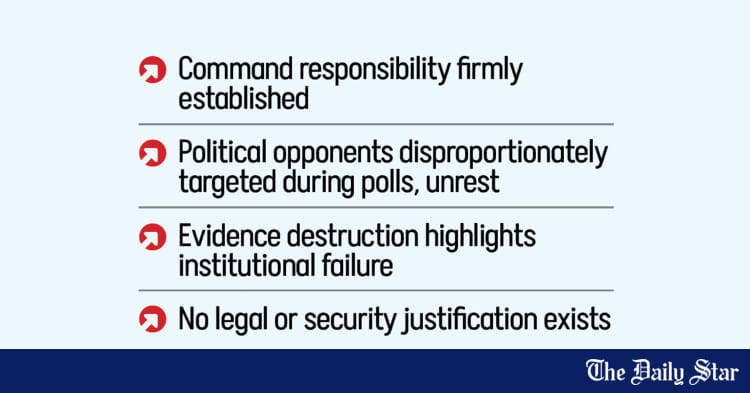
The commission stated that this pattern shows the disappearances and related abuses were not politically neutral. Individuals linked to opposition politics were disproportionately targeted. The predominance of victims from Jamaat-e-Islami, Islami Chhatra Shibir, and BNP suggests that this was not arbitrary, rather specific political ideologies were deliberately targeted.

The report shows that these incidents were not isolated or the result of immediate law-and-order situation, rather they were part of a continuous process closely linked to political pressure, elections, security crises, and institutional changes.

A large proportion of victims were members of student and youth organisations, indicating that politically active young people were particularly at risk. This statistics corresponds with periods of political conflict, anti-terror operations, and repression of opposition parties.

Among those missing whose political identities are confirmed, around 68 per cent were leaders or members of BNP and its affiliate organisations. Meanwhile, approximately 22 per cent of them were from Jamaat-e-Islami and Islami Chhatra Shibir, the commission stated in its report.

23 women were disappeared
Gender analysis of the commissionโ€™s report shows that of the 1,546 victims, 1,523 were men (98.5 per cent) and 23 were women (1.5 per cent). This figure indicates that men were primarily targeted, likely due to their political activity, security risk, or socially defined roles.

However, the low number of women may underrepresent reality, as families often reported intense social stigma, fear, and pressure in cases of female disappearance. Many women refused to lodge complaints directly. Despite the small number, the presence of female victims is significant and warrants close attention due to their particular vulnerability, says the commission.

In seeking answer to the question of how many enforced disappearances occurred in which year, the commissionโ€™s analysis has come up with a clear picture.

It shows that these incidents were not isolated or the result of immediate law-and-order situation, rather they were part of a continuous process closely linked to political pressure, elections, security crises, and institutional changes.

According to the commissionโ€™s data, 10 disappearances occurred in 2009, 34 in 2010, 47 in 2011, 61 in 2012, 128 in 2013, 95 in 2014, 141 in 2015, 215 in 2016, 194 in 2017, 192 in 2018, 118 in 2019, 51 in 2020, 95 in 2021, 110 in 2022, 65 in 2023, and 47 in 2024.

The commission notes that the number of enforced disappearances gradually began to rise when the Awami League government came to power in 2009. After 2012, this increase became more pronounced and remained high through the middle of the decade. Then a slight decline in numbers is observed after 2018.

Political motives were behind enforced disappearances, says Commission in final report.

The commission has cautioned that these year-by-year figures should not be taken as definitive historical records. In particular, data from before 2012 may significantly underrepresent the actual number of incidents, as many victims who later returned had not filed complaints with the commission at the time due to fear and psychological trauma.

The commissionโ€™s report highlights that there was a sharp spike in enforced disappearances in 2013, which corresponds with unrest surrounding the national election of January 2014. A similar pattern is observed around the 2018 election. Even in 2022, when there was no national election, the number of disappearances rose again during street protests and clashes.​
 
Analyze

Analyze Post

Add your ideas here:
Highlight Cite Respond
Enforced disappearances: Systematic crime, not aberrations

Says commission as it refutes officialsโ€™ claims of innocence


1767747585090.webp


Enforced disappearances in the country were not the work of rogue officers or isolated incidents, but a deliberate stateโ€‘run campaign, the Commission of Inquiry on Enforced Disappearances said in its report.


Refuting claims of innocence by senior officials, the Commission said that evidence shows the operations were part of an organised state security framework -- planned and coordinated across military, police, and intelligence services -- making ignorance or justification on security grounds implausible.


Considering the persistence of these activities, the Commission said, both individual officers and the agencies they represented cannot evade responsibility,

The report, shared yesterday by the Chief Adviser's Press Wing, indicates that multiple agencies were involved, including the Directorate General of Forces Intelligence (DGFI), Rapid Action Battalion (Rab), and National Security Intelligence (NSI).


These agencies not only carried out the detentions but also coordinated and concealed them, the report reads. Senior officers, including Lt Gen Akbar of DGFI, were directly implicated in authorising or sustaining unlawful detentions, it added.

A common defence by those implicated is that they did not personally order the abductions or carry them out, or that the detainees and facilities predated their tenure.

The Commission rejected the arguments, stating that responsibility for the crimes cannot be confined to the original act. Enforced disappearance is a continuing crime; as long as a victim remains unlawfully detained and their whereabouts concealed, the crime persists, it said.

Officials assuming control over detention facilities inherit responsibility for ongoing violations.

The report cited the 2024 army inquiry into Brigadier Azmi's abduction, which concluded that subsequent commanders who maintained his detention were equally responsible.

Another claim is that senior officials were unaware of the disappearances.

The Commission also dismissed this, noting the scale, duration, and visibility of the practice made ignorance implausible. Enforced disappearances occurred nationwide over several years, affecting thousands of victims, documented in media reports, court proceedings, and family testimonies.

The Commission's framework for accountability does not require proving that an official personally ordered the abductions. It only requires proving that they knew, or should have known, of the ongoing violations and failed to act.

Testimonies, including those of Lt Gen Akbar, confirm that top officials were aware of these actions. Akbar admitted discussing the disappearance of Hummam Quader with former prime minister Sheikh Hasina, who instructed that the detainee be released, showing high-level knowledge and involvement.

The report also found no legal justification for the disappearances. International law prohibits enforced disappearances under any circumstance, including during states of emergency.

Claims that rogue officers acted alone were similarly rejected.

Victims reported consistent methods of abduction, detention, and interrogation, often in facilities near senior officials' offices, making it implausible they were unaware. The operations required careful planning and coordination among the military, police, and intelligence agencies, said the report.

The commission also found clear evidence of inter-agency communication in transferring detainees between facilities.

These were organised, state-sponsored actions, not random acts of misconduct, it said.

Evidence indicates that enforced disappearances targeted opposition members, activists, and government critics rather than individuals involved in terrorism, the Commission said. It added that many incidents occurred during elections or periods of political unrest, suggesting political suppression rather than national security concerns as the primary motive.

The report warned that these practices have increased social instability, leaving released victims with deep psychological and emotional scars, which have been exploited by extremist groups.

MILITARY LAW VS CIVILIAN COURTS

Some military officials have argued that allegations against military personnel should be addressed under military law rather than through civilian courts.

However, the Commission rejected this, highlighting the inadequacies of the Army Act, 1952, specifically for two reasons.

"First, the Army Act does not recognise enforced disappearance or abduction as criminal offences, nor does it provide for superior or command responsibility. The omission is not merely technical: the Army Act is structurally incapable of addressing the gravity, systemic nature, and leadership accountability inherent in enforced disappearance," read the report.

"Second, the International Crimes (Tribunals) Act, 1973 not only recognises enforced disappearance as a crime against humanity and expressly provides for the responsibility of superiors, it also contains a non obstante clause in Section 26, giving it overriding effect over any conflicting law."

The Commission also found that military-led investigations have failed to hold perpetrators accountable.

For example, an internal military inquiry into Brigadier Azmi's abduction was disbanded without resolution, and the evidence was destroyed, demonstrating the military's failure to ensure accountability.​
 
Analyze

Analyze Post

Add your ideas here:
Highlight Cite Respond

Enforced disappearances increased ahead of elections: Commission report

Staff Correspondent Dhaka
Updated: 17 Jan 2026, 16: 43

1768697740086.webp


The interim government later released photos of such secret detention centres where victims of enforced disappearance were held under the Awami Leagueโ€™s rule. File photo

While the Awami League was in power, 61 cases of enforced disappearance occurred in 2012, and the number more than doubled the following year. Again, in 2018, the number of enforced disappearances was higher than in the year after.

Presenting year-by-year data, the report of the Commission of Inquiry on Enforced Disappearances states that incidents of enforced disappearance increased ahead of elections, with leaders, activists, and supporters of Bangladesh Nationalist Party (BNP) and Jamaat-e-Islami being selectively targeted.


During the Awami Leagueโ€™s 16 years in power, enforced disappearance became a routine occurrence. After the fall of this government in 2024 following the studentโ€“public uprising, the interim government formed the Commission of Inquiry into Enforced Disappearances. The five-member commission, headed by Justice Moinul Islam Chowdhury, submitted its final report to the Chief Adviser on 4 January.

Page 16 of the report states that ahead of elections, BNP and Jamaat-e-Islami leaders and activists were arrested en masse and selectively subjected to enforced disappearance.

Amid repression against opposition forces during the Awami Leagueโ€™s time in power, three elections were held in 2014, 2018 and 2024โ€”all of which were controversial.

The 2014 and 2024 elections were boycotted by most parties. Although all parties participated in the 2018 election, it became known as a โ€œnight-time voteโ€ because ballot boxes were allegedly stuffed before polling day.

The report says there was a link between the rise and fall of enforced disappearances and politically turbulent moments, security crises and elections.

The increase in enforced disappearances in 2013 is linked to the election held the following year (5 January 2014). A similar trend was observed surrounding the 2018 election.

Ahead of the 2014, 2018 and 2024 elections, BNP and Jamaat leaders and activists were more frequently subjected to enforced disappearance.

The commission also said that law enforcement agencies picked up opposition leaders and activists ahead of major political rallies and protests.

According to the report, 948 people were subjected to enforced disappearance due to their political identity. The total number of people who remain missing is 157.

The figure of 948 includes both those who remain missing after enforced disappearance and those who later returned. Among the victims of enforced disappearance, leaders and activists of Jamaat and its affiliated organizations were more numerous.

However, among those who did not return after disappearanceโ€”that is, those who remain missing, BNP leaders and activists and those of its affiliated organisations were more numerous.

Of the total missing persons, 68 per cent are leaders and activists of the BNP and Jubo Dal, while 22 per cent are leaders and activists of Jamaatโ€“Shibir.

Stating that political identity is crucial to understanding enforced disappearances, the report says political affiliation reveals who was at greater risk and whether enforced disappearance was a general law and order issue or was carried out with specific targets and objectives.

Number of enforced disappearances by year

There are allegations that after coming to power in 2009, the Awami League began using enforced disappearance as a tool to suppress opposition views.

The commission documented a total of 1,564 incidents of enforced disappearance between 2009 and 2024. The highest number of enforced disappearances occurred in 2016.

In 2016, there were 215 cases of enforced disappearance. The second-highest year was 2017, with 194 cases. In 2018, the number was 192. In 2019, it was 118. In 2020 and 2021, the numbers were 51 and 56 respectively.

In 2022, the number rose again to 110. In 2023, it declined to 65 and in 2024 the number was 47. In August of that year, Sheikh Hasina was ousted from power and fled the country.

In 2009, the year the Awami League returned to power, there were 10 cases of enforced disappearance. The number continued to rise thereafter.

In 2010, the number increased to 34. In 2011, it rose to 47. In 2012, there were 61 cases. The following year, 2013, saw 128 cases of enforced disappearance. In 2014, the number declined somewhat to 95. In 2015, it rose again to 141.

A total of 1,913 complaints were submitted to the commission. After verification, 1,569 complaints were classified as enforced disappearance according to the definition. Among these, 287 complaints fell into the โ€œmissing and deadโ€ category.

Link between enforced disappearance and individuals

The commission also identified a connection between fluctuations in enforced disappearances and changes in leadership within various agencies.

The report states that changes in institutions and leadership within agencies involved in enforced disappearances coincided with a reduction in the number of such incidents.

By way of example, the report says that when Major General Ziaul Ahsan was removed from his post as additional director general (Operations) of RAB in 2016, the number of enforced disappearances declined.

This does not mean that the practice stopped altogether. Rather, during this period, a small number of people remained permanently missing, while many were later found in custody or produced before courts, the report says.

The commission notes that after the United States imposed sanctions on RAB in December 2021 over continued enforced disappearances, there was some disruption in such incidents.

However, this did not last long. The Awami League government turned counterterrorism and preventive detention laws into weapons to suppress opposition views.

The report says that after coming to power in 2009, the Awami League faced national and international criticism over extrajudicial killings.

In the same year, Bangladesh participated in the United Nations Universal Periodic Review to assess the human rights situation of member states.

Due to international scrutiny of human rights conditions, pressure mounted on the government to adopt a zero-tolerance policy toward extrajudicial killings.

To reduce this international pressure, the Awami League government changed its strategy. Instead of extrajudicial killings, it chose enforced disappearance as a means to suppress dissenting views.​
 
Analyze

Analyze Post

Add your ideas here:
Highlight Cite Respond

Posts you haven't read yet..

Members Online

No members online now.

Latest Posts

Back
PKDefense - Recommended Toggle