New Tweets

[๐Ÿ‡ง๐Ÿ‡ฉ] UN investigation into enforced disappearances /deaths of students/citizens at the hands of security agencies

G Bangladesh Defense
[๐Ÿ‡ง๐Ÿ‡ฉ] UN investigation into enforced disappearances /deaths of students/citizens at the hands of security agencies
96
3K
More threads by Saif


ENFORCED DISAPPEARANCE: Commission members, survivors face threats.
Tanzil Rahaman 28 June, 2025, 00:27


1751070604201.webp


The Commission of Inquiry on Enforced Disappearance in its second interim report revealed that its members and surviving victims were facing various challenges, including intimidation, threats, and other obstacles.

Several commission members and surviving victims said that they were intimidated and put under surveillance by members of the forces that were involved in incidents of enforced disappearance during the ousted Awami League regime.

The challenges faced by the commission have been multifaceted and, at times, deeply obstructive, according to a part of the report shared by the chief adviserโ€™s press wing on June 23.

โ€˜The Commission members have faced sustained intimidation, both directly and indirectly. Threats have been issued in person, by phone, and through online communication channels. They have been subjected to systematic harassment, slander, and public disinformation campaigns. Accusations have ranged from being agents of foreign intelligence services, such as Pakistanโ€™s Inter-Services Intelligence, Indiaโ€™s Research and Analysis Wing and USAโ€™s Central Intelligence Agency, to being religious or political extremists,โ€™ said the report.

During some interviews, the report said, alleged perpetrators have explicitly stated that they were monitoring the families of commission members.

โ€˜These efforts at intimidation, however, have not affected the direction or pace of our work. We have treated such provocations with the disregard they deserve and continued our efforts in full commitment to the victims and our mandate,โ€™ it added.

The Directorate General of Forces Intelligence, Rapid Action Battalion, police, Detective Branch of police, Counter Terrorism and Transnational Crime, and Criminal Investigation Department were allegedly involved in enforced disappearance incidents, according to the commission.

Commission member Nabila Idris told New Age on Friday that they did not face such threats in the early days of their work as alleged perpetrators in security forces then largely ignored the commission and its activities.New age fashion

โ€˜All members of the commission did not face such threats and intimidations. But the number of members that faced threats and obstacles is multiple. They have faced threats and intimidation from members of security forces,โ€™ explained Nabila.

The report said that surviving victims also faced numerous obstacles.

โ€˜If we bring them (surviving victims) under the public gaze, for instance, during high-profile visits, such as those of the chief adviser to the secret detention centres in February 2025, we take care to ensure that they are prepared for the subsequent pressure they may face. And victims have indeed demonstrated resilience,โ€™ the report said.

The report further said that sustained public attacks and online harassment from political entities, particularly affiliates of the Awami League, had exacted a psychological toll on them.

โ€˜Even those victims who had appeared ready to face scrutiny later reported significant mental distress following such targeted backlash. Conversely, when we do not bring some victims in the public eye, sometimes they feel as if they are being sidelined,โ€™

Another commission member and human rights activist, Nur Khan Liton, alleged that perpetrators in all forces were threatening members and subjected surviving victims to surveillance.

United Peopleโ€บs Democratic Front leader Maichel Chakma, also a surviving victim, alleged that he was forced to switch off his mobile phone to avoid surveillance of intelligence agencies.

โ€˜In the first week of June, I came to know from a close source in an intelligence agency that I am now under surveillance,โ€™ Maichel told New Age on Friday.

Quoting the intelligence member, Maichel said that he was doing excesses according to members of that intelligence agency and was now under surveillance of the agency.

He, however, did not disclose the name of the agency.

Co-founder Sanjida Islam Tulee of Maayer Daak, a platform of families of victims of enforced disappearances, said that surviving victims were facing threats and intimidations.

โ€˜I have heard that several incidents took place in Dhaka and Chattogram. Our family has also faced intimidation,โ€™ Tulee said.

Home adviser retired Lieutenant General Jahangir Alam Chowdhury could not be reached for comment despite several attempts. The interim government formed the commission following the ouster of Sheikh Hasina-led government on August 5 past year amid a student-led mass uprising.

The commission claimed that it had so far found proof and documents of 253 incidents of enforced disappearance out of the 1,850 allegations they had received.

The incidents of these enforced disappearance occurred during the Awami League regime between January 6, 2009 and August 5, 2024, according to the commission.​
 
Analyze

Analyze Post

Add your ideas here:
Highlight Cite Respond

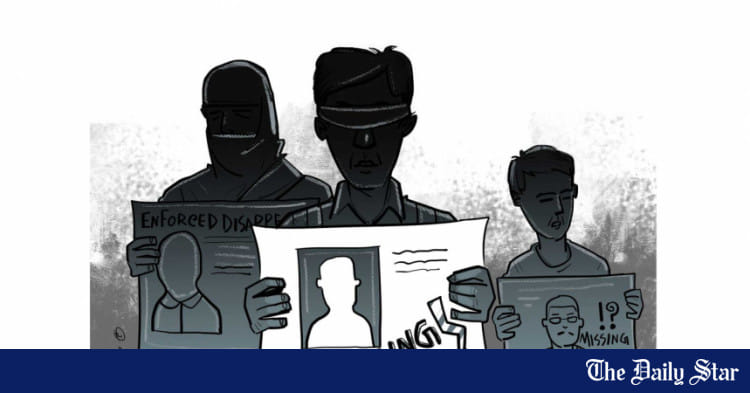
Ensure justice for the disappeared
Hold those responsible for enforced disappearances to account

1751246462661.webp


The United Nations Working Group on Enforced or Involuntary Disappearances has expressed deep concerns over the widespread impunity surrounding enforced disappearances in the country and has called on Bangladesh to ensure genuine accountability from its security, law enforcement, and intelligence agencies. Following a four-day visit to the country, it published a report highlighting these concerns. We echo the UN's concerns, as we still await a full account of the state-sponsored human rights violations that occurred during the 15-year rule of the Awami League. After the July uprising that led to the fall of the AL government, the public expected that those responsible for such grave human rights abuses would be held accountable. Unfortunately, we have yet to see significant progress in the investigation of these enforced disappearance cases.

Soon after taking office, the interim government established a commission to investigate all cases of enforced disappearances. It also ratified the International Convention for the Protection of All Persons from Enforced Disappearance, making Bangladesh accountable to international human rights bodies. The commission has verified 1,350 cases of disappearance and identified 16 secret detention centres, known as Aynaghar, which were used for torture. Evidence suggests that these were not isolated incidents, but part of a coordinated system operated under centralised authority. Investigations revealed that state security forces, including the RAB, DGFI, and the Detective Branch, were directly involved in these grave human rights violations. As highlighted in a fact-finding report by the United Nations Human Rights Office (OHCHR), the AL government systematically abused the justice system and security apparatus to suppress civil society, targeting journalists, activists, and dissenting voices through intimidation and enforced disappearances. Such practices must stop once and for all. The next elected government must make a firm commitment that such grave human rights violations will never be repeated in future.

To deliver justice in these cases and to prevent future human rights violations, the state must ensure full accountability and uphold fair trial standards in all judicial proceedings, as emphasised by the UN Working Group. Preserving the evidence properly is of utmost importance. Survivors of enforced disappearances have recently called on the government to establish independent oversight mechanisms for all security and intelligence agencies, while also urging the state to formally acknowledge the role of these agencies in past rights violations, which is critical in ensuring justice for the victims. Furthermore, the repressive laws such as the Special Powers Act, 1974, and the Anti-Terrorism (Amendment) Act, 2013, which have reportedly been used to justify extrajudicial killings, arbitrary arrests, and enforced disappearancesโ€”and are also incompatible with international human rights standardsโ€”must be repealed. Last but not least, the security institutions must regain public trust and legitimacy "through genuine accountability processes within these institutions," as the UN Working Group has suggested.​
 
Analyze

Analyze Post

Add your ideas here:
Highlight Cite Respond

Enforced disappearances: Justice must be done

MIR MOSTAFIZUR RAHAMAN
Published :
Jun 30, 2025 22:30
Updated :
Jun 30, 2025 22:30

1751325130409.webp


The darkest chapters in a nation's history are often written not by foreign enemies but by its own ruling forces. In Bangladesh, the scourge of enforced disappearances under the previous Awami League regime has emerged as one such shameful chapter -- a terrifying manifestation of state-sponsored violence, abuse of power, and the collapse of democratic accountability. Today, as the nation stands at a critical juncture in its political transition, the demand for justice is louder and more urgent than ever. And justice delayed in this case, as history repeatedly warns us, would be justice denied -- not just for victims, but for the very soul of the Republic.

Soon after the fall of the Awami League government on 5 August 2024, the interim government acted with commendable resolve by forming the Commission of Enquiry on Enforced Disappearance. That commission recently submitted its second interim report, bringing to light findings that are as explosive as they are distressing. The report does not merely narrate individual acts of abuse -- it exposes an entire architecture of violence, linking the disappearances directly to the political and military high command.

According to the Commission's findings, key political figures -- including Sheikh Hasina, General Tariq Siddiqui, the former Home Minister, and other senior officials -- were embedded in the strategic decision-making layer that had the authority to order abductions and extrajudicial killings. These were not rogue operations. These were calculated acts of terror designed to silence dissent, intimidate the opposition, and crush voices of resistance -- executed with military precision and political approval.

The report further revealed the existence of a clear chain of command: from the top civilian leadership to senior military officers and down to the operational ranks. Tragically, many of these mid- to senior-level officers, who could have served as critical witnesses, are now absconding. Their absence severely undermines the possibility of getting full truth and poses a major impediment to ensuring justice.

Those officers who were strategically placed between the political command and the executing forces were in the best position to confirm that the orders for these crimes came from the highest levels of civilian authority. Their testimony would not only help to hold individual perpetrators accountable but also shield the broader institution of the military from unjust collective blame.

But their disappearance now threatens to cut off that essential link. This absence does not merely frustrate legal proceedings; it provides space for denials, disinformation, and ultimately impunity. It also risks painting the entire security apparatus with the brush of criminality, when in truth, responsibility lies with a handful of powerful individuals.

The Commission's findings show that even after the democratic opening provided by the regime change, a culture of silence and non-cooperation persists.

For instance, a former intelligence officer reportedly told the Commission that their unit had nothing to fear because, though they detained individuals incommunicado, they did not "engage in other forms of misconduct." Such logic reflects a dangerous normalisation of illegal detention and a deeper institutional tendency to minimise or obscure wrongdoing.

This attitude not only frustrates justice but re-traumatises the families of the disappeared. Their anguish -- already immeasurable -- is deepened by the knowledge that those responsible are either in hiding or being shielded. The prospect of truth, accountability, and closure continues to be postponed indefinitely. That this is occurring after a change of government, when there was hope for transparency, makes it especially tragic and unacceptable.

The Commission has documented further disturbing developments. On 6 January 2025, the International Crimes Tribunal (ICT) issued arrest warrants for eleven individuals, including senior military officials formerly associated with the Directorate General of Forces Intelligence (DGFI). These individuals, the report reveals, were directly responsible for operations at the Joint Interrogation Cell (JIC) -- widely known as Aynaghar -- where many disappeared individuals were last seen alive.

Based on the clear command structure, it is beyond reasonable doubt that these crimes could not have occurred without the explicit knowledge of DGFI leadership. Accordingly, the Commission requested the cancellation of their passports in November 2024 -- a request granted by the Ministry of Home Affairs. At the time of issuing the warrants, many of these accused were reportedly still residing in Dhaka Cantonment. However, none of the warrants have been executed to date.

Given that their passports were revoked, their escape raises grave questions about collusion or negligence within the security apparatus. Were they allowed to flee? Did someone within the chain of command deliberately turn a blind eye?

The Commission rightly warns that the failure to bring these crimes to justice will not only haunt the families of the disappeared but also erode the credibility of some national institutions. Indeed, the damage is already underway. Those within the forces who support reform and justice are finding themselves demoralised. If the senior officers can abscond without consequences, why should lower-ranking personnel believe in reform?

This absence of accountability sets a perilous precedent. It implies that political leaders and security officials can orchestrate the disappearance, torture, and murder of citizens -- and then escape justice simply by evading summons or hiding behind institutional shields. Such impunity is a direct threat to democracy, the rule of law, and human rights.

Justice for the victims of enforced disappearances must be more than a slogan; it must be an uncompromising national commitment. The interim government must take decisive and transparent steps to locate and arrest the absconding security officials, using all intelligence and law enforcement tools at its disposal.

The authorities must hold accountable those who facilitated their escape, whether through inaction or active collusion.

Witness protection should be ensured so that lower-ranking officers feel safe to testify about their orders and experiences.

The government should engage international human rights bodies, including the UN Working Group on Enforced Disappearances, to lend support and legitimacy to domestic efforts.

History is watching. So are the victims' families, who have spent years in despair, often holding on only to the hope that the truth will someday be known and justice served. If this hope is crushed now, it will not be a mere policy failure -- it will be a moral collapse.

More than anything else, the enforced disappearances under the previous regime represent a betrayal of the social contract between the state and its citizens. Unless justice is done -- and seen to be done -- that contract remains broken. And in a broken republic, no one is truly safe.

The victims of enforced disappearance are not just statistics. They were sons, daughters, fathers, journalists, political opponents, and activists. They had names, dreams, and rights. To abandon them now is to abandon the very ideals upon which our Republic is founded.

Justice must not only be pursued - it must be delivered. And it must be delivered now.​
 
Analyze

Analyze Post

Add your ideas here:
Highlight Cite Respond

Enforced Disappearances
Extend inquiry commission's mandate
Amnesty writes to president


1751330739737.webp


Amnesty International has sent a letter to President Mohammed Shahabuddin, urging him to extend the mandate of the Commission of Inquiry on Enforced Disappearances.

The letter, signed by Friedhelm Kuhl of Amnesty International Group and dated June 17, urged the interim government to ensure that the commission's efforts can continue.

The mandate of the commission was slated to end yesterday.

"Victims were frequently held and subjected to torture and ill-treatment at secret detention sites, including a notorious site within DGFI's headquarters referred to as Aynaghar or 'House of Mirrors,' and similar secret sites run by Rab. Some victims disappeared for weeks or months before being brought to court to face fabricated criminal charges, while others were detained for years or extrajudicially killed. Although a few victims were released in August 2024, many families are still waiting to learn the truth about their loved ones' fate," said the letter sent to the president.

"When the commission inspected secret detention sites run by the DGFI and Rab, it found recent attempts to conceal and destroy evidence of these abuses, such as the removal of walls to enlarge cramped cells, fresh paint over walls on which victims had carved their names, and at the Rab-1 site, a bricked over entrance to cells so small that victims could not lie down," it added.

It continued, "The commision has found that security forces under Sheikh Hasina and top Awami League leaders used disappearances to target political opponents, activists and others expressing dissent."

"Security forces involved in disappearances include specialised police units -- the Rapid Action Battalion (Rab), Detective Branch, Counter Terrorism and Transnational Crimes -- and the Directorate General of Forces Intelligence (DGFI)," said the letter.

It commended the interim government for forming a commission and committing to international protocols to protect citizens from enforced disappearance.

"However, to end the work of the commission prematurely, in the midst of its fact finding and prior to its completion of a final report, would undermine the interim government's efforts thus far to secure justice, truth and reparations for those who suffered these gross violations."

"I strongly urge the interim government to ensure the commission's vital efforts are not cut short," it concluded.​
 
Analyze

Analyze Post

Add your ideas here:
Highlight Cite Respond

Action if army members found involved in enforced disappearances: Army

UNB
Published: 03 Jul 2025, 19: 14

No army personnel will be spared if proved involved in enforced disappearances, said Colonel Md Shafiqul Islam, Staff Colonel of the Military Operations Directorate.

โ€œWhen army personnel are on deputation, we donโ€™t have direct control over them. However, investigations are ongoing. If anyone is proved involved in enforced disappearances, the army will take action,โ€ he said at a press briefing held at Dhaka Cantonment on Thursday.

Replying to a question, he said ahead of the next general election, the army is working to ensure a stable situation in the country.

Colonel Shafiqul said 80 percent of the looted arms have already been recovered and expressed the hope that the remaining weapons would also be retrieved soon.

Around 12,000 arms had gone missing, of which approximately 9,000 have been recovered so far, he added.

The army official also informed that 4,790 people received treatment at Combined Military Hospitals (CMHs) during the last year July movement.

Currently, 22 patients are undergoing treatment at the Combined Military Hospital (CMH), Dhaka.

The law and order situation has improved significantly compared to previous periods, with the army remaining deployed to support efforts in maintaining peace.​
 
Analyze

Analyze Post

Add your ideas here:
Highlight Cite Respond

Enforced disappearance victims depict horrific torture in secret detention cells

Mehedi HasanDhaka
Published: 05 Jul 2025, 19: 51

1751759843954.webp


Harrowing tales of torture including "waterboarding" was inflicted on victims of enforced disappearance in secret detention cells run by RAB (Rapid Action Battalion).

This information emerged in the second interim report of the commission investigating enforced disappearances. On 4 June, the report titled โ€œUnfolding the Truth: A Structural Diagnosis of Enforced Disappearance in Bangladeshโ€ was handed over to Chief Adviser Professor Muhammad Yunus.

The report analysed about 1,850 complaints and presented information on 253 victims of enforced disappearance, according to the commission.

The report contains chilling accounts of many people who disappeared at the hands of law enforcement and security agencies. The victims spoke of being kept in unsanitary cells, being beaten while hung upside down, having their nails pulled out, suffering electric shocks, and being tortured in various ways โ€” including being strapped into a spinning chair.

In most cases, no written records were kept of these disappearances, abductions, or detentions. As a result, the perpetrators evaded accountability, the report notes.

Earlier, on 14 December last year, the commission submitted its first interim report. That report detailed who was involved in enforced disappearances during the 15 years of the Awami League government, how the abductions took place, and how victims were tortured or killed.

โ€œI was suffocatingโ€

A 27-year-old man, detained by RAB-10 in 2017 for 39 days, said in his testimony, โ€œThey started pouring water over a towel covering my face. They poured a whole jug of water on my face. I was suffocating. Then they removed the towel and said, โ€˜What were you doing?โ€™ I said, โ€˜Sir, what can I say? Please tell me why you brought me here.โ€™ They said, โ€˜That wonโ€™t do. Put the towel back, pour water again.โ€™ They did this three or four times, then asked others to take me away.โ€

This torture method was a regular practice. And he wasnโ€™t alone โ€” many others recounted similar horrific experiences.

Constant CCTV surveillance

Victims said they were kept for days in unsanitary cells โ€” small, dark rooms where the eating area and toilet were the same. When they lay down to sleep, their bodies rested over the toilet pan. Continuous surveillance was maintained via CCTV, even while they used the toilet โ€” causing extreme humiliation and shame.

Torture on spinning chair

Multiple testimonies described spinning devices in the cells. The commission confirmed the existence of two types of such machine. One was a spinning chair used at RABโ€™s Taskforce for Interrogation Cell (TFI).

Victims said they were strapped into the chair and spun at high speed โ€” causing vomiting, loss of bladder or bowel control, or unconsciousness.
At the DGFI-controlled Joint Interrogation Cell (JIC), an even more horrific spinning device was used, designed to spin the entire body rather than just a chair.

โ€œSpecial punishmentโ€ for female detainees

Women faced particularly shameful and severe abuse. A 25-year-old woman detained by the police in 2018 testified, โ€œThey tied my hands and forced me to face the window. Without my scarf, male officers came and stared at me. They said things like, โ€˜Such purdah before, totally stripped off now.โ€™โ€

She added, โ€œOnce they tortured me so much that my period started. When I asked for a pad, the officers laughed at me.โ€

โ€œThey wouldnโ€™t let me sleepโ€

In 2015, a 46-year-old man was detained for 391 days by various law enforcement agencies. Describing the torture he endured, he said, โ€œThey wouldnโ€™t let me sleep. After interrogations, they would take away my pillow. In winter, they would remove both the blanket and pillow. They made me sit with my weight on my bare feet, without a chair. Sometimes they would handcuff me and chain me to the bed. Even when mosquitoes bit me, I couldnโ€™t swat them. Thatโ€™s how they punished me.โ€

Immense mental pressure

The report states that severe beatings were the most common method of torture. Almost every victim experienced extensive physical assault. Even those who werenโ€™t subjected to any โ€œspecialโ€ torture were brutally beaten. In many cases, victims were beaten while hanging upside down. This kind of torture was more common among the police than the military.

Sometimes medicines or ointments were used to conceal the marks of torture. Victims would not be brought before the public until their wounds were hidden. The report notes that after release, many victims appeared before magistrates still bearing visible signs of torture โ€” but often those marks were ignored.

The report also states that victims of enforced disappearance were often given little food. They were kept handcuffed, blindfolded, and isolated in solitary cells. The uncertainty about their fate created a constant and unrelenting psychological pressure.

โ€œHe doesnโ€™t speak properly anymoreโ€

Even after release, most victims suffered long-term psychological trauma. Many saw their education, careers, or marriage prospects ruined. Some required medical treatment. Fake cases filed against them cost families an average of Tk 700,000.

A 16-year-old abducted by RABโ€™s intelligence unit and RAB-3 in 2019 was held for 20 months and 13 days. His father said, โ€œโ€ฆ(after he came back) he would just sit quietly, then suddenly get angry. If someone asked him something, he would slap themโ€ฆ now he just laughs to himself. He doesnโ€™t speak and respond properly. Heโ€™s not like he was before.โ€

He said his son does not want to take medicine.

The father of the 16-year-old said he does not even have the money required to hire a lawyer for battle the case.

โ€œReality was even more horrificโ€

The Commission of Inquiry on Enforced Disappearances was formed on 15 September last year. It began work to trace, identify, and document the circumstances of the disappeared.

Commission member and human rights activist Sazzad Hossain told Prothom Alo, โ€œThe reality is far worse that we had imagined about the torture of disappeared persons. Itโ€™s unimaginable if you donโ€™t hear from the victims! No form of torture was spared. They tortured people until they were on the brink of death.โ€​
 
Analyze

Analyze Post

Add your ideas here:
Highlight Cite Respond

Electric shocks, nail removal, and other forms of torture at secret detention cells
The report paints a harrowing picture of abductions carried out by law enforcement and security agencies, with no official records maintained in most cases.


Mehedi Hasan Dhaka
Published: 07 Jul 2025, 17: 59

1751933389020.webp


A gamchha (thin cotton towel) would be draped over the face, and water poured over it, cutting off airflow. The sheer terror, suffocation, and pain would often cause victims to pass out. This method, known as waterboarding, was one of the horrific torture techniques used at secret detention facilities operated by the Rapid Action Battalion (RAB) on victims of enforced disappearance.

The second interim report by the Commission of Inquiry on Enforced Disappearances reveals such disturbing accounts of the torture methods employed in these secret facilities, as recounted by the victims themselves.

These included being held in unsanitary cells, beaten while hung upside down, fingernails pulled out, subjected to electric shocks, or placed in spinning chairs, each method more inhumane than the previous one.

On 4 June, the commission presented the report, titled โ€œUnfolding the Truth: A Structural Diagnosis of Enforced Disappearances in Bangladesh,โ€ to Chief Adviser Professor Muhammad Yunus.

The report analysed nearly 1,850 complaints and documented the cases of 253 individuals subjected to enforced disappearance.

The report paints a harrowing picture of abductions carried out by law enforcement and security agencies, with no official records maintained in most cases. This lack of documentation, the report notes, enabled perpetrators to evade accountability for the torture and disappearances.

Torture in a spinning chair

One 27-year-old man recounted his 39-day detention by RAB in 2017: โ€œThey started pouring water over a gamchha on my face. They used an entire jug. I couldnโ€™t breathe. Then they removed the towel and asked, โ€˜What were you doing?โ€™ I said, โ€˜Sir, please tell me why youโ€™ve brought me here.โ€™ They replied, โ€˜No, this wonโ€™t do. Put the towel back, pour the water again.โ€™ This happened three or four times before they said, โ€˜Take him back.โ€™โ€

The commission identified two kinds of spinning devices used to disorient and torment detainees. One was a rotating chair reportedly used in RABโ€™s Taskforce for Interrogation (TFI) cell, in which detainees were spun at high speed, causing some to vomit, lose control of their bowels, or faint.

The other, more severe device, used in the Joint Interrogation Cell (JIC) run by the Directorate General of Forces Intelligence (DGFI), was not a chair but a machine designed to spin the entire body.

Electric shocks during urination

A 25-year-old woman detained by police in 2018 said, โ€œThey tied my hands and made me face the window. Without a scarf, the male officers would look at me and laugh, saying, โ€˜So much for modesty; now itโ€™s all gone.โ€™ Once they tortured me so badly that my period started. When I asked for a sanitary napkin, they laughed at me.โ€

In RAB custody, torture often involved beatings with eyes blindfolded. Detainees were told to urinate, and as they did, they would receive electric shocks. One survivor said, โ€œThe moment I urinated, I felt like I was being launched five feet into the air. It felt as if a massive jolt had hit my body.โ€

They tied my hands and made me face the window. Without a scarf, the male officers would look at me and laugh, saying, โ€˜So much for modesty; now itโ€™s all gone.โ€™ Once they tortured me so badly that my period started. When I asked for a sanitary napkin, they laughed at me.

According to the report, electric shocks were the second most frequently used form of torture by RAB, due to their portability and ease of use in vehicles, cells, or hidden locations.

Hanging upside down and beaten

A 46-year-old man who was held for 391 days said, โ€œThey wouldnโ€™t let me sleep. I had to sit on bare feet without a chair. Sometimes they handcuffed me to the bed. Even when mosquitoes bit me, I couldnโ€™t move to swat them.โ€

The report found that beatings were the most common form of torture, often carried out with extreme cruelty. Victims were frequently suspended upside down while being beaten.

To conceal evidence of torture, authorities would sometimes apply ointments or medicines. Detainees would not be presented in court until the marks faded.

In several cases, however, victims appeared before magistrates bearing clear signs of abuse, which were often ignored.

Whatever we thought we knew about the torture of disappeared individuals, the reality is far worse. Unless you hear the victimsโ€™ testimonies, you cannot imagine it.
Sazzad Hossain, a commission member and human rights activist.

Many were kept in solitary confinement, blindfolded and handcuffed, with minimal food. The uncertainty over their fate caused deep and continuous psychological distress.

Long-term trauma

The report states that most released victims continued to suffer from long-term trauma.

In one case, a 16-year-old boy was picked up by RAB in 2019 and held for 20 months and 13 days. His father said, โ€œAfter coming back, he would just sit quietly. Suddenly, heโ€™d get angry and slap anyone who spoke to himโ€ฆ Now he just laughs to himself. He avoids conversation and can no longer communicate normally. Heโ€™s not the same as before.โ€

The father added, โ€œHe refuses to take his medication. Iโ€™ve stopped going to lawyers too, thereโ€™s no money left.โ€

The Commission of Inquiry on Enforced Disappearances was formed on 15 September last year to trace and identify the disappeared and investigate the circumstances of their abduction.

Its first interim report, submitted to the interim government on 14 December last year, also contained chilling descriptions of how people were abducted, tortured, or even killed.

Speaking about this, Sazzad Hossain, a commission member and human rights activist, told Prothom Alo, โ€œWhatever we thought we knew about the torture of disappeared individuals, the reality is far worse. Unless you hear the victimsโ€™ testimonies, you cannot imagine it. There was no method of torture that wasnโ€™t used. They were tortured right up to the brink of death.โ€​
 

Analyze Post

Add your ideas here:
Highlight Cite Respond

BBC investigation reveals horrific police killing in Jatrabari on 5 August
BBC Eye &
BBC Bangla
Updated: 09 Jul 2025, 18: 12

1752109356595.webp


Indiscriminate police firing in one of Dhakaโ€™s busiest areas, Jatrabari, on 5 August last year resulted in deaths of at least 52 people, according to a BBC Eye investigation.

The incident is being considered one of the deadliest acts of police violence in Bangladeshโ€™s history.

The massacre occurred on the very day Prime Minister Sheikh Hasina was ousted from power and fled to India, following 36 consecutive days of student-led protests.

To uncover how this horrific event unfolded on the final day of last yearโ€™s anti-government protests, BBC Eye analysed hundreds of videos and photos, conducted eyewitness interviews, and visited the Jatrabari site multiple times.

Although various media outlets and UN report covered the event, this investigation brings to light new evidence about how the killing started and ended, and the true scale of the casualties, previously undocumented.

When contacted by the BBC regarding the police shooting, a Bangladesh Police spokesperson acknowledged the incident, saying, "There were regrettable incidents in which certain members of the then police force engaged in excessive use of force."

How the Jatrabari massacre began
During the investigation, the BBC obtained a crucial video capturing the moments just before police opened fire in Jatrabari on the afternoon of 5 August. The footage came from the phone of a protester Miraj Hossain, who was killed by police gunfire that same day.

Miraj recorded the video using his mobile phone, and the final moments of his life were also captured on that recording. After his death, his family found the phone and later shared the footage with the BBC.

1752109416259.webp

Agitated people set fire to the Jatrabari police station during the student-people mass uprising Prothom Alo file photo

Metadata analysis revealed that the shooting began at 2:43 pm. In the video, a military unit is seen standing in front of the protesters at the Jatrabari police station gate, before suddenly withdrawing.

Moments later, police officers inside the station started firing on the crowd outside. CCTV footage from a building across the station shows protesters fleeing down alleys to escape the gunfire. In another video, police can be seen kicking wounded individuals.

How long did the shooting last?
According to BBCโ€™s findings, the police violence in front of Jatrabari station lasted over 30 minutes. Drone footage obtained by the BBC shows that even at 3:17pm, police were firing at protesters on the highway in front of the station. A large group of protesters is seen taking refuge in a temporary army barrack across the road.

The footage also shows multiple dead bodies lying on the highway, while protesters tried to carry the injured to hospitals using vans, rickshaws, and motorbikes.

In the hours that followed, some protesters moved toward Shahbagh, while others remained in Jatrabari. A furious group set fire to the police station. At least six police officers were killed at that moment.

1752109472200.webp

Student and mass people clash with police in Jatrabari area during July mass uprisingProthom Alo file photo

Initially, at least 30 protesters' deaths were reported. However, based on media coverage, interviews with families, hospital records, and verified social media posts, the BBC confirmed that at least 52 civilians were killed in the Jatrabari massacre.

In addition, at least six police officers also died.

Multiple cases have since been filed against Jatrabari police officials, including the then officer-in-charge (OC) Abul Hasan, who was present during the shootings.

Bangladesh Police told the BBC via email that they have initiated steps to prosecute those involved, stating that police have launched thorough and impartial investigations. All criminal cases related to the mass protest are being handled with utmost seriousness to bring all perpetrators to justice.

When contacted for comment on the role of army personnel, no response was received from the Bangladesh Army.​
 
Analyze

Analyze Post

Add your ideas here:
Highlight Cite Respond

Posts you haven't read yet..

Members Online

No members online now.

Latest Posts

Back
PKDefense - Recommended Toggle