โ˜• Support Us โ˜•
[๐Ÿ‡ง๐Ÿ‡ฉ] - UN investigation into enforced disappearances /deaths of students/citizens at the hands of security agencies | Page 6 | PKDefense

[๐Ÿ‡ง๐Ÿ‡ฉ] UN investigation into enforced disappearances /deaths of students/citizens at the hands of security agencies

Reply (Scroll)
Press space to scroll through posts
G Bangladesh Defense
[๐Ÿ‡ง๐Ÿ‡ฉ] UN investigation into enforced disappearances /deaths of students/citizens at the hands of security agencies
91
2K
More threads by Saif

Sandwitched between Myammar and Modi's India, they also becoming kattar.. a new species of wahabbi is emerging.

I don't think Islamists (leave alone Wahhabis) get even 10% of the vote there.

Bangladeshis don't like extremists. Wearing Hijab or Topi does not mean they're all kattar. Only has fear of Allah.

People in Bangladesh don't wear their religion on their sleeves like in other Muslim countries, enforcing Islam at the expense of other religions.

Look at my Avatar, this is how most everyone feels.

Not like Indian situation. People won't get beat up for eating pig. Or for not converting to Islam.

More like Malaysia/Indonesia in that regard. Live - and let live tolerance for all religions.
 
Last edited:
Sandwitched between Myammar and Modi's India, they also becoming kattar.. a new species of wahabbi is emerging.
Anytime there is muzlim fundus or jihadists or anyother type of religious harami, you can be sure that movement is covertly US/ Israel backed.

Everytime the head choppers, the talibunnies or da Al-Qaeda or Daesh or ISIS.......or the 'muzlim jihadist' attacks in western cities.......all these basturds are on the take.

Unfortunately sunni muzlim like Sawdi Judean or Al-Turkiyan or Al-Baqistani are promoting this western propaganda under the gun, or else they will get balkanized in short order.

Iran gets bad press for exposing this bullshiit.
 
Anytime there is muzlim fundus or jihadists or anyother type of religious harami, you can be sure that movement is covertly US/ Israel backed.

Everytime the head choppers, the talibunnies or da Al-Qaeda or Daesh or ISIS.......or the 'muzlim jihadist' attacks in western cities.......all these basturds are on the take.

Unfortunately sunni muzlim like Sawdi Judean or Al-Turkiyan or Al-Baqistani are promoting this western propaganda under the gun, or else they will get balkanized in short order.

Iran gets bad press for exposing this bullshiit.
What might the US gain from toppling Hasina in BD ?

They gone anti India and pro China..
 
What might the US gain from toppling Hasina in BD ?

They gone anti India and pro China..
Dis da mystery Sharma........nobody can answer dis.......

who financed dis color revolution......

You tell me bhai.

There used to be 'old school' guy here and his thesis was that the west wants Christy X-Tian country ova there to angle in toward China's soft tribal guppu peepal underbelly.

Angling in via Afghanistan is hard now cuz Iran is controlling the talibunnies with food n fuel, and we in Pakistan will not act against China!
 

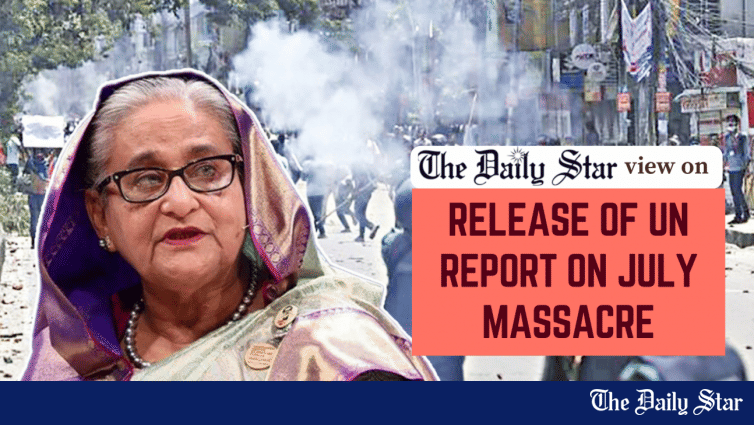
Horrific details of July massacre strengthen the cause of justice
UN report provides proof of Hasinaโ€™s own role in killing protesters

1739576085092.png


We welcome the long-awaited release of the fact-finding report of the United Nations Human Rights Office about the crimes and abuses committed by the Awami League government during the July-August uprising. And as expected, it provides conclusive proof of the systematic brutalities inflicted upon protesters as well as Sheikh Hasina's role in orchestrating them. This should put to rest any lingering attemptsโ€”domestic or internationalโ€”to distort, downplay, or whitewash the atrocities the regime carried out in a desperate bid to retain power. The facts are now indisputable, so the path to justice should be clearer than ever before.

In its 114-page report, the UN, based on testimonies from senior security officials, confirms that Hasina herself ordered security forces to kill protesters. On July 19, she explicitly instructed them to "arrest the ringleaders of the protests, the troublemakers, kill them and hide their bodies." Her trusted lieutenant, then-home minister Asaduzzaman Khan, reinforced this directive in meetings with top security officials, ordering the Border Guard Bangladesh (BGB) to use lethal force. These instructions and consequent measures paved the path for the killing of as many as 1,400 peopleโ€”including many childrenโ€”in what the UN describes as "crimes against humanity." Other findings of the report are equally chilling.

In its 114-page report, the UN, based on testimonies from senior security officials, confirms that Hasina herself ordered security forces to kill protesters. On July 19, she explicitly instructed them to "arrest the ringleaders of the protests, the troublemakers, kill them and hide their bodies." Her trusted lieutenant, then-home minister Asaduzzaman Khan, reinforced this directive in meetings with top security officials, ordering the Border Guard Bangladesh (BGB) to use lethal force.

It states that protesters were shot at point-blank range and killed. It identifies the integrated role of at least seven security forces, including the Army, BGB, and RAB, as well as ruling party activists, who coordinated to arbitrarily harass, arrest, torture, and even execute protesters. The details provided by the report about these developments, and the roles played by both security and intelligence agencies, are shocking. The report also sheds light on the sexual violence committed against women protesters as part of a broader strategy to suppress dissent. It reveals that officers also obstructed medical care for injured protesters, intimidating doctors and pressuring them to falsify medical reports or deny treatment to victims. Forensic pathologists were forced to misclassify causes of death, erasing proof of extrajudicial killings. There were also frequent internet blackouts to disrupt protesters' ability to organise.

Following the unveiling of the report, the UN rights chief has rightly called for additional criminal investigations to determine the full extent of these violations. For now, it is only appropriate that the ongoing trials of former regime figures and officials incorporate these findings as evidence, which the chief prosecutor of the International Crimes Tribunal (ICT) said they would. The UN, however, said it would not share evidence from its investigation with Bangladesh unless the trials meet international standards. There are certain issues that may stand in the way of a UN approval of the justice process, but we hope for the sake of the victims that those will be resolved soon. It is also vital that past crimes by the Awami regime, including enforced disappearances and extrajudicial executions, are tried and those responsible held to account. The UN has made a number of recommendations in its report, which too must be seriously considered and acted on.​
 

Prolonged single-party rule politicised security sector in Bangladesh: UN
BSS
Dhaka
Published: 17 Feb 2025, 22: 53

1739838569447.png


The prolonged single-party rule had steadily politicised Bangladeshโ€™s state institutions that permeated the countryโ€™s entire security sector as well, since authorities preferred recruitment and promotion there to be based on perceived political loyalty instead of professionalism, the UN rights office report said.

โ€œFifteen years of rule by a single political party coincided with a steadily increasing politicisation of state institutions that has permeated the entire security sector,โ€ read the Office of the United Nations High Commissioner for Human Rights (OHCHR) fact finding report.

The OHCHR said, โ€œMany police officers were recruited and promoted not on the grounds of professionalism, integrity and merit, but based on their perceived loyalty to, or affiliation with, the Awami League and the ruling Government it backedโ€.

The UN rights office last week released its report on human rights violation during the July-August, 2024 uprising in Bangladesh from its Geneva office last week where it dedicated a chapter on โ€œpoliticisation of the security sectorโ€.

The report said according to senior officials, the Directorate of Forces Intelligence (DGFI), National Security Intelligence (NSI) and policeโ€™s Special Branch (SB) were vetting each candidate for mid-level and higher positions based on the political party affiliation of the candidate and their relatives.

It noted that the then prime minister personally signed off on any appointments to a position of Deputy Inspector-General or higher and Awami League loyalists were strategically placed to control important units such as the Detective Branch in the metropolitan police forces.

OHCHR said the people concerned its fact finders talked highlighted that the relevance of political party affiliation in police appointments predated the former government and stems from the long-time absence of an independent body to manage police appointments and promotions.

The report said despite Bangladesh Armyโ€™s involvement in politics in the past through military coups and attempted coups โ€œthe Army is widely regarded as less politicised than other security forces.

But, it said, serving army officers and others with inside knowledge told OHCHR that the military had long been permeated by party politics, especially at the senior level.

The report said based on their perceived political loyalties, senior officers were promoted or placed in key positions in Dhaka and Army Headquarters, while officers seen as disloyal were denied promotion, placed in remote positions or, in some cases, illicitly pressured to leave the army.

โ€œThis facilitated abuse by the political party in power of not only the Army, but even more so the paramilitary forces and intelligence agencies, which were commanded by Army officers and which reported directly to the Prime Minister or Home Minister,โ€ it read.

The UN fact finders observed that politicisation had driven a negative symbiotic relationship between the ruling party and the security sector.

โ€œIn exchange for suppressing challenges to the ruling party and not intervening in crimes by ruling party members, police and other security sector personnel could expect impunity for their own serious violations and acts of corruption,โ€ the OHCHR reported.

It said criminal accountability for serious violations remained a rare exception to the generalised rule of impunity noting that since 2009, Bangladeshi civil society groups documented 2597 alleged extrajudicial killings and 708 enforced disappearances.

โ€œRAB alone was implicated in over 800 alleged killings and some 220 disappearances. Yet, RAB officers have only been convicted of murder in a single case, in which one of the victims was an influential local Awami League official,โ€ the report read.

According to the same civil society sources, it said, DGFI officials were allegedly involved in more than 170 of the alleged enforced disappearances, but not a single DGFI officer has been prosecuted.

Among others, the United Nations Committee against Torture has expressed concern about the widespread and routine commission of torture by law enforcement officials to obtain confessions or extort bribes.

The OHCHR said Bangladesh in 2013 passed a law called Torture and Custodial Death (Prohibition) Act but since then, at least 103 detainees were reportedly been tortured to death.

It said the government so far only reported 24 cases filed under the Act and in only one case were police officers convicted for torturing a person in their custody to death and โ€œthese patterns of impunity have become institutionalized and anchored in lawโ€.​
 

Security forces, AL men abused female protesters during July uprising: UN
BSS
Published :
Feb 19, 2025 22:33
Updated :
Feb 19, 2025 22:33

1740010611302.png


State security forces and armed Awami League (AL) supporters had abused girls and women sexually during the July uprising to deter their participation in the movement, according to a recent report of the United Nations (UN) rights office.

"Physical assaults on female protesters often targeted specific body parts such as face, chest, pelvis, and buttocks, as the perpetrators aimed not only to inflict pain but also apparently sought to humiliate and degrade women specifically based on their gender," said the Office of the UN High Commissioner for Human Rights (OHCHR) fact-finding report.

The Office of the OHCHR released its Fact-Finding Report titled "Human Rights Violations and Abuses related to the Protests of July and August 2024 in Bangladesh" from its Geneva office on February 12.

The report revealed that the violence targeting female protesters was often gender-based in its aims and means, reflecting abusive patterns specifically directed against women and girls.

Scrutinising interlocutors, it found that the perpetrators conducted gender-based violence as a tool to deter women's participation, undermine female leadership within the movement, and reinforce entrenched patriarchal norms.

Physical violence was routinely accompanied by gender-based insults, with female protestors frequently labelled as "whores," "*&*&*&*&*&," and "prostitutes," among other such degrading terms.

The OHCHR highlighted that AL and Chhatra League men and police officers frequently issued verbal threats of rape, forced nudity, and other forms of sexual violence against women.

The UN rights agency claimed that it received credible victim accounts of assaults by the AL supporters involving physical sexual violence.

In one case, a group of men armed with bamboo sticks apprehended a woman in early August in Dhaka and questioned her whether she was a protester.

After searching her bag and phone and finding a Bangladeshi flag, they physically assaulted her, tearing her hair, ripping her shirt, and groping her breasts and buttocks while scratching her chest and hurling sexualised insults, according to the UN fact-finding report.

It showed that two Chhatra League supporters, in another case that occurred in July in Dhaka, threatened to rape a female protester, her mother, and all the women in her family, and physically assaulted her, including by groping her breasts and genitals while making sexually explicit remarks.

After the incident, the victim received threatening calls with further threats of rape against her and other family members.

Witnesses also reported Chhatra League men assaulting several women in Cumilla, including two female students whom they apprehended and groped before handing them over to the police the report read.

Victims in Bangladesh often refrain from reporting sexual violence due to the lack of effective state reporting mechanisms, fear of retaliation from perpetrators, especially if they are in law enforcement, and the pervasive social stigma.

They also often do not receive medical, psychosocial and legal services they require, and then, if they are willing to report, they are not sufficiently protected, respected and given agency, the UN rights body observed.

The OHCHR considered it therefore likely that substantially more incidents occurred than could be documented by it, and strongly recommended that sexual and gender-based violence be a particular focus for further, gender-sensitive investigation.​
 

Implications of UN fact-finding report
Tanim Asjad
Published :
Feb 28, 2025 21:27
Updated :
Feb 28, 2025 21:27

1740792869999.png


The findings by the United Nations (UN) Human Rights Office, as revealed in its investigation report, have strongly confirmed that there was a brutal and systematic repression of protests in Bangladesh by the ousted regime of Sheikh Hasina during the July-August uprising last year. The UN body-generated report last month after conducting an extensive investigation pointed out that there was an 'official policy to attack and violently repress anti-Government protesters and sympathisers.' In this connection, the UN body expressed concern that there might be 'crimes against humanity', requiring urgent further criminal investigation.

The UN fact-finding report, a testament to the UN's meticulous and extensive work, carries significant implications for Bangladesh and the global community. The report, which meticulously details the various incidents of human rights violations during the July-August mass uprising, is a result of the UN Human Rights Office of the High Commissioner (OHCHR) fact-finding team's 230 confidential, in-depth interviews in Bangladesh and online. The interviewees, including victims, witnesses, students, and other protest leaders, as well as human rights activists, university professors, journalists, medical professionals, lawyers, businesspeople, and others, provide a comprehensive and reliable account of the events.

Moreover, in 11 medical facilities, the OHCHR's forensic physician conferred with doctors, examined 29 victims and reviewed, with consent, 153 medical case files, including images of injuries. The OHCHR also preserved and reviewed thousands of original videos and photos obtained mainly from witnesses, victims, and journalists, providing direct evidence of violations at the protests, responsible actors involved, their weapons and modes of operation. The team used the latest technology available in terms of digital verification. Again, the UN fact-finding team talked to a number of past and current army, police and other law enforcement agency officials. The team also spoke to four Hasina government ministers, each of whom had key roles in relation to the protests and some leaders of the Awami League and the now-banned Bangladesh Chhatra League. The full methodology to conduct the probe and standard of proof has been described at the beginning of the report. The 114-page report provides a horrifying picture of the suppression and brutality of the Hasina government.

Loyalists, supporters and beneficiaries of the ousted regime have been trying to undermine the UN findings. Some of them have tried to mock the UN body for 'fabricated' and 'biased' reports. Some have argued that the report has been designed in association with the Yunus-led interim government. It is, however, a standard international norm that the UN body shared its draft report with the interim government of Bangladesh for its comments regarding 'any factual errors or inaccuracies.' It also integrated relevant comments into the report before finalisation.

Again, those who are criticising the UN OHCHR have entirely forgotten that Hasina herself said on August 2 last year that her government sought cooperation from the UN and other international organisations to probe the death and violence due to the quota protest movement. It is, however, difficult to believe whether she really did so if she stayed in power.

The UN report is not just a documentation of the gross violation and abuse of human rights in Bangladesh by the ousted regime, but also a global recognition of the mass uprising. This international acknowledgment is significant, especially in the context of the persistent state-sponsored human rights abuse in Bangladesh over the last one and half decades of the Hasina regime.

The events of July-August, with the brutal killing of at least 1,400 people, injuring of more than 20,000, and detaining and torturing around 11,700 people, are not just unacceptable, but also demand immediate and full accountability. The fact that the perpetrators and their backers are now clearly identified underscores the urgency of the situation. This is a call for action that cannot be ignored.

Though the report's recommendations are not legally binding for Bangladesh to implement, it is necessary to do so in the country's greater interests.​
 

UN fact-finding report on uprising crucial for due process
Says Volker Tรผrk at Human Rights Council

1741044688975.png


UN High Commissioner for Human Rights Volker Tรผrk yesterday hoped that their recent independent fact-finding report will support truth-telling, accountability, reparations, healing and reform in Bangladesh.

"It will be crucial to ensure due process in criminal cases and investigate revenge violence, including against minorities," he said, while sharing a global update at the 58th session of the Human Rights Council in Geneva.

Turk said Bangladesh last year experienced a paroxysm of violence as the government of the time "brutally suppressed" a student movement that carried human rights as its torch.

"The country is now charting a new future," he said, adding that their recent independent fact-finding report on the grave human rights violations that took place is an "important contribution" to this journey.

UN Resident Coordinator in Dhaka Gwyn Lewis on Sunday informed Chief Adviser Prof Muhammad Yunus that Tรผrk will brief the member states about its findings on March 5 during the 55th session of the Human Rights Council.

Yunus stressed documenting all "atrocities" committed during the regime of ousted Prime Minister Sheikh Hasina.

The atrocities, including the crackdown on protesters at Shapla Chattar, police brutalities against protesters after the verdict against Delwar Hossain Sayeedi, and extrajudicial killings over the years.

"There is a need for proper documentation of all atrocities committed against the people of this country. Unless this documentation is done, it is difficult to know the truth and ensure justice," said the chief adviser.

He made the comment when UNRC Lewis and Senior Human Rights Adviser at the UN Resident Coordinator's Office in Bangladesh Huma Khan, called on him at the state guest house Jamuna.

Meanwhile in Myanmar, 2024 was the deadliest year for civilians since the military coup four years ago, said the UN rights chief in Geneva on Monday.

Turk said the military ramped up brutal attacks on civilians as their grip on power eroded, with retaliatory airstrikes and artillery shelling of villages and urban areas, arbitrary arrests and prosecutions, and the forcible conscription of thousands of young people.

"I urge the international community to decisively cut the supply of arms and finance that enable the military's vicious repression," said the UN human rights chief.​
 

ENFORCED DISAPPEARANCE: Commission searches for victims in Indian jails
Staff Correspondent 04 March, 2025, 15:04

1741134212210.png

Commission of Inquiry on Enforce Disappearance member Nur Khan addresses a press conference at the commission office at Gulshan in Dhaka on Tuesday. | Focus Bangla photo

330 still missing, Aynaghar found in Bogura Police Lines


The Commission of Inquiry on Enforce Disappearance on Tuesday said that their investigation was underway to know whether there was any victim of enforced disappearance in the list of 1,067 Bangladeshis detained in Indian jails in the past two and a half years.

The commission received the list containing the detained peopleโ€™s names and addresses from Bangladeshโ€™s foreign ministry.

โ€˜The ministry has informed the commission in writing that if they get more information, they will provide us with them. The investigation is going on to know whether there is any name of enforced disappearance victims there,โ€™ said Moyeenul, addressing a press conference held at the commissionโ€™s office in the capitalโ€™s Gulshan area.

There are two highly publicised cases that provide valuable insights into how such operations were carried out โ€“ the case of Shukhranjan Bali, who was abducted from Bangladesh Supreme Court premises and was found later in an Indian jail, and that of the Bangladesh Nationalist Party leader Salahuddin Ahmed, said the commission in its first preliminary report submitted to chief adviser Professor Muhammad Yunus on December 14.

The commission was formed on September 15, 2024, five weeks after the Professor Muhammad Yunus-led interim government assumed power on August 8, 2024, three days after the fall of the Sheikh Hasina-led Awami League regime on August 5, 2024 amid a student-led mass uprising.

The commission received 1,752 allegations of enforced disappearances that occurred during the AL regime between January 6, 2009 and August 5, 2024, said Justice Moyeenul.

He said that 1,000 of the allegations and attached papers were primarily scrutinised.

He said that the commission had already recorded statements from 280 complainants and 45 members of law enforcement and intelligence agencies.

He also said that 330 enforced disappearance victims were still missing.

Asked about the chance of their return, the commission chief said that the chance of their return was โ€˜lowโ€™.

He said that they, from the superintendents of police of the bordering districts and the Border Guard Bangladesh sector commanders, came to know that a total of 140 Bangladeshis were pushed into Bangladesh from the Indian side since August 5, 2024.

โ€˜The Police and the BGB are investigating the incidents to get the complete information,โ€™ he said.

He, however, referring to the findings of the primary investigation, said that the 140 people, pushed into Bangladesh, included none of the enforced disappearance victims.

โ€˜But, the commission came to know that enforced disappearance victim Mohammad Rahmat Ullah, a resident of Dhamrai, was pushed into Bangladesh through the Gomastapur border in Chapainawabganj on December 22, 2024. The commissionโ€™s investigation is underway over the issue,โ€™ said Moyeenul.

The name of Rahmat Ullah is not among the 140 Bangladeshis pushed into Bangladesh from the Indian side, a commission member told New Age.

Moyeenul told the press conference that the commission was inquiring about the members of law enforcement and intelligence agencies who had been facing allegations of their involvement in disappearing citizens forcefully.

โ€˜Some people are expressing their concern that the entire force is panicked for the involvement of a section of the force members in enforced disappearance,โ€™ said the commission chair in an oblique reference to the Chief of Army Staff General Waker Uz Zamanโ€™s February 25 remarks saying that the members of the police, the Rapid Action Battalion, the Border Guard Bangladesh, the Directorate General of Forces Intelligence and the National security Force were panicked.

The commission chief, however, urged all members of the forces not to be panicked as the involvement of an individual or individuals in the forces in the incidents of enforced disappearances was their personal criminal liability.

Referring to the commissionโ€™s visit to the secret detention centers, he said that they had found the structures of the RAB headquartersโ€™ Taskforce for Interrogation and the Directorate General of Forces Intelligenceโ€™s Joint Interrogation Cell, popularly known as Aynaghar, had been changed.

Commission member Noor Khan Liton said that they had also found secret detention centres in Bogura Police Lines where detainees were tortured.

According to the commission, they had found secret detention centres in several districts including Dhaka, Bogura, Rajshahi, Narayanganj, Chattogram and other districts of the agencies like the DGFI, the Counter Terrorism and Transitional Crime and the RAB.

The commission asked the authorities not to make any change in the structures of the secret detention centres.

On December 14, 2024, the Commission of Inquiry on Enforced Disappearance in its first interim report submitted to the interim government found prima facie involvement of the deposed prime minister Sheikh Hasina and some high-ranking officials of her government and security forces in enforced disappearances.

The commission also found prima facie involvement of Indian authorities in the incidents of enforced disappearance in Bangladesh.

The commission chairman said that they would identify prima facie involvement of individuals in enforced disappearance and its conclusion would be decided by the International Crimes Tribunal.

Commission members Nabila Idris and Sazzad Hossain, among others, were present at the press conference.​
 

Members Online

Latest Posts

Latest Posts