Donate ☕
201 Military Defense Forums
Wars - 2024+ Iran VS Israel | Page 177 | PKDefense
Home Post Alerts Inbox Videos

Wars 2024+ Iran VS Israel

Reply (Scroll)
Press space to scroll through posts
G War Archive
Wars 2024+ Iran VS Israel
3K
106K
More threads by Saif

Status
Not open for further replies.

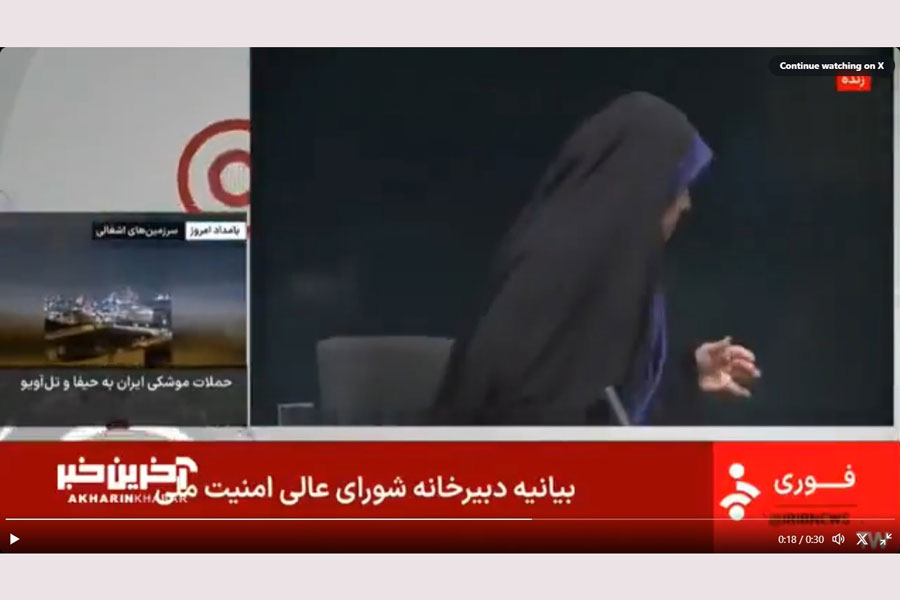
Israel bombs Iran’s state TV in latest wave of attacks on Tehran

FE ONLINE DESK
Published :
Jun 16, 2025 22:19
Updated :
Jun 16, 2025 22:19

1750115430211.webp


Iran’s state television says it has been attacked by Israel in the latest wave of missile strikes on Tehran, Al Jazeera reports.

Multiple explosions have been heard around the Iranian capital as Israel issued new evacuation threats, warning of imminent attacks, according to the report.

Iranian forces, in turn, have warned residents of Tel Aviv to evacuate, the Doha-based broadcaster adds.​
 
Analyze

Analyze Post

Add your ideas here:
Highlight Cite Fact Check
  • Wow (+2)
Reactions: Bilal9

Iran's Guards call on Israel's Tel Aviv residents to evacuate, media says

REUTERS
Published :
Jun 16, 2025 22:12
Updated :
Jun 16, 2025 22:33

1750117176340.webp

The Iranian flag flutters outside the IAEA headquarters in Vienna, Austria, June 9, 2025. Photo : Reuters/Files

Iran's Revolutionary Guards called on the residents of Tel Aviv to evacuate as soon as possible, Iranian state media reported today, shortly after Israel issued an evacuation warning for a designated area in Tehran.​
 
Analyze

Analyze Post

Add your ideas here:
Highlight Cite Fact Check
  • Like (+1)
Reactions: Bilal9

Tehran residents flee Israeli attacks, sparking huge jams: Reports
AFP Paris
Published: 16 Jun 2025, 22: 34

1750117654152.webp

This picture shows a general view of Iran's capital Tehran on 16 June 2025. AFP

Residents of Tehran have fled the Iranian capital in large numbers in the face of Israeli bombardments, creating immense traffic jams on the main road heading north, according to social media content posted on Monday.

Images verified by AFP, shot by a social media user from an overpass, showed near immobile traffic on a Tehran highway heading north with almost no vehicles in the opposite lane.

Israel on Friday launched a surprise aerial campaign targeting sites across Iran, saying the attacks aimed to prevent its archfoe from acquiring atomic weapons -- a charge Tehran denies.

The Israeli strikes have so far killed at least 224 people, including top military commanders, nuclear scientists but also civilians, according to Iranian authorities.

Iran launched strikes on Israel in retaliation which so far have killed 24 people, according to Israeli authorities.

Iranian authorities have closed civilian air space until further notice due to the Israel attacks, leaving land routes the only way out of Tehran which has been the main focus of Israeli attacks.

Israel has warned Iranians to stay away from any military infrastructure in a city where the security forces maintain a heavy presence, both overt and covert.

Videos filmed inside Iran and posted by Persian-language TV channels based abroad, such as Iran International and Manoto, as well as widely followed bloggers including Vahid Online, showed long queues of cars barely moving as they tried to leave Tehran.

The congestion appears to be concentrated on Highway 49 which connects Tehran with Chalus on the Caspian Sea in the Mazandaran province.

The region, about 150 kilometres (90 miles) north of Tehran and typically a three-hour drive even in normal times due to the mountain roads, has so far been largely spared.

It is popular with Tehranis for its mild climate, with many maintaining holiday homes there.

Persian-language outlets meanwhile also posted images of hundreds of cars lining roads outside petrol stations in Tehran and its satellite city of Karaj, saying they were filling up ahead of long journeys outside of the city.

While air travel is impossible, Iranians can still in theory cross borders by land to go abroad.

Footage posted on social media, which has not been verified by AFP, showed hundreds queueing at the Bazargan crossing point in western Iran with Turkey close to the eastern Turkish city of Dogubayazit.​
 
Analyze

Analyze Post

Add your ideas here:
Highlight Cite Fact Check
  • Haha (0)
Reactions: Lulldapull
Analyze

Analyze Post

Add your ideas here:
Highlight Cite Fact Check

Khamenei, Iran's political survivor, faces ultimate test
AFP Paris
Updated: 16 Jun 2025, 19: 49

1750118405285.webp


A handout picture released by the official website of Iran`s Supreme Leader Ayatollah Ali Khamenei shows him during a meeting with school and university students in the capital Tehran on 3 November, 2019. AFP

Iran's supreme leader, Ayatollah Ali Khamenei, has weathered a series of challenges but Israel's unprecedented strikes mark his most serious crisis yet, threatening both the clerical system he leads and his own physical survival.

Khamenei, Iran's top leader since the death of Ayatollah Ruhollah Khomeini in 1989, has ruled in the face of sanctions, near constant international tensions as well as protests that were ruthlessly repressed, most recently the 2022-2023 women-led uprising.

With Khamenei aged 86, the issue of succession was already looming large in Iran. But his moves now will have a decisive impact on the future on the system of which he has been a pillar since the 1979 Islamic Revolution that ousted the shah.

Meanwhile, his own physical survival could be at stake, with a senior American official saying Donald Trump rejected an Israeli plan to kill Khamenei but Israel is still not ruling out such a move.

"Khamenei is at the twilight of his rule, at the age 86, and already much of the daily command of the regime is not up to him but to various factions who are vying for the future," said Arash Azizi, senior fellow at Boston University.

"This process was already underway and the current war only accelerates it," he told AFP.

'Self-inflicted dilemma'

Israel's success in killing key Iranian figures, including the army chief and head of the Revolutionary Guards, has illustrated how Israeli intelligence can track Iranian leaders and raised the question of whether Prime Minister Benjamin Netanyahu could give an order to seek to kill Khamenei himself.

The movements of the supreme leader, who has not left Iran since taking up the position and made his last foreign visit to North Korea in 1989 while still president, are subject to the tightest security and secrecy.

"It is possible that they might have a regime change plan of their own, either by supporting or semi-supporting a coup inside the regime or by continuing to kill at the highest level hoping that this leads to a fundamental shift in posture toward Israel or something of a regime change," said Azizi.

Karim Sadjadpour, senior fellow at the Carnegie Endowment for International Peace, said Khamenei faced a "self-inflicted dilemma" and already lacked the "physical and cognitive acumen to lead Iran into a high-tech war".

"A weak response to Israel further diminishes his authority, a strong response could further jeopardise his survival, and that of his regime," he said.

'Prided himself'

While keeping up the rhetoric of confrontation with the US and Israel and backing proxies like Hezbollah in Lebanon, Khamenei long kept Iran out of direct conflict with its foes. But the current strikes appear to represent a sudden end to this strategy.

"He has prided himself on deterring conflict away from Iran's borders since he assumed the supreme leadership in 1989," said Jason Brodsky, policy director of US-based United Against Nuclear Iran. "So Khamenei has badly miscalculated."

Brodsky said the nearest comparison to the current situation were the attacks against leaders blamed on the opposition in the early 1980s which saw the then president killed and Khamenei himself wounded in a 1981 assassination attempt.

"It will be an experience that Khamenei will undoubtedly draw upon in the current context," Brodsky told AFP.

"But what we are witnessing today is on a completely different level of magnitude. And it's occurring at a pace that threatens to overwhelm the capacity of Tehran."

The scale of Israel's first attacks overnight Thursday to Friday, ahead of what were supposed to be a new round of talks in Oman on the Iranian nuclear programme, took the leadership by surprise at a time when it has been on the lookout for any further protests amid economic hardship.

"Indeed, the strikes have intensified already simmering tensions, and many Iranians want to see the Islamic republic gone. Crucially, however, most of them do not want this outcome to come at the cost of bloodshed and war," said Holly Dagres, senior fellow at The Washington Institute.

'Stay strong'

In an interview with Fox News, Netanyahu suggested that "regime change" could be the outcome of the Israeli strikes, while insisting that it would be for the Iranian people to bring this about.

"It could certainly be the result as the Iran regime is very weak," he said, claiming that "80 percent of the people would throw these theological thugs out".

Asked if there was an Israeli plan to kill Khamenei that had been vetoed by Washington, Netanyahu replied: "We do what we need to do, we will do what we need to do and I think the United States knows what is good for the United States".

The Iranian opposition, both in exile and inside the country, remains riven by division. One of its most prominent representatives Reza Pahlavi, the son of the last shah Mohammad Reza Pahlavi and who has warm relations with Israel, has told Iranians: "Stay strong and we will win."

So far, however, there have been no reports of mass protests, although some Persian-language television channels based abroad have broadcast images of groups shouting anti-Khamenei slogans.

Azizi cautioned: "The idea that this ends in a popular uprising that changes the regime or gives to power to someone in the Iranian opposition abroad has no basis in reality."​
 
Analyze

Analyze Post

Add your ideas here:
Highlight Cite Fact Check
Status
Not open for further replies.

Members Online

⤵︎

Latest Posts

Latest Posts