
☕ Support Us
[🇧🇩] - Monitoring Bangladesh's Economy | Page 32 | PKDefense

[🇧🇩] Monitoring Bangladesh's Economy

Reply (Scroll)
Press space to scroll through posts
G Bangladesh Defense
[🇧🇩] Monitoring Bangladesh's Economy
877
23K
More threads by Saif


Increase in remittance: Let this flow continue, stop hundi
Editorial Desk
Dhaka
Published: 05 Oct 2024, 22: 30

It’s a matter of hope that the positive trend of remittance flow into the country continues even after the political transformation on 5 August. The total influx of remittance or expatriate income into the country exceeded USD 2 billion (USD 200 crore) in September this year. That means last month saw the second highest remittance flow of this year.

Records derived from the Bangladesh Bank showed that a total of 2.4 billion US dollars (USD 240 crore) arrived as remittance last month. Meanwhile in August, the country received USD 2.22 billion (USD 222 crore) as remittance.

In September last year, there was a remittance flow of USD 1.33 billion (USD 133 crore). Compared to the same period last year, expatriates have sent 80 per cent more money to the country this time.

After the fall of Awami League government, private research organisation, Policy Research Institute (PRI) executive director Ahsan H Mansur took charge as the governor of Bangladesh Bank on 14 August.

There’s nothing to be delighted about even though there has been an 80 per cent growth in remittance. Now the concern here is that whether this trend of growth can be sustained or not.

Right after taking charge as the governor, he increased the existing band of inter-bank foreign exchange transactions from 1 per cent to 2.5 per cent aiming at reducing the crisis of dollar or foreign exchange.

As a result of this decision from the central bank, banks are able to increase the intermediary rate of the dollar from Tk 117 to a maximum of Tk 120 taka in the crawling peg system of determining the exchange rate. Because of this, the banks are able to pay a little higher price for dollars when it comes to exchanging remittance.

According to the records of the central bank, a total of USD 4.13 billion (USD 413.79 crore) arrived in remittance during the first two months of the 2024-25 fiscal year. Of that, USD 1.91 billion (USD 191.37 crore) arrived in July and USD 2.22 billion (USD 222.41 crore) arrived in August.

Meanwhile, the country received USD 2.25 billion (USD 225 crore) as remittance in May. And, June saw the highest remittance flow in this year, which amounted to USD 2.54 billion (USD 254 crore).

In that case, there’s nothing to be delighted about even though there has been an 80 per cent growth in remittance influx. Now the concern is that whether this trend of growth can be sustained or not.

At a roundtable titled ‘Where do we want to see the banking sector’ organised by Prothom Alo recently, Bangladesh Bank governor Ahsan H Mansur said that efforts are on to solve the issues of the financial sector without printing money or selling dollars from the reserve.

If the dollar market continues running in the way, there won’t be any instability in this market. The current price of dollar against remittance in the banks is higher than the price available in the open market. And, this is helping stabilise the dollar market, he added.

People will feel reassured with the remarks of the Bangladesh Bank governor only when the channels to siphon off dollars out of the country will be sealed off and it becomes easier for expatriates to send remittance through legal channels.

If the expatriates do not find the opportunity to invest inside the country, they will obviously invest their money abroad. And, we don’t want that.
Apart from that, the drive against illegal hundi business has to be strengthened even more. Reportedly, there are several rings active in different countries to take away money from the expatriate Bengalis. They lure expatriates by promising higher exchange rates for sending money to the country through them.

But in reality, they just embezzle the hard-earned money of the expatriates and pay it back through their relatives and business partners living here. As a result, the country is deprived of some valuable foreign currency.

Various facilities and incentives need to be extended to the expatriates, who are sending remittance. This way, they will be encouraged even more to send remittance through legal channels. At the same time, expatriates should be given unrestricted opportunities of investment inside the country.

The limit of bond investment imposed on expatriates has been lifted already. Intentions of those who had taken this unilateral decision in the past were not noble at all. If the expatriates do not find the opportunity to invest inside the country, they will obviously invest their money abroad. And, we don’t want that.​
 

Economic output may expand 29% if more women employed: WB

1728780040447.png


Bangladesh could increase its output in the manufacturing, service and farming sectors by up to 29 percent simply by bringing more women into the workforce, according to the World Bank.

The increase would be the highest among South Asian countries due to Bangladesh's relatively higher initial labour productivity.

If more women were to access manufacturing jobs alone, output in Bangladesh could rise by as much as 21 percent, the Washington-based lender said in its South Asia Development update published last week.

Despite progress in the local garment industry, the report shows a sizable gender gap in employment across the broader manufacturing sector.

The report said the female labour participation rate in Bangladesh remained static at 37 percent in 2022 and 2023.

It identified supply-side constraints, restrictive laws and conservative social norms as factors deterring more women from joining the labour force.

Economists agreed with the World Bank's projection, citing the country's apparel might with female labour force at its core. However, they also listed demand-side factors that discourage more women from participating in the workforce.

"Employers are often hesitant to hire women," said Professor Selim Raihan, executive director of the South Asian Network on Economic Modeling (Sanem). "Many firms still do not have women-friendly production processes or workplace arrangements."

According to the report, if more women joined farming in Bangladesh, only modest gains of 0.63 percent could be expected due to low labour productivity and a smaller gender gap in employment.

However, closing the gender gap could lead to a gain of 8.12 percent in the service sector.

The Sanem executive director said the task of caring for children and elderly persons falls disproportionately on women, acting as a supply-side factor that limits employment opportunities.

"To increase women's participation in employment, both supply-side and demand-side constraints must be addressed," he remarked.

"Safety and security issues also contribute to the lower participation," the economist added. "The availability of transportation for women is also important. The government should take care of these issues."

The World Bank said Bangladesh has the least protective laws for women, leading to severe shortcomings in safety. According to the report, Bangladesh and Pakistan also have the most conservative social expectations for women.

Frustrating participation shadows promising outlook

The report said the female labour force participation rates in most South Asian countries are in the bottom quartile among emerging and developing countries and far below male participation rates.

"South Asia's female labour force participation rate of 32 percent is well below the 54 percent average in emerging market and developing economies," said Franziska Ohnsorge, World Bank chief economist for South Asia.

However, this contrasts with the share of female employment in a range of export-oriented sectors across South Asia, such as ready-made garments in Bangladesh, call centres in India, and textiles in Sri Lanka.

The multilateral lender said increased female participation in the workforce could boost India's output by 23 percent, Pakistan's by 21 percent, Nepal's by 22 percent and Sri Lanka's by 28 percent.

If more women were to access manufacturing jobs, output in India would rise by 9 percent, it said.

Low female employment means a substantial loss of aggregate and per capita incomes. Raising women's labour force participation rate to parity with men would increase regional GDP by 13–51 percent, with larger impacts if capital and labour markets are more flexible, it said.

"South Asia's outlook is undoubtedly promising, but the region could do more to realise its full economic potential," said Martin Raiser, World Bank vice president for South Asia.

World Bank Chief Economist for South Asia Franziska Ohnsorge said, "Increasing women's employment requires action from all stakeholders; a multi-pronged effort where governments, the private sector, communities and households all have a role to play."

Echoing these sentiments, Raiser said key policy reforms to integrate more women into the workforce and remove barriers to global investment and trade could accelerate growth.​
 

Inward remittance through MFS hits 5-year high in August

Bangladesh's migrant workers sent home Tk 1,101.8 crore in remittances through mobile financial service (MFS) providers in August, marking the highest monthly receipts through digital channels in the past five years.

This figure represents a remarkable 113 percent year-on-year increase from the Tk 515.4 crore that was sent home through MFS providers in August 2023, offering a glimmer of hope for bolstering the country's dwindling foreign exchange reserves.

Bangladesh currently has around $20 billion in its foreign exchange reserves, far lower than the record $40.7 billion it boasted in August 2021.

Industry people said remittance transactions through MFS were higher in August as there were banking disruptions and limited cash supplies to ATMs following the political changeover in that month.

Besides, they credited the increasing use of technology, a 2.5 percent government incentive on remittance through formal channels, as well as various cash benefits offered by the MFS providers for the remittance surge.

Currently, at least 13 MFS platforms, including bKash, Nagad and Rocket, operate in Bangladesh.

MFS providers facilitated 54.21 percent more remittances in August compared to the month prior, according to data from the Bangladesh Bank.

In July, expatriate workers had sent home Tk 7,144 crore through MFS channels.

An analysis of central bank data reveals that August's remittance inflow through MFS channels was the highest since December 2018.

The increase follows the recent political changeover on August 5, when former prime minister Sheikh Hasina resigned and fled the country amid a mass uprising.

With MFS channels contributing significantly, total remittances surged nearly 39 percent to $2.2 billion year-on-year in August.

According to the latest data from the Bangladesh Bank, overall remittance receipts continued to rise in September, jumping 80.28 percent year-on-year to $2.40 billion.

Moreover, September's receipts were 8.12 percent higher than the previous month's.

Apart from ease of access and cash benefits, various policies from the central bank and continuous efforts of MFS providers encouraged migrant workers to use the formal channel, industry insiders said.

At the end of last year, the Bangladesh Bank doubled the maximum single-transaction limit for sending remittances to individual MFS accounts from Tk 1.25 lakh to Tk 2.5 lakh.

Ali Ahmed, chief commercial officer of bKash, said the central bank had recognised the critical role of remittance inflows in bolstering the country's economy.

Through concerted efforts and technological and distributional support of MFS providers, they have successfully channelled remittances through digital channels, he said.

Over the years, bKash has built a robust partnership ecosystem for remittances whereby seamless cross-border fund transfers can be initiated from more than 130 countries through Money Transfer Operators (MTOs) and leading commercial banks, Ahmed said.

He added that remittances received through bKash could be accessed anytime, anywhere.

Families of the expatriates can utilise remittance to take various services through their bKash accounts, including paying for goods and services, utility bills, and educational and government fees. They can also send money, donations and many other services from the comfort of their homes, he said.

In addition to offering convenient, instant, and secure remittance transfers, bKash has lowered cash-out fees, he added.

Beneficiaries can now withdraw remittances at a minimal cost of Tk 7 per thousand from approximately 2,500 ATMs of 19 leading commercial banks, Ahmed said.

"Furthermore, bKash has collaborated with various organisations and launched regular campaigns with attractive offers to encourage the use of legal remittance channels among expatriates and raise awareness. These efforts have contributed significantly to the growth of remittance inflows in Bangladesh."

Muhammad Zahidul Islam, head of media and communications at Nagad, said they had witnessed significant remittance earnings in August.

"With the natural growth, we from Nagad have also given tremendous effort to bring more remittances, such as by onboarding world-class foreign partners. Currently, people from more than 200 countries can send remittances through Nagad to Bangladesh," he said.

He said Nagad has already started a Tk 100 cashback campaign on top of the 2.5 percent government incentive to further boost inward remittance, adding that it had garnered a huge response from non-resident Bangladeshis.

"We have observed that these efforts have regained respect for us and the number of transactions has grown rapidly over time."

Through such measures, top MFS providers like Nagad are playing a vital role in strengthening and elevating the country's foreign exchange reserves, he added.​
 

Bangladesh seeks $3.0b ITFC loan for 2025
FHM Humayan Kabir
Published :
Oct 13, 2024 00:00
Updated :
Oct 13, 2024 10:09

1728867322913.png


Bangladesh has taken a fresh move to rebuild ties with the Islamic Development Bank (IsDB) as it sought a substantial US$3.0 billion credit from the middle-eastern donor to finance the imports of fuel, LNG and fertiliser in 2025, officials said on Saturday.

The government has recently sought the loan from the IsDB's commercial window ITFC for the next year, they said.

The Economic Relations Division (ERD) requested the ITFC (International Islamic Trade Finance) team, which visited Bangladesh last week, for extending the financial support in addition to its continuing lending in the next calendar year, ERD officials said.

"We have sought nearly an additional $1.0 billion for the next fiscal than the ITFC's $2.1 billion committed annual portfolio to Bangladesh in the year 2024. The lender has assured us of considering the additional financing," said a senior ERD official.

He said: "The last meeting with the ITFC team was the initial one for securing the fund commitment. If they agree, we will go for negotiations soon to confirm the next year's credit requirement."

Over the last few years, the support from the IsDB declined as the previous Sheikh Hasina's government maintained weak relations with the donors from the Islamic nations including the middle-eastern development, another ERD official said.

Securing the proposed loan will be a good gesture of rebuilding the fragile trust between the IsDB and Bangladesh, he added. Under an agreement in February this year, the Jeddah-based IsDB's ITFC provided $2.1 billion worth of funds for purchasing fuel oil and LNG from the overseas market during this calendar year 2024.

Now the government is looking to get funds from the IsDB for purchasing fertiliser as Bangladesh needs a significant amount of the agricultural inputs for increasing its crop production.

In the last year (2023), the ITFC provided $1.40 billion worth of loan for importing the fuel.

Under the credit agreement, the ITFC will finance state-owned Bangladesh Petroleum Corporation (BPC) to import petroleum fuels and state-owned Petrobangla to import liquefied natural gas (LNG).

According to the government's plan, some $1.6 billion out of the $2.1 billion credit will be utilised to import petroleum fuel oils, while the remaining $500 million for LNG.

Bangladesh is one of the top borrowers of the Gulf lender, ITFC, in the energy sector. According to the ITFC, it bankrolled Bangladesh with the highest amount of $1.16 billion in 2022.

Bangladesh mostly depends on the imports of fuel oil, LNG and fertilizer, spending the highest amount for fuel oil imports.

The country annually spends around $5.0 billion for importing refined and crude oil from the gulf and other oil supplying countries.

The ITFC has so far approved trade finance proposals totaling nearly $16.50 billion for Bangladesh since its inception in 2008.

The private sector, including banks, takes trade finance from the middle-eastern lender.

The repayment period for the $2.1 billion loan has been set for one year, with an interest rate to be calculated using the Secured Overnight Financing Rate (SOFR) plus 2.0 per cent spread. This 2.0 per cent includes a 1.80 per cent interest rate and a 0.20 per cent administrative charge.

This administrative charge must be paid before releasing the loan. On October 10, the SOFR was at 5.34 per cent, which fluctuates daily.

Government officials said the country's energy import bills, including petroleum and LNG, stood at around $10 billion in the FY2023, with a similar amount expected for the last fiscal year ending in June 2024.

Local experts forecast that if Bangladesh continues relying on imports in this way, the energy bill could double by the year 2030.

In the last FY2023, Bangladesh's oil company - Bangladesh Petroleum Corporation (BPC) - imported 1.307 million metric tonnes (MT) of crude oil spending US$836.744 million, government statistics showed.

It also imports 4.388 million MT of Jet A-1, SKO, Mogas and HSD; while 0.6608 million MT of furnace oil at a total Tk 461.704 billion cost from different overseas suppliers for catering to the demands for the local market, the BPC data showed.​
 

Current slow pace of economy in Bangladesh may lead to recession: Experts
FE ONLINE REPORT
Published :
Oct 14, 2024 22:26
Updated :
Oct 14, 2024 22:26

1728952558920.png


Currently, regardless of the measures taken through fiscal policy, no significant results are expected to be achieved within the next six months, experts observed on Monday.

Dr. Monzur Hossain, Research Director of the Bangladesh Institute of Development Studies (BIDS), made this remark during a seminar titled "Current Economic State and Way Forward," held at the Bangladesh Institute of Social Research (BISR) Trust office in Lalmatia.

He further stated that the current sluggishness of the economy could lead to a recession.

“Although government spending has decreased, both public and private investment have significantly dropped. Additionally, the National Board of Revenue does not have a separate research cell. They create and implement policies, which is why there are no positive outcomes,” Monzur added.

Moreover, Bangladesh's tax-to-GDP ratio is the lowest in South Asia. Therefore, the current tax policy is unlikely to remain sustainable for long, he noted.

“The Bangladesh Bank is currently trying to provide liquidity support to fragile banks by arranging cash from other commercial banks. However, stabilizing the banks will still be difficult. During the previous government, there were no economic policies, which is why countries around us have been able to reduce inflation while we have not. Inflation cannot be controlled solely through monetary policy; if extremely high rates are imposed, all sectors, including industry and trade, will collapse,” Monzur Hossain stated.

He said maintaining reserves between $25-30 billion is sufficient. At one point, reserves reached around $48 billion because imports were restricted after the pandemic, while exports were performing well. He also advised focusing on quality investments.

In response to a question from Munem Ahmad Chowdhury, a research associate at BISR Trust, Monzur mentioned that even if autonomy is granted to the Bangladesh Bank, the country's central bank, it is crucial to fulfill such responsibilities. In that case, the governor must act impartially under this autonomy, and lobbying should not occur.

He added that the Bangladesh Bureau of Statistics is not very responsible, as accurate information is not always available.

The seminar was moderated by Khurshed Alam, Chairman of BISR Trust, who emphasized the need for data to accurately understand any developmental activity or issue.

“Many dismiss data from the previous government as baseless, raising the question of why people should still trust government data. Transparency and accountability are thus crucial,” he remarked.

Khurshid also noted a common issue in mega projects like the Jamuna Bridge, Padma Bridge, and Karnaphuli Tunnel: weak planning. He questioned whether spending on the Karnaphuli Bridge would have been more beneficial than spending on the tunnel.

Md. Murad Ahmed, Senior Researcher at BISR Trust, stated that enhancing the efficiency of the capital market would restore investor confidence, leading to diversified investments and profits. If certain instruments can be introduced to the country's economy, inflation will decrease, and the economy will move toward a more robust position.

AKM Riaz Uddin, Senior Research Fellow at The Hunger Project, remarked that just as abnormal symptoms arise when a drug addict stops using drugs, abnormalities will emerge if economic irregularities are addressed all at once. Therefore, patience is necessary to achieve sustainable solutions.

During the discussion, prominent businessman Swapan Kumar Das pointed out that previous agreements regarding loan contracts have caused millions in losses, placing investors in significant danger.

He noted that the system is being driven by words rather than actions. If this situation is not quickly resolved, investors will lose interest, potentially leading to an economic collapse, he added.

Mohammad Yakub, CEO of the All Bangladesh Research and Development Group, highlighted the importance of research in ensuring transparency in the financial sector.​
 

Chinese debt rescheduling, import credits seen imperative for BD economy
FE REPORT
Published :
Oct 15, 2024 00:10
Updated :
Oct 15, 2024 00:10

1728953662435.png


Leading economists and foreign-relations experts stressed debt rescheduling by the Chinese side raising the loan-repayment and grace periods to enable Bangladesh to absorb economic shocks, as closer cooperation between the two countries came into the limelight.

Addressing an international seminar on 'Bangladesh-China Relations: A Future Outlook'" they also opined that if China provides credit arrangements to Bangladesh for its import from China, it would help the country address the fragile BoP situation.

Bangladesh Institute of International and Strategic Studies (BIISS) and the Centre for China Studies (SIIS-DU) jointly organised the meet to commemorate the 50th anniversary of the establishment of diplomatic relations between China and Bangladesh.

Md. Touhid Hossain, Adviser for Foreign Affairs of the current interim government, was the chief guest at the seminar which was also addressed by Yao Wen, Ambassador of China in Bangladesh, and Dr Debapriya Bhattacharya, Distinguished Fellow of CPD and Chair of the Committee on White Paper on the State of Bangladesh's Economy.

"Almost a quarter of our imports are coming from China, but the trade deficit is increasing. Trade deficit is increasing at a faster rate than the volume of the trade itself. China has been generous in order by providing us, first, the 97-percent duty- free and quota-free market access. Now it has gone up to 100 per cent, but we know by now in the world, trade does not depend on only market access based on tariffs and other regulatory or other forms of financial considerations. It also depends on the process through which it happens. It also depends on the non-trade barriers which are there," said Dr Debapriya.

"So I think if you look at the future of Bangladesh exports to China, then it is not tariff, it is the non-tariff barriers which we need to look at."

He also stressed the need to look at the lengthy processes. "Quite often it takes to dispute settlement."

Highlighting the need for debt rescheduling with China he said, "As I mentioned, almost 9.0 per cent to 10 per cent of the financial flows are coming from China. And, well, if you look at the debt situation of Bangladesh at this moment, almost 5.6 billion dollars are owed to China which is almost 10 per cent of the total debt of Bangladesh has overseas. So the debt per repayment is becoming an increasing challenge for Bangladesh."

The economist also points out that some of the loans come as supplier's credit.

And shorter repayment period, shorter grace period, and higher commitment charges than others show there are opportunities for streamlining them in the future.

He argues that Chinese loan and debt in Bangladesh definitely demand a bit much closer look.

He suggests making the debt situation more compatible with the upcoming development requirements of this country.

Mr Debapriya also observed that although the foreign-exchange reserves improved in the recent weeks, and the foreign-exchange flow stayed quite sustainable in the recent past, a debt rescheduling is not totally out of picture.

"At this moment, a debt-rescheduling issue may soon come up to look at how we really pay back some of these loans which are really maturing very fast," he told the cutting-edge function at an important crossroads in Bangladesh's political history following the July-August uprising.

About the importance of more Chinese investment in Bangladesh he said China can bring Bangladesh into the regional value chain through investing in the garment and manufacturing sector.

"What is becoming important now to have the Chinese investment more in Bangladesh over here, and where the Chinese investment can go in Bangladesh," he said, adding that it has to go to the Chinese economic and industrial zone which has been allocated in Anwara upazila in Chittagong.

He also argues that more investment in the Anwara EPZ is needed to make the Karnaphuli Tunnel economically viable.

The CPD economist stresses the need for Chinese credit to support Bangladesh's import from that country. Import from China is critical for Bangladesh, and given that Bangladesh does not have adequate foreign exchange now to pay up debt, it is important to get a financing from China in order to underwrite those imports.

"It is the old-fashioned open general licence system that you open up a credit line which can only go to finance the imports which are coming from China and support that one and create no less pressure on our balance-of-payments situation," he said.

He notes that China remains the single-largest provider of financial support to Bangladesh, as of last year (2023). The latest data show Dhaka received nearly US$4.0 billion almost in financial support which is about 9.0 per cent of the total flow which came to Bangladesh in that year.

The economist mentions that Bangladesh imports almost $25 billion of goods from China. It is about 23 per cent of the total imports coming to Bangladesh, and China's investment has now reached almost $1.5 billion.

"And what we see is important also in terms of human development. There're 20,000 students from Bangladesh currently studying in China at this very moment. So if this is one of the benchmarks and if you look at the future, why

Bangladesh should be looking at China as its major source of development cooperation and economic cooperation in the future."

Speaking on the strengths of China, he said, "China, as you may know, remains the driver of global economy at this moment, at least 30per cent of the global good is attributable to China. We make the joke that if China catches cold, then the whole world sneezes. That is the economic situation what we have now. So we are talking about a country which has generated $600 billion of trade surplus. We are talking about a country which has 3000 billion of foreign-exchange reserves."

Foreign Adviser Touhid Hossain said Bangladesh could not capitalise on the duty-free access that China has given for many reasons. "I would say that it's basically our lack of competitiveness in many areas and lack of diversification. I think we need to concentrate on these two. We need to enhance our competitiveness."

He agrees on the issue of debt rescheduling by the Chinese side.

The adviser said Bangladesh and China have very important defence cooperation. "As we all know, China is a major supplier of our defence equipment and the modernisation of our military services that we are looking forward to. I think we need a lot of cooperation in this respect, from China."

About the collaboration in the infrastructure-development sector, he said, "Of course, there are some limitations, as has already been mentioned, and we need to overcome those so that the infrastructure-development cooperation that exists between our two countries becomes more useful, more sustainable."

The foreign affairs' adviser of the interim government also stressed enhanced cooperation in the energy sector, both in green and traditional. Some projects are ongoing in various areas, and he hopes that these will be expedited so that they can be completed in time and become more useful for the Bangladesh economy.

One important area of cooperation between the two countries, as has been already touched by the ambassador, is technological know-how and communications, and Information and Communication Technology, he said.

Seeking Chinese cooperation in resolving the Rohingya crisis he said China has been cooperating in this respect for the return of the refugees. "We know that there is only one solution to this problem, which is that the people who are now in the camps in Bangladesh have to go back to their home. That is the only solution."

"China has been with us and there were trilateral dialogues, but, unfortunately, the previous initiatives have not resulted in any return of any of the Rohingya people to their homeland."

He notes that China has a lot of influence in Myanmar Dhaka looks forward to more active Chinese role in ensuring that these people, who are in a very deplorable situation, can be sent back.

"There their rights have been trampled upon, and they should be allowed to go back with rights and security so that we can get over this problem once and for all, and it is not repeated one again and again. Cash has been in the past," the foreign adviser opined.

He said both countries, from the very beginning, supported each other on the matters of core interest and work together on a path to realising the respective development.

"Now, in the current situation, as Bangladesh has witnessed the most significant political change in its national history, the future of Bangladesh in a post- revolution setting requires a more comprehensive approach," he said.

Ambassador AFM Gousal Azam Sarker, Chairman, BIISS, presided over the seminar where Major-General Iftekhar Anis, Director-General, BIISS, delivered the welcome address.

Dr Yang Jiemian, Professor, Director of the Academic Advisory Council, SIIS, made a special remark during the session.

There were three working sessions in the international seminar. The first working session titled 'The Impact of Bangladesh's Changing Political Landscape on Regional Dynamics' was moderated by Ambassador Farooq Sobhan, former Foreign Secretary. The second working session titled 'Bangladesh's Political, Economic, and Social Reforms and the Trends' was moderated by Dr Zhang Jiu'an, Associate Research Fellow, Academy of Contemporary China and World Studies. Professor Amena Mohsin, Department of International Relations, the University of Dhaka, moderated the third working session titled 'Strengthening China-Bangladesh Cooperation and Advancing the Comprehensive Strategic Cooperative Partnership'.​
 

Go-ahead given for RCEP dealmaking negotiations
Joining the bloc may boost BD exports by over 17.37pc: Study
REZAUL KARIM
Published :
Oct 15, 2024 00:13
Updated :
Oct 15, 2024 00:13

1728953963609.png


A standing proposal gets the go-ahead from the interim government to begin formal negotiations towards signing on the Regional Comprehensive Economic Partnership (RCEP), an emerging economic bloc encompassing the Asia-Pacific region, sources said.

Commerce ministry Monday received the approved summary note sent to Chief Adviser Prof Muhammad Yunus for the nod, they informed.

Recently, the ministry sent the note to the interim government's premier for permission to starting off talks on striking the proposed agreement on the RCEP that accounts for a third of world GDP.

Contacted, commerce secretary Md. Selim Uddin said, "We have received the summary. We have got approval from the CA for starting process regarding signing the deal."

He expects that Bangladesh will be able to net significant trade facilities from a good number of countries if the agreement gets through.

"We in principle have taken a decision to prepare a detailed workout plan which will be formed within next one week," Mr. Uddin mentions.

The immediate-past government kept in abeyance the move to join the world's largest trade regime due to last general election. But, the commerce ministry had sent a summary of the RCEP deal and dos to the then prime minister for necessary approval.

In August 2023, an inter-ministerial meeting under the then government had recommended joining the trade bloc, as an assessment suggested that joining would increase Bangladesh's exports to the global market by more than 17.37 per cent.

The commerce ministry expects to kick-start formal proceedings at the forum headquarters for the country's membership in RCEP after completion of the workout plan, the commerce secretary mentioned.

He said, "We expect to send formal proposal to the RCEP for joining the bloc through the Foreign Affairs Ministry."

Bangladesh has started the process of joining mega trade bloc on hope of a boost to export to the member-countries, but it had been postponed since October 2023, they added.

It expects to send a formal proposal to the depository and temporary secretariat of the world's largest trade bloc at the ASEAN headquarters for the country's membership.

Bangladesh decided in principle to join the emerging vast trade bloc at a workshop held at commerce ministry on August 01, 2023.

The ministry already completed necessary scrutiny and review in this regard, based on commitments fulfilled by Vietnam, a member of the China-mooted bloc.

A high official also says the commerce ministry will have to take cabinet approval to move ahead. Vetting from the law ministry may also be required.

Bangladesh's inclusion in the RCEP will be positive although the existing regional deals with the South Asian Association for Regional Cooperation (SAARC) and Bay of Bengal Initiative for Multi-Sectoral Technical and Economic Cooperation (BIMSTEC) have hardly made any visible outcomes, says Research Director of CPD Dr Khondaker Golam Moazzem.

He hopes that huge cross-border trade opportunities will be created for Bangladesh after getting membership in RCEP. Besides, Bangladesh can be able to enter important manufacturing hubs, including China. It will also be a part of value chain.

An earlier study conducted by Bangladesh Trade and Tariff Commission (BTTC) showed Bangladesh's trade with RCEP-member countries mostly concentrated on trade in goods.

Bangladesh's export may grow more than 17 per cent and gross domestic product (GDP) 0.26 per cent if free-trade agreement is signed with the bloc members, it mentioned.

The RCEP deal came into force in January 2022 and any country/customs territory is eligible for applying for membership.

As of now, 15 Asia-Pacific nations are party to the world's biggest free-trade domain.

The ASEAN members are Brunei, Cambodia, Indonesia, Laos, Malaysia, Myanmar, the Philippines, Singapore, Thailand and Vietnam, while its FTA partners are Australia, China, Japan, New Zealand and Korea.

An outstanding feature of the RCEP is that it represents world's largest FTA, comprising about 30 per cent of global GDP and about a third of the world population.

The economic-cooperation forum, spanning Asia-Pacific realm that covers 2.3 billion people, accounts for US$ 25.8 trillion or about 30 per cent of global GDP.

Also, it accounts for $12.7 trillion or over a quarter of global trade in goods and services, and 31 per cent of global foreign direct investment (FDI) inflows.

In the fiscal year (FY) 2020-21, Bangladesh exported goods worth $3.9 billion to and imported goods worth $24.5 billion from these countries.

On the other hand, at the same time, the services export was worth US$1.8 billion and import worth $2.6 billion.

Bangladesh enjoys preferential market access to many of the RCEP countries, either through preferential trade agreement (PTA) or through GSP facilities.

After graduating from the least-developed country (LDC) status in 2026, the duty-free access will no longer be available except for reciprocal general preference under the Asia-Pacific Trade Agreement (APTA).

In such a situation, sustaining the consistent progress achieved by Bangladesh in bilateral export trade with some of the RCEP countries as well as availing the opportunity to some potential destinations in RCEP will be a real challenge.

The study says RCEP includes some of the major export destinations as well as major import sources of Bangladesh. "Considering the bilateral-trade scenario, RCEP remains more as an important partner from the Bangladesh perspective."

Imports from RCEP contribute around 43.92 per cent of the total global imports by Bangladesh, 55.33 per cent of the total tax-revenue and 58.56 per cent of total revenue from customs duty collected under home consumption, as of FY 2020-21.

Thus, the probable accession of Bangladesh to RCEP may, however, have a negative impact on revenue generation from customs duty.

Since some major import sources of Bangladesh like China, Japan, Thailand, South Korea, Indonesia, Malaysia and Australia are involved with RCEP, there is a threat of losing a certain amount of revenue from these countries.

More than 68 per cent of total merchandise exports to RCEP are under apparel-product category. Top twenty export items to RCEP mostly consist of apparel products and these twenty products constitute 64 per cent of total exportable.

The study found that the average most-favoured nation (MFN) tariffs for Bangladesh had been comparatively higher than that of the RCEP members.

It says the probable increase in import along with a comparatively protective regime of Bangladesh estimated a probable high revenue loss for Bangladesh compared to that of the RCEP.

"However, as estimated trade creation would likely be higher than the trade-diversion effect for Bangladesh, it may generate additional revenue from other duties and charges, if not reduced due to a possible accession in RCEP," the study mentions as regards a tradeoff.

The Trade and Tariff Commission recommends that the government may express its positive stand regarding the accession of Bangladesh to RCEP through weighing all the pros and cons. In that case, domestic rules and regulations may need to be changed in some cases, if a situation arises.

The RCEP negotiations were formally launched during the 2012 ASEAN Summit in Cambodia. India withdrew from the agreement in November 2019 despite participation from the beginning of negotiations.​
 

Reform and the pressing needs of our economy

1729039553426.png


As the current political transition in Bangladesh stands, it presents a rare opportunity for massive reform that must not be missed. Navigating this pivotal time requires focus on changes that enhance governance, foster a business-friendly environment, and protect the rights and freedoms of our people. This reformative era should aim to build a transparent, competitive ecosystem that boosts investor confidence and curbs corruption.

The challenges of our economy, particularly in the financial sector, cannot be overlooked. High levels of non-performing loans (NPLs) and liquidity crises arise from systemic flaws, a lack of protection, and insufficient accountability. These shortcomings have created opportunities for political interference, resulting in significant losses for our nation.

Our flawed financial frameworks hinder our pursuit of an economy driven by youth and small-and-medium enterprises (SMEs), primarily protecting the interests of lenders. The absence of an exit policy traps borrowers in uncertainty, denying them the chance to turn their situations around. This scenario is a significant drawback for young entrepreneurs. To overcome these constraints, we must create a system that prevents undue interference and upholds accountability and fairness; one where laws serve the greater good, leaders act as enablers of progress, and discrimination is actively addressed.

Political reform is a crucial step for a new governance paradigm -- one that emphasises transparency and accountability at every level. A political system that prevents vested groups from wielding undue influence and resists the politicisation of institutions is essential for progress.

At this critical time, businesses must not be victims of politics, particularly given the disruptions we've seen, like internet blackouts and political activities affecting supply chains. There must be a consensus that the economy should take precedence over politics and that industrial security must be prioritised.

A governance structure fostering inclusivity in decision-making is essential. Regulatory coherence, improved policy coordination, and greater accountability are needed to minimise the risks of arbitrary decisions that harm businesses. A clear separation of functions within government departments is equally crucial to address conflicting priorities effectively.

The failure to integrate plans across various government sectors undermines effective governance and transparency, affecting industries' day-to-day operations, whether in customs, port or tax-related activities. Dismantling siloed governance and embracing effective public-private partnerships are necessary steps.

A smoother transition from LDC status is also crucial for our economy; however, given our limitations in resources, time, administrative capacity and governance challenges, our position regarding this transition must be carefully considered.

An acute focus on infrastructure, logistics, supply chain management and long-term energy policies should take precedence in the reform agenda. Infrastructure development has been a cornerstone for countries like Malaysia, South Korea, and Vietnam, providing valuable lessons for Bangladesh in terms of industrialisation and economic growth.

As things stand, Bangladesh lags behind many of its competitors in the Global Logistics Performance Index. Even during recent floods, our national highway connecting to a major port was submerged, exposing our infrastructure's vulnerabilities and raising questions about our resilience and investment in infrastructure and sustainable energy.

In aligning policies with global competition, we must revisit trade and foreign policies to ensure they are responsive to market realities and position Bangladesh as a competitive player on the international stage. Developing strategic partnerships, enhancing trade agreements and promoting initiatives that attract foreign investment in niche sectors are essential steps.

While prioritising our economic agenda, attention must also be given to protecting SMEs, advancing the ESG agenda and promoting technology and skills adoption. Innovative approaches supported by thoughtful policy frameworks are needed to create synergies that drive meaningful impact.

This reformative era must inspire a collective vision that aligns with our people's hopes and aspirations. It is our moment to break free from past constraints and usher in a new chapter of growth and opportunity. The time for change is now.

The author is a director of the Bangladesh Garment Manufacturers and Exporters Association​
 

Diverse income streams needed for poverty alleviation
Say speakers at a roundtable

1729121808172.png

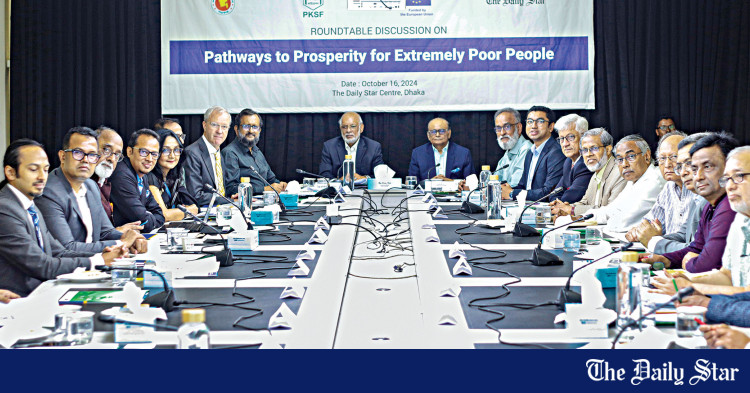
Participants of a roundtable titled “Pathways to prosperity for extremely poor people” at The Daily Star centre yesterday. The Palli Karma-Sahayak Foundation, European Union, and The Daily Star jointly organised the event marking the International Day for the Eradication of Poverty. Photo: Star

Households with diverse income streams, both farm and non-farm, are more resilient and can escape poverty faster, said experts yesterday.

Research over the last 20 years on the impact of microcredit indicates, both nationally and internationally, that pure microfinance will not have a sustainable impact on poverty alleviation, said MA Baqui Khalil, professor and dean for the School of Business at the University of Asia Pacific.

This is because poor people need insurance, savings, health expenses and other non-financial services beyond credit, he said at a roundtable styled "Pathways to prosperity for extremely poor people (PPEPP)".

Palli Karma-Sahayak Foundation (PKSF), the European Union and The Daily Star jointly organised the event to mark the International Day for the Eradication of Poverty at The Daily Star Centre in Dhaka.

"People with multiple income opportunities are less vulnerable to poverty and can graduate out of it at a faster rate," Khalil said.

If a household has both farm and non-farm activities, it can absorb shocks, and income from multiple sources contributes to savings.

The creation of wage employment is important as an alternative to farm employment to reduce extreme poverty.

"These issues were reflected in the PPEPP project of the PKSF," he added.

In 2019, with lessons learned from various extreme-poverty projects, PKSF undertook a multi-dimensional initiative titled PPEPP with funding from the UK's Foreign, Commonwealth and Development Office (FCDO) and the EU.

The project aims to eradicate extreme poverty for approximately 250,000 households (about 1 million people) in selected poverty-prone districts across the northwestern char areas, the southwestern coastal belt and the Haor region.

The project also includes ethnic minority pockets in Dinajpur and Thakurgaon districts.

Since 2022, the PPEPP project has been funded by the EU and renamed PPEPP-EU, targeting 215,000 households.

It provides a carefully sequenced package of livelihoods, nutrition and primary healthcare, inclusive finance and community mobilisation interventions as the core components.

To address the multidimensional nature of poverty, the project also integrates climate resilience-building, disability inclusion and women empowerment with the core components.

"If we want to bring the issue of sustainable poverty reduction to the forefront, there needs to be a linkage between this project and a market-based linkage," said Mustafa K Mujeri, executive director at the Institute for Inclusive Finance and Development.

"If we can provide them with loans and create such enterprises, then it is possible to move them toward a sustainable livelihood. So, it is necessary to think about how we can link them with cottage, micro and small enterprises," he added.

Poverty and inequality are two different things and should not be conflated together, said Zakir Ahmed Khan, chairman of PKSF.

"What we are doing now is dealing with poverty, not inequality. Poverty is not only a lack of money -- it means many more things."

The PPEPP should be taken as a programme and not as a project, he said.

There must be a connection between sustainability and the market, said Mohammad Muslim Chowdhury, chairman of Sonali Bank.

"Otherwise, we may go from one project to another. If we don't link it with the market and create self-employment opportunities, it won't succeed."

Different projects and programmes should be linked to central policies and aligned with the national strategy.

The programme needs to be implemented comprehensively, he said, adding that the local government should also be linked.

The primary goal of PKSF is to eradicate inequality along with poverty, aiming for zero poverty and the creation of an inclusive and equitable society, said Md Fazlul Kader, acting managing director of PKSF.

Bangladesh has witnessed remarkable growth and development, but unfortunately, extreme poverty still exists, said Michal Krejza, head of cooperation at the delegation of the EU to Bangladesh.

For example, in the southern coastal belt, the incidence of extreme poverty is quite high and is increasing in some areas due to the impacts of climate change.

To make these people less vulnerable, better access is needed to basic public services such as education, health care, safe drinking water and sanitation, and safe and nutritional food, he said.

"They need skills development and jobs. Those for whom the need is the highest often have the poorest access."

Since its inception of the project in 2019, 72 percent of the extremely poor households covered by the project have risen above the international poverty line, he added.

Macroeconomic policies do have a significant impact on poverty reduction at the national level, said Zaidi Sattar, chairman of the Policy Research Institute of Bangladesh.

"The impact on poverty comes from the kind of macroeconomic policies we have. Macroeconomic stability is essential and macroeconomic policies for economic growth are also essential," he added.

Bangladesh has done very well on many things including poverty, said Mahfuz Anam, editor and publisher of The Daily Star.

"But what remains is also a massive task. Let us not get into some sort of a comfort zone that we have done well."

As the most densely populated country, whatever the country achieved really stands threatened because of climate change and Bangladesh needs global support, he added.​
 

Gross forex reserves cross $25b in steady rebound
Lower imports-outflows, higher remittances help in changed milieus
Siddique Islam
Published :
Oct 17, 2024 00:37
Updated :
Oct 17, 2024 00:37

1729127259209.png


A steady rebound on the back of changed milieus helps Bangladesh see its gross foreign-exchange reserves climb over US$25 billion again amid tightfisted import payments and higher remittances, officials said.

The forex reserves rose to $25.14 billion on October 15 from $24.97 billion on October 08 as per traditional calculation method of the Bangladesh Bank (BB). It was $24.86 billion on September 30.

As per the International Monetary Fund (IMF) Balance of Payments International Investment Poisson Manual-six edition, generally known as BMP6, the reserves rose to $19.93 billion during the period under review from $19.83 billion, according to the central bank's latest data released Wednesday.

The IMF-calculated figure was $19.86 billion on September 30.

Forex reserves--one of the major macroeconomic indicators of an economy--fell to $24.53 billion in terms of gross calculation by the central bank after clearing $1.37 billion import payments to the Asian Clearing Union (ACU) on September 07 last while the amount stood at $19.46 billion as per IMF's BMP6 arithmetic.

"Higher inflows of remittances have helped the country see forex reserves cross $25-billion mark further," a senior official of the central bank told the FE while replying to a query.

He also said Bangladesh received $1.21 billion in inward remittances during the first 14 days of October.

Meanwhile, the flow of inward remittances grew over 33 per cent to $6.54 billion in the first quarter (Q1) of the current fiscal year (FY), 2024-25, from $4.91 billion in the same period of FY '24.

This surge indicates a growing trend of expatriates utilising formal banking channels to send money to Bangladesh, bankers said, adding that this increase is a shift away from informal methods like hundi since the formation of the new government.

Besides, the purchasing of the US currency from the commercial banks directly has contributed to growth in the forex reserves in recent days, another central banker explains.

Nearly $50 million has so far been bought from the commercial banks in October as part of the regulator's intervention in the market, the central banker adds.

On the other hand, the selling of the greenback from the central bank almost suspended recently as part of a move to build up the recently depleted forex reserves in Bangladesh.

"We've sold only $10 million so far to the commercial banks in the month of October 2024," the BB official adds.

However, the actual import in terms of settlement of letters of credit (LCs) fell by 5.58 per cent to $16.10 billion during the July-September period of the FY'25, from $17.05 billion in the same period of the previous fiscal year, due to political unrest as well as uncertainty associated with post-unrest regime.

On the other hand, the opening of fresh LCs, generally known as import orders, dropped by 8.44 per cent to $15.65 billion in the first three months of this fiscal from $17.09 billion in the same period of FY'24.

Bangladesh's forex reserves had surged to $48.04 billion on 24 August 2021, setting a new record, from $46.58 billion of the previous working day. The rise was propelled by the receipt of $1.45 billion from the IMF as general allocation of Special Drawing Right (SDR).​
 

Members Online

Latest Posts

Latest Posts