Home Watch Videos Wars Movies Login

[🇧🇩] July Charter

[🇧🇩] July Charter
39
1K
More threads by Saif

G Bangladesh Defense

Parties divided over ways of July Charter implementation
Staff Correspondent 30 July, 2025, 23:54

Major political parties were divided on Wednesday over the procedures of implementation of the the July National Charter 2025.

The Bangladesh Jamaat-e-Islami and National Citizen Party, among some parties, demanded legitimising the charter before the upcoming national elections.

The Bangladesh Nationalist Party, among some others, on the other hand, recommended that the charter should be considered as a ‘social treaty’ that would oblige the signatory parties to rectify in the next parliament and start implementation.

The parties shared their opinions while speaking at the National Consensus Commission’s dialogue session at the Foreign Service Academy in Dhaka.

The session was also scheduled for discussing on topics including women’s representation, election and power of the president, composition of the upper house, the state’s fundamental principles, appointment of key constitutional and statutory bodies and the citizens’ basic rights.

The parties, however, could only discuss the women’s representation issue but failed to reach a broader consensus.

Regarding the women’s representation in the parliament, the NCC proposed an amendment to Article 65(3), binding parties to field seven per cent of their nominations from women, a gradual increase of women’s nominations at a five per cent rate each election till the total number of reserved seats reaches 100. Until then, the NCC recommended maintaining the existing 50 reserved women’s seats.

BNP’s standing committee member Salahuddin Ahmed suggested a 5 per cent reservation for women candidates among contestants for 300 seats in the 13th parliament.

This reservation would gradually increase to 10 per cent from the 14th parliament.

Such an increment was proposed to equip parties to field 100 women candidates, at which point an amendment would omit the existing 50 reserved seats, he said.

NCP’s member secretary Akhter Hossen reiterated his party’s support for direct elections for 100 reserved women›s seats.

He also raised concerns about the implementation of the draft July Charter.

Jamaat›s nayeb-e-amir Syed Abdullah Mohammed Taher opposed the BNP and requested parties to find alternative methods to increase the number of reserved seats to 100.

Regarding the draft of the July Charter, Taher asked who would be responsible for implementing the charter and how it would gain legal standing.

He proposed to use either the Legal Framework Order, or a referendum, or a proclamation by the chief adviser, to be ratified by the next parliament.

In response, the NCC’s vice-chair Ali Riaz clarified that a final decision on this significant matter would follow guidance from the commission chief, Professor Muhammad Yunus.

Liberal Democratic Party secretary general Redwan Ahmed suggested that either an ordinance or a proclamation could provide the necessary legal framework for the proposals.

Meanwhile, Bangladesh Jatiya Samajtantrik Dal-Jasod’s presidium member Mushtuq Husain expressed deep frustration over the NCC’s proposal, noting that political parties have consistently failed to uphold the women’s contribution in the July uprising.

Communist Party of Bangladesh’s general secretary Ruhin Hossain Prince shared his disappointment and advocated for direct elections to fill the 100 reserved seats.

Islami Andolan Bangladesh’s presidium member Ashraf Ali Akon pushed for a proportional representation system based on shared votes for 100 reserved seats.

Nagorik Oikko›s organising secretary Sakib Anwar recommended that the proposed 5 per cent reservation be made obligatory.

Ahmed Abdul Kader of Khelafat Majlis stated that his party would not support the proposal unless it included a clause ensuring a vote-based proportional representation system for 100 reserved seats.

Ali Riaz reiterated the commission’s principled stance on gradually increasing women’s representation to 100 reserved seats.

Ganosamhati Andolan’s chief coordinator Zonayed Saki recommended making 15 per cent women’s representation mandatory from the 14th national election.

Jamaat’s Hamidur urged flexibility in setting the percentage, but the NCC vice-chair rejected this request.

At about 9:20pm, Ali Riaz, while briefing the journalists, said that a majority of the party agreed that women’s reserved seats should be gradually increased from 50 to 100. Some parties recommended proportional representation, and some voted for direct elections.

He said that most of the parties agreed to make a call for contesting parties to nominate women candidates, at least five per cent of their total nominees in the next national election, and a 10 per cent increment in each of the following elections, and continue this until women›s representation in the parliament touched a minimum 33 per cent.

At that time, he said, a constitutional amendment would omit the reserved women’s seats. ‘Parties may express their reservations.’

Earlier, the NCC vice-chair said the dialogue session would conclude today.

He said that today’s session would cover discussions on the election and power of the president, the composition of the upper house, proportional representation in the lower house, and other unresolved issues.

The NCP and Gano Adhikar Parishad, however, requested the NCC to extend the period of the dialogue to finalise the charter and its implementation procedures.

As part of finalising the July Charter, the NCC sent the list of reform proposals agreed by the majority of the parties during the first round of dialogue held between March 20 and May 19.

The list featured 62 reform points, mentioning the number of parties that agreed to the points.​
 
Analyze

Analyze Post

Add your ideas here:
Highlight Cite Respond

Shahbagh in standstill due to blockade demanding July proclamation, charter

Published :
Jul 31, 2025 19:47
Updated :
Jul 31, 2025 19:47

1754006629927.webp


A group of people under the banner ‘July Shahid Paribar O July Joddha’ has been blocking the Shahbagh intersection since Wednesday morning, demanding constitutional recognition of the July Charter and a separate July Proclamation.

The blockade has led to severe traffic congestion in the surrounding areas, causing immense sufferings to commuters, reports UNB.

The protesters are calling for the constitutional recognition of the July Proclamation and Charter, along with state recognition of the martyrs and the injured from the July uprising.

They are also demanding legal and social protection for those affected.

In addition, the demonstrators have urged the government to announce a clear roadmap for the trial of those responsible for the July massacre.

“We won’t leave the streets until our demands are met or the government gives a clear assurance,” said Masud Rana Sourov, a protest leader who was injured during the July Uprising at Mohakhali.​
 
Analyze

Analyze Post

Add your ideas here:
Highlight Cite Respond

Jamaat threatens to sue government, Consensus Commission over July Charter’s legal basis

Published :
Jul 31, 2025 18:56
Updated :
Jul 31, 2025 18:56

1754009108164.webp


Jamaat-e-Islami has threatened to sue the government and the National Consensus Commission for compensation if the July Charter is not granted legal recognition.

The warning came from the party’s deputy chief, Syed Abdullah Mohammad Taher, during a lunch break in Thursday’s ongoing dialogue with the commission, reports bdnews24.com.

“We have made it clear -- we won’t sign the July Charter without legal basis. It must be implemented within the tenure of this government. That can begin as early as [Friday],” he said.

He reiterated Jamaat’s demand for the adoption of the peer system for elections, citing “longstanding electoral irregularities in Bangladesh’s 54-year history”, including partisan influence, rigging, fake and night-time polls.

Taher said the peer system is now practised across nearly 90 countries worldwide, including in Africa, Europe, America and Asia.

“It is a global reality, not a matter of rich or poor, black or white,” he added, noting that many countries adopt this system every year.​
 
Analyze

Analyze Post

Add your ideas here:
Highlight Cite Respond

July Charter to be signed soon, hopes BNP leader Salahuddin

Published :
Aug 01, 2025 18:03
Updated :
Aug 01, 2025 18:03

1754091485136.webp


BNP senior leader Salahuddin Ahmed on Friday said except for 51 points his party has no disagreement with the National Consensus Commission on the remaining recommendations.

“We are hopeful that the July Charter will be signed soon. Apart from 51 points, BNP has no disagreement with the commission on the remaining recommendations,” he said.

He made the remarks while talking to reporters after visiting Al-Jamiatul Ahlia Darul Uloom Muinul Islam Madrasa in Hathazari of Chattogram on Friday, reports UNB.

The BNP leader reiterated their commitment to the implementation of the July Charter.

BNP standing committee member Nazrul Islam Khan, who also visited the madrasa, expressed confidence that there would be no obstacle to holding elections in February.

They visited the madrasa on behalf of BNP Chairperson Khaleda Zia and acting Chairman Tarique Rahman.

Upon their arrival, Salahuddin and Nazrul Islam were welcomed by senior madrasa teachers.

The BNP leaders visited the graves of former Hefazat-e-Islam leaders Shah Ahmad Shafi and Allama Junaid Babunagari and offered prayers.

Later, the BNP leaders held a courtesy meeting with the institution’s head scholar Sheikh Ahmad and Director General Mufti Khalil Ahmad Qasemi at the madrasa auditorium.

Local BNP leader Barrister Mir Helal Uddin and others were present during the visit.​
 
Analyze

Analyze Post

Add your ideas here:
Highlight Cite Respond

Jamaat threatens to sue government, Consensus Commission over July Charter’s legal basis

Published :
Jul 31, 2025 18:56
Updated :
Jul 31, 2025 18:56

1754093299366.webp


Jamaat-e-Islami has threatened to sue the government and the National Consensus Commission for compensation if the July Charter is not granted legal recognition.

The warning came from the party’s deputy chief, Syed Abdullah Mohammad Taher, during a lunch break in Thursday’s ongoing dialogue with the commission, reports bdnews24.com.

“We have made it clear -- we won’t sign the July Charter without legal basis. It must be implemented within the tenure of this government. That can begin as early as [Friday],” he said.

He reiterated Jamaat’s demand for the adoption of the peer system for elections, citing “longstanding electoral irregularities in Bangladesh’s 54-year history”, including partisan influence, rigging, fake and night-time polls.

Taher said the peer system is now practised across nearly 90 countries worldwide, including in Africa, Europe, America and Asia.

“It is a global reality, not a matter of rich or poor, black or white,” he added, noting that many countries adopt this system every year.​
 
Analyze

Analyze Post

Add your ideas here:
Highlight Cite Respond

July Charter signing date uncertain
Several parties vow not to endorse document without legal compulsion

Sadiqur Rahman 02 August, 2025, 00:28

1754096366431.webp


The date of signing the July National Charter 2025 remains uncertain, as the National Consensus Commission is yet to finalise the draft charter while several political parties have vowed not to endorse it without a clear commitment to legally enforce the charter.

The consensus commission had planned to finalise the charter by July 31and there was an expectation that the charter would be signed before August 5.

After holding 23 sessions since June 3, the commission on Thursday wrapped up its second round of dialogue with 30 political parties, claiming to have reached consensus on 19 key reform issues.

But many parties questioned the closure of the dialogue, intended to produce a consensus-based charter, without any clear roadmap for the implementation of the document.

Although NCC vice-chair Professor Ali Riaz earlier said that the responsibility to implement the charter lay with the political parties due to the commission’s limited mandate, he said on Thursday, ‘The commission would soon invite the parties again to discuss the way forward on the implementation.’

In the wake of the Awami League regime’s fall from power in August 2024 following the July uprising, the Muhammad Yunus-led interim government established 11 reform commissions to initiate state reforms. To facilitate building political consensus on the proposals, the National Consensus Commission was formed on February 12 this year.

In March, the consensus commission issued a 166-point questionnaire to 38 political parties, outlining six possible options for adopting the agreed reforms.

The options included passing an ordinance, holding a referendum before or during the general election, forming a constituent assembly, making post-election constitutional amendments, or approval by the next elected parliament, which would also work as a constituent assembly.

The National Citizen Party, formed by the July uprising organisers, demanded a constituent assembly, while the Bangladesh Jamaat-e-Islami proposed a referendum. In contrast, the Bangladesh Nationalist Party, its like-minded allies, and left-leaning parties insisted that only an elected parliament would have the authority to enact reforms.

Although the Jamaat and NCP did not specify their earlier choices during the final days of the second round dialogue, their leaders strongly demanded that the National Consensus Commission should include a clear legal framework for adopting the reform agenda.

Jamaat nayeb-e-amir Syed Abdullah Muhammad Taher told New Age, ‘The charter must have a legal basis. Otherwise, the consensus building will be futile.’New Age specials

Meanwhile, the BNP and some other parties voiced support for the NCC proposal that the signatory parties must commit to implementing the July Charter within two years of the next parliament’s formation.

‘When the July Charter will be signed by the NCC members, including commission chair Professor Muhammad Yunus, and by the political parties concerned, it will become a ‘crucial’ document binding on the elected members of the next parliament,’ said BNP standing committee member Salahuddin Ahmed.

Amid diverging views, the consensus commission may reconvene the relevant parties next week to finalise the implementation pathway. In the meantime, the commission will finalise the charter, said Monir Haidar, special assistant to the chief adviser for reforms. However, he gave no timeline when speaking on Thursday.

Most party representatives told New Age that they viewed the commission’s second-round dialogue positively, as it brought together parties with different ideologies and visions.

Amar Bangladesh Party chair Mojibur Rahman Monju termed the outcome of the NCC dialogue a ‘milestone’ and a guideline for the future political operation.

Although the discussions did not touch on reforms in local administration, labour, health, media, and women’s affairs, political leaders observed that consensus-building on major state reforms marked meaningful progress in the country’s democratic transition.

‘Our primary objective was to resolve election-related issues first. The dialogue covered all the issues crucial for the next election,’ said Bangladesh Jatiya Samajtantrik Dal-Jasod’s presidium member Mushtuq Husain, adding that the other important issues would also be addressed in different ways.

On Thursday, NCC vice-chair Ali Riaz declared that consensus had been reached on 19 issues, adding that 30 political parties had reached a broader agreement on nine, while the remaining 10 would carry notes of dissent.

The agreed nine issues include opposition lawmakers-chaired parliamentary standing committees for public accounts, privileges, estimates, and public undertakings, the delimitation of electoral constituencies, modified presidential clemency powers, fresh procedures for declaring a state of emergency, new procedure for constitutional amendments, a 10-year term limit for the prime minister, the formation of an independent police commission, embedding the process of appointing the Election Commission in the constitution, and the expansion of citizens’ basic rights.

The 10 issues with dissenting opinions include amending article 70 of the constitution, women’s representation in the parliament, decentralisation of the judiciary and Supreme Court, appointment of the chief justice, the prime minister holding multiple offices, enshrining new procedures for appointing the Public Service Commission, Anti-Corruption Commission, Comptroller and Auditor General, and Ombudsman, forming a 100-member upper house, the presidential election method, presidential powers, selection of the chief adviser under the caretaker government, and the fundamental principles of the state.

Ganosamhati Andolan executive coordinator Abul Hassan Rubel observed that the NCC dialogue outcome was an advancement towards a democratic pathway. ‘But the challenges exist regarding the implementation of the agreed reforms. My party recommends a constitutional reform council with voters’ mandate to adopt the reforms,’ he said.

Left-leaning parties, including the Communist Party of Bangladesh, Socialist Party of Bangladesh, Socialist Party of Bangladesh (Marxist), and Bangladesh Jatiya Samajtantrik Dal (Jasod) boycotted the consensus-building dialogue in protest of the NCC position on fundamental state principles.

As part of its charter-drafting efforts, the consensus commission presented a 62-point list addressing reform of the constitution, electoral system, public administration, judiciary, and the Anti-Corruption Commission. The commission claimed that the points were agreed during its first-round dialogue separately attended by 38 political parties.

However, in reality, support for many of these proposals varied as some were agreed by over 30 parties while others received backing from fewer than 25.

Expressing disappointment, NCP member secretary Akhter Hossen said that an extended second-round dialogue would have brought more results.

‘For example, the parties agreed to expand the citizen’s basic rights. But we could not finalise the additional basic rights due to the conclusion of the dialogue,’ he said.​
 
Analyze

Analyze Post

Add your ideas here:
Highlight Cite Respond

Prothom Alo Explainer
What are the ‘July Declaration’ and the ‘July National Charter’?

Riadul Karim Dhaka
Published: 04 Aug 2025, 20: 57

1754354321220.webp


Students demonstrate in July, 2024 Prothom Alo file photo

The interim government is set to present the ‘July Declaration’ before the nation on Tuesday afternoon.

Meanwhile, the National Consensus Commission is working to finalise the ‘July National Charter’.

Both documents have turned into topics of significant political discussion in recent times. While the two documents may appear similar, they are fundamentally different.

In simple terms, the “July Declaration” is a political document affirming the July 2024 mass uprising, aiming to grant it constitutional and state recognition.

On the other hand, the “July National Charter” is a political consensus document outlining proposed reforms in various areas of state governance and how those reforms will be implemented.

The mass uprising began in July last year under the banner of the Anti-Discrimination Student Movement, initially calling for civil service quota reform. It quickly evolved into a nationwide student–public uprising. On 5 August, in the face of this uprising, then Prime Minister Sheikh Hasina fled the country and took refuge in India. Since the fall of that government, the student and youth leaders who led the uprising have consistently called for a formal declaration recognising the movement.

They themselves took initiatives several times to publish such a declaration. At one stage, the government held meetings with various political parties and resolved to issue the declaration from the state level.

The National Citizen Party (NCP) has been especially vocal about this declaration from the beginning. Its leaders argue that without it, future regimes may brand the July Uprising as an ‘unconstitutional seizure of power’, potentially prosecuting the students, citizens, and members of the interim government involved as ‘traitors’.

The July Declaration, they say, must serve to protect and legitimise the movement.

What the July Declaration includes

According to a draft obtained from relevant sources, the July Declaration comprises 26 points. The first 21 points briefly outline the country’s historical democratic struggles, including the Liberation War, and the context that led up to the July Uprising.

The draft also includes criticisms of constitutional amendments made under Sheikh Mujibur Rahman that established the one-party BAKSAL regime. It also referred to events such as the “Pilkhana tragedy” and the “Shapla Chattar massacre”.

One clause in the draft states that an interim government was formed under the leadership of Professor Muhammad Yunus on 8 August 2024, based on the sovereign will of the people.

Subsequent sections highlight aspirations for democratic reform, justice for enforced disappearances, killings, genocide, and crimes against humanity under the Awami League’s rule. It also declares a commitment to rule of law, human rights, anti-corruption, and a democratic state free of inequality and exploitation.

One point in the draft states, “The July 2024 student–public uprising shall receive proper constitutional and state recognition. Specifically, it will be mentioned in the Preamble of the Constitution and annexed in the Schedules.”

If adopted in its current form, the July Declaration will become part of the Constitution in the future. However, the BNP has expressed a different view. While they agree on including it in the Constitution, they prefer it be added only in the Fourth Schedule, not the Preamble.

The declaration will be deemed effective retroactively from 5 August 2024.

What is the ‘July National Charter’?

After coming to power through the uprising, the interim government initiated a series of structural reforms. Political consensus has already been reached on the initial proposals submitted by six reform commissions, formed in the first phase.

The ‘July National Charter’ will be a formal document based on these agreed-upon reforms. A draft has already been prepared by the National Consensus Commission, though it has not yet been finalised.

Broadly, the draft July National Charter is divided into three sections: background and context; list of agreed reform proposals; commitments on implementation.

It states that participating parties will commit to implementing the agreed reforms within two years of forming a government through the next general election.

However, some political parties, including Bangladesh Jamaat-e-Islami and the NCP, have reservations about mere verbal commitments. They want the Charter to have legal binding status to ensure actual implementation.

The National Consensus Commission is expected to hold further discussions with political parties and experts before finalising the Charter. So far, 30 political parties and alliances have taken part in the discussions and are expected to sign the document.

This July National Charter will contain a framework for the future Constitution of Bangladesh.​
 
Analyze

Analyze Post

Add your ideas here:
Highlight Cite Respond

July charter: Commission likely to push parties for legally binding deal

1755224027488.webp


Following demands from several parties, including Jamaat-e-Islami, National Citizen Party, and Islami Andolan Bangladesh, the National Consensus Commission is considering a proposal to make the July National Charter a legally binding document.

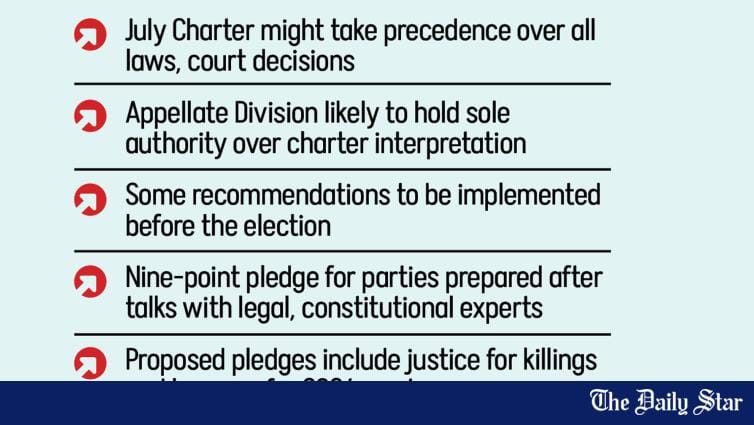
The commission is likely to urge political parties to pledge to enact an ordinance with special constitutional provisions, giving the charter the highest legal authority with precedence over all other laws and court rulings.

According to pledges for the parties in the latest draft of the July National Charter 2025, parties are likely to be asked to commit to ensuring full legal and constitutional protection at every stage of implementing it. If any word, sentence, or policy of the charter conflicts with the constitution or other laws, the charter would prevail.

The commission will also seek a pledge from the parties to give constitutional and state recognition to the uninterrupted struggle for democracy, human rights, and justice, and to the historical significance of the 2024 anti-discrimination democratic movement and mass uprising.

Prof Ali Riaz, vice-president of the commission, told The Daily Star yesterday that they hope to send the draft to the political parties today or tomorrow. "Our work on the draft is at the final stage," he said.

Asked whether the document will be legally binding, he said the commission was holding discussions with legal experts on the matter.

Prof Riaz yesterday briefed Chief Adviser Prof Muhammad Yunus on the overall progress of the July Charter. Asked when the commission would hold its third-phase meetings with political parties on the implementation and legal basis of the charter, he said no decision has yet been made.

The pledges to be sought from the parties also include ensuring constitutional recognition of the July uprising, justice for those killed during the uprising, granting state honours to the martyrs, and arranging treatment and rehabilitation for the injured.

"Any recommendations in this charter deemed immediately implementable will be carried out by the government and relevant authorities without delay and with effective measures before the next national parliamentary election," one of the pledges in the draft states.

On Sunday and Tuesday, the commission held talks with constitutional and legal experts and, according to sources, prepared a nine-point pledge for implementing the charter.

Prof Riaz told The Daily Star that discussions were held on how to implement the July Charter and give it legal backing, and that various proposals were presented.

However, he added that the pledges for the charter's implementation and legal basis have not yet been finalised, and the discussion is ongoing.

The July 2024 mass uprising, led by students and the public, toppled the Awami League government. On August 8, an interim government headed by Nobel laureate Prof Muhammad Yunus took office.

After the Prof Muhammad Yunus-led interim government took charge following the fall of the Awami League regime in August last year, six commissions were initially formed to recommend basic reforms. Later, Prof Yunus formed the consensus commission with heads of the reform commissions. Under Prof Yunus, the consensus commission is tasked with preparing the July Charter through dialogues with and consensus among political parties, to serve as a blueprint for future governance.

In March, the commission held its first round of talks with 32 political parties and alliances on 166 proposals, reaching consensus on 62. In the second round, agreement was reached on 20 issues, while BNP, Jamaat, NCP and others placed notes of dissent on nine.

The preliminary draft of the charter, based on the 82 agreed proposals, was sent to the parties on July 28. In that draft, the commission asked parties to pledge to recognise and "enshrine the historical importance of the 2024 anti-discrimination democratic movement and popular uprising in the constitution with due prominence".

That version, however, made no mention of constitutional and state recognition for the broader democratic struggle or of ensuring justice for the killings.

Clause 3 of that draft proposed implementing the recommendations within two years after the next general election, which is now slated for February 2026. BNP and like-minded parties supported this, but Jamaat, NCP, Islami Andolan, and others demanded full implementation and legal backing within the tenure of the current government, threatening to withhold their signatures otherwise.

In response, the commission began preparing an outline for swift implementation. The integrated draft now being developed will include the background of the uprising, the formation of reform commissions, the 82 agreed proposals, and the nine-point pledge for implementation, according to commission sources.

The pledges state that jurisdiction over the charter's interpretation and legality will rest solely with the Appellate Division. They also state that the charter will be fully legally effective, and that no court may question its legality, necessity, or authority.

They also stipulate that necessary ordinances will be issued to ensure its provisions prevail over article 93(2) of the constitution or any other law or judgment.

One of the pledges, if approved by the parties, will allow amendments to the constitution, judiciary, electoral system, public administration, policing, and anti-corruption measures, as well as the enactment or revision of laws, rules, and regulations, to implement the charter's recommendations.​
 
Analyze

Analyze Post

Add your ideas here:
Highlight Cite Respond

Members Online

No members online now.

Latest Posts

Back
 
G
O
 
H
O
M
E