Wars 2022 02/24 Monitoring Russian and Ukraine War.

Wars 2022 02/24 Monitoring Russian and Ukraine War.
738
40K
More threads by PakistanProud

G War Archive

Ukraine accuses Russia of war crime after video shows drone attacking market vendor

1785885351360.webp

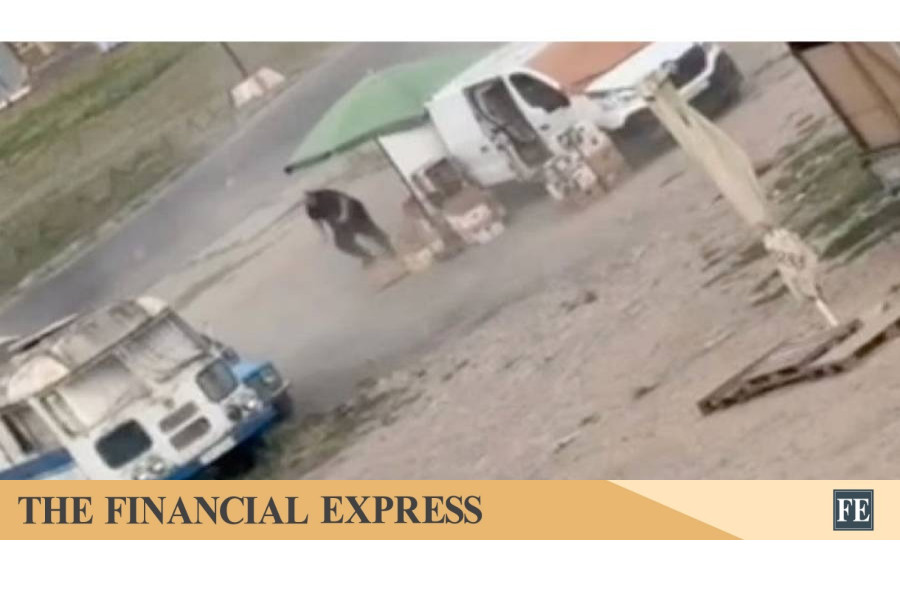
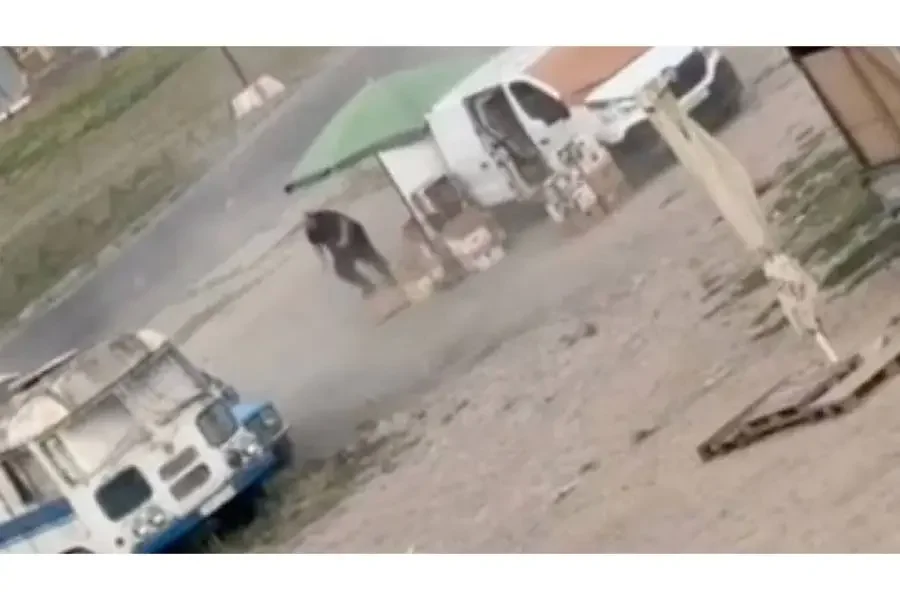
A drone circles over a man at a market in Kherson, southern Ukraine, before detonating nearby, in an incident that Ukrainian authorities said occurred on Aug 4, 2026, amid Russia’s attack on Ukraine, in this still image obtained from a handout video on Aug 4, 2026.

Source: KHERSON REGIONAL MILITARY ADMINISTRATION/Handout via REUTERS

Ukraine on Tuesday accused Russia of committing a war crime after a video was released showing a drone chasing down and wounding a street vendor in the southern Ukrainian city of Kherson.

Footage released by Ukrainian police shows the drone pursuing an unidentified man around a van being used as a street stand before exploding after he dives for cover behind the vehicle. Police said the vendor, a man in his 50s, survived but suffered shock and shrapnel injuries.

“Today, many were shocked by yet another video of the drone ‘safari’ Russians are carrying out against civilians in Kherson,” President Volodymyr Zelenskiy wrote on X, issuing a fresh call for more pressure on Russia and strong security guarantees for Ukraine.

“We must act and support life in ways that force Russia to think seriously about peace rather than expanding the range of its drones.”

Reuters verified the location using buildings, the road layout and vegetation that matched satellite and archive imagery. The date could not be independently confirmed, but Ukraine’s police and Foreign Minister Andrii Sybiha said the incident happened on Tuesday.

Sybiha said the attack formed part of a deliberate Russian campaign to intimidate civilians. “This barbaric Russian war crime in Kherson demands international condemnation and justice, but thousands of similar crimes never come to the public eye,” he wrote on Telegram.

The minister said the pilot of the Russian drone would have been aware they were targeting a civilian, branding them a “sadist”.

Two children and an elderly woman were also killed in overnight Russian guided bomb strikes on Ukraine’s northern city of Sumy, regional governor Oleh Hryhorov said on Telegram.

In July, the UN Human Rights Monitoring Mission in Ukraine said it had documented 1,396 civilian deaths and 7,978 injuries in the first six months of 2026, marking a 37 percent increase from 2025 and more than double the figures from 2024.

It said that the surge in civilian casualties was primarily driven by intensifying Russian long-range missile and drone strikes targeting urban centres far beyond the front lines.

Ukraine is also attacking Russia with drones and long-range missiles, many of which have ‌also caused civilian casualties, Russian authorities say.

Russia on Monday accused Ukraine of terrorism after seven people, including three children, were killed and 60 injured at its Black Sea holiday resort of Gelendzhik in what it said was a deliberate Ukrainian drone attack on civilians.

A Ukrainian official said that the drone only fell on the beach in Gelendzhik because it was shot down by Russian air defences, adding that “Ukraine uses its weapons exclusively against the Russian military-industrial complex and economic infrastructure facilities”.

Both Russia and Ukraine deny targeting civilians in the war triggered by Russia’s ⁠full-scale invasion of Ukraine in February 2022.​
 

Zelensky visits Russian ally Serbia as Moscow pounds Kyiv
Agence France-Presse . Belgrade, Serbia 08 August, 2026, 23:24

1786242267128.webp

Serbia’s president Aleksandar Vucic and his Ukrainian counterpart Volodymyr Zelensky review the honour guard during a welcoming ceremony in Belgrade on Saturday. | AFP photo

President Volodymyr Zelensky was making his first official visit to Serbia—a rare European country still closely aligned with Moscow—on Saturday as Ukraine seeks to bolster international support in the face of intensifying Russian strikes.

Zelensky received a ceremonial welcome as talks with his counterpart Aleksandar Vucic got under way at the presidential palace, after another intense bombardment of Kyiv and the surrounding region overnight killed at least four people.

Diplomacy is at a standstill more than four years after the start of Russia’s large-scale offensive against Ukraine and the two countries are ramping up long-range strikes, causing a growing number of civilian casualties.

Moscow has significantly upped its attacks on the Ukrainian capital in recent months, typically firing salvos of hard-to-intercept ballistic missiles in short blitzes, with Ukraine pleading for more US-made Patriot interceptors.

Kyiv, in turn, has been firing record numbers of drones at Russia in retaliation.

A senior Ukrainian official earlier described Zelensky’s visit to Moscow’s traditional ally Serbia as ‘a slap in the face for the Russians’.

Serbia is historically close to Russia and Vucic has refused to sanction Moscow, a move that has irked the EU and slowed Belgrade’s path to joining the bloc.

Zelensky had dinner on Friday with Vucic, who repeated this week that he will not change his mind on sanctions, ahead of the talks.

‘We will discuss expanding economic ties between our countries, relations with the European Union, other areas that can benefit our nations, and security issues,’ Zelensky said on X.

After arriving at the palace on Saturday morning, the leaders posed for photos before talks began behind closed doors.

They are later due to address the media.

Zelensky—who has toured much of the world seeking support since Russia’s 2022 invasion—has not visited Serbia since he became president in 2019.

Although heavily dependent on cheap Russian gas and one of the rare European leaders to still visit Moscow, Vucic has also supplied non-military aid to Kyiv.

The Kremlin has accused Serbian firms of selling munitions to Ukraine, a claim Vucic has repeatedly denied.

Vucic went to Ukraine for a regional summit in 2025 and visited Kyiv this year. He has promised assistance to Ukraine but avoided signing a formal declaration of support in the war.

The visit comes as Russia launched another overnight barrage of missiles and drones, targeting mostly the capital Kyiv region.

The attack killed three people, including a child, outside Kyiv, Zelensky said on X on Saturday.

‘Last night, Russia killed three people in Pukhivka, Kyiv region, with drone strikes—a grandfather, a grandmother, and their grandson,’ Zelensky said, adding that ‘the boy was only three years old’.

Ukraine’s state emergency service shared photos of a destroyed building in flames, saying the attack in Pukhivka destroyed a two-storey house and two cars and sparked a fire in a warehouse.

‘Four more people were hospitalised: the child’s parents, his 15-year-old brother, and a neighbour who came to the family’s aid and was wounded in a double-tap strike,’ Zelensky said.

Another person was killed in a strike ‘involving six ballistic missiles against civilian infrastructure in Kyiv.’

He urged more pressure on Russia, including ‘new sanctions that will prevent the production of these ballistic missiles’.

An AFP reporter in the capital heard a dozen explosions as Ukraine’s air force warned of the ‘threat of ballistic weapon use from the north’.​
 

Russian attacks kill 9 in Ukraine
Agence France-Presse . Kyiv, Ukraine 11 August, 2026, 23:14

1786493099560.webp

Ukrainian rescuers work at the site of a Russian strike in Zaporizhzhia on August 11, 2026, amid the Russian invasion of Ukraine. | AFP photo.

Russian attacks across Ukraine killed at least nine people overnight and wounded dozens, Kyiv said Tuesday, accusing Moscow of launching North Korean missiles in the raid.

The allegation comes after Ukrainian president Volodymyr Zelensky warned — without providing evidence — that Moscow was receiving more ballistic projectiles and troops from its ally Pyongyang.

Russia has turned to North Korea for support throughout its four-and-a-half-year invasion.

Earlier in the war, Pyongyang dispatched thousands of troops to help Russia fight back a Ukrainian counterattack into its western Kursk region.

And intelligence from the West, Kyiv and Seoul, has long accused North Korea of supplying weapons to Russia.

The southeastern city of Zaporizhzhia was worst hit in Russia’s latest overnight barrage, with six people killed and 19 wounded, Zelensky said.

‘The city was struck with North Korean ballistic missiles, Zircons, and guided aerial bombs. It was a vicious attack, calculated to inflict maximum damage specifically on civilian infrastructure,’ he said.

Three more were killed by Russian drones and missiles in the neighbouring Dnipropetrovsk region, the local military administration said.

In the capital Kyiv, Zelensky said an infectious diseases hospital was hit, while strikes on the frontlines cities of Kherson and Kharkiv caused power outages.

A children’s hospital in Kyiv was also hit, the health ministry said, posting photos of broken windows and debris in a courtyard.

‘Children and medical staff were not harmed, as they were in a shelter at the time of the attack,’ the ministry said.

Russia’s defence ministry said its forces ‘delivered a group strike with high-precision ground-based weapons, hitting military-industrial enterprises and transport-logistics centres in the cities of Kyiv and Zaporizhzhia’.

Zelensky has recently renewed his warnings of deepening military ties between Moscow and Pyongyang, while appealing for more Western air-defence supplies.

On Monday, he said that Russia received ‘additional ballistic missiles from North Korea.’

Over the weekend, he alleged ‘a decision has been made for 30,000 to 50,000 North Koreans to be deployed on the territory of Russia.’

Kyiv has not explained how it obtained the figures and did not provide a timeframe for the deployment.

But Zelensky is urging allies in the Asia-Pacific to supply air defence to Kyiv in order to counter Pyongyang’s capabilities.

Russia and North Korea signed a mutual defence pact in 2024, ahead of Pyongyang sending troops to help push Ukrainian forces out of Russia’s Kursk region.

In recent weeks, Russia has considerably stepped-up strikes with ballistic missiles — a fast and powerful weapon that is hard to intercept.

Dozens have been killed in Kyiv in the attacks.

Only the most advanced air defence, such as the US-made Patriot system, is capable of intercepting them.

Ukraine has been reporting an acute shortage of Patriot interceptors since the US-Israeli war against Iran began in February.

Kyiv has also boosted its own long-range drone strikes against Russia, hitting oil infrastructure and e-commerce warehouses in counterattacks it says are justified and designed to crimp Moscow’s logistics and revenue sources.

The latest spiral of escalation has brought the civilian death toll in Ukraine to the highest since the war’s first months in 2022, according to the United Nations.​
 

Russian drone hits train in Ukraine

Civilian deaths in Ukraine hit highest level since May 2022: UN

Agence France-Presse . Kyiv, Ukraine 13 August, 2026, 22:36

1786665288421.webp

Ukrainian rescuers work to extinguish a fire in a train locomotive following an air attack at an undisclosed location in the Odesa region on Thursday, amid Russia’s invasion of Ukraine. | AFP photo

A Russian drone attack on a train carrying hundreds of passengers in southern Ukraine killed two people on Thursday, Ukrainian officials said.

Moscow’s forces have repeatedly targeted trains throughout the four-and-a-half-year war in what Kyiv calls a campaign to cut off logistics and hit civilians.

‘Today in the Odesa region, the Russians once again destroyed an ordinary passenger train locomotive with a jet-powered drone. There were 340 people on the train,’ Ukrainian president Volodymyr Zelensky said.

‘Whoever was operating that drone certainly could not have been unaware that the target was entirely civilian,’ he added.

Two crew members were killed.

None of the passengers were harmed, the CEO of the state railway operator said.

Video published by the Ukrainian emergency services showed a bright fire raging in the train cab, the front of which was blown out and mangled.

Zelensky repeated his call for ‘more air defence support and more pressure on Russia’.

Meanwhile, the number of civilians killed in Ukraine in July jumped to its highest level since the first months of the Russian invasion, the United Nations said Thursday, as Moscow intensified its long-range missile strikes.

Russia fired a record number of missiles at Ukraine during the month, AFP analysis of data published by Kyiv’s air force showed, raining hard-to-intercept ballistic missiles down on the Ukrainian capital.

‘At least 437 civilians were killed and 2,610 injured in Ukraine in July, a 30 per cent increase compared with the previous month and a 70 per cent increase compared with July 2025,’ the UN Human Rights Monitoring Mission said in a statement.

‘The number of those killed is the highest recorded since May 2022,’ it added.

Hundreds of thousands — mostly soldiers from both sides — have been killed since Russia launched its full-scale invasion in February 2022.

The conflict has spiralled into Europe’s deadliest since World War II, with US-led efforts at halting the fighting having made no progress.

The UN said it has verified the deaths of 16,874 civilians since Russia invaded, though cautions this is likely a significant underestimate since it cannot confirm casualties in parts of Ukraine occupied by Russian troops.

That includes Mariupol, the port city Russia laid siege to at the start of the war where thousands are widely believed to have died.

Ukrainian president Volodymyr Zelensky has pleaded with allies to deliver more advanced air defence systems — particularly US Patriots — to fend off the attacks by super-fast ballistic missiles, whose trajectory and speed make them hard to stop.

At least 54 civilians were killed in Kyiv during the month — ‘one of the hardest hit cities’, the UN said.

For the first years of the war, the capital was relatively well protected, but shortages of air defence and Russia’s intensifying strikes have left it exposed.

Ukraine has also increased its own long-range attacks on Russia — justifying them as retaliatory strikes designed to hit Moscow’s war machine and dent its vital energy revenues.

Russian authorities reported an increase in the number of civilians killed to 79 in July.

But the United Nations said it had not been able to ‘independently verify these figures to its verification standards due to lack of access and limited information.’​
 

Civilian deaths in Ukraine jumped in July as Russia hit cities, UN says

1786750964757.webp

Smoke rises in the city during a Russian missile strike, amid Russia's attack on Ukraine, in Kyiv, Ukraine Aug 11, 2026. REUTERS/Gleb Garanich/Files

Civilian casualties from the war in Ukraine rose by nearly a third month-on-month in July, to the highest level since May 2022, as Russia struck towns and cities far from the battlefield with missiles and drones, the UN said on Friday.

The United Nations Human Rights Monitoring Mission in Ukraine said in a report that it had confirmed at least 437 civilians killed and 2,610 injured in July, a 30 percent rise from June and a 70 percent jump from the same month last year.

Long-range weapons, such as missiles and drones, remained the leading cause of civilian deaths last month, accounting for 38 percent of the total.

"Most casualties from these weapons occurred far from the frontline in urban centres," the UN report said.

Ballistic Missile Attacks

In recent months, Russia has stepped up its attacks on Ukraine with ballistic missiles, which due to their speed and steep trajectory are much harder to intercept than drones or cruise missiles.

Ukraine has a chronic lack of US-made Patriot interceptors needed to defend against these attacks. President Volodymyr Zelensky urgently appealed to Washington this week for more supplies.

Russian glide bombs – an air-launched guided munition – became the second-largest cause of death. Civilian casualties from aerial bombardments increased by 143 percent month-on-month in July to 105 killed and 753 wounded.

The UN also noted a rise in the number of deaths from short-range drones near the frontline, which killed 111 people and wounded 710 in July, the highest monthly level since the war began in February 2022.

Residents in cities close to the battlefield – such as Kherson – have coined the term "safari" to refer to Russian drones "hunting down" civilians and vehicles in the streets.

Overall, Kyiv was the hardest-hit city, with a total of 54 civilians killed in July, followed by Kherson and Zaporizhzhia, the UN said.

"The number of child casualties (17 killed; 166 injured) was the highest since April 2022," the report stated.

The figures also included 25 civilians killed and 50 wounded in parts of Ukraine occupied by Russia, the UN said. Due to increasingly limited publicly available information – the actual figure was probably significantly higher, it noted.

Both Russia and Ukraine deny deliberately targeting civilians.

More than 16,000 civilians have been killed in nearly four-and-a-half years of fighting, according to the United Nations, the overwhelming majority of them Ukrainian.

Ukraine is also increasingly attacking Russia with drones and long-range missiles, some of which have caused civilian casualties, Russian authorities say.

On Monday, authorities said that a Ukrainian drone strike in the Russian city of Nizhnekamsk killed at least 13 people.

The Conflict Intelligence Team, an independent group that tracks the war, estimated that a total of 634 civilians were killed in July on both sides of the frontline. Reuters was not able to verify that figure independently.​
 

Russian strike kills 10 in Ukraine
Agence France-Presse . Kyiv, Ukraine 18 August, 2026, 23:14

1787098024109.webp

This handout photograph released by the Ukrainian Presidential Press Service on Tuesday, shows burning cars following an air attack in Pechenigy, Kharkiv region, amid the Russian attack of Ukraine. | AFP photo

A Russian attack on a village in the Kharkiv region of northeast Ukraine killed 10 people, Kyiv said Tuesday, vowing to respond.

The strike comes amid a surge in civilian deaths in the four-and-a-half-year war.

Russian forces ‘carried out a rocket strike on Pechenigy’, a village around 40 kilometres from the Russian border, Kharkiv regional governor Oleg Synegubov said on social media.

‘According to preliminary information, 10 people were killed,’ he added, with 17 people wounded.

Ukrainian president Volodymyr Zelensky said on social media that the strike hit a busy intersection, ‘a location with a post office and stores, surrounded only by residential buildings’.

Images from the site of the attack posted by the Ukrainian emergency services showed rescuers working at the scene, carrying people to safety amid destroyed buildings, smouldering rubble and cars on fire or reduced to charred shells.

‘We will definitely respond to this Russian strike. And it is equally important that our partners also complement our responses with their own actions to put pressure on Russia and support Ukraine,’ Zelensky said.

The Kharkiv region — parts of which are occupied by Russian forces — has been hit hard since Moscow invaded Ukraine in February 2022.

According to the United Nations, more civilians have been killed in the war in recent months than in any period since the start of the invasion.

Ukrainian authorities on Tuesday ordered almost 2,200 children with their guardians to leave settlements in the country’s centre-east Dnipropetrovsk region amid ramped up Russian strikes and Moscow’s troops inching forward.

Mandatory evacuation has been announced for 16 settlements located east of the region’s capital Dnipro, Oleksandr Ganzha, the head of the regional military administration, said on social media.

“Within a month, families with children must leave these areas. Parents, guardians or legal representatives must take 2,177 boys and girls to safer territories,” Ganzha said.

He said the evacuees would be taken to transit centres and assisted with finding new accommodation.

The Dnipropetrovsk region is frequently pummelled by Russian drones and missiles.

Fighting is ongoing in the region’s east, but the Ukrainian army made minor gains in the area last month, according to AFP analysis of data from the Institute for the Study of War.

Russia’s advance across the sprawling frontline has slowed in 2026, though Ukraine’s army remains stretched by manpower shortages and fatigue as the Russian invasion drags through its fifth year.

The number of civilians killed in Ukraine in July jumped to its highest level since the first months of the Russian invasion, the United Nations said.

Meanwhile, Ukrainian foreign minister Andriy Sybiga and his Belgian counterpart Maxime Prevot were on Tuesday forced to hold talks in an underground shelter as an air alert blared out in Kyiv.

‘Due to Russian drones attacking our capital, we held our talks underground in the @MFA_Ukraine bomb shelter — a daily reality for millions of Ukrainians, shared by our Belgian guests today,’ Sybiga said on social media.

He posted a picture of the two top diplomats sitting at a table in a windowless room and a video of the two delegations making their way through underground corridors.

Air alerts ring out in war-torn Ukraine every day as Russia launches barrages of drones and missiles at its neighbour, forcing people into shelters and killing civilians in the capital and across the country.

During a visit to Kyiv in July, European Union chief Ursula von der Leyen had to shelter briefly because of an air alert and drone threat in the city.​
 

Wartime election would ‘destroy’ Ukraine, Zelenskiy says

Poll shows 57% of Ukrainians favour holding elections only after the fighting ends

Reuters

1787528716673.webp

Reuters file photo

Holding a wartime election in Ukraine while active fighting with Russia continues would "destroy" the country by splitting Ukrainians, President Volodymyr Zelenskiy said.

His comments, released to reporters on Sunday, were Zelenskiy's first on the subject since ousted former Defence Minister Mykhailo Fedorov called for a wartime poll in a bombshell address last week.

Fedorov's surprise dismissal last month sparked widespread protests, but supporters calling for his reinstatement later baulked at his call for an election - the first such demand by a major Ukrainian political figure since Russia launched its full-scale invasion in 2022.

"I believe that if we want to destroy the country, then we can move towards elections during this kind of war," Zelenskiy said.

Elections in war are prohibited by Ukrainian law. Analysts also say security concerns and the millions of Ukrainians abroad, under Russian occupation or fighting at the front mean it would be too difficult to hold an election.

ELECTIONS WOULD SPLIT UKRAINE, PRESIDENT SAYS

Zelenskiy's approval rating has remained generally stable at about 60%, but pollsters have said that while Ukrainians want fresh faces in politics, many have little appetite for voting now.

An August 5 poll by the Kyiv International Institute of Sociology found that 57% of Ukrainians want elections only after fighting ends.

Echoing his previous comments on the matter, Zelenskiy said a wartime election might be possible if Kyiv's partners could guarantee security, but that no one has proposed such a plan.

"Elections right now are a tsunami for the state, which will split Ukraine," he said.

"That's why my strategy is to steer the country toward an ending of the war and to preserve an independent and sovereign state."

Fedorov, a longtime Zelenskiy ally who has been seen as a top political challenger, did not explicitly say whether he would stand in any future election.​
 

UK PM dismisses Russian threats as Ukraine allies gather in Kyiv
Agence France-Presse . Kyiv, Ukraine 24 August, 2026, 23:36

1787616103785.webp

Britain’s prime minister Andy Burnham receives the ‘Honorary Distinction to the British People’, ‘Gratitude of the Ukrainian People’ award from Ukraine’s president Volodymyr Zelensky, left, during a commemorative ceremony marking Ukraine’s 35th Independence Day outside St. Sofia cathedral in Kyiv on Monday. | AFP photo

The United Kingdom will keep providing defence aid to Ukraine despite Russia’s threats, prime minister Andy Burnham said Monday on a visit to Kyiv where allies gathered to discuss support.

Air defence supplies are due to be the main priority at the meeting of the Coalition of the Willing, jointly chaired by the leaders of France and Germany, who will participate remotely, and by Britain’s Burnham.

Burnham has arrived in Kyiv for his first trip abroad since taking office, alongside other European leaders and EU Council president Antonio Costa.

‘Despite Russia’s outrageous threats to my country, we will continue our support for Ukraine’s defence,’ Burnham said in a speech delivered on Ukraine’s independence day and ahead of the meeting.

Russia has recently pounded Kyiv with ballistic missiles, ripping open apartment blocks and killing dozens in the capital.

The escalating Russian strikes have pushed civilian deaths to their highest levels since the first months of Moscow’s 2022 invasion.

A Russian drone attack on Chernigiv, north of the capital, wounded 15 people, Ukraine emergency services said.

‘Right now, things are really very difficult for all of us. But there is a force holding us firmly by the hand,’ Ukrainian President Volodymyr Zelensky said in an address to mark the occasion, adding: ‘It is the strength of our mutual circle’.

He called on allies to give Ukraine ‘everything it needs to stop this war’.

Also Monday, the European Union said that it had released another 6.1 billion euros ($7.1 billion) in military aid for Ukraine to boost its air defences.

The finance is part of a 90 billion-euro loan, including 60 billion euros in military aid, that the EU has said will go to Ukraine.

Ahead of the talks, Ukraine has forged ahead with its campaign against Russia’s logistics sites, hitting multiple warehouses belonging to e-commerce giant Ozon.

Ozon reported fires early Monday at its warehouses in Krasnodar and Makhachkala, both in southern Russia, adding that sites in Adygeysk and Nevinnomyssk were evacuated due to threats of drone attack.

Russian authorities also said debris from a Ukrainian drone attack killed two children and wounded nine others.

Russian leader Vladimir Putin on Saturday said Kyiv had ‘opened Pandora’s box’ by targeting Russia’s economy and promised further escalation, including against Ukrainian agriculture.

Burnham is set to announce that the British government is authorising defence firm MBDA to release classified information needed to help Ukraine and France set up local production of the long-range SCALP missile.

The Kremlin accused London of preventing peace in Ukraine by handing the information to Kyiv and threatened to target and ‘destroy’ facilities producing the missile in Ukraine.

On Saturday, French president Emmanuel Macron pledged Paris would deliver new interceptor missiles.

The ballistic missiles Russia has been firing in their dozens are incredibly fast and travel with a high-arching trajectory, making them difficult for Kyiv to intercept.

Ukraine relies on advanced systems — chiefly, US Patriot interceptors — to protect its skies.

But it has reported a shortage of Patriot interceptors since the United States and Israel went to war with Iran in February, diverting supplies.

Ahead of the meeting, Zelensky revealed the extent of the deficit, releasing usually closely guarded numbers.

He said deliveries of crucial Patriot interceptors had halved since 2023.

‘Over the entire of 2023, Ukraine received 675 missiles, and over all of 2025 — 364, even though Russian missile strikes have increased,’ Zelensky said.

‘For 2026, as currently projected, it is 264,’ he added, saying Ukraine was seeking a package of at least 300 for the upcoming winter.

The United States faces its own shortages of the missiles during its war on Iran and has resisted releasing large numbers to Ukraine.

Zelensky said Russia could produce around 100 ballistic missiles a month.

Ukraine, meanwhile, has accelerated its own campaign of long-range strikes on Russian energy and logistics sites — including oil refineries and retail warehouses.

The Coalition of the Willing is a Franco-British initiative to deliver support to Ukraine and ramp up pressure on Russia.

Originally designed as a group of countries that would be willing to deploy peacekeeping troops to Ukraine in the event a ceasefire was reached, it has become a parallel forum for marshalling support to Kyiv as uncertainty persists over US commitments under Donald Trump.​
 

At least 37 people killed in Russian strike on depot near Kyiv
Agence France-Presse . Kyiv, Ukraine 29 August, 2026, 19:21

1788047605625.webp

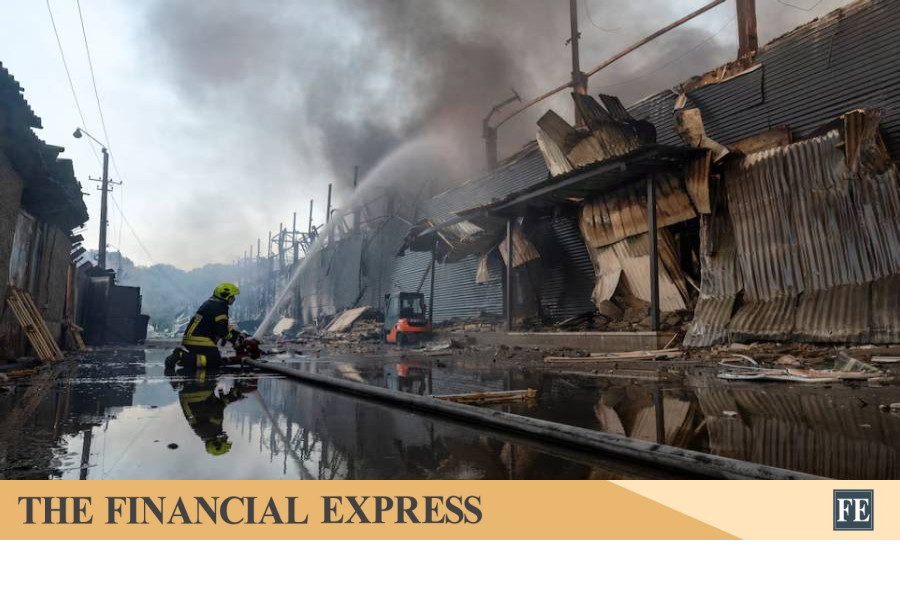
In this handout photograph taken and released by the Ukrainian Emergency Service on August 29, 2026, a Ukrainian rescuer stand next to a truck with a spray of water as they work to extinguish a fire in a warehouse following an air attack at an undisclosed location in the Kyiv region, amid the Russian invasion of Ukraine. | AFP photo.

At least 37 people were killed when an overnight Russian drone strike on a depot near Kyiv sparked a huge fire and explosions, authorities said Saturday.

The depot, near the capital’s western suburbs, appeared to have been storing ‘explosive objects’, Ukrainian prosecutors said, as president Volodymyr Zelensky suggested ammunition was to blame.

‘Those who allowed this to happen must be held accountable for their decisions. Ammunition cannot be stored near homes or other residential areas,’ he wrote on X.

Both Russia and Ukraine have intensified long-range strikes on each other in recent months, sparking fires and pushing civilian casualties to their highest level since Moscow invaded in 2022.

AFP reporters saw a huge column of black smoke rising over the capital’s western suburbs, as officials reported that hundreds had been evacuated from the area.

The blast damaged surrounding residential areas, as well as a care home for the elderly and disabled people, Zelensky said.

At least 37 people were killed, among them the mayor of the nearby town of Dmytrivka, Kyiv region governor Tymur Tkachenko said on Telegram.

‘Rescuers and all relevant services are continuing their operations at the scene of the tragedy,’ he said.

The depot was located in the town of Myla, on Kyiv’s western outskirts.

Officials did not say whether it was a military or civilian facility.

Ukrainian prosecutors said they had opened an investigation.

‘On 28 August at about 8:10pm, an unmanned aerial vehicle fell on or struck the grounds of an enterprise in the town of Myla,’ the office of Ukraine’s prosecutor general said.

‘A large-scale fire broke out on the enterprise’s grounds, and detonation began,’ it added.

The prosecutor’s office said that its investigation would focus on ‘the legality of the storage of explosive objects and materials on the enterprise’s grounds’, as well as whether the owner, whom it did not name, had the ‘necessary permits and approvals’.

Ukrainian prime minister Sergiy Koretsky expressed regret that a ‘lesson’ had not been learned following a previous deadly strike on a munitions depot near Kyiv in July.

That investigation revealed serious failings on the part of a state-owned company, which did not comply with regulations regarding the proximity of residential buildings.

‘In the fifth year of the full-scale invasion, making the same mistakes over and over is criminal negligence,’ he said on Telegram.

‘Everyone responsible, without exception, must face severe punishment so that such situations never happen again.’

Russia launched at least two missiles and 267 drones at Ukraine between late Friday and early Saturday, according to the Ukrainian air force.

In addition to the depot strike, Russian attacks on Ukraine killed three people on Saturday, including a two-year-old infant in Kyiv and a 14-year-old girl in the capital’s outer suburbs, officials said.

In Russia, Ukrainian strikes killed three people in the Belgorod region and caused a fire at a warehouse belonging to Russian retailer Ozon, officials said.

A strike on the city of Sevastopol in Crimea killed one person, according to Sevastopol’s Russian-installed governor.

US-led diplomatic efforts to end the conflict, Europe’s deadliest since World War II, have been at a standstill for months.

Russia has demanded sweeping territorial and political concessions from Ukraine, which Kyiv has ruled out as tantamount to capitulation.

Earlier this week, US Central Intelligence Agency director John Ratcliffe visited Moscow on an unannounced trip, amid escalating tensions in the four-and-a-half-year war.​
 

Russia hits Kyiv airports as Trump peace envoys awaited

AFP
Kyiv, Russia

1788651739899.webp


Ukrainian flag waves on a flagpole as fire spread throughout a warehouse hit by a Russian drone strike, amid Russia's attack on Ukraine, in Kyiv region, Ukraine, 4 September, 2026. REUTERS

Russian strikes hit Kyiv's airports overnight, Ukrainian President Volodymyr Zelensky said Saturday, as US envoys are expected to arrive in the region to discuss a plan to end more than four years of war.

US President Donald Trump said on Friday that he was sending Steve Witkoff and Jared Kushner to Moscow and Kyiv, in Washington's latest bid to break a diplomatic stalemate in Europe's deadliest conflict since World War II.

Russia hit a civilian target in the Dnipro region overnight, killing four people, as well as Kyiv's two airports, Zelensky said, accusing the Kremlin of trying to disrupt the envoys' visit.


"Clearly, these Russian strikes on the airports are a reaction to the discussions and preparations for the possibility of the US side using an aircraft to travel to Ukraine," Zelensky said on X, adding there would be "no threats to diplomacy" from the Ukrainian side.

It will be the first time that Trump's businessman friend Witkoff and son-in-law Kushner have visited war-torn Kyiv since Trump returned to office last year with a pledge to resolve the conflict.

Travelling by plane would be a highly unusual move, with Ukrainian airspace closed since Russia's full-scale invasion in 2022. Leaders and officials visiting Kyiv have largely travelled by train.

The envoys are expected in Kyiv on Sunday, a senior Ukrainian official told AFP, while US outlet Axios reported they would meet Russian President Vladimir Putin in Moscow on Saturday.

Trump told reporters that the two negotiators would seek to gauge whether progress was possible towards peace in the conflict.

Peace efforts have stalled due to Washington's war with Iran, while Moscow and Kyiv have intensified long-range attacks, driving up civilian casualties to levels not seen since the start of fighting.

"I sent Steve Witkoff and Jared Kushner, two great negotiators. They've done a great job, and we sent them over to see whether or not we can get something done. And there may be a good chance that we'll do it," Trump said.

"They're bringing with them a proposal to end the war," he said.

The US president would not say whether the plan involved Ukraine ceding territory as he has previously suggested, but added: "We have an idea for peace."

Witkoff and Kushner, who have been involved in negotiations for ceasefires in Gaza and Iran, have travelled repeatedly to Moscow in previous attempts at diplomacy.

- Grinding war -

The renewed push for diplomacy comes as Russia and Ukraine pummel each other with long-range missile and drone attacks.

Just hours before Trump's announcement, a Russian drone struck the headquarters of Ukraine's SBU security service in central Kyiv, according to Zelensky.

The strike, which Zelensky said was aimed at the office of the agency's acting chief, was the first on its headquarters since the start of the invasion.

Despite the unprecedented nature of the strike, the Ukrainian president proposed observing a ceasefire with Russia for the duration of the US envoys' trip.

"There will be no airstrikes on our part, and Russia must reciprocally ensure a ceasefire -- without its own airstrikes -- for the duration needed to conduct these talks," he said in his evening address.

Russia did not immediately comment on the proposal.

Hours later, Oleksandr Ganzha, head of the Dnipropetrovsk regional military administration, said a Russian strike killed four people and wounded five in the southeastern city of Kamianske.


Zelensky had said on Wednesday that Russian airspace would be "completely unsafe" and filled with Ukrainian drones as long as Moscow continued its war.

On Saturday he said Ukraine would "adjust" its air operations to ensure there was "no threats to diplomacy from our side".

Witkoff and Kusher's trip comes more than week after a rare visit to Moscow by CIA director John Ratcliffe, who warned Russia against any attack on NATO member states, according to US media.

Earlier this week, the United States welcomed the Russian finance minister at a G20 gathering in North Carolina.​
 

Four killed in Russian strikes, Zelensky offers Putin meeting
Agence France-Presse . Berlin 13 September, 2026, 00:00

1789257013445.webp

Vladimir Putin and Volodymyr Zelensky.

Four people were killed in overnight Russian strikes on Ukraine as president Volodymyr Zelensky said Saturday he was willing to meet his Russian counterpart Vladimir Putin at a G20 summit in December.

Two people were killed in Zaporizhzhia in southern Ukraine, while two others were found dead after a missile struck the ArcelorMittal steel plant in Kryvyi Rih, the authorities and the company said.

The strike damaged production facilities at the civilian plant, ArcelorMittal Kryvyi Rih said in a statement.

Russian missile and drone strikes also hit residential buildings in the southern port city of Odesa, destroying entire floors and injuring 35 people, regional governor Oleg Kiper said.

The latest attacks came as both Russia and Ukraine have intensified long-range strikes, contributing to the highest civilian death toll since the early months of the war.

Zelensky, meanwhile, said he would meet Putin at the G20 summit in Miami in December if both were invited.

‘Yes, of course. We have to come. We have to meet, to speak, and make decisions,’ he told German broadcaster Deutsche Welle in an interview released Saturday.

US-mediated efforts to end the war have so far failed to produce a concrete breakthrough. US negotiators Steve Witkoff and Jared Kushner recently visited Kyiv and Moscow, while US president Donald Trump and Putin also held a phone call on the conflict.

Zelensky said the recent diplomatic efforts were a ‘good signal’ and that Ukraine was now in a stronger position for negotiations.

‘We think that we have now good position for negotiations,’ he said, citing heavy Russian battlefield losses.

He also urged Ukraine’s allies to provide more interceptor missiles to counter Russian air attacks, saying Russia was producing about 140 ballistic missiles a month.

Kyiv has said negotiations could begin as early as this month, but the Kremlin has said it is too early to discuss a venue or dates. Several previous rounds of talks have failed, with neither side showing signs of changing its position.​
 

Trump tells Ukraine’s Zelenskiy to stop hitting Russian diesel


1789428086903.webp

U.S. President Donald Trump holds a bilateral meeting with Ukrainian President Volodymyr Zelenskiy alongside the NATO leaders summit at the Bestepe Presidential Compound in Ankara, Turkey, July 8, 2026. REUTERS/Jonathan Ernst TPX IMAGES OF THE DAY

U.S. President Donald ‌Trump on Sunday called on Ukrainian President Volodymyr Zelenskiy to stop targeting Russian diesel infrastructure, saying the attacks were causing a shortage of the fuel that is “hurting the world”.

A wave of long-distance Ukrainian drone attacks on Russian oil refineries in recent months ⁠has reduced that country’s fuel production, triggering gasoline shortages across the country.

The Reuters Power Up newsletter by columnist Ron Bousso provides everything you need to know about the global energy industry. Sign up here.

Ukraine, which faces regular Russian attacks on its own energy infrastructure, says refineries are legitimate military targets.

The U.S. national average price for diesel, which is used by trucks, trains, ships and farm equipment, rose over $6 a gallon for the first time on Thursday, according to price tracker GasBuddy.

“Mr. Zelenskiy has to do one thing: He has to ‌stop ⁠knocking out diesel fuel in Russia,” Trump told journalists during a visit to the Irish Open, which is being held in the west of Ireland on a golf course owned by his family.

“We spoke to Mr. ⁠Zelenskiy about it. There are plenty of other targets. Don’t hit diesel fuel. That’s hurting the world,” he said.

The global shortage “isn’t done by the Middle East, ⁠this is done by what’s happening with Russia and Ukraine,” Trump added.

Russia downgraded its oil output forecast for this year to a 17-year low ⁠and revised its fuel exports outlook for 2026 and 2027 due to the war, according to a government draft forecast seen by Reuters.​
 

Ukraine launches offensive against Russia near key town
Agence France-Presse . Kyiv, Ukraine 16 September, 2026, 00:00

1789535994742.webp

A policeman pushing out a fire in gas station damaged after a Russian drone strike in Kyiv on Tuesday, amid Russian attack in Ukraine. | AFP photo

A Ukrainian army unit has launched a counter-offensive against Russian forces near Lyman, an embattled town in Ukraine’s east that Moscow has been edging towards for months, the unit’s commander said Tuesday.

Russia has seized around three-quarters of the Donetsk region since invading in February 2022, with Lyman one of the few urban areas in the region still under Ukraine’s control.

Its capture could pave the way for Moscow to sweep further south and threaten the Ukrainian-held strongholds of Kramatorsk and Sloviansk, according to military analysts.

The area has been the site of intense battles throughout the four-and-a-half-year war.

‘The 3rd Army Corps has launched an offensive operation called Vivaldi in this sector,’ the Commander of Ukraine’s 3rd Army Corps, Andriy Biletsky, said in a video on Telegram.

Ukrainian units have cleared Russian infiltrators from an area ‘about 75 square kilometres’, he added.

DeepState, a battlefield map linked to the Ukrainian army, showed Ukrainian troops had made a small pocket of gains north of the town.

There was no immediate public comment from Russia to Ukraine’s claims. Widespread drone use at the front has made large-scale troop movements almost impossible, preventing either side from gaining a clear advantage in the grinding conflict.

Russia’s advance in east Ukraine gained pace in August, but remained far slower than in previous years of its invasion, an AFP analysis of data from the Institute for the Study of War showed earlier in September.​
 

Russians vote as Ukraine war drags on for fifth year
Council of Europe body slams ‘fake’ Russia vote

Agence France-Presse . Moscow, Russia 19 September, 2026, 00:39

1789774419952.webp

People vote in Russia’s parliamentary election at a polling station in Moscow on Friday. | AFP photo

Russians began voting Friday in a tightly controlled three-day election that is set to tighten president Vladimir Putin’s 26-year grip on power, in the country’s fifth year of war with Ukraine.

It is Russia’s first parliamentary election since Moscow sent troops to Ukraine in February 2022, setting off a conflict that has killed hundreds of thousands.

Only parties that support Putin and the Kremlin’s military campaign have been registered to run. Moscow has also organised voting in occupied Ukraine.

The European Union slammed the elections, saying ‘repression’ had been used to eradicate opponents, while a Council of Europe body denounced the vote as ‘fake’.

While few Russians doubt Putin’s United Russia party will cruise to victory again, the vote offers a gauge of public support for the war.

Voting for all 450 seats in the Duma, Russia’s lower house, runs until 1800 GMT on Sunday.

Putin has ruled Russia since 1999 and his party has dominated politics since the early 2000s.

Moscow has banned criticism of the Ukraine campaign, and elections under Putin rarely produce surprises.

Putin had called on Russians to vote to show they back Moscow’s troops and to deliver an ‘answer to those who want to weaken Russia’.

The Kremlin published footage of the 73-year-old president voting online — rare footage of the longtime leader using technology.

On Moscow’s streets, several voters said they wanted the war in Ukraine to end — but on Russia’s terms, backing Putin’s goals.

Rail worker Sergei Korenets, 41, said he will back United Russia, voting for ‘stability’ — echoing Putin’s main slogan.

Asked whether four-and-a-half years of war amounts to ‘stability’, Korenets said: ‘Of course, I want all this (the war) to end as quickly as possible.’

But he did not want change at home, he said, as ‘I am satisfied from the point of view of my financial situation’.

Despite sweeping Western sanctions, Russia’s economy has not collapsed and life in the capital remains relatively normal even as Moscow bombards Ukrainian cities daily.

United Russia faces only parties that broadly back Putin’s policies and the war: the Communist Party, the nationalist LDPR, A Just Russia and New People.

Yabloko, which called for an end to the fighting, was barred from running shortly before the vote. One of its main figures, Lev Shlosberg, was imprisoned for criticising the war.

Russia has since 2022 introduced Soviet-style censorship and jailed war critics.

‘I am fully for the special military operation,’ 55-year-old Lyubov said in Moscow, using the Kremlin’s term for its offensive.

‘NATO cannot be at our borders,’ she added, repeating one of Putin’s arguments for launching the war.

But she criticised some social policies, still upset by Putin raising the pension age several years back, saying she wanted a ‘return to the Soviet economic system.’

Older voters are among Putin’s strongest supporters, though many complain about living standards.

Some fear the post-election period in Russia will bring a new military mobilisation, similar to the 2022 call-up of 3,00,000 reservists. The deeply unpopular move triggered a mass exodus of draft-age men.

Ukrainian president Volodymyr Zelensky has accused the Kremlin of planning a fresh mobilisation drive, an allegation Putin has denied.

Ukrainian strikes have caused increased disruption this year, hitting as far as Siberia and the Urals.

Putin’s political opponents have mostly been driven into exile and his main opponent Alexei Navalny died in an Arctic prison in 2024.

Russia’s exiled opposition has urged anti-Kremlin Russians not to boycott the elections but instead vote ‘against Putin’s party’.

Navalny’s widow Yulia Navalnaya called on anti-war Russians to cast their ballots at noon on Sunday.

Yabloko disagrees, arguing that it was better not to vote.

‘You are suggesting that we once again go, like sheep, dancing to their tune, and vote for those who have caused the deaths of people in Russia and Ukraine?’ party chairman Nikolay Rybakov said this week.

But one Moscow voter, Yekaterina, who has lived her whole life under Putin’s rule, saw no reason for political change and was undeterred by the war.

‘I still trust my president,’ the 26-year-old said.​
 

Russian strike kills 4 in Ukraine
Agence France-Presse . Kyiv, Ukraine 23 September, 2026, 00:00

1790135911274.webp

Ukrainian firefighters extinguish a fire at a building of Zaporizhzhia National University following a Russian drone strike in Zaporizhzhia on Monday, amid the Russian attack of Ukraine. | AFP photo

Russian strikes killed at least four people in Dnipro in eastern Ukraine, local authorities said Tuesday, as president Volodymyr Zelensky was in New York to plead Ukraine’s case at the United Nations.

For months, Russia and Ukraine have been engaged in intensifying long-range strikes targeting a growing number of civilian sites, including factories, warehouses and energy and port infrastructure, as well as ships in the Black Sea.

Interpipe, which makes steel pipes and railway products, confirmed that four of its employees were killed in a ballistic missile strike.

‘The death toll has up to now risen to four, while seven others were injured,’ it said in a statement.

‘The hostile attack also damaged the facility’s key production equipment and infrastructure, bringing the manufacture of products to a halt.’

Specialists were assessing how long the facility will be out of action, it added.

Earlier, Dnipropetrovsk regional governor Oleksandr Ganzha said four districts in the city were targeted by ‘missiles, drones and artillery’.

Shelling hit warehouses and a business, which was severely damaged, he added.

Industrial sites were also targeted in Kryvyi Rig — Zelensky’s home city — and Pavlograd, both of which are in the region, according to the authorities there.

In the southern region of Mykolaiv, a Russian long-range drone killed a three-year-old child. Four other people were wounded in a neighbouring locality, one of them seriously.

Ukraine’s prime minister Sergiy Koretsky said 13 regions, as well as the capital, were attacked overnight and Tuesday morning.

‘The Russians are deliberately striking businesses, farms, warehouses, railways, energy facilities and residential buildings,’ he added.

Zelensky is expected to meet his US counterpart Donald Trump on Tuesday, on the sidelines of the UN General Assembly in New York.

‘There are concrete security proposals and de-escalation measures that could bring the end of the war closer. We are working to strengthen air defence and ensure sufficient financing for Ukraine,’ he wrote on X.

Washington has restarted its diplomatic mediation efforts aimed at stopping Russia’s full-scale invasion of Ukraine, which began in February 2022.​
 

Russian strikes hit railways, shipping, transport in Ukraine
Agence France-Presse . Kyiv, Ukraine 24 September, 2026, 00:00


1790224362390.webp

Smoke rises above the city following an air attack in Kyiv on Wednesday, amid the Russian attack of Ukraine. | AFP photo

Ukraine on Wednesday accused Russia of increasing its targeting of civilian transport infrastructure after renewed attacks on petrol stations, shipping and railways left at least two dead.

The authorities in Kyiv said targets were hit in the capital and the surrounding area and a 42-year-old man wounded in a strike on a petrol station died in hospital.

A railway worker returning home after his shift was wounded after being hit by shrapnel.

Ukrainian Railways chief Oleksandr Pertsovsky said Kyiv’s rail network was ‘under fire’ and urged ‘maximum’ vigilance from passengers using the city’s central station.

Ukraine’s state-run railways have kept operating and been a lifeline since the start of Russia’s full-scale invasion in February 2022.

But Pertsovsky said earlier this month that strikes were worsening every week, after one attack hit a train used by diplomats near the Polish border.

President Volodymyr Zelensky has accused Russia of trying to ‘cripple the economy and destroy people’s lives’.

In Ukraine’s southern Black Sea port of Odesa, the captain of a cargo ship was killed in a Russian attack — part of a wave of strikes from both sides on commercial vessels designed to hit export revenues.

The head of the Odesa region, Oleg Kiper, said the Ukrainian captain was in charge of the vessel, which was sailing on the Black Sea under the flag of Antigua and Barbuda.

At least 226 civilian and commercial vessels have been hit on the Black Sea since the start of the conflict, Turkey’s IMEAK chamber of shipping said.

Seventy per cent — or 163 attacks — took place in the first eight months of this year.

Turkey, whose vessels are increasingly in the firing line, has sent a proposal to Russia and Ukraine to end strikes on civilian ships but the two foes have failed to act on it.

‘The recent attacks on commercial vessels in the Black Sea are unacceptable, regardless of who is responsible,’ Turkey’s president Recep Tayyip Erdogan told the UN General Assembly in New York on Tuesday.

Russia’s defence ministry said its latest attacks on the Kyiv region hit a warehouse and business linked to the production of drones for the Ukrainian armed forces and similar sites were hit in the Odesa area, as well as a vessel delivering military cargo.​
 

Eight killed in wave of Russian strikes on Ukraine
Agence France-Presse . Kyiv, Ukraine 25 September, 2026, 00:00

1790319490494.webp

This handout photograph taken and released by the National Police of Ukraine on Thursday shows a burning building and damaged vehicles following an air attack on an agricultural enterprise in Stara Hnylytsia, Kharkiv region, amid the Russian attack of Ukraine. | AFP photo

A barrage of Russian drone and missile strikes pummelled Ukraine on Thursday, killing six agricultural workers in the east and two people in the capital, Kyiv, in the latest in an intensifying exchange of attacks.

The strikes, which triggered air raid sirens and sent locals scurrying underground for shelter, came after both Kyiv and Moscow were at the United Nations and vowed no let-up in their long-range attacks, dimming any immediate prospects for peace in Europe’s worst conflict since World War II.

Ukraine’s president Volodymyr Zelensky, who was in New York seeking more Western support for stronger sanctions against the Kremlin, accused Russia of deliberately targeting civilian infrastructure.

The increase in attacks, particularly on Kyiv, has prompted residents to consider contingency plans for the winter, if Russian strikes once again knock out the energy system vital for heating in bitter sub-zero temperatures.

Burnt-out cars and the smouldering remains of buildings were seen in Kyiv, emergency service images showed, after the early morning attacks that the authorities said included powerful ballistic missiles.

At least two people were killed across the city, prime minister Sergiy Koretsky said.

In the Kharkiv region, the regional prosecutor’s office published images showing the inside of a destroyed warehouse, with what appeared to be piles of apples strewn on the floor and a gaping hole in the roof.

The storage facility in the Chuguiv district, southeast of Kharkiv, was hit as employees were sorting vegetables, it added.

‘Preliminary data indicate that the enemy used a small-sized cruise missile known as ‘Banderol’,’ a statement read.

A Banderol is a low-cost hybrid weapon combining characteristics of a cruise missile and an attack drone. The Russian military has used them on a large scale, notably to overwhelm Ukrainian air defences.

Eight settlements in the region had been attacked in the last 24 hours, its governor Oleg Synegubov said.

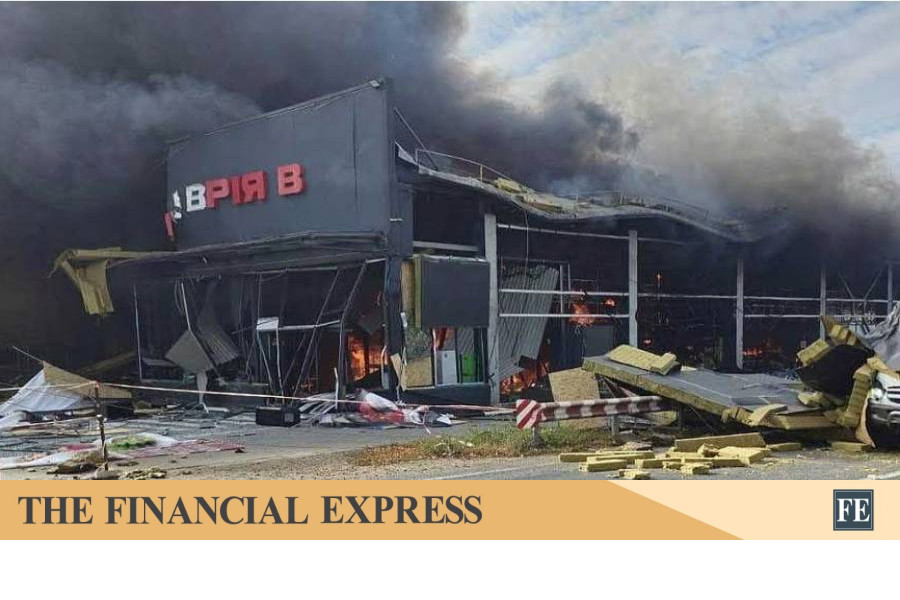
In and around Ukraine’s Black Sea port of Odesa, officials said Russian strikes caused a fire at a shopping mall and also hit houses and businesses.

The latest attacks came a day after a series of Russian strikes killed at least seven people in Ukraine and sparked fires in Kyiv.

The capital, which is home to some three million people, has been the target of particularly intense drone attacks in recent days, hitting petrol stations and the rail network.

The Nova Post postal and courier company said one of its branches was destroyed and its sorting depot was damaged in Thursday’s strikes.

AFP analysis of data from the ACLED armed conflict monitor showed that there were more Russian strikes on the Kyiv region in the first 18 days of September than in any full month since the start of the war apart from March 2022.

Zelensky met NATO secretary general Mark Rutte in New York to brief him on the latest security situation, and made a renewed push for US-made interceptors against ballistic missiles and tougher sanctions on Russia.

US secretary of state Marco Rubio has urged both sides not to target the other’s energy sector.

He also invited president Vladimir Putin to attend the G20 summit in the United States in December.

The Kremlin said it would consider the invitation — while the European Union said it would use the summit to keep condemning Russia’s war on Ukraine.​
 

Russian attacks kill five in Kyiv
Agence France-Presse . Kyiv, Ukraine 26 September, 2026, 00:00

1790384190422.webp

Ukrainian rescue personnel carry an injured person on a stretcher following an air attack in Kyiv, amid the Russian attack of Ukraine. | AFP photo

Russian daytime strikes on Kyiv killed five people on Friday, local authorities said, the latest in a wave of intensifying attacks on the war-torn capital.

Kyiv has faced increasing drone and missiles strikes in recent months, prompting renewed calls for air defence systems, including for advanced Patriot air defence systems that Ukraine hopes to produce with US licences.

New explosions rang out in the capital in the early afternoon, sending some people running for shelter, while others walked by without reacting, an AFP journalist saw.

Shortly after, Kyiv Mayor Vitali Klitschko said four people had been found dead.

This followed an earlier attack, which killed a 14-year-old boy, in what Ukrainian President Volodymyr Zelensky called ‘an absolutely savage and sickening strike, devoid of any military logic’.

AFP journalists at the scene earlier saw residents gathering around a multi-storey building, with apartments on the ninth and 10th floors left charred.

While Russia used to target Kyiv mainly during hours of darkness, it now often attacks in broad daylight.

Alisa Boyko, who lived in the multi-storey building struck on Friday morning, said Russia’s objectives were clear.

Russian forces seek ‘to torment us’, she said, ‘so that everyone is affected, one way or another.’

Moscow has been increasingly firing at the capital with newly developed jet-powered drones, which have succeeded in bypassing some of the drone interception systems developed by Ukraine.

Residents have expressed hope that Ukraine will soon find countermeasures against the new drones.

‘This is a technological race and a technological war,’ said Mykyta Sysoyev, smoking outside his damaged building.

‘Unfortunately, people will suffer while we’re searching for solutions,’ he added.

Moscow has also increased its attacks with ballistic missiles, which Kyiv’s air force struggles to intercept.

US-designed Patriots remain the only system reliably able to counter Russia’s powerful ballistic missiles, experts say.

Zelensky has repeatedly called for more air defences, especially Patriot systems, including during his visit to the United States this week.

‘At our last meeting, President Trump emphasised to me that yes, I have made a final decision. Ukraine will receive licences for the production of Patriot missiles,’ Zelensky said in a voice note to journalists.

In July, Trump said it would be ‘pretty cool’ to grant Ukraine the licences, before backtracking, saying the United States should be ‘very careful’ before granting Ukraine authorisation.

Ukraine has reported an acute shortage of Patriot interceptors since the United States and Israel went to war with Iran in February, diverting supplies of the advanced systems.

Even if the licences are granted, establishing industrial capacity would require more than a year and would not meet Kyiv’s immediate needs.

In the southern region of Odesa, another person was killed in a repeated strike on a postal facility, authorities said.​
 

Russian strikes on Ukraine kill five
Agence France-Presse . Kyiv, Ukraine 28 September, 2026, 00:00

Russian strikes on Ukraine killed five people, Ukrainian authorities said Sunday, warning the Kremlin’s forces were ‘relentlessly’ attacking Kyiv, a day after Moscow vowed to achieve its war aims ‘no matter the circumstances.’

One of the victims was killed in Kyiv, with authorities saying Russian strikes on the city and its suburbs damaged more than 16 sites — both residential and industrial.

Russia has upped attacks on the city in the fifth year of its invasion, as the capital braces for another winter of war.

US-led talks to end the war, launched by the Kremlin in 2022, have failed to lead to a breakthrough, with the UN warning of a rise in civilian deaths.

President Volodymyr Zelensky said three people were killed in night-time strikes on the southern Zaporizhzhia region and that a Russian drone strike killed one man in Kyiv.

Kyiv mayor Vitalii Klitschko said a woman and two 16-year-olds were wounded and hospitalised in the capital.

‘The enemy continues to relentlessly attack the Kyiv region with strike drones,’ Kyiv’s administration said.

‘Sixteen sites have been damaged,’ it added, saying this included 12 private houses in Kyiv’s outskirts, as well as a warehouse and production facility.

Authorities in the Odesa region said a ‘massive strike’ on the south of the Black Sea region killed one more person.

Regional head Oleg Kiper said Russian strikes damaged ‘a residential building, a medical institution, a hotel, a shop, as well as a warehouse used for storing grain crops.’

The attacks came a day after Russian foreign minister Sergei Lavrov told the UN Moscow intends to continue its military campaign ‘to the end’.

In Moscow, the defence ministry said Sunday that Russian forces seized a border village in Ukraine’s eastern Kharkiv region, where Russia controls pockets of land.

Russia does not claim the Kharkiv region as its own — unlike the Donetsk, Lugansk, Zaporizhzhia and Kherson regions — but has throughout the war attacked the region and seized land there.

Moscow said forces captured the small village of Khrypuny.

The Kremlin has repeatedly said it intends to seize the rest of east Ukraine.​
 

Russian drone hits Kyiv’s Academy of Sciences
Agence France-Presse . Kyiv, Ukraine 29 September, 2026, 00:00

1790641073064.webp

Rescue personnel carry a wounded elderly woman out of a multistorey residential building, damaged following a Russian aerial attack on Kharkiv on Monday, amid the Russian attack of Ukraine. | AFP photo.

Russian drones crashed into Ukraine’s National Academy of Sciences in the historic heart of Kyiv on Monday, in the latest deadly daytime attack on the Ukrainian capital.

Kyiv has increasingly been facing a round-the-clock bombardment of Russian drones and missiles, intensifying Europe’s worst conflict since World War II to levels unseen since just after it began in 2022.

The capital, where petrol stations, the transport network and communications infrastructure as well as residential buildings have been hit, again came under fire, after an air force alert warning of approaching drones.

Video footage shared online showed what appeared to be a high-speed drone smashing into the National Academy of Sciences at a sharp angle, exploding and sending acrid smoke into the blue skies above.

People were seen leaning out of windows for fresh air as bright orange flames engulfed part of the building.

‘A fire broke out. Employees were inside at the time of the strike,’ Ukraine’s prime minister Sergiy Koretsky said. ‘Preliminary reports indicate that one person was killed and four were injured.’

Central Kyiv is usually well-protected from Russian attacks, and the National Academy of Sciences is close to the German embassy, a cathedral, the national opera and government buildings.

But cultural sites, government buildings and schools have all been targeted before, according to the authorities in Kyiv.

Earlier this month, a Russian drone hit the headquarters of Ukraine’s SBU security services.

The academy called the attack ‘Russian terror’ and ‘barbarity’, targeting ‘peaceful people who were simply at their workplaces... Ukrainian science, education and culture’.

Elsewhere, Russian strikes killed four and wounded at least 19 at a business centre in the central city of Dnipro while there were unspecified fatalities and several children wounded when a residential area was hit in eastern Kharkiv.

The prime minister said in the Zhytomyr region west of Kyiv, Russian forces damaged an ice cream factory and residential buildings were hit in Sumy, in the north, Rivne, in the northwest, and southern Odesa.

‘The danger persists in many regions. The enemy is intensifying its terror. I urge citizens not to ignore the alerts and to stay in safe places whenever possible,’ he warned.

In recent months, Russia has been deploying newer jet-powered drones that move faster and are harder to intercept than the traditional models, based on Iranian Shahed drones.

President Volodymyr Zelensky last week renewed his appeal to Ukraine’s Western allies to step up their military support, including for US-made Patriot interceptors capable of downing powerful ballistic missiles.

His request comes as Ukrainians consider their options with winter approaching, after Russian attacks last year on energy infrastructure cut power and heating as temperatures plunged to as low as -20C.

In an interview with Ukrainian television broadcast on Sunday night, Koretsky stopped short of saying that all residents in cities should leave before winter sets in, calling that an ‘extreme step’.

But he indicated that vulnerable people should relocate, to avoid overloading the hard-pressed emergency services as they deal with the aftermath of the relentless Russian strikes.

‘If a person lives, for example, on the 16th floor and for instance the power gets cut, why at that moment, when the state emergency service specialists need to focus on dealing with the consequences, should we be... handling people who need extra attention?’ he told TSN television.

‘For such people, it’s worth finding an alternative place to stay for the winter period.’

Meanwhile, European defence ministers discussed whether the bloc needed its own NATO-style emergency mechanism to bolster coordination against ‘hybrid attacks’ by Russia.

European governments say Moscow is stepping up its campaign of sabotage and interference against Ukraine’s supporters, as Kremlin troops struggle to make headway on the frontlines, more than four years after their full-scale invasion.​
 

Russia targets Kyiv power supply
Agence France-Presse . Kyiv, Ukraine 01 October, 2026, 00:00

Russia hit Ukrainian energy infrastructure in a wave of deadly drone and missile strikes on Wednesday, prompting an urgent call for civil contingencies as freezing winter approaches.

Kyiv said it was Moscow’s opening salvo in an expected campaign to try to knock out heating and power as the temperature plunges — a tactic it has deployed throughout the grinding conflict.

At least four people were killed in and around Kyiv, including a young child found under the rubble of a demolished residential building, after another night of continuous air raid red alerts and repeated blasts.

Sirens screamed across the city warning people to take cover in basement shelters and metro stations from ballistic and cruise missiles, as well as high-speed attack drones in the skies above.

In Moscow, Russia’s defence ministry said it had conducted ‘a massive missile and drone strike’ on Kyiv and the surrounding region that targeted the power infrastructure.

Ukraine’s main energy provider DTEK confirmed that the grid was damaged and supplies to 8,000 households were affected. Engineers got the power back on, it said, but called it ‘another difficult night for the capital’.

Generating equipment was also damaged at the Trypillia thermal power plant near Kyiv in a deliberate strike, said Sergiy Isachenko, the chief executive of the plant’s operator PJSC Centrenergo.

Ukraine’s weather service announced that the first overnight frosts were due in many parts of the country from Thursday.

Ensuring winter energy supply in Ukraine is critical. Russian strikes last year cut light and heating when temperatures fell to as low as -20C.

The prospect of a repeat has left many in Kyiv to consider whether to stay, alongside calls for the vulnerable and disabled people to relocate.

Prime minister Sergiy Koretsky said Russia had been hitting Ukraine’s energy infrastructure almost daily since the summer.

‘However, such a large-scale combined attack has taken place for the first time since the end of the last heating season,’ he wrote on Telegram.

‘It was predictable,’ Ivan Danylevych, a 22-year-old student, told AFP on the streets of Kyiv.

‘Why are they doing it? To frighten people. Pure terror. To make people exhausted and willing to make concessions on military issues.’

The increase in attacks has left many people in Kyiv glued to their mobile phones, scouring Telegram channels and apps that track the skies for signs of approaching drones or missiles.

But Tetiana Ivashchuk, a university worker, said only one thing helps her — coffee.

‘The main thing is to stay calm,’ she added. ‘We can’t change what’s happening now... God willing, everything will be fine.’

Ukraine’s energy system was already battered by previous attacks since the war began in February 2022 and the latest damage was being assessed, said Koretsky.

‘Local authorities must check the readiness of back-up power systems for critical facilities in communities and complete all work on their installation and connection as quickly as possible,’ he added.

The International Criminal Court in 2024 issued arrest warrants for Russia’s then military leaders over attacks on Ukraine’s energy grid, saying they constituted a war crime that was causing ‘excessive harm’ to civilians.

Wednesday’s strikes hit residential buildings and businesses, sparking fires and widespread damage to property and cars, the authorities said.

Kyiv mayor Vitali Klitschko said a driver at a local utility firm was killed when a warehouse was hit, while two others were killed elsewhere.

The emergency services said a child was found dead under the rubble of a residential building that was destroyed in the wider Kyiv region.

Russia has been deploying newer jet-powered drones that move faster and are harder to intercept than the traditional models, which are based on Iranian Shaheds.

Ukraine’s president Volodymyr Zelensky, who announced on Wednesday that he had visited frontline troops in the east, has repeatedly appealed to Ukraine’s allies for more military support, including US-made interceptors against ballistic missiles.

But there is widespread concern about mounting civilian casualties on both sides, with an increase in long-range strikes and no progress on faltering peace talks.​
 

Ukraine regains ground in Donetsk counteroffensive
Agence France-Presse . Paris, France 02 October, 2026, 00:00

Ukrainian troops have regained ground in a counteroffensive in the Donetsk region, according to an AFP analysis of data from the Institute for the Study of War.

Operation ‘Vivaldi’ was launched in September with the aim of pushing Russian forces back from the cities of Sloviansk and Kramatorsk.

The Ukrainian military has retaken small patches of territory from Russia, for total gains in the Donetsk region of 172 square kilometers, an area more than 1.5 times the size of Paris.

President Volodymyr Zelensky this week visited troops fighting near the Donetsk city of Lyman, 10 kilometres north of Sloviansk.

ISW data shows that Ukrainian forces advanced north and south of Lyman.

Elsewhere, Ukraine retake small areas in the regions of Kharkiv in the north and the eastern regions of Dnipropetrovsk and Lugansk.

By contrast, Russian offensives in Zaporizhzhia south and Sumy north enabled Kremlin forces to seize 104.5 square km and 20 square km respectively.

Overall, Ukraine made a net territorial gain of 80 square km in September, according to the data.

It had been three months since Ukraine last recorded a net territorial gain.

September was only the sixth month in which Ukraine gained more ground than it lost against Russia since early 2023.

The armies remain largely deadlocked along the vast frontline, characterised by a ‘kill zone’ either side where explosive-laden drones complicate any movement.

Moscow controls more than 19 per cent of Ukrainian territory. Of the occupied areas, around seven per cent corresponds to Crimea and parts of the Donbas that were already under Russian or pro-Russian separatist control before Russia’s February 2022 invasion.

Most of Russia’s gains occurred during the first weeks of the conflict.

According to ISW data, since January, Russia has advanced by an average of only 15.5 square km per month — after its gains averaged around 405 square km per month in 2025.

The ISW estimates exclude territorial gains claimed by Russia that the institute has not been able to confirm or refute.

The ISW works with the Critical Threats Project, part of the American Enterprise Institute, another US think tank specialising in conflict analysis.

Diplomatic efforts to end the Europe’s deadliest armed conflict since World War II remain at a standstill.

Moscow demands that Ukraine cede territory it still controls in areas that Russia claims to have annexed.

Kyiv has called those demands a capitulation that would leave the country vulnerable to a future Russian attack.

According to the United Nations, the number of civilian casualties has in recent weeks reached its highest level since the early months of the war, mainly due to Russian missile and drone attacks on Kyiv and other Ukrainian cities.​
 

Russia warns diplomats to leave Kyiv
Agence France-Presse . Kyiv, Ukraine 04 October, 2026, 00:00

1791071886088.webp

Firefighters extinguish a fire at a house following air strikes in Kharkiv on October 2, 2026, amid the Russian invasion of Ukraine. | AFP photo.

Russia on Saturday issued a new call for diplomats and foreigners to leave Kyiv, warning the Ukrainian capital of new ‘massive’ air attacks hours after striking another major bridge in the city.

Moscow has ramped up its pummelling of Kyiv, launching waves of drones at the city, targeting key infrastructure and putting the capital on a near-constant state of alert against attacks.

The strike on the Northern Bridge on Saturday morning wounded two people and damaged road surface and trolleybus overhead wires restricting traffic, Kyiv Mayor Vitali Klitschko said.

AFP reporters saw traces of an explosion on a pedestrian walkway and technicians repairing power lines on the bridge.

Hours after the attack, the Russian authorities warned of more strikes, issuing a fresh call for diplomats and foreigners to leave the city and refrain from visiting Ukraine.

‘We note with concern that not everyone has heeded these warnings, and that individuals are knowingly exposing themselves to mortal danger,’ the Russian foreign ministry said in a statement.

The Russian ministry also stated that ‘responsibility for any potential negative consequences rests entirely with those who ignore this warning.’

Moscow issued a similar warning in May but heads of state and governments from countries backing Ukraine have defied it by travelling to the war-torn country and the capital in show of support.

On Friday, Klitschko said the city was in a ‘very dramatic situation’ and should now be on a war footing as the enemy was ‘tearing Kyiv apart’ with strikes on bridges and energy infrastructure.

President Volodymyr Zelensky accused his Russian counterpart, Vladimir Putin, of ripping up the rulebook of armed conflict by sanctioning massive attacks on civilian areas, an accusation the Kremlin has rejected.

Kyiv has been increasingly under aerial bombardment in recent months, with the attacks and alerts disrupting daily life and sowing traffic chaos.

Long lines of stationary cars and buses clogged major roads on Friday as commuters sought alternate routes, with some forced to continue their journeys on foot.

Air raid sirens warning of approaching threats sound almost round the clock, urging the city’s estimated three million people to seek shelter.

Strikes across the country in recent days have also caused power outages in several regions in the east, north and centre, with grid operator Ukrenergo urging consumers to limit usage even as demand increases with colder weather.

Ukraine braces for another difficult winter. Last year, heating and power were cut for days on end as temperatures plunged to -20C.

The grinding war, which began with Russia’s full-scale invasion in February 2022, has turned into Europe’s bloodiest conflict since World War II.

Ukraine has appeared to stabilise the front in recent months, but depleted air-defence stocks since the start of the US-Israeli war in Iran have left its cities exposed to Russian barrages.

The US-brokered peace efforts are effectively frozen as Moscow has shown no signs of dropping its maximalist conditions to end the war, including a demand that Ukraine cede territory in the east that Russia’s troops have not captured.​
 

Russian strikes hit Kyiv while German chancellor Merz visits
Agence France-Presse . Kyiv, Ukraine 04 October, 2026, 23:45

Ukraine and Germany have signed a $1.5-billion weapons deal to help fight an upsurge in Russian drone attacks, while fresh strikes and air raid sirens greeted chancellor Friedrich Merz on a solidarity visit on Sunday.

The agreement includes combat drone weapons and support for Ukraine’s battered energy sector, which Russia is targeting to cut off heating and power during the freezing winter months, Ukrainian president Volodymyr Zelensky wrote on X.

Merz was on a surprise visit to show European support as attacks increase — and discovered the new reality of daily life in the Ukrainian capital.

Air raid sirens wailed repeatedly, including as Zelensky showed him the damage to the National Academy of Sciences, which was hit by a Russian attack drone on Monday, killing two.

‘We can see the entire pointlessness of this war at this place,’ noted Merz.

‘These barbarous attacks on the civilian population of Ukraine must stop. These are war crimes that are being committed daily here.’

One blast that was heard across the city damaged the road surface of the Northern Bridge — one of several connecting the eastern and western parts of Kyiv over the Dnipro river which have been struck repeatedly in the last four days.

Kyiv mayor Vitali Klitschko has said the capital — largely spared from the devastation wrought near the front line in more than four years of conflict — should now be on a war footing.

Round-the-clock attacks have hit residential areas, petrol stations, schools, rail and communications infrastructure, while the near-constant air raid sirens disrupt daily life and put people on edge.

Merz warned as he arrived that support for Ukraine was vital for European security.

‘If Russia is not stopped, its war machine will sooner or later turn against us,’ he claimed.

Ukraine has repeatedly called for advanced interceptors to shoot down Russia’s new fast-moving, jet-powered drones and powerful ballistic missiles.

The latest deal provides for the joint production of anti-jet drones, Merz told a joint news conference with Zelensky.

‘Significant technical breakthroughs have already been achieved in this area in recent weeks,’ he added.

‘Production is now being ramped up. This strengthens Ukrainian air defence quickly and significantly.

‘We are supplying standoff weapons, combat drones and satellite technology so that Ukraine can also target Russian launch sites.’

Russia’s defence ministry vowed on Sunday to ramp up its strikes on military and related targets in Kyiv and elsewhere after Zelensky said this week that Ukraine would intensify its own attacks against oil facilities that it says supply Moscow’s troops.

Merz called this week for NATO and European unity against Russia, as well as in his own country, where the far-right, Moscow-friendly AfD opposition is on the rise.

There have been increasing fears in Europe that it could find itself in Russia’s crosshairs.

Security was a top concern for voters in this weekend’s election in NATO member Latvia, which borders Russia.

On Saturday, Moscow warned foreigners and diplomats to leave Kyiv, saying ‘massive’ new airstrikes would hit the city.

Leaders from countries allied to Ukraine have continued to make visits despite a similar threat made in May.

‘The EU Delegation is staying. Threatening us will not stop Europe’s support for Ukraine. It only reminds us why that support matters!’ European Union ambassador Katarina Mathernova wrote on X on Sunday.

Merz told reporters he was unfazed by the threat but did not know if it had been made to coincide with his visit.

Russia has admitted deliberately targeting Ukraine’s energy sector as winter approaches. Last year, similar attacks knocked out power and heating for days on end as temperatures plummeted to minus 20C.

In Kyiv, home to some three million people, residents are mulling what to do if that happens again, and there have been calls for the vulnerable and disabled to consider leaving.

Merz said Berlin’s winter support programme was worth some 350 million euros to help provide generators, transformer stations and for grid repairs.​
 

Russia launches heavy strikes at Ukraine, killing at least 20


1791415252536.webp


A firefighter works at the site of a warehouse that burned out after it was hit during a night of Russian missile attacks, amid Russia's attack on Ukraine, in Kyiv, Ukraine October 7, 2026. REUTERS/Thomas Peter

Russia pounded Ukraine with waves of missiles and drones in one of its most “vile strikes” on Wednesday, President Volodymyr Zelenskiy said, killing at least 20 people, including children, and damaging industrial facilities and energy infrastructure.

Zelenskiy said the strike coincided with Russian President Vladimir Putin’s birthday.

The heaviest death toll was in Pryluky in ‌the northern Chernihiv region, where a Russian missile obliterated a five-storey residential building. At least 14 people, including four children, were killed there, local officials said.

“Today, as a birthday ‘gift’ to Putin, the Russian army destroyed a residential building in Pryluky...,” Zelenskiy said.

“The Russians wanted to strike painfully and demonstratively. This was one of the most vile strikes: 70 missiles in total, many of them ballistic.”

An excavator and dozens of rescuers with shovels sifted through rubble at the site where several sections of the five-storey building collapsed.

Emergency workers used ladders to get to the upper floors of what remained of the building. Around 50 people were wounded, including seven children, regional officials said.

BIG JUMP IN REPORTED DRONE INTERCEPTIONS

Zelenskiy said six other people were killed ⁠in Kyiv, Oleksandria and Kremenchuk during the heavy overnight attack.

Russia’s defence ministry said its forces had carried out a “massive strike” on military-industrial facilities in Kyiv and other Ukrainian regions, using high-precision land-, sea- and air-launched weapons, as well as drones.

Ukraine’s air force said it had downed just over 80% of the 46 jet-powered drones launched by Russia — a sharp increase from recent weeks when, on average, air defences took down 50% to 60%.

Since the summer, Russia has used increasing numbers of the new high-velocity drones in round-the-clock attacks on Kyiv and other cities, with Ukraine’s air defences struggling to cope with their speed.

The air force did not explain the jump in the interception rate and did not immediately respond to requests for comment.

Zelenskiy said the Russian ballistic missiles remained the major challenge for Ukraine, adding that he and his team were “every day looking for Patriot (missile interception) systems that can and must protect people’s lives”.

Ukraine received a new €1.2 billion ($1.34 billion) tranche from the European Union on Wednesday and will channel the funds towards defence needs, Prime Minister Sergii Koretskyi said.

The US-made Patriot system is the only weapon in Ukraine’s arsenal ‌capable of ⁠stopping high-velocity ballistic missiles but tight global supplies have been drained by the Iran war as well as the Ukraine conflict.

Ukraine’s energy ministry said it had started to roll out partial emergency power cuts in five Ukrainian regions due to the attacks.

Russia’s defence ministry said its targets included sites where Ukrainian defence company Fire Point manufactures and stores its Flamingo cruise missiles and medium- and long-range drones in Kyiv as well as regions of Kyiv, Chernihiv, Kirovohrad, Dnipropetrovsk, Poltava and Kharkiv.

Last week Zelenskiy said Ukraine had fired its first domestically made ballistic missile in combat, produced by Fire Point. In an interview with Reuters, he ⁠said he expected the company to have a longer-range FP-9 missile ready by the autumn. Fire Point has said that weapon will be able to reach Moscow.

PEOPLE SHELTER OVERNIGHT IN KYIV METRO

Zelenskiy said Ukrainian troops hit four targets in Russia over the past 24 hours, including two Russian oil facilities and a training ground in the Perm, Samara, and Astrakhan regions.

In the Reuters interview, Zelenskiy said Ukraine would hit Russia’s energy assets ⁠in response to Moscow’s escalating strikes on civilian infrastructure.

Many Kyiv residents took shelter in the city’s deep underground metro stations as warnings of the upcoming attacks were shared by Ukrainian officials and military intelligence.

Several loud explosions reverberated through the capital during the night.

“The metro is better because we live on the 9th floor of a high-rise, and it’s really scary when you’re ⁠on the 9th floor and missiles are flying at you,” Lesia, a 49-year-old Kyiv resident, told Reuters.

Ukrainian officials said Russian ballistic missiles as well as the drones had targeted Kyiv.

Overnight air strikes on the southeastern city of Dnipro damaged an industrial facility, transport infrastructure in Zaporizhzhia and apartment buildings in Kremenchuk, regional officials said on the Telegram messaging app.​
 

Ukraine's Zelenskiy tells ABC he will organize elections if Russia agrees to 60-day ceasefire


1791761333039.webp

Ukraine's President Volodymyr Zelenskiy appears at an interview with Reuters, amid Russia's attack on Ukraine, in Kyiv, Ukraine, October 2, 2026. REUTERS/Alina Smutko/Files

Ukrainian President Volodymyr Zelenskiy said on Sunday, in response to critical comments from US President Donald Trump, that he will organise elections in Ukraine if ‌Russian President Vladimir Putin agrees to a 60-day ceasefire.

“Please tell Putin, give us two months, 60 days of total ceasefire, 60 days, and we will organise elections,” Zelenskiy told ABC’s “This Week.”

Trump on Saturday criticised Zelenskiy for attacking Russian oil refineries a day after the US temporarily lifted sanctions ⁠on Russian fuel that were designed to deprive Moscow of revenues to fund its war in Ukraine.

“I think it’s time for Ukraine to get a new president,” Trump had told reporters at the White House.

In response, Zelenskiy said “it’s up to Ukrainians” to choose their leader and noted that Putin would also like to change who is leading Ukraine.

He said it is easy for Ukraine to be blamed for higher fuel prices “when everybody in the world understands that because of ‌the war ⁠in the Middle East, the prices are rising.”

Earlier on Sunday, Zelenskiy said Ukraine was ready to halt attacks on Russian oil refineries if Moscow ceases its own strikes on Ukrainian energy infrastructure.

Under terms of the deal as described by Trump on Friday, Russia will ⁠immediately supply more than 300,000 metric tons of diesel to US and global markets, equal to about 2.25 million barrels of fuel. The US exports about 1.5 million ⁠barrels of diesel per day.

Trump is under pressure to bring down rising fuel prices ahead of November midterm elections that will determine whether his Republican Party ⁠will retain control of the US Congress for his final two years in office.

Many lawmakers, including Republicans, have criticised the diesel deal as rewarding Putin.​
 

Kremlin accuses Ukraine of undermining US peace efforts with oil refinery strikes


1792106598806.webp


The Kremlin on Thursday said that Ukrainian strikes on Russian oil refineries ran counter to US peace efforts, after a Ukrainian drone struck a refinery in Russia’s Ryazan region overnight.

US President Donald Trump declared an energy ceasefire on Sunday, something Ukraine said it had first learnt about from media reports and which Russia did not publicly commit itself to.

Kyiv said it had paused strikes on Russian oil refineries for three days, but had resumed them after Russia continued to attack Ukraine’s energy sector.

Kremlin spokesman Dmitry Peskov told reporters on Thursday that Moscow did not perceive that Kyiv had ever complied with the ceasefire and said that the fact that it had struck another Russian refinery was “nothing new”.

“The Ukrainian regime in Kyiv continues to strike these facilities, thereby, of course, coming into serious contradiction with the peace efforts of the United States and of the American negotiators who are indeed making very vigorous efforts to somehow initiate the peace process. But so far, these vigorous attempts have been thwarted by the unwillingness of the Kyiv regime – and of (President Volodymyr) Zelensky personally – to make peace,” said Peskov.

Russia itself had previously argued that the scope of the ceasefire had not been determined, and on Wednesday said it had struck seven Ukrainian energy infrastructure facilities.​
 

Kremlin says Ukrainian attacks won’t change war aims as Kyiv hits Saint Petersburg

​
  • Oil refinery and depot catch fire​
  • One killed, five hospitalized in Saint Petersburg​
  • Russia says 144 Ukrainian drones were downed​


1792369778416.webp

People watch an oil terminal burn in Saint Petersburg on October 18, 2026, after a Ukrainian drone attack. Photo: AFP

The Kremlin on Sunday said Ukrainian large-scale attacks on Russian cities will not change its war aims as Kyiv hit Saint Petersburg with the biggest drone attack on Vladimir Putin’s hometown since 2022, setting an oil refinery ablaze.

Rising smoke was visible from Saint Petersburg’s historic city centre on the banks of the Neva River, with Russia saying Ukraine struck an oil refinery and depot in night-time strikes that killed one person.

The attack came as Ukraine’s Volodymyr Zelensky accused Moscow of violating an “energy ceasefire” announced by US leader Donald Trump 76 times as he warned Russia planned a “blackout” in Ukraine before winter.

Kyiv struck Saint Petersburg as its ties with Washington strained massively in recent days, with Trump waiving sanctions on Russia and striking a deal with Moscow on diesel.

Ukraine and its European allies have worried the White House is siding with Moscow, which launched Europe’s worst war since WWII in 2022.

Saint Petersburg Governor Alexander Beglov said one person was killed and five hospitalised in the city.

Authorities were fighting fires at the Saint Petersburg oil terminal, the Ruchyi oil depot and industrial warehouses, he said.

Flights were restricted at the city’s Pulkovo airport, Beglov said, adding that 12 housing blocks were also damaged.

Russia’s VKontakte social network said its data centre was hit in the city and Ozon -- Russia’s second largest retailer -- also reported a hit on its logistics centre.

The head of the wider Leningrad region, Alexander Drozdenko, said air defence shot down 144 Ukrainian drones, with state media saying this was the largest attack on the city since the start of the 2022 war.

Ukraine has attacked Moscow and Saint Petersburg throughout the Kremlin’s dragging offensive but large-scale hits on Russia’s main cities are rare.

“The Kyiv regime is putting up a fight, but that cannot change the course of events,” Kremlin spokesman Dmitry Peskov told Russian media.

Russia’s offensive against Ukraine has killed hundreds of thousands and displaced millions. Moscow has rained drones and missiles on Ukrainian cities daily and Kyiv says its strikes are fair retribution.

US-led peace talks have not led to a breakthrough. In a fifth year of war, few see a way out. Putin appeared in military uniform this week and repeated Moscow intends to seize the rest of east Ukraine.

Dreadful routine of war

“There’s a general feeling: they’re attacking, we’re attacking -- it’s become the dreadful routine of war,” 58-year-old Galina told AFP in Saint Petersburg.

Sergei, another resident of the city who is also 58, said he felt his apartment block shake and quickly realised it was a drone attack.

“I don’t know if I was scared, what must be will be,” he told AFP.

“My main thought was that petrol would run out at the petrol stations and I’d better fill up.”

Ukrainian strikes caused nationwide fuel shortages in Russia earlier this year.

Leningrad governor Drozdenko said 20,000 people were without power in the town of Yanino, where a substation was hit.

He said a woman and three children were hospitalised “with symptoms of carbon monoxide poisoning” in the region after drone debris fell on a house, causing a fire.

“I woke up at night, heard bangs, looked out of the window and there was a fire,” 40-year-old Saint Petersburg resident Igor told AFP.

“They’re getting on my nerves already,” he added, referring to Ukraine.

Bet on war is paying off

In Ukraine, Zelensky said Russian strikes hit substations in four Ukrainian regions, leaving “tens of thousands of families without power.”

Ukrainian authorities said Russian attacks killed at least three people Sunday, including a 27-year-old woman in Zaporizhzhia and two people in the western Volyn region bordering Poland.

The Saint Petersburg attack came a day after Zelensky called on allies to keep up pressure on Moscow as he denounced Trump’s move to block new sanctions on Russia.

“America should see that Russia is not taking any reciprocal steps in response to sanctions relief or agreements,” Zelensky said Sunday, adding:

“On the contrary, they take every signal of an opportunity to make money as proof that their bet on war is paying off and they can keep fighting.”

Trump this week blocked a package of new sanctions on Russia which was meant to target Putin, as well as Russia’s energy and defence sectors.

He also signed an agreement with Moscow this month to buy diesel, seen as a way to try to lower fuel prices for American consumers ahead of elections.

“It is Russia that must face pressure for peace to have a chance,” Zelensky said Sunday.​
 

Trump says he wants Zelensky to “make a deal” with Russia

AFP

Washington, United States

1792628810455.webp

Ukrainian President Volodymyr Zelensky and US President Donald Trump BSS

US President Donald Trump on Tuesday urged Volodymyr Zelensky to make a deal with Russia -- redoubling pressure on the Ukrainian leader even as Moscow grinds on with the war it launched four years ago.

Trump also said he had asked Russian President Vladimir Putin to release Stephen Hubbard -- an American taken captive by Moscow's forces years earlier in Ukraine -- in a fresh sign of his pivot back to Moscow.

"We want Zelensky to make a deal. He can make a deal. He could have made a deal two years ago when we had our little chat in the Oval Office," Trump told reporters in the same room.

Trump, Vice President JD Vance and Zelensky had a bruising televised confrontation in the Oval Office in February 2025, shortly after the Ukraine-skeptic US president returned to office.

"He's going to have to want to make a deal, because I don't think his people are going to stand for it any longer," Trump said Tuesday.

Relations between Kyiv and Washington have soured since Trump partially lifted sanctions to strike a diesel-supply deal with Putin and slammed Zelensky as a warmonger for Ukrainian attacks on Russian oil refineries.

The Ukrainian leader met Trump's envoy Steve Witkoff in Oslo on Tuesday for talks aimed at easing the tensions.

Zelensky hailed the resumption of US intelligence sharing on looming Russian strikes, but insisted Kyiv must be included in any future talks on its fate after meetings with US envoys.

Ukraine has been increasingly alarmed by Trump's return to effectively blaming Kyiv for a failure to end the war that began with Moscow's February 2022 invasion, and by his warm words towards Putin.

Trump indicated that a deal with Russia to free Hubbard could be near.

"I've been talking to President Putin about Hubbard. I've been talking to him at length. I've asked him to release him. Let's see what happens," Trump said in response to a question from an AFP journalist.

"Just stick with me," Trump added. "Just you remember that question a couple of days from now, because I do things that nobody else can do."​
 

Putin agrees to resume 3-way peace talks with Ukraine and US


1792713387545.webp

Russian President Vladimir Putin shakes hands with US special envoy Steve Witkoff during a meeting at the Constantine Palace in Saint Petersburg, Russia, Oct 21, 2026.
Source: Sputnik/Gavriil Grigorov/Pool via REUTERS

Russian President Vladimir Putin has agreed to resume US-mediated peace talks with Ukraine as soon as next month, the Kremlin said on Wednesday, after Putin met US envoy Steve Witkoffin Washington's latest push to stop Europe's bloodiest conflict since World War Two.

The negotiations in a grand imperial palace in St Petersburg, the ninth time that Witkoff has met Putin in person, began with a goodwill gesture from Russia - the release of Stephen Hubbard, a retired US school teacher held in Russia whom US President Trump had asked the Kremlin chief to release.

Wednesday's encounter unfolded amid concerns in Kyiv and among its allies that the United States is backing away from Ukraine, at times holding back real-time intelligence on Russian attacks and hobbling Ukraine's military communications.

The latest talks also came more than two years since Trump promised in his successful election campaign to end the Ukraine war within 24 hours.

The Kremlin said the new 3-way peace talks, which would be at a technical level, could take place in Abu Dhabi and would be focused on how to guarantee the security of Ukraine and Russia once the war ended. They could begin sometime on or after November 10, it said. The last US-mediated peace talks took place in February before the United States and Israel launched a war against Iran.

The Kremlin was less upbeat, however, about the outcome of talks Witkoff had held a day earlier in Oslo with Ukrainian President Volodymyr Zelensky, the leaders of Finland and Norway, and European and NATO representatives. Witkoff told Putin the talks had been characterised by "some degree of momentum" and a US official said Ukraine had brought new ideas and proposals.

"These nuances, so to speak, do not entirely satisfy us," Kremlin aide Yuri Ushakov told reporters after the St Petersburg meeting - which lasted nearly three hours.

Possible Meeting Between Trump, Putin And XI

Ukraine and Russia remain far apart when it comes to the terms of any possible peace deal, though Trump has recently intensified pressure on Ukraine to strike some kind of a deal. He said on Tuesday it was time for Ukraine to end the war or face "a very bad thing."

Putin also used Wednesday's talks to offer to help Trump deal with Iran, saying Russia had a decades-long relationship with Tehran which it has repeatedly offered to leverage to address US concerns about Iran's nuclear programme. Putin told Witkoff it was possible and necessary to get a deal with Tehran, the Kremlin said.

Russia could also supply vast quantities of fertiliser to the United States to help US farmers, the Russian president told Witkoff.

A potential meeting in China next month with Trump and Chinese President Xi Jinping was also discussed. The Kremlin said Beijing was already preparing what it said would be the first meeting of its kind in history.

'New Ideas'

Putin has shown few signs of compromising on his central war aims, which include full Russian control of the Donetsk region in eastern Ukraine, no NATO membership for Kyiv, and an overall peace deal rather than a temporary ceasefire.

Kirill Dmitriev, Putin's special investment envoy, was also present at the talks with Witkoff and the Kremlin said that major joint economic projects had been discussed, including some that were close to being realised.

Witkoff said he had brought some documents with him containing various ideas for a potential peace deal for Putin to review, and that Jared Kushner, Trump's son-in-law, also wanted to convey some ideas to Putin. Kushner later joined the meeting remotely by phone.

Zelensky said he hoped to discuss key issues on how to end the war during a trilateral meeting with Putin and Trump.

The Kremlin has repeatedly said that any Putin-Zelensky meeting would need to be painstakingly prepared in advance by aides to make it worthwhile.

Fraying US-Ukraine Ties

US-Ukraine ties have deteriorated sharply since Trump announced a diesel export deal with Russia earlier this month to help lower prices in the United States. High fuel costs since he launched strikes on Iran have hurt his Republicans ahead of November legislative elections.

Since the diesel deal, Ukraine has complained of disruption to some intelligence sharing and to its use of the Starshield military satellite system, though Zelensky said that Tuesday's Oslo meeting had reached an agreement to resolve those issues.

Citing US officials and people familiar with the matter, the Wall Street Journal reported on Wednesday that billionaire Elon Musk had last week ordered the slowdown of a military-grade version of SpaceX's Starlink satellite service that Ukraine relies on to track Russian ballistic missile strikes.

Reuters could not immediately verify the report.

Musk has said any such decision is taken by the US military or the president. Trump has said he was not responsible and US Secretary of State Marco Rubio reiterated on Wednesday that Washington had not pulled back Kyiv's ability to access Starlink.​
 

Ukraine receives 252 bodies in swap with Russia
Agence France-Presse . Kyiv, Ukraine

Ukraine has received the bodies of 252 people in an exchange of war dead with Russia, Ukrainian authorities said on Thursday.

Russia received 25 bodies in return, Russian lawmaker Shamsail Saraliev was quoted as saying by the RBC news outlet.

The exchange of prisoners of war and fallen soldiers is one of the few areas of cooperation between the warring sides.

‘As a result of repatriation measures, the bodies of 252 deceased have been returned to Ukraine,’ said Ukraine’s Coordination Headquarters for the Treatment of Prisoners of War.

Police and other officials would ‘carry out all the necessary procedures to identify the repatriated deceased’, it said.

It thanked the International Committee of the Red Cross for help facilitating the exchange, posting pictures on social media of several large white trailer trucks parked back to back, as workers in white, hooded jumpsuits.

The I Want to Live foundation, which is affiliated with Ukraine’s Intelligence Directorate and involved in managing Russia’s prisoners of war, meanwhile said ‘the remains of Russian servicemen were repatriated’.

Among them was the body of a Sri Lankan citizen, the organisation said, adding that he was sent to Russia since he was considered under international law as a combatant in the Russian army.

The exchanges of remains between the two sides take place regularly.

Earlier this month, Ukraine’s military intelligence chief Kyrylo Budanov estimated that more than 26,000 bodies and human remains had been repatriated to Ukraine through exchange operations.

Most of them are still awaiting identification.

According to official announcements from the two sides, Ukraine has received the remains of 5,300 people since the start of this year alone, while Russia has received fewer than 300.

The war, Europe’s worst conflict since World War II, has claimed tens of thousands of lives since Russia’s invasion in February 2022.​
 

Ukraine, Russia swap 270 POWs each

AFP, Kyiv

1792802253958.webp

Russian prisoners of war

Ukraine and Russia have each exchanged 270 prisoners of war, both sides said on Friday, in one of the few areas of cooperation between the warring sides.

Among the Ukrainians freed were five people presumed to have been killed in an attack on a prison in occupied east Ukraine in 2022, Ukrainian President Volodymyr Zelensky said.

‘270 of our people are home. This is a very important achievement,’ Zelensky said on social media.

Russia’s defence ministry also confirmed the swap, saying that ‘270 Russian service members have been returned.’ Zelensky posted images of some of the Ukrainians freed, many with shaved heads and draped in Ukrainian flags. Both Moscow and Kyiv have exchanged thousands of captive soldiers since Moscow launched its Ukraine offensive in 2022.

Ukrainian police said Friday they had detained a 17-year-old girl suspected of helping Russia’s security services to poison Ukrainian soldiers and that two had died. Ukraine and Russia have throughout their war since 2022 accused each other of recruiting minors for sabotage acts including poisoning.

The girl, who was not named, is suspected of having packaged deadly drugs and sending them to Ukrainian soldiers she contacted by Telegram, said a police statement.​
 

Melania Trump helps forge a ceasefire deal in a Russian-occupied Ukrainian city, White House says


1792884925741.webp


First lady Melania Trump has brokered an upcoming ceasefire between Russia and Ukraine in the war-ravaged Ukrainian city of Oleshky to allow for humanitarian aid and the evacuation of civilians, the White House announced on Friday.

The localized ceasefire is set to begin on Oct. 29, with the American first lady saying in a news release that the situation there is "on the brink of disaster."

The White House said Melania Trump had initiated the discussions and that she and a representative worked directly with Russian and Ukrainian leadership to define the terms of the ceasefire.

Ukraine's lead negotiator for the agreement thanked Melania Trump for her involvement and said the deal would be "extremely challenging to implement."

"Under our agreement: first a ceasefire will be put in place; second, humanitarian aid will be delivered to Oleshky; and third, civilians will be allowed to move freely out of Oleshky," Dmytro Lubinets, Ukraine's human rights ombudsman, said in a video message posted online. "The operation will be carried out gradually and is extremely challenging to implement. I will therefore keep Ukrainian society informed and share the results of the operation."

Russia's chief of the general staff, Gen. Valery Gerasimov, said Russian forces "will cease fire on the Kherson axis" starting at 4 a.m. Tuesday Moscow time "in connection with the humanitarian operation near Oleshky." The Russian forces will also carry out "engineering reconnaissance" and ensure "safe movement of the humanitarian convoy" into the city, Gerasimov said.

Kremlin spokesman Dmitry Peskov also said Moscow was grateful to the first lady and that effort was discussed during the latest call between Russian President Vladimir Putin and President Donald Trump, he said.

Peskov said "those who want to leave it would be able to do so." He would not say whether those who evacuate will be taken to Russia- or Ukraine-held territory. He also demurred when asked how long the evacuation will last, saying only it would likely take several days.

Saving children is first lady's focus, president says

Melania Trump has made helping children in conflict one of her signature issues and hosted a U.N. Security Council meeting on the issue earlier this year. She has written Putin to work on efforts to reunite families with children who have been displaced by the war.

"What she wants to do is save children, and that's her focus," the president said of the first lady during a question-and-answer exchange with journalists in Washington.

Tensions between Washington and Kyiv are rising

The development comes as tensions have increased to new highs between the Trump administration and Ukraine's government. Kyiv has faced restrictions on the satellite internet system that it relies on to knock down Russian attacks, with Trump and other top U.S. officials sending mixed messages about who was responsible for throttling the Elon Musk-made Starshield system.

Trump also has recently waived new Russian sanctions, reached an agreement with Russia to import diesel and pushed Ukrainian President Volodymyr Zelenskyy to make a deal to end the war that began in February 2022. In renewed efforts to revive the peace process, Trump envoy Steve Witkoff traveled to Norway this week for talks with Zelenskyy before meeting with Putin in St. Petersburg, Russia.

Zelenskyy did not mention the ceasefire in Oleshky during a remote appearance at the Hudson Institute, a Washington think tank. He did note that American Patriot missile interceptors were still on hold and Starshield and Starlink speed limits were still in place.

He also spoke of the importance of the United States to renewed diplomatic efforts to end the war, including a possible joint meeting with Trump and Putin.

Dire situation in Oleshky

Food and medical supplies have been scarce for months in Oleshky, which sits on the Dnipro River that separates Ukrainian forces from the city's Russian occupiers. There is no electricity, heat or running water. Roads leading from town are mined and dotted with burned-out cars. Drones buzz overhead.

Once a city of about 24,000 residents, Oleshky was captured by Moscow's forces on the first day of their full-scale invasion of Ukraine in February 2022. Its buildings were shelled and burned, and its infrastructure damaged. In June 2023, floodwaters inundated the city after the Kakhovka Dam collapsed from an explosion that an Associated Press investigation found was likely caused by the Russian military. Hundreds of residents were killed.
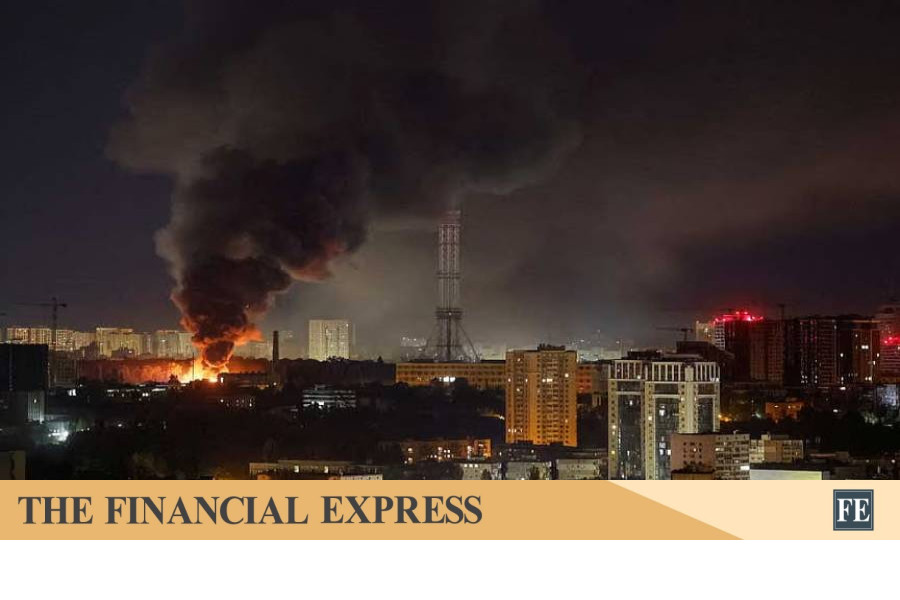
Those left in the city along Ukraine's southeastern front face death from hunger or disease as another harsh winter looms. Ukraine has appealed repeatedly for a local ceasefire to organize evacuations. Russia, as the occupying power, is obligated by international law to ensure civilians under its control have what they need to survive.

Melania Trump details the mission

Melania Trump said in the White House news release that civilian leaders from Ukraine and Russia will visit Oleshky residents to determine the level of assistance they require.

"Residents who wish to evacuate will receive coordinated support and transportation to their preferred destination," she said. "I anticipate some will want to go to Russia, and some to Ukraine."

Melania Trump also said "an impartial American media organization" will accompany and document Russian and Ukrainian teams on the ground throughout the process.

"This will play a significant role in ensuring that the wishes of each family are faithfully respected," she said.

The statement did not identify the media organization.​
 

Russia, Ukraine agree on ceasefire in Oleshky from 27 Oct, to hold peace talks next month

Reuters

1792885418858.webp

A still image taken from an undated drone video released September 12, 2026, shows a destroyed buildings in Oleshky, Kherson Region, Russian-controlled Ukraine. Reuters

Ukraine and Russia said on Friday they had agreed on a ceasefire in the Russian-occupied Ukrainian town of Oleshky, brokered through US first lady Melania Trump, while Ukrainian President Volodymyr Zelenskiy said peace negotiators would meet next month for new talks.

The two sides said the ceasefire would go into effect on 27 October, allowing the delivery of aid and the evacuation of residents through humanitarian corridors.

Amid a US push to organise new talks aimed at ending the 4-1/2-year-old war, Zelenskiy said negotiators from Ukraine, Russia and the United States had agreed to technical-level meetings in the first half of November in Abu Dhabi. A US official later said the three countries may hold their next talks in a couple weeks in Abu Dhabi or Switzerland.

Zelenskiy said he hoped a meeting of the countries' leaders would follow.

Previous rounds of talks headed by the United States stalled in February ⁠with no significant progress towards ending the bloodiest conflict in Europe since World War Two. Russia continues to demand Ukraine cede all of the eastern Donbas region, including territory Russia has not occupied militarily, while Kyiv rejects any notion of giving up land it currently holds.

The latest peace efforts follow a rift between Washington and Kyiv in recent weeks and a series of moves by US President Donald Trump seen as favouring Russia.

A major source of friction was limitations placed on SpaceX's Starlink communication system that Ukraine uses to protect against incoming attacks. Trump said on Friday that if Ukraine still faced a problem with the system, he would straighten it out and, if necessary, speak about the matter to SpaceX CEO Elon Musk.

Another contentious point was Trump's announcement of a deal to allow Russia to provide diesel for the US and global markets, an agreement denounced by Ukraine and meant to keep prices down as the president's Republicans contest US midterm elections.

On Friday, Russian Deputy Prime Minister Alexander Novak said the first three tankers with Russian diesel were on their way to North America.

In the town of Oleshky, occupied by Russian forces since February 2022, residents have reported that they faced a deepening food crisis.

"Both nations agreed to temporarily stop all military action in Oleshky to allow for humanitarian aid to enter and to prepare a civilian evacuation through a designated safe passageway," the White House said in a statement.

The chief of staff of Russian forces, Valery Gerasimov, said on the Defence Ministry's Telegram channel that Russian troops would halt fire from 4 a.m. local time (0100 GMT) on October 27 to allow for the humanitarian operation to start.

Ukraine's General Staff issued a statement agreeing to observe the ceasefire from the same time and pledging to "do everything possible to help Oleshky's residents." Ukraine says it has already used drones twice to send food into the town.

Ukraine's human rights ombudsman, Dmytro Lubinets, also said the ceasefire would go into effect on October 27 and told Reuters the operation would involve demining roads to the town, deliveries of food and evacuations of civilians.

Melania trump's diplomatic efforts

Both sides said Melania Trump played an important role in coordinating the agreement. The first lady has been active in trying to get Ukrainian children seized by Russia during the war returned to their families.

"Oleshky is a front-line war city on the brink of disaster," she said in a statement.

"Oleshky's remaining population is comprised primarily of elderly residents who urgently need medical attention, medicine, food and clean water."

Pope Leo had spoken in the past week both to Zelenskiy and to Russian President Vladimir Putin about conditions in Oleshky.

The White House said Oleshky, located across the Dnipro River from the Ukrainian-held city of Kherson, had 1,700 to 2,000 residents remaining, down from 24,000 before the war.

US envoys

Zelenskiy's comments on resuming peace talks followed a meeting with US presidential envoy Steve Witkoff in Norway early this week and a subsequent meeting between Witkoff and Putin in St Petersburg.

Zelenskiy said he spoke on Friday with Witkoff and US envoy Jared Kushner. He said any peace agreement would need strong security guarantees for Ukraine and funding for 10 years to maintain the Ukrainian army.

"The plan is to meet in the first half of November, and as early as possible, of course," Zelenskiy told the Hudson Institute think tank via a video link. He said much would depend on Russia, noting that a similar meeting expected this month had not materialised.

Zelenskiy spoke of the importance of continued diplomatic efforts to reach a ceasefire and end the war, now in its fifth year, adding that Europe should also be involved in the talks.

Ukrainian officials said on Friday that speed restrictions on Starlink systems in Ukraine remained in place, despite Trump's previous statement that the services had been fully restored.

Trump told reporters at the White House on Friday that he had not spoken to Musk about the restrictions but would do so if required.

"If there is a problem, I'll get it straightened out," he said. The caps have been in place since October 13.

Ukraine and Russia also swapped 270 servicemen each in a prisoner exchange on Friday, the Russian Defence Ministry said. Zelenskiy described the swap, the first since August, as a "very important result."

Ukraine's acting prosecutor, Anton Kovalskyi, writing on Telegram, said more than 19,000 Ukrainian civilians, including 762 children, had been killed since Russia launched its full-scale war more than four years ago.​
 

Local Ukraine truce holds for 2nd day

Agence France-Presse . Kyiv, Ukraine

1793234883362.webp

A Ukrainian firefighter extinguishes a blaze at the site of a Russian drone strike in Kharkiv on Wednesday, amid the Russian attack of Ukraine. | AFP photo.

A US-brokered local ceasefire in southern Ukraine was holding for a second day, both sides said on Wednesday, as hopes grew that vital aid would be able to reach stranded residents.

Locals in the city of Oleshky, under Russian occupation in Ukraine’s southern Kherson region, have faced food, water and medicine shortages for months, caught in the crossfire between both sides.

Some of the estimated 2,000 still there — out of the pre-war population of 24,000 — had resorted to hunting and eating pigeons, former residents who are still in touch with those in the city said.

The human rights ombudsmen of both Russia and Ukraine said Wednesday that the truce — which came into effect early Tuesday morning — was still holding.

‘30 hours of the ceasefire in Oleshky have passed without a single incident,’ said Ukraine’s Dmytro Lubinets.

‘No incidents have been recorded in the 30 hours of the ceasefire in Oleshky,’ Russia’s Yana Lantratova said in a similarly worded statement.

The ceasefire will be guaranteed by ‘the physical presence of both ombudsmen: Ukrainian and Russian’ on the ground, Lubinets’s office told journalists.

The planned truce was announced by US First Lady Melania Trump after months of mounting international concern over the fate of residents in the city.

It remains unclear how many people will choose to leave, or what route they will have to take.

Crossing the frontline — marked by the Dnipro river — is all but impossible, and Russian-installed officials have indicated they could have to travel through Russian-occupied Crimea.

Russian officials said most of those who wanted to flee had already done so.

A senior Ukrainian official also said that many people in the city wanted to stay, so the ceasefire operation was designed to allow humanitarian supplies into the city.

Oleshky was captured by Russian forces at the start of their 2022 invasion.

Lubinets said the truce was also bringing respite for the regional capital of Kherson, where around 280,000 people lived before the invasion.

‘Kherson, which had been under constant shelling, has literally come back to life. There are more people on the streets, and urban life has picked up,’ Lubinets wrote on social media.

‘People are going outside without fear, taking walks and enjoying the autumn sunshine,’ he added.

He posted pictures of people selling fruit under anti-drone nets on the street and municipal workers mowing lawns amid buildings reduced to rubble.

The city lies on the Dnipro river, directly across from Russian forces on the opposite bank, and has been heavily bombarded throughout the war.

It was occupied by Russian forces at the start of the 2022 invasion, before Ukraine retook it in a counter-offensive later that year.

Regional governor Oleksandr Prokudin wrote on Telegram on Wednesday morning that ‘no strikes or hits on civilian or critical infrastructure facilities were recorded’ over the past 24 hours.

David Arakhamia, a Ukrainian lawmaker who took part in peace negotiations with Russia in 2022, described the ceasefire as the ‘biggest de-escalation since 2022’.

Previous short-lived truces in the war — such as to mark Orthodox Easter — have seen drop-offs in aerial attacks but been marred by accusations of widespread violations by both sides.​
 

Bringing back Bangladeshis trafficked to Russia's warfront


1793316156533.webp

File photo


The disclosure by the UN Independent International Commission of Inquiry on Ukraine that Bangladeshis were among the nationals of 29 countries trafficked to Russia's warfront with Ukraine is, in a word, shocking. What is further disturbing is the UN Commission's finding that it was the Russian authorities which had been coordinating with agents operating in different countries to lure men, mostly from economically vulnerable backgrounds, with offers of well-paid civilian jobs. The Bangladeshi victims were reportedly issued business visas against invitations from a civilian company in Russia. But instead of the promised jobs, the recruits, on arrival, were forced to sign contracts, written in Russian language, with that country's defence ministry. In cases, their passports and phone sets were confiscated before they were rushed to the Ukrainian warfront, often with little training. Many have been killed or gone missing. Evidently, the sequence of events that led to the victims' discovering themselves in a battlefield bear the marks of an organised transnational trafficking network.

The question is, how Bangladesh is going to respond to this grave violation of its citizens' human rights. Since, diplomatically, Russia is no stranger to Bangladesh, there should be room for Dhaka to raise the issue at the highest diplomatic level and ask Moscow why and under whose authority people who went there seeking employment found themselves fighting a war that is no concern of theirs. Since the findings come from an independent UN inquiry and point to the involvement of Russian authorities, Moscow cannot simply wash its hands of the responsibility by blaming unscrupulous recruiting agents. Also, the government should lodge a protest, demand immediate discharge and repatriation of the surviving Bangladeshis, including the injured and disabled and ensure return of the bodies of those killed. It should also press for adequate compensation for affected families.

At this point, it is important to distinguish between one who willingly joins a foreign country's armed forces and someone who is driven by deception or under duress to do so. The UN inquiry has been categorical that the latter are trafficking victims, not mercenaries. That these men have been turned into cannon fodder in a war not of their making is inhuman. The distress of families which have lost contact with their sons or husbands can only be imagined. Under the circumstances, the foreign and expatriates' welfare ministries need to work jointly to establish how many Bangladeshis travelled to Russia on work, business or tourist visas, identify those trapped in military service and contact the families. In cases of capture by Ukrainian forces, consular support through the appropriate international humanitarian agencies also needs to be sought. Meanwhile, the law-enforcement agencies must identify and bring to justice local recruitment rackets and their collaborators, seeking help, where necessary, from international anti-trafficking bodies.

But why are so many young men vulnerable to such monstrous deception? The answer, at least in part, lies in the country's acute unemployment problem and the shrinking opportunities for decent work. Thousands of youths, including educated ones, are ready to borrow heavily or sell family assets in the hope of securing a job abroad. The desperation is exactly what traffickers exploit. Of course, no degree of joblessness can justify trapping an unsuspecting jobseeker and making him a combatant against his will. Still, jailing traffickers or tightening overseas recruitment checks would address only a part of the problem. The government must also create conditions for productive investment, expand skill training and generate employment at home, especially for the youth. So, along with firm diplomatic action to rescue those already trapped, Bangladesh needs a sustained policy to stop its young jobseekers from becoming easy prey to international trafficking networks.​
 

Russian drone strike kills 14 at Ukraine train station
Agence France-Presse . Kyiv, Ukraine

1793321813717.webp

In this handout photograph taken and released by the Ukrainian Emergency Service on October 29, 2026, Ukrainian rescuers carry an injured person on a stretcher following an air attack on the railway station in Dnipro, amid the Russian invasion of Ukraine. | AFP photo.

A Russian drone slammed into a busy platform at a railway station in Ukraine’s Dnipro on Thursday killing at least 14 people in what President Volodymyr Zelensky called a ‘horrific’ attack that demands a response from Kyiv’s allies.

The strike came as Ukraine and Russia strive to uphold a fragile local ceasefire in the ravaged city of Oleshky — under Russian occupation since 2022 and where residents have faced months of food, water and medicine shortages.

The truce was holding into its third day, both countries said, with the Ukrainian human rights ombudsman Dmytro Lubinets announcing that he had ‘set out with the Ukrainian delegation towards Oleshky’ through Belarus and Russia.

But elsewhere, Moscow continued to pummel Ukraine.

The strike at the Dnipro train station hit a platform ‘where a regular commuter train and a regular passenger train were standing’, Zelensky said.

By early Thursday afternoon, Dnipropetrovsk regional governor Oleksandr Ganzha said the death toll from the strike had risen to 14.

Another 14 had been wounded, he said, adding that six of them were in severe condition after suffering ‘multiple shrapnel wounds’, including an 11-year-old boy and a man who had ‘both legs amputated’.

Zelensky slammed the attack as ‘horrific’ and insisted that ‘sanctions against Moscow and its war machine must not be eased for as long as this Russian war continues’.

Images released by Ukrainian emergency services showed bodies on the platform, rescuers helping victims to safety and two burnt-out passenger trains with their windows shattered.

French President Emmanuel Macron reacted with outrage to the attack, stressing the need for ‘far more than a localised ceasefire’ like the one in Oleshky.

‘It is intolerable that Russia continues to reject all proposals to this end, choosing instead to pursue escalation and target civilians,’ he said on X.

Russia has fired drones on trains across Ukraine since the first days of its 2022 invasion — destroying hundreds of locomotives and killing several railway workers.

Ukraine’s air force said it had intercepted three jet-powered drones in a daytime attack, but that a fourth evaded its defences and hit the station.

In the aftermath of the attack, Zelensky refreshed his criticism of a deal struck this month between US President Donald Trump and his Russian counterpart Vladimir Putin to ease some sanctions on Russia allowing Moscow to release diesel onto global markets.

‘How many such terrorist strikes has Russia carried out against our people since sanctions were lifted on some Russian oligarchs and the energy sector, instead of de-escalating,’ he asked.

At least six others were killed across Ukraine in separate Russian attacks, according to local officials.

A strike on the city centre of Chernigiv, north of Kyiv, killed two 15-year-old girls and wounded nearly two dozen others, including four children, the head of the city’s military administration, Dmytro Bryzhynsky, said.

A drone also slammed into a multi-storey residential building in the central city of Kremenchuk, killing three and wounding several — including a six-year-old — the local governor said.

Russia has intensified drone and missile attacks on Ukraine in recent weeks, hitting energy sites around major cities in what Kyiv says is a bid to plunge the country into cold and darkness throughout the winter.

The Kremlin earlier this week vowed not to let up in the overall pace of the war even as the sides prepare to restart stalled talks under US mediation.

Zelensky said on Wednesday it would be a ‘huge success’ if the local ceasefire in Oleshky — brokered by US First Lady Melania Trump — allowed for the evacuation of stranded citizens.

Locals trapped there have resorted to hunting and eating pigeons in recent months, former residents in touch with those in the city said.

Russia and Ukraine are to meet next month with US envoys to discuss ways to end Europe’s worst conflict since World War II, with no firm dates set for the talks yet.

Several previous rounds have failed to move the sides closer to a deal.

Russia demands more territory in eastern Ukraine and sweeping military and political restrictions on Kyiv.

Ukraine and its allies say ceding ground to Moscow would be tantamount to a capitulation and leave Kyiv vulnerable to future Russian attacks.​
 

Russia's blockade of Ukraine is a threat to global food security — and Bangladesh should take note


1793404376233.webp

Russia has recently stepped up attacks targeting civilian infrastructure in Ukraine. Reuters

At a time when 7.8 per cent of the world’s population faces hunger, one of the world’s most important grain routes is again under attack. Russia is choking off Ukraine’s ability to export food through the Black Sea, the Danube River and overland corridors. Its deliberate strikes on ports, warehouses, inland logistics, shipping and agricultural infrastructure are an assault on global food security, disrupting trade, energy and fertiliser markets.

This is a hard economic and humanitarian fact: when grain cannot leave Ukraine, global markets tighten, prices rise and vulnerable countries pay the price.

The timing could hardly be worse. As Ukraine entered the harvest season in August, attacks on transport routes and export facilities trapped grain, oilseeds and other agricultural products inside the country. Grain exports in August were cut by half compared with 2025. International prices have already reacted. And the pressure may intensify in the months ahead.

In October, Ukraine risks running out of storage capacity. By November, more than 9 million tonnes of grain, oilseeds and meal could remain outside available storage. A harvest capable of feeding millions could instead be left stranded. If farmers are unable to sell this season’s crop, they will have less cash for the next sowing season, reducing future production and compounding the crisis into next year.

That matters in a world where an estimated 645 million people already face hunger. Disruptions to maritime routes, energy markets, trade flows and humanitarian logistics do reverberate far beyond the immediate conflict zone as the concurrent crisis in the Middle East demonstrates. The most exposed countries and communities are the least able to absorb another shock to food prices and supplies.

Bangladesh is one of the countries that should be watching particularly closely. Wheat is this country’s second-most-consumed cereal, and Bangladesh relies on imports for more than 80 per cent of its wheat-based food needs.

That dependence leaves Bangladesh exposed to disruptions in major wheat-producing regions and to instability along global trade routes. It is not a theoretical risk. When the war disrupted supply starting four years ago, Bangladesh felt the consequences quickly through higher import costs and rising domestic prices for wheat and wheat-based foods. Inflation has remained high.

Russia has understood this from the start. Weaponising food insecurity has been part of its broader strategy since the beginning of its full-scale war of aggression. By targeting Ukraine’s export routes, Russia is not only trying to weaken Kyiv. It is also testing how much pressure the rest of the world will tolerate when food becomes collateral damage. Bangladesh is part of the collateral damage.

Ukraine’s role in world food markets explains why this matters so much. Before February 2022, Ukraine supplied 15 per cent of global corn exports, 10 per cent of wheat exports, 15 to 20 per cent of barley exports and fully 50 per cent of sunflower oil exports. It has long extended its agricultural reach deep into Asian markets. A strong harvest is again expected this year. But harvests only contribute to food security if they can reach the ports, the ships and, ultimately, the people who need them.

International efforts to ease the pressure have become a critical alternative route for Ukrainian exports and a lifeline for Ukraine’s economy.

But while overland and river alternatives can mitigate the damage, they cannot substitute for safe maritime navigation on the scale global food markets require. Indeed, freedom of maritime navigation is a global security concern, including to Bangladesh.

Open and predictable international food trade is not an abstract concern but an issue on which responsible partners need to take a stand. That is why we call for an urgent moratorium on attacks against grain export facilities, infrastructure and civilian shipping in the Black Sea. It would protect critical infrastructure, restore some stability to food markets and give farmers, traders and import-dependent governments the predictability they need.

The world must not allow food to become yet another weapon of war. A ceasefire leading to a just and lasting peace is necessary to end the daily suffering of Ukrainians and to stabilise a global food system on which millions depend. If Russia ends its war and stops attacking Ukraine’s trade lifelines, the benefits will be felt far beyond Europe — including in Bangladesh, where food security depends not only on what is grown at home, but on what can safely move across the sea.

*The opinion is written by the ambassadors and high commissioners of the European Union, the United Kingdom, Canada, Denmark, France, Germany, Italy, the Netherlands, Norway and Spain to Bangladesh: Michael Miller, Sarah Cooke, Ajit Singh, Christian Brix Møller, Jean-Marc Séré-Charlet, Rüdiger Lotz, Antonio Alessandro, Joris van Bommel, Håkon Arald Gulbrandsen and Gabriel Sistiaga Ochoa de Chinchetru.​
 

US approves $2.1 billion Patriot missile sale to Ukraine

Reuters

1793490215732.webp

A launcher of a Patriot air defence system of the Ukrainian Air Forces is seen on the ground, amid Russia's attack on Ukraine, in an undisclosed location, Ukraine 4 August, 2024. Reuters

The US State Department said on Friday it had approved the sale of 500 Patriot PAC-3 missiles to Ukraine for an estimated $2.1 billion, in what would be one of the most significant steps to supply defensive weapons to Kyiv since the start of the second Trump administration.

Delayed missile deliveries have ‌added ⁠to Ukraine's tensions with the US after President Donald Trump announced a diesel deal with Russia and criticised Ukrainian President Volodymyr Zelenskiy for Ukraine's unwillingness to stop attacks on Russian refineries.

Ukraine has long said it urgently needs more missile interceptors to knock down the growing waves of missiles Russia's military fires at the country. The Patriot missile system is the most effective weapon to counter fast-moving ballistic missiles.

On Thursday, a Russian drone strike killed at least 14 people on a crowded rail platform in the Ukrainian ‌city of Dnipro, while 5 died in daytime strikes on two other provincial cities and a late-evening missile strike killed 1 person in the capital Kyiv, officials said.

Zelenskiy said on Monday that Ukraine had been waiting for almost a month for the US to sign off on critical missile supplies, as Russia stepped up attacks on energy and civilian infrastructure.

But despite Ukraine's urgency, it will likely not receive the missile interceptors quickly. Weapons sales typically take years to fulfill, and two people briefed on the US decision said the missiles ( which are yet to be manufactured) are not expected to be delivered until a couple of years into the 2030s.

One of the people said Ukraine's Ministry of Defense is encouraging the Pentagon to bring forward the delivery date, possibly by giving Kyiv missiles already in the US arsenal and backfilling with the new Patriot interceptors.

Ukraine will pay for the missiles with contributions from Canada, Germany and Norway routed through a program called US JUMPSTART, along with national funds financed by the European Union's Ukraine Support Loan, the State Department said in a statement.

The program uses donations from allies to buy weapons, services and training for Ukraine to support its self-defense following Russia's invasion, according to a Pentagon website.

The JUMPSTART program was used in August to buy 3,350 air-launched cruise missiles worth $825 million made by Zone 5 Technologies and CoAspire.

Lockheed Martin LMT.N is the principal contractor for the sale of the Patriot interceptors.

The US ‌has supplied large quantities of weapons to allies while also using munitions in its own military operations in Iran, raising concerns about inventories of key air defense and precision-guided weapons.

In July, the US Army awarded Lockheed a contract worth up to $58.6 billion to produce Patriot interceptor missiles.

Lockheed has said that deal would allow it to follow through on a promise to triple PAC-3 MSE production capacity by the end of 2030 and increase jobs ⁠at its Camden, Arkansas, plant by 50 per cent, to about 1,850 from 1,200. Lockheed previously announced Patriot PAC-3 missile interceptor production would go to 2,000 units annually.

Pentagon negotiators are ⁠pressing contractors to move much faster, with tentative production agreements struck earlier this year at the center of efforts to increase missile output.​
 
Back
Top