Wars 2022 02/24 Monitoring Russian and Ukraine War.

Afghanistan Albania Algeria Andorra Angola Antigua Austria Azerbaijan Bahamas Bahrain Bangladesh Barbados Canada China Egypt Finland Germany India Iran Israel Japan Lebanon North Macedonia Pakistan Palestine Qatar Russia Syria Turkey Ukraine United Kingdom United States Yemen
Wars 2022 02/24 Monitoring Russian and Ukraine War.
700
33K
More threads by PakistanProud

G War Archive

Europe, Kyiv lay out Ukraine ceasefire terms to Trump on call

REUTERS
Published :
Aug 13, 2025 23:34
Updated :
Aug 13, 2025 23:34

1755134139319.webp

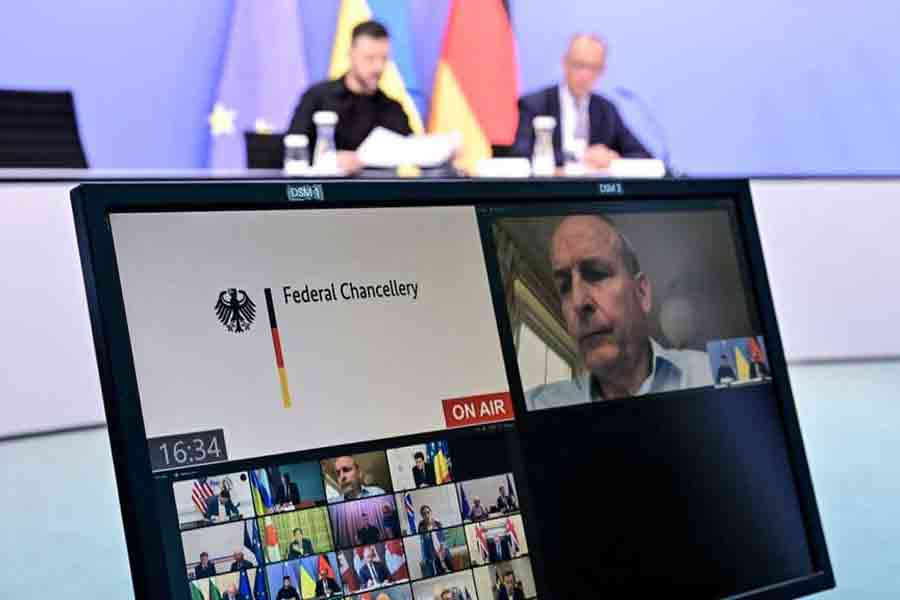
Ukrainian President Volodymyr Zelensky (back L) and German Chancellor Friedrich Merz (back R) attend a video conference of European and world leaders on the Ukraine war, ahead of the summit between US President Trump and Russian President Vladimir Putin, in Berlin, Germany, Aug 13, 2025. Photo : JOHN MACDOUGALL/Pool via REUTERS

German Chancellor Friedrich Merz said European leaders had laid out terms for a ceasefire in Ukraine that would protect their security interests in a call on Wednesday with US President Donald Trump.

European leaders including Ukrainian President Volodymyr Zelensky held the call with Trump in a bid to influence his meeting with Russian President Vladimir Putin in Alaska on Friday, the first US-Russia summit since 2021.

"We have made it clear that Ukraine must be at the table as soon as follow-up meetings take place," Merz said in at the joint press conference with Ukrainian President Volodymyr Zelensky.

"We want negotiations to proceed in the right order, with a ceasefire at the outset."

Merz, who initiated the meeting with Trump, said that Ukraine was prepared to negotiate on territorial issues, but "legal recognition of Russian occupation is not up for debate".

The country would need "robust security guarantees", he said, although he did not detail what kind.

If there was no movement on the Russian side in Alaska, however, "then the United States and we Europeans should and must increase the pressure".

"President Trump is aware of this position and largely shares it," Merz said.

The chancellor noted that all conversations held with Putin since Russia's full-scale invasion of Ukraine three and a half years ago had each time been accompanied by an even Russian harsher military response.

If the same occurred this time, it would show conversations with Putin were neither credible nor successful.

"If the United States of America now work towards peace in Ukraine that safeguards European and Ukrainian interests, he can count on our full support in this endeavour," said Merz.​
 

A brief history of summits in our time

Syed Badrul Ahsan
Published :
Aug 13, 2025 22:30
Updated :
Aug 14, 2025 00:36

1755134583024.webp


Donald Trump and Vladimir Putin will be meeting in Alaska on Friday in what has been billed as a summit. And the summit will focus on the war between Ukraine and Russia that has been raging for more than three years. That is when a question comes up: Why has Ukraine's Volodymyr Zelensky not been invited to Alaska? If Trump's role is to act as a broker between Moscow and Kyiv, he could have done the diplomatic thing of bringing Putin and Zelensky together, in his presence.

But Trump has not done that, in the expectation that he can have the door opened to a bilateral meeting in the near future between the Presidents of Russia and Ukraine. That again raises the question of whether, given the bellicosity Putin and Zelensky have been demonstrating toward each other, a Moscow-Kyiv summit will at all take place without Washington being present on the scene.

In the not so distant past, American administrations carefully assisted parties in conflict to come together in a search for peace in such global regions as the Middle East. President Jimmy Carter brought Egypt's Anwar Sadat and Israel's Menachem Begin together in the 1970s. In the 1990s, it fell to President Bill Clinton to have Yasser Arafat, Yitzhak Rabin and Shimon Peres work out the details of a peace deal for their region.

Summits are serious affairs, different from official or state visits by heads of state or government. They involve either the leaders of two states tied to seemingly intractable conflicts or are moves by statesmen attempting to have leaders of nations engaged in conflict with one another, in that military sense of the meaning, speak to each other in the presence of their hosts.

But with Donald Trump, summitry has not quite been a serious affair. One need only go back to his much touted meetings with North Korea's Kim Jong-Un, summits which yielded little in terms of substance. Which raises the apprehension that the Alaska summit may not have much on offer. Much hype will be there, of course. But hype has never made a success of diplomacy.

When leaders of nations wary of each other meet, they do so with full preparation for the points they mean to articulate during their summit. The summit between President Richard Nixon and Mao Zedong/Zhou En-lai in February 1972 was a carefully organised coming together of leaders intellectually and diplomatically prepared to present their ideas before each other.

In similar fashion, the summits between Nixon and Soviet leader Leonid Brezhnev, beginning in 1972, were focused affairs, the agenda being the issue of a promotion of détente even as both Moscow and Washington were fully aware of the need to maintain their positions at the talks without jeopardising their national interests.

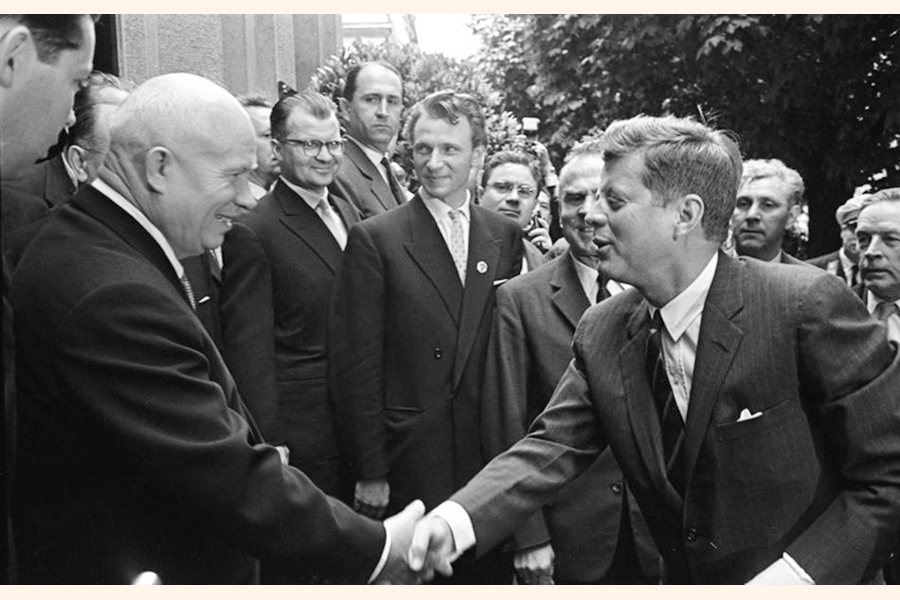
Summits are also occasions when leaders test each other, often to the point of trying to gauge one another's resilience in the face of hard negotiations. The experienced Nikita Khrushchev was clearly determined to subject the new US President John Kennedy to nervousness at their summit in Vienna in 1961. It was a meeting which had Kennedy rattled and the Soviet leader feeling rather triumphant in the feeling that he had bested the American leader. The summit achieved nothing, unless of course a deepening of the Cold War could be measured in terms of achievement.

Summitry by mediation, which ought to have been a thought with the Trump administration, was diplomacy the Soviet Union deployed in bringing the leaders of India and Pakistan to Tashkent for peace talks in the aftermath of the September 1965 war between their two countries. Alexei Kosygin carefully orchestrated the occasion, to the point of ensuring that President Ayub Khan and Prime Minister Lal Bahadur Shastri made their entry to the summit hall through different doors but at the same time. Premier Kosygin and Foreign Minister Andrei Gromyko were rewarded for their diligence when Ayub and Shastri initialled the Tashkent Declaration in January 1966.

But third party mediation was not required the next time India and Pakistan went to war, this time over Bangladesh, in December 1971. The summit in Simla in July 1972 was a bilateral arrangement arrived at by Prime Minister Indira Gandhi and President Zulfikar Ali Bhutto. It resulted in the Simla Agreement, which was purely a statement defining the future course of ties between the two countries. Given that Pakistan's eastern wing had seven months earlier broken away to become the independent nation of Bangladesh, the Simla Agreement stayed clear of any statement on it.

Not until June 1974 did Bangladesh and Pakistan engage in summitry when Bhutto visited Dhaka at the head of an 80-member delegation. The negotiations, with Bangabandhu Sheikh Mujibur Rahman leading the Bangladesh delegation, produced no result. No agreement was reached on a sharing of the assets and liabilities of pre-1971 Pakistan as well as the repatriation to Pakistan of Biharis stranded in Bangladesh. No joint statement or joint communique was issued at the end of the summit. It was a pointer to the long road the two countries would need to travel before the bitterness engendered between them in 1971 could be replaced by normal ties.

There are moments when summits, before they actually take place, project all the signs of drama. In the weeks before new Soviet leader Mikhail Gorbachev and US President Ronald Reagan met in Geneva in late 1985, the media in the West busied themselves in predictions of how Reagan would deal with a relatively young and agile Gorbachev. In the end, the summit went off well and in subsequent years the two leaders got along very well with each other. Both Gorbachev and Reagan needed to deal with knotty issues of the Cold War. They did the job with noticeable finesse.

Some summits leave a lasting impact on succeeding generations. During the Second World War, the summits attended by Franklin Roosevelt, Josef Stalin and Winston Churchill in Tehran and Yalta, followed by the summit in Potsdam which Roosevelt's successor Harry Truman attended were to prove instrumental in a reshaping of the world following the collapse of Nazi Germany, Fascist Italy and Imperial Japan.

Summits abjure theatrics. They are not for leaders unprepared on issues which need thrashing out at the table. They are not about Presidents and Prime Ministers driven by a desire to play to the gallery or impress the public. All of this leaves one wondering about the Trump-Putin summit in Alaska, about its results or, in a worst case scenario, about its being a sad waste of time.

Putin knows what he wants. History informs us that Trump is not in the league of Kennedy or Nixon or Carter or Clinton, for diplomacy is an area he has not mastered.​
 

Trump wants Ukraine to have say on territory talks with Russia, Macron says

REUTERS
Published :
Aug 13, 2025 22:03
Updated :
Aug 13, 2025 22:03

1755136605721.webp

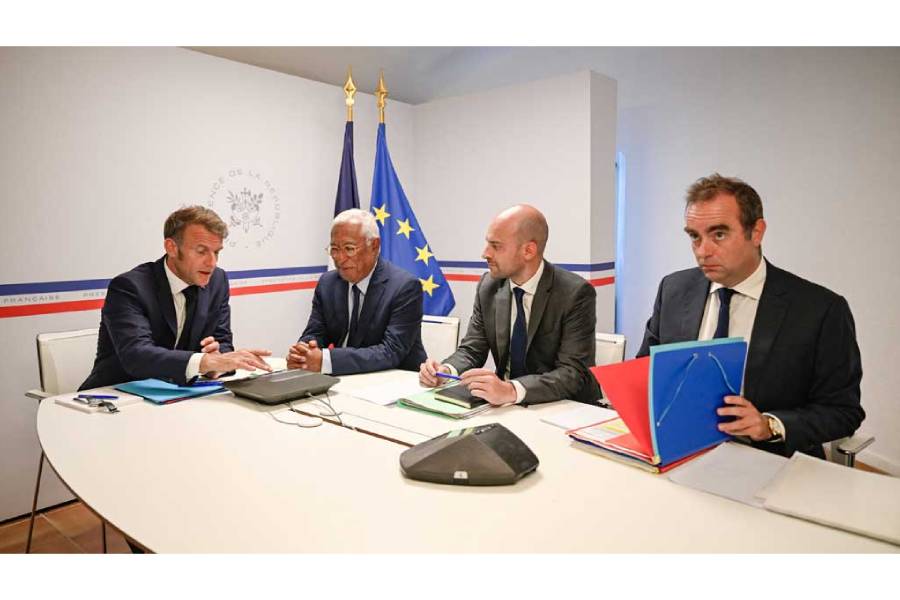
French President Emmanuel Macron, Antonio Costa, President of the European Council, French Minister for Europe and Foreign Affairs Jean-Noel Barrot, and France's Minister of Armed Forces Sebastien Lecornu attend a video conference with US President Donald Trump, Ukrainian President Volodymyr Zelensky and European Union leaders about the upcoming Trump-Putin meeting on Ukraine, at Fort de Bregancon in Bormes-les-Mimosas, France, Aug 13 2025. Photo : PHILIPPE MAGONI / POOL/Pool via REUTERS

US President Donald Trump has said Ukraine must be involved in talks about land in any truce deal with Russia, French President Emmanuel Macron said on Wednesday, suggesting Kyiv and its European allies had got their message across before a superpower summit.

The comments were among the first indications of what came out of talks between Trump, European leaders and Ukrainian President Volodymyr Zelensky, intended to influence Trump as he prepares to meet Russian President Vladimir Putin in Alaska on Friday.

Trump’s insistence on involving Ukraine, if confirmed, could bring a measure of relief to Ukraine and its allies, who have feared that Trump and Putin could reach a deal that sells out Europe’s and Ukraine’s security interests and proposes to carve up Ukrainian territory.

Trump and Putin are due to discuss how to end the three-and-a-half-year-old conflict, the biggest in Europe since World War Two. Trump has said both sides will have to swap land to end fighting that has cost tens of thousands of lives and displaced millions.

On a day of intense diplomacy, Zelensky flew into Berlin for German-hosted virtual meetings with European leaders and then with Trump.

The Europeans worry that a land swap could leave Russia with almost a fifth of Ukraine, rewarding it for almost 11 years of efforts to seize Ukrainian territory, and embolden Putin to expand further west into the future.

“The second point on which things were very clear, as expressed by President Trump, is that territories belonging to Ukraine cannot be negotiated and will only be negotiated by the Ukrainian president,” Macron said.

“There are currently no serious territorial exchange schemes on the table.”

German Chancellor Friedrich Merz said Trump would prioritise reaching a ceasefire on Friday, adding that there was no question of legally recognising Russia’s territorial holdings.

Zelensky said there should be a three-way meeting between himself, Putin and Trump.

Merz said Ukraine was prepared to negotiate on territorial issues, but “legal recognition of Russian occupation is not up for debate”.

“If the United States of America now works towards a peace in Ukraine that safeguards European and Ukrainian interests, he can count on our full support in this endeavour,” Merz said at a joint press conference with Zelensky.​
 

End the war or face ‘very severe consequences’
Trump tells Putin ahead of Alaska meet
1755139947002.webp


US President Donald Trump yesterday threatened Russian counterpart Vladimir Putin with "very severe consequences" if he does not agree to end the war in Ukraine during their upcoming summit in Alaska.

Asked if Russia would face repercussions if Putin does not agree to end the conflict, Trump told reporters, "Yes, they will."

"They will face very serious consequences," he said during remarks at the Kennedy Center in Washington, DC.

The remarks came just hours after Trump took part in a virtual meeting with Ukrainian President Volodymyr Zelenskyy and other European leaders, which the US president said was "very good."

"I would rate it a 10, you know, very, very friendly," he said.

The comments come as the president prepares to sit down with Putin for the first time in his second term.

Trump said the face-to-face summit, slated to take place in Alaska's most populous city of Anchorage, is likely to result in the establishment of a trilateral summit with Putin, Zelenskyy and himself.

"There's a very good chance that we're going to have a second meeting, which will be more productive than the first, because the first is, I'm going to find out where we are and what we're doing," he said.

"If the first one goes okay, we'll have a quick second one. I would like to do it almost immediately, and we'll have a quick second meeting between President Putin and President Zelenskyy and myself, if they'd like to have it," he said.

Trump said that while "certain great things" can be achieved during Friday's summit it is largely geared toward "setting the table" for a follow-up trilateral, which he acknowledged may not be in the offing.

"There may be no second meeting because if I feel that it's not appropriate to have it because I didn't get the answers that we have to have, then we're not going to have a second meeting," he said.

The US leader promised dozens of times during his 2024 election campaign to end the conflict on his first day in office but has made scant progress towards securing a peace deal.

He threatened "secondary sanctions" on Russia's trading partners over its invasion of Ukraine but his deadline for action came and went last week with no measures announced.

According to an AFP analysis of battlefield data from the US-based Institute for the Study of War, Russian forces made their biggest 24-hour advance into Ukraine in more than a year on Tuesday.

As the war rages on in eastern Ukraine, Zelensky flew to Berlin and joined Chancellor Friedrich Merz on an online call with other European leaders and the NATO and EU chiefs, in which they talked to Trump and urged a united stance against Russia.

Zelensky voiced doubt about Moscow's intentions and said: "I have told my colleagues -- the US president and our European friends -- that Putin definitely does not want peace."

Trump on Monday played down the possibility of a breakthrough in Alaska but said he expected "constructive conversations" with Putin.

"This is really a feel-out meeting a little bit," Trump said. But he added that eventually "there'll be some swapping, there'll be some changes in land".​
 

Putin, Trump to discuss 'huge' economic potential as well as Ukraine war, Kremlin says

REUTERS
Published :
Aug 14, 2025 16:58
Updated :
Aug 14, 2025 16:58

1755218971531.webp

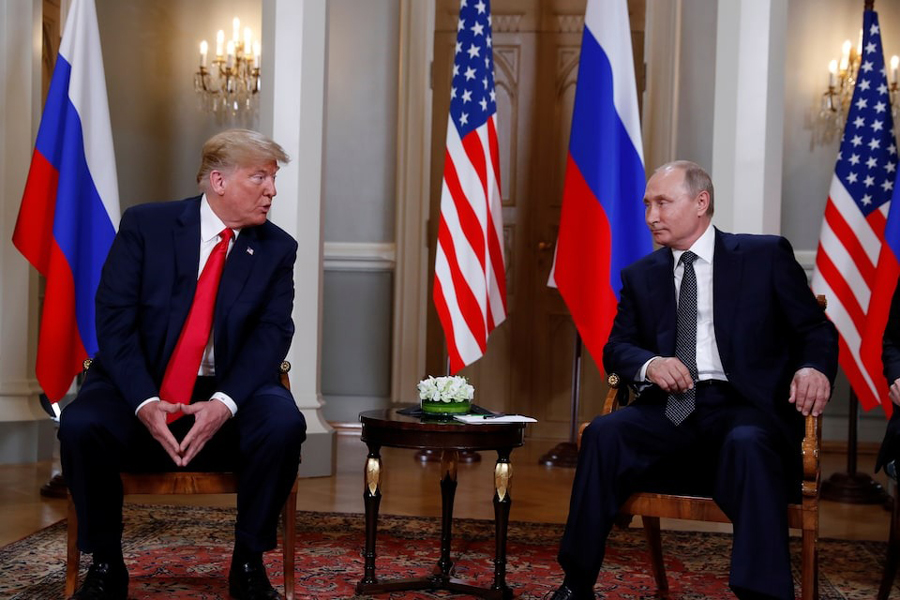
US President Donald Trump meets with Russia's President Vladimir Putin in Helsinki, Finland, July 16, 2018. Photo : REUTERS/Kevin Lamarque/Files

Presidents Vladimir Putin and Donald Trump will discuss the "huge untapped potential" for Russia-US economic ties as well as the prospects for ending the war in Ukraine when they meet in Alaska on Friday, Kremlin aide Yuri Ushakov said.

Ushakov told reporters that the summit would start at 1930 GMT, with the two leaders meeting one-on-one, accompanied only by translators.

He said delegations from the two countries would then meet and have a working lunch, and the presidents would give a joint news conference.

Trump and Putin agreed last week to hold the meeting - the first summit between their countries since Putin met Joe Biden in June 2021 - as the US president presses for an end to the 3-1/2-year-old war in Ukraine.

Ushakov said it was "obvious to everyone" that Ukraine would be the focus of the meeting, but broader security and international issues would also be discussed.

He added: "An exchange of views is expected on further developing bilateral cooperation, including in the trade and economic sphere. I would like to note that this cooperation has huge, and unfortunately hitherto untapped, potential."

Ushakov, who is Putin's foreign policy adviser, said the other members of the Russian delegation would be Foreign Minister Sergei Lavrov, Defence Minister Andrei Belousov, Finance Minister Anton Siluanov and Kirill Dmitriev, Putin's special envoy for investment and economic cooperation.​
 

Russia, Ukraine exchange 84 prisoners each
AFP Moscow
Published: 14 Aug 2025, 20: 03

1755222721970.webp

In this handout photograph taken and released by the Coordination Headquarters for the Treatment of Prisoners of War on 14 August, 2025, Ukrainian prisoners of war (POWs), wrapped with Ukrainian national flags, pose for a photo following an exchange at an undisclosed location, amid the Russian invasion in Ukraine. AFP

Russia and Ukraine exchanged 84 prisoners each on Thursday, both sides said, the latest in a series of swaps that has seen hundreds of POWs released so far this year.

This latest one came on the eve of a high-level summit between Russian President Vladimir Putin and US counterpart Donald Trump in Alaska on Friday.

The Russian defence ministry said on Telegram that the United Arab Emirates had mediated the exchange and that the released Russian personnel were receiving "psychological and medical assistance".

Ukrainian President Volodymyr Zelensky said on social media that among the exchanged prisoners were "both military personnel and civilians," some of whom had been "held by the Russians since 2014, 2016, and 2017".

He said "defenders of Mariupol" were also part of the swap, referring to a Ukrainian port city that fell to Russian forces in 2022 following a nearly three-month siege.

Zelensky shared pictures of Ukrainian soldiers, smiling and draped in blue-and-yellow national flags. He said "there will be more exchanges" of prisoners.

Large-scale prisoner exchanges were the only tangible result of three rounds of peace talks between Russian and Ukrainian delegations in Istanbul between May and July.

In their latest round of talks last month, Russia and Ukraine agreed to exchange 1,200 prisoners of war each.

A Russian negotiator said that Moscow had also offered to hand Kyiv the bodies of 3,000 killed soldiers.​
 

Zelensky, Trump meet at White House for high-stakes Ukraine meeting

bdnews24.com
Published :
Aug 19, 2025 01:00
Updated :
Aug 19, 2025 01:00

1755559602092.webp

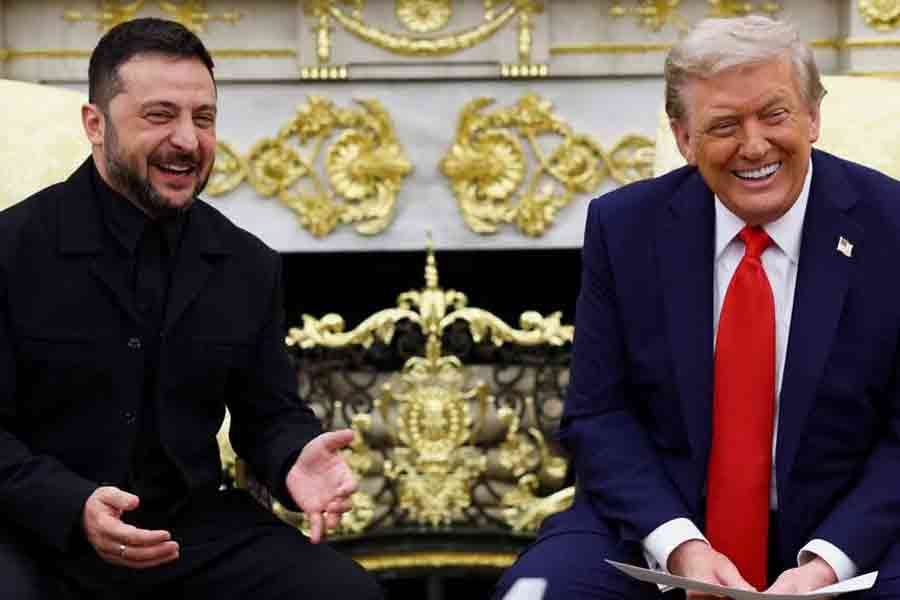
US President Donald Trump and Ukrainian President Volodymyr Zelensky laugh as they meet at the Oval Office of the White House, amid negotiations to end the Russian war in Ukraine, in Washington, DC, US, Aug 18, 2025. Photo : REUTERS/Kevin Lamarque

US President Donald Trump said on Monday that the United States would "help out" Europe in providing security for Ukraine as part of any deal to end Russia's war in Ukraine, as he and President Volodymyr Zelensky began a hastily arranged White House meeting to discuss a path to peace.

Speaking to reporters in the Oval Office with Zelensky seated beside him, Trump also expressed hope that Monday's summit could eventually lead to a trilateral meeting with Russian President Vladimir Putin, adding that he believes Putin wants the war to end.

Zelensky and a group of European leaders arrived in Washington facing increased pressure from Trump to reach a resolution to end the war on terms more favorable to Moscow, after Trump and Putin met in Alaska on Friday for nearly three hours.

"We need to stop this war, to stop Russia and we need support - American and European partners," Zelensky told reporters.

Trump greeted Zelenskiy outside the White House, shaking his hand and expressing delight at Zelensky's black suit, a departure from his typical military clothes. When a reporter asked Trump what his message was to the people of Ukraine, he said twice, "We love them."

Zelensky thanked him, and Trump put his hand on Zelensky's back in a show of affection before the two men went inside to the Oval Office, where their last meeting in February ended in disaster after Trump dressed Zelenskiy down in front of television cameras.

This time, the leaders of Britain, Germany, France, Italy, Finland, the European Union and NATO joined Zelensky to demonstrate solidarity with Ukraine and push for strong security guarantees in any post-war settlement.

Trump is pressing for a quick end to Europe's deadliest war in 80 years, and Kyiv and its allies worry he could seek to force an agreement on Russia's terms after the president on Friday in Alaska rolled out the red carpet - literally - for Putin, who faces an arrest warrant from the International Criminal Court for war crimes.

The European leaders will meet with Trump afterwards in the White House's East Room at 3pm EDT (1900 GMT), according to the White House. Such a high-level gathering at the White House on such short notice appears to be unprecedented in recent times.

Russian attacks overnight on Ukrainian cities killed at least 10 people, in what Zelenskiy called a "cynical" effort to undermine talks.

Trump has rejected accusations that the Alaska summit had been a win for Putin, who has faced diplomatic isolation since Russia's invasion of Ukraine in 2022.

"I know exactly what I'm doing, and I don't need the advice of people who have been working on all of these conflicts for years, and were never able to do a thing to stop them," Trump wrote on social media.

Trump's team has said there will have to be compromises on both sides to end the conflict. But the president himself has put the burden on Zelensky to end the war, saying Ukraine should give up hopes of getting back Crimea, annexed by Russia in 2014, or of joining the NATO military alliance.

Zelensky "can end the war with Russia almost immediately, if he wants to, or he can continue to fight," Trump said on social media.

PUTIN'S PROPOSALS

Zelensky has already all but rejected the outline of Putin's proposals from the Alaska meeting. Those include handing over the remaining quarter of its eastern Donetsk region, which is largely controlled by Russia. Ukrainian forces are deeply dug into the region, whose towns and hills serve as a crucial defensive zone to stymie Russian attacks.

Any concession of Ukrainian territory would have to be approved by a referendum.

Zelensky is also seeking an immediate ceasefire to conduct deeper peace talks, a position that his European allies have also backed. Trump previously favored that idea but reversed course after the summit with Putin, instead indicating support for Russia's preference to negotiate a comprehensive deal while fighting rumbles on.

Ukraine and its allies have taken heart from some developments, including Trump's apparent willingness to provide post-settlement security guarantees for Ukraine. A German government spokesperson said on Monday that European leaders would seek more details on that in the talks in Washington.

The war, which began with a full-scale invasion by Russia in Feb 2022, has killed or wounded more than a million people from both sides, including thousands of mostly Ukrainian civilians, according to analysts, and destroyed wide swaths of the country.

Russia has been slowly grinding forward on the battlefield, pressing its advantages in men and firepower. Putin says he is ready to continue fighting until his military objectives are achieved.

Officials in Ukraine said a drone attack on a residential complex in the northern city of Kharkiv killed at least seven people, including a toddler and her 16-year-old brother. Strikes in the southeastern city of Zaporizhzhia killed three people, they said.

Russia says it does not deliberately target civilians, and the Defense Ministry's daily report did not refer to any strike on Kharkiv.

Local resident Olena Yakusheva said the attack hit an apartment block that was home to many families. "There are no offices here or anything else, we lived here peacefully in our homes," she said.

Ukraine's military said on Monday that its drones had struck an oil pumping station in Russia's Tambov region, leading to the suspension of supplies via the Druzhba pipeline.​
 

Trump tells Ukraine to give up on NATO, Crimea, ahead of Zelenskiy meeting
Reuters Kyiv
Updated: 18 Aug 2025, 18: 01

1755562357273.webp

Volodymyr Zelensky and Donald Trump AFP file photo

US President Donald Trump told Ukraine to give up hopes of getting back annexed Crimea or joining NATO as he prepared to host President Volodymyr Zelenskiy and European leaders in Washington on Monday to press Kyiv into accepting a peace deal with Russia.

After rolling out the red carpet for Russian President Vladimir Putin in Alaska on Friday, Trump is leaning on Ukraine to accept a deal to end Europe's deadliest war in 80 years, which has killed tens of thousands and displaced millions.

Trump will meet first Zelenskiy and then the leaders of Britain, Germany, France, Italy, Finland, the European Union and NATO, the White House said. The European leaders are flying to Washington to show solidarity with Ukraine and to press for strong security guarantees in any post-war settlement.

Trump's team stressed on Sunday that there had to be compromises on both sides. But Trump put the burden on Zelenskiy to end the war that Russia began with its full-scale invasion in February 2022. That, along with his comments on NATO and Crimea, annexed by Russia in 2014 during Barack Obama's presidency, suggested he would press Zelenskiy hard at Monday's meeting.

Zelenskiy "can end the war with Russia almost immediately, if he wants to, or he can continue to fight," Trump said on Truth Social. "Remember how it started. No getting back Obama given Crimea (12 years ago, without a shot being fired!), and NO GOING INTO NATO BY UKRAINE."

Ukraine and its allies have long feared that Trump could press an agreement favourable to Moscow. However they have taken heart from some developments, including Trump's apparent willingness to provide post-settlement security guarantees for Ukraine.

However, Zelenskiy has already all but rejected the outline of Putin's proposals from the Alaska meeting, including for Ukraine to give up the rest of its eastern Donetsk region, of which it currently controls a quarter.

Zelenskiy is also seeking an immediate ceasefire to conduct deeper peace talks. Trump previously backed that but reversed course after the summit with Putin and indicated support for Russia's favoured approach of negotiating a comprehensive deal while fighting rumbles on.

Trump will meet first with Zelenskiy at 1:15 p.m. EDT (1715 GMT) in the Oval Office and then with all the European leaders together in the White House's East Room at 3 p.m. EDT (1900 GMT), the White House said.

The Ukrainian president, seeking to avoid a repeat of the bad-tempered Oval Office meeting he had with Trump in February, said after arriving in Washington late on Sunday he was grateful to Trump for the invitation.

"We all equally want to end this war swiftly and reliably," Zelenskiy said on the Telegram messaging app. "Russia must end this war — the war it started. And I hope that our shared strength with America and with our European friends will compel Russia to real peace."

Russia launched missiles and drones in overnight attacks that included strikes on Ukraine's second largest city Kharkiv, near the Russian border, which killed seven people, including two children, officials said.

"They hit an ordinary apartment block, many flats, many families were living here, small children, children's playground, residential compound, there are no offices here or anything else, we lived here peacefully in our homes," said Olena Yakusheva, a local resident, as firefighters battled a blaze in the building and rescue workers dug in the rubble.

On the battlefield Russia has been slowly grinding forward, pressing home its advantages in men and firepower. Putin says he is ready to continue fighting until his military objectives are achieved.

Russian peace proposal

The outline of Putin's proposals, reported by Reuters earlier, appears impossible for Zelenskiy to accept. Ukrainian forces are deeply dug into the Donetsk region, whose towns and hills serve as a crucial defensive zone to stymie Russian attacks.

Concerned that they would be shut out of the conversation after a summit with Putin to which they were not invited, European leaders held a call with Zelenskiy on Sunday to align on a common strategy for the meetings with Trump.

"It's important for the Europeans to be there: (Trump) respects them, he behaves differently in their presence," Oleksandr Merezhko, a Ukrainian lawmaker from Zelenskiy's ruling party, told Reuters.

"D-Day at the White House" said Britain's Daily Mail, while the Daily Mirror said "Europe takes a stand" in its front page headline. Germany's Die Welt called it the "moment of truth" for the U.S. president.

"It is probably not an exaggeration to say the whole world is looking to Washington," Germany's Foreign Minister Johann Wadephul said at a press briefing.

Relations between Kyiv and Washington, once extremely close, have been rocky since Trump returned to the White House in January.

However, Ukraine's pressing need for U.S. weapons and intelligence sharing, some of which have no viable alternative, has forced Zelenskiy and his allies to work with Trump.​
 

Latest Posts

Back