☕ Support Us
Wars - 2023 10/08 Monitoring the Israel and Lebanon War | Page 7 | PKDefense

Wars 2023 10/08 Monitoring the Israel and Lebanon War

Reply (Scroll)
Press space to scroll through posts
G War Archive
Wars 2023 10/08 Monitoring the Israel and Lebanon War
187
7K
More threads by Saif

One thing is for sure doc…..Semitic religion is a done deal bhai.

Sub khatam!

We need to be very careful about this unfolding drama in our country or we’re going to Balkanize in short order.

Without Islam we’re not going to survive and you know it.

Our establishment is still secular and they promote this culture of religion because the alternative is Balkanization bhai.

It’s the same in most other Muslim countries and I’m telling you if it’s not promoted then theys goin be gone within a few weeks or months.

I wonder if the US is talking to Iran behind the scenes on the situ.

Iran hasn’t lost anything yet…..the war is on like donkey Kong…..no problem there, but I know that I’ve yet to meet a religious Irani person.

At their core, they’re still Zartosht…I see it. I know lots of em…..totally secular bhai, but they can’t drop the act, or the millions of proxies will all get disillusioned.

Good luck finding millions willing to give their lives for you then.

You need to understand the situation Irans always in.

If you pledge allegiance…..they’ll back you. Don’t matter your religion. It’s just been like this for almost 3 millennia.

Iran chhorray ga nahi Israel ko ab, cuz now it’s a matter of honor.

Very good points bhai.
 

Lebanon urges DNA tests to identify missing in Israel strikes

1727742144158.png

Photo: AFP

Lebanese authorities on Monday urged the families of people who went missing in Israeli strikes to conduct DNA tests at specialised centres to identify the remains of loved ones.

"To help families of those who went missing following the Israeli aggression on Lebanon and to make the process of identifying victims and their remains smoother," families should head to centres affiliated with the Judicial Police "to conduct DNA tests", the police said in a statement.

For the past week, Israel has heavily bombed the country's east, south and southern Beirut suburbs, killing hundreds of people and displacing up to one million.

The escalation comes on the heels of nearly one year of cross-border fire with Israel that Hezbollah says is in support of ally Hamas, whose October 7 attack on Israel triggered war in Gaza.

On Friday, Israel killed Hezbollah leader Hassan Nasrallah in Beirut's southern suburbs -- a strike Lebanon said killed six people, without identifying them.

On Saturday, Health Minister Firas Abiad said bodies and body parts were still under the rubble.

Social media users have called for help finding missing relatives, while an AFP correspondent in southern Lebanon reported hospital morgues were filled with unidentified remains.

Since mid-September, Israeli strikes on across Lebanon have killed more than 1,000 people, authorities said.​
 

Hezbollah vows to keep fighting Israel after Nasrallah killing
Agence France-Presse . Beirut 30 September, 2024, 23:37

1727745750661.png

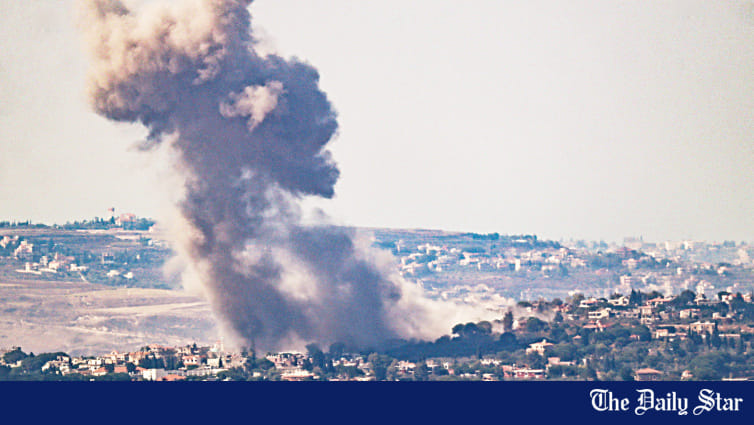
Smoke rises from the site of an Israeli airstrike that targeted the southern Lebanese village of Khiam on Monday. | AFP photo

Hezbollah vowed on Monday to keep fighting Israel and said it was ready to face any ground operation into Lebanon, after its leader was killed in an air strike that dealt the group a seismic blow.

Meanwhile, Hamas says the leader of its Lebanese group has been killed by Israeli air strikes in southern Lebanon, reports BBConline.

In a televised address, the Iran-backed group’s deputy chief Naim Qassem said a new leader to replace Hassan Nasrallah, who enjoyed cult status among his supporters, would be selected ‘at the earliest opportunity’.

He also said the group was ready for any Israeli ground offensive, even though Israel’s bombardment of its strongholds has in the past week killed a large number of its top commanders and officials.

Hezbollah began low-intensity cross-border strikes on Israeli troops a day after its Palestinian ally Hamas staged its unprecedented attack on Israel on October 7, triggering war in the Gaza Strip.

Israel said earlier this month that it was shifting its focus from Gaza to securing its northern border with Lebanon, in order to allow Israelis displaced since October to return to their homes.

It has also not ruled out a ground offensive in order to achieve its goals.

Israel’s strikes on Lebanon have killed hundreds and forced hundreds of thousands more to flee their homes, and left people across the region fearful of more violence to come.

Qassem said Hezbollah would continue ‘confronting the Israeli enemy in support of Gaza and Palestine, in defence of Lebanon and its people, and in response to the assassinations and the killing of civilians’.

Warning that any battle with Israel would be long, he said: ‘We will face any scenario and we are ready if Israel decides to enter by land, the resistance forces are ready for any ground confrontation.’

On the other side of the border, Israel’s defence minister Yoav Gallant told troops: ‘The elimination of Nasrallah is an important step, but it is not the final one.’

‘In order to ensure the return of Israel’s northern communities, we will employ all of our capabilities, and this includes you,’ he said.

Most of Israel’s strikes have targeted Hezbollah strongholds in eastern and southern Lebanon and the southern suburbs of Beirut, the group’s main bastion.

On Monday, a drone strike hit a building in the Cola district in central Beirut, with an armed Palestinian group saying it had killed three of its members.

The strike, the first in the centre of the city in years, sparked panic, with 41-year-old resident Mohammed al-Hoss saying ‘the kids were in shock’ after his house was damaged.

‘We are with Gaza and support the Palestinian cause, but our country cannot cope with us going to war,’ he said.

‘Our country is in a wretched state. They (Israel) finished with Gaza and they have come to Lebanon.’

Lebanon’s health ministry also reported the strike, saying it had killed four people and wounded four others. Israel has yet to comment.

Palestinian Islamist group Hamas later announced that its leader in Lebanon, Fatah Sharif Abu al-Amine, had been killed along with his wife and two children in another strike on Al-Bass refugee camp in south Lebanon.

The Israeli military confirmed it had ‘eliminated’ Sharif in a strike.

Lebanon’s health ministry said six rescuers affiliated with Hezbollah were killed in an Israeli strike Monday.

Around Lebanon, Israeli strikes killed more than 100 people on Sunday, including 45 near the southern city of Sidon, according to the ministry.

Lebanon’s health minister Firass Abiad said Saturday that 1,030 people including 87 children had been killed since September 16.

UN refugee agency chief Filippo Grandi said ‘well over 2,00,000 people are displaced inside Lebanon’, while more than 1,00,000 have fled to neighbouring Syria.

Prime minister Najib Mikati said up to one million people may have been uprooted, in potentially the ‘largest displacement movement’ in Lebanon’s history.

The violence in Lebanon has raised fears of a much wider conflagration in the region.

On Monday, the Israeli army said it ‘successfully intercepted a suspicious aerial target that crossed from Lebanon into Israeli territory’.

Israel said it also carried out strikes on Sunday targeting Iran-backed Huthis in Yemen that the rebels said killed four people and wounded 33.

The raids in Yemen came a day after the Huthis said they launched a missile at Israel’s Ben Gurion airport, trying to hit it as prime minister Benjamin Netanyahu was returning from New York.

Iran has said Nasrallah’s killing would bring about Israel’s ‘destruction’, though the foreign ministry said Monday it would not deploy any fighters to confront Israel.

Lebanon began a three-day national mourning period for Nasrallah on Monday, with flags flying at half-mast.

In Israel, some had mixed feelings about the Hezbollah chief’s killing.

‘Nasrallah was responsible for the deaths of many Israelis, so it is good news,’ said Matan Sofer, 24, in the northern town of Rosh Pina.

‘But do we risk it getting worse, who knows?’

World leaders have called for a de-escalation.

French foreign minister Jean-Noel Barrot met with the Lebanese premier in Beirut Monday, and said his government sought ‘an immediate halt’ in the strikes.

He is the first high-level foreign diplomat to visit since the Israeli strikes intensified.

US president Joe Biden, whose government is Israel’s top arms supplier, said Sunday a wider war ‘really has to be avoided’.

In Gaza, AFP journalists said the number of air strikes across the territory has dropped significantly in recent days.

Hamas’s unprecedented October 7 attack on Israel resulted in the deaths of 1,205 people, mostly civilians, according to an AFP tally based on Israeli official figures that include hostages killed in captivity.

Israel’s retaliatory military offensive has killed at least 41,615 people in Gaza, most of them civilians, according to figures provided by the Hamas-run territory’s health ministry. The UN has described the figures as reliable.​
 

Hezbollah says it is ready for any Israeli land invasion in Lebanon
REUTERS
Published :
Sep 30, 2024 17:09
Updated :
Sep 30, 2024 17:10

1727746967647.png

People inspect the damage at the site of Sunday's Israeli attack on the city of Ain Deleb, amid the ongoing hostilities between Hezbollah and Israeli forces, in southern Lebanon September 30, 2024. Photo : REUTERS/Aziz Taher

Hezbollah’s deputy leader Naim Qassem, in his first public address since Israel assassinated the group’s chief Hassan Nasrallah last week, said the movement is ready to confront any Israeli ground invasion of Lebanon.

Israel will not achieve its goals, he said.

“We will face any possibility and we are ready if the Israelis decide to enter by land and the resistance forces are ready for a ground engagement,” he said.

Israeli forces have dealt multiple blows to Hezbollah in a two-week wave of attacks on targets in Lebanon that has eliminated several commanders. The possibility that Israel’s next move might be to send ground troops and tanks over the border is on many minds.

In other developments, the Palestinian militant group Hamas said an Israeli airstrike killed its leader in Lebanon in the city of Tyre on Monday, and another Palestinian organisation said three of its leaders died in a strike in central Beirut - the first such hit inside the capital’s limits.

The killings were the latest in a wave of intensified Israeli attacks on militant targets in Lebanon, part of a conflict also stretching from the Palestinian territories of Gaza and the occupied West Bank, to Yemen, and within Israel itself.

Hamas said its leader in Lebanon, Fateh Sherif Abu el-Amin was killed along with his wife, son and daughter, in a strike that targeted their house in a refugee camp in the southern city of Tyre in the early hours of Monday.

Another group, the Popular Front for the Liberation of Palestine (PFLP), said three of its leaders were killed in a strike that targeted Beirut’s Kola district.

This was the first time Israel had struck Beirut beyond its southern suburbs in a campaign which culminated in the assassination of Hezbollah’s veteran leader Hassan Nasrallah last week in a succession of heavy air strikes.

The strike against the PFLP hit the upper floor of an apartment building, Reuters witnesses said. There was no immediate comment from the Israeli military.

The latest attacks indicated Israel has no intention of slowing down its offensive on multiple fronts even after eliminating Nasrallah, who was Iran’s most powerful ally in its “Axis of Resistance” against Israeli and U.S. influence in the region.

Israel’s intensified attacks against the Iran-backed Hezbollah in Lebanon and Houthi forces in Yemen have prompted fears that Middle East fighting could spin out of control and draw in Iran and the United States, Israel’s main ally.

Iranian Foreign Ministry spokesperson Nasser Kanaani said Tehran would not leave any of Israel’s “criminal acts” go unanswered. He was referring to the killing of Nasrallah and an Iranian Guard deputy commander, Brigadier General Abbas Nilforoushan, who died in the same strikes on Friday.

Lebanon’s Health Ministry says more than 1,000 Lebanese have been killed and 6,000 wounded in the past two weeks, without specifying how many were civilians. One million people - a fifth of the population - have fled their homes, the government says.

The escalation has put Beirut on edge, with Lebanese fearful that Israel will expand its military campaign.

“There is nothing else to say or add, except God save Lebanon,” Beirut resident Nawel said. “What will happen to me is the same as what can happen to anyone.”​
 

UN chief calls for immediate ceasefire in Lebanon

1727829128503.png


United Nations Secretary-General Antonio Guterres appealed on Tuesday for an immediate ceasefire in Lebanon and for the sovereignty and territorial integrity of the country to be respected, UN spokesperson Stephane Dujarric said.

"An all-out war must be avoided in Lebanon at all costs," Dujarric said in a statement, adding that Guterres spoke with Lebanon's caretaker Prime Minister Najib Mikati earlier on Tuesday, telling him the UN was ready to help those in need.

"The Secretary-General will continue his contacts, and his representatives on the ground will also continue their efforts to de-escalate the situation," Dujarric said.

He later told reporters at a briefing that UN peacekeepers in Lebanon, known as UNIFIL, had seen sporadic incursions by the Israeli military.

"The information they have and they've received ... is that they've seen sporadic incursions by the IDF," Dujarric said. "They have not witnessed a full-scale invasion."​
 

Hezbollah vows to keep fighting Israel after Nasrallah killing
AFP
Beirut, Lebanon
Published: 30 Sep 2024, 20: 44

1727833228453.png

Mourners attend the funeral of slain Hezbollah Commander Ali Karaki, who was killed days earlier with other top commanders in an Israeli air strike, in Beirut’s southern suburbs on 30 September 2024 AFP

Hezbollah vowed on Monday to keep fighting Israel and said it was ready to face any ground operation into Lebanon, after its leader was killed in an air strike that dealt the group a seismic blow.

In a televised address, the Iran-backed group’s deputy chief Naim Qassem said a new leader to replace Hassan Nasrallah, who enjoyed cult status among his supporters, would be selected “at the earliest opportunity”.

He also said the group was ready for any Israeli ground offensive, even though Israel’s bombardment of its strongholds has in the past week killed a large number of its top commanders and officials.

Hezbollah began low-intensity cross-border strikes on Israeli troops a day after its Palestinian ally Hamas staged its unprecedented attack on Israel on 7 October, triggering war in the Gaza Strip.

Israel said earlier this month that it was shifting its focus from Gaza to securing its northern border with Lebanon, in order to allow Israelis displaced since October to return to their homes.

It has also not ruled out a ground offensive in order to achieve its goals.

Israel’s strikes on Lebanon have killed hundreds and forced hundreds of thousands more to flee their homes, and left people across the region fearful of more violence to come.

Qassem said Hezbollah would continue “confronting the Israeli enemy in support of Gaza and Palestine, in defence of Lebanon and its people, and in response to the assassinations and the killing of civilians”.

Warning that any battle with Israel would be long, he said: “We will face any scenario and we are ready if Israel decides to enter by land, the resistance forces are ready for any ground confrontation.”

On the other side of the border, Israel’s Defence Minister Yoav Gallant told troops: “The elimination of Nasrallah is an important step, but it is not the final one.”

“In order to ensure the return of Israel’s northern communities, we will employ all of our capabilities, and this includes you,” he said.

Beirut strike

Most of Israel’s strikes have targeted Hezbollah strongholds in eastern and southern Lebanon and the southern suburbs of Beirut, the group’s main bastion.

On Monday, a drone strike hit a building in the Cola district in central Beirut, with an armed Palestinian group saying it had killed three of its members.

The strike, the first in the centre of the city in years, sparked panic, with 41-year-old resident Mohammed al-Hoss saying “the kids were in shock” after his house was damaged.

“We are with Gaza and support the Palestinian cause, but our country cannot cope with us going to war,” he said.

“Our country is in a wretched state. They (Israel) finished with Gaza and they have come to Lebanon.”

Lebanon’s health ministry also reported the strike, saying it had killed four people and wounded four others. Israel has yet to comment.

Palestinian Islamist group Hamas later announced that its leader in Lebanon, Fatah Sharif Abu al-Amine, had been killed along with his wife and two children in another strike on Al-Bass refugee camp in south Lebanon.

The Israeli military confirmed it had “eliminated” Sharif in a strike.

Lebanon’s health ministry said six rescuers affiliated with Hezbollah were killed in an Israeli strike Monday.

Around Lebanon, Israeli strikes killed more than 100 people on Sunday, including 45 near the southern city of Sidon, according to the ministry.

Lebanon’s Health Minister Firass Abiad said Saturday that 1,030 people including 87 children had been killed since 16 September.

UN refugee agency chief Filippo Grandi said “well over 200,000 people are displaced inside Lebanon”, while more than 100,000 have fled to neighbouring Syria.

Prime Minister Najib Mikati said up to one million people may have been uprooted, in potentially the “largest displacement movement” in Lebanon’s history.

Yemen strikes

The violence in Lebanon has raised fears of a much wider conflagration in the region.

On Monday, the Israeli army said it “successfully intercepted a suspicious aerial target that crossed from Lebanon into Israeli territory”.

Israel said it also carried out strikes on Sunday targeting Iran-backed Huthis in Yemen that the rebels said killed four people and wounded 33.

The raids in Yemen came a day after the Huthis said they launched a missile at Israel’s Ben Gurion airport, trying to hit it as Prime Minister Benjamin Netanyahu was returning from New York.

Iran has said Nasrallah’s killing would bring about Israel’s “destruction”, though the foreign ministry said Monday it would not deploy any fighters to confront Israel.

Lebanon began a three-day national mourning period for Nasrallah on Monday, with flags flying at half-mast.

In Israel, some had mixed feelings about the Hezbollah chief’s killing.

“Nasrallah was responsible for the deaths of many Israelis, so it is good news,” said Matan Sofer, 24, in the northern town of Rosh Pina.

“But do we risk it getting worse, who knows?”

Calls for halt

World leaders have called for a de-escalation.

French Foreign Minister Jean-Noel Barrot met with the Lebanese premier in Beirut Monday, and said his government sought “an immediate halt” in the strikes.

He is the first high-level foreign diplomat to visit since the Israeli strikes intensified.

US President Joe Biden, whose government is Israel’s top arms supplier, said Sunday a wider war “really has to be avoided”.

In Gaza, AFP journalists said the number of air strikes across the territory has dropped significantly in recent days.

Hamas’s unprecedented 7 October attack on Israel resulted in the deaths of 1,205 people, mostly civilians, according to an AFP tally based on Israeli official figures that include hostages killed in captivity.

Israel’s retaliatory military offensive has killed at least 41,615 people in Gaza, most of them civilians, according to figures provided by the Hamas-run territory’s health ministry. The UN has described the figures as reliable.​
 

Fierce clashes rage inside Lebanon
Israeli infantry, armoured units join ground ops; Hezbollah vows to push back invading forces

1727914606782.png

People walk on the rubble at the site of the Israeli airstrike that killed Lebanon's Hezbollah leader Sayyed Hassan Nasrallah on Friday, in Beirut's southern suburbs, Lebanon, September 29, 2024. Photo: Reuters/Ali Alloush

Hezbollah said its fighters were engaging Israeli forces inside Lebanon yesterday, reporting ground clashes for the first time since Israel began pushing into its northern neighbour in a campaign to hammer the Iran-backed armed group.

The Israeli military said regular infantry and armoured units were joining its ground operations in Lebanon, a day after Israel was attacked by Iran in a strike that raised fears the oil-producing Middle East could be engulfed in a wider conflict. Eight Israeli soldiers have been killed in the combat, the Israeli military said.

Iran said yesterday its missile attack - its biggest assault on Israel - was over barring further provocation, but Israel and the United States promised to hit back hard.

Hezbollah fighters clashed with Israeli troops in the border town of Maroun el-Ras and pushed back forces near other border towns. The Iran-backed group said it has destroyed three Merkava tanks with guided rockets. The group also fired rockets at military posts inside Israel.

Hezbollah's media chief Mohammad Afif said those battles were only "the first round" and that the group had enough fighters, weapons and ammunition to push back Israel.

Israel's addition of infantry and armoured troops from the 36th Division, including the Golani Brigade, the 188th Armoured Brigade and 6th Infantry Brigade suggests that the operation may move beyond limited commando raids.

Israel also renewed its bombardment of Beirut's southern suburbs, a stronghold of the Iran-backed group, with more than a dozen airstrikes against what it said were targets belonging to Hezbollah.

The aerial strikes killed 55 people and wounded 156 in 24 hours, the Lebanese health ministry said. In retaliation, Hezbollah targeted areas north of Israel's city of Haifa with a large missile salvo early yesterday.

More than 1,000 people in Lebanon have died since last week when Israel started attacking targets inside Lebanon.

Ibrahim Jafari, an advisor to the General Commander of Iran's Revolutionary Guards, said a cyber operation was launched along with the missile strikes which reached their targets. Yemen's Houthis also targeted military posts deep in Israel with three winged 'Quds 5' rockets.

Meanwhile, Israel's foreign minister said yesterday that he was barring UN Secretary-General Antonio Guterres from entering the country because he had not "unequivocally" condemned Iran's missile attack on Israel.

World leaders yesterday called on Iran and Israel to step back from the brink.

"The Chinese side calls on the international community, especially major influential powers, to truly play a constructive role and prevent the situation from further deteriorating," said a foreign ministry spokesman in a statement published online.

"This situation is developing by the most worrying scenario," Kremlin spokesman Dmitry Peskov said yesterday.

German Chancellor Olaf Scholz called on Iran and Hezbollah to immediately end their attacks on Israel and warned that Iran risks inflaming the entire region. Japan said it is deeply concerned by the situation.

Meanwhile, police in Denmark and Sweden yesterday said they were probing explosions and gunfire around Israeli embassies in their capitals which took place amid spiralling Middle East tensions.

In Denmark, police said three Swedish nationals had been arrested after two blasts, likely from hand grenades, in the "immediate proximity" of the Israeli embassy in Copenhagen early Wednesday.

Swedish police said the Israeli embassy in Stockholm had been targeted in a shooting on Tuesday just before 6:00 pm (1600 GMT).

No injuries were reported from the incidents.​
 

Israel, Hezbollah in deadly fighting on Lebanon border
Agence France-Presse . Beirut 03 October, 2024, 00:17

1727917775641.png

Demonstrators wave Palestinian, Iranian and Hezbollah flags during a rally in Tehran on Wednesday, a day after Iran fired a barrage of missiles at Israel. | AFP photo

Israeli forces battled Hezbollah militants in Lebanon on Wednesday, with Israel announcing the first death of a soldier since it launched cross-border raids.

Confirmation of the fighting in two border areas came hours after Iran launched its second-ever direct attack on Israel, prompting Israeli prime minister Benjamin Netanyahu to warn the Islamic republic would pay for its ‘big mistake’.

Hezbollah backer Iran in turn said it would launch an even bigger attack if Israel makes good on its pledge to hit back, defying calls to de-escalate in a war that has already cost more than 1,000 lives in Lebanon since last week.

Israel shifted its focus last month from the war in Gaza, which was sparked by the October 7 attacks by Iran-backed Hamas, to securing its northern border with Lebanon, where it is fighting Hezbollah.

A day after the Israeli military said its troops had started ‘targeted ground raids’ in southern Lebanon, it announced the first death of a soldier in combat across the border since the Israel-Hezbollah war erupted.

Israel kept up its bombardment of Hezbollah’s main bastion in south Beirut, where it dealt the militant group a seismic blow last week by killing its leader Hassan Nasrallah in a massive strike.

Hezbollah said it forced Israeli soldiers to withdraw after they attempted to enter a border village, and that its fighters were clashing with troops in another area. It said it also targeted an Israeli unit with an explosive device.

The Lebanese army said Israeli troops had staged two brief incursions before withdrawing, adding one of its soldiers had been wounded in an Israeli drone strike.

The Israeli military told residents to evacuate more than 20 areas in south Lebanon, a day after issuing a similar call.

It also said it was bombarding Hezbollah targets in Beirut, with a Lebanese security source saying Israel had hit the city’s southern suburbs repeatedly overnight.

AFP correspondents heard about 20 explosions coming from southern Beirut, and smoke billowed over the area.

Hours after Israel announced the start of ground operations in Lebanon, Iran fired what it said were 200 missiles including hypersonic weapons, sending frightened Israeli civilians into shelters.

Israel, which put the number of missiles at 180, intercepted most of them, while Israeli medics reported two people injured by shrapnel.

One of the missiles damaged a school building.

On Wednesday the Israeli military said several Iranian missiles fell inside air force bases without causing any damage.

In the occupied West Bank, a Palestinian was killed in the city of Jericho ‘when pieces of a rocket fell from the sky and hit him’, the city’s governor Hussein Hamayel said.

‘Iran made a big mistake tonight and will pay for it,’ Israeli prime minister Benjamin Netanyahu said.

‘Whoever attacks us, we attack them.’

Defence minister Yoav Gallant, who was at the command and control centre monitoring the interception of Iranian missiles, also vowed vengeance.

‘Iran has not learned a simple lesson — those who attack the state of Israel, pay a heavy price,’ he said in a statement.

Iran’s Islamic Revolutionary Guard Corps said the missiles were fired in response to Israel’s killing of Nasrallah, as well as the death of Hamas leader Ismail Haniyeh in a Tehran bombing in July.

The attack also sought to avenge Israel’s killing of leading Iranian commander Abbas Nilforoushan of the Quds Force, the Guards’ foreign operations arm.

Lebanon’s disaster management agency said 1,873 people have been killed since Israel and Hezbollah began trading cross-border fire after the Hamas attacks on Israel on October 7.

The spike in violence has forced hundreds of thousands more to flee their homes.

President Joe Biden said the United States was ‘fully supportive’ of Israel after the missile attack.

US defence secretary Lloyd Austin slammed an ‘outrageous act of aggression’ by Iran, while Biden’s National Security Advisor Jake Sullivan told reporters there would be ‘severe consequences’.

Iran’s armed forces chief of staff, Major General Mohammad Bagheri, threatened to fire ‘with bigger intensity’ if Israel makes good on its pledge to retaliate.

The conflict is now expected to escalate, with analyst Jordan Barkin saying: ‘This will not end well.’

‘Netanyahu has a long history of fighting back strongly and quickly when provoked. Restraint is not Mr. Netanyahu’s strong suit,’ he said.

James Demmin-De Lise, an analyst who writes for The Times of Israel newspaper, agreed.

‘I think we’ll see Israel launch decisive attacks against Iran. Likely with the hope of toppling the Islamic regime,’ he said.

But some Israelis expressed fatigue with the war, with Tel Aviv resident Liron Yori, 22, saying: ‘I feel very, very disappointed. I see where the war’s going and I don’t I don’t feel comfortable with it.’

In central Beirut, people were weary and afraid, though some Hezbollah supporters were defiant.

Youssef Amir, displaced from southern Lebanon, said: ‘I have lost my home and relatives in this war, but all of that is a sacrifice for Lebanon, for Hezbollah’.

The Iran strikes prompted widespread condemnation as well as renewed calls for the escalation in violence to stop.

UN chief Antonio Guterres slammed the ‘broadening conflict in the Middle East’ and renewed his calls for a ceasefire, but stopped short of explicitly condemning Iran.

That prompted Israel to declare Guterres ‘persona non grata’, with foreign minister Israel Katz saying he did not ‘deserve to step foot on Israeli soil’.

Hezbollah began low-intensity strikes on Israeli troops a day after Hamas staged its October 7 attack on Israel, which resulted in the deaths of 1,205 people in Israel, mostly civilians, according to an AFP tally based on Israeli official figures that include hostages killed in captivity.

Israel’s retaliatory military offensive has killed at least 41,689 people in Gaza, the majority of them civilians, according to figures provided by the Hamas-run territory’s health ministry. The UN has described the figures as reliable.

In Gaza, the civil defence agency said Israeli bombings killed 19 people on Tuesday.​
 

Israel says eight of its soldiers killed in clashes with Hezbollah in Lebanon
REUTERS
Published :
Oct 02, 2024 22:35
Updated :
Oct 02, 2024 22:35

1727918381251.png


Israel said on Wednesday eight of its soldiers were killed in combat in south Lebanon as its forces thrust into its northern neighbour in a campaign against the Hezbollah armed group.

The losses were the deadliest suffered by the Israeli military on the Lebanon front in the past year of border-area clashes between Israel and its Iranian-backed Lebanese foe.

Hezbollah said its fighters were engaging Israeli forces inside Lebanon on Wednesday, reporting ground clashes for the first time since Israeli forces pushed over the border. Hezbollah said it had destroyed three Israeli Merkava tanks with rockets near the border town of Maroun El Ras.

Israeli Prime Minister Benjamin Netanyahu, in a condolence video, said: "We are at the height of a difficult war against Iran's Axis of Evil, which wants to destroy us.

"This will not happen because we will stand together and with God's help, we will win together," he said.

The Israeli military said regular infantry and armoured units were joining its ground operations in Lebanon, a day after Iran fired more than 180 missiles into Israel, a barrage which raised concerns that the oil-producing Middle East could be caught up in a wider conflict.

Iran said on Wednesday its missile volley - its biggest ever assault on Israel - was over barring further provocation, but Israel and the United States promised to hit back hard.

A 38-year-old Palestinian from Gaza, the only known fatality in Iran's attack on Israel, was buried on Wednesday.

Sameh Khadr Hassan Al-Asali had been staying in a Palestinian security forces compound in the West Bank when he was killed by falling missile debris during Tuesday's attack, which Israel said was largely foiled by its air defence systems.

Hezbollah said it had repelled Israeli forces near several border towns and also fired rockets at military posts inside Israel.

The paramilitary group's media chief Mohammad Afif said those battles were only "the first round" and that Hezbollah had enough fighters, weapons and ammunition to push back Israel.

Israel's addition of infantry and armoured troops from the 36th Division, including the Golani Brigade, the 188th Armoured Brigade and 6th Infantry Brigade, suggested that the operation might expand beyond limited commando raids.

The military has said its incursion is largely aimed at destroying tunnels and other infrastructure on the border and there were no plans for a wider operation targeting the Lebanese capital Beirut to the north or major cities in the south.

Nevertheless, it issued new evacuation orders for around two dozen towns along the southern border, instructing inhabitants to head north of the Awali River, which flows east to west some 60 km (37 miles) north of the Israeli frontier.

BORDER CLASHES

Israel renewed its bombardment early on Wednesday of Beirut's southern suburbs, where Hezbollah has its headquarters, with more than a dozen airstrikes against what it said were targets belonging to Hezbollah.

Israel also carried out an airstrike on a residential building in the Mezzah suburb in the west of Syria's capital Damascus, killing three civilians and injuring three, Syrian state media reported on Wednesday. Israel has been carrying out strikes on Iran-linked targets in Syria for years.

More than 1,900 people have been killed and over 9,000 wounded in Lebanon in almost a year of cross-border fighting, with most of the deaths occurring in the past two weeks, according to Lebanese government statistics.

Caretaker Prime Minister Najib Mikati said that about 1.2 million Lebanese had been displaced by Israeli attacks.

Malika Joumaa, from Sudan, was forced to take shelter in Saint Joseph's church in Beirut after being forced from her house near Sidon in coastal south Lebanon with her husband and two children.

"It's good that the church offered its help. We were going to stay in the streets; where would we have gone? We were (sheltering) under the bridge, it is not safe. If we go back home, it is not safe, they are striking everywhere."

Iran described Tuesday's missile assault as a response to Israeli killings of militant leaders, including Hezbollah chief Hassan Nasrallah, attacks in Lebanon against the group and Israel's war against Palestinian Hamas militants in Gaza.

The general staff of Iran's armed forces said any Israeli response would be met with "vast destruction".

US news website Axios on Wednesday cited Israeli officials as saying Israel will launch a "significant retaliation" for Iran's attack within days that could strike oil production facilities inside Iran and other strategic sites.

On social media, Iranians were apprehensive about Israeli reprisals and said past wars, such as the eight-year conflict with Iraq in the 1980s that killed about one million people, would only bring more suffering.

FEARS OF FURTHER VIOLENCE

"The destruction of generations, young people being cannon fodder, the enrichment of generals and elites, and the empowerment of extremists? Leaders will not pay for dragging Iran into war," said Nima Mokhtarian, who works at an NGO.

Some Iranians believe their government had no choice but to send scores of missiles to Israel, but fear what will come next as Israel's military, the most powerful and advanced in the region, prepares to hit back.

"If there is a war, I'm just worried for my children," said an Iranian mother walking to work past a towering billboard in Tehran's Valiasr Square featuring a portrait of Nasrallah, who was Iran's strongest regional proxy.

Iran's missile strikes and Israeli operations in Lebanon have caused alarm around the world as Tehran's Middle East proxies - Hezbollah, Yemen's Houthis and armed groups in Iraq -- have shown no let-up in attacks in support of Hamas.​
 

Iran’s Khamenei warned Nasrallah of Israeli plot to kill him, sources say
REUTERS
Published :
Oct 02, 2024 21:32
Updated :
Oct 02, 2024 21:32

1727919042783.png

Students hold posters of Hassan Nasrallah, the assassinated chief of Lebanon’s Hezbollah, during a rally in Sanaa, Yemen October 2, 2024. Photo : REUTERS/Khaled Abdullah

Iran’s Supreme Leader Ayatollah Ali Khamenei warned Hezbollah leader Syyed Hassan Nasrallah to flee Lebanon days before he was killed in an Israeli strike and is now deeply worried about Israeli infiltration of senior government ranks in Tehran, three Iranian sources said.

In the immediate aftermath of the attack on Hezbollah’s booby-trapped pagers on Sept 17, Khamenei sent a message with an envoy to beseech the Hezbollah secretary general to leave for Iran, citing intelligence reports that suggested Israel had operatives within Hezbollah and was planning to kill him, one of the sources, a senior Iranian official, told Reuters.

The messenger, the official said, was a senior Iranian Revolutionary Guards commander, Brigadier General Abbas Nilforoushan, who was with Nasrallah in his bunker when it was hit by Israeli bombs and was also killed.

Khamenei, who has remained in a secure location inside Iran since Saturday, personally ordered a barrage of around 200 missiles to be fired at Israel on Tuesday, a senior Iranian official said. The attack was retaliation for the deaths of Nasrallah and Nilforoushan, the Revolutionary Guards said in a statement.

The statement also cited the July killing of Hamas Leader Ismail Haniyeh in Tehran, and Israel’s attacks on Lebanon. Israel has not claimed responsibility for Haniyeh’s death.

Israel on Tuesday began what it labelled as a “limited” ground incursion against Hezbollah in southern Lebanon.

Iran’s foreign ministry and the office of Israel’s Prime Minister Benjamin Netanyahu, which oversees the country’s foreign intelligence agency Mossad, did not reply to requests for comment.

Nasrallah’s assassination followed two weeks of precise Israeli strikes that have destroyed weapons sites, eliminated half of Hezbollah’s leadership council and decimated its top military command.

Iran’s fears for the safety of Khamenei and the loss of trust, within both Hezbollah and Iran’s establishment and between them, emerged in the conversations with 10 sources for this story, who described a situation that could complicate the effective functioning of Iran’s Axis of Resistance alliance of anti-Israel irregular armed groups.

Founded with Iran’s backing the 1980s, Hezbollah has long been the most formidable member of the alliance.

The disarray is also making it hard for Hezbollah to choose a new leader, fearing the ongoing infiltration will put the successor at risk, four Lebanese sources said.

“Basically, Iran lost the biggest investment it had for the past decades,” said Magnus Ranstorp, a Hezbollah expert at the Swedish Defense University, of the deep damage caused to Hezbollah that he said diminished Iran’s capacity to strike at Israel’s borders.

“It shook Iran to the core. It shows how Iran is deeply infiltrated also: they not only killed Nasrallah, they killed Nilforoushan,” he said, who was a trusted military adviser to Khamenei.

Hezbollah’s lost military capacity and leadership cadre might push Iran towards the type of attacks against Israeli embassies and personnel abroad that it engaged in more frequently before the rise of its proxy forces, Ranstorp said.

IRAN MAKES ARRESTS

Nasrallah’s death has prompted Iranian authorities to thoroughly investigate possible infiltrations within Iran’s own ranks, from the powerful Revolutionary Guards to senior security officials, a second senior Iranian official said. They are especially focused on those who travel abroad or have relatives living outside Iran, the first official said.

Tehran grew suspicious of certain members of the Guards who had been traveling to Lebanon, he said. Concerns were raised when one of these individuals began asking about Nasrallah’s whereabouts, particularly inquiring about how long he would remain in specific locations, the official added.

The individual has been arrested along with several others, the first official said, after alarm was raised in Iran’s intelligence circles. The suspect’s family had relocated outside Iran, the official said, without identifying the suspect or his relatives.

The second official said the assassination has spread mistrust between Tehran and Hezbollah, and within Hezbollah.

“The trust that held everything together has disappeared,” the official said.

The Supreme Leader “no longer trusts anyone,” said a third source who is close to Iran’s establishment.

Alarm bells had already rung within Tehran and Hezbollah about possible Mossad infiltrations after the killing in July of Hezbollah commander Fuad Shukr in an Israeli airstrike on a secretive Beirut location while meeting an IRGC commander, two Hezbollah sources and a Lebanese security official told Reuters at the time. That killing was followed a few hours later by the assassination of Hamas leader Haniyeh in Tehran.

Unlike Haniyeh’s death, Israel publicly claimed responsibility for the killing of Shukr, a low-profile figure who Nasrallah nonetheless described, at his funeral, as a central figure in Hezbollah’s history who had built its most important capabilities.

Shukr was key to the development of Hezbollah’s most advanced weaponary, including precision-guided missiles, and was in charge of the Shi’ite groups operations against Israel over the past year, Israel’s military has said.

Iranian fears about Israeli penetration of its upper ranks stretches back years. In 2021, former Iranian president Mahmoud Ahmadinejad said the head of an Iranian intelligence unit that was supposed to target agents of Mossad had himself been an agent for the Israeli spy agency, telling CNN Turk that Israel obtained sensitive documents on Iran’s nuclear programme, a reference to a 2018 raid in which Israel obtained a huge trove of top secret documents about the programme.

Also in 2021, Israel’s outgoing spy chief Yossi Cohen gave details about the raid, telling the BBC that 20 non-Israeli Mossad agents were involved in stealing the archive from a warehouse.

PAGER WARNING

Khamenei’s invitation to Nasrallah to relocate to Iran came after thousands of pagers and walkie talkies used by Hezbollah blew up in deadly attacks on Sept 17 and 18, the first official said. The attacks have been widely attributed to Israel, although it has not officially claimed responsibility.

Nasrallah, however, was confident in his security and trusted his inner circle completely, the official said, despite Tehran’s serious concerns about potential infiltrators within Hezbollah’s ranks.

Khamenei tried a second time, relaying another message through Nilforoushan to Nasrallah last week, imploring him to leave Lebanon and relocate to Iran as a safer location. But Nasrallah insisted on staying in Lebanon, the official said.

Several high-level meetings were held in Tehran following the pager blasts to discuss Hezbollah and Nasrallah’s safety, the official said, but declined to say who attended those meetings.

Simultaneously, in Lebanon, Hezbollah began conducting a major investigation to purge Israeli spies among them, questioning hundreds of members after the pager detonations, three sources in Lebanon told Reuters.

Sheikh Nabil Kaouk, a senior Hezbollah official, was leading the investigation, a Hezbollah source said. The probe was progressing rapidly, the source said, before an Israeli raid killed him a day after Nasrallah’s assassination. Another raid earlier last week had targeted other senior Hezbollah commanders, some of who were involved in the inquiry.

Kaouk had summoned for questioning Hezbollah officials involved in logistics and others “who participated, mediated and received offers on pagers and walkie-talkies,” the source said.

A “deeper and comprehensive inquiry” and purge were now needed after the killing of Nasrallah and other commanders, the source said.

Ali al-Amin, the editor-in-chief for Janoubia, a news site based that focuses on the Shi’ite community and Hezbollah said reports indicated that Hezbollah detained hundreds of people for questioning after the pagers saga.

Hezbollah is reeling from Nasrallah’s killing in his deep bunker in a command HQ, shocked at how successfully Israel penetrated the group, seven sources said.

Mohanad Hage Ali, deputy research director of the Carnegie Middle East Center in Beirut with a focus on Iran and Hezbollah, described the offensive as “the biggest intelligence infiltration by Israel” since Hezbollah was founded with Iran’s backing in the 1980s.

The current Israeli escalation follows almost a year of cross-border fighting after Hezbollah began rocket attacks in support of its ally Hamas. The Palestinian group killed 1,200 people and seized 250 hostages in an attack on Israel on Oct. 7, 2023, according to Israeli tallies.

In Gaza, Israel’s retaliation has killed more than 41,000 Palestinians, according to the Gaza health ministry.

LOSS OF TRUST

The Israeli offensive and fear of more attacks on Hezbollah have also prevented the Iranian-backed group from organizing a nationwide funeral on a scale reflecting Nasrallah’s religious and leadership status, according to four sources familiar with the debate within Hezbollah.

“No one can authorize a funeral in these circumstances,” one Hezbollah source said, lamenting the situation in which officials and religious leaders could not come forward to properly honor the late leader.

Several commanders killed last week were buried discreetly on Monday, with plans for a proper religious ceremony when the conflict ends.

Hezbollah is mulling the option of securing a religious decree to bury Nasrallah temporarily and hold an official funeral when the situation permits, the four Lebanese sources said.

Hezbollah has refrained from officially appointing a successor to Nasrallah, possibly to avoid making his replacement a target for an Israeli assassination, they said.

“Appointing a new Secretary General could be dangerous if Israel assassinates him right after,” said Amin. “The group can’t risk more chaos by appointing someone only to see them killed.”​
 

Members Online

Latest Posts

Latest Posts