☕ Support Us
Wars - 2023 10/08 Monitoring the Israel and Lebanon War | Page 8 | PKDefense

Wars 2023 10/08 Monitoring the Israel and Lebanon War

Reply (Scroll)
Press space to scroll through posts
G War Archive
Wars 2023 10/08 Monitoring the Israel and Lebanon War
187
7K
More threads by Saif


Nasrallah killing sets a dangerous precedent
Syed Badrul Ahsan
Published :
Oct 02, 2024 21:35
Updated :
Oct 02, 2024 21:35

1727919611343.png


The killing of Hezbollah leader Sayyed Hassan Nasrallah, along with many of his close associates, in an Israeli raid in Lebanon certainly does not end the crisis in the Middle East. Much as Benjamin Netanyahu would like the world to know, the activities of the Israeli military in this past year have only exacerbated conditions in the region. And now, with Nasrallah's death, a greater danger is what the wider world confronts.

There are the reasons why the world should be concerned about what has been going wrong in the Middle East. Israel's pounding of Gaza and the West Bank in the past twelve months, the consequence being the death of nearly 42,000 Palestinians and survivors forced into internal exile of the worst sort, has gone on unchecked. The international community has been unable to either restrain Netanyahu or to censure him, that last bit owing to the strong levels of support he yet enjoys in such capitals as Washington.

The consequences of inaction against Netanyahu and his extremist government are now out there for all to see. Israeli intelligence has tracked senior military commanders of Hamas and Hezbollah --- and add to that number the high-level Iranians who have been victims of targeted killings --- and put an end to their lives. But such action has only emboldened Israel's enemies into deepening their operations against Tel Aviv. Netanyahu's consistent claim that he would destroy Hamas has been followed by renewed assaults, through missile attacks on Israeli towns, by Hamas.

Israel has clearly been unable to subdue Hamas. It should have been for Israel's embattled leadership to opt for a diplomatic solution to the crisis. A refusal to take that path has only widened the theatre of conflict, with the Israelis now embroiled in fresh crises in southern Lebanon and Yemen. Israel's bizarre ability to create new enemies has now made it hard for it to set a course toward a rolling back of the situation. It was a blunder taking out Nasrallah and his team in Beirut. It does not help that Joe Biden, rather than taking Netanyahu to task over the action, chose to describe the killing operation in Beirut as a measure of justice for the Hezbollah leader.

All of this has pushed geopolitics into a condition where niceties and respect for territorial integrity have been pushed to an extreme by Israel's leaders. With Israel freely and without any demonstration of respect for international law having its air force rain down missiles on Beirut in search of Hezbollah, worries assume a horrendous dimension. And that is largely the creation of a precedent that in future will allow states to send in their forces into countries they might feel will be necessary to bomb, kill or flush out their enemies. Lebanon is no stranger to such external violence. In the 1980s, Israeli troops and Palestinian guerrillas fought it out in the country, ruining the very fabric of Lebanon's political system. Now the assault on Beirut and on southern Lebanon throws up the very real possibility of the Middle East crisis not only broadening out but also of states not involved in the crisis bearing the brunt of external assault.

Benjamin Netanyahu has warned Iran's leadership that Israel has the ability to reach deep into Iran, a statement grounded on the understanding that the Hezbollah has long enjoyed Tehran's support in its operations against Tel Aviv. Now 200 Iranian missiles hitting Tel Aviv have given Netanyahu a taste of his own medicine. Netanyahu's bellicosity should raise alarm bells around the world, for it is patently dismissive of international law. A rules-based world is clearly under threat, for other nations might now begin to feel the need to assert their authority over nations they consider enemies by simply bombing them into submission or having their soldiers march into them as a way of achieving their questionable purposes. It is a precedent which someday might have Pakistani soldiers go into Afghanistan to subdue the Taliban forces responsible for trouble at the frontier between the two countries.

Israel's violation of Lebanese sovereignty, together with its refusal to draw an end to the massacre of Palestinians in Gaza, is stark warning for the world of the terror that might threaten the future of nations. Iran will, in light of Netanyahu's bombast, be under threat of an Israeli assault. And one can be sure that no leaders in the West will condemn such a move if it comes to pass. The irony is that while large sections of the western leadership were quick to condemn Russia's invasion of Ukraine, one does not seriously expect them to do a similar act if Iran falls under Israeli aggression. They will be happy to see regime change in Tehran through Israeli military action. And out of that situation will emerge a new crisis, with Turkey's Recep Tayyep Erdogan not willing to remain quiet when his own borders come under threat as a result of Israeli action against Iran.

Nations around the globe have a right to be concerned about the impunity with which Israel's leadership has been vitiating the scene over the past year. Its bombing of Beirut has pushed Lebanon to a fresh spate of instability, given that it already suffers from issues of governance. If Israel's leadership remain unleashed in their violence, other leaders around the world, their own motives at work, might be inspired into taking a leaf out of the Israeli playbook. Rwanda could decide to march into Congo in force to subdue elements it considers a threat to its security. With the Chinese laying claims to chunks of Indian territory, the leadership in Delhi will be properly and justifiably worried about the threat. The 1962 border clashes have not been forgotten by Indians. A new Trump administration could be tempted to send American troops into Mexico to force an end to the influx of refugees into the United States. With belligerence permeating policy-making in the new Nato member states along its border, a resurgent Russia might someday decide to teach them a lesson by direct military means. Hungary 1956 and Czechoslovakia 1968 remain unforgotten.

The danger is therefore hard to ignore. The state of Israel is a threat to global stability in these times. More pertinently, Netanyahu symbolises this danger. As long as he clings to power, people around the world will not sleep well at night. War criminals on the loose are a risk to lives everywhere.​
 

Hezbollah loses contact with top leaders after air strikes
Agence France-Presse . Beirut 06 October, 2024, 00:21

1728175561691.png

Smoke rises from the site of an Israeli airstrike that targeted Beirut’s southern suburbs on Saturday. | AFP photo

Hashem Safieddine, with whom contact has been lost after Israeli air strikes, according to a senior Hezbollah source, is the man widely considered the potential successor to the group’s assassinated leader Hassan Nasrallah.

Another source close to Hezbollah previously told AFP that the deeply religious cleric Safieddine, who has family ties to Nasrallah and good relations with its backer Iran, was the ‘most likely’ candidate for the party’s top job.

Grey-bearded and bespectacled, Safieddine bears a striking resemblance to his distant cousin Nasrallah, but is several years his junior, aged in his late 50s or early 60s.

A week after massive Israeli strikes on Beirut’s southern suburbs killed longtime leader Nasrallah, heavy bombardment early Friday again targeted Beirut’s southern suburbs.

‘Contact with Sayyed Safieddine has been lost since the violent strikes on Beirut’s southern suburbs’ Friday, the source told AFP, requesting anonymity to discuss sensitive matters.

‘We don’t know if he was at the targeted site, or who may have been there with him.’

Hezbollah’s deputy leader Naim Qassem, who took over the leadership by default after Nasrallah’s death, said Monday the group would name a new chief ‘at the earliest opportunity’.

The powerful decision-making Shura Council must meet to elect a new secretary-general.

Safieddine, a member of the council, has strong ties to the Islamic republic after undergoing religious studies in Iran’s holy city of Qom.

His son is married to the daughter of General Qasem Soleimani, the commander of Iran’s Revolutionary Guards foreign operations arm who was killed in a 2020 US strike in Iraq.

Safieddine bears the title of Sayyed, his black turban marking him—like Nasrallah—as considered to be a descendant of the Prophet Mohammed.

The United States and Saudi Arabia put him on their respective lists of designated ‘terrorists’ in 2017.

Unlike Nasrallah, who lived in hiding for years, Safieddine has appeared openly at recent political and religious events.

Foregoing his usual calm demeanour, he has broken into fiery rhetoric at the funerals of Hezbollah fighters killed in nearly a year of cross-border clashes with Israel.

Amal Saad, a Lebanese researcher on Hezbollah based at Cardiff University, said that for years people have been saying that Safieddine was ‘the most likely successor’ to Nasrallah.

‘The next leader has to be on the Shura Council, which has a handful of members, and he has to be a religious figure,’ she said.

Safieddine has ‘a lot of authority’, she added, describing him as ‘the strongest contender’ for the group’s leadership.

Nicholas Blanford, a Beirut-based Hezbollah expert and senior fellow at the Atlantic Council, also said Safieddine has ‘been touted as a potential successor to Nasrallah for years’.

He has ‘the right credentials’, Blanford said—he is a religious figure, from Lebanon’s south, from where ‘most of Hezbollah’s leadership tends to come’, and also heads Hezbollah’s powerful executive council.

Hezbollah was created at the initiative of Iran’s Revolutionary Guards and gained its moniker as ‘the Resistance’ by fighting Israeli troops who occupied southern Lebanon until 2000.

The movement was founded during the Lebanese civil war after Israel besieged the capital Beirut in 1982.

In July in a speech in Beirut’s southern suburbs, Safieddine alluded to how Hezbollah views its leadership succession.

‘In our resistance... when any leader is martyred, another takes up the flag and goes on with new, certain, strong determination,’ he said.​
 

Israel pounds Lebanon ahead of Hamas attack anniversary
Agence France-Presse . Beirut 06 October, 2024, 23:52

1728283061147.png

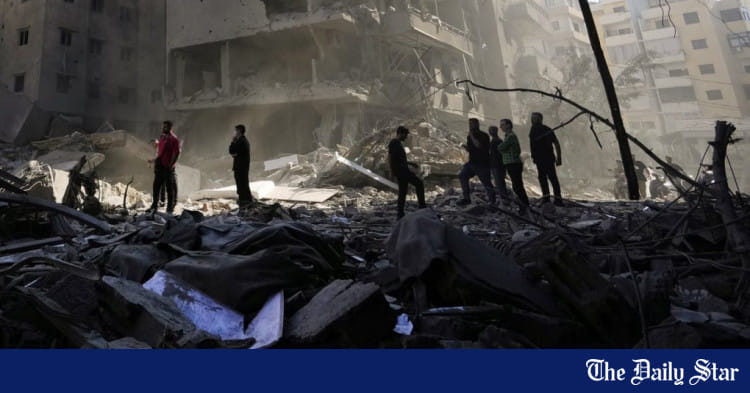
Residents walk amid the destruction in the aftermath of an Israeli strike that targeted the Sfeir neighbourhood in Beirut’s southern suburbs on Sunday. | AFP photo

A fireball lit up the sky and smoke billowed over Beirut on Sunday as Israel unleashed intense strikes targeting Hezbollah, almost a year since the Hamas attack that sparked war in Gaza.

In Gaza, Israel’s military said it had encircled the northern area of Jabaliya after indications Hamas was rebuilding despite nearly a year of devastating air strikes and fighting.

As another strike hit Beirut’s southern suburbs, Lebanese prime minister Najib Mikati appealed to the international community to put pressure on Israel for a ceasefire.

Israel is on high alert ahead of the anniversary on Monday of Hamas’s unprecedented October 7 attack which triggered the war in Gaza.

Israel has now turned its focus northwards to Hezbollah, Hamas’s Iran-backed ally in Lebanon, and has vowed to avenge an Iranian missile attack.

Iran on Sunday said it had prepared a plan to hit back against any possible Israeli attack, before Israel’s defence minister Yoav Gallant warned Iran it could end up looking like Gaza or Beirut.

Lebanon’s official National News Agency said Hezbollah’s south Beirut stronghold was hit by more than 30 strikes, with a petrol station and a medical supplies warehouse also hit.

‘The strikes were like an earthquake,’ said shopkeeper Mehdi Zeiter, 60.

Israel’s military said it struck weapons storage facilities and infrastructure while taking measures ‘to mitigate the risk of harming civilians’.

AFPTV footage showed a massive fireball over a residential area, followed by a loud bang and secondary explosions. Smoke was still billowing from the site after dawn.

Later, Israeli prime minister Benjamin Netanyahu paid a visit to troops along the northern border, his office said, nearly a week after the army launched a ground operation inside Lebanon.

Ahead of Monday’s grim anniversary, Israeli military spokesman Rear Admiral Daniel Hagari told a televised briefing: ‘We are prepared with increased forces in anticipation for this day’, when there might be ‘attacks on the home front’.

Last year’s October 7 attack on Israel by Palestinian militants resulted in the deaths of 1,205 people, mostly civilians, according to an AFP tally based on Israeli official figures that include hostages killed in captivity.

One year on, Israel’s war in Gaza against Hamas continues despite its focus shifting to Lebanon and Hezbollah.

On Sunday the military said it had encircled the Jabaliya area of northern Gaza after intelligence detected ‘efforts by Hamas to rebuild its operational capabilities’.

The army said it had killed about 440 Hezbollah fighters in Lebanon ‘from the ground and from the air’ since Monday, when troops began what it called targeted ground operations.

Israel says it aims to allow tens of thousands of Israelis displaced by almost a year of Hezbollah rocket fire into northern Israel to return home.

Israeli president Isaac Herzog called Iran an ‘on-going threat’ after Tehran, which backs armed groups across the Middle East, launched around 200 missiles at Israel on Tuesday in revenge for Israeli killings of militant leaders including Hezbollah chief Hassan Nasrallah.

Iran’s attack killed a Palestinian in the Israeli-occupied West Bank and damaged an Israeli air base, according to satellite images.

It came the same day Israeli ground forces began raids into Lebanon after days of intense strikes on Hezbollah strongholds.

One Israeli military official said the army ‘is preparing a response’ to Iran’s attack.

Netanyahu noted Iran had twice launched ‘hundreds of missiles’ at Israel since April.

‘Israel has the duty and the right to defend itself and to respond to these attacks and that is what we will do,’ he said in a statement.

Netanyahu’s critics accuse him of obstructing efforts to reach a Gaza ceasefire and a deal to free hostages still held by Hamas.

Iran has prepared a plan to respond to a possible Israeli attack, Tasnim news agency reported, citing an informed source.

The Islamic republic’s supreme leader, Ayatollah Ali Khamenei, on Friday warned that ‘the resistance in the region will not back down’.

A senior Hezbollah source said Saturday the group had lost contact with Hashem Safieddine, widely tipped as its next leader, after air strikes in Beirut.

The movement has yet to name a new chief after Israel assassinated Nasrallah late last month in a massive strike in Lebanon’s capital.

Across Lebanon, strikes against Hezbollah have killed more than 1,110 people since September 23, according to an AFP tally based on official figures.

UN’s refugee agency head Filippo Grandi said Lebanon ‘faces a terrible crisis’ and warned ‘hundreds of thousands of people are left destitute or displaced by Israeli air strikes’.

Israeli bombardment has put at least four hospitals in Lebanon out of service, the facilities said.

The UN peacekeeping force in Lebanon said it rejected a request by Israel’s military to ‘relocate some of our positions’ in south Lebanon.

Iran’s foreign minister Abbas Araghchi, in Damascus Saturday after visiting Beirut, renewed his call for ceasefires in both Gaza and Lebanon and threatened Israel with an ‘even stronger’ reaction to any attack on Iran.

US, Qatari and Egyptian mediators tried unsuccessfully for months to reach a Gaza truce and secure the release of 97 hostages still held there.

Gaza’s civil defence agency said on Sunday an Israeli strike on a mosque-turned-shelter in central Deir al-Balah killed 26 people. Israel said it had targeted Hamas militants.

Israel’s retaliatory military offensive has killed at least 41,870 people in Gaza, the majority of them civilians, according to figures provided by the Hamas-run territory’s health ministry and described as reliable by the UN.

Ahead of the October 7 anniversary, thousands joined pro-Palestinian rallies in London, Paris, Cape Town and other cities.

Israel’s president Herzog said his country’s October 7 ‘wounds still cannot fully heal’.​
 

Hezbollah says targets Israel army base near Haifa
Published: 07 Oct 2024, 09: 57

1728284038118.png

Damaged cars in Hezbollah's rocket attack in Israel's Haifa on 22 September AFP file photo

Lebanon's Iran-backed Hezbollah group said early Monday it had targeted an Israeli military base near the northern city of Haifa, the third attack on a military position in the area in one day.

Hezbollah fighters launched "a salvo of Fadi 1 rockets at the Carmel base south of Haifa," late Sunday the group said in a statement, having earlier reported two attacks on another base also south of Haifa. The group dedicated the attack to its leader Hassan Nasrallah, killed in an Israeli strike on Beirut's southern suburbs last month.​
 

Israeli strikes endanger civilians on Lebanon-Syria border
Agence France-Presse . Beirut 07 October, 2024, 21:56

1728351433957.png

Children play around an emergency services tent set up at the Jdeidat Yabus border crossing in southwestern Syria as displaced people arrive from Lebanon on Monday. | AFP photo

Human Rights Watch on Monday said Israeli strikes near the main Lebanon-Syria border crossing were putting civilians at ‘grave risk’ as they prevented them from fleeing and hampered humanitarian operations.

The Israeli military said Friday its fighter jets struck Hezbollah positions near the Masnaa border crossing in Lebanon’s eastern Bekaa Valley.

Syrian transport ministry official Sleiman Khalil said on Monday that the road was still ‘completely cut off to vehicle traffic’, but people could still cross on foot.

Human Rights Watch said the strikes were ‘impeding civilians trying to flee and disrupting humanitarian operations’, adding ‘the situation places civilians at grave risk.’

‘An Israeli attack on a legitimate military target may still be unlawful if it can be expected to cause immediate civilian harm disproportionate to the anticipated military gain,’ it said in a statement.

If Hezbollah used the crossing to transfer weapons, the Iran-backed group too ‘may be failing to take all feasible precautions to protect civilians under their control’, HRW added.

The Israeli military said it ‘struck an underground tunnel’ crossing the border that ‘enables the transfer and storage of large quantities of weapons underground’.

‘The tunnel’s operations were led by the 4400 Unit, the unit responsible for the transportation of weapons from Iran and its proxies to Hezbollah in Lebanon,’ the military added.

On Friday, an AFP photographer saw people carrying bags and children as they walked around a crater where a strike had hit.

The head of the United Nations refugee agency Filippo Grandi warned Sunday that the bombing of the road ‘has de facto blocked many people from seeking safety in Syria’.

Lebanese authorities said Friday that more than 3,70,000 people had crossed from Lebanon into Syria since September 23, most of them Syrian nationals.

More than 7,74,000 Syrian refugees were registered with the UN in Lebanon before the latest escalation, though the tiny country said that it hosted some two million of them — the world’s highest ratio of refugees per capita.

HRW’s Lama Fakih said that ‘by making a border crossing inaccessible at a time when hundreds of thousands of people are fleeing fighting and many others are in need of aid, the Israeli military threatens considerable civilian harm.’

Even if the crossing were used for military purposes, ‘Israel would need to take into account the expected civilian harm compared to the anticipated military gain’, she added in the statement.​
 

Lebanon could face same ‘spiral of doom’
UN warns referring to devastation in Gaza

1728436420171.png

Palestinian children cry next to the bodies of their relatives, who were killed in Israeli strikes, at Al-Aqsa Martyrs Hospital in Deir Al-Balah in the central Gaza Strip yesterday. Photo: REUTERS

UN humanitarian officials yesterday called for urgent action to stop the escalating conflict in Lebanon from spiralling into a similar scene of devastation as seen in Gaza.

"We need to do everything we can to stop that from happening," said Matthew Hollingworth, Lebanon country director for the United Nations' World Food Programme.

Speaking to reporters in Geneva from Beirut, he said he had spent the first half of the year coordinating WFP's operations in Gaza before taking the helm of its Lebanon office, and was deeply concerned by the similarities.

"It is in my mind from the time I wake until the time I sleep, that we could go into the same sort of spiral of doom... We shouldn't allow that to happen," he said.

Israel's offensive in Gaza has killed at least 41,965 people, mostly civilians. The UN has said the figures are reliable.

The resulting conflict spilled into Lebanon, with intensifying airstrikes and Israeli troops battling Hezbollah militants on the ground.

Israel's bombardment of Lebanon has killed more than 1,100 people and displaced upwards of a million in less than two weeks.

Hollingworth said many people were fleeing because they "have watched over the last year as the offensive in Gaza has continued and neighbourhoods have been decimated and pounded, and that is deep in their gut, in their hearts, in their minds".​
 

Hezbollah, Israeli forces clash along Lebanon-Israel border
Agence France-Presse . Jerusalem 10 October, 2024, 01:59

Hezbollah members and Israeli forces exchanged fire along the Lebanon-Israel border on Wednesday.

Hezbollah said its fighters were locked in clashes with Israeli troops in southern Lebanon, using rocket-propelled weapons to repel Israeli attempts to breach the border.

US president Joe Biden was set to hold talks with Israeli prime minister Benjamin Netanyahu.

Two people were killed by suspected Hezbollah rocket fire in the northern Israeli town of Kiryat Shmona, while Israeli air defences also intercepted two projectiles fired towards the coastal town of Caesarea, officials said.

As fighting raged, with Netanyahu warning Lebanon could face ‘a long war like we see in Gaza’, Biden was expected to seek to prevent the conflict escalating into a regional war directly involving Iran.

The US leader will speak to Netanyahu for the first time in seven weeks later Wednesday, a source familiar with the issue said, with Israel’s response to last week’s missile attack by Iran expected to be high on the agenda.

Biden has cautioned Israel against attempting to target Iran’s nuclear programme, which would risk major retaliation, and is also against striking the country’s oil installations, which would send world crude prices spiking.

A new book by veteran US journalist Bob Woodward details growing tensions between Biden and Netanyahu, with Biden telling the Israeli premier in July that ‘the perception of Israel around the world increasingly is that you’re a rogue state, a rogue actor’, the New York Times reported.

British foreign secretary David Lammy warned of the ‘incredibly dangerous’ situation in the Middle East as he began a trip to the region on Wednesday to visit Western allies Bahrain and Jordan to discuss a region-wide ceasefire.

Israel has intensified air strikes on Hezbollah strongholds in Lebanon since September 23, leaving more than 1,190 people dead and forcing more than a million to flee, according to an AFP tally of official figures.

Its ground forces crossed into Lebanon on September 30 in response to Hezbollah rocket and artillery attacks over the past year that have forced tens of thousands of Israelis from their homes in border areas.

Israel’s military said on Wednesday that its troops had ‘eliminated terrorists during close-quarter encounters and in aerial strikes’ over the previous 24 hours, adding that ‘100 Hezbollah terror targets were destroyed.’

Israeli operations have expanded from border areas in the interior to the southern section of Lebanon’s Mediterranean coast.

According to a new toll from the Israeli army on Wednesday, 13 soldiers have died since ground operations inside Lebanon began.

‘You have an opportunity to save Lebanon before it falls into the abyss of a long war that will lead to destruction and suffering like we see in Gaza,’ Netanyahu said in a video message addressed to the Lebanese people on Tuesday.

Israel was also extending an on-going military operation around Jabalia in the north of Gaza on Wednesday, where around 4,00,000 people are trapped, according to Philippe Lazzarini, head of the UN agency for Palestinian refugees.

Posting on X, Lazzarini said that there was ‘no end to hell’ in the area and that ‘recent evacuation orders from the Israeli authorities are forcing people to flee again & again.’

The army surrounded the town of Jabalia and its refugee camp at the weekend and was shelling it on Wednesday, preventing the delivery of aid, the Palestinian territory’s civil defence agency said.

Israel invaded Gaza after last year’s October 7 attack by Hamas militants that resulted in the deaths of 1,206 people, mostly civilians, according to an AFP tally based on Israeli official figures, which include hostages killed in captivity.

Israel’s retaliatory offensive has killed at least 42,010 people in Gaza, according to figures from the Hamas-run territory’s health ministry that the United Nations has described as reliable.

Israeli police said at least six people were wounded Wednesday, some of them seriously, in a stabbing rampage at four locations in the central town of Hadera.

During their talks later, Biden is expected to press Netanyahu for details about how Israel intends to retaliate for Iran’s launch of around 200 missiles at Israel last week.

Israeli defence minister Yoav Gallant had been due to visit Washington for talks on Wednesday but the visit was postponed at the last-minute.

Israeli media reported that Netanyahu had demanded the cabinet decide on the action to be taken before Gallant’s departure.

Both Hamas and Hezbollah, which are backed by Iran, have vowed to keep up their attacks on Israel, with Hezbollah’s deputy leader Naim Qassem on Tuesday saying the group would make it impossible for Israelis to return to the north of the country.

In Beirut, many people are sleeping out in the streets after Israeli air strikes and dozens of displaced families were seen on Beirut’s seafront on Wednesday.

Ahmad, a 77-year-old Beirut resident who did not want to give his second name for fear of reprisals, said he had a message for Hezbollah.

‘If you can’t continue to fight, announce you are withdrawing and that you have lost. There is no shame in losing,’ he said.

But Raed Ayyash, a displaced man from the south of the country, said he hoped Hezbollah would keep fighting.

‘We hope for victory and we will never give up,’ he said.​
 

SOUTHERN LEBANON
Israeli troops fire at 3 UNIFIL positions

Five Lebanese medics killed in another strike; Hezbollah fires 40 rockets at Israel’s Galilee

1728607461579.png


Israeli troops opened fire at three positions held by UN peacekeepers in southern Lebanon yesterday, said a UN source, adding that one of the locations fired at was UNIFIL's main base at Naqoura.

The UNIFIL force said two of its peacekeepers were injured in one of the incidents. There were no casualties in the other two incidents.

Another Israeli strike killed five emergency workers in southern Lebanon, the health ministry said, as Israel pressed its major offensive against the Iran-backed Hezbollah and warned Lebanese civilians in the south not to return home.

Lebanon's caretaker Prime Minister, Najib Mikati, said contacts were under way between the United States and France with the aim of reviving a ceasefire, an apparent reference to diplomatic efforts to clinch a truce which Israel rejected last month. There was no immediate comment from Washington or Paris.

US President Joe Biden and Israeli Prime Minister Benjamin Netanyahu spoke later on Wednesday about potential Israeli retaliation against Iran, in a call both sides described as positive.

Israel warns Lebanese people in south not to return home

The Lebanese health ministry said the Israeli strike overnight hit a civil defence centre in the village of Derdghaiya, some 10 km from the border, killing five paramedics and rescue workers. There was no immediate comment from the Israeli military.

Israeli strikes have killed more than 2,100 people in Lebanon over the last year, the vast majority of them since September 23, when Israel dramatically scaled up its assault with widespread airstrikes before later sending soldiers in on the ground.

Israel reported the death of a 12th soldier in ground operations in south Lebanon yesterday.

Hezbollah has sustained its rocket attacks on Israel, and the Israeli military said around 40 projectiles were identified crossing from Lebanon into Israel, some of which were intercepted, and several fell in the area of the upper Galilee.​
 

Lebanon's army watches from sidelines as Hezbollah, Israel battle
AP
Published :
Oct 12, 2024 17:31
Updated :
Oct 12, 2024 17:31

1728783502969.png


Since Israel launched its ground invasion of Lebanon, Israeli forces and Hezbollah militants have clashed along the border while the Lebanese army has largely stood on the sidelines.

It's not the first time the national army has found itself watching war at home from the discomfiting position of bystander.

Lebanon's widely beloved army is one of the few institutions that bridge the country's sectarian and political divides. Several army commanders have become president, and the current commander, Gen. Joseph Aoun, is widely regarded as one of the front-runners to step in when the deadlocked parliament fills a two-year vacuum and names a president.

But with an aging arsenal and no air defenses, and battered by five years of economic crisis, the national army is ill-prepared to defend Lebanon against either aerial bombardment or a ground offensive by a well-equipped modern army like Israel's.

The army is militarily overshadowed by Hezbollah. The Lebanese army has about 80,000 troops, with around 5,000 of them deployed in the south. Hezbollah has more than 100,000 fighters, according to the militant group's late leader, Hassan Nasrallah. Its arsenal - built with support from Iran - is also more advanced.

A cautious initial response

Israeli forces and Hezbollah fighters have been clashing since Oct. 8, 2023, when the Lebanese militant group began firing rockets over the border in support of its ally Hamas in Gaza.

In recent weeks, Israel has conducted a major aerial bombardment of Lebanon and a ground invasion that it says aims to push Hezbollah back from the border and allow displaced residents of northern Israel to return.

As Israeli troops made their first forays across the border and Hezbollah responded with rocket fire, Lebanese soldiers withdrew from observation posts along the frontier and repositioned about 5 kilometers (3 miles) back.

So far, Israeli forces have not advanced that far. The only direct clashes between the two national armies were on Oct. 3, when Israeli tank fire hit a Lebanese army position in the area of Bint Jbeil, killing a soldier, and on Friday, when two soldiers were killed in an airstrike in the same area. The Lebanese army said it returned fire both times.

Lebanon's army declined to comment on how it will react if Israeli ground forces advance farther.

Analysts familiar with the army's workings said that, should the Israeli incursion reach the current army positions, Lebanese troops would put up a fight - but a limited one.

The army's "natural and automatic mission is to defend Lebanon against any army that may enter Lebanese territory," said former Lebanese Army Gen. Hassan Jouni. "Of course, if the Israeli enemy enters, it will defend, but within the available capabilities ... without going to the point of recklessness or suicide."

Israeli and Lebanese armies are 'a total overmatch'

The current Israeli invasion of Lebanon is its fourth into the neighboring country in the past 50 years. In most of the previous invasions, the Lebanese army played a similarly peripheral role.

The one exception, said Aram Nerguizian, a senior associate with the Washington-based Center for Strategic and International Studies, was in 1972, when Israel attempted to create a 20-kilometer (12-mile) buffer zone to push back Palestinian Liberation Organization fighters.

At that time, Nerguizian said, the Lebanese army successfully slowed the pace of the Israeli advance and "bought time for political leadership in Beirut to seek the intervention of the international community to pressure Israel for a cease-fire."

But the internal situation in Lebanon - and the army's capabilities - deteriorated with the outbreak of a 15-year civil war in 1975, during which both Israeli and Syrian forces occupied parts of the country.

Hezbollah was the only faction that was allowed to keep its weapons after the civil war, for the stated goal of resisting Israeli occupation of southern Lebanon - which ended in 2000.

By 2006, when Hezbollah and Israel fought a bruising monthlong war, the Lebanese army "had not been able to invest in any real-world post-war modernization, had no ability to deter Israeli air power" and "was left completely exposed," Nerguizian said. "The few times that the (Lebanese army) and Israeli forces did engage militarily, there was total overmatch."

International aid has been a mixed blessing

After the 2011 outbreak of civil war in neighboring Syria and the rise of the Islamic State militant group there, the Lebanese army saw a new influx of military aid. It successfully battled against IS on Lebanon's border in 2017, although not alone - Hezbollah was simultaneously attacking the group on the other side of the border.

When Lebanon's financial system and currency collapsed in 2019, the army took a hit. It had no budget to buy weapons and maintain its existing supplies, vehicles and aircraft. An average soldier's salary is now worth around $220 per month, and many resorted to working second jobs. At one point, the United States and Qatar both gave a monthly subsidy for soldiers' salaries.

The U.S. had been a primary funder of the Lebanese army before the crisis. It has given some $3 billion in military aid since 2006, according to the State Department, which said in a statement that it aims "to enable the Lebanese military to be a stabilizing force against regional threats" and "strengthen Lebanon's sovereignty, secure its borders, counter internal threats, and disrupt terrorist facilitation."

President Joe Biden's administration has also touted the Lebanese army as a key part of any diplomatic solution to the current war, with hopes that an increased deployment of its forces would supplant Hezbollah in the border area.

But that support has limits. Aid to the Lebanese army has sometimes been politically controversial within the U.S., with some legislators arguing that it could fall into the hands of Hezbollah, although there is no evidence that has happened.

In Lebanon, many believe that the U.S. has blocked the army from obtaining more advanced weaponry that might allow it to defend against Israel - America's strongest ally in the region and the recipient of at least $17.9 billion in U.S. military aid in the year since the war in Gaza began.

"It is my personal opinion that the United States does not allow the (Lebanese) military to have advanced air defense equipment, and this matter is related to Israel," said Walid Aoun, a retired Lebanese army general and military analyst.

Nerguizian said the perception is "not some conspiracy or half-truth," noting that the U.S. has enacted a legal requirement to support Israel's qualitative military edge relative to all other militaries in the region.​
 

Members Online

Latest Posts

Latest Posts