Wars 2023 10/08 Monitoring the Israel and Lebanon War

Wars 2023 10/08 Monitoring the Israel and Lebanon War
230
11K
More threads by Saif

G War Archive

Israeli strikes kill 39 in Lebanon amid continued cross-border hostilities

UNB
Dhaka
Published: 10 May 2026, 10: 32
1778467199767.webp

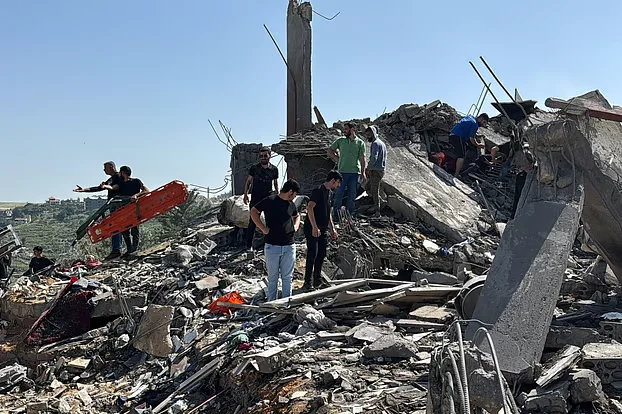
Emergency responders assisted by other people and heavy machinery inspect the site of an Israeli strike in Saksakiyeh, Lebanon, 9 May, 2026. Picture taken with a mobile phone. REUTERS

At least 39 people were killed in a fresh wave of Israeli airstrikes across Lebanon, the country’s health ministry said, as hostilities between Israeli forces and Hezbollah persist despite a ceasefire announcement.

One of the deadliest strikes hit the southern town of Saksakiyeh, where at least seven people, including a child, were killed and 15 others injured, among them three children, according to the ministry.

The Israeli military said it targeted Hezbollah operatives using a structure for military purposes and acknowledged reports of civilian casualties. It added that precautions were taken to minimise harm to civilians, including the use of precision weapons and aerial surveillance, and that the incident is under review.

Lebanon’s state-run National News Agency reported multiple Israeli strikes across southern regions on Saturday.

In another incident, an Israeli drone strike in Nabatieh targeted a motorbike carrying a Syrian man and his 12-year-old daughter. The health ministry said the pair were hit in successive strikes, killing the father and critically injuring the girl, who was undergoing surgery.

Hezbollah also launched a drone attack into northern Israel, wounding three Israeli soldiers, one of them seriously, according to the Israeli military.

Clashes between Israel and Hezbollah have continued since a ceasefire deal announced on April 16. Israel says its strikes are aimed at Hezbollah-linked targets, while the group has responded with rocket and drone attacks.

According to Lebanon’s health ministry, more than 120 people have been killed in Israeli attacks over the past week, including women and children, though it does not distinguish between civilians and combatants.

Israeli forces continue to occupy parts of southern Lebanon along the border, aiming to establish what they describe as a Hezbollah-free buffer zone. Reports indicate widespread destruction in some villages, drawing concern from rights groups.

Since early March, nearly 2,800 people have been killed in Lebanon, while Israeli authorities report 17 soldiers and three civilians killed in related violence on both sides of the border.​
 

Two Bangladeshis in Lebanon killed in Israeli drone strike

The victims, Shafiqul Islam and Nahidul Islam, were from Satkhira

Star Online Report

1778547156880.webp

Smoke rises following an Israeli strike in southern Lebanon as seen from Marjayoun, May 11, 2026. File photo: Reuters/Karamallah Daher

Two Bangladeshi expatriates were killed in an Israeli drone strike in southern Lebanon on Monday.

The attack took place around 12:00pm local time in a residential area in Zebdine of Nabatieh, according to the Bangladesh Embassy in Beirut.

The victims were Shafiqul Islam, of Bhaluka Chandpur village in Sadar upazila of Satkhira, and Md Nahidul Islam, of Kadakati village in Ashashuni upazila of the same district.

A senior official of the foreign ministry, quoting the Bangladesh embassy, confirmed the deaths of the two Bangladeshis, reports Prothom Alo.

According to the embassy, the bodies have been kept at Nabih Berri Hospital in Nabatieh.

The embassy expressed deep condolences to the bereaved families.

On April 8, a Bangladeshi female worker Dipali Begum was killed in an Israeli airstrike in Beirut.​
 

Another Bangladeshi killed in Israeli drone strike in Lebanon

Shuvo Das from Satkhira had gone abroad in 2024 to support his family

Our Correspondent, Satkhira

1778631842563.webp


Shuvo Das. Photo: Collected

Another Bangladeshi expatriate was killed in an Israeli drone strike in southern Lebanon early today.

The victim was Shuvo Das, 22, son of Suranjan Das and Shikha Rani Das of Shreerampur village in Satkhira’s Kalaroa upazila. He was the second among three sons and one daughter.

The attack took place around 2:00am (Bangladesh time) in the Zebdine area of Nabatieh district in southern Lebanon.

The Bangladesh Embassy in Beirut informed the family about the incident this morning, Shuvo’s elder brother Shanto Das told The Daily Star.

“We don’t have any land of our own. My father drives a rickshaw van. Shuvo was sent to Lebanon in 2024 with a loan to support the family. He worked on a cattle farm there. This morning, I received a call from the embassy that my brother had been killed in a drone strike,” Shanto said.

The deceased’s mother, Shikha Rani Das, said, “I spoke with my son on Monday night and asked him to come home next month. He told me, ‘Ma, I will come at the end of the year.’ Who knew that would be our last conversation?”

She added, “I could not see my son alive. Now, all I want is for his body to be brought back to the country.”

Family members said Shuvo could not continue his studies after SSC exams and went abroad, hoping to ease his family’s financial hardship.

HM Shaheen, officer-in-charge of Kalaroa Police Station, said they are in contact with the family of the deceased.

With Shuvo, three people from Satkhira have now been killed in Israeli drone strikes in Lebanon.

Earlier on Monday, two Bangladeshis were killed in a drone strike in the Zebdine area of southern Lebanon. The victims were Shafiqul Islam of Bhaluka Chandpur village in Satkhira Sadar upazila and Md Nahidul Islam of Kadakati village in Ashashuni upazila of the same district.​
 

Israeli strikes killed 380 since truce: Lebanon
Agence France-Presse . Beirut, Lebanon 13 May, 2026, 03:41

Israeli strikes on Lebanon have killed 380 people since a ceasefire in the Israel-Hezbollah war began on April 17, Lebanon’s health minister Rakan Nassereddine told a press conference on Tuesday.

The overall toll in Israeli strikes since the war erupted between Israel and Hezbollah on March 2 has reached 2,882 people including 279 women and 200 children, he added.

Since the ceasefire, ‘380 people have been killed and 1,122 wounded,’ Nassereddine said.

A ministry official said that the toll includes 39 women and 22 children.

Under the terms of the truce released by Washington, Israel reserves the right to act against ‘planned, imminent or on-going attacks’.

In addition to carrying out on-going airstrikes, Israeli troops have been operating behind a so-called ‘yellow line’ that runs around 10 kilometres north of the border between the two countries.

Some 108 emergency and health workers are among the overall death toll while 249 others have been wounded and ‘16 hospitals have been damaged’ since the start of the conflict, Nassereddine said.

‘It’s a massacre... there are no armed men or fighters in these (ambulance) vehicles, just medical equipment and wounded, contrary to what Israel says,’ he added.

Israel has accused Hezbollah of using ambulances and medical facilities for military purposes, an accusation the group denies.

Hezbollah drew Lebanon into the Middle East conflict on March 2 when it launched rockets at Israel to avenge the killing of Iran’s supreme leader in US-Israeli strikes.

Israel responded with massive strikes and a ground invasion in the country’s south.

The Iran-backed Hezbollah says its fighters are included in the government tolls.

Lebanese leaders on Monday urged the United States to pressure Israel to halt its attacks, which have intensified in recent days.

The appeal came as Lebanese and Israeli representatives are set to meet later this week in Washington for a third round of direct talks.​
 

Israel strikes Lebanon as authorities report 380 killed since truce

AFP
Beirut, Lebanon
Published: 13 May 2026, 11: 32

1778716973800.webp


An explosion erupts in the area of al-Housh following Israeli bombardment as seen from Tyre in southern Lebanon on 12 May, 2026. AFP

Israel hammered south Lebanon with strikes on Tuesday ahead of talks between the two countries in Washington, as Beirut reported 380 people killed in Israeli attacks since an 17 April ceasefire took effect.

Hezbollah Chief Naim Qassem vowed to turn the battlefield into "hell" for Israeli forces, and insisted his Iran-backed group's weapons would not be up for discussion at the talks on Thursday and Friday, after the US had called for its disarmament.

Israel has intensified its attacks on south Lebanon, where it continues to trade fire with Hezbollah despite the ceasefire. Under the truce terms released by Washington, Israel reserves the right to act against imminent threats.

Lebanon's health ministry said Israeli strikes on Tuesday killed 13 people in the south, including two rescuers responding to an earlier raid in the city of Nabatieh and a wounded person they went to save.

The ministry decried Israel's "complete disregard for all international norms".

Hezbollah has also been carrying out attacks, including several on Tuesday, both against Israeli troops who have invaded south Lebanon and across the border, saying they are in response to Israeli ceasefire violations.

Lebanon's Health Minister Rakan Nassereddine told a press conference on Tuesday that since the ceasefire, "380 people have been killed and 1,122 wounded".

A ministry official told AFP that toll includes 39 women and 22 children.

'Massacre'

Nassereddine decried a "systematic, ongoing attack on civilians", and described the ceasefire as "fragile and ineffective".

Save the Children said in a statement that "more than four children have been killed or injured every day on average in Lebanon in the first 25 days" of the truce.

Its Lebanon country director Nora Ingdal said "attacks on civilians have not stopped -- it has simply continued under another name".

In addition to its ongoing air raids, Israel's troops are operating behind a "yellow line" that runs around 10 kilometres (six miles) inside Lebanon, and have issued evacuation warnings for dozens of villages in the south and east ahead of strikes, including on Tuesday.

The overall toll from Israeli attacks since the war erupted on March 2 has reached 2,882 people, including 279 women and 200 children, Nassereddine said.

Some 108 emergency and health workers were also among the dead, he noted, before the latest civil defence deaths.

"It's a massacre... there are no armed men or fighters in these (ambulance) vehicles, just paramedics, medical equipment and wounded," he added.

Israel has accused Hezbollah of using ambulances and medical facilities for military purposes, an accusation the group denies.

'Hell'

Israel's military said Tuesday that over the past week, its troops had conducted a "special operation to clear terrorist infrastructure" from south Lebanon's Litani region "and establish operational control in the area".

Hezbollah's Qassem vowed that "we will not abandon the battlefield and we will turn it into hell for Israel".

Last week, State Department spokesman Tommy Pigott said "comprehensive peace is contingent on the full restoration of Lebanese state authority and the complete disarmament" of Hezbollah.

But Qassem said his group's weapons were "an internal Lebanese matter" and again rejected Lebanon's direct talks with Israel, calling for authorities to withdraw ahead of the upcoming round.

Hezbollah drew Lebanon into the Middle East conflict on 2 March when it launched rockets at Israel to avenge the killing of Iran's supreme leader in US-Israeli strikes.​
 

Lebanon, Israel hold new talks in US as ceasefire nears end

AFP
Washington, US
Published: 14 May 2026, 20: 42

1778803546950.webp

Flares are fired by Israeli forces in Arnoun as seen from Marjayoun, Lebanon 14 May, 2026. REUTERS

Lebanon and Israel held new peace talks in Washington on Thursday, as their latest ceasefire -- considered to still be in place despite hundreds of deaths in Israeli strikes -- nears its end.

Israel's military said it was striking Hezbollah targets in south Lebanon on Thursday after warning residents of several towns and villages there and in the country's east to evacuate. It also said a Hezbollah drone fell in Israeli territory, wounding several civilians.

Lebanon's state-run National News Agency (NNA) reported Israeli airstrikes on the south and east, including in areas not covered by the warning, a day after the health ministry said intense raids killed 22 people, eight of them children.

One diplomat privy to the two-day talks in Washington said discussions started just after 9:00 am (1300 GMT) at the State Department.

Lebanese and Israeli representatives last met on 23 April at the White House, where US President Donald Trump announced a three-week ceasefire extension and voiced optimism for a groundbreaking agreement between the countries, which have technically been at war for decades.

Trump at the time made the bold prediction that during the three-week extension he would welcome Israeli Prime Minister Benjamin Netanyahu and Lebanese President Joseph Aoun to Washington for a historic first summit between the countries.

The summit did not happen, with Aoun saying a security deal and an end to Israeli attacks were needed before such a landmark meeting.

Hezbollah lawmaker Ali Ammar on Thursday reiterated his group's rejection of the direct talks, saying they amounted to "free concessions" to Israel.

The ceasefire, which began on 17 April, lasts through Sunday.

Ongoing strikes

Still, Israeli strikes have killed more than 400 people during the truce, according to an AFP tally of health ministry figures.

Israel has vowed to keep pursuing attacks against Hezbollah, the Shia armed group and political movement backed by Iran's ruling clerics.

Hezbollah drew Lebanon into the Middle East war on 2 March with rocket fire at Israel in retaliation for the killing of Iran's supreme leader Ayatollah Ali Khamenei in US-Israeli strikes days earlier.

"Anyone who threatens the State of Israel will die because of his actions," Netanyahu said last week after an Israeli strike on Beirut's southern suburbs killed a senior Hezbollah commander.

A Lebanese official told AFP that the country would seek "the consolidation of the ceasefire" during the talks in Washington.

"The first thing is to put an end to the death and destruction," the official told AFP on condition of anonymity.

Iran has demanded a lasting ceasefire in Lebanon before any agreement to end the wider war in the region, and it has frustrated Trump by refusing his appeals for an accord on his terms.

The Middle East war has roiled the global economy and impacted hundreds of millions of people worldwide.

Israeli attacks since 2 March have killed more than 2,800 people in Lebanon, including at least 200 children, according to Lebanese authorities, a toll Hezbollah says includes its fighters.

Israel has pounded Hezbollah strongholds in the south and Beirut's southern suburbs, and has invaded the border region, parts of which Israel previously occupied for around two decades until withdrawing in 2000.

Disarmament push

Lebanon has repeatedly called for Israel to withdraw its troops from the south, and insists on extending state sovereignty over all its territory as part of a commitment last year to disarm Hezbollah.

Washington has endorsed Beirut's commitment to do so, while pressing it to take more action.

The United States believes "comprehensive peace is contingent on the full restoration of Lebanese state authority and the complete disarmament of Hezbollah," a State Department statement said.

"These talks aim to break decisively from the failed approach of the past two decades, which allowed terrorist groups to entrench and enrich themselves, undermine the authority of the Lebanese state, and endanger Israel's northern border," it said.

Thursday's meeting will be the third round of talks between the two countries, which have no diplomatic relations.

Unlike the previous two rounds, neither Secretary of State Marco Rubio nor Trump will participate as both are on a state visit to China.

The US mediators include the ambassadors to Israel and Lebanon -- respectively Mike Huckabee, an evangelical pastor and staunch supporter of Israel's regional ambitions, and Michel Issa, a Lebanese-born businessman and golf partner of Trump.

Lebanon was represented by special envoy Simon Karam, a lawyer and diplomat who has defended Lebanon's sovereignty, as well as its ambassador in Washington.

Israel's team will include its ambassador in Washington, Yechiel Leiter, a Netanyahu ally who is close with the Israeli settler movement in the occupied West Bank.​
 

Israel, Lebanon say extending ceasefire despite new strikes

AFP
Washington, United States
Published: 16 May 2026, 09: 34

1778988035807.webp

Smoke billows from southern Lebanon following an Israeli strike, as seen from Marjeyoun, Lebanon, 15 May, 2026.REUTERS

Israel and Lebanon agreed to extend a ceasefire and hold expanded talks on a political settlement, the United States announced Friday, even as Israel carried out new strikes that it insists are not subject to the truce.

Israel has been pounding Lebanon and invaded its south in response to fire from Hezbollah, the Iranian-backed Shia movement that is not part of the ceasefire diplomacy.

Envoys from Israel and Lebanon's government, which has struggled to restrain Hezbollah, met for two days in Washington and said they would extend the ceasefire that was set to expire Sunday.

The cessation of hostilities "will be extended by 45 days to enable further progress," State Department spokesman Tommy Pigott said.

He said that the State Department would hold negotiations aimed at reaching a permanent political agreement on June 2 and 3 and that the Pentagon would bring together delegations from the countries' militaries on 29 May.

Lebanon's delegation said in a statement that the ceasefire extension and opening of military talks would offer "critical breathing room for our citizens" with a goal of "lasting stability."

In an implicit rebuke to Hezbollah, Lebanese Prime Minister Nawaf Salam told an NGO dinner in Beirut that his country has had "enough of these reckless adventures serving foreign projects or interests."

The latest brought "a war we did not choose but was forced upon us, which led to Israel occupying 68 towns and villages," he said.

The United States steadfastly backs Israel, with which it launched attacks on Iran on February 28, but has also gently voiced unease about Israeli troops' encroachments into southern Lebanon.

Israel's ambassador to Washington, Yechiel Leiter, who led his country's delegation, said after the talks that the priority was ensuring Israel's security.

"There will be ups and downs, but the potential for success is great," Leiter wrote on X.

Iran's clerical state, Hezbollah's patron, has demanded a lasting ceasefire in Lebanon before any peace agreement with US President Donald Trump, who has been frustrated by Tehran's refusal to an accord on his terms.

Truce met with violence

Hundreds of people have died in Israeli strikes despite the truce announced on 17 April.

Moments after the ceasefire renewal was announced, an Israeli strike hit a center of the Hezbollah-linked Islamic Health Committee in the southern town of Hanuf, authorities said. Six people died, including three paramedics, according to the Lebanese health ministry.

Israel also carried out strikes in the southern city of Tyre after issuing evacuation orders, and Hezbollah said it targeted Israeli barracks in the northern city of Kiryat Shmona with drones.

Lebanon's health ministry said strikes in the Tyre district also wounded at least 37 people, including six hospital personnel, nine women and four children.

Hafez Ramadan, a resident near the building targeted by the airstrike, said it had housed people who had fled their towns due to the war and was adjacent to a hotel where more displaced were staying.

"There are only women, children and the elderly here," he said. "Because of this strike, people have been displaced again."

The Israeli military said another of its soldiers was killed in southern Lebanon, bringing the number of Israeli soldiers killed in clashes with Hezbollah since early March to 19. A civilian contractor was also killed.

It said it killed more than 220 Hezbollah fighters over the past week and struck hundreds of targets.

'Unacceptable' toll

The United Nations humanitarian coordinator for Lebanon, Imran Riza, said that diplomacy needed to stop the violence.

"The reality on the ground in Lebanon has been deeply alarming," he said. "Airstrikes and demolitions continue daily, with an unacceptable toll on civilians and civilian infrastructure."

But he expressed his hope that the Lebanon-Israel talks "will pave the way toward a political solution."

During the last talks between Israel and Lebanon, Trump brought envoys to the White House and predicted within the current ceasefire period that he would host a historic meeting between Israeli Prime Minister Benjamin Netanyahu and Lebanese President Joseph Aoun.

That meeting has not happened, with Aoun saying a security deal was necessary first, and there was no mention of a summit in the last ceasefire extension.

Lebanon was dragged into the Middle East war on 2 March when Hezbollah fired rockets at Israel in retaliation for the killing of Iran's supreme leader Ali Khamenei.

Israeli attacks since then have killed more than 2,900 people in Lebanon, including more than 400 since the truce took effect, according to Lebanese authorities.​
 

Latest Posts

Back