
New Tweets

[🇧🇩] Agriculture in Bangladesh

G Bangladesh Defense
[🇧🇩] Agriculture in Bangladesh
246
11K
More threads by Saif


Agriculture and the youth
Mrinmoy Sanyal 21 May, 2024, 00:00

1716249003350.webp

| — New Age
BANGLADESH'S identity as primarily an agricultural nation underscores the pivotal role of its farming sectors in driving economic prosperity. Therefore, fostering a profitable, sustainable, and eco-friendly agricultural framework is imperative to safeguarding long-term food security for its populace. Over the past two decades, agricultural production value has surged steadily, marking an annual growth rate of 3.54 per cent. Recent provisional estimations by the Bangladesh Bureau of Statistics reveal that agriculture's contribution to the gross domestic product for the fiscal year 2021–22 stands at approximately 11.50 per cent.

To read the rest of the news, please click on the link above.
 
Analyze

Analyze Post

Add your ideas here:
Highlight Cite Respond
  • Like (+1)
Reactions: Bilal9

Agriculture credit disbursement rises

1716335740710.png


Agriculture credit disbursements in Bangladesh grew 12.46 percent year-on-year to Tk 23,690 crore in the July-February period of the current fiscal year, central bank data showed.

The government has set the farm loan disbursement target at Tk 355,000 crore for 2023-24, up 13.60 percent from the year prior, as per the central bank's monthly report on agriculture and rural finance.

This year's target is 6.61 percent higher than the actual disbursements made in 2022-23. But with Tk 23,690 crore lent so far, 67.69 percent of the disbursement goal has already been achieved.

According to the agricultural credit programme of the Bangladesh Bank, state-owned commercial banks have been given a target to allocate Tk 3,280 crore in FY24 while state-owned specialised lenders have been asked to lend Tk 8,750 crore.

The allocation target for private commercial banks has been set at Tk 21,923 crore while it is Tk 1,047 crore for foreign commercial banks.

To read the rest of the news, please click on the link above.
 
Analyze

Analyze Post

Add your ideas here:
Highlight Cite Respond
  • Like (+1)
Reactions: Bilal9

Agri sector should get focus as key economic driver: experts
Staff Correspondent 23 May, 2024, 22:37

1716506194119.webp

An aerial view shows a farmer ploughing an agricultural land with a tractor in Sherpur recently. Experts and economists on Thursday said that agriculture sector should get focus as one of the key economic drivers, beyond food security. | Md Saurav

Experts and economists on Thursday said that Bangladesh's agriculture sector should get focus as one of the key economic drivers, beyond food security.

At a seminar 'The Political Economy of Agrarian Futures in Bangladesh' organised by the Bangladesh Institute of Development Studies at the BIDS Conference Room in the capital Dhaka, they said that the fair prices of agricultural products for the farmers should be ensured to make the supply chain efficient and to ensure food security.

Agriculture economists also said that the social system of agriculture was undergoing a process of disarticulation and rearticulation to accommodate the intrusion of capital, along with the involvement of various stakeholders and economic actors associated with this transformation.

To read the rest of the news, please click on the link above.

 
Analyze

Analyze Post

Add your ideas here:
Highlight Cite Respond
  • Like (+1)
Reactions: Bilal9

Why agri-magic falling flat to Bangladesh farmers?
SOHEL MAHAMUD
Published :
May 23, 2024 22:15
Updated :
May 23, 2024 22:15
1716507516466.png


Soon after its independence in 1971, western communities and foreign development agencies largely wrote off Bangladesh. Food insecurity for roughly 70 million people in a war-torn nation was the reason for labelling the country a "bottomless basket." But the country's agri-might has largely proven these assumptions wrong.

Despite declining farmland and almost annual crop devastation from natural disasters, Bangladeshi farmers have managed to feed a population that has grown to 180 million. This agri-magic, powered by farmers' remarkable ability to increase crop production up to sixfold since 1971, is appreciated by the majority of the population. However, Mabroor Mahmood challenges this rosy picture.

To read the rest of the news, please click on the link above.
 
Analyze

Analyze Post

Add your ideas here:
Highlight Cite Respond
  • Like (+1)
Reactions: Bilal9

'Investment in agriculture should be given importance in the budget'
24 May 2024, 12:00 am
1716507939985.webp


Staff Reporter :

The investment in agriculture should be given importance in the budget so that the technologies developed for food security and the transformation of agriculture can reach the village level," Binayak Sen, director general of the Bangladesh Institute of Development Studies (BIDS), said at a programme on Thursday.

"Food security not only requires rice but also poultry and fisheries products. Budget support should be given to maintain their production.

For this, the agricultural technologies that have been invented should be prioritised so that they can easily reach the village level," he said at the seminar on a research titled "The Political Economy of Agrarian Futures in Bangladesh."

"If this can be achieved, a significant change will come," he hoped.

To read the rest of the news, please click on the link above.
 
Analyze

Analyze Post

Add your ideas here:
Highlight Cite Respond
  • Like (+1)
Reactions: Bilal9

The Agrarian Question in Bangladesh
Is the family farm disappearing?

1716590865337.webp

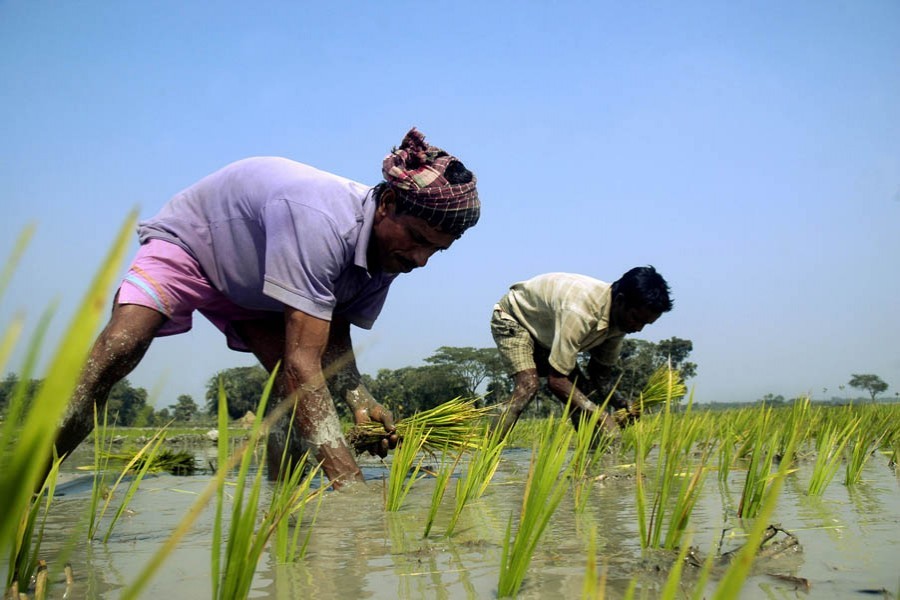
If lumpy machinery like tractors, pump sets and combine harvesters offer prospects of higher productivity and returns to land, then how is a small farmer with scattered, fragmented plots supposed to access those opportunities? FILE PHOTO: MOHAMMAD MONIRUZZAMAN

In 1899, Kautsky predicted that the peasantry in Russia would be squeezed out of existence by larger-scale capital and that such rural people would become proletarianised labour as the country industrialised. Lenin and Trotsky adopted this stance and in effect sought to hasten the process, supported by Preobrazhensky, but were thwarted by the post-revolutionary food crisis, thus adopting the New Economic Policy instead, which encouraged markets and kulaks producing higher net marketable surplus under quasi-capitalist conditions. The rise of the kulaks as a political force then encouraged Stalin to lead a process of collectivisation, communes and state-enforced targets for surplus grain to the cities. However, resistance to this direction came from Chayanov, who mobilised statistics to demonstrate a distinctive peasant mode of production—drudgery-averse production for immediate family consumption, calibrated to the family's life cycle and changing dependency ratio (workers over consumers within the family) so that additional land from the village authorities could be added to the family farm, with its worker members just working harder to feed its larger numbers. Chayanov ended up in jail for arguing that the farmer (i.e. peasant) should not be separated from this family consumption (subsistence) motive by being forced into collectivisation. Sholokhov's novels, such as Virgin Soil Upturned and Harvest on the Don, vividly tell this story of peasant alienation.

To read the rest of the news, please click on the link above.
 
Analyze

Analyze Post

Add your ideas here:
Highlight Cite Respond
  • Like (+1)
Reactions: Bilal9

Prioritising agriculture for national benefit
FE
Published :
May 25, 2024 23:02
Updated :
May 25, 2024 23:02

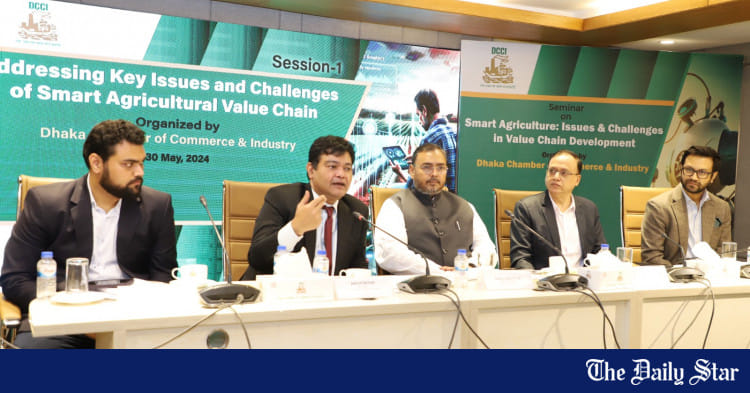
In one of the most densely populated nations on earth, food security naturally is of utmost importance for Bangladeshi policymakers. For many years, national policymaking has been geared towards industrialisation out of the feeling that it would better serve employment generation and help attract a greater volume of foreign direct investment (FDI). There is no denying that such policies have paid off and the country has emerged as a global industrial powerhouse in textiles and apparel. This transformation has largely helped the country cut its poverty rate by half in a matter of three and a half decades. However, alongside industrialization, agriculture has taken giant steps in modernisation and crop diversification despite a declining share of the sector in the country's Gross Domestic Product (GDP).

To read the rest of the news, please click on the link above.
 
Analyze

Analyze Post

Add your ideas here:
Highlight Cite Respond
  • Like (+1)
Reactions: Bilal9

Smart agriculture practices can increase productivity by 30%: DCCI
Smart practices can fuel farmers' income by 40%, the leading chamber said in a seminar on smart agriculture

1717111786571.webp


Adoption of smart agriculture practices could potentially increase agricultural productivity by 20-30 percent in Bangladesh, said Ashraf Ahmed, president of the Dhaka Chamber of Commerce and Industry (DCCI).

Smart agriculture practices also reduce input costs by up to 20 percent and increase farmers' income by 30 to 40 percent, he said today.

The Dhaka chamber president shared the information at a seminar on "Smart agriculture: issues and challenges in value chain development" organised by the DCCI at its office in the capital.

"We see at least 40-45 percent post-harvest loss from the farmers to the consumers," Ahmed said.

To mitigate post-harvest losses, availability of cold chain and smoother transportation systems are necessary, he said.

"Moreover, we should develop a waste management system so that we can recycle the agriculture wastages into other products."

Inefficiencies in the supply chain, market access barriers and limited value addition are few bottlenecks for the development of value chain in Bangladesh's agriculture sector, the leading trade body chief said.

He also emphasised the need for building an updated database to create a smart agriculture environment.

State Minister for Commerce Ahasanul Islam Titu said a need-based locally-tailored farmer-friendly technology is required to implement smart agriculture system in the country.

The state minister said it is equally important to ensure better and logical prices both for the producers and the consumers and for that the presence of a smooth supply chain is a must.

The Logistic Policy-2024 is going to be a game changer for the businessmen, Titu said.

ICT-backed research and innovation will be needed to diversify Bangladesh's export basket, he said.​
 
Analyze

Analyze Post

Add your ideas here:
Highlight Cite Respond
  • Like (+1)
Reactions: Bilal9

Latest Posts

Back
PKDefense - Recommended Toggle