โ˜• Support Us โ˜•
[๐Ÿ‡ง๐Ÿ‡ฉ] - Agriculture in Bangladesh | Page 8 | PKDefense

[๐Ÿ‡ง๐Ÿ‡ฉ] Agriculture in Bangladesh

Reply (Scroll)
Press space to scroll through posts
G Bangladesh Defense
[๐Ÿ‡ง๐Ÿ‡ฉ] Agriculture in Bangladesh
223
9K
More threads by Saif


Centres opened to help farmers get fair price
United News of Bangladesh . Dhaka 14 June, 2024, 19:58

1718407677138.png

| UNB photo.

Agritech startup Fashol Dotcom Limited and SAFE have collaborated to establish three farmers' centres in the Barendra region, notably in Natore, Rajshahi and Bogura districts, to address challenges farmers encounter when selling their produce, according to a press release on Friday.

The Fashol Farmers' Centres were opened last Monday in the presence of nearly 300 farmers. Among those who attended the event were SAFE founder Arifa Jesmin Kanika, Fashol founder and CEO Sakib Hossain, SAFE co-founder Nasima Akter Nisha, Singra Municipality Mayor Md Jannatul Ferdous, Fashol co-founder Mamunur Rashid, agricultural officers from the three sub-districts and Fashol's head of distribution Nasir Uddin.

According to government agricultural officers, these three sub-districts are home to about 4,00,000 farmers. These farmers sell their agricultural products to buyers across the country via multiple intermediaries, where they are frequently subjected to uncertainty and receive low prices for their production.

Farmers can use these Fashol Farmers' Centres to send their products all across the country without the need for intermediaries. Currently, about 25 to 30 per cent of produce is lost during transportation to customers; however, with supply chain technology and Fashol's direct supply chain, this may be reduced to less than 4 per cent, they said.

SAFE founder Arifa Jesmin stated that Bangladesh was an agricultural country. However, the amount of fertile land available for agriculture decreases rapidly year after year. To boost production on available land, the essential actions must be implemented. In this regard, SAFE has collaborated with Fashol to help farmers develop in agriculture. These Fashol Centres provide farmers with a wide range of services.

Farmers can sell their agricultural products at good prices at these centres, receive 24-hour agricultural assistance, purchase contemporary technology and obtain correct seeds to boost output.

According to the press release, Fashol Dotcom Limited, one of the country's major vegetable supply chain networks, has launched a new project to bring about necessary improvements in the agriculture industry.

Company's CEO Sakib Hossain said that they had intended to establish 300 Fashol Centres by the end of 2025, each connected via Fashol's supply chain technology. These Farmers' Centres will allow about 1 million farmers in more than 40 districts to sell their products.​
 

From Bare To Bountiful
Chittagong Hill Tracts transform into a new hub of agriculture


1719013300857.png

Photo: Laltanlian Pangkhua

"You are being transferred to the Chittagong Hill Tracts."

This was a popular dialogue in the climactic scene of Bengali movies in the 1990s, when the hilly regions were looked upon as the backwoods of the nation, a place where government employees would be posted as a punitive measure.

However, the 'backwards' CHT of the past now stands as a beacon of massive economic, educational, and social progress. Once, thousands of acres were uncultivated in the CHT. Now, the areas are full of various crops and fruits.

A few hundred years ago, rice, tea, and oilseeds were cultivated in the plains between the valleys of the CHT, earning it the acclaim of being known as Karpas Mahal (land of cotton) during the Mughal Empire.

But as times changed, so did the mode of cultivation. Jhum cultivation, also known as slash and burn agriculture, was the dominant force in the region in the past. While it remains a tradition, it is no longer the way of life.

Now, the region is filled with all kinds of crops throughout the year as the community cultivates cashew nuts, coffee, pineapples, mangoes, jackfruits, bananas, oranges, guavas, dragon fruits, strawberries, lemons, papayas, custard-apples, wood apples, ginger, and turmeric.

Vegetables are also produced, with most being organic as they hardly apply fertilisers since the soil is fertile and naturally yields abundantly. At present, orchards upon orchards of fruit are being cultivated in the hills.

The three hilly districts -- Rangamati, Khagrachhari, and Bandarban -- now produce about 20 percent of the total fruit in Bangladesh, according to officials of the Department of Agricultural Extension (DAE). This is a result of modern farming methods.

Once a rare sight in the CHT, power tillers, pumps, and tractors combined with modern irrigation systems and the use of improved seed varieties have replaced the traditional farming system.

Mohammed Basirul Alam, acting deputy director of the DAE of Khagrachhari, said there are around 3,500 people in the district who cultivate mangoes on around 4,150 hectares.

According to DAE estimates, Khagrachhari will produce around 49,000 tonnes of mangoes this year. Alam believes mangoes worth around Tk 200 crore are grown in the district annually.

Md Altaf Hossain, chief scientific officer of the Hill Agriculture Research Station under the Bangladesh Agriculture Research Station in Khagrachhari, said fruit production increased substantially in the three hill districts in the past 15 years on the back of the improvement in the communication systems and growing entrepreneurial mindset.

He is also the project director of the "Cashew nut and coffee research project".

Once, mangoes would be brought to the CHT from Rajshahi, but according to Hossain, the three districts now meet over 20 percent of the country's demand for the delicious fruit.

Although it would be impossible to pinpoint the moment that things began to shift, the introduction of mobile networks to the region in 2008 undoubtedly shaped its economic destiny. Numerous infrastructure development projects since 2009, including the widening of roads and bridges boosted connectivity in the remote areas of the CHT. That played a major role, as did the connection to the national electricity grid.

Such bold initiatives brought a change in the mindset of the educated young generation, who began investing and profiting. Seeing that success, the next generation was encouraged to invest in agriculture.

To read the rest of the news, please click on the link above.
 

IMF charts path out of farm subsidy
1719528327666.png


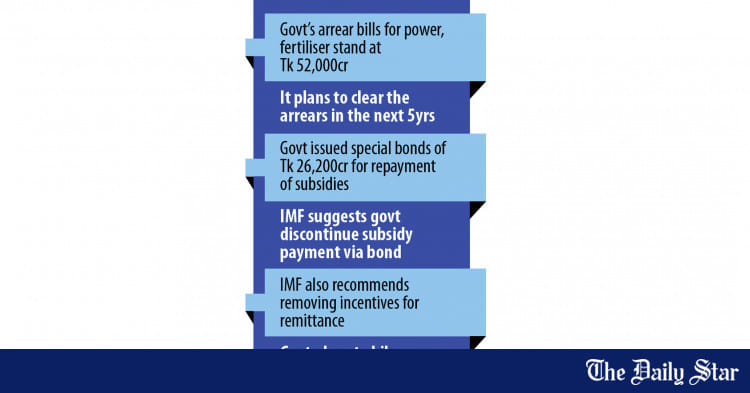
The International Monetary Fund has suggested an alternative to reducing agricultural subsidies -- raising fertiliser prices and providing cash or vouchers for certain farm inputs to support poor farmers.

The global lender also recommended removing incentives for remittance and gradually reducing subsidy on electricity.

The IMF made the suggestions in its programme document as the lender approved $1.15 billion in the third tranche of the $4.7 billion loan to Bangladesh on Monday.

The government has assured the IMF of progressively reducing the subsidy on power by hiking the prices four times a year, but it did not say anything about cutting or withdrawing the subsidies on remittance and agriculture.

"Increases in fertiliser prices could be coupled with cash transfers or vouchers for a range of agricultural inputs (including fertiliser) targeted at small or poor farmers," the IMF said.

It said several options can be considered to lessen the fertiliser subsidy bill.

Raising domestic production of fertiliser by increasing the natural gas supply to existing fertiliser factories could also help cut the reliance on expensive imports. The impact of a reduction in gas supply to other sectors would need to be carefully considered, the IMF said.

In April 2023, the World Bank provided Bangladesh $500 million for agricultural and rural transformation. With the funding, the government will build a comprehensive database of farmers and experiment with e-vouchers for fertilisers and other agricultural inputs.

The IMF said the new database and the findings are expected to yield valuable information that the authorities can use for a rethink of the agricultural subsidy system and put current budget allocations for fertiliser subsidies to more productive uses.

It said the current fixed price system -- under which farmers purchase fertiliser at a set price irrespective of quantity procured or farmer characteristics -- provides a universal and untargeted subsidy that favours the use of fertiliser over other agricultural inputs.

"As a result, farmers may overuse fertilisers while underinvesting in other inputs such as high-yielding seed varieties and precision irrigation systems."

Better agricultural extension services could help lower dependence on fertilisers and achieve the same agricultural output with a smaller amount of fertiliser inputs, the global lender said.

A sharp rise in global prices of these commodities since 2021 has led to a significant increase in subsidy claims in recent years. This is concentrated in the electricity and agricultural sectors, where domestic price adjustments have failed to keep pace with the rise in costs, according to the IMF.

Whereas natural gas and fuel prices were raised broadly in line with international prices, concerns about food security and affordability amid an already inflationary environment led the government to limit price increases on fertilisers and power, it said.

"As a result, subsidy claims by electricity and fertiliser producers and importers have risen substantially and were met in part through arrears and the issuance of special, low-interest bonds to commercial banks to offset outstanding loans to electricity and fertiliser companies."

The government allocated more than Tk 1 lakh crore for subsidies and incentives in the current fiscal year. The same amount has been allocated in the proposed budget for the next fiscal year.

As per the IMF report, the government has recognised the unsustainable nature of the current subsidy bill and signalled its intention to raise power prices in 2024 and beyond.

It said the government intends to avoid incurring new arrears and enable the gradual clearing of arrears and eventual phasing out of power subsidies over five years.

To this end, the authorities implemented a first round of increase in the retail electricity price by 4 percent in February 2024 and are expected to continue raising prices gradually with around four price adjustments per year.

"Electricity subsidies are thus expected to start declining from FY25."

The IMF said avoiding new domestic arrears and clearing arrears is crucial to safeguarding fiscal prudence.

Increased subsidy demands from independent power producers and fertiliser suppliers since FY22 have resulted in domestic arrears of Tk 52,000 crore, which is about 1 percent of the GDP.

"The issuance of special bonds to commercial banks at below-market interest rates to pay off outstanding debts of electricity and fertiliser companies in lieu of subsidy payments should be discontinued," the IMF said.

Since January, the government has issued special bonds worth Tk 26,200 crore, which is 0.5 percent of the GDP.

The bonds carry interest rates equal to the repo rate, below prevailing market rates for treasury bonds of comparable maturity (8-10 years) and can be used as collateral against liquidity facilities from the Bangladesh Bank, it said.

The repo rate is the rate at which the central bank lends money to commercial banks.

The government now provides 2.5 percent incentives for remittance.

The IMF said the recent exchange rate reforms make such an incentive for attracting inflows unnecessary.

"Consequently, the government is encouraged to reduce this subsidy below 2 percent and eliminate it eventually."​
 

Agri product export rises, but amount remains below par
Staff Correspondent 29 June, 2024, 22:20

1719703950506.png

A file photo shows a man arranging jackfruits at a roadside makeshift shop in the capital Dhaka recently. Bangladesh's agricultural product exports increased in the July-May period of the 2023-24 financial year compared with that in the same period of the previous financial year, but exporters expressed disappointment over the amount, saying that the export performance was below par. | New Age photo

Bangladesh's agricultural product exports increased in the July-May period of the 2023-24 financial year compared with that in the same period of the previous financial year, but exporters expressed disappointment over the amount, saying that the export performance was below par.

Bangladesh has failed to fully realise the potential of its agricultural product exports to the global market due to a shortage of air cargo, excessively high freight costs, and increased production costs of vegetables, exporters said.

They urged the government to ensure the availability of air cargo at competitive rates for agricultural products to maintain competitiveness on the global market, as competitor countries like India, Pakistan, and Sri Lanka are capturing potential market share in the Middle East and the United Kingdom.

According to Export Promotion Bureau data, Bangladesh's agricultural product exports in the 11 months of FY24 increased by 8.2 per cent to $846.33 million compared with that of $782.19 in the same period of FY23.

'We should not be complacent with the 8 per cent growth in the sector, instead, we must remember that export earnings from the sector exceeded $1 billion in FY21 and FY22,' Mohammad Monsur, chairman of the FBCCI standing committee on import and export of fruits and vegetables, told New Age on Saturday.

He observed that exports in the sector had been decreasing for the past three years due to lack of adequate cargo space for perishable goods, high freight costs, a shortage of scanners at the country's airports and increased production costs of agricultural products.

Monsur, also managing director of Monsur General Trading Company, claimed they were facing a severe shortage of cargo space as air shipments of readymade garments had increased in recent months due to the Red Sea crisis.

Additionally, he mentioned that Biman Bangladesh increased freight rates 10 times in the past two months, with costs rising to $4.30 a kilogram from $2 a kilogram in February.

The EPB data showed that, Bangladesh's vegetables exports in July-May of FY24 increased by 52.23 per cent to $88.92 million compared with that of $58.03 million in the same period of fY23.

Dry food exports in the period increased by 6.45 per cent to $200.96 million.

The data showed that the country's fruits exports in the first 11 months of FY24 increased to $22.33 million from less than $1 million in the same period of the previous financial year.

Monsur said that although the data showed significant increase of fruits exports in July-May of FY24 and the earnings mostly came from India as exporters were forced to send mangoes, litchis and jackfruits to India through land ports instead of the UK and the Middle East due to lack of cargo space.

He also said that the earnings could have increased if exporters could send the fruits directly to the European and Middle East markets.

The exporter also said that in exporting vegetables Bangladesh had failed to gain its potential market share in the UK, Australia, Saudi Arabia and the United Arab Emirates, as competitor countries, including India, Pakistan and Sri Lanka were sending low-cost vegetables with lower freight costs than Bangladesh.

The government data showed that Bangladesh's export earnings from vegetables in FY23 decreased to $61.14 million compared with that of $164 million in FY20.

The country's vegetables exports were at $99.91 million in FY22.

The Federation of Bangladesh Chambers of Commerce and Industry has recently urged the government to ensure sufficient air cargo capacity to expand the export of fruits, vegetables and other agricultural products.

FBCCI president Mahbubul Alam said that the apex trade body had already held high-level discussions with the government to address issues related to the import and export of goods.​
 

AI set to revolutionize agriculture in Bangladesh
1719788861576.png


Agriculture, the backbone of Bangladesh's economy, is on the brink of a technological revolution. With agriculture contributing approximately 13.6 percent to the national GDP and employing nearly half of the workforce, advancements in artificial intelligence (AI) offer an unprecedented opportunity to enhance productivity and sustainability in the sector.

Bangladesh, like many developing countries, faces technological backwardness in agriculture. AI can act as a catalyst, fast-tracking the adoption of advanced technologies.

Empowering farmers with disease identification

Identifying plant diseases early and accurately has been a perennial challenge for Bangladeshi farmers. Traditional methods often require expert knowledge and significant time investment, resources that smallholder farmers frequently lack. AI technology is poised to change this dynamic.

Leveraging image recognition, AI systems can identify plant diseases with remarkable accuracy. Farmers can photograph an affected plant using a smartphone, and the AI will diagnose the disease and suggest remedies. This innovation saves time and prevents crop losses, ensuring better yields and income for farmers.

Accessible consultations for illiterate farmers

A significant number of Bangladeshi farmers are illiterate or have limited formal education. Traditional dissemination methods, like written manuals, are often ineffective for these farmers.

AI-powered systems can provide consultations over the phone, using natural language processing (NLP) to understand and respond to queries in local languages. This voice-based interaction makes it easier for farmers to receive expert advice, improving their farming practices and decision-making. This also solves the dependency on smartphones, a blocker to reaching out to many farmers in the country.

Adapting agricultural education

To effectively implement these technological advancements, agricultural universities in Bangladesh must adapt quickly. Updating curricula to include the latest technologies and AI applications is essential.

Equipping students with knowledge and skills in modern agricultural practices will ensure a future-ready workforce capable of driving the sector forward.

Role of start-ups in bringing new technology

Agritech start-ups in Bangladesh are emerging as key players in introducing new technologies. Though still few, some start-ups have gained recognition and secured funding.

Notable examples include iFarmer, Khamar-e, Integrated Precision Agriculture and Engineering Bangladesh (iPAGE), Krishi Shwapno, Bhalo Social Enterprises, and Fashol. These start-ups are at the forefront of integrating AI and other advanced technologies into agriculture, providing innovative solutions that enhance productivity and sustainability.

Global success stories

AI's transformative potential in agriculture is evidenced by success stories worldwide. In India, the AI-powered app Plantix helps farmers identify pests and diseases by analysing photos of crops, significantly reducing crop loss and improving yields.

In the United States, Blue River Technology, acquired by John Deere, uses machine learning to develop precision agriculture equipment that identifies and manages individual plants, reducing herbicide use and improving crop management. In Africa, AI-powered drones for precision farming have improved irrigation management, soil analysis, and crop monitoring, increasing productivity and sustainability.

The integration of AI into agriculture in Bangladesh promises a transformed landscape. By enabling disease identification, providing accessible consultations, supporting start-ups, updating educational curricula, and learning from global success stories, AI can significantly enhance agricultural productivity and sustainability.

As Bangladesh strides towards a technologically advanced future, AI will undoubtedly play a crucial role in shaping its agricultural success.

The author is chief of staff of ShopUp.​
 

Supporting small farmers to ensure nation's food security
Published :
Jul 02, 2024 22:09
Updated :
Jul 02, 2024 22:09
1719964253307.png


Small farmers, who constitute 28 per cent of the country's population and work on farmlands that have been shrinking at an alarming rate of about 16,000 hectares annually, thanks to unplanned urbanization, development work and expanding settlements, are obviously in dire straits. As they contribute in a big way to the nation's food security, protecting them involves preventing the agricultural lands on which they still work from further receding. At the same time, they would need policy support including cheap credit to procure the crucial agricultural inputs to continue with their farming activities. Needless to say, they would also need the support from the scientific community to come up with new farming techniques to make the best use of the agricultural land still available through preserving its fertility and increasing productivity by introducing newer varieties of rice and other food crops that can withstand the onslaught of climate change.

All such issues of huge national significance were the subject of deliberations at a recent seminar hosted in the city by the government-supported policy think tank, Bangladesh Institute of Development Studies (BIDS). The experts at the discussion could not agree more with the factors already delineated in the foregoing that are coming in the way of the small farmers' capacity to go on with their farming activities sustainably. Consider the target of producing 47.2 million tonnes of rice by 2050, as projected by the Bangladesh Rice Research Institute (BRRI), which does research and develop ways to improve rice production. It may be argued that encouraging commercial agriculture more aggressively, the nation can meet that target using modern farming technology. But in that case, the challenge would be to protect the small farmers and their livelihood. In fact, protection of the small farmers also includes preservation of their agricultural practices handed down from previous generations and the culture that go with them.

True, commercialisation of agriculture that requires investment of bigger capital promises higher profit. And that often comes at the expense of the existing farming practices that focus more on protecting the environment and the ecosystem of land, water, and the farming community than on just yield. And how thoughtless use of fertllisers and pesticides wreaked havoc on land fertility and agricultural ecology in the name of the mid-twentieth century's so-called 'Green Revolution' is now history.

A developing, land-scarce nation facing the challenge of feeding an ever-growing population, Bangladesh can ill-afford to put all its eggs in one basket. So, a mix of commercial, scientific and traditional farming culture would be required to protect the existing farming community as well as boost production of food grains. In this connection, discussants at the said seminar suggested bringing over 4.4 million hectares of land in 17 coastal districts under three-season cultivation. The policymakers in the agriculture sector need to think seriously about the idea keeping in mind that the worst challenge to food security will be coming from the country's coastal districts, home to around 29 per cent of the population. As rising sea level has increased salinity of coastal lands, the farmers of those districts will require such varieties of food crops which can fight salinity, floods and other vagaries of nature effectively.

Saving the small farmers is not just about serving a humanitarian cause. For it is important that a sector that accounts for 40 per cent of national employment is well-protected through necessary state intervention in the form of financial inclusion of small farmers so their living condition is improved. In that case, they won't have to switch to other professions or migrate en masse to the cities in search of a livelihood.​
 

Traditional farming now at risk
SYED MANSUR HASHIM
Published :
Jul 02, 2024 22:03
Updated :
Jul 02, 2024 22:03
1719964510585.png


Small farmers are now in danger of leaving the profession altogether. In the face of severe shortcomings, the traditional small holding farmer can no longer afford to stay true to the profession of his forefathers and that has raised alarm bells across the board from policymakers to agriculture experts. And although the country has pivoted towards gradual industrialisation and trade, food security remains a cornerstone of State policy because of the large population that must be fed. In the midst of the increasing trend of big business groups branching into large-scale commercial farming, the lot of the average farmer has fallen on hard times.

These matters and others came up for discussion at a seminar organised by the Bangladesh Institute of Development Studies (BIDS) last Sunday. Experts have opined that traditional agriculture needs to evolve and in a developing nation like Bangladesh, more targeted policy support is needed to save small farms. Increasingly, agri-commercialisation is elbowing out small farmers, who form the backbone of agriculture in this country. The fact that Bangladesh needs to raise rice output to 47.2 million tonnes by 2050 isn't going to happen on its own, and a lot depends on these subsistence farmers surviving and continuing to grow crops. While technological advancements have made it possible for the country to feed its 165 + million populace till date, experts opined that some 4.4 million hectares of land in 17 coastal districts need to be brought under the three-season cropping system.

Policymakers must be acutely aware of giving space to small farmers if it wishes not only to uplift millions out of subsistence living but also ensure food security. However, changing weather patterns - ample historical data that is available through research in Bangladesh and collaborative works between Bangladeshi and foreign agencies, reveal that adverse conditions point to a declining trend of arable land. While there has been progress made in introducing multiple stress-tolerant varieties of crop, policy support will be essential to bring more land under cultivation.

Entire generations of farmers are quitting farming and this has everything to do with the fact that they cannot get their money's worth during harvest season. Market imperfections run rampant and not much has happened to cut out the middlemen who make windfall profits at the cost of farmers who often sell at a loss. The lack of proper logistics is another major impediment that hasn't been sorted out satisfactorily for farmers to get their harvested crops or other produce to markets cost effectively.

As pointed out by one expert, the government should give them support in terms of mechanisation, i.e. provide the financial regime whereby small farmers can leapfrog into the 21st century with time-saving equipment that could seriously increase food production at field level. Despite some breakthroughs, not enough research is being done to bring multiple varieties of crops and other foodstuffs to the farmers which could help them increase the variety of things they can grow or rear on land. A gamut of policy initiatives that will range from reaching not just financial support, but also work out the nagging problems of supply chain, which includes addressing problems with the cold chain. Bangladeshi farmers produce in abundance many essential items - a significant portion of which rots due to unavailability of sufficient cold storage facilities.

Experts and agriculturists agreed that many issues need to be worked out, without which, traditional agriculture employing tens of millions of people will increasingly be at risk. Extortion on roads, transport management and the presence of syndicates which need to be treated as a law-and-order problem and dealt with accordingly. It is not the job of the government to manage the market, rather it ought to be involved heavily in ensuring fair market practices.​
 
Urea output plummets on feeble gas supply
Imports meeting fertiliser needs ahead of aman season

1720572023634.png


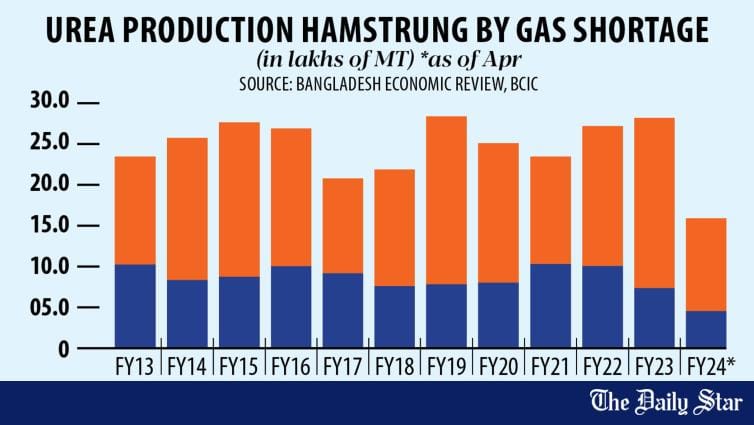
Bangladesh is mostly relying on imports for urea as gas shortage has brought local fertiliser production to a near halt, in a development that will cost the country dearly in terms of foreign currency reserves and food inflation.

The country's six urea factories need 329 million cubic feet of gas a day (mmcfd), according to Petrobangla. Since February, Petrobangla has been providing only 107 mmcfd to the fertiliser sector. Subsequently, four of the six factories have halted production.

Only Ghorashal Polash Fertiliser (GPFPLC) and Karnaphuli Fertiliser (Kafco) are getting their required gas and are in operation. Of the two, the government has to purchase fertiliser at the prevailing rate in the global market from Kafco, a joint venture between the government and private investors from Bangladesh, Japan, Denmark and the Netherlands.

It means the government is getting urea from only GPFPLC out of five state-owned producers at a lower cost.

Currently, there is no fertiliser crisis, according to Md Saidur Rahman, chairman of Bangladesh Chemical Industries Corporation (BCIC).

"If we don't get gas from one or two more factories in the near future, there might be a problem," he said, adding that if the energy division were able to supply adequate gas, the factories would have been running in full swing.

The Aman season, which accounts for about 40 percent of Bangladesh's rice production, begins in July-August and ends in November-December. If the gas crisis continues, fertiliser supply may be hampered in the upcoming Aman season, which can go on to fuel food inflation.

In the absence of local urea production, the government is relying more and more on costly imports.

This gives rise to two problems: exhaustion of limited dollar stockpile and ensuring a strict shipment schedule of fertilisers, said Jahangir Alam, an agriculture economist.

As of June 30, foreign currency reserves stood at $21.8 billion, enough to meet about three-and-a-half months' import bills, according to data from the Bangladesh Bank.

"If we rely completely on imports during the farming season, there might be hold-ups in getting steady supply of fertilisers. Rather, it will be beneficial for all if we increase gas supply to the fertiliser plants," Alam added.

Gas supply to the fertiliser plants was reduced to make way for increased supply to the gas-fired power plants for higher electricity generation during the summer months, said a top official of Petrobangla on the condition of anonymity to speak candidly on the matter.

"The gas crisis has been going on for a long time, so the supply has to be rationed," he added.

Between July last year and April this year, Jamuna Fertiliser could meet just 42 percent of its production target for want of gas, while Shahjalal Fertiliser managed 57 percent, according to the latest report of BCIC.

Chittagong Urea Fertiliser met 74 percent of its production target and Ashuganj Fertiliser and Chemical Company 69 percent, the report said.

The four factories are shut now, which means they fell short of their production target for fiscal 2023-24 by a wider margin, according to BCIC officials.

Besides the urea, Bangladesh consumes DAP and TSP fertilisers, both of which are mostly imported.

The lone DAP factory achieved only 36.6 percent of its production target and the TSP factory achieved about 66 percent in April.

Last fiscal year, as much as $5 billion was spent on fertiliser imports, according to data from BCIC. In fiscal 2020-21, fertiliser imports stood at $1.4 billion. In the previous years, imports were even lower.

About 15 years ago, BCIC was producing 70 percent of the fertiliser required, according to Alam, also a director of Dhaka School of Economics. Now, local production accounts for 25 to 30 percent of the demand.

"BCIC became import dependent instead of focusing on scaling up local production, which was the main duty of the organisation. We have the advantage and ability to produce nearly 100 percent of required urea locally, but due to gas shortage, the import dependency has been increasing," Alam added.

If the government purchased fertiliser from local producers, the cost for per metric tonne of urea would be about Tk 25,000, according to BCIC officials. It costs more than Tk 45,000 to bring the same volume of urea from abroad. For urea purchases from Kafco, the rate is about Tk 40,000.
 

Potential of seaweed farming looks bright
SYED MANSUR HASHIM
Published :
Jul 12, 2024 21:27
Updated :
Jul 13, 2024 21:41
1720918917082.png


Seaweed typically grows in salty sea water or on rocks below the high-water marks. It is an aquatic resource that is rich in iodine, vitamins and minerals and has been used widely in food supplements and pharmaceutical products. Research in many nations has shown that it has properties to help fight various diseases in the human body and yet this natural resource has hardly been given the attention to it deserves in Bangladesh. Our farmers at large are not aware that this could very well provide a valuable source of income if farmed correctly.

While it is easy to talk about the 'Blue Economy', steps have not been taken at policy level to popularise seaweed cultivation. According to one study by a UN body, the annual global production of seaweed until recently was 33 billion tonnes with an economic value of US$11.80 billion. In Bangladesh, farmers are currently producing roughly 400 tonnes with an economic value of roughly $0.5 billion. The global market production is projected to double by 2024.

These are serious numbers and it's time to take cognizance of the fact that Bangladesh needs to diversify its exports. For too long the discourse in the country has revolved around diversification of readymade apparels, which constitutes 85 per cent of exports. The narrative has revolved around industrial production. While it is easy to forget that around 40 per cent of the workforce is still engaged in agriculture, and climatic changes are effecting changes in weather patterns that are adversely affecting traditional crops, it is time the government started thinking about other things like, seaweeds. As stated before, seaweeds have multiple applications and use ranging from food supplements to and for fodder (for cattle), chemicals, medicines, construction materials, to name but a few.

Another major advantage is that the production of this resource requires no land, fertilisers or pesticides - it simply grows on its own. All it requires is proper cultivation in the coastal belts of the country. According to researchers, there are some 32 types of seaweed available in Bangladesh and "14 of these species are commercially viable but only four variants are being farmed, that too on a small scale."

While the applications for this aquatic resource are well documented, as is the commercial value of it, there is no national plan to develop the resource on a large scale and numerous problems have been identified which hold back the growth of this sector. Cox's Bazaar area remains a prime location for planned seaweed production. Some efforts have been taken by the UNDP to train and financially equip some members of the community and the exercise has shown its viability. But it is one thing to ramp up seaweed production that adheres to international standards, quite another to introduce proper packaging and marketing of the product in question. Seaweed is a product and like all products, it requires a proper supply chain, marketing and promotion.

The global market for this product already exists, but there are numerous uses for it locally. In other countries, seaweed has been used to make fodder for cattle and that has direct application in our agriculture. If the supply of seaweed could be ensured in a large quantity at domestic level, the country's pharmaceutical industry would procure it as a raw material, and the surplus could be exported.

With introduction of large-scale seaweed cultivation, Bangladeshi farmers could get the benefit of opening up a secondary source of income and nutrition - not just by farming it, but also partly processing it, which would be considered "value addition" to fetch better prices. This could generate employment in the coastal belt. At the end of the day, since the demand is there, why not use this nature's gift to help generate income to reduce poverty and better the livelihoods of people along the coastal belt? Experience in other countries has shown that that seaweed is in vogue in developed nations as a food and new applications for this versatile resource is being found every day.

For any of this to happen, policymakers need to take stock of what is needed to develop a seaweed sector. Some of the impediments include lack of technology and knowhow, a trained labour force to harvest seaweed, etc. But these are hardly issues because workers can be trained and joint-ventures can be set up with foreign companies that can introduce the technology needed to make modern farms. State research organisations can also reach out to other countries which are global leaders in seaweed production. What is needed is policy direction and the will to effect change and only the State has the resources to imitate the changes needed in terms of rules and regulations and introduce the right policies to encourage what could be, a budding industry with serious export potential.​
 

Agro-processors for allowing aromatic rice export

Agro-processors have urged the government to allow the export of aromatic rice to increase earnings, according to a press release of Bangladesh Agro-Processors' Association (Bapa).

Bapa said the domestic market for fragrant rice is small.

Exports of aromatic rice will result in the shipment of other products, enhancing the export basket, said the trade body after its 23rd annual general meeting (AGM) at Dhaka Club on Saturday.

The commerce ministry last year banned the export of fragrant rice in an effort to contain prices in the domestic market.

At the AGM, Bapa members expressed discontent over the government's latest move of reducing incentives on the export of agro-processed products from 15 percent to 10 percent.

Bapa demanded a reduction of the source tax for export from one percent.​
 

Members Online

No members online now.

Latest Posts

Latest Posts