โ˜• Support Us โ˜•
[๐Ÿ‡ง๐Ÿ‡ฉ] - Agriculture in Bangladesh | Page 10 | PKDefense

[๐Ÿ‡ง๐Ÿ‡ฉ] Agriculture in Bangladesh

Reply (Scroll)
Press space to scroll through posts
G Bangladesh Defense
[๐Ÿ‡ง๐Ÿ‡ฉ] Agriculture in Bangladesh
223
9K
More threads by Saif


Enough fertilizer in stock to last till December: Agriculture Secretary
UNB
Published :
Sep 08, 2024 22:17
Updated :
Sep 08, 2024 22:17

1725840639139.png


There will be no crisis with the stock of fertilizers, whether urea or non-urea, in the country till December, according to the secretary to the Agriculture Ministry on Sunday.

There is at present a stock of 10.63 lakh metric tonnes of fertilizer, Secretary Emdad Ullah Mian said on Sunday.

โ€œWith the current stock of fertilizers, the demand can be met till December. However, there is still some crisis in opening the LC of fertilizer import but we are constantly working to resolve the issue,โ€ he said, while speaking at a view-exchange meeting with Bangladesh Agriculture Reporters Forum (BARF) at the ministry.

However, the process to provide incentives to the affected farmers in the flood-hit areas is ongoing, he said.

So far, Tk 193 crore has been allocated for the farmers which will be used for agriculture rehabilitation in phases, he added.

More than 14 lakh farmers in 23 districts have been affected by the floods, but mainly 11 districts have suffered extensive damage and most of the incentives are being given to the farmers of these districts, said secretary Emdad.

Besides, seedbeds of Aman have been made in all the unused lands of the agriculture department in these affected districts and adjoining districts which will be distributed among Aman farmers.

Under the rehabilitation programme, 80,000 small and marginal farmers of nine districts will be given free seeds of Ufsi variety, 10 kg of fertilizer assistance and Tk 1000 cash through mobile banking services for cultivating one bigha of land, he said.

Meanwhile, around 1.5 lakh farmers in 22 districts will be given seeds of different varieties of vegetables and Tk 1,000 in cash for early winter vegetable cultivation at homesteads.

The floods were caused by the onrush of water from upstream and torrential rainfall from August 16 to August 30, he said.

Almost ten lakh metric tonnes of produce including paddy, fruits and vegetable were damaged in the flood, incurring a damage of Tk 3,346 crore.

Besides, a total of 3,72,733 hectares of land have been damaged in the flood.​
 

Women in agriculture: Breaking barriers, shaping futures
Published :
Sep 08, 2024 21:53
Updated :
Sep 08, 2024 21:53

1725841146247.png


Women comprise half of the country's population, yet they still lack equal access to the formal workforce. In the informal sectors, such as household work and rural farm and non-farm activities, they play a vital role that often goes unrecognised. There is, however, hope that the situation will gradually improve as more and more women are joining the mainstream workforce. Over the past decade, Bangladesh has witnessed a quiet but powerful transformation in its agricultural sector. Women are now stepping forward from management of household chores to undertaking of commercially run small and medium farming enterprises across the country. This shift is not only altering the face of agriculture but also changing the dynamics of the labour force, where females are increasingly outpacing their male counterparts in participation and entrepreneurship. According to the Bangladesh Bureau of Statistics (BBS) Labour Force Survey (LFS) 2022, women aged 15 and above now account for 26.2 per cent of the agricultural workforce, compared with 19.2 per cent of men. This represents a significant 7-percentage-point gap, with women taking the lead in agriculture and its sub-sectors, including poultry, livestock, fisheries, and horticulture.

A recent report published in the Financial Express shed ample light on the success stories of female agro-entrepreneurs. The story of one woman entrepreneur highlights the scope of this transformation. Starting with a modest cattle farm, she has expanded into a thriving enterprise with croplands, fisheries, and livestock. Her journey, along with countless others, signals a broader trend of women turning household farming into commercial operations. Women, often viewed as supplementary contributors to family farming, are now the driving force behind many agricultural enterprises. This not only increases their economic independence but also empowers them to take control of their lives and play important roles in their communities. Women's growing participation in agriculture is also important to meet the shortage of farm labourers as most of the male farmers are migrating to urban areas or abroad with the hope of earning more money. Here, women can fill the vacuum left by their male counterparts.

Analysts believe that this gender shift in agriculture can further boost Bangladesh's agricultural productivity, provided women's capacity is continually upgraded. Various stakeholders-including local startups, banks, and international organisations-are already stepping in to support these efforts. Companies like iFarmer are facilitating access to finance, inputs, and markets, ensuring that women farmers have the resources they need to grow their businesses. These collaborations are dismantling long-standing barriers that have held women back.

In today's world, women are seen as active agents of change. The increase in the number of women in farming and entrepreneurship is just one example of how women are overturning long-standing gender norms that have confined many to household chores for generations. As women continue to cement their foothold in various sectors, it is essential to address the obstacles that may hinder their progress, such as the gender pay gap and sexual harassment. Moreover, to sustain this momentum, government agencies, commercial banks and development partners must intensify their efforts to provide the necessary support. Thus women's access to the same resources and opportunities as their male counterparts can be ensured. Training, access to technology, and financial inclusion are crucial to helping their transition from small-scale operations to larger, more impactful enterprises.​
 

Govt to train 32,000 Farmers

1727048359646.png

Photo: Collected

The government has launched an initiative to train 32,000 farmers on climate change adaptation strategies in an effort to build resilience against the growing impact of climate change.

As part of this project, 800 farmer groups from nine upazilas across five districts will be selected to participate in the training.

The plan was revealed at a National Validation Workshop on Vulnerability Risk Assessment held today.

The training aims to equip farmers with the knowledge and skills needed to adapt to changing environmental conditions, helping secure agricultural productivity in the face of climate challenges.

According to officials, the Global Environment Facility (GEF) is funding this project.

The project, with a budget of Tk 66 crore, began in July 2023 and is expected to be completed by June 2028.

Of the total budget, Tk 56 crore has been allocated to the Department of Agricultural Extension (DAE), while Tk 10 crore is set aside for the Department of Environment.​
 

Averting a potential threat to agriculture
Published :
Sep 29, 2024 21:34
Updated :
Sep 29, 2024 21:34

1727660893612.png


Any possible threat to a vital sector of the national economy, agriculture to be precise, raises alarm and great concern. A back-page story of the Financial Express on Saturday shed light on a looming fertiliser crisis that could hit agricultural output hard during the upcoming Rabi season in January. The recent floods have already severely impacted crop production in 23 districts, affecting over 1.41 million farmers. A total of 986,214 tonnes of crops, including Aush and Aman paddy, vegetables, ginger, turmeric, fruit orchards, chilies and tomatoes, have been completely destroyed. Now a fertiliser shortage, as warned by different government agencies including the agriculture ministry and the Bangladesh Chemical Industries Corporation (BCIC), poses a double threat to the sector.

The economic hardship farmers have been facing due to the devastation of crops caused by the vagaries of nature is undoubtedly a matter of grave concern. The most alarming aspect of this situation, with potentially devastating consequences for the future of agriculture, is the failure of relevant government bodies to import sufficient fertiliser. Thanks to the unparalleled resilience of farmers against all odds, they will somehow recuperate from the losses caused by the floods. However, what will happen to them, to agriculture, and to the national economy if farmers are not supplied with an adequate amount of fertiliser in time? The gravity of this issue cannot be overemphasised. Experts have pointed out that a significant shortage of fertilisers could lead to severe disruptions in agricultural production, potentially spiralling into widespread unrest across the nation.

Despite the government's efforts to manage the situation, including approving the procurement of 140,000 tonnes of fertilisers and seeking to source supplies from various countries, including Russia, there remains an urgent need for coherent and coordinated action. The Bangladesh Agricultural Development Corporation (BADC) currently owes $80 million in bills to international suppliers, a situation that has prompted major suppliers to halt shipments of fertilisers to Bangladesh. Projections indicate that by January 2025, the country's fertiliser stocks will dwindle to critical levels, potentially standing at just 0.438 million tonnes, which is insufficient to meet the needs of farmers during the peak Rabi season. Stakeholders are, therefore, asking the government to increase fertiliser imports and ensure timely payments to suppliers. Moreover, a number of fertiliser factories at home have been closed for months due to gas shortages, exacerbating the situation. It is imperative to ensure that fertiliser production facilities receive adequate gas supplies to resume operations.

Against the backdrop of poor performance in different sectors, the country's agriculture achieved sterling successes over the years in terms of research and development of new strains of crops, crop diversification and a near self-sufficiency in food production. These achievements of the sector not only contributed to the relative economic stability of the country but also to an increased calorie intake of the people and poverty reduction. No laxity should be allowed to vitiate the prospect of this vital sector. Fertiliser and quality seeds are the most fundamental inputs on which the agricultural sector thrives. Even if it requires allocation of special fund for procuring adequate amount of fertiliser, the government must opt for the initiative in the interest of the economy and the nation.​
 

Ensure steady supply of fertilisers for farmers
Looming fertiliser crisis could disrupt food production

1728174369580.png

VISUAL: STAR

It is quite concerning to learn that the country may soon face a severe fertiliser shortage unless the government takes immediate action to address the production and import shortfalls. According to a report by Samakal, three major fertiliser factories have been closed for an extended period due to the ongoing gas crisis. At the same time, the government has been unable to meet its fertiliser import targets due to the dollar shortage and resultant accumulation of outstanding bills. Complicating matters further are administrative issues stemming from the instability following the July uprising and regime change, which prevented timely decisions. If the government fails to address these challenges promptly, it could disrupt food production in the coming months.

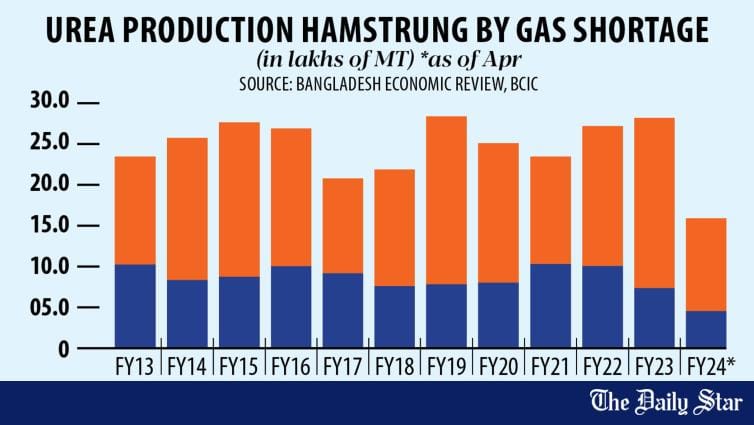
Reportedly, due to gas supply issues, factories under the Bangladesh Chemical Industries Corporation (BCIC) fell short of the fertiliser production target for the fiscal year 2023-24. While the target was set at one million tonnes, only 646,000 tonnes were produced, leaving a deficit of more than 350,000 tonnes. The current fertiliser stocks stand at just 435,000 tonnes, while the demand through March next year is 1.8 million tonnes. The alarming gap between demand and supply (through domestic production and imports) highlights the severity of the problem, requiring swift government intervention.

The question is: how will the government meet this enormous demand with only two of its fertiliser factories operating at present and import efforts being halted? Apparently, the BCIC's attempts to increase fertiliser imports through government-to-government (G2G) agreements have been hampered by the dollar crisis. Furthermore, Bangladesh owes international suppliers $80 million in unpaid bills, leading many exporters from China, Canada, Saudi Arabia, and Morocco to halt shipments.

Given these circumstances, the government must take steps to resolve the crisis urgently. Immediate measures should include settling the outstanding payments to resume imports and avert a supply chain collapse. Additionally, to reduce reliance on foreign imports in the long term, the government should bolster local fertiliser production by resolving the gas crisis and reopening closed factories. This will ensure a more stable and self-sufficient supply chain. We must understand that the fertiliser shortage is directly linked to our food security. Ensuring a steady supply of fertiliser is vital for maintaining agricultural productivity, supporting farmers, and preventing any food crisis. So, the authorities cannot afford to delay action any longer.​
 

Bangladesh's rice output crosses 4cr tonnes for the first time

1728520329263.png


For the first time, Bangladesh has bagged more than 4 crore tonnes of rice in a fiscal year (FY) thanks to increasing yields of the most grown crop, according to official data.

Local farmers have been gradually switching to high-yielding and hybrid varieties of the cereal grain, bringing the country's need for rice imports down to zero.

Estimates by the Bangladesh Bureau of Statistics (BBS) show that farmers bagged 4.10 crore tonnes of rice in FY 2023-24, up by 4.1 percent year-on-year in what was the highest growth in six years.

The largest growth in yields came from Aman paddy, which was harvested in the previous winter ahead of Boro paddy in the dry season. Boro is the principal rice crop in Bangladesh.

Farmers got about 2.10 crore tonnes of rice through the Boro harvest in the May-June period early this calendar year.

FY24 marked the fifth year of a consistent rise in rice production with Wais Kabir, a former executive chairman of the Bangladesh Agricultural Research Council, linking the spike to yield enhancement.

"One of the main factors is that farmers have shifted to cultivating modern varieties of rice. They are growing more high-yielding and hybrid varieties. The acreage has also risen over time," he said.

Jahangir Alam, an agricultural economist, said increased rice production cut import of the cereal grain.

"We did not have to import any rice [in FY24]. Besides, this did not have much of an impact on prices as it seems public and private stocks were adequate," Kabir added.

Data of the food ministry shows that Bangladesh imported 10.56 lakh tonnes of rice in FY23 compared to zero public and private imports as of October 7 this year.

Kabir also said one of the reasons behind the zero rice imports was a surge in wheat imports.

The use of wheat by bakery and food processing industriesas well as animal feed has increased. This contributed to the reduced requirement for rice, he added.

Imports of wheat, the second most consumed cereal grain after rice, soared 71 percent year-on-year to 66 lakh tonnes in FY24.

M Asaduzzman, a professorial fellow at the Bangladesh Institute of Development Studies expressed doubt over the rice production estimate.

He questioned why prices have gone up if supply was indeed adequate.

"Production has not risen as much as reported. Higher prices mean there is a supply shortage," he said, adding that rice accounts for a good portion of food inflation, which was high in the previous fiscal.

The BBS said food inflation rose to 10.65 percent in FY24 from 8.71 percent the year prior.

The price of rice coarse rice, the cheapest variety, was 7 percent higher year-on-year at Tk 50 to Tk 55 per kilogramme in Dhaka yesterday.

Asaduzzman informed that recurrent floods this year have raised concerns over the cultivation of Aman.

"We will have to import rice if Aman production suffers. And that will be clear at the beginning of November. So, the government should take a decision regarding imports next month," he said.

By the end of August, the US Department of Agriculture (USDA) said Aus and Aman rice acreage and production in Bangladesh might decline because of the floods, particularly the devastating deluge in the eastern part of the country.

Estimates by the Department of Agricultural Extension show that Aman acreage declined to 57.35 lakh hectares this season from 35.5 lakh hectares previously.

Agricultural economist Alam said the overall Aman rice output may be 1.55 crore tonnes to 1.60 crore tonnes this year.

"Farmers had to transplant the seedlings late because of floods. This may cause lower yields," he said while adding that imports might not be needed as stocks of the grains are favourable.

"But the next Boro rice crop is crucial," he said. "We will not need to worry about food security of the staple grain if we can ensure production inputs, mainly fertiliser, at the doorsteps of farmers."

Kabir said the ongoing flood in the Sherpur-Netrokona districts will damage the Aman crop in the fields and it cannot be recovered.

"So, whether we will need to import or not will depend on the next Aman harvest. And the output of the upcoming Boro would depend largely on the management of fertiliser by the government."

"The interim government has to ensure proper management of fertiliser to ensure a good harvest of Boro rice," he added.​
 

Flood-hit farmers need proper support
Govt must ensure swift response based on their needs

1728779583495.png


As floodwaters begin to recede in the Mymensingh, Netrokona and Sherpur region, the scale of the destruction caused by the recent flash floods is gradually becoming apparent. Current estimates suggest that Aman crops over 83,000 hectares of land have been totally or partially ruined, impacting around 322,000 farmers. Moreover, a large number of fish farms have been washed away. In Sherpur alone, floods have washed away the fish from 7,366 ponds, affecting around 4,500 farmers. While a comprehensive assessment of the damage done to agriculture, fish farms, livestock and properties can only be made after the water fully recedes, it is already clear that recovery will be an immense challenge for this agriculturally crucial region.

Farmers whose crops have been destroyed have an uncertain future awaiting them. The damage to this season's Aman paddy is beyond repair, as the window for new cultivation has already passed. How will these farmers survive? Or, consider the case of fish farmers like Mohammad Ali, who had taken the lease of an acre of land to set up a fish farm and invested nearly Tk 7 lakh by taking a bank loan. He and others like him have not only lost their livelihoods but are now saddled with a crushing debt.

While the flood situation in these districts has improved to some extent over the last few days, many villages in low-lying areas still remain inundated. According to the local administration, about 13,000 families are still trapped by water. These people, too, face an uncertain future, not knowing what awaits them when the waters finally recede.

Under the circumstances, the government must urgently come up with a robust post-flood recovery plan for all the affected areas, while continuing its relief efforts by providing food, medicine and other essential supplies to the victims. Understandably, livelihood rehabilitation, particularly for farmers, will be one of the government's biggest challenges as they need to be given an alternative choice of crops or vegetables to cultivate since the Aman season is already over. To this end, the Department of Agricultural Extension should swiftly assess the conditions on the ground and identify suitable crops and vegetables for the affected areas. Immediate distribution of crop saplings, vegetable seeds, fertilisers, and other necessary inputs is also essential.

Those who cannot go back to their previous livelihoods must be given alternative means of earning a living. This is a huge task requiring strong coordination among all the relevant government agencies. We hope that the government will rise to the challenge, supported by NGOs and philanthropic organisations, to meet the post-flood needs of the affected communities.​
 

Bangladeshโ€™s cotton use forecast revised upwards

1728780319225.png


Bangladesh's cotton consumption is expected to rise marginally to 78 lakh bales in marketing year 2024-25, which began in August, according to a US Department of Agriculture (USDA) report published on Friday.

The US agency, in its initial projection in April this year, estimated cotton consumption in Bangladesh, the world's second-biggest clothing factory, at 80 lakh bales.

One bale equals 480 pounds or 218 kilogrammes (kg).

It revised the projection downwards in August and September before raising the forecast in its latest update.

Although the USDA did not explain the reasons behind the hike in its latest report, titled "Cotton: World Markets and Trade", industry stakeholders said the overall use of cotton by local textile mills may be higher this year.

"Business was unfavourable for various reasons, including the gas crisis and hike in its prices alongside unavailability of US dollars to open letters of credit (LCs) for cotton imports. Now, we can open LCs," said A Matin Chowdhury, managing director of New Asia Group, a vertically integrated apparel manufacturer.

Import and consumption of cotton yarn also grew last year.

It appears that local production of yarn will increase this year as cotton prices are falling in the international marketโ€” A Matin Chowdhury Managing Director of New Asia Group.

"It appears that local production of yarn will increase this year," he said, citing falling prices of cotton on the international market.

Cotton prices declined 15 percent year-on-year to $1.79 per kilogramme (kg) in July-September from $2.11 a year ago, according to the World Bank Commodities Price Data (The Pink Sheet).

"But a lot depends on gas and electricity supply," he said.

Insiders said the domestic market had been sluggish in July and August, with demand only starting to pick up by the end of September.

"The overall situation has improved to some extent. But spinners cannot run operations properly due to the gas and electricity crises," an official of the Bangladesh Textile Mills Association (BTMA) said.

Mills run at over 80 percent of their capacity when the energy supply is adequate.

"But they are currently running at half of their capacity because of the gas and electricity crises," the official added.

The USDA said Bangladesh's domestic use of cotton hit 88 lakh bales in MY22 to feed the demand for export-oriented knitwear makers, the main export-earning sector.

However, cotton consumption began declining in subsequent years and overall use stood at 77.5 lakh bales in MY24.

The country is highly reliant on imports because of its low domestic production of cotton, which amounts to around 1.5 lakh bales annually.

Local millers import a good chunk from countries in West Africa followed by India, Brazil, the United States and Australia, according to the USDA.

The US agency estimated Bangladesh's imports of cotton for MY25 at 77 lakh bales -- around 2 percent higher than the 75.75 lakh bales imported the previous year.​
 

Agri product exports growing slower than others. Hereโ€™s why

View attachment 7839

Even though Bangladesh is an agricultural country, its agricultural product exports grew at a slower pace compared to other goods over the past decade due to a lack of policy support, high costs and the absence of good agricultural practices.

The country's annual export earnings soared 114 percent to $50 billion in fiscal year 2022-23 in around a decade.

And while data for the whole of fiscal year 2023-24 is not yet available, it stood at $40 billion in the July-May period, according to data of the Bangladesh Bank.

The country's export of agricultural products was worth $536 million in fiscal year 2012-13 and it rose by 57 percent to $843 million by the end of fiscal year 2022-23.

In the 11 months of the last fiscal year, it was $846 million, the data showed.

And while there are several barriers to exporting agricultural products, the main one is a lack of policy support, said Md Iqtadul Hoque, general secretary of Bangladesh Agro-Processors' Association (BAPA).

For instance, aromatic rice exports were banned over apprehensions that it could put the country's food security at risk. "But this type of rice is not an essential food so it is not linked with food security," he added.

According to the Department of Agricultural Extension (DAE), Bangladesh annually produces up to 19 lakh tonnes of aromatic rice, of which it exports only about 10,000 tonnes.

As such, the government has the scope to earn a huge amount of foreign currency by allowing the export of aromatic rice, said Hoque.

There are many other examples of how policy support is lacking, including a reduction of cash incentives from 20 percent to 15 percent from fiscal year 2024-25, he said.

The high cost of raw materials is another reason that local exporters are lagging in international competition, he said, adding that the price of sugar has more than doubled in Bangladesh compared to India and Pakistan.

The price of wheat is also higher in the country, and sugar and wheat are two major ingredients of juice and snack items. "So how will we compete with others?" he asked.

Container freight costs also rose 4 to 5 times here. Besides, food producers need to import specialised packaging and pay a high duty to this end, which pushes up their input cost, said Hoque.

At present, there are 486 manufacturers of processed agricultural products, of which 241 are exporters while the rest cater to the domestic market.

Bangladesh exports cereal grains, tea, vegetables, tobacco, flowers, fruits, spices, dry food and other processed agricultural products to more than 145 countries.

Although the export earnings of the agricultural sector are not soaring, it is helping to ensure food security while also saving the country's foreign currency by providing import substitutes, Hoque added.

By fiscal year 2022-23, Bangladesh's food crop production had increased by around 38 percent to 467 lakh tonnes, as per data of the finance ministry.

Eleash Mridha, managing director of PRAN Group, said the export of agricultural products dropped in the last two years mainly due to the ban on exporting aromatic rice.

He also blamed high prices of sugar and flour and the rise in freight costs, saying cargo freight costs have not increased over the last couple of years in India and Thailand but it did rise in Bangladesh.

"So, we lag behind in competition," he added.

The Association of Southeast Asian Nations (ASEAN) is a good market for Bangladesh and so, the government could sign a free trade agreement with the ASEAN member countries in order to grab the market, he said.

Bangladesh's agro-processing sector has huge potential as most of the raw materials are locally produced, Mridha said, adding that the demand for their products is also high abroad.

As a result of the revolution in agricultural production, Bangladesh ranks third globally in the production of rice, vegetables, and onions while it is second in jute production, fourth in tea production and seventh in potato and mango cultivation.

Crop production in the country has risen in recent years thanks to farm mechanisation.

For example, around 6 percent of the agricultural land in Barishal has been lost due to urbanisation and other causes between 2014 and 2019. However, rice production in the region has not decreased and instead rose by 1.5 times owing to modern cultivation techniques.

In this situation, the country needs to focus on two things before putting in the effort on exports and securing a good position in global markets, said Md Nazim Uddin, senior scientific officer of Bangladesh Agricultural Research Institute (BARI).

The first is to implement good agricultural practices and the second is to ensure the testing of products in laboratories accredited by the International Organization for Standardization (ISO), he said.

Good agricultural practices encourage moderate use of pesticides, organic and chemical fertilisers, and environment-friendly management of resources, he said.

In implementing these practices, it is important that uniform and correct procedures are adopted all throughout the way. It would ensure consumers' confidence as foreign buyers seek assurance of quality food, said Nazim Uddin.

Apart from Western countries, the Middle East has a huge demand for Bangladeshi products and other Asian countries are also exporting to this market comparatively easily, he said.

Sending agricultural products to the Middle East requires proper certification for ensuring food safety. Sometimes, ultrasonic washing and packaging can improve the quality, he added.

Nazim Uddin also said freight costs and a shortage of space for air cargoare major reasons for the low export of agricultural products.

"There is a huge potential for agricultural exports as the international market is huge," he added.

Data of Bangladesh Investment Development Authority shows that the international agriculture market is projected to reach $19,000 billion with a compound annual growth rate of 9.1 percent by 2027.

Bangladesh's total market size for agricultural products was $47.54 billion till 2022. So, there is a huge potential to grow the industry to capture the market. In this situation, the focus should be on the agro-processing industry, Hoque said.

The Bangladesh Institute of Development Studies, a state-run research firm, also identified in a research paper that policy barriers have a major impact on the export process of fruits and vegetables.

Export expansion and demand from supermarkets is constrained by poor quality of produce and imposition of different sanitary and phytosanitary criteria by importing countries, it said while adding that the high cost of airfreight is another big barrier.

Although the industrial and service sectors grew fast over the past decade, even contributing to export earnings and GDP, employment in the agricultural sector remains the major contributor. This indicates that the agricultural sector can ensure a higher number of jobs.

In fiscal year 2016-17, jobs in the agricultural sector accounted for 41 percent of the total labour force while it rose to 45 percent in 2022.

Interestingly, more women are joining the agriculture sector in Bangladesh as their job opportunities in industries, especially garment factories, have stagnated while men are switching to non-farm sectors.

Of the 31.98 million people employed in agriculture, 18.43 million are female, the data showed.

BAPA's Hoque recommended that they be provided bonded warehouse facility and tax rebates so that they could compete with international competitors.

To increase the contribution of the agricultural sector, he suggested that banks should come forward to provide more loans and the government should promote and facilitate farm mechanisation.

BARI's Uddin recommended focusing on Middle Eastern and Asian countries and following good agricultural practices targeting the Western countries.

He also suggested that contract farming by corporates could be a good way of sending products abroad as they can properly meet the preconditions set by the destination countries.

PRAN's Mridha recommended reducing the duty on sugar and flour used by export-based agro-processing industries.​

Produce exports are being slowed because food processing sector has grown beyond leaps and bounds (of which some are also exported). If Mangos get converted to boxed juice - that is export that occurs.
 

Natural disasters cause colossal farming losses
Subsidised crop insurance seen as an effective tool to help affected farmers
Jasim Uddin Haroon
Published :
Oct 12, 2024 23:43
Updated :
Oct 12, 2024 23:43

1728783060130.png


A lack of insurance protection costs Bangladesh farmers hundreds of millions of dollars in colossal crop losses perennially in onslaughts of climate-related calamities, according to independent findings.

Agricultural losses have amounted to an estimated US$700 million over the past six years since 2019 due only to nine cyclones and heavy rains, according to data collated by the Ministry of Disaster Management through assessments conducted by officials at all administrative levels-- from the lowest to the highest tiers.

While considering all types of climate-related disasters, they have found agricultural damages significantly higher, with estimates from the Bangladesh Bureau of Statistics (BBS), the country's national statistical organisation, showing average annual losses of nearly $720 million between 2015 and 2020 or around 1.0 per cent of GDP.

These figures underscore severe threat that climate change poses to Bangladesh's agricultural sector, as crop insurance is not widely available for farmers at present.

In 2019, two major meteorological disasters caused agricultural losses amounting to $105.77 million. In 2020, a single disaster resulted in losses of $115.87 million, followed by a disaster in 2021 in sync that caused damages worth $360.35 million. In 2022, one event led to losses of $12.43 million, while in 2023, three major disasters caused damages of $42.45 million. As of 2024, one disaster has inflicted losses totaling $59.37 million.

A significant flood event in several southern districts in August and September 2024 is not included in those numbers.

The disaster ministry does not account for agricultural losses caused by minor events as they assess losses only for major disasters, according to officials familiar with the situation.

However, the estimates from the BBS for 2015-2020, published in May 2022, include losses from not only major disasters like cyclones and floods but also factors such as heavy rainfall, droughts, waterlogging, tidal surges, thunderstorms, landslides, and river erosion.

According to the EM-DAT database, a global disaster database, Bangladesh has experienced 133 meteorological, climatological, and hydrological disasters since 2000. More than half (70) were storms, especially tropical cyclones, followed by floods (41).

Climate experts note that increasingly frequent high temperatures and shorter winters are creating a gap in assessing the full impact of climate-related losses on the country's agriculture employing more than 40 per cent of total workforce.

Dr. Jiban Krishna Biswas, the immediate -past chief of Krishi Gobeshona Foundation, a non-profit organisation supporting sustainable agricultural research and development, told The Financial Express that high temperatures and shorter winters have become common phenomena in Bangladesh.

"Of course, this is due to global warming," the climate researcher, also former director -general of Bangladesh Rice Research Institute (BRRI), stated.

Dr Fazle Rabbi Sadek Ahmed, a climate scientist and Deputy Managing Director of Palli Karma-Sahayak Foundation (PKSF), says: "Farmers are losing out each year due to floods, droughts, short-lived winters, excessive rainfall, and insufficient rain."

PKSF, which finances NGOs providing credits and non-financial services at the grassroots level, is on the front lines of this development, as the country's agricultural loans amounting to Tk 350 billion annually are primarily disbursed through NGOs.

Dr Ahmed also notes with concern that the increasing frequency of heatwaves is reducing farmers' work capacity and degrading soil fertility, further inflating the already-substantial losses.

The 2024 Bangladesh heatwave, a significant climatic event that began on April 1, saw temperatures soar up to 42ยฐC (108ยฐF). This extreme heat had forced nationwide school closures, according to Meteorological department.

He mentions that Bangladesh lacks the technical capacity to collect and process data on agricultural losses due to heatwaves and short-lived winters from weather stations.

Despite the frequency of climate-related disasters, the country's total 16.88 million farm holdings in accordance with agricultural census remain unprotected, lacking the safety nets necessary to recover from losses and continue farming.

"Crops insurance remains neglected, keeping the entire agricultural sector uninsurable, as no government has seriously addressed the issue," he says in his Dhaka office, his frustration evident.

Farmers like Md Sabiar Rahman from Godagari in Rajshahi, a five-hour journey from Dhaka, are bearing the brunt of these disasters.

In November 2023, incessant rain turned his paddy fields into a soggy, inharvestable mess, costing him Tk 100,000 or $ 834, he shared with this correspondent recently during a visit.

Forced to take a Tk 50,000 or $417 loan from an NGO to cover his losses, Rahman struggles with the mandatory monthly deposits called DPS (a monthly deposit pension scheme)required by the loan, further straining his fragile finances.

Sitting under the tin roof of his modest home in Dewapara in Godagari, Rahman recalls the brief respite that a climate-related crop -insurance project offered him in 2018 when a similar disaster struck.

"We need financial help after disasters that affect our crops, but there's no insurance protection now," he says, his voice tinged with frustration and desperation.

Rahman's concerns are a common topic at local NGO meetings as he frequently advocates for the reinstatement of crop insurance.

Ekramul Hoque of Dhuroil in Mohanpur, another area in Rajshahi, has similar tales to tell.

Hoque, who now relies entirely on agriculture after leaving his job as a madrasa teacher (religious school), cultivates paddy and potatoes on his five bighas (approximately 135,000 square feet) of land.

"We are often victims of nature-whether it's floodwater, heavy rain, or no rain at all-it all affects our crops," he says.

The short-lived winters also impacts his potato cultivation, leading to poor yields.

"We need financial support after losing our crops, but there is no insurance now," Hoque laments, recalling the one time he insured his paddy in 2018, a decision he wishes he could make again.

The lack of widespread crop insurance in Bangladesh is rooted in a complex web of issues, including opposition reportedly from the ministry of agriculture.

Former Agriculture Secretary Md Nasiruzzaman told the FE that the then Agriculture Minister, Ms. Motia Chowdhury, opposed the introduction of widespread crop insurance, arguing that poor farmers would be unable to afford the premiums. As a result, the burden would fall on the government. He had worked with Ms. Chowdhury for a long time.

This correspondent had tried to contact the former agriculture minister, Ms Motia Chowdhury, but she could not be found through mobile phone.

A former senior official of the Ministry of Finance, while explaining the Agriculture Ministry's lack of cooperation on the issue of crop insurance, mentions that he faced significant opposition. "I encountered many challenges, even when launching an ADB-funded crop-insurance project in 2014," Mr. Arijit Chowdhury recalls.

Industry experts say that Bangladesh does not have crop insurance in the true sense. Very few non-life insurers out of 81 provide it as part of their "CSR (Corporate Social Responsibility)" activities, but these efforts are not impactful for the entire agriculture sector or cannot be called widespread.

They have emphasised that subsidies are essential to make crop insurance viable, as insurers will only enter the market if such support is provided.

"I can say with certainty that there is no real crop insurance in Bangladesh. We only provide small-scale coverage, which can be seen as CSR because, without subsidies, offering crop insurance commercially across the agriculture sector is not feasible," says Md Khaled Mamun, Chief Executive Officer of Reliance Insurance Company, a leading privately-owned non-life insurer in Bangladesh.

"Subsidies are crucial, along with strong government commitment to protect farmers. In India, the government covers up to 80 per cent of premiums, which is why their system is successful," he adds.

The Manila-based Asian Development Bank (ADB) funded a weather-index-based crop -insurance project, implemented by the state-owned Sadharan Bima Corporation (SBC).

The project, which ran from 2014 to 2018, covered farmers in Rajshahi, Sirajganj, and Noakhali due to their exposure to droughts, floods, and cyclones respectively.

Despite insuring 10,000 farmers and collecting Tk 5.2 million in premiums, the project paid out Tk 6.5 million in compensation during its four-year run, along with additional administrative costs.

The ADB-funded pilot project on weather-index-based crop insurance concluded in 2018.

The ADB- financed pilot project used the NGOs' network to collect the farmers interested in the crop insurance.

Md Wasiuful Hoq, Project Director and now a general manager at SBC in Dhaka, suggests forming a national agriculture- insurance corporation to address these issues and ensure wider coverage.

He points to India's Agriculture Insurance Company as a successful model, where crop insurance is widely available with substantial government subsidies.

Mr. Hoq also states that this is feasible in Bangladesh, too, and insurers will not incur losses if reinsurance is secured, along with government subsidies.

Arup Kumar Chatterjee, an ADB financial specialist who worked on the project, emphasises that crop insurance is vital for any South Asian country's agricultural sector, including Bangladesh.

"It serves as a financial safety net, protecting farmers against losses caused by various climate and weather-related threats that can adversely affect crops," he notes.

He notes that premium subsidies are a sensitive issue. "Governments can use premium subsidies to promote private-sector agricultural insurance to replace ad hoc disaster relief."

In India's main crop- insurance scheme, the Pradhan Mantri Fasal Bima Yojana (PMFBY), the subsidy, is the central element of the insurance system.

Most of the PMFBY premiums are subsidised by central and state government payments to insurers, ensuring affordable premium rates for farmers.

The Insurance Development and Regulatory Authority (IDRA), the insurance regulator of Bangladesh, believes that agricultural insurance should be a primary tool for mitigating agricultural risks, says Mohammed Jainul Bari, who was Chairman of the IDRA until recently, but has now resigned as he was appointed by recently ousted Sheikh Hasina government.

However, he has now been appointed chairman of the largest state-owned non-life insurer, SBC, which conducted the crop -insurance pilot project.

Mr. Bari says that the IDRA is always ready to approve such products promptly, and parametric insurance products are seen as suitable for dealing with climate-related risks by providing prompt loss funding, which is crucial for maintaining crop cycles.

Parametric (or index- based) solutions are a type of insurance that covers the probability (or likelihood) of a loss-causing event happening (like an earthquake) instead of indemnifying the actual loss incurred from the event, according to Swiss Re.

"Developing countries with widespread agricultural insurance generally rely on government subsidies to make it affordable," says Mr Bari.

He notes that India has the largest number of farmers covered by agricultural insurance, with private insurers participating under government-subsidized schemes.

However, IDRA does not have the authority to decide on subsidies, which is the purview of relevant ministries.

Ekramul Hoque from Dhuroil in Mohanpur told this writer recently that after the ADB project ended, they even seiged the SBC office in Rajshahi in frustration. This is also confirmed by Mr. Mohammed Ali, the manager of SBC Rajshahi.

"We are desperately waiting for such insurance to return so we can maintain our crops without interruption and secure our livelihoods," he said, expressing the deep uncertainty farmers face without this type of protection.

The story calculates the exchange rate at Tk 120 per $1.​
 

Members Online

Latest Posts

Latest Posts