
 Bangladesh Defense
Saif
Senior Member
- Jan 24, 2024
- 19,449
- 9,006
- Nation

- Residence
- Axis Group

Date of Event:
Jun 3, 2026
Curiosity sparks over ‘autonomous underwater vehicle’ caught in fishermen’s net in Bay
M Jashim Uddin & Mohammad Rafiq
Barisal and Barguna
Published: 01 Jun 2026, 22: 29
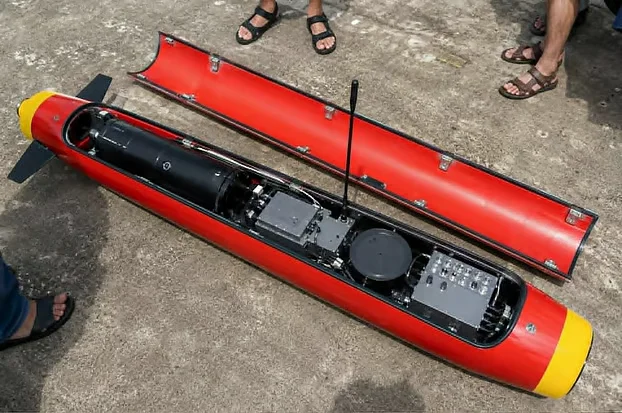
The marine vehicle-like device that was caught in fishermen’s nets in the Bay of Bengal has sparked widespread discussion. The object was brought ashore in Patharghata, Barguna, in the afternoon on 1 June 2026 Prothom Alo
A mechanical object, closely resembling an autonomous underwater vehicle (AUV), has been caught in the nets of fishermen during a fishing expedition off the coast of Patharghata in Barguna.
The recovery of the red and yellow device, measuring approximately eight feet in length, has ignited widespread curiosity ranging from the local fishing community to administrative and research circles.
Oceanographers initially suspect that the object could be an ‘Autonomous Underwater Vehicle’ (AUV)—an automated subsurface research vessel.
Across the globe, such vessels are deployed for marine research, environmental monitoring, seabed mapping, climate data collection, and military surveillance.
Its appearance in the coastal waters of Bangladesh within the Bay of Bengal has raised significant interest.
‘We hauled in the net to find a machine, not fish’
Speaking to local fishermen, it was learned that on Sunday afternoon, a fishing trawler from the Khalifar Hat area of Charduani Union under Patharghata Upazila was fishing in the estuary area of the Bay of Bengal. While hauling in the net, the fishermen felt an unusual weight.
Miraj Hossain, a fisherman aboard the trawler, said, “Initially, we thought a large sailfish had been trapped in the net. But when we hauled it in, we saw it wasn’t a fish, but a machine. We have never seen anything like this before.”
Miraj added that upon noticing fin-like structures on the body of the device and various electronic gadgets inside, they grew somewhat panicked.
At first, many mistook it for a missile component or a military object. The fishermen subsequently lifted it onto the trawler, brought it to Patharghata on Monday morning, and notified the Patharghata police station. The Patharghata police station has since taken custody of the device.
What was observed on the device
Photographs of the recovered device show it to be a long, cylindrical, torpedo-shaped object. Both ends are rounded, and the rear section features fans or fins for stability. When the upper section is opened, various electronic modules, battery units, sensors, control systems, and an antenna-like communication device are visible inside.
When the upper section is opened, various electronic modules, battery units, sensors, control systems, and an antenna-like communication device are visible inside.
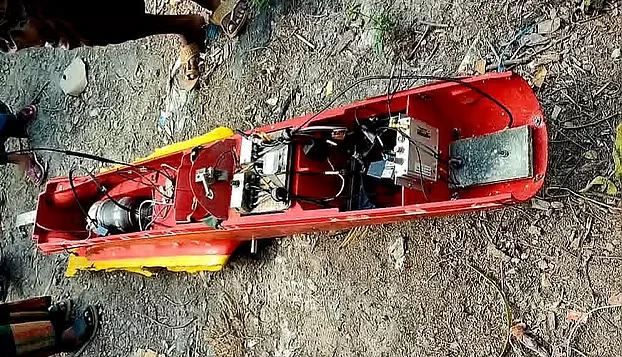
When the upper section is opened, various electronic modules, battery units, sensors, control systems, and an antenna-like communication device are visible inside. Prothom Alo
To ascertain more about the object, photographs were sent to Professor Mohammad Abdul Aziz of the Department of Zoology at Jahangirnagar University, a renowned national expert on dolphins and marine zoology.
After examining the images, he told Prothom Alo, “Based on preliminary observations, I believe this could be an Autonomous Underwater Vehicle or AUV. I am unaware of any regular deployment of such vessels within our maritime boundaries. However, judging by the photos, it does not appear to have been operational. It is highly probable that it drifted towards the coast due to tidal currents after experiencing a mechanical failure or running out of power.”
Professor Abdul Aziz explained that these vessels typically remain underwater for extended periods to collect data autonomously before returning to a designated location or transmitting the data.
Experts noted that universities, research institutions, meteorological agencies, navies, and offshore oil and gas companies worldwide routinely utilise this technology.
Professor Abdul Aziz added, “I have no information regarding the use of such vessels in our country. If it belongs to another nation, the vessel may have drifted into our territorial waters after becoming non-functional.”
Technical analysis required
According to researchers, identifying the true nature of the device requires a thorough technical analysis of its serial number, manufacturer’s name, memory data, sensor configuration, and communication systems.
According to them, if the internal data remains intact, it could provide insights into its origin, how long it had been at sea, and the type of data it was gathering.
Mohammad Sohan, Sub-Inspector (SI) of Patharghata police station, stated that they took custody of the device after being alerted via the 999 emergency hotline. Contact is being established with relevant authorities and experts to determine the nature of the technology and its origin.
Tapas Paul, Patharghata Upazila Nirbahi Officer (UNO), said, “The matter is being treated with utmost seriousness. Further action will be taken based on expert opinions.”
Mir Mohammad Ali, Assistant Professor of the Department of Aquaculture at Sher-e-Bangla Agricultural University and a marine life researcher, told Prothom Alo that if this truly is an Autonomous Underwater Vehicle (AUV), the public recovery of such a technological device on the coast of Bangladesh is quite rare.
The incident raises new questions regarding international marine research, climate monitoring, maritime resource exploration, and regional maritime security operations being conducted in the Bay of Bengal, he pointed out.
Uncovering its true identity through technical analysis could yield invaluable data concerning marine research and maritime management, he stated.
M Jashim Uddin & Mohammad Rafiq
Barisal and Barguna
Published: 01 Jun 2026, 22: 29
The marine vehicle-like device that was caught in fishermen’s nets in the Bay of Bengal has sparked widespread discussion. The object was brought ashore in Patharghata, Barguna, in the afternoon on 1 June 2026 Prothom Alo
A mechanical object, closely resembling an autonomous underwater vehicle (AUV), has been caught in the nets of fishermen during a fishing expedition off the coast of Patharghata in Barguna.
The recovery of the red and yellow device, measuring approximately eight feet in length, has ignited widespread curiosity ranging from the local fishing community to administrative and research circles.
Oceanographers initially suspect that the object could be an ‘Autonomous Underwater Vehicle’ (AUV)—an automated subsurface research vessel.
Across the globe, such vessels are deployed for marine research, environmental monitoring, seabed mapping, climate data collection, and military surveillance.
Its appearance in the coastal waters of Bangladesh within the Bay of Bengal has raised significant interest.
‘We hauled in the net to find a machine, not fish’
Speaking to local fishermen, it was learned that on Sunday afternoon, a fishing trawler from the Khalifar Hat area of Charduani Union under Patharghata Upazila was fishing in the estuary area of the Bay of Bengal. While hauling in the net, the fishermen felt an unusual weight.
Miraj Hossain, a fisherman aboard the trawler, said, “Initially, we thought a large sailfish had been trapped in the net. But when we hauled it in, we saw it wasn’t a fish, but a machine. We have never seen anything like this before.”
Miraj added that upon noticing fin-like structures on the body of the device and various electronic gadgets inside, they grew somewhat panicked.
At first, many mistook it for a missile component or a military object. The fishermen subsequently lifted it onto the trawler, brought it to Patharghata on Monday morning, and notified the Patharghata police station. The Patharghata police station has since taken custody of the device.
What was observed on the device
Photographs of the recovered device show it to be a long, cylindrical, torpedo-shaped object. Both ends are rounded, and the rear section features fans or fins for stability. When the upper section is opened, various electronic modules, battery units, sensors, control systems, and an antenna-like communication device are visible inside.
When the upper section is opened, various electronic modules, battery units, sensors, control systems, and an antenna-like communication device are visible inside.
When the upper section is opened, various electronic modules, battery units, sensors, control systems, and an antenna-like communication device are visible inside. Prothom Alo
To ascertain more about the object, photographs were sent to Professor Mohammad Abdul Aziz of the Department of Zoology at Jahangirnagar University, a renowned national expert on dolphins and marine zoology.
After examining the images, he told Prothom Alo, “Based on preliminary observations, I believe this could be an Autonomous Underwater Vehicle or AUV. I am unaware of any regular deployment of such vessels within our maritime boundaries. However, judging by the photos, it does not appear to have been operational. It is highly probable that it drifted towards the coast due to tidal currents after experiencing a mechanical failure or running out of power.”
Professor Abdul Aziz explained that these vessels typically remain underwater for extended periods to collect data autonomously before returning to a designated location or transmitting the data.
Experts noted that universities, research institutions, meteorological agencies, navies, and offshore oil and gas companies worldwide routinely utilise this technology.
Professor Abdul Aziz added, “I have no information regarding the use of such vessels in our country. If it belongs to another nation, the vessel may have drifted into our territorial waters after becoming non-functional.”
Technical analysis required
According to researchers, identifying the true nature of the device requires a thorough technical analysis of its serial number, manufacturer’s name, memory data, sensor configuration, and communication systems.
According to them, if the internal data remains intact, it could provide insights into its origin, how long it had been at sea, and the type of data it was gathering.
Mohammad Sohan, Sub-Inspector (SI) of Patharghata police station, stated that they took custody of the device after being alerted via the 999 emergency hotline. Contact is being established with relevant authorities and experts to determine the nature of the technology and its origin.
Tapas Paul, Patharghata Upazila Nirbahi Officer (UNO), said, “The matter is being treated with utmost seriousness. Further action will be taken based on expert opinions.”
Mir Mohammad Ali, Assistant Professor of the Department of Aquaculture at Sher-e-Bangla Agricultural University and a marine life researcher, told Prothom Alo that if this truly is an Autonomous Underwater Vehicle (AUV), the public recovery of such a technological device on the coast of Bangladesh is quite rare.
The incident raises new questions regarding international marine research, climate monitoring, maritime resource exploration, and regional maritime security operations being conducted in the Bay of Bengal, he pointed out.
Uncovering its true identity through technical analysis could yield invaluable data concerning marine research and maritime management, he stated.


