[🇧🇩] July uprising

Afghanistan Albania Algeria Andorra Angola Antigua Austria Azerbaijan Bahamas Bahrain Bangladesh Barbados Canada China Egypt Finland Germany India Iran Israel Japan Lebanon North Macedonia Pakistan Palestine Qatar Russia Syria Turkey Ukraine United Kingdom United States Yemen
[🇧🇩] July uprising
88
3K
More threads by Saif

G Bangladesh Defense

UN stands by report on July uprising deaths
Staff Correspondent 02 June, 2026, 21:53

1780452162624.webp

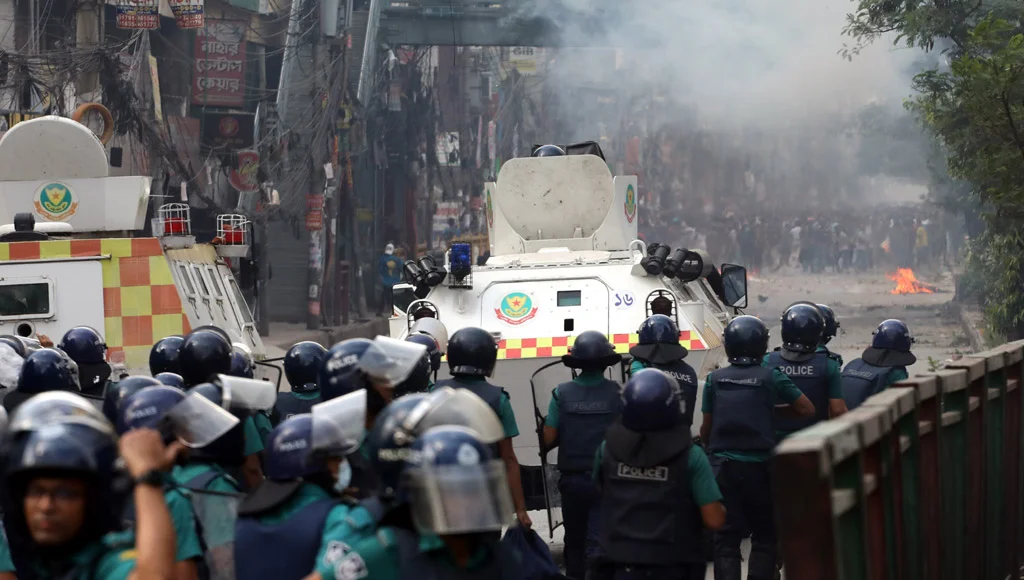
File photo shows the police clash with the students near Abul Hotel at Malibagh in Dhaka in July 2024 as students wage protests against the killing of their fellows by the police and ruling party-backed Bangladesh Chhatra League activists. | New Age photo

The United Nations has reaffirmed its confidence in the findings of its fact-finding mission on Bangladesh’s July 2024 mass uprising, dismissing a question over the credibility of the UN report on rights abuses.

Responding to a question at the regular UN briefing on Monday at its headquarters in New York, UN spokesperson Stéphane Dujarric said that the organisation had no reason to doubt the report prepared by the Office of the High Commissioner for Human Rights.

The questioner referred to claims by Bangladesh’s ousted Awami League regime that the UN fact-finding report, which estimated that around 1,400 people were killed during the July uprising that ousted the Awami League government on August 5, 2024, was inaccurate.

The questioner also mentioned reports in Indian media alleging that convicted deposed prime minister Sheikh Hasina had sent a letter to the United Nations challenging what she described as misinformation in the report.

In response, Dujarric said, ‘The report was issued by our colleagues in the Human Rights Office, and we have no reason to question it.’

The brief remark indicates that the United Nations continues to stand by the findings of the fact-finding mission despite criticism from figures associated with the ousted Awami League regime.

The UN Human Rights Office published its report following an investigation into the violence surrounding the mass uprising that led to the fall of the Sheikh Hasina regime.

The report documented widespread human rights violations and estimated that approximately 1,400 people were killed during the unrest.

The findings have been strongly contested by supporters of the Awami League regime, who argue that the casualty figures and some of the report’s conclusions are inaccurate.

Responding to a question regarding stolen money taken out of Bangladesh, the UN spokesperson said that the issue of illicit gains having flown out of various member states was a very important one.

‘It’s one that impedes development, and we encourage international cooperation to ensure that monies that belong to peoples are returned to those countries,’ he remarked.​
 

Jamaat slams govt for not taking July programmes
Staff Correspondent 02 July, 2026, 00:17

Leaders of the Bangladesh Jamaat-e-Islami on Wednesday criticised the government for not announcing any programme to observe the second anniversary of the July Uprising.

They urged the government to announce an official programme to observe the anniversary and implement the February 12 referendum verdict, in which about 70 per cent of voters favoured the referendum.

Dhaka south city unit of Jamaat organised the discussion at the Diploma Engineers Institution to mark the second anniversary of the July uprising.

The unit Jamaat amir Nurul Islam Bulbul chaired the programme.

Alleging that the BNP-led government has been ignoring the spirit of the uprising, Nurul urged the government to announce programmes to observe the July uprising anniversary on August 5.

He announced the party’s month-long programme to observe the anniversary.

The party’s central leader Abdus Sabur Fakir said that Jamaat wanted to establish a discrimination-free democratic Bangladesh and was continuing its programmes to implement the spirit of the uprising.

The discussion was addressed, among others, by Dhaka south city Jamaat general secretary Shafiqul Islam Masud.

A number of wounded victims of the July uprising and family members of the July martyrs also attended the programme.​
 

JCD vows to uphold July spirit
DU Correspondent 01 July, 2026, 02:25

1782952505225.webp

Bangladesh Jatiyatabadi Chhatra Dal holds a candlelight vigil at the Central Shaheed Minar in the capital early Wednesday, paying tribute to the martyrs of July uprising of 2024. | Md Saurav

Leaders of the Bangladesh Jatiyatabadi Chhatra Dal, the student wing of the ruling Bangladesh Nationalist Party, said early Wednesday that they would uphold the spirit of the July mass uprising.

They made the remarks at a midnight candlelight vigil marking the start of July at the Central Shaheed Minar in the capital Dhaka.

The event, titled ‘Aloke Aloke Smriti Samajjwal’ (Memories Shining in Light), was held to honour the students and citizens who made the supreme sacrifice in the student-led mass uprising.

The mass uprising that began on July 1, 2024, ousted the authoritarian Awami League government on August 5, 2024.

JCD leaders and activists from different universities, including Dhaka University, Jagannath University, Jahangirnagar University and Sher-e-Bangla Agricultural University, and various private institutions gathered at the Central Shaheed Minar on the occasion.

The event was presided over by JCD president Rakibul Islam Rakib and moderated by general secretary Nasir Uddin Nasir.

‘To honour all the martyrs of the movement, Chhatra Dal has organised this candlelight vigil at the Central Shaheed Minar. We firmly resolve that Chhatra Dal will continue this tradition every year to keep the memory of our brave martyrs alive,’ Rakib said.

He said, ‘A total of 142 leaders, activists and supporters of the Jatiyatabadi Chhatra Dal gave their lives in this struggle.’

Addressing the event, the prime minister’s political adviser and BNP senior secretary general, Ruhul Kabir Rizvi, said, ‘The memory of the July martyrs will continue to inspire us, ignite our spirit and drive us forward in any future struggle against tyranny.’​
 

NCP to skip Gopalganj on ‘July March’ over ‘security concerns’

Asif Howladar
Dhaka
Published: 05 Jul 2026, 21: 19

1783302974585.webp

The National Citizen Party (NCP) chief organiser for the northern region, Sarjis Alam, announces details of the party’s “July March” programme at a press conference held at the party’s central office in Banglamotor, Dhaka, on 4 July 2026 Courtesy NCP.

The National Citizen Party (NCP) will not go to Gopalganj this time as part of its ‘July March’ campaign. Instead, on 16 July, which will be observed as July Martyrs’ Day, the party’s local leaders and activists in Gopalganj will hold prayers and munajat (supplication).

None of the party’s central leaders will attend the programme, with “certain security concerns” cited as the primary consideration.

The NCP is set to launch its month-long ‘July March 2026 for the Implementation of the People’s Mandate, Employment and Border Security’ tomorrow, Monday, as part of its programme marking the second anniversary of the July Mass Uprising.

As was the case last year, the party had initially announced plans to visit Gopalganj on 16 July. However, within an hour of unveiling the month-long itinerary on Saturday evening, it removed the Gopalganj programme from the official schedule.

The NCP announced the roadmap for its July March at a press conference held at Banglamotor in Dhaka on Saturday evening.

Responding to a question, the party’s chief organiser for the northern region, Sarjis Alam, said, “In the first phase, we have already announced party candidates in a number of upazilas and municipalities, including one municipality in Gopalganj. As part of the July March, we are visiting all 64 districts and those 100 upazilas and municipalities.”

1783303014505.webp

Army personnel patrol in an armoured vehicle during clashes between law enforcement agencies and supporters of the banned Awami League over the NCP’s programme in Gopalganj on 16 July 2025 AFP file photo.

The itinerary distributed to journalists after the press conference included the Gopalganj programme for 16 July. The announcement quickly sparked discussion on Facebook.

Within an hour, however, the NCP circulated a revised schedule to the media, with the Gopalganj programme omitted. That decision also prompted considerable debate on social media, both in support of and against the move.

The party, however, did not formally explain the reason behind the change.

Asked about the matter on Sunday afternoon, Sarjis Alam, a member of the party’s top leadership, told Prothom Alo, “On 16 July, the NCP’s senior leaders will be occupied with various programmes in Rangpur, including visiting the grave of martyr Abu Sayed. Moreover, last year’s July March in Gopalganj led to an unfortunate incident. This year, the programme happened to fall on the same date, and there are certain security-related considerations.”

Sarjis said the party would instead observe the day in Gopalganj in a different manner.

“Instead of a march, our local leaders and activists in Gopalganj will hold an organisational discussion along with prayers and munajat. The programme will be held on 16 July, observed as Martyrs’ Day. No central leaders from Dhaka will attend the event there,” he added.

During the first anniversary of the July Mass Uprising in July 2025, the NCP’s senior leaders travelled across the country under the banner ‘July March to Build the Nation’.

NCP leaders leave the Gopalganj district police office in an armoured vehicle of the Army amid violence on 16 July 2025. From left: Sarjis Alam, Hasnat Abdullah and Akhter Hossen

1783303067423.webp

NCP leaders leave the Gopalganj district police office in an armoured vehicle of the Army amid violence on 16 July 2025. From left: Sarjis Alam, Hasnat Abdullah and Akhter Hossen. A combination made of photos taken from screengrab of a video

Ahead of the party’s planned visit to Gopalganj, several of its leaders promoted the event on Facebook using slogans such as ‘March to Gopalganj’. Tensions surrounding the programme escalated significantly on 16 July, eventually erupting into violence that claimed the lives of four people in Gopalganj.

In the wake of the violence, Section 144 was imposed across Gopalganj, creating a tense atmosphere. Following the unrest, the NCP’s chief organiser for the southern region, Hasnat Abdullah, chief organiser for the northern region, Sarjis Alam, and other senior party leaders were evacuated from Gopalganj with the assistance of the Army, Police, Rapid Action Battalion (RAB) and Border Guard Bangladesh (BGB). Photographs of the leaders boarding an armoured military vehicle later circulated widely on Facebook.

NCP may visit Gopalganj in September

Although the party has dropped its July March programme in Gopalganj this month, it may still visit the district in September.

Speaking to Prothom Alo on Sunday afternoon, Sarwar Tushar, a member of the NCP’s highest policy-making body, the Political Council, said, “The NCP has already announced candidates in 100 upazilas and municipalities, and candidates for the remaining areas will be announced shortly. As part of our local government election campaign, we will visit all the places where we have candidates in September. That will include Gopalganj.”

Another Political Council member, Ali Ahsan Junaed, also told Prothom Alo that the party would soon visit Gopalganj as part of its political programme, although he did not specify a timeframe.​
 

UN stands by report on July uprising deaths
Staff Correspondent 02 June, 2026, 21:53
View attachment 27324
File photo shows the police clash with the students near Abul Hotel at Malibagh in Dhaka in July 2024 as students wage protests against the killing of their fellows by the police and ruling party-backed Bangladesh Chhatra League activists. | New Age photo

The United Nations has reaffirmed its confidence in the findings of its fact-finding mission on Bangladesh’s July 2024 mass uprising, dismissing a question over the credibility of the UN report on rights abuses.

Responding to a question at the regular UN briefing on Monday at its headquarters in New York, UN spokesperson Stéphane Dujarric said that the organisation had no reason to doubt the report prepared by the Office of the High Commissioner for Human Rights.

The questioner referred to claims by Bangladesh’s ousted Awami League regime that the UN fact-finding report, which estimated that around 1,400 people were killed during the July uprising that ousted the Awami League government on August 5, 2024, was inaccurate.

The questioner also mentioned reports in Indian media alleging that convicted deposed prime minister Sheikh Hasina had sent a letter to the United Nations challenging what she described as misinformation in the report.

In response, Dujarric said, ‘The report was issued by our colleagues in the Human Rights Office, and we have no reason to question it.’

The brief remark indicates that the United Nations continues to stand by the findings of the fact-finding mission despite criticism from figures associated with the ousted Awami League regime.

The UN Human Rights Office published its report following an investigation into the violence surrounding the mass uprising that led to the fall of the Sheikh Hasina regime.

The report documented widespread human rights violations and estimated that approximately 1,400 people were killed during the unrest.

The findings have been strongly contested by supporters of the Awami League regime, who argue that the casualty figures and some of the report’s conclusions are inaccurate.

Responding to a question regarding stolen money taken out of Bangladesh, the UN spokesperson said that the issue of illicit gains having flown out of various member states was a very important one.

‘It’s one that impedes development, and we encourage international cooperation to ensure that monies that belong to peoples are returned to those countries,’ he remarked.​

Some haramis in India as usual trying to re-write history, and cover up their foreign policy f*ck-ups.
 

NCP to skip Gopalganj on ‘July March’ over ‘security concerns’

Asif Howladar
Dhaka
Published: 05 Jul 2026, 21: 19

View attachment 28083
The National Citizen Party (NCP) chief organiser for the northern region, Sarjis Alam, announces details of the party’s “July March” programme at a press conference held at the party’s central office in Banglamotor, Dhaka, on 4 July 2026 Courtesy NCP.

The National Citizen Party (NCP) will not go to Gopalganj this time as part of its ‘July March’ campaign. Instead, on 16 July, which will be observed as July Martyrs’ Day, the party’s local leaders and activists in Gopalganj will hold prayers and munajat (supplication).

None of the party’s central leaders will attend the programme, with “certain security concerns” cited as the primary consideration.

The NCP is set to launch its month-long ‘July March 2026 for the Implementation of the People’s Mandate, Employment and Border Security’ tomorrow, Monday, as part of its programme marking the second anniversary of the July Mass Uprising.

As was the case last year, the party had initially announced plans to visit Gopalganj on 16 July. However, within an hour of unveiling the month-long itinerary on Saturday evening, it removed the Gopalganj programme from the official schedule.

The NCP announced the roadmap for its July March at a press conference held at Banglamotor in Dhaka on Saturday evening.

Responding to a question, the party’s chief organiser for the northern region, Sarjis Alam, said, “In the first phase, we have already announced party candidates in a number of upazilas and municipalities, including one municipality in Gopalganj. As part of the July March, we are visiting all 64 districts and those 100 upazilas and municipalities.”

View attachment 28084
Army personnel patrol in an armoured vehicle during clashes between law enforcement agencies and supporters of the banned Awami League over the NCP’s programme in Gopalganj on 16 July 2025 AFP file photo.

The itinerary distributed to journalists after the press conference included the Gopalganj programme for 16 July. The announcement quickly sparked discussion on Facebook.

Within an hour, however, the NCP circulated a revised schedule to the media, with the Gopalganj programme omitted. That decision also prompted considerable debate on social media, both in support of and against the move.

The party, however, did not formally explain the reason behind the change.

Asked about the matter on Sunday afternoon, Sarjis Alam, a member of the party’s top leadership, told Prothom Alo, “On 16 July, the NCP’s senior leaders will be occupied with various programmes in Rangpur, including visiting the grave of martyr Abu Sayed. Moreover, last year’s July March in Gopalganj led to an unfortunate incident. This year, the programme happened to fall on the same date, and there are certain security-related considerations.”

Sarjis said the party would instead observe the day in Gopalganj in a different manner.

“Instead of a march, our local leaders and activists in Gopalganj will hold an organisational discussion along with prayers and munajat. The programme will be held on 16 July, observed as Martyrs’ Day. No central leaders from Dhaka will attend the event there,” he added.

During the first anniversary of the July Mass Uprising in July 2025, the NCP’s senior leaders travelled across the country under the banner ‘July March to Build the Nation’.

NCP leaders leave the Gopalganj district police office in an armoured vehicle of the Army amid violence on 16 July 2025. From left: Sarjis Alam, Hasnat Abdullah and Akhter Hossen

View attachment 28085
NCP leaders leave the Gopalganj district police office in an armoured vehicle of the Army amid violence on 16 July 2025. From left: Sarjis Alam, Hasnat Abdullah and Akhter Hossen. A combination made of photos taken from screengrab of a video

Ahead of the party’s planned visit to Gopalganj, several of its leaders promoted the event on Facebook using slogans such as ‘March to Gopalganj’. Tensions surrounding the programme escalated significantly on 16 July, eventually erupting into violence that claimed the lives of four people in Gopalganj.

In the wake of the violence, Section 144 was imposed across Gopalganj, creating a tense atmosphere. Following the unrest, the NCP’s chief organiser for the southern region, Hasnat Abdullah, chief organiser for the northern region, Sarjis Alam, and other senior party leaders were evacuated from Gopalganj with the assistance of the Army, Police, Rapid Action Battalion (RAB) and Border Guard Bangladesh (BGB). Photographs of the leaders boarding an armoured military vehicle later circulated widely on Facebook.

NCP may visit Gopalganj in September

Although the party has dropped its July March programme in Gopalganj this month, it may still visit the district in September.

Speaking to Prothom Alo on Sunday afternoon, Sarwar Tushar, a member of the NCP’s highest policy-making body, the Political Council, said, “The NCP has already announced candidates in 100 upazilas and municipalities, and candidates for the remaining areas will be announced shortly. As part of our local government election campaign, we will visit all the places where we have candidates in September. That will include Gopalganj.”

Another Political Council member, Ali Ahsan Junaed, also told Prothom Alo that the party would soon visit Gopalganj as part of its political programme, although he did not specify a timeframe.​

They should find out who is getting enabled by Hasina's looted money in Gopalganj (all these Awami goondas - head honchos who have made that city command control center for Awami Goondagiri) and cordon the whole city, block all roads in and out and restrict the movements of these people so they get no respite. Once you put all the "Paler Godas" in jail - you will see all this subversive crap peter out slowly. A massive combing campaign has to be conducted by RAB and Army once it becomes manageable .

Now that Indian visas are free for the taking, I'm sure all of them will go to India when able and hatch some subversive conspiracy. We should watch the border like a hawk to see when these people are coming and going to India or anywhere overseas. DGFI and PBI should work overtime to look at movements.
 
Last edited:

DU to mark 2nd July Mass Uprising anniversary with memorials, discussions

1784072191289.webp


Dhaka University has announced a series of programmes to commemorate the second anniversary of the historic July Mass Uprising, including the foundation stone laying of a memorial monument, the establishment of a memory corner at the Central Library, and discussions reflecting on the movement.

The decisions were taken at a preparatory meeting held on Tuesday at the Professor Abdul Matin Chowdhury Virtual Classroom, chaired by Vice-Chancellor Prof Dr. A B M Obaidul Islam, according to the public relation office of the university.

The meeting was attended by Pro-VC (Admin) Prof Dr. Mohammed Almujaddade Alfasane, deans of different faculties, provosts of residential halls, the university proctor, Acting Registrar, heads of offices, and representatives of the Dhaka University Central Students' Union (DUCSU) and student organizations.

Participants reviewed the overall preparations for observing the anniversary and discussed plans for various commemorative activities.

One of the key decisions was to lay the foundation stone of the university's proposed July Memorial Monument on August 5, 2026. To oversee the project, the university formed a committee headed by the Dean of the Faculty of Fine Arts, with Proctor serving as member secretary.

The meeting also approved the establishment of a July Memory Corner at the Dhaka University Central Library to preserve documents and materials related to the uprising. A separate committee, also led by the Dean of the Faculty of Fine Arts with the Acting University Librarian as member secretary, will implement the initiative.

As part of the observance, a discussion programme focusing on the July Mass Uprising will be held at the Teacher-Student Centre (TSC) auditorium on August 5. Individual faculties and residential halls will also organize their own commemorative events.

Special prayers will be offered at the university's Central Mosque, mosques in residential halls and university housing areas, as well as at other places of worship, seeking eternal peace for those killed in the uprising and the speedy recovery of those who were injured.

The meeting also decided to observe Women's Day on the university campus every year on July 14.​
 

Why Bangladesh's July uprising was obvious


1784243602369.webp


One winter evening in Dhaka in 2017, I went with my wife to the 300 Feet Road beside the Bashundhara Residential Area, a popular stretch of the city where many people go to get some fresh air and take a short break from the city's overcrowding. It was the kind of evening many Dhaka families know well: People eating popular street food, couples walking and friends sitting in makeshift shops beside the highway before returning home. Nothing unusual happened near us. The city looked tired, noisy and alive.

Two days later, while sitting at my office desk, I opened the news and read that former Ambassador Maroof Zaman had disappeared on his way to Dhaka Airport from the same road, on the same day that we had been there. The road, the hour, the city and the familiar route to the airport suddenly became frightening. In Dhaka by then, people had already learned the grammar of fear: the microbus, the men in plain clothes, the missing phone, the waiting family, the agencies denying knowledge, and the silence that followed.

This is the memory that returns to me when I think of Bangladesh's July uprising. It is often described as a sudden explosion, born from the quota-reform movement and expanded by state violence. But July was not sudden. It was the blast of rage that had gathered under 16 years of bad rule. The surprise was not that July happened. The surprise was that the Awami League believed it could avoid July forever.

I spent seven consecutive years in Dhaka. Since early 2012, I had entered conservative student politics out of curiosity, at a time when such politics was unofficially banned in many public universities. Fear soon became concrete. In 2013, we saw students being held, interrogated and tortured inside dormitories by secular, pro-Awami League student groups. Later, after my formal studies, I worked in human-rights documentation, collecting daily incidents from media reports. From that desk, Bangladesh did not look like a normal democracy with occasional abuses. It looked like a society being trained to obey fear.

The public university was one of the training grounds. Student halls were not only places of residence. They were political territories where loyalty could decide who slept peacefully, who was beaten, who was labelled, and who was expelled from normal student life. Local documentation initiatives such as Sochchar recorded how torture in universities, overwhelmingly attributed to Bangladesh Chhatra League activists, targeted general students and often took place inside residential halls. This mattered because July was led by the same generation that had learned politics through humiliation before it learned politics through voting.

The culture of enforced disappearance was even darker. It did not only remove people. It changed the imagination of society. A person could be taken by men in plain clothes. Every agency could deny knowledge. A family could wait at police stations, Rapid Action Battalion (RAB) offices, court premises and newspaper offices, yet receive no answer. Some returned after weeks or months and remained silent. Some were shown as arrested. Some never returned.

Aynaghar later gave that fear a name. It was not only a secret detention site. It became the symbol of a political condition in which the state could erase a citizen and then deny the erasure. The later return of Abdullahil Amaan Azmi and Ahmad Bin Quasem Arman after eight years of captivity confirmed what many families had whispered for years: disappearance was not rumor, but a method.

This is why July was obvious. Bangladesh had already tried other exits. The opposition's March for Democracy in 2013 was blocked before the 2014 election. The quota-reform movement of 2018 was beaten down. The safe-road movement of 2018, led even by schoolchildren after two students were killed by a bus, was met with force and attacks. Each moment taught citizens that peaceful anger would be tolerated only until it embarrassed power.

By 2024, the quota was no longer only about the quota. For many families, government jobs meant dignity, stability and the hope of social mobility. When students felt that the future was being distributed through inherited privilege and political loyalty, they were not simply rejecting a recruitment policy. They were rejecting a closed future. When protesters were pushed into the moral category of "Razakar," a term with a strong connotation of betrayal, the dispute crossed another line. In Bangladesh, that word carries the wound of 1971. Awami League, which had long monopolized patriotism, suddenly found that a new generation would no longer accept its gatekeeping of national belonging.

Then came Abu Sayed, a student activist. His arms opened, his chest exposed, his body facing armed police. His death did not create the anger by itself, but it gave the anger a face. For years, people had lowered their voices, deleted posts, avoided phone calls, feared dormitory rooms and watched mothers wait for disappeared sons. Abu Sayed's exposed chest reversed that training. It told people that fear could no longer be managed privately.

During July, a phrase appeared on placards and walls: "For every pharaoh there is a Moses." Its force was not only religious. It expressed a political philosophy that ordinary people understood without academic language. Power imagines itself permanent. It builds loyal media, controlled elections, party enforcers, police fear and secret rooms. But every pharaoh's politics also produces its own Moses, not always as one man, but sometimes as a generation that refuses to bow.

Turkish people know another July. On July 15, 2016, ordinary people stood before tanks to defend their elected government against a coup attempt in a country marked by repeated military interventions. Bangladesh's July was different. People were not defending an elected order from tanks. They were reclaiming the nation from a government that had wrapped itself in the language of democracy while relying on police violence, party muscle, controlled elections and disappearance. Yet the emotional core was similar: People stepped into danger because the homeland had become more important than fear.

The United Nations Human Rights Office later described the July-August crackdown as brutal and systematic, estimating that as many as 1,400 people may have been killed. Such figures matter, but July cannot be understood by figures alone. It began earlier, in dormitory rooms, missing-person posters, mothers waiting, controlled elections, silent newspapers, whispered phone calls and the ordinary knowledge that a citizen could vanish from the protection of law.

That is why Bangladesh's July uprising was obvious long before July arrived. A state cannot disappear people, narrow elections, beat students, frighten journalists, monopolise patriotism and still expect society to remain silent forever. In 2024, fear changed direction. It stopped trembling privately and began shouting in public.

The writer is a sociologist and researcher in Islam, secularism and post-colonial identity in South Asia, currently based in Türkiye. The piece is excerpted from www.dailysabah.com
 

Latest Posts

Back