Feed

[🇧🇩] Bangladesh Agricultural Research Institute

[🇧🇩] Bangladesh Agricultural Research Institute
4
1K
More threads by Saif

G Bangladesh Defense

Saif

Senior Member
Messages
21,724
Likes
9,794
Nation

Residence

Axis Group

History

BARI has a long historical background of its own. The emergence of the Institute in its present form has occurred through a number of changes starting from simply a sub-ordinate status under the Department of Land Records in the then Bengal. On the recommendation of the Famine Commission in 1880, the Bengal Department of Agriculture was established as a sub-ordinate part of the Department of Land Records in the then Bengal. In 1906, Lord Curzon, the then Vice Roy of India had granted separate status to the Bengal Department of Agriculture and in the same year, a nuclear agricultural research laboratory under this department was established at Tejgaon, Dhaka. In 1908, an experimental station what has become known as Dhaka Farm was established on an area of 161.20 hectares of land. This Dhaka Farm was the predecessor of BARI and some other research institutes. Establishment of Dhaka Farm offered a good scope for conducting research in the field. In 1947, Bengal Department of Agriculture was renamed as East Pakistan Department of Agriculture. The two constituent divisions of the department were Research and Extension. In 1962, there was a severe blow to agriculture research when the land of Dhaka Farm was acquired for establishing Second Capital (today called Sher-e-Bangla Nagar). In 1968, two separate directorates were established - one was Directorate of Agriculture (Extension and Management) and the other was Directorate of Agriculture (Research and Education).The Directorate of Agriculture (Research and Education) was mostly concerned with research. This Directorate as well was responsible for the management of Bangladesh Agricultural Institute (BAI) at Sher-e-Bangla Nagar, Dhaka. Later in eighties and nineties, two other agricultural colleges, one in Patuakhali and the other in Dinajpur, were established. These two agricultural colleges were also administered by BARI until these became universities. In 1971, the former provincial organization took on national responsibilities. Like many other sectors, agriculture as well inherited poor manpower and insufficient administrative set ups. Therefore, it was rightly thought to have established a coordinated and comprehensive research and some major decisions were taken up in 1973. Another important development in the year was the Presidential Order No. XXXII that helps strengthen and reconstitute agricultural research organizations and system in the country. Upon subsequent developments of research institutions led to further restructuring. In 1976, through the Presidential Order No. LXII, the Bangladesh Agricultural Research Institute (BARI) was emerged as an autonomous and effective research organization following the dissolution of the Directorate of Agriculture (Research and Education) with sufficient operational flexibility, structural modification, and improvement of regional and sub-stations.​
 

Mission & Vision​


ভিশন (Vision)
বাংলাদেশ কৃষি গবেষণা ইনস্টিটিউটের আওতাধীন ফসলের উৎপাদন ও উৎপাদনশীলতা বৃদ্ধিকরণ।

মিশন (Mission)

ফসলের উচ্চ ফলনশীল, পুষ্টিমান সম্পন্ন ও প্রতিকুল পরিবেশ সহিষ্ণু জাত উদ্ভাবন

ফসলভিত্তিক উন্নত, আধুনিক ও টেকসই উৎপাদন প্রযুক্তি উদ্ভাবন ও লাগসই ফসল বিন্যাস নির্ধারণ

পরিবেশবান্ধব শস্য সংরক্ষণ প্রযুক্তি উদ্ভাবন

মাটির স্বাস্থ্য সংরক্ষণ ও উন্নয়ন

লাগসই কৃষি যন্ত্রপাতি উদ্ভাবন ও উন্নয়নের মাধ্যমে কৃষি যান্ত্রিকীকরণ ত্বরান্বিত করা

শস্য সংগ্রহোত্তর ক্ষতির পরিমাণ কমিয়ে আনার জন্য লাগসই প্রযুক্তি উদ্ভাবন

উদ্ভাবিত জাত ও প্রযুক্তিসমূহ হস্তান্তরের মাধ্যমে দেশের আর্থ-সামাজিক উন্নয়ন

ফসলের বাজার ব্যবস্থাপনা সমীক্ষা করা
 

Mandate​

The mandates of the Institute as contained in the Bangladesh Agricultural Research Institute Amendment Act. No. 14 of 1996 are to:
  1. Approve the course study in broad outlines;
  2. Undertake research to ensure a stable and productive agriculture through scientific management of land, water, evaluation of new varieties of various agricultural products and development of appropriate technologies and pest management methods;
  3. Provide farmers with information necessary for carrying out their farming business efficiently and profitably;
  4. Set up research centres, sub-stations, project areas and farms in different regions on various problems of agriculture;
  5. Carry out demonstrations, tests or trials of new varieties of crops and their management practices;
  6. Publish annual reports, agricultural manuals, monographs, bulletins and other literatures related to crop research and activities of the Institute;
  7. Train research and extension officers in the improved technology of crop production;
  8. Provide post-graduate research facilities;
  9. Organize seminars, symposia and workshops on selected problems which may afford specialists from different research institutes and stations opportunity to exchange ideas and be acquainted with the recent advancements in agriculture;
  10. Perform such other function as may be necessary for the purpose of the Act.
 

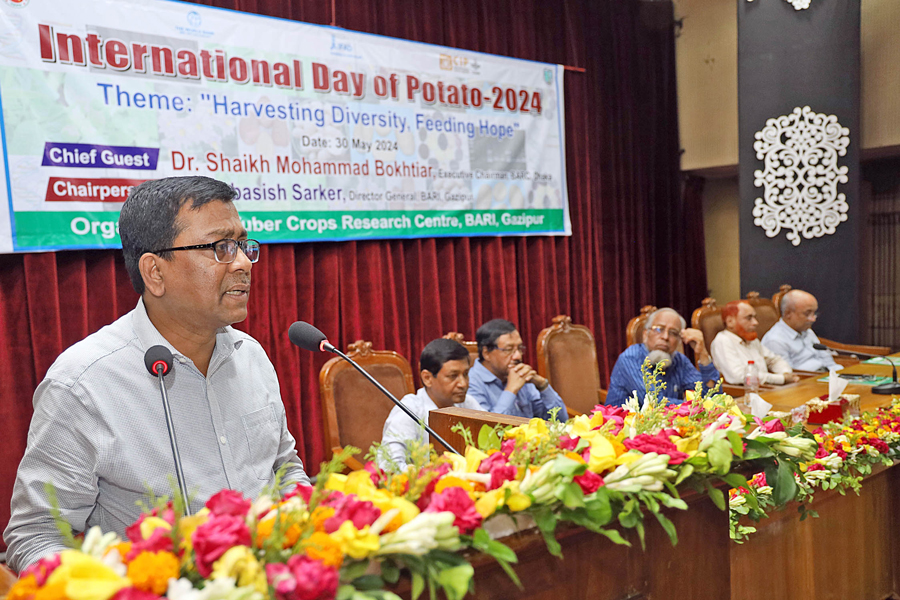
BARI celebrates International Day of Potato
1717114153969.webp


Marking the day, in the morning, a rally was held on International Day of Potato with the participation of BARI's various levels of scientists, various departments and organisations, Seed Company, CIP, Farming Future, NGO, and Representatives including those concerned with potato production, storage, and management. Later, the programme started with the recitation of the Holy Quran at Kazi Badrudduza Auditorium of this stitute. The theme of this programme is "Harvesting diversity, feeding hope," according to a press release.

Potatoes are a key crop across diverse farming systems globally, ranging from smallholders producing diverse heirloom varieties by hand in the Andes, to vast commercial, mechanised farms in different continents. Potatoes contribute to the food security and nutrition as well as livelihoods and employment of people in rural and urban areas all over the world. A staple food for the world's population, potatoes are rich in carbohydrates, providing a primary source of energy. It also contains several micronutrients including vitamin B, vitamin C, folate, potassium, phosphorus and magnesium. Potatoes are a vital part of the global food system and play a critical role in strengthening world food security and alleviating poverty.

The day is an opportunity to build on the International Potato impact to stakeholders. The observance will also be used to underscore the importance of the crop to combating hunger and poverty and addressing environmental threats to agrifood systems.

Director General of BARI Dr Debasish Sarker presided over the session, while Executive Chairman of Bangladesh Agricultural Research Council (BARC) Dr Sheikh Mohammad Bokhtiar was present as chief guest.

Former Director of BARI Dr Mohammad Hossain gave the key-note paper presentation for the event.

At the time, Director (Training and Communication) Dr Md Tariqul Islam, Director (Support & Services) Dr Ferdouse Islam, Director (Research) Dr Md Abdullah Yousuf Akhond, Director (Planning and Evaluation) Dr Md Abu Hena Sorwar Jahan, Director (Director General's Office) Dr M M Kamrozzaman, Director (Horticulture Research Centre) Dr Munshi Rashid Ahmad and Director (Oilseed Research) Dr Md Nazrul Islam were present.

BARI's former directors, senior scientists from various center/division/section of BARI, various departments and organisations, Seed Company, CIP, Farming Future, NGO, agricultural representatives including those concerned with potato production and storage and management were also present.​
 

President for more investment in agri research, better facilities of scientists

Bangladesh Sangbad Sangstha . Gazipur


1792108612830.webp

President Mirza Fakhrul Islam Alamgir visits innovation stalls of scientists on the Bangladesh Rice Research Institute premises during his BRRI visit in Gazipur on Thursday. | Star Mail photo.


President Mirza Fakhrul Islam Alamgir on Thursday called for increasing investment in agricultural research, ensuring fair prices for paddy produced by the farmers and improving facilities for agricultural scientists.

‘Significant benefits can be achieved through investment in agricultural research. Therefore, investment in research must be increased to further boosting agricultural production in the country, while ensuring a conducive working environment and better facilities for agricultural scientists,’ he said.

The president made the remarks while addressing a view-exchange meeting as chief guest during his visit to the Bangladesh Rice Research Institute.

He said that Bangladesh faced a much larger population and significant food shortages after independence.

‘The country has now achieved a surplus in food production, with the contributions of agricultural scientists in developing high-yielding rice varieties being one of the key reasons behind this success,’ he added.

‘The use of technology in agriculture is increasing while machinery for rice planting, harvesting and weed control had brought significant changes to farming,’ he added.

The president expressed concern over farmers’ failure to receive fair prices for their paddy.

‘Farmers often fail to recover even their production costs by selling paddy. As a result, their interest in rice cultivation was declining, prompting them to shift to alternative crops. Rice production is crucial to ensuring the country’s food security,’ he added.

He called for providing subsidies where necessary to encourage farmers to cultivate rice.

He also stressed continuing agricultural research and technological development to increase food production in line with population growth.

He called on private sector to play important role in rice research internationally.

‘Initiatives must be taken to increase private investment in rice research in the country and the government must ensure adequate funding for research,’ he said.

On improving facilities for agricultural scientists, the president said, ‘Scientists are making significant contributions to society through their research. Alongside improving their working environment, appropriate pay structures and pension benefits must be ensured.

Describing the denial of pension benefits to scientists after retirement as inhumane, he urged the relevant authorities to resolve the issue with utmost care.

‘People involved in agricultural research and production must be valued properly. As society benefits from the research conducted by agricultural scientists, the government has a responsibility to encourage them and ensure the necessary facilities,’ he added.

Agriculture minister Mohammed Amin Ur Rashid, Gazipur-2 lawmaker Manjurul Karim Rony, secretary of the ministry Md Selim Khan, BARI director general Dr Md Manjurul Kadir and Bangladesh Rice Research Institute director general Dr Md. Rafiqul Islam were present on the occasion.

Agriculture minister, the agriculture ministry secretary and the BRRI director general spoke at the event, titled ‘BRRI’s Contribution to Food Security and Future Plans.’

Administrative officials present included the Dhaka Divisional Commissioner, Dhaka Range Deputy Inspector General of Police, Gazipur Metropolitan Police Commissioner, Deputy Commissioner and Superintendent of Police.

Earlier, the president visited BRRI’s innovation stalls, gene bank, technologies, research fields and other facilities after arriving BRRI premises.

Before leaving BRRI, the president inaugurated BARI’s 56th founding anniversary programme by releasing balloons and cutting a cake in front of BARI Dormitory-2. A smartly turned-out contingent of Bangladesh Police then accorded him a farewell Guard of Honour.​
 

Latest Posts

Back
PKDefense - Recommended Toggle Create