[🇧🇩] Bangladeshi Achievers

Post a Reply — Share your thoughts or reply to this thread...
Reply
Quick Reply ✓ Posted!
[🇧🇩] Bangladeshi Achievers
42
3K
More threads by Saif

G Bangladesh Defense

Saif

Senior Member
Joined
Jan 24, 2024
Messages
22,262
Likes
9,869
Nation

Axis Group

9 Bangladeshis named in Forbes 30 under 30 Asia list

1715900729932.webp

9 young Bangladeshis have been named in the Forbes 30 Under 30 Asia list for 2024. Image: Forbes/Tech & Startup

Forbes has announced the ninth edition of its '30 Under 30 Asia' list, highlighting 300 young entrepreneurs, leaders, and innovators under the age of 30 who are driving change and innovation across the Asia-Pacific region. The honourees represent diverse fields, including arts, technology, media, finance, and more. This year, 9 individuals from Bangladesh have been recognised for their contributions across various industries.

Anusha Alamgir

Anusha Alamgir has been featured in the Arts category. Holding a master's degree in architecture from the Royal College of Art in London, Alamgir was the sole female Bangladeshi exhibitor at the 18th International Architecture Exhibition at the 2023 Venice Biennale. Her film 'Porda,' addressing Muslim veiling practices, gained significant attention. Alamgir's work spans sculpture, painting, photography, and performance, and she also founded the online thrift store Colors Dhaka.

Mehedi Shoron (HelloTask)

Mehedi Shoron, co-founder of HelloTask, has been recognised in the Consumer Technology category. HelloTask is an app that offers hourly bookings, monthly subscriptions, and safety features for domestic maids. The company has secured funding from investors and grants from the World Bank and Oxfam. HelloTask aims to expand its workforce to 100,000 maids by 2025 and explore international markets.

Redwan Ahmed

Redwan Ahmed, an award-winning freelance journalist, has been listed in the Media, Marketing & Advertising category. His notable work includes coverage of the Rohingya crisis and investigations into the exploitation of garment factory workers. Ahmed co-founded the Bangladeshi Journalists in International Media, an organisation dedicated to protecting local journalists.

MD Shahidul Islam, Abdul Gaffar Sadi, and MD Tushar (Drutoloan)

Drutoloan, co-founded by MD Shahidul Islam, Abdul Gaffar Sadi, and MD Tushar, has been featured in the Finance & Venture Capital category. The Dhaka-based startup assists micro and small businesses in obtaining loans by simplifying paperwork and assessing creditworthiness. Since its establishment in 2019, Drutoloan has disbursed over $2 million in loans and raised $125,000 in pre-seed funding.

Sultan Moni, Mumtahina Anika (Zatiq)

Sultan Moni and Mumtahina Anika, co-founders of Zatiq, have been recognised in the Finance & Venture Capital category. Zatiq provides software and hardware solutions to help small companies manage accounting. The company also offers tools for small businesses to create e-commerce websites. In August, Zatiq raised $1.6 million in pre-seed funding.

Fahad Ahmed (Wind.App)

Fahad Ahmed, co-founder of Wind.App, has been honoured in the Finance & Venture Capital category. Wind.App uses blockchain technology and stablecoins to facilitate faster and cheaper cross-border remittances. The startup secured $3.8 million in pre-seed funding. Prior to Wind, Ahmed was part of the founding team at Pathao, where he launched various services.​
 

Another Bangladeshi conquers Mount Everest
Sozib MiaDhaka
Updated: 19 May 2024, 12: 33

1716101447686.webp

Babar Ali Collected

Babar Ali from Chattogram has summited Mount Everest and raised the red and green flag on the world's highest peak.

Farhan Zaman, the chief coordinator of his Everest mission, confirmed the information to Prothom Alo, saying he reached the summit at 8:30 am (Nepal time) on Sunday.

His mountaineering club, Vertical Dreamers, also disclosed the achievement through a post on Facebook.

The post read, "Mother Nature has temporarily placed Babar on her peak with the grace of the Creator and the prayers of millions of well-wishers. The base camp manager and outfit owner confirmed this information to us a while back."

1716101493796.webp

Courtesy

Regarding his current position, the post noted, "Babar is now on his way down to Camp-4. It will take time to get pictures as it is not possible to communicate with him in the death zone."

Journey to Everest
Babar Ali left Bangladesh for Nepal on 1 April, to embark on his Everest journey. After taking necessary preparations, he flew from Kathmandu to Lukla Airport on 4 April. From there, he began his trek to Everest base camp and reached there on 10 April.

1716101574244.webp

Courtesy

In a press release, Vertical Dreamers said acclimatisation with the altitude is a critical part of an Everest expedition. Babar undertook several climbs to adapt to the altitude. He traveled from base camp to camp-2 on 26 April and wrapped up the acclimatisation phase. He then waited for favorable weather conditions.

On 14 May, Babar started his journey from the base camp and reached camp-2 within the day. After spending two nights there, he moved to camp-3 on 18 May and reached camp-4 on 19 May.

The upper part of camp-4, situated at 26,000 feet, is known as the 'death zone'. Babar resumed his climb at midnight on 18 May and reached the peak of Mount Everest at 29,032 feet by the first light of 19 May.

Physician by profession, mountaineer by hobby

Babar Ali, 33, is a physician by profession. He graduated with an MBBS from Chittagong Medical College. Leaving the medical career, he shifted his focus to travel and adventure.

Last year, he started a bi-cycle journey from Srinagar of Kashmir on 13 April and reached Kanyakumari of Tamil Nadu after one month, covering nearly 4,000 kilometers on the way. He experienced the diverse landscapes of 13 states and union territories of India during the journey.

Earlier in 2019, he walked across 64 districts of Bangladesh, with commitment for environmental protection. He documented these expeditions in his books.​
 
Suborno Bari graduates Highschool in Long Island, headed to NYU at 12.

 
Last edited:

Bangladeshi student creates water purifier from e-waste
Zabeer Zarif Akhter water purifier

1720573870016.webp


Instead of relying on expensive, specialised components, Zabeer says his purifier is built from readily available electronic waste. Photos: Courtesy

Zabeer Zarif Akhter, a 17-year-old Bangladeshi student from St. Joseph Higher Secondary School, has secured the national title in the Stockholm Junior Water Prize competition. His water purification system, crafted from recycled electronic waste, aims to tackle water pollution and waterborne diseases while promoting environmental responsibility.

Zabeer's invention, the "high voltage plasma water purifier", is built to "eradicate all types of microbiological contaminants and break the double and triple bonds of organic compounds," according to Zabeer. This translates to cleaner water free of bacteria and potentially harmful organic materials. "It can be deployed for individual use in flood-prone areas of Bangladesh to decontaminate water from bacteria and reduce the impact of waterborne diseases," he elaborates.

Instead of relying on expensive, specialised components, Zabeer says his purifier is built from readily available electronic waste. "All the components, including batteries, are collected from electronic waste, such as three-wheeler motor driver circuit parts, old CRT TV materials, abandoned laptops, and mobile lithium batteries," he explains.

As per the young inventor, this not only reduces the overall cost of the purifier but also promotes a solution for managing Bangladesh's growing e-waste problem. "The project is eco-friendly because the components for this project are collected from electronic waste, which can decrease hazardous material emissions into the environment," he says. To further minimise environmental impact, he states that solar panels can be used to charge this device, significantly reducing its carbon footprint.

Zabeer's drive to innovate stems from concerns for his community's well-being. "Industrial wastewater and textile dyes are significant pollutants that contaminate water and soil, leading to increased carcinogenic materials in both," he mentions. Furthermore, Bangladesh's frequent floods pose a significant threat to public health. "Floods pose a significant challenge during the rainy season, causing widespread suffering and loss of life due to waterborne diseases," he notes.

Zabeer's win in the national round grants him a fully-funded trip to Stockholm, Sweden, to compete in the international leg of the Stockholm Junior Water Prize.​
 

Sy Huq: Bangladeshi origin producer making it big in Japan
1720660624623.webp

Photo: Courtesy

Sy Huq, a young filmmaker, has become the first Bangladeshi-American creative executive in Japan's anime industry. He secured a prestigious role at D'ART Shtajio, Japan's first Black-owned anime studio, and boasts a reputation as a four-time Oscar-qualified director and producer. Intrigued by his backstory and what inspired him to pursue filmmaking, I wanted to learn more about his journey.

1720660700367.webp

Photo: Courtesy

A traveler at heart and filmmaker by passion, he discovered his love for Japanese films at a young age. He frequented public libraries to watch VHS tapes, drawing inspiration from Kurosawa's live-action movies and Hayao Miyazaki's animations. His imagination and creativity were further fueled by writing and drawing comics.

"Production was never something I thought was within reach for someone like me, especially at the Hollywood level. While backpacking overseas, I realised the profound impact and community-building power of bringing people together through storytelling. After completing my first few screenplays during my travels and receiving positive feedback from those around me, I sensed it was time to take a leap forward. I decided to immerse myself in Hollywood, learn the film business through UCLA's Professionals Programs in Producing, and approach production with dedication," said Sy.

1720660749282.webp

Still image of "MFINDA". Photo: Courtesy

Recently, Animation Magazine announced Sy Huq's new role at D'ART Shtajio, known for their work on notable animated projects such as "Star Wars: Visions – The Pit", "The Boys Presents: Diabolical", and "The Weeknd-Snowchild" (Animated video).

Their collaboration was destined. While immersed in various creative anime projects in Tokyo, Sy began collaborating with D'ART Shtajio on several ventures.

1720660808202.webp

Still image of "THE WEEKND - Snowchild." Photo: Courtesy

"It was during these collaborations, especially with D'ART Shtajio's incredibly talented CEO, Arthell Isom, that we realised not only our natural inclination to collaborate and enjoy the process of developing and structuring stories that innovate and challenge the anime industry, but it was also our potential to create something truly remarkable. It was this realisation that led to discussions with D'ART about joining as lead executive producer. At D'ART Shtajio, I will focus on developing, creating, and writing large-scale anime projects, expanding their portfolio to impact animation enthusiasts worldwide with our unique storytelling style that blends Eastern and Western influences," shared the young producer.

While he has roots in Bangladesh, he has not had much exposure to the Bangladeshi animation industry. He is eager to learn more about it from industry professionals in the country to deepen his understanding of its production.

"There is a project I've been creating and developing since I filmed the primary story in documentary form in Bangladesh in 2022, based on my father's experiences during the Liberation War as a child in 1971, in the countryside. It's been an exciting journey, gaining attention within my trusted circles. We're taking our time to ensure the project is as impactful as possible while allowing it to creatively evolve. I look forward to seeing it come to life to represent the beauty of Bangladesh, frame by frame, in the future." said Sy.

An anime enthusiast, he is also a four-time Oscar-qualified director and producer. His debut as a director, "Things That Fall", was eligible for the 92nd Academy Awards for Best Live Action Short Film. He served as executive producer for "The Boys:Diabolical", which qualified for the 94th Academy Awards in the same category. Sy also produced two short films, "The Stranger" and "Panorama", both qualifying for the 95th Academy Awards for Best Live Action Short Film.

Sy Huq, despite his films earning critical acclaim and festival awards, encountered challenges while directing his debut film "Things That Fall". The project faced setbacks twice before coming to fruition.

"Through that film, I learned the power of empathy and the importance of championing meaningful causes, such as hiring with authenticity and representation in mind. We incorporated sign language, cast deaf talent for deaf roles, collaborated with mental health organizations for authentic portrayal, and experimented with new sound technology. It was a bold approach that underscored the impact of innovative storytelling and dedication, particularly as we navigated the journey from festivals to the Oscars," explained the director.

After "Things That Fall" qualified for the Academy Awards, Sy Huq realised his responsibility to address real issues through his narratives. He aimed to create films that would impact audiences and provoke reflection.

"My goal was to contribute to improving lives in some way. After four qualifications, I realised that the next step in my career was to scale up and significantly increase the impact I could make in my community," shared the filmmaker.

"My short films, like 'Things That Fall', draw inspiration from animated shorts such as 'Paperman'. They utilise silent film principles to resonate with audiences, focusing on actions over dialogue and the power of non-verbal storytelling. Short films provided a rich education in bringing stories to life, and animation allows imagination to flourish with fewer limitations," Sy explained.

Currently, he's involved in undisclosed larger projects. However, he mentioned collaborating with Arthell Isom on D'ART's first Congolese anime feature, "MFINDA".​
 

Rushanara Ali appointed as under-secretary of state for housing, communities and local govt
Saidul IslamLondon
Updated: 10 Jul 2024, 12: 22
1720680739981.webp

Rushanara AlIUK government website

Rushanara Ali has been appointed Britain's' Parliamentary Under-Secretary of State in the Ministry of Housing, Communities and Local Government, according to the list of minsters published on the UK government website on Tuesday.

She became the second Bangladeshi-origin member of the Labour government cabinet after Tulip Siddiq, who was appointed as the 'City Minster'.

Tulip Siddiq is the granddaughter of Bangabandhu Sheikh Mujibur Rahman and daughter of Bangabandhu's younger daughter Sheikh Rehana.

Rushanara Ali has been elected from the Bangladeshi-dominated Bethnal Green and Stepney constituency for the fifth time in the 4 July election.

Rushanara is the first MP of Bangladeshi origin in the UK parliament, first winning in the 2010 election from Tower Hamlets' Bethnal Green and Stepney constituency. Since them, she has been representing the constituency from 2010.

This time she won with 15,896 votes. Despite a drop in her votes compared to previous times, she managed to hold on to this Labour seat. Her close contender was also of Bangladeshi origin, Ajmal Masroor. He secured 14,207 votes.

Since 2010 Rushanara had been the shadow minister for international development. From October 2013 she was appointed shadow state minister for education.

Born in Sylhet, Rushanara came to the UK with her family when she was seven. She earned her Bachelor's degree in philosophy, politics and economy from St John's College in Oxford.​
 

MIST’s Saraf Nawer wins world's largest student architecture competition

1726618494014.webp

Photo: Courtesy

Saraf Nawer, a recent graduate from the ARCH-4 batch of the Military Institute of Science and Technology (MIST), has made Bangladesh proud by winning the prestigious 9th Annual Inspireli Awards 2024 in the Architecture category.

The Inspireli Awards is a global competition that celebrates architectural talent among students worldwide, promoting international collaboration across more than 160 countries. The competition provides a platform for young architects to showcase their creativity and vision in fields such as architecture, interior design, landscape, and urban planning.

Saraf's undergrad thesis project, "Tale of an Ocean: Oceanarium Complex at Sonadia", secured her this global recognition. Her project, centred on sustainable and energy-efficient solutions for the ecologically critical area (ECA) of Sonadia, also won two additional international accolades: the People's Choice Award at the International Architecture and Design Thesis Awards (UniATA'24) and an Honourable Mention at the Architectural Thesis Award 2024 by Mango Architecture. Competing against 1,174 projects from 87 countries, Saraf expressed her honour at being the Bangladeshi to wave the country's red and green flag in the world's largest student architecture competition.

"A Tale of an Ocean", envisions an oceanarium complex on Sonadia Island in Bangladesh. The site is home to a delicate ecosystem, featuring mangroves, tidal surges, and complex topographical challenges. Saraf's design includes a saltwater aquarium, freshwater aquarium, dolphinarium, and an ocean heritage museum, all set in harmony with the surrounding Bay of Bengal and mangrove forests.

Faced with environmental challenges like salinity, cyclones, and freshwater scarcity, Saraf introduced energy-efficient, lightweight modular construction methods using sustainable materials. Her design integrates a solar-powered desalination system and rainwater harvesting, aiming for a self-sustaining complex that complements the local ecosystem rather than disrupting it. Instead of isolating marine life, her conscious landscaping invites local species by mapping ideal habitats, creating a symbiotic relationship between architecture and nature.

"To design an aquatecture that addresses and survives the existing site conditions and is also aesthetically and volumetrically pleasing as an oceanarium complex was a challenge for me," recalls Saraf.

However, she tried to address the challenge by designing a structure that is environmentally sustainable and energy efficient in a way that the architecture and nature develop a symbiotic relationship. She also attributes much of her success to the guidance of her studio mentors at MIST – Associate Professor Sudipti Biswas, Assistant Professor Syeda Jafrina Nancy, and Assistant Professor Kazi Zayed Titumir, who played pivotal roles in shaping her architectural vision and execution.

Saraf entered the Inspireli Awards in September 2023, submitting her designs, 3D walkthroughs, and visualisations by July 2024. Finalists were announced in August 2024, and on September 14, 2024, Saraf was announced as the winner in the architecture category. Jury member Martin Dudaško praised her project as "an explosion of great ideas and wonderfully executed shapes", further commending her work for its flawless blending with the unique location and its stunning presentation. The jury described Saraf's submission as evidence of her immense talent and architectural vision.

Fatima Ashraf is a Campus Ambassador for The Daily Star from Military Institute of Science & Technology (MIST).​
 

Bangaldesh maestro Zainul Abedin's painting fetches Tk 8.27 crore at Sotheby’s auction
United News of Bangladesh . Dhaka 27 September, 2024, 22:04

1727485626006.webp

UNB/ Collected photo

In a recent auction organised by renowned auction house Sotheby’s in London, United Kingdom, two paintings by the Bangladeshi art maestro ‘Shilpacharya’ Zainul Abedin fetched record prices, the highest for any Bangladeshi artist in history.

Sotheby’s, which was founded in London close to 300 years ago but is now headquartered in New York, recently organised an auction in London on Thursday titled ‘Modern and Contemporary South Asian Art’, where these two paintings were auctioned at record prices.

According to Sotheby’s website, one of the two paintings, ‘Untitled,’ was sold for 516,000 GBP, or $692,048, equivalent to Tk 8.27 crore.

This is a work from Zainul’s ‘Monpura 70’ series, which the artist painted in southern Char Monpura after the disastrous cyclone of 1970. Millions of people lost their lives in that cyclone.

The other painting, another of the Shilpacharya’s ‘Untitled (Group of Figures)’ series was sold for US $643,690, which is approximately Tk 7.69 crore.

Both of these original artworks were gifted by Shilpacharya to Cedomil Plazek, a hydrogeologist and representative of Geotehnika Yugoslavia for the United Nations.

He lived in Dhaka, Bangladesh, and for many years worked on the United Nations’ groundwater resources development project, as per the description written on the Sotheby’s website.

During his tenure in Bangladesh, Plazek befriended Shilpacharya Zainul Abedin, who gifted him these two paintings, according to the description of these two auctioned paintings.

As per the description, the first painting is an ‘ink and wash on paper’ based work, measured as 54.5 x 74.6 cm (21 3/8 x 29 3/8 in.), signed and dated ‘Zainul / 1970’ and stamped lower right, and executed in 1970. The second painting is an ‘oil on canvas’ artwork, measured as 68 x 153.8 cm (26 ¾ x 60 ½ in.), signed and dated ‘Zainul. 71’ lower right, and painted in 1971.

Besides these two record-setting paintings, a third painting by the art maestro titled ‘Untitled (Figures)’, sold for $289,663, or Tk 3.46 crore.

Back in March this year, Sotheby’s auctioned two record-setting paintings of Shilpacharya Zainul Abedin in New York, USA.

One of them was his famous painting ‘Untitled’ (Santal Couple), painted in 1951, and was sold for $381,000. Another painting ‘Untitled,’ created between 1956 and 1963 depicting a woman at rest, was sold for $279,400.​
 

Bangladesh’s Ifty becomes 1st runner-up at IEEE R10-HTC 2024 Innovation Challenge

Rashedul Arefin Ifty, a student of Computer Science and Engineering (CSE) at International Islamic University Chittagong (IIUC), was the sole participant from Bangladesh who advanced through the finals as one of the top three finalists.

1728111637977.webp

Rashedul Arefin Ifty, a student of Computer Science and Engineering (CSE) at International Islamic University Chittagong (IIUC).

Project AgriSage Tech by Rashedul Arefin Ifty from Bangladesh secured the 1st runner-up position at the 12th IEEE Region 10 (Asia-Pacific Region) - Humanitarian Technology Conference 2024 Innovation Challenge held in Kuala Lumpur, Malaysia on October 1. This innovation challenge is a project-based competition designed for IEEE – Institute of Electrical and Electronics Engineers – students all over the Asia-Pacific region to share their ideas empowering humans with sustainable growth and development.

Rashedul Arefin Ifty, a student of Computer Science and Engineering (CSE) at International Islamic University Chittagong (IIUC), was the sole participant from Bangladesh who advanced through the finals as one of the top three finalists from more than 500 applicants and over 75 accepted projects from all over the ten IEEE Asia-Pacific regions. His AgriSage Tech empowers farmers with weather prediction capabilities, assists in determining proper land use for crop cultivation, and helps predict appropriate harvest periods through a mobile app.

The app combines machine learning algorithms to predict weather and is one of the first of its kind to use machine learning technology in agriculture. The project is still a prototype and when completed, it will provide farmers with technology to plan their crop cultivation according to the weather. Drastic changes in weather can also be easily predicted and preventive measures can be taken accordingly before natural calamities.

Suborno Barua is the Campus Ambassador for The Daily Star from International Islamic University Chittagong (IIUC).​
 

Two Bangladeshis become Regional Winners at Global Undergraduate Awards 2024

1728866200065.webp

The Global Undergraduate Awards logo

Shafaet Alam Abir from Bangladesh University of Engineering and Technology (BUET) and Hasan Shaikh from Northern University of Business and Technology Khulna became the Regional Winners at the 2024 Global Undergraduate Awards (GUA). Shafaet won the regional award in the "Architecture & Design" category while Hasan won the award in the "Linguistics" category.

Six other Bangladeshi students also received recognition at the GUA 2024 as "Highly Commended Entrants". They include A Myat, Sakib Nasir Khan, and Razin Sachi, all from BUET, in the "Architecture and Design" category; Amreeta Lethe Chowdhury from University of Liberal Arts, Bangladesh (ULAB) and Md Tasnim Islam Patwary from Dhaka University (DU) in the "Social Sciences: Anthropology & Cultural Studies" category; and Mehrin Morshed from DU in the "Social Sciences: Sociology & Social Policy" category.

The highest performing "Highly Commended Entrant" in each region is declared a Regional Winner of their respective category. On the other hand, entrants whose paper or project ranked in the top 10 percent of submissions in their respective category, are listed as "Highly Commended Entrants".

The Global Undergraduate Awards is the world's leading undergraduate award programme which recognises top undergraduate work, shares this work with a global audience, and connects students across cultures and disciplines. Every year GUA coordinates an awards programme for penultimate and final year undergraduate students, as well as students who have graduated within the programme year. Entrants can submit their work to one of 25 categories, which represent a broad range of academic disciplines. Their submissions are then anonymously assessed by a panel of international academics and industry leaders.​
 

Bangladesh’s Bored Tunnelers making tunnel boring machine in collaboration with Elon Musk's company
1728951067548.webp

Team Bored Tunnelers from Bangladesh

After becoming the first-ever Asian team to reach the top three in Elon Musk's "Not-a-Boring Competition" and winning the coveted "Rookie Award", team Bored Tunnelers from Bangladesh has now been invited to Elon Musk's The Boring Company headquarters in Texas to trial their micro tunnel boring machine (MTBM). The invitation came through the annual competition, where teams are challenged to bore a 30-metre tunnel in eight days.

Tunnel boring technology, especially MTBM, is vital for developing countries like Bangladesh. Projects like Dhaka's Mass Rapid Transit (MRT) Line-5 by the Dhaka Mass Transit Company Limited (DMTCL), which includes underground sections, rely on tunnel boring machine technology to reduce air and sound pollution, and is more environmentally sustainable, as highlighted in the project's Environmental Impact Assessment (EIA). Again, traditional tunnel digging by authorities like the Water Supply and Sewerage Authority (WASA) often causes surface disruptions, traffic congestion, and drainage damage.

Micro tunnelling technology avoids these issues by eliminating open-surface excavation as MTBM technology operates entirely underground, boring tunnels of 30-40 metres without disturbing the surface. Bored Tunnelers aims to revolutionise this process with automated systems that enhance safety, speed, and cost-effectiveness, with potential applications in underground cables, subways, and other infrastructure projects.

1728951104907.webp

Boring machine design from Team Bored Tunnelers, Bangladesh

Bored Tunnelers started back in 2023, founded by Shaekh Mohammed Shithil, Shahriar Iqbal Mahim, and Fahin Uddin Enam. It has since grown into a cross-institutional team of students from universities like Bangladesh University of Engineering and Technology (BUET); Rajshahi University of Engineering & Technology (RUET); Dhaka University (DU); Military Institute of Science and Technology (MIST); BRAC University (BRACU); North South University (NSU); Independent University, Bangladesh (IUB); United International University (UIU); University Technology Malaysia (UTM), and so on.

Currently led by Md Jawadur Rahman, with co-leads Nafis Ashraf and Md Sakib Islam Fahim, the team is building a more advanced MTBM this year. The technical teams have already made advancements in soil extraction technologies, supported by test engineer Dan Wagner from The Boring Company, while civil, geotech, and software teams are designing tunnels and custom software with input from Cole Kenny, also from The Boring Company.

Last year, Bored Tunnelers faced significant financial challenges, lacking funds for timely manufacturing and transportation. Unable to afford sea or air freight for their 500 kg industrial-grade MTBM, they painstakingly packed it into 37 cartons for shipping. Their determination caught the attention of The Boring Company engineers, who were impressed by their grit and dedication.

Meanwhile, this year's invitation comes during a transformative period for Bangladesh, following the fall of the Hasina regime which was driven by a united student movement. With Nahid Islam, the pioneering student leader and Advisor for Information and Broadcasting of Bangladesh, opening doors for technological and industrial support, the tunnel boring sector is one which is ready for change and for the better. Thus, Bored Tunnelers hopes to gain the advisor and ministry's backing for the resources needed for success this year.

The team's vision is clear – they want to move towards building mega tunnel boring machines that will reduce Bangladesh's reliance on foreign engineers for massive infrastructure projects. With that goal in mind, the team is expected to fly to Texas in March 2025 to test their rig and, once again, represent not just Bangladesh, but all of Asia, in one of the world's most innovative engineering competitions.

Fatima Ashraf is a Campus Ambassador for The Daily Star from Military Institute of Science & Technology (MIST).​
 

Bangladesh's Shanum wins Silver at International Psychology Olympiad

1729212842351.webp

Shanum Sarkar secured a Silver Medal at the International Psychology Olympiad (IPsyO) 2024.

Shanum Sarkar, a recent graduate of Bangladesh International Tutorial (BIT), secured a Silver Medal at the International Psychology Olympiad (IPsyO) 2024.

A relatively new olympiad, IPsyO has been gaining traction amongst students interested in the field of psychology in recent times with this year's competition attracting students from 42 countries. The olympiad does not have any qualifying rounds and the international round is free to sign up for, making it largely accessible for all students.

International Psychology Olympiad is dedicated to supporting and encouraging students worldwide who take a keen interest in psychology and behavioral science. It hopes to foster the future generation of scientists in behavioral science by promoting psychological research to resolve real-world problems.

"I feel like the olympiad really taught me to embrace the real-life applications of psychology," says Shanum. "This olympiad is unique in the sense that there's a new theme every year. This year explored how AI can be used to better understand and identify mental health challenges, and help in coming up with strategies to better tackle said challenges."

Shanum is only the second person from Bangladesh to have ever secured a win at IPsyO. Previously, Parthib Paul of Government City College, Chattogram received a Bronze Medal in IPsyO 2023.​
 

BUET students secure first prize in international science photo contest

1729212952546.png

Labiba Islam Salsabil and Abdur Rahman from BUET

Labiba Islam Salsabil and Abdur Rahman, students from Bangladesh University of Engineering and Technology (BUET) secured first prizes in the "Most Popular Photographer" and "Best Photographer" categories respectively in the "Sci-capture International Science Photo Contest 2024" organised by the Sri Lankan Academy of Young Scientists (SLAYS).

Both winners will receive a cash prize of USD 80 as well as e-certificates.

1729213815401.png


The photo contest was organised in collaboration with National Young Academy of Bangladesh (NYAB), National Young Academy, Nepal (NaYAN), Indian National Young Academy of Science (INYAS), and Thai Young Scientists Academy (TYSA). This year's contest sought to celebrate the individuals who have dedicated their lives for the advancement of science and dissemination of scientific knowledge to a wider community.

The competition was open to all students enrolled in a bachelor's, master's, or doctorate programme. Participants had to endorse their submission by an authorised personnel from their respective institution.

Sci-capture 2024 had four categories for students to submit their entries under. They included: Science Superheros, Microscopic images, Disseminating scientific knowledge, and General category.

1729213885118.png


Labiba Islam Salsabil submitted her photo, titled "Territorial disparity", under the Microscopic images category and won the "Most Popular Photographer" award. Abdur Rahman submitted two photos – one under the Microscopic images category and the other under the General category. The latter, which is titled "Nature's embroidery: A morning symphony of beauty and deception" won the "Best Photographer" award.​
 

Avik makes history with podium finishes in Dubai​


He secured 2nd and 3rd place finishes in 2 fiercely competitive races, beating competitors from Russia, Germany, India, UK, Egypt and Italy

https://www.dhakatribune.com/366866

Ace Bangladesh motorsport driver Avik Anwar
Tribune ReportTribune Report

Published : 02 Dec 2024, 05:46 AM
Updated : 02 Dec 2024, 05:46 AM

Premier Bangladesh motorsport driver Avik Anwar made history by his incredible performance at the Renault Clio Cup Middle East, round two.

Besides representing Bangladesh on the international stage, he also secured second and third place finishes in two fiercely competitive races.

Beating competitors from Russia, Germany, India, United Kingdom, Egypt and Italy on Dubai Autodrome's GP Layout, the dedicated Avik showed his testament to racing.

Clio Cup is the oldest touring car racing format where all cars are equal in terms of performance with only a driver’s talent alone making all the difference.
 

Four Bangladeshis honoured with 2024 Diana Award

1733618161141.webp


Established in 1999, The Diana Award is an international accolade given out in memory of Princess Diana. It exists to recognise and celebrate young changemakers between the ages of 9 and 25 who have made a positive impact on society through humanitarian and charitable activities for at least 12 months.

This year, four Bangladeshis were honoured with the award for their outstanding contribution to society. They are Adiba Binte Ahmad Tuba, Jawad Araf Khan, Shawon Mahmud, and Tamzid Rahman.

Adiba, 15, founded the "Esho Pashe Darai Foundation" to address poverty and resource gaps in Bangladesh. She started this journey of hers at the age of 13. Currently, Adbia's initiatives include improving education for underprivileged children, organising winter clothing drives, distributing mosquito nets, and providing food during Ramadan.

Jawad, 24, founder of "Trio Business Cubers", provides innovative business solutions to those who need them. He has conducted free training sessions, equipping over 30,000 young people with business and entrepreneurship skills. Jawad's live online shows like Hustle & Bustle and Let's Amaze, have connected youth with global experts, allowing him to reach an audience of 100,000 worldwide.

Shawon, 24, founded "BigyanPriyo" in 2018 to address gaps in science education as well as combat 'pseudoscience' in Bangladesh. Currently, the platform has become the largest Bangla science network, reaching over a million students globally thanks to its engaging content and community-driven initiatives.

Tamzid, 17, founded "BloodLink Foundation", Bangladesh's first peer-to-peer blood donation app. He took this initiative after losing his cousin to Thalassemia. Tamzid's aim is to eliminate child mortality due to a lack of blood transfusions. BloodLink Foundation has already reached over 20,000 people and enabled over 2,500 connections between donors and recipients.​
 

Bangladeshi-born Australian named 'Business Person of the Year' by Australian Financial Review
Robin Khuda

1733965327356.webp

Robin Khuda, a Bangladeshi-born entrepreneur and founder of the data centre company AirTrunk, has been named The Australian Financial Review’s (AFR) Business Person of the Year for 2024. Photo: AirTrunk official website

Robin Khuda, a Bangladeshi-born entrepreneur and founder of the data centre company AirTrunk, has been named The Australian Financial Review's (AFR) Business Person of the Year for 2024. Jack Gance, Sam Gance, and Mario Verrocchi, founders of the discount pharmacy chain Chemist Warehouse, were also recipients of the award this year.

Khuda moved to Sydney from Bangladesh at the age of 18 and pursued an accounting degree at the University of Technology Sydney. He later completed an MBA in finance from Manchester Business School in the UK and further studies in the USA. After working in the corporate sector, he transitioned to entrepreneurship, using his retirement savings to establish AirTrunk in Sydney in 2015, according to SmartCompany, an Australian publication.

In an article discussing the recognition, the AFR highlighted Khuda's journey, describing him as "the penniless student who arrived in Australia from Bangladesh", who "defied the doubters (and an empty bank account), and did something truly unique."

AirTrunk, now among the largest data centre groups in the Asia-Pacific region, operates 11 hyperscale data centres across Australia, Japan, Malaysia, Hong Kong, and Singapore. In September 2024, the company was sold to private equity firm Blackstone for $16.11 billion. This deal, reportedly the largest data centre transaction in history, is also Blackstone's largest investment in the Asia-Pacific region and one of the largest Australian buyouts in recent years, according to an article by Reuters.

On LinkedIn, Khuda acknowledged the recent achievement and credited the AirTrunk team for their role in the company's success, stating, "I'm truly humbled, honoured, and privileged to receive this prestigious accolade. But this recognition belongs to all AirTrunkers who worked tirelessly and with passion to make AirTrunk a global success."

Khuda also received The Australian Financial Review's Business People of the Year for 2023. At the time, AirTrunk in an official press release noted that Khuda's risk-taking and perseverance were critical factors behind his leadership in scaling the company.

As per a recent report by AFR, AirTrunk has also announced plans to expand into South Korea and India, with a goal of surpassing a valuation of $100 billion.​
 

Project involving 3 BRAC University students wins international pitch competition

1737330685351.webp


A plastic recycling project of a multinational student team, whose three members are from BRAC University, has been awarded the first prize of USD 1,500 at the international pitch competition, "Launch a Different World 2024".

The project focuses on converting recycled plastic into cost-effective 3D printing materials and sustainable products, and in the process, empowering communities, reducing plastic waste, and promoting a circular economy.

Of the members of "Team Repurpose", Mohammad Imran Uddin (MBA in Marketing), Mohiuddin Ahmed (BBA in Finance), and Abtahi Abrar (BBA in Marketing) are studying at BRAC Business School of BRAC University.

Of the remaining two members, Wei Jou Huang (MS in Oceanography) is a student at National Taiwan University, while Maria Vlaykova (BBA in Management) is from the American University in Bulgaria.

The team plans to launch pilot production and distribute their initial batch of 3D printing filament for testing among firms and services in Bangladesh that create architectural models and personalised gifts. They are also working on collaborations with the Eindhoven University of Technology, filament company Recycling Fabrik, and 3D printing service provider Tangible Creative.

The team believes that the future of sustainability lies in Bangladesh and that if it can be done in this country, it can be made possible anywhere in the world.

The pitch competition was run under an Open Society University Network (OSUN) course titled Social Entrepreneurship Practicum which was taught in the Fall 2024 semester. The course was co-taught by faculty members of universities and entities in Bangladesh, Palestine, Kyrgyzstan, Bulgaria, the United States, Lithuania, South Africa, the Netherlands, the Philippines and Ghana. The prize was sponsored by Bard College. At BRAC University, the course is taught by Dr Sebastian Groh of BRAC Business School and Neealana Naushin of the School of General Education.​
 

Bangladeshi-Australian entrepreneur donates $100 mln for women in STEM

1739057742823.webp

Robin Khuda, founder and CEO of AirTrunk. Image: AirTrunk.

Robin Khuda, a Bangladeshi-Australian tech entrepreneur, has donated $100 million to the University of Sydney (USYD), to support a two-decade program aimed at increasing participation of young girls in science, technology, engineering, and mathematics (STEM).

According to the vice-chancellor of the University of Sydney, this donation is the largest single philanthropic contribution in the university's history and across New South Wales which will fund a comprehensive support system for female students from high school through university. The program, developed over two years in consultation with Khuda, will provide tutoring, mentoring, and financial assistance, culminating in guaranteed scholarships and university placements for eligible graduates.

According to a recent report by The Guardian, the initiative will begin in 2027 with six partner high schools, providing academic support in mathematics, physics, and engineering for students in years seven to ten. In their final years of school, 1,200 students will have the opportunity to join the "Khuda Academy," receiving mentoring from University of Sydney students and financial bursaries to encourage STEM studies. Graduates of the academy will receive a guaranteed place at the university, along with scholarships covering tuition and accommodation.

Khuda selected the University of Sydney over other local universities, citing its outstanding academic and research reputation. He described the initiative as an effort to give back and create lasting change in the sector, as per the report.

Robin Khuda, who founded the data centre company AirTrunk back in 2015, launched his philanthropy foundation in 2020 to promote gender diversity in technology. His commitment to social impact follows the USD 16.1 billion (AUD 23 billion) acquisition of AirTrunk by US private equity firm Blackstone, after which he distributed $22 million in bonuses to employees.

Robin Khuda, founder and CEO of AirTrunk, moved to Australia at the age of 18 to study accounting at the University of Technology Sydney. In recognition of his achievements, he was named The Australian Financial Review's (AFR) Business Person of the Year for 2024.​
 
Avik Anwar makes history by finishing 2nd and 3rd for 2 races of the Renault Clio Cup! Representing Bangladesh, Avik won in the oldest racing format where all cars perform the same, only difference is the one behind the wheel. Looking forward to more wins from Avik!
----------------------------------------------------------------

Here is a story sometime ago about Avik in one of the Dhaka News Magazines. He is a local legend in auto-racing circles.

Avik Anwar- FORMULA ONE,In Pole Position​

by K Tanzeel Zaman
Avik-COver.jpg


Racing is a sport of fine margins, often coming down to matters of split seconds, even less. One error, one bad judgement call and just like that, your lead is gone. And it’s precisely this aspect of the game that helped the meticulous Avik Anwar bag his first international race win. Avik, who spent the first two laps trailing, noticed how his opponent would always brake late at a specific corner and completely miss it. That’s the error he decided to capitalise on during the third lap, and after that, he was just too fast to catch. All of Avik’s hard work culminated into a single moment of sheer genius which led him to win the 2019 VW Ameo Cup, making him the first-ever international race winner from Bangladesh. However, this is only the start of aspirations and ICE Today caught up with the man who is usually rather difficult to catch to get to know more about his roots, how he put Bangladesh on the map in the racing world and his next goals.

digital-cover-08.jpg
How it all began

Avik’s passion for Racing dates back to the late ’90s when he developed a fascination towards F1 Racing. Speaking fondly of his earliest memories, he recalled. “I remember that we got a cable dish so that I can watch formula one. The year was 1997, so F1 wasn’t really broadcasted in any local channels, so that was the only way. Every time I watched it on television, I just knew that this is what I wanted to do when I grew up”. Avik’s father though didn’t share this view, according to him, this career option was not a suitable one for his son as due to its low popularity in Bangladesh. So, despite having all the passion in the world, he had to settle for a different career path and pursued economics, a field in which he excelled as well. But Avik wasn’t going to let go of his dreams of Racing so quickly, and while pursuing a masters degree in, he also attended racing school on the side. “I did two side jobs just to be able to pay for racing school”, he recalled.

Initial hurdles and shifting the gears
It wasn’t all smooth sailing for Avik. Sure, he knew the basics of Racing since he was a child and was naturally gifted, but there were still a lot of obstacles. Apart from the mental and physical challenges, he had to face a lot of financial challenges. “It’s a pretty expensive sport so you need sponsors which can be hard to come by since this is not cricket or even football,” he added. He has even participated in races without any sponsors.

On top of that, there was always some sort of societal pressure. “Tamim Iqbal didn’t become Tamim Iqbal in one day. Even for him, it took some time to gain his flow, and the same applied to me. I didn’t start winning instantly and would place 4th or 5th most of the time when I first began. People didn’t understand why I still kept going. Little did they know that their scepticism only motivated me to shut the haters up”, he elaborated.
His first win came in 2014 in a racing event where he was an underdog with no sponsors. “There were three runs, and after a shaky start, I came second on the second run and won the third run. That was my first taste in victory”, recalled Avik. This was only the beginning as he won his next race, that too with a fractured foot. “The night before the race, my mother asked the doctor to fix me up so that I can participate. I had so many pain killers; I could barely feel my hands when people congratulated me afterwards. It was a tough experience, but I was overwhelmed by my mother’s support”, he added. Victories started pouring in left and right, and pretty soon Avik realised that there were no more competitions in Bangladesh to conquer, so it was time to take his game global. First, it was India, then came to Malaysia. Obviously, it took some time for him to adapt because Racing against people with more experience is no walk in the park. Still, he has the “pace in him” to overcome all obstacles, and after placing the first few races modestly, he was back in his winning ways.

MGL4655-copy-scaled.jpg


The intricacies of the game

Avik’s biggest inspirations are Niki Lauda and Fernando Alonso. He admires the perseverance and meticulous approach of the former and is a massive fan of how the latter can perform in sub-par machinery, something in which Avik himself excels in. On a surface level, Racing only seems like a one-man show, but there’s more to it than meets the eyes. “Racing is a team effort, even if the driver is good on his own; he needs to be in sync with his team to find success. When I race in Malaysia, we have our own team, they take data from the car and tell me in which corners I’m slow and where I’m doing good. So they’d tell me to focus on the weakest part of the track. We also compare my data to that of other drivers to point out the areas I need to work on”, he explained. Racing is not just about how fast you can go; it is about how well you can pay attention to fine details, how well you can brake and how well you can turn. It’s a sport of great finesse.


Sky’s the limit
Avik’s dream is to someday participate in Le Mans, and he is slowly building towards achieving that. Now obviously a 24-hour race is no joke and will require any individual to be in peak physical and mental conditions and Avik is consistently working to take his game to the next level. “I have been doing a lot of endurance racing. For instance, last year, I did Sepang 1000km in Malaysia, which is a 9-hour race. I did it with one of my teammates from India, and I drove for 5 hours, and he covered for the rest. We beat a lot of top guys from around the world”, he explained. One of the keys to winning an endurance race is having a lot of patience. Another crucial factor is that all the drivers involved in a team must match each other’s pace and be at the same level. Avik and his teammate were up against decorated drivers who have won the likes of the Taikyu GT Cup in Japan but were able to outlast them because they didn’t push their vehicle too far and were in perfect harmony with each other throughout the race. “This was a 9-hour race, next we want to do a 24 hour one. Before the whole Covid-19 situation, I was supposed to participate in one in Thailand, but sadly that fell through. But I intend to participate in as many endurance racing as possible so that I can eventually take part in Le Mans”, he stated.

Avik is also working to popularise Racing in Bangladesh and is planning to build a race track in Gazipur industrial area. The project had just kicked off, and talks were ongoing with a few companies to finance it, but things are currently at a standstill due to the pandemic, but it’s safe to say that once this blows out, Avik has big things planned out for the sport of Racing and its prevalence in Bangladesh. In his closing remarks, he asked aspiring racers not to be disheartened by how expensive the sport is. “I know it can get quite expensive, but you get simulators these days which makes the process much easier. There are also racing schools in India and Coimbatore that you can look into. My only advice for anyone who wants to follow my footsteps will be to start young,” he concluded.
 

Bangladeshi researchers at Shanghai Ocean University mark breakthrough in fish species

1741133741130.webp


A joint team of researchers from Shanghai Ocean University and Jagannath University in Bangladesh recently unveiled three groundbreaking research findings on Hilsa shad (Tenualosa ilisha), a flagship species in Bangladesh and its national fish, marking a new milestone of international cooperation in the species' study, management and protection.

These breakthroughs were made by three Bangladeshi researchers, namely Md Rashedur Rahman, Kishor Kumar Sarke and Anirban Sarker, all of whom are PhD graduates from the Lab of Molecular Systematics and Ecology of Shanghai Ocean University. Their research mainly focuses on three landmark studies on Hilsa shad, including its sex reversal, whole genome sequencing, and population genomics.

Notably among them, Rahman, who completed his PhD in Shanghai and returned to his own nation in December, has for the first time proved the sex change phenomenon in Hilsa shad. Through biological and histological analyses on 203 samples from six regions including the Padma River, Meghna River and the Bay of Bengal, his research revealed that this species undergoes protandrous hermaphroditism, meaning individuals transition from male to female at a certain stage of their life cycle.

This discovery provides critical insights into the apparent scarcity of male Hilsa, which has long puzzled researchers and fisheries managers, and provides an important scientific basis for understanding the complete life cycle, reproductive strategies, and sexual transition mechanisms of shad.

"The Hilsa shad, a flagship species in Bangladesh, holds immense economic and ecological value. These findings not only deepen our understanding of the biological characteristics of the Hilsa shad but also provide a scientific foundation for the conservation and sustainable management of this critically important species," said Huang Xuxiong, executive deputy dean of the College of Fisheries and Life Science at Shanghai Ocean University, at a news briefing on Feb 27.

Li Chenhong, a professor at Shanghai Ocean University and supervisor of the lab, pointed out that the research findings are the results of nearly 10 years of hard work made by three classes of Bangladeshi students in countless days and nights.

"We hope that these results will provide a scientific basis for the conservation and sustainable utilization of Hilsa shad, and we also hope that the educational cooperation between the two universities will bear more fruitful results," he said.​
 

2 IUB students reach finals of Elon Musk’s ‘Not-A-Boring Competition’ in the US
Bored Tunnelers are scheduled to reach Texas between March 18 to 22, with their machine scheduled for shipment on March 23

1741304621732.webp


Two undergraduate students from Independent University, Bangladesh (IUB) have secured a place in the finals of the 2025 Not-A-Boring Competition, an annual engineering contest organised by The Boring Company, the tunnel-digging venture of billionaire Elon Musk.

According to a recent blog by IUB, Shah Asif Hafiz, from the Department of Accounting, and Dewan Md Alif, from the Department of Finance, are part of Bored Tunnelers, a 19-member multidisciplinary team made up of students and researchers from various universities across Bangladesh. The team will compete in the final round of the competition, which is set to take place from March 27 to 29, 2025, at The Boring Company's R&D headquarters in Bastrop, Texas, USA.

Bored Tunnelers, formed in 2023, has developed a micro tunnel boring machine (MTBM) using an interdisciplinary approach that integrates robotics, mechanical, electrical, civil, and computer engineering. The team previously competed in the 2024 edition of the competition, and earned the 'Rookie Award' for their innovative concept. The team was also invited to trial their MTBM at The Boring Company headquarters in Texas.

1741304677715.webp


The Not-A-Boring Competition challenges teams to construct a 30-metre-long, 500mm-wide tunnel as efficiently as possible, with the objective of advancing tunnelling speed and reducing costs. The event serves as a testing ground for future tunnelling technology with applications in urban planning, high-speed transportation, utilities, defence, and space colonisation. Teams compete across three categories—Innovation, Accuracy, and Speed—with the overall winner determined by tunnel completion time.

Despite their achievements, the team faces financial challenges in funding the local testing phase, manufacturing, shipment, and travel costs for the final round in Texas. However, they remain committed to advancing tunnel boring machine (TBM) technology in Bangladesh.

According to the IUB website, Bored Tunnelers is working closely with manufacturing partner Bangladesh Industrial Technical Assistance Centre (BITAC) and has secured sponsorship from Grameenphone, GIGABYTE AORUS, Super Star Group (SSG), and the Ministry of Public Administration.

The team has also expressed their gratitude for receiving guidance from Salman Khan Promon, Graduate Teaching and Research Fellow at the University of Houston, USA; Md Mamunur Rashid, Executive Engineer at BITAC; and Md Ashrafuzzaman, Additional Secretary to the Ministry of Public Administration in Bangladesh.

The 2025 Not-A-Boring Competition will bring together teams for safety inspections, technical presentations, and networking opportunities before the main event. Final presentations and inspections will take place from March 24 to 26, leading up to the competition including tunnel drilling and performance evaluations from March 27 to 29. The event will conclude with post-competition cleanup on March 30 and final packing on April 1.​
 

From Brick Lane to Boardrooms: The Remarkable Rise of British Bangladeshis​

MunzerAhmedChowdhury.jpg

byMunzer Ahmed Chowdhury

March 13, 2025

1741830779.jpg

The Rise of British Bangladeshis

The British Bangladeshi community stands as a vibrant and increasingly influential part of the UK's multicultural tapestry. Their journey, marked by resilience, entrepreneurship, and a strong commitment to community, is a testament to the transformative power of immigration. From humble beginnings to significant achievements across various sectors, the British Bangladeshi story is one of remarkable success.

Historical Context and Early Settlement: The initial wave of Bangladeshi immigration to the UK, primarily from the Sylhet region, began in the 1950s and 1960s. Many arrived seeking economic opportunities, filling labor shortages in industries like textiles and manufacturing. These early immigrants often faced significant challenges, including language barriers, discrimination, and difficult living conditions. They established tight-knit communities, particularly in areas like Tower Hamlets in London, which became the heart of the British Bangladeshi presence.

The history of the British Bangladeshi community is a rich and complex narrative, marked by resilience, adaptation, and significant contributions to British society. Here's a summary of key historical points:

Early Presence: The earliest presence of people from what is now Bangladesh in the UK can be traced back to the era of the British Empire. Many were "lascars" (seamen) who worked on British ships, arriving in port cities like London and Cardiff.

Early 20th Century: Small numbers of individuals from the region began to settle in the UK in the early 20th century.

Post-World War II Migration: The major wave of Bangladeshi immigration occurred after World War II, driven by labor shortages in the UK. Many immigrants came from the Sylhet region of what was then East Pakistan (later Bangladesh).They found employment in industries such as textiles, manufacturing, and later, the restaurant sector.

Settlement Patterns: Significant communities developed in urban areas, particularly in London's East End (especially Tower Hamlets, including Brick Lane), as well as in other industrial cities like Birmingham, Manchester, and Bradford.

Formation of Community:

1971: Bangladesh Independence: The independence of Bangladesh in 1971 played a crucial role in shaping the community's identity and sense of solidarity.

British Bangladeshis played an active role in supporting the independence movement.

Bangladeshi community at the forefront of anti-apartheid movement in Britain:

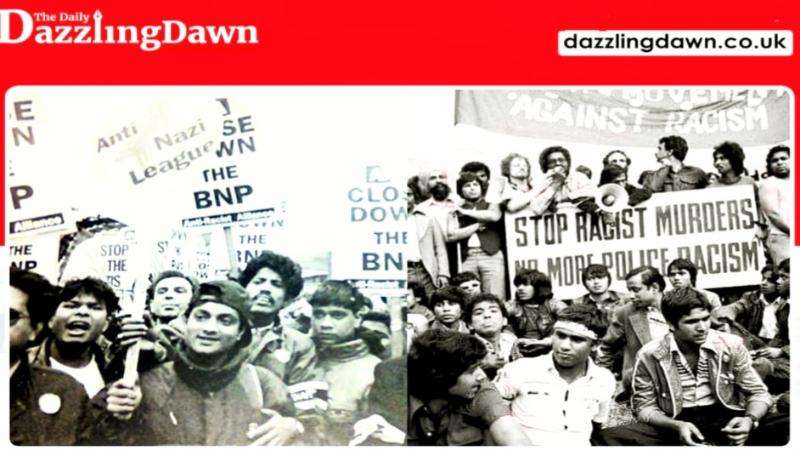
A small park, formerly St Mary's Park, in the City of London, Billet, on Edler Street, White Church Lane, and White Chapel High Street. As soon as you enter the park, you will see 'Altab Ali Park' written in English in big letters. Altab Ali was a Bengali immigrant from London. He worked as a factory worker. In the seventies of the last century, there was an anti-apartheid movement in Britain. On May 4, 1978, on his way home from work, he was brutally murdered by some unidentified racists in East London's Edler Street. Two Bangladeshis were killed in this movement.

Thousands of people erupted in protests over the death of Altab Ali in a racist attack. Anti-apartheid movement gets a new dimension. People come down the street. Altab Ali's death served as an important 'turning point' in this movement. An Altab Ali's name spread through people's mouths through massive protests. That is why in 1998 St. Mary's Park on Edler Street in East London was named Altab Ali Park in his honor. In the name of Altab Ali Park in London, it is established as a tower of inspiration for Bangladeshis to fight against the racist forces. This Shaheed Tower was built in the southern part of Altab Ali Park in East London in 1999, which is the first Shaheed Minar built outside the country.

A Story of Progress: The Thriving British Bangladeshi Community Today

The community established mosques, community centers, and cultural organizations to preserve their heritage and provide support to new arrivals. The creation of Bangladeshi owned businesses, most notably restaurants, became a staple of British culture.

Contemporary British Bangladeshi Community: The British Bangladeshi community is now a vibrant and integral part of British society, contributing to its cultural diversity and economic prosperity.

Economic Contributions and Entrepreneurship: One of the most notable achievements of the British Bangladeshi community is their entrepreneurial spirit. The "Bangladeshi restaurant" has become a staple of British culinary culture, with thousands of curry houses across the country. These businesses have not only provided employment opportunities but also contributed significantly to the UK economy. Beyond restaurants, British Bangladeshis have excelled in other sectors, including:

Retail: Establishing and managing independent shops, supermarkets, and other retail businesses.

Real Estate: Investing in property and contributing to the development of local communities.

Finance: Increasingly entering professional roles in banking and finance.

Technology: A growing number of British Bangladeshis are forging careers in the technology sector, reflecting the community’s adaptability to evolving industries.

Political Representation and Civic Engagement:
The British Bangladeshi community has made significant strides in political representation. From local councilors to members of parliament, their voices are increasingly heard in the UK's political landscape. Notable achievements include:

The election of numerous British Bangladeshis to local councils, enabling them to influence local policies and address community needs. The election of British Bangladeshi MPs to the House of Commons, providing a platform for national representation and advocacy.

Active participation in civic organizations and community initiatives, working to improve social and economic conditions.

Educational Attainment and Professional Success:The younger generation of British Bangladeshis is achieving remarkable success in education and professional careers. Increased access to higher education has led to a surge in graduates in fields such as medicine, law, engineering, and academia. This upward mobility is transforming the community's socioeconomic profile.

Rising numbers of British Bangladeshi doctors, lawyers, and other professionals are contributing to the UK's workforce.

Growing representation in academic institutions, with British Bangladeshi scholars and researchers making valuable contributions to various fields.

The rise of British Bangladeshi figures in the arts, media, and creative industries.

Cultural Identity and Community Cohesion:
Maintaining a strong cultural identity is a vital aspect of the British Bangladeshi experience. The community has successfully preserved its heritage while integrating into British society. This is evident in:

The preservation of Bengali language and cultural traditions through community centers, schools, and cultural events. The celebration of Bangladeshi festivals and cultural events, fostering a sense of community and identity.

The blending of British and Bangladeshi cultural influences, creating a unique and dynamic cultural expression.

Why Bangladeshis behind in British politics?

Bangladeshis, especially the Sylhety people, have passed one hundred years as a community in Britain. Compared to Indians, Pakistani & other South Asians, and many other ethnic minority communities living in the country, Bangladeshis are lagging behind in terms of education, employment, mainstream politics, and even health.

However, in recent years in Britain, Bangladeshis have spread the light of success in education and research. The participation of our new generation is growing slowly in British mainstream politics.

The fourth generation of thousands of Sylhety families continues in Britain. There are 600 parliamentary seats in the House of Commons. There are only four British Bangladeshi MPs among them. At least four-thirds of the fourth-generation expatriates are originally from Sylhet. But there are only two MPs from Greater Sylhet in the current British Parliament. All four MPs of Bangladeshi origin belong to the Labour Party. All are women. Our women are more successful in politics in the UK. All four of the current MPs are second-generation British Bangladeshis. The community of Bangladeshis has been established in the country for a century. The residence of Indian Pakistanis is also centuries old. British Pakistanis went to the British Cabinet. Sadiq Khan, the repeatedly elected mayor of London, is also of Pakistani descent.

Apart from the two seats in East London, Britain's policymakers have no other place in the country to judge the outcome and impact of the Bangladeshi votes. British Bangladeshi's far behind in mainstream politics because our community was not careful because of the lack of foresight of the previous generation and the ego and jealousy of the current generation. In Britain, if a candidate of Indian or Pakistani origin is nominated by any major party, the natives of that country spontaneously come forward to campaign with their own labour and their own money. They don't get divided on the issues of who they belong to in their country or who they believe in, and they don't spread division in their own community. But, at the same time, we have to admit with shame that Bangladeshis are the main obstacle to the advancement of Bangladeshis in British politics. If a Bangladeshi has the opportunity to go to the House of Lords or the House of Parliament, it is the social negative trend of the community of people to prevent him from campaigning for a different country's candidate, slandering the candidate's personal and family life, and writing complaints. People who wanted to give moral leadership could not come out. Most people are disappointed with the practice of dragging behind someone who is ahead rather than pushing someone forward in the country. A large number of Bangladeshis live outside Tower Hamlets in Camden, London, Oldham, and Birmingham, outside London. Since there are thousands of conscious voters of their own country in these seats, there was a chance to get elected MP of Bangladeshi origin long ago. It did not happen, only because of the lack of unity in the Bangladeshi community. The youth complained of the negative trend of socially discouraging the new generation in politics rather than encouraging them.

Even after living abroad for many years, the slander of opposition to domestic politics and not being able to unite on any issue of public importance have left Bangladeshis behind in Britain's mainstream politics. As long as we do not get out of the culture of support and opposition for the regionalization of the country's village and union level in local government councillor elections in this country, until we can't get out of the culture, relative people will not be able to reach mainstream politics.

Hopefully, in the midst of this negativity of breaking the journey of others by cutting off one's own nose, the participation of the new generation of Bangladeshis in British mainstream politics, councillors, and local government elections has increased more than before. Last year, British Bangladeshi Ismail Uddin showed surprise by being elected as a councillor at the age of 19 in independent elections without the support of any party. The participation of Bangladeshis in the posts of garlanded mayors in councils without voting has increased. Still, the participation rate of Bangladeshis as major party candidates in general elections is much lower than that of Indians and Pakistanis.

In the two general elections of the 1990s, four candidates of Bangladeshi origin were shortlisted for the Labour Party nomination for MP in the East London seats of Bethnal Green and Bow. They are the late Jahangir Alam, Councillor Rajan Uddin Jalal, Paula Manjila Uddin, and Kumar Murshid. The late Jahangir Alam and Councillor Rajan Uddin Jalal were left off the shortlist twice. In Britain, the men of the Bangladeshi community have lost many potential politicians by leaving the party without getting a party nomination, opposing party ideology, supporting the candidate of the opposition party, and changing parties again and again.

The major point of crisis is, In the field of politics in the UK, the Bangladeshi community hasn't yet gotten a political leader who can be imitated, who can be an example as an idol, and who can be an example to the new generation. Which is true in many other ethnic minority communities. Apart from the voting season, he introduced himself as a proud representative of the Bangladeshi community, standing by the people of the community in any issues who would be encouraged by the new generation to build a career in mainstream politics in Britain, a huge void in that place.

As millions of British Bangladeshis of the new generation cannot read and write Bengali, the place for learning Bengali in Britain is gradually shrinking.

In many of our families, our children do not want to speak Bengali, even at home. The institutional space of the crisis has become visible as schools teaching Bengali have been closed by the government on the pretext of a lack of budget. Sadly, there is no planned and coordinated effort by our politicians to raise the barriers to progress in the health, education, culture, and livelihood of Bangladeshis at the policy level in Britain.

There are hundreds of Bangladeshi community organisations in Britain. The 50-year-old community organisations are being torn apart for selfish personal reasons, spreading division.

May the chapter of the Bangladeshi community shine brightly in the sovereign journey of a traditional nation-state like Britain. In Britain's mainstream politics, in Parliament, and in the Cabinet, British Bangladeshis should be able to proudly hold up their British identity as well as their Bangladeshi roots.

Despite their successes, the British Bangladeshi community continues to face challenges, including:
  • Persistent socioeconomic disparities in certain areas.
  • Ongoing issues related to discrimination and prejudice.
  • The need to address the needs of an aging population within the community.
However, the future prospects for the British Bangladeshi community are bright. The younger generation's educational achievements, coupled with the community's entrepreneurial spirit and growing political influence, suggest a continued trajectory of success. As they continue to contribute to the UK's economy, society, and culture, the British Bangladeshi community will undoubtedly play an increasingly important role in shaping the nation's future.

Munzer Ahmed Chowdhury
 

65 Bangladeshi students win Top in World award
Staff Correspondent 30 November, 2024, 23:08

Sixty-five Bangladeshi students have been honoured with ‘Top in the World’ awards at the Outstanding Cambridge Learner Awards 2024, a prestigious event co-hosted by the British Council and Cambridge International Education at a hotel in the capital on Saturday.

The students were recognised for exceptional achievements in the June 2024 Cambridge examination series, said a press release.

A total of 98 Bangladeshi students received 121 awards at the 2024 OCLA. These global accolades celebrate the highest achievers in Cambridge International exams, with over a million students worldwide taking part in Cambridge’s internationally recognised courses each year.

Cambridge International Education has been holding global examinations for more than 160 years.

The awards recognise achievement in four categories: Top in the World, High Achievement, Top in Country, and Best Across.

Among the 121 awards presented, sixty-five Bangladeshi students were honoured with the prestigious ‘Top in the World’ awards, given to those who have achieved the highest marks worldwide for a particular subject.

Of these winners, 98 students received this accolade across Cambridge O Level, Cambridge International AS & A Level, and Cambridge IGCSE subjects.

Professor SMA Faiz, chairman of the University Grants Commission, and James Goldman, acting British High Commissioner to Bangladesh, Shahin Reza, Country Manager for Cambridge International Education in Bangladesh and Rod Smith, group managing Director of International Education at Cambridge, also spoke, among others.​
 
Back
Top