[🇧🇩] Banking Industry in Bangladesh

Quick Reply ✓ Posted!
[🇧🇩] Banking Industry in Bangladesh
446
21K
More threads by Saif

G Bangladesh Defense

Sonali Bank lends Tk 7,000cr to National Bank with Bangladesh Bank guarantee

Star Business Report


1791935993182.webp


State-owned Sonali Bank PLC has lent Tk 7,000 crore to financially distressed National Bank PLC to help the private lender meet customers’ withdrawal demands.

The Bangladesh Bank has provided a 100 percent guarantee for the three-month loan, Md Shawkat Ali Khan, managing director of Sonali Bank, confirmed to The Daily Star yesterday.

The loan carries an interest rate of 10 percent, he said, adding that the transaction had been completed.

“We face no risk here because Bangladesh Bank is providing the guarantee,” Shawkat said, explaining that if National Bank fails to repay the loan within the stipulated period, the central bank will repay Sonali Bank.

He expressed hope that the funds would help restore depositors’ confidence but stressed that National Bank must use the money for the intended purposes.

“The National Bank needs to use this money properly. It must be utilised for the right purposes,” he said.

Prof Melita Mehjabeen, chairman of National Bank, said the bank was preparing to resume full banking services on October 15, allowing customers to withdraw their deposits. The bank has already started taking withdrawal requests as part of its preparations to restore customer services.

It had received nearly 7,000 requests as of yesterday, Melita said.

“We are making arrangements to ensure that funds reach every branch by tomorrow. From the day after tomorrow, we will try to provide services to all our customers,” she said.

National Bank’s top executives had met Bangladesh Bank Governor Md Mostaqur Rahman to seek support last week. The central bank assured the lender of liquidity assistance to help it repay depositors.

At the meeting, Governor Mostaqur said protecting depositors would remain the regulator’s priority.

He instructed National Bank to take the necessary measures to ensure that depositors could withdraw money according to their needs from all branches and ATM booths.

“Depositors must not be turned away under any circumstances. From October 15, they will get their money back. In this regard, the bank will be provided with liquidity support as needed,” BB Executive Director and Spokesperson Arief Hossain Khan said after the meeting.

Melita said while the Bangladesh Bank instructed National Bank to reopen and resume operations, the regulator had not specified the exact mechanism through which assistance would be provided.

National Bank incurred losses of nearly Tk 9,000 crore in the four years since 2022. In 2025, the bank posted a loss of Tk 2,430 crore, up 41 percent from Tk 1,722 crore in the previous year, according to its annual report.

Its non-performing loans accounted for 59.69 percent of total outstanding loans at the end of 2025.

The latest liquidity support comes after four National Bank depositors approached the High Court last month seeking access to their savings.

One of Bangladesh’s oldest private lenders, National Bank has received uncollateralised liquidity support from Bangladesh Bank over the past several years amid funding shortages and a high level of non-performing loans.​
 

BANKS' FINANCIALS AND STATE OF ECONOMY

Forty commercial banks report losses in corporate tax returns

Of total 62 commercial banks, 22 show profits despite some financial hurdles


1792537952752.webp


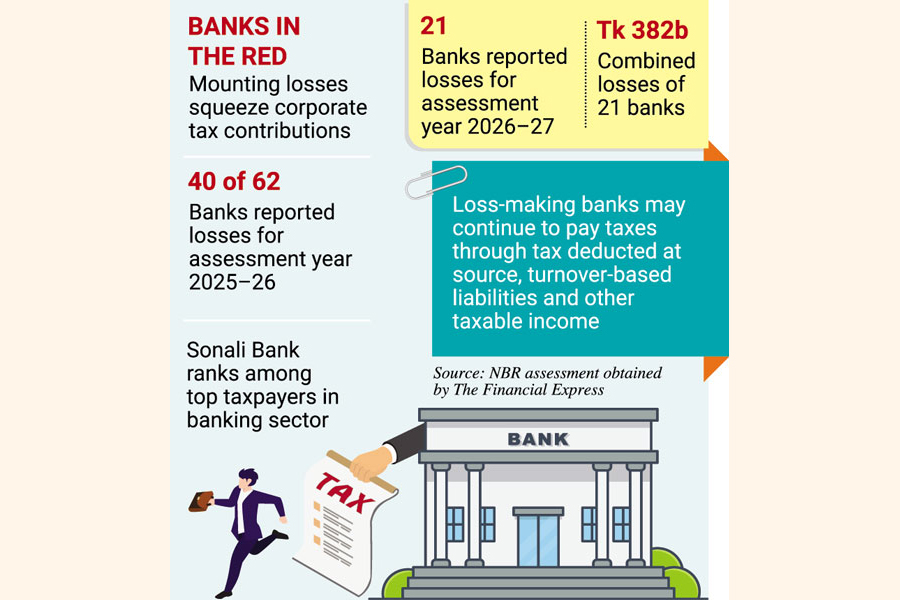
Forty of Bangladesh's 62 commercial banks reported losses in their corporate-tax returns for the past tax year, reflecting sluggish business activity and a slowdown in private-sector credit growth.

The remaining 22 banks reported profits for assessment year 2025-26, contributing varying amounts of corporate-income tax. However, several of the lenders also experienced deterioration in their financial performance.

An internal assessment by the National Board of Revenue (NBR), obtained by The Financial Express (FE), on corporate-tax collection from the banking sector and its projections reveals the banking and overall economic trends.

However, a senior tax official at the NBR said banks having incurred loss paid taxes too due to turnover tax and tax deducted at source from sales of bonds.

"It does not mean that decline in income means negative tax payment in a particular tax year," he added.

State-owned Sonali Bank ranked among the top corporate taxpayers in the banking sector, followed by Dutch-Bangla Bank. BRAC Bank ranked among the leading private commercial banks in terms of tax payments.

Pubali Bank, HSBC, City Bank PLC, Eastern Bank, Agrani Bank, Shahjalal Islami Bank, Uttara Bank and Prime Bank were also among the top 10 corporate taxpayers in the sector during the year.

The assessment, however, shows a significant deterioration in the tax-return positions of several banks, with losses deepening over in the 2026-27 assessment year.

One public and some first-generation private commercial banks reported losses in the latest assessment year.

Of the 22 banks that reported profits for assessment year 2025-26, 11 subsequently reported losses in the assessment year, while 21 banks reported losses in assessment year 2026-27, according to the assessment. Bangladesh Krishi Bank's figure for the latter period was unavailable.

The situation deteriorated further in assessment year 2026-27, when 21 banks reported aggregate losses of approximately Tk 382 billion, excluding Bangladesh Krishi Bank.

The assessment also identifies banks that relapsed from profit into loss, including the state-owned Janata Bank and few private banks.

The deterioration is particularly concerning for lenders that had previously remained profitable, as the shift may indicate mounting pressure on their financial performance.

Despite reporting losses, the banks continued to pay some taxes, partly because tax deducted at source on bond sales is included in their reported tax payments.

Talking to the FE, former commissioner of Large Taxpayers Unit (LTU) income tax Apurba Kanti Das said income from businesses is separate from income from securities for corporate taxpayers.

"This results in payment of taxes despite incurring losses," he added.

Income tax also imposes tax on provisions of bad loans, he noted.

Regular tax payments remained positive for almost all the banks, suggesting that some payments may reflect minimum or turnover-based tax liabilities rather than taxes on profits.

The figures suggest that weak earnings and mounting losses are affecting a growing number of lenders, potentially constraining their capacity to contribute to corporate income-tax revenue.

Former chairman of Sonali Bank Muslim Chowdhury says unless the banking sector is completely revamped through a major policy shift, particularly in governance and ownership structures, the crisis cannot be resolved.

Two major problems are money laundering and lending without adequate collateral. In many cases, loans were disbursed in the names of projects but the funds were never invested in those projects.

"Instead, the money was siphoned off and laundered abroad," he says.

"When public confidence in Islami Bank declined, many depositors shifted their money to Sonali Bank. The bank has invested the surplus funds in treasury bills and treasury bonds, generating profits through treasury management," he explains.​
 

Private-bank seniors being hired to fill public banks' MD posts

Govt move meant to better manage banking operations, public banks' aspirants fear career blockage


1792626217487.webp


A plan is under active consideration of the government to appoint private commercial banks' senior executives as managing directors in state-owned commercial banks in a management reshuffle.

Meanwhile, the top executive posts in some public banks lay vacant following marching orders for the incumbents, ostensibly as the banks facing various problems.

The move comes after the Ministry of Finance opened the scope for appointing executives from outside the state-owned banks under a recently issued policy, sources have said.

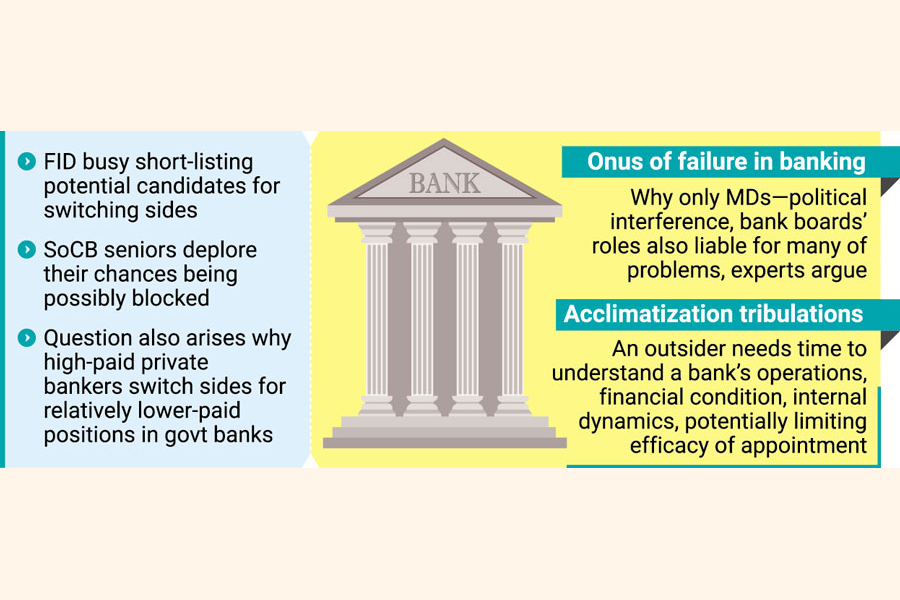
According to the sources, the financial institutions division (FID) under the ministry of finance is busy making a list of potential candidates to be placed to the special committee led by the finance minister for final approval.

Contacted, FID additional secretary for the Central and Commercial Banks Wing Md. Azimuddin Biswas said the government can appoint anyone from existing pool of executives to state-owned banks, such as retired bankers or executives from the private-sector banks.

"There is no bar or restriction that senior executives from privately-operated banks cannot be appointed," he said, adding that a high-powered special committee led by the finance minister will finalise the names before sending it to the central bank for its clearance.

The government reportedly believes that bringing in executives from the private sector could improve corporate governance in state-owned banks and help reduce irregularities and corruption to bring back vibrancy in banking operations.

However, the possible appointments have triggered dissatisfaction among employees at different levels of state banks, who fear that such move could effectively block the career progression of deputy managing directors (DMDs) and other senior officials who have spent years working in the state-owned banking sector and traditionally aspire to become MD.

Bankers, speaking on condition of anonymity, have argued that some private-sector bank executives had failed to prevent their institutions from falling into serious financial distress.

Several private banks are currently undergoing merger processes amid mounting problems in the banking sector, they have pointed out.

A senior executive of a private bank, on condition of not being quoted by name, raised the question why executives drawing significantly higher salaries in private banks would be interested in taking relatively lower-paid positions at state-owned banks.

He said employees had legitimate expectations of reaching the top position after serving their institutions for many years.

"We have served the banks for years. Naturally, we expect to become managing director before retirement. But that opportunity is now being taken away," said one public-sector banker.

Another executive who spent more than 25 years in public banks said that irregularities and corruption in state-owned banks could not be attributed solely to managing directors as political interference and the role of bank boards were also responsible for many of the problems.

"Such appointments could create disorder within state-owned banks. Officials may not readily accept an MD coming from outside. That could ultimately hurt the bank," he told the FE.

He added that an outsider would also need considerable time to understand the bank's operations, financial condition and internal dynamics, potentially limiting the effectiveness of the appointment.

The government recently removed the managing directors of Sonali Bank, Janata Bank and Rupali Bank. Earlier, it had cancelled the remaining terms of the managing directors of BASIC Bank and Agrani Bank.

But the government did not publicly clarify whether the removals were made on political considerations or based on performance assessments.​
 

Learning nothing from past mistakes in banking


1792797234424.webp

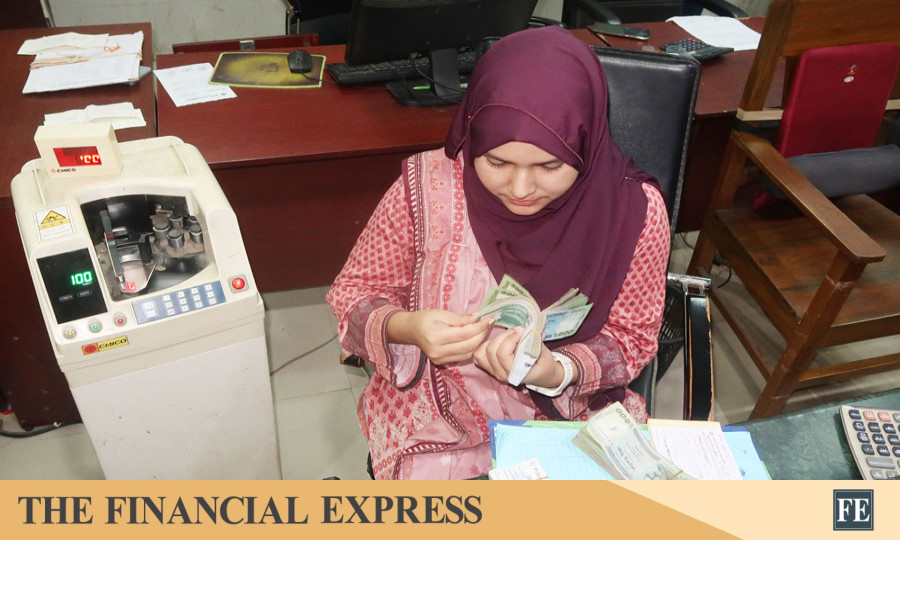
A bank teller is counting notes at a bank branch in Dhaka — FE File Photo

The distress in the banking sector is hardly news to anyone following the economy. Nor did it arise overnight. Deliberate policy decisions and the organised plundering of banks during the latter half of the Awami League's 15 years misrule have created and compounded this banking crisis. The situation became so dire that five banks had to be merged into a single entity called Sammilito Islami Bank after massive loan defaults wiped out their share value. The alternative was simply to shut them down. Even this rescue has yielded little improvement as Sammilito Islami Bank continues to struggle. Of the remaining 56 banks, 22 to 23 remain burdened by heavy losses and capital shortfalls still today.

Just as banks are still absorbing the costs of those earlier policy missteps, the government is considering changes to the Bank Company Act that could allow powerful business families and their allies to keep their grip on banks. Rules designed to curb family control and limit directors' tenure are being relaxed, while provisions that hold directors accountable for loans taken by companies linked to them may also be weakened. This gives the impression that the authorities have learnt nothing from past mistakes and their devastating consequences.

Much of the damage inflicted on the banking sector stemmed from the very problem that the proposed changes risk perpetuating which is control over bank boards. Banks operate largely with money that belongs to other people, and their directors decide how the savings of ordinary citizens are to be used. When a family or a close circle of associates dominates the boardroom, distinction between a bank and family business can disappear. Lending decisions then serve the interests of the directors and their businesses rather than the long-term health of the bank. Depositors may believe their savings are entrusted to regulated financial institutions, but in effect, those in control may empty out the banks as though the money belongs to them.

The country paid a heavy price for such arrangement under the Awami League regime. Powerful business groups like S Alam, Beximco, Premier and Sikder reportedly took control of several banks by putting spouses, children, in-laws and other close associates on their boards. The rules that allowed this kind of concentration were tweaked again and again to favour the owners. In 2018 and then again in 2023, laws were changed to let directors serve longer continuous terms, first up to nine years and later to 12. These changes were never about improving efficiency. They were done to meet the demands of influential people who wanted to hold on to power. Some of these directors lent money to their own business groups on easy terms violating rules and then laundered it abroad. Consequently, those banks are now drowning under the weight of non-performing loans.

Against this record, the reform plan prepared under the interim government was a necessary step towards restoring discipline in the banking sector. It proposed reducing the maximum number of directors from a single family from three to two and shortening the maximum continuous tenure from 12 years to six. To prevent owners from bypassing these limits through extended family members, it also sought to widen the legal definition of family to include in-laws and siblings. The plan further proposed that independent directors make up half of each bank's board and that directors face consequences when companies linked to them default on loans. After the experience of recent years, it is difficult to justify a retreat from these safeguards. Yet, the current administration is considering changes that could once again allow influential business groups to treat banks as their personal piggy banks.

The bankers' association has reportedly defended the proposed changes by claiming that longer tenures preserve experience and that reducing family representation threatens operational stability. Such arguments do not hold. Increasing family representation and director tenures do more to strengthen nepotism and family dominance and open the door to irregularities than any benefit from longer experience could justify. True stability comes from independent oversight and professional management rather than from keeping power inside a closed circle of relatives.

Thus, this current approach clearly undermines the very foundation of good governance and is not good for the banking industry. It is really hard to see how regulators could think allowing denser family control could bring in anything positive when many past irregularities took place through the collusion of board members. Thanks to those outright lootings of the past, Bangladesh has effectively become a global leader in non-performing loans. The present government shows little visible commitment to reverse the situation. Nor is there any clear process in sight to recover the stolen money siphoned out of the country. The effect on the wider economy is already clear and the International Monetary Fund warning that growth may fall below four per cent this year is evidence enough of the weakness that continues to weigh on overall performance.

Those responsible for these decisions should not assume that their actions will carry no consequences. Bangladesh is due to undergo its fourth round of mutual evaluation by the Financial Action Task Force (FATF) in 2027-28 when the country's safeguards against money laundering and other financial crimes will face close scrutiny. After one of the worst episodes of bank looting in history, this assessment will be a serious test of the country's commitment to financial integrity. Although allowing more family members on bank boards or extending directors' tenure would not, by itself, violate FATF standards, weakening safeguards against conflicts of interest and lending abuses could raise concerns about the effectiveness of financial sector oversight. This could be read as enabling the same powerful business families to regain or keep control of banks that were behind the previous lending irregularities. Should that view take hold, grey listing becomes a credible risk, and its costs would fall on the whole economy, not just on the banking sector.​
 

BB to run alternative to SWIFT for local LCs

Mostafizur Rahman . Dhaka

1792974755412.webp


Bangladesh Bank will shift the processing of local back-to-back letters of credit (LCs) from the international SWIFT network to a domestic messaging system next month, aiming to reduce banks’ transaction costs.

BB officials said the system is ready and is expected to become operational next month.

The central bank met commercial banks on October 22 and instructed them to begin trial runs from Sunday.

The new system will handle only back-to-back LCs between banks in Bangladesh and will not affect international payments or communications with foreign banks.

They said that the system will reduce around Tk 75 crore costs for banks annually.

A back-to-back LC is a credit arrangement in which a bank opens a second letter of credit against an existing LC issued in support of an export order. It allows an exporter to purchase raw materials and other supplies needed to fulfil the order without paying the full cost upfront.

For example, a foreign buyer in Europe places an order worth $1 million with a Bangladeshi garment exporter and opens a master LC through its bank.

The exporter needs fabric from a local textile mill to manufacture the garments. The exporter’s bank then opens a back-to-back LC in favour of the textile mill, using the foreign buyer’s LC as security. The mill can supply the fabric against the bank’s payment commitment, while the exporter uses the proceeds from the export order to settle the financing.

Such LCs are central to Bangladesh’s garment industry, as exporters frequently depend on credit to purchase fabric, yarn and accessories before receiving payment from foreign buyers.

Back-to-back LCs do not necessarily involve only two local banks. A foreign bank may issue the master LC, while a Bangladeshi bank opens the second LC for a local supplier. In that case, the transaction involves international banking communications as well as domestic financing.

BB’s new system will replace SWIFT only for messages exchanged between Bangladeshi banks under the local arrangement, not for communications with foreign banks.

SWIFT, or the Society for Worldwide Interbank Financial Telecommunication, is a Belgium-based cooperative that provides a secure, standardised network for banks to exchange financial messages.

It does not itself transfer money; payments are settled through accounts held by banks. Banks pay SWIFT fees for using its services, and these costs may be passed on to customers through LC and messaging charges.

Under the new arrangement, local banks will exchange messages relating to eligible back-to-back LCs through a system operated by BB, avoiding SWIFT charges on those messages.

The central bank will not charge banks for using the domestic system, but the extent of any savings for businesses will depend on whether banks reduce their customer fees.

However, experts have cautioned that a domestic messaging network could become a target for cyberattacks if security controls are inadequate. The system will carry sensitive information about exporters, suppliers, contracts and credit arrangements, making data protection and uninterrupted service important for the garment supply chain.

Experts recommend independent security audits and penetration tests, strong authentication, multiple approvals for transactions, tamper-resistant records, isolated bank connections and continuous monitoring for suspicious activity.

Mashrur Arefin, Managing Director & CEO of City Bank PLC, said local LC messages can be transmitted through Foreign Exchange Transaction Management System (FxTMS) of Bangladesh Bank rather than SWIFT, potentially reducing foreign-currency message transmission fees.

The new system uses message formats similar to SWIFT’s and connects directly to banks’ trade systems, which reduces manual work. Banks must still set up secure links, test the system and bear integration and maintenance costs.

Its message structures and data fields largely follow familiar SWIFT MT templates, including MT 700, MT 707 and MT 799.

API connectivity is intended to support integration with banks’ core trade systems and reduce reliance on separate manual processes, he added.

He said the move does not by itself raise fraud risk. Only authorised head-office staff can access it, the computers are hardened and isolated, the link between banks and BB is private, and only approved IP addresses can connect. Banks will test it by sending LCs to each other before launch.

SWIFT stays for international trade, so exports are unaffected. The main risk is mismatched data between FxTMS and banks’ own systems. Banks and BB should follow international message standards, map data consistently and keep traceable transaction references for reconciliation, he said.​
 

PKDefense Forums: Country-by-Country Military Discussions

Log In Register Forums
Back