Home Watch Videos Wars Login

[🇧🇩] Banking System in Bangladesh

[🇧🇩] Banking System in Bangladesh
275
9K
More threads by Saif

G Bangladesh Defense

No respite yet from banking sector woes
Mostafizur Rahman 27 October, 2024, 23:47

1730076523879.webp


A crisis of confidence has gripped the country’s banking sector amid little action taken to resolve the deep-rooted challenges facing the sector and hold those accountable for years of malfeasance and mismanagement.

According to several officials of the Bangladesh Bank and other banks, aside from limited board restructurings in a few banks, no major reforms have been initiated since the interim government assumed office on August 8.

Despite initial hopes that the banking sector would stabilise after Sheikh Hasina resigned as prime minister and fled to India on August 5, the situation has barely improved.

Many banks are still unable to meet depositor demands, facing continued erosion of public trust causing panic fund withdrawals.

On September 8, new central bank governor Ahsan H Mansur acknowledged that around 10 banks faced risk of bankruptcy—a statement that further deepened the clients’ panic intensifying the rush of withdrawals.

The situation deteriorated further after the central bank restructured the boards of 11 banks and announced that it would not directly provide them with liquidity support.

These moves only deepened depositor mistrust, making it increasingly difficult for struggling banks to recover.

In response to the crisis, the central bank began providing limited support by guaranteeing interbank loans, disbursing Tk 5,000 crore to six distressed banks over the past one month.

The sector’s liquidity crisis, however, persists, with depositors still deeply concerned about the security of their funds.

Mutual Trust Bank managing director and chief executive officer Syed Mahbubur Rahman said that currently approximately 15 banks were battling against various crises that were unlikely to resolve soon.

He noted that aside from board restructurings at some banks, no significant reforms had yet been observed, adding, ‘We anticipate some visible reforms by December this year.’

Mahbubur said that although boards were restructured, much of the same senior management remained in place, casting doubt on their intension to lead meaningful changes.

He acknowledged the challenge of replacing senior management staff who had been in place for years.

On the crisis of confidence among depositors, Mahbubur highlighted that a quarter of banks were struggling with a severe liquidity crisis failing to repay depositors’ money.

Besides, he also mentioned the prevailing overall uncertainty and poor law and order situation as some key factors behind the ongoing crisis in the banking sector.

‘Government officials, including bankers, are currently in a “wait and see” mode given the broader political climate,’ he remarked.

As of the last working day in August, total bank deposits dropped to Tk 17.31 lakh crore from Tk 17.34 lakh crore in the last working day in July.

In end of August, currency outside banks surged for the 10th consecutive month, reaching Tk 2.92 lakh crore as depositors continued withdrawals.

Non-performing loans skyrocketed to Tk 2.11 lakh crore by June, up from Tk 88,734 crore in December 2021, underscoring the sector’s prolonged loan irregularities.

S Alam Group withdrew around Tk 2 lakh crore loans through companies including shell firms in collusion with some banks and central bank officials.

Similarly, Beximco Group borrowed Tk 25,000 crore from Janata Bank of which Tk 18,000 crore is now non-performing.

The central bank has largely turned a blind eye to such massive loan irregularities, often aiding these groups through relaxing regulations and maintaining silence.

Consequently, the sector faces a crippling liquidity shortage, with depositors losing trust not only in individual banks but also in regulatory bodies.

According to bankers, influential officials with strong ties to powerful political and business groups have retained their positions, blocking meaningful reform efforts.

Even within the central bank, key officials linked to groups like S Alam and Bashundhara remain in place, leading to the bank’s failure to address or expose corrupt practices, they observe.

So far, the Bangladesh Bank has refrained from taking punitive action against bank officials involved in these activities, perpetuating a lack of accountability and further deepening the sector’s ongoing crisis.

Additionally, the persistent dollar crisis, elevated exchange rates, acute liquidity shortages, and high-interest rates are deterring businesses from securing loans and opening letters of credit, negatively impacting the economic.

The government, facing this bleak scenario, has also struggled to secure sufficient loans from the banking sector.

Bangladesh Bank’s spokesperson and executive director, Husne Ara Shikha, stated that the central bank has restructured the boards of 11 banks to rebuild public trust and ensure good governance.

Regarding allegations that information on prior irregularities involving senior bank officials has been concealed, she clarified that the responsibility lay with the respective bank’s board to remove, transfer, or replace employees, including the managing director, for the sake of public interest.

Moreover, the central bank would make final decisions based on recommendations from the respective boards, she said.

The central bank was committed to taking action against any bank officer if complaints were found valid, said the Bangladesh Bank executive director.​
 
Analyze

Analyze Post

Add your ideas here:
Highlight Cite Fact Check Respond

We need to protect depositors from bank boardroom misuse

1730337444279.webp

Visual: Salman Sakib Shahryar

In recent times, we have had a barrage of reports showing how, during the tenure of the Awami League regime, politically influential or affiliated directors in private banks abused their power to misappropriate general depositors' savings through illegal or unethical practices. These include sanctioning loans without due diligence, waiving or writing off loans and their interest, extending or rescheduling loans without reasonable grounds, making bank investments without proper feasibility studies, etc. Such poor governance resulted in an unprecedented misappropriation of depositors' money over the last decade or so.

While most malpractices in the banking sector stem from inadequate supervision and poor accountability practices by the central bank, the loopholes within the existing legal framework on banking governance also play a significant role. Corrupt individuals and their allies managed to legalise their wrongful actions by using some flawed provisions of the Bank Company Act, 1991 (amended up to 2023)—the primary legislation governing the banking sector. To identify the weaknesses in the legal provisions regarding accountability and transparency, it is crucial to understand the functions and powers of a bank's board of directors.

Legally, a board of directors is the highest decision-making body in a bank, responsible for formulating and implementing policies, risk management, internal controls, internal audits, and compliance. In short, the board oversees all business and administrative actions of a bank. So having a well-balanced and accountable board is paramount, especially as a bank holds and manages the funds of depositors. However, malpractice in the banking sector often begins when influential individuals take control of the board. The question is, does the current banking legislation prevent a bank from falling under the control of vested interests? The answer is somewhat affirmative.

Section 14Ka of the Act states that the shares of a bank cannot be accumulated in the hands of an individual, particular family, or company—and it bars them from acquiring more than 10 percent of shares in a banking company. Moreover, Section 15 restricts the number of directors from one family to three at a time, while Section 23 allows two additional directors from the same family's affiliated or controlled company or institution.

But since a bank, being a public limited company, must have at least three members on its board, including at least two independent directors, it is legally possible for five out of seven members on a board to be from a single family or its affiliated companies, allowing it to control the board. Such a concentration of control within a family raises ethical and legal concerns. For instance, appointing family members and associates to key positions in a bank could lead to conflicts of interest, where personal interests might overshadow depositor interests. Moreover, favouritism and incompetence may lead to poor compliance and thereby increase the risk of financial mismanagement and misappropriation.

Furthermore, according to an amendment to the Act passed on June 21, 2023, an individual can serve as a director for twelve consecutive years and may be reappointed after a three-year break. Such a lengthy tenure can allow directors to entrench themselves and misuse their position for personal gain rather than safeguarding depositor interests. All these vague and legally tenuous provisions of the Bank Company Act can open avenues for vested interests to amass control over banks.

Beyond the formation of the board, the most critical issue is ensuring transparency and accountability among directors. The Act mandates that directors, managing directors or chief executives, and senior management officials disclose the "name, address, and other details of their commercial, financial, agricultural, industrial, and other businesses," along with details of family business interests, to the board annually. However, Section 18 does not require this disclosure to be submitted to Bangladesh Bank, creating a transparency loophole. A board plagued by vested interests will naturally like to shield its members. Additionally, the Act requires directors and members of senior management to notify the board if they have a relationship with anyone bound or about to be bound in a significant contract with the bank. While this provision initially appears well-suited to promote transparency, the vague term "significant contract" leaves room for misinterpretation and manipulation.

Beyond the formations and functions of bank management, the 2023 amendment to the Act also raised concerns by granting substantial concessions to loan-defaulting companies. It stipulates that if one company within a group defaults, other companies within the same group or linked to the same individuals won't be classified as defaulters. This will also not affect their ability to secure new loans. Economists believe these changes risk increasing intentional loan defaults, further worsening bank governance issues.

What becomes clear from the above discussion is that existing legal provisions can, and do, allow for malpractice within banks. To protect general depositors' interests and restore good governance in the sector, we must reform the legal framework for board formation and its transparency.

Farhan Masuq is lecturer of law at Bangladesh University of Professionals (BUP).

Khushnuma Khan is a barrister-at-law.​
 
Analyze

Analyze Post

Add your ideas here:
Highlight Cite Fact Check Respond

Tk 3,000cr export fund held up in four troubled banks

1730507955082.webp


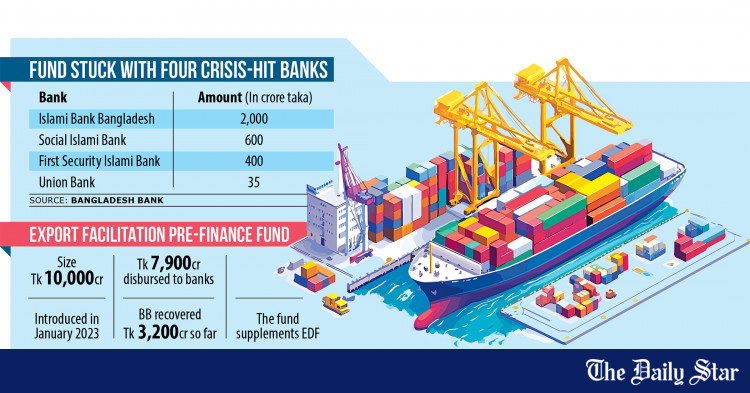
A large chunk of a Tk 10,000 crore central bank fund, meant for financing raw material imports for export orders, remains stuck with four crisis-hit banks, according to Bangladesh Bank officials.

This has made it difficult for sound banks to get adequate liquidity from the Export Facilitation Pre-Finance Fund (EFPF) to lend to local exporters for raw material purchases from foreign markets.

The four banks are Islami Bank Bangladesh, Social Islami Bank, First Security Islami Bank and Union Bank -- the boards of which were previously dominated by the Chattogram-based industrial conglomerate S Alam Group.

Following the political changeover on August 5, the banks saw their boards reconstituted, ousting S Alam's men from the boardroom.

Still, the banks have struggled to repay the Bangladesh Bank Tk 3,035 crore, due mainly to their severe liquidity crisis. Therefore, the central bank has been extending the repayment deadline.

Of the total amount, Tk 2,000 crore is owed by Islami Bank Bangladesh, Tk 600 crore by Social Islami Bank, Tk 400 crore by First Security Islami Bank and Tk 35 crore by Union Bank.

In January last year, the Bangladesh Bank formed the Tk 10,000 crore EFPF to support industries facing raw material import challenges due to a foreign currency crisis.

Since the fund's formation, the central bank disbursed Tk 7,900 crore to banks, and has so far recovered Tk 3,200 crore in principal, according to central bank officials.

The officials said several other banks such as NCC Bank, Janata Bank, Global Islami Bank, Premier Bank, Prime Bank, Mercantile Bank, Bangladesh Krishi Bank, Bank Asia and Eastern Bank continue to utilise the pre-finance fund.

Speaking on condition of anonymity, a senior central bank official told The Daily Star that the banking regulator usually deducts the fund from lenders' current accounts upon the expiration of the repayment term.

As per the rules, every lender has to maintain a current account with the central bank.

But the current accounts of the four banks with the central bank remained negative for a long time due to the liquidity crisis. As a result, the central bank was unable to deduct the fund, the official added.

"New fund disbursement to the lenders has been suspended as a large portion is already stuck with them," said the official.

Except for Islami Bank Bangladesh, the commercial lenders are now struggling even to repay their depositors.

Central bank officials expressed optimism that Islami Bank Bangladesh would be able to repay the fund by December of this year, as its negative current account balance continues to decrease.

The Daily Star attempted to contact Islami Bank Bangladesh Chairman Obayed Ullah Al Masud and Managing Director Mohammed Monirul Moula by phone, but neither responded to the calls as of yesterday noon.

The crisis-hit banks are currently repaying depositors on a limited scale by securing liquidity support from the inter-bank money market and through central bank-issued guarantees.

Mohammad Abdul Mannan, the new chairman of First Security Islami Bank, recently told the newspaper that normal banking activities were resuming and they were working to repay depositors with the liquidity support.

A senior Social Islami Bank official said they are now repaying depositors for emergency purposes by utilising the liquidity support.

Union Bank's new Chairman Md Farid Uddin Ahmad could not be reached for comment.

In January of 2023, the central bank introduced the EFPF for exporters, coinciding with the phasing out of the Export Development Fund (EDF) as per prescriptions of the International Monetary Fund (IMF).

As of now, the EDF stands at around $2 billion, trimmed down from $7 billion in December 2022.

Members of the Bangladesh Garment Manufacturers and Exporters Association (BGMEA), Bangladesh Textile Mills Association, BKMEA and B and C type industries in export processing zones (EPZs) are eligible for financing from the EFPF.

An exporter can get a maximum loan of Tk 200 crore from the fund, which must be used for raw material imports. Banks are required to pay back the fund within six months, although they may extend or reduce the repayment period for their clients.

According to the scheme guidelines, clients with overdue export bills are not eligible for new funds from the scheme.

Besides, clients already receiving loans from other central bank funds for raw material imports are not allowed to get loans from the EFPF. Central bank officials said loan defaulters are also barred from accessing the EFPF.​
 
Analyze

Analyze Post

Add your ideas here:
Highlight Cite Fact Check Respond

Don’t withdraw money from banks unless necessary: BB spokesperson
Deposited money is safe in banks, Husnay Ara Shikha says

1730940345149.webp


Bangladesh Bank Executive Director and Spokesperson Husnay Ara Shikha has requested depositors to avoid withdrawing money from banks unless absolutely necessary, assuring them that their funds are safe.

No bank in the world would be able to provide funds if all depositors tried to withdraw their money at once, she said in a press conference today on the current scenario in the banking sector.

Some banks are failing to repay depositors due to the withdrawal rush, Shikha said.

"Don't panic about the deposited money. Everyone will get their money back."

Shikha made the comments at a press conference held at the Bangladesh Bank headquarters in Dhaka today.

The banking regulator is extending liquidity support to some restructured banks, the central bank spokesperson said.

The board of directors of 11 banks – majority controlled by the controversial S Alam Group -- were reconstituted since the installation of the interim government in August this year.

Half of them are now struggling to repay depositors as the central bank has suspended providing liquidity support by printing money.

Three task forces were formed a month ago for banking sector reforms, Shikha said.

One of the task forces is working on banking reforms, another on increasing the efficiency of the banking sector workforce, and the third on recovering laundered money, she said.

Lawyers and consultants from different countries are being recruited in the task forces, she added.

Bangladesh saw a fall in inflation in this year's September, when it came down to 9.92 percent from August's 10.49 percent, according to data released by the Bangladesh Bureau of Statistics.

The BB executive director said inflation fell in the country thanks to the increase in the policy rate by the banking watchdog.

The policy rate, which now hovers around 10 percent, has been increased thrice since the beginning of the interim government's tenure, she said.

Inflation may come down to around 6 percent if the downward trend continues for the next six months, the BB spokesperson said.​
 
Analyze

Analyze Post

Add your ideas here:
Highlight Cite Fact Check Respond
  • Like (+1)
Reactions: Bilal9

How to choose a good bank


1731198051805.webp

Depositors looking to put money in banks often face the risk of selecting a bad bank. This is because often they don’t have complete information about the financial and other conditions of the banks. VISUAL:SALMAN SAKIB SHAHRYAR

Depositors looking to put money in banks often face the risk of selecting a bad bank. This is because often they don't have complete information about the financial and other conditions of the banks. For a safe and good banking experience, it is essential to recognise strong banks, which can be done in the following ways.

A good bank ensures quality of loans (assets) by selecting the right borrowers, sanctioning loans to various sectors in different sizes, and keeping collateral. It avoids credit concentration and aggressive lending to high-risk borrowers, and grants loans to those who have credit discipline. It is motivated by value-driven strategies rather than immediate performance-driven ones. A bank's performance can be measured by its loan quality: if it has a small amount of distressed assets, its quality is good, but a bank with huge distressed assets—which include non-performing, rescheduled, restructured and other loans stuck in money loan courts—is surely a bad one. Such a bank fails to be profitable because it has to maintain a provision against non-performing assets from its profits. A bank that has a non-performing loan (NPL) rate of less than five percent is a good bank in Bangladesh's context. Depositors should look at this rate.

There is a single-borrower exposure limit, indicating the maximum amount of loan that banks can grant to one borrower. A bank can sanction 25 percent of its capital at most to a single borrower. It can also make a large loan that's at least 10 percent of its capital. It should not extend such loans frequently because doing so creates a concentration risk. It also fails to construct a diversified portfolio with many large loans. In contrast, when a bank extends many small and medium loans, its portfolio is diversified, making a trade-off between risks and returns. Depositors should avoid banks that have high proportions of large loans.

Capital is a parameter that's used to understand banks' loss absorption capacity. A bank must have sufficient capital for solvency purposes. When the capital is adequate, it can absorb significant unforeseen losses. Any loss that arises mainly from credit, interest rate, liquidity, foreign exchange and/or price risks is adjusted against the capital. Hence, a bank must keep a minimum amount of capital against its risk-weighted assets. If it possesses more risky assets, its capital requirement is high. A sound bank also maintains additional capital rather than the minimum. It keeps some capital buffer to face the loss emerging from unfavourable economic conditions and adverse business cycle. Depositors must also look at the overall capital position of a bank.

Liquidity is the ease with which an asset can be converted into cash without affecting its market price. Liquidity risk is a sudden surge in liability withdrawals that may leave banks in a position of having to liquidate assets at a very short notice and low prices. It is one of the most significant risks that banks need to manage to keep the trust of their depositors. When a bank faces a liquidity problem, it generally borrows from the money market. But when it tends to borrow at high interest rates, that signals that the bank is at a serious liquidity risk. It may also tend to collect deposits at abnormally high interest rates. As a last resort, it may borrow from Bangladesh Bank (BB). Sometimes, it may even need special liquidity support from BB to continue its operations.

Depositors should also know whether a bank can maintain regulatory reserves required by the central bank. Every bank has to maintain certain statutory reserves in cash and other assets. Failure to maintain the reserves leads to punitive action. Recently, several banks have failed to maintain these reserves, for which they were fined.

In a good bank, there are checks and balances between the board of directors and the top management where the former ensures that the bank's affairs are carried out competently, ethically, and in accordance with the law and policies; it also ensures that quality services are provided. The latter have to supervise all operations of a bank. There must be a fair participation of all directors in policymaking. The management must have freedom in its operations and the right to say "no" to the board of directors.

However, sometimes a bank is dominated by the chairpersons or directors from the same family. The chairperson makes major decisions on issues such as lending, recruitment, and large purchase. This type of governance puts the bank at a high risk. The banks that are currently facing problems with liquidity, NPLs, capital and provision were largely dominated by their respective chairpersons or a few influential directors. We have seen reports in the media about some banks afflicted with this problem. Depositors must be careful about putting their money in these banks.

The BB discloses information indicating the quality of banks. Recently, it categorised banks in red, yellow and green zones based on their performances. Banks in the green zone are safe, while those in the red zone are risky. The central bank also runs stress testing on banks to better understand their financial position and risks. The test shows the shock absorption capacity of banks under different adverse conditions. A good bank is highly shock-absorbent.

The BB analyses a bank's conditions by the CAMELS (capital adequacy, assets, management capability, earnings, liquidity and sensitivity) rating. Although this rating is not made public, every bank knows its own rating. In addition, banks are also rated by external credit assessment institutions every year. When a bank attains a good rating, it is advertised in newspapers. This rating is an important indicator of performance.

A good bank is also consistent in making profit; it declares a certain percentage of dividends every year for its shareholders and retains a portion of its profit to increase capital base and expand business. Its share price does not change abruptly. A good bank earns a decent return on assets and equity. It has respectable earnings per share, and so is its net asset value. The financial statements of banks contain these sets of information which depositors can look through.

Depositors should not necessarily make all these analyses by themselves. Most analyses are readily available in annual reports. They can depend on media reports too. If they are confused while selecting a bank, they can simply talk to bankers and experts. What's most important is that they need to be conscious about choosing a good bank. Doing so can reduce the risk of losing money.

Dr Md Main Uddin is professor and former chairman of the Department of Banking and Insurance at the University of Dhaka.​
 
Analyze

Analyze Post

Add your ideas here:
Highlight Cite Fact Check Respond
  • Like (+1)
Reactions: Bilal9

Members Online

Latest Posts

Back
 
G
O
 
H
O
M
E