[🇧🇩] Banking System in Bangladesh

[🇧🇩] Banking System in Bangladesh
363
13K
More threads by Saif

G Bangladesh Defense

Pvt sector credit growth hits record low of 4.72pc
Staff Correspondent 20 May, 2026, 23:28

1779333786592.webp

A file photo shows a man counting taka notes in the capital. | New Age photo

Private sector credit growth in Bangladesh fell to a historic low of 4.72 per cent in March 2026, reflecting sluggish business activities, weak investment appetite and continued stress across the economy.

According to data from Bangladesh Bank, private sector credit growth declined sharply 6.03 per cent in both January and February and 6.1 per cent in December, extending the prolonged slowdown in bank lending to businesses.

The March figure marked the lowest level in Bangladesh Bank’s recorded history since it began compiling private sector credit growth data in 2003.

The trend represents a steep decline from 10.13 per cent in July 2024 before credit growth started falling steadily following the political transition in August that year.

Economists said that businesses postponed fresh investment decisions for months due to uncertainty over economic policies, a weak business environment, high inflation and continued global economic disruptions.

Although the February 12 national election delivered a decisive victory for the Bangladesh Nationalist Party, business confidence has yet to recover significantly.

Experts also said stress in the banking sector, tight monetary policy and aggressive government borrowing from banks further weakened credit flow to private businesses.

In its monetary policy statement for January–June 2026, Bangladesh Bank attributed the slowdown to tight liquidity conditions, weak demand for loans and increased government borrowing to finance the budget deficit.Bangladeshi Culture Course

Government borrowing has emerged as a major factor behind the credit squeeze.

During July–December of FY26, net government borrowing from the banking system reached Tk 98,000 crore, accounting for 99 per cent of the revised annual target.

Economists said excessive government borrowing absorbs a large portion of banks’ available funds, leaving less liquidity for businesses, particularly when many banks are already facing cash shortages.

The banking sector’s deteriorating financial health has also severely constrained lending capacity.

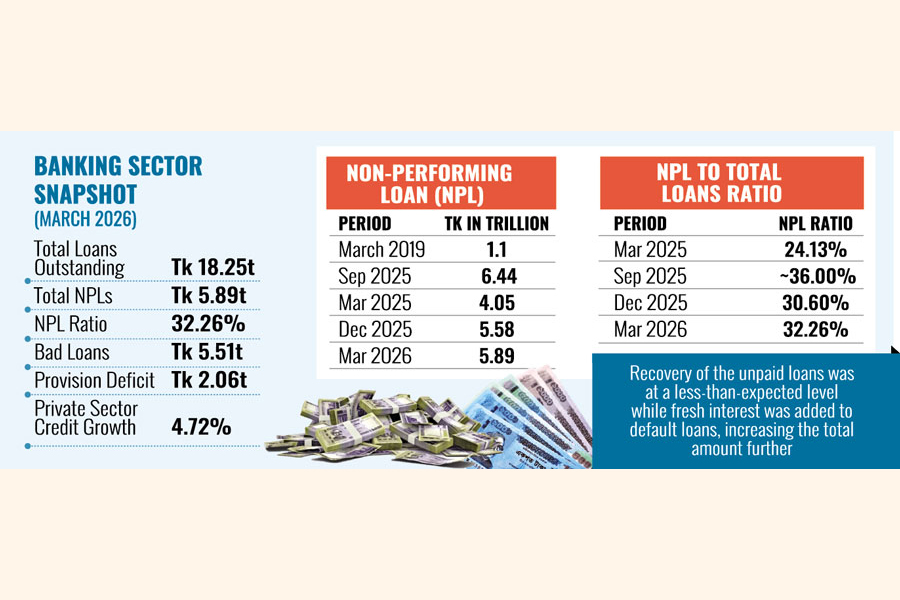
Defaulted loans stood at Tk 5.57 lakh crore at the end of December 2025, accounting for nearly one-third of total outstanding loans.

High levels of bad loans force banks to maintain large provisions against potential losses, reducing both profitability and their ability to issue fresh loans.

At the same time, high borrowing costs have discouraged businesses from taking new loans.

Bangladesh Bank’s policy interest rate currently stands at 10 per cent, while commercial lending rates in many cases have climbed close to 15 per cent.Politics

Such elevated rates have made borrowing increasingly expensive, particularly for small and medium-sized enterprises that depend heavily on bank financing for operations and expansion.

The impact of weak credit growth is already visible across the broader economy.

Imports of capital machinery have declined, indicating slower industrial expansion, while many factories are reportedly operating below capacity because of weak demand and limited access to working capital.

Lower private investment has also reduced money circulation in the economy, slowing business activities and limiting employment growth.

Bangladesh Bank has set a private sector credit growth target of 8.5 per cent for the second half of FY26, but economists said the current trend suggests the target may be difficult to achieve.​
 

Central bank tightens rules on bank dividends
Only banks with Tk 20b paid-up capital will qualify for cash dividends from 2026

FE REPORT

Published :
May 24, 2026 08:09
Updated :
May 24, 2026 08:09

1779589727969.webp


Bangladesh Bank has introduced a tougher dividend policy for banks that allows only institutions with at least Tk 20 billion in paid-up capital to declare cash dividends from 2026 onward.

The move signals the regulator's growing emphasis on building stronger capital buffers and improving the banking sector's ability to withstand economic shocks.

The new directive, issued by Bangladesh Bank on Saturday, comes at a time when the banking industry continues to grapple with rising stress from weak asset quality, capital shortages and broader global economic uncertainty.

Industry insiders say the policy could accelerate consolidation and encourage the emergence of larger, financially stronger banks.

According to a circular issued by the central bank's Supervisory Policy and Coordination Department, the measure is intended to help the industry withstand potential risks arising from both domestic and global economic uncertainties while improving the overall capital base of commercial banks.

The new policy takes effect from the current calendar year and will apply to dividend declarations for 2026.

A desktop analysis based on data available on the Dhaka Stock Exchange website suggests that only one listed bank -- BRAC Bank -- currently meets the required paid-up capital threshold among the country's 36 listed banks. Another institution, Sommilito Islami Bank, formed through the merger of five Shariah-based banks, also appears to qualify under the new requirement.

However, the bank's managing director has yet to be appointed following the merger process.

People familiar with developments in the banking industry said increasing capital buffers has become essential for absorbing potential economic shocks and maintaining financial stability.

They also said the central bank's broader objective may be to encourage the emergence of larger and financially stronger institutions rather than maintaining a banking system dominated by relatively small banks with limited capital strength.

Shah Md Ahsan Habib, professor at the Bangladesh Institute of Bank Management (BIBM), told the FE that the move indicates a strategic shift by the regulator.

"This is most probably an indication that the central bank wants stronger and larger banks, as there is no alternative to adequate capital in absorbing financial shocks," he told the FE.Trade finance solutions

He added that many local banks still operate with significantly lower capital bases compared with their counterparts in peer economies, making capital strengthening increasingly important amid economic uncertainty at home and abroad.​
 

Islamic banks see steady growth in deposits, assets in March

Their investments remain broadly stable at Tk 5.91t

SAJIBUR RAHMAN

Published :
May 23, 2026 09:41
Updated :
May 23, 2026 14:36

1779590451980.webp


The country's Islamic banks saw steady growth in deposits, assets and key financial indicators in March 2026, according to Bangladesh Bank (BB) data.

The total deposits in Islamic banks stood at Tk 4.79 trillion in March 2026, up from Tk 4.76 trillion in February 2026, according to Bangladesh Bank (BB) data.

On a year-on-year basis, the amount of deposits increased by 9.22 per cent over that of Tk 4.39 trillion in March 2025, indicating gradual stabilisation in the sector after recent turbulence.

However, the volume of deposits in conventional banks rose more sharply to Tk 17.04 trillion in March 2026 from Tk 15.12 trillion a year earlier, reflecting a 12.72 per cent annual increase and highlighting a relative shift in depositor behaviour across the banking system.

Islamic banks continued to rely heavily on Mudaraba-based deposits, which account for around 86.61 per cent of total deposits, while the private sector contributes around 90.48 per cent of the deposit base.

Investments by Islamic banks remained broadly stable at Tk 5.91 trillion in March 2026, compared to Tk 5.88 trillion in February 2026.

On a year-on-year basis, their investments rose by 6.85 per cent from Tk 5.53 trillion in March 2025.

Investment portfolios remained concentrated in Bai-Murabaha with 44.20 per cent), followed by HPSM 17.34 per cent and Bai-Muajjal 17.26 per cent, indicating continued dependence on a limited set of financing structures. Sectoral exposure is largely focused on industry and trade and commerce.

Total assets of Islamic banks also rose to Tk 9.46 trillion in March 2026, up from Tk 9.34 trillion in February 2026, showing a monthly growth of 1.26 per cent.

On a year-on-year basis, their assets increased 5.95 per cent from Tk 8.93 trillion in March 2025.

External trade-related indicators showed mixed trends. Export receipts handled by Islamic banks increased to USD $ 617 million in March 2026 from USD $604 million in February 2026, a monthly rise of 2.11 per cent.

However, on a year-on-year basis, export receipts declined 16.94 per cent from USD $742 million in March 2025.

Import payments through Islamic banks stood at USD $870 million in March 2026, up 2.16 per cent from the previous month but down 25.28 per cent year-on-year.

Remittance inflows rose to USD $701 million in March 2026 from USD $661 million in February 2026, marking a 6.02 per cent monthly increase, although down 3.09 per cent compared to March 2025.

In agent banking, Islamic banks reported deposits of Tk 272 billion in March 2026, up from Tk 269 billion in February 2026. On a year-on-year basis, deposits increased 22.96 per cent from Tk 221 billion in March 2025. Islamic banks accounted for 53.75 per cent of total agent banking deposits. The number of specialised Islamic banking employees stood at 580 in March 2026, slightly down from 582 in February 2026, but up 3.94 per cent from 558 in March 2025.

Experts said Islamic banks are showing signs of stabilisation, driven by growth in deposits and continued demand for Shariah-based banking services despite recent challenges.

However, they said slower growth in investments and trade transactions suggests banks remain cautious amid economic uncertainty, underscoring the need for stronger governance, transparency and regulatory oversight.

"Islamic banks in Bangladesh are showing signs of stabilisation after a difficult period, but restoring long-term confidence will depend on stronger governance, transparency and regulatory oversight. The latest data suggest the sector remains resilient, particularly in deposits, agent banking and Shariah-based financing demand," said Masrur Reaz, chairman of Policy Exchange Bangladesh.

He said the slower growth in investments and external trade transactions indicates that Islamic banks are still operating cautiously amid broader macroeconomic uncertainty.

"The sector now needs stronger institutional reforms and improved risk management to sustain growth and compete effectively with conventional banks," he added.​
 

AI in Islamic finance: Bangladesh must act before the future arrives

M Kabir Hassan
Published :
May 24, 2026 23:27
Updated :
May 24, 2026 23:27

1779682349803.webp


Artificial Intelligence (AI) is no longer merely a technological development. It is rapidly becoming a transformative force reshaping banking, business models, risk management, regulatory supervision, and customer relationships. Islamic finance cannot remain outside this transformation. With global Islamic financial assets already exceeding $4.5 trillion and projected to reach about $6.67 trillion by 2027, the question is no longer whether AI will affect Islamic finance, but whether Islamic financial institutions and regulators will adopt it responsibly and ethically, in full harmony with Shariah principles.

This article draws on my recent co-authored review article, "AI Agents in Islamic Finance: Applications, Governance, and Future Directions," written with Mohammad Rezoanul Hoque and Md Meftahul Ferdaus. The central argument of that study is straightforward: AI offers enormous opportunities for Islamic finance, but the technology must not be allowed to outrun Shariah governance, human judgment, and ethical accountability.

Islamic finance is built on the prohibition of riba, gharar and haram activities. These principles are rooted in the Qur'an, Sunnah, and the broader tradition of Islamic jurisprudence. Unlike conventional financial regulation, where compliance can often be reduced to technical rules and quantitative thresholds, Shariah compliance requires interpretation, context, and scholarly judgment. A financial product may appear technically acceptable but still raise deeper concerns about fairness, risk-sharing, exploitation, or substance over form. This makes the application of AI in Islamic finance both promising and delicate.

At present, AI is being applied in Islamic finance mainly in three areas: Shariah compliance automation, risk assessment and management, and customer service. In compliance automation, AI systems can scan contracts, monitor transactions, detect prohibited elements, and flag potential Shariah violations. Natural language processing can help review financial documents more quickly than manual methods. Bank Islam Malaysia, for example, has reportedly used AI-driven contract analysis to reduce manual review time by 60 per cent, while Dubai Islamic Bank has introduced automated Shariah screening systems that can examine thousands of transactions daily.

The second major area is risk management. Islamic financial products such as murabaha, ijara, musharakah and sukuk have distinct risk profiles because they are based on asset-backing, trade, leasing, partnership or profit-sharing arrangements. Conventional credit and market risk models are not always suitable for these instruments. AI can help Islamic financial institutions assess credit risk, liquidity risk, operational risk and market risk with greater speed and sophistication. It can also assist in sukuk valuation, portfolio screening, fraud detection and stress testing.

The third area is customer service and advisory functions. Islamic robo-advisors and Shariah-compliant chatbots can provide personalised financial guidance to customers seeking halal investment options. They can analyse customers' risk tolerance, investment goals and financial behavior while applying Shariah screening criteria. For markets with large Muslim populations and growing digital finance ecosystems, these services can expand access to Islamic financial advice at lower cost.

Yet these opportunities come with serious limitations. Our review highlights a major concern known as semantic drift. AI systems may use Islamic finance terminology correctly at the surface level while failing to capture the deeper jurisprudential meaning of those terms. Research cited in our study shows that, when AI-generated definitions of 96 AAOIFI-defined Islamic finance terms were compared with authoritative standards, the vast majority showed low conceptual similarity. In practical terms, AI may sound fluent but still be doctrinally inaccurate.

The same problem appears in compliance judgment. AI systems may identify simple Shariah violations, such as explicit interest, with relatively high accuracy. But their performance weakens sharply when they face complex cases involving hybrid instruments, cross-border transactions, or new fintech products. These are precisely the situations where Islamic finance needs careful reasoning, human wisdom and scholarly deliberation. Therefore, AI should assist Shariah scholars, not replace them.

This is why I propose a dual governance framework for AI in Islamic finance. Under this model, the traditional Shariah Supervisory Board should work alongside an AI Governance Committee. The Shariah board would remain responsible for religious compliance, fiqh interpretation and fatwa-related decisions. The AI Governance Committee would oversee algorithmic transparency, model performance, data quality, cybersecurity, explainability and operational risks. A joint oversight panel would then ensure that technological efficiency and religious authenticity move together, not in opposite directions.

For Bangladesh, this debate is timely and urgent. Islamic banking represents a significant part of the country's banking system and has deep social trust among depositors. Bangladesh has also made remarkable progress in mobile financial services and digital financial inclusion. This gives the country a strong foundation for Islamic fintech innovation. Yet in AI adoption, Bangladesh remains behind leading jurisdictions such as Malaysia and the UAE, where regulatory sandboxes, innovation hubs, and national AI strategies have already created space for experimentation.

Bangladesh should not wait passively. Bangladesh Bank can begin by establishing a dedicated Islamic fintech and AI regulatory sandbox. Such a sandbox would allow banks, fintech firms, universities, and Shariah scholars to test AI-driven solutions in a controlled environment. These may include automated Shariah screening, AI-assisted sukuk valuation, halal investment advisory, compliance monitoring, digital onboarding, and risk analytics. A sandbox would encourage innovation while protecting consumers, depositors, and the credibility of Islamic finance.

Islamic banks must also modernise their legacy systems. Many existing platforms lack standardised data, open APIs, and the technical architecture needed for AI integration. Without clean, structured and reliable data, AI systems will produce unreliable results. Data governance, cybersecurity, privacy protection, and model validation should therefore be central to Islamic banking reform.

Bangladesh also needs human capital. The future of Islamic finance will require professionals who understand both Shariah and technology. Universities should introduce interdisciplinary programs combining Islamic finance, data analytics, AI governance, fintech regulation, and ethics. Shariah scholars should receive exposure to AI concepts, while technologists should be trained in the foundations of Islamic commercial jurisprudence. Without this bridge, AI solutions may remain technically impressive but religiously weak.

Robo-advisory services deserve special attention in Bangladesh. A Shariah-compliant robo-advisor can help small investors identify halal investment options, diversify portfolios and understand risk. It can support capital market development, especially if linked with sukuk, Islamic mutual funds and ethical investment products. However, such systems must be transparent, explainable and validated by qualified Shariah scholars. The customer must know not only what recommendation is being made, but why it is considered Shariah-compliant.

The broader lesson is clear: AI can make Islamic finance more efficient, inclusive and innovative, but it can also create new risks if introduced without proper governance. Technical errors may become Shariah errors. Data bias may become financial exclusion. Algorithmic opacity may weaken public trust. That is why regulators, Islamic banks, Shariah scholars, universities and technology firms must work together.

AI is a powerful tool, but it is not a moral authority. The ethical and spiritual foundations of Islamic finance must remain under human stewardship. If Bangladesh combines technological ambition with Shariah integrity, it can become a meaningful South Asian hub for Islamic fintech. But the window of opportunity will not remain open forever. The future of Islamic finance is arriving quickly; Bangladesh must prepare for it now.

Kabir Hassan is Professor of Finance and Moffett Chair, University of New Orleans; 2016 IsDB Prize Laureate in Islamic Banking and Finance; Member, AAOIFI Ethics and Governance Board and Chairman, AAOIFI Education Board.​
 

Latest Posts

Back