Home Watch Videos Wars Movies Login

[🇧🇩] BNP Jamaat On A Collision Course

[🇧🇩] BNP Jamaat On A Collision Course
31
659
More threads by Saif

G Bangladesh Defense

Sherpur Jamaat leader dies after clash with BNP men

BNP suspends 41-member Sherpur district convening committee after the clash

By Our Correspondent, Mymensingh

1769648313732.webp

Maulana Md Rezaul Karim

A Jamaat leader, reportedly injured in a clash with BNP activists, died at Mymensingh Medical College Hospital around 9:45 pm on Wednesday night.

The deceased has been identified as Maulana Md Rezaul Karim, 42, secretary of Jamaat’s Sreebordi upazila unit in Sherpur, said Nuruzzaman Badal, Jamaat candidate from Sherpur-3 (Jhenaigati-Sreebordi).

Rezaul sustained critical injuries along with some 50 Jamaat activists and supporters in clashes with BNP men this afternoon.

Rezaul and two others -- Aminul Islam and Maulana Tahirul Islam -- were referred to MMCH where Rezaul died. Maulana Tahirul was later sent to Dhaka, said Nuruzzaman.

The clash broke out over seating arrangements at a programme around 3:00pm at the Jhenaigati Upazila Mini Stadium ground, leaving at least 65 people injured, locals and witnesses said.

They said the upazila administration organised the programme, where candidates for the Sherpur-3 constituency were invited to present their electoral manifestos before voters.

Jhenaigati UNO Ashraful Alam Rasel was expected to preside over the event.

However, supporters of the BNP- and Jamaat-nominated candidates got into an altercation over sitting in the front row, triggering the clash.

Of the injured, 45 were taken to the Jhenaigati Upazila Health Complex, where 25 were admitted and 20 received primary treatment, said physician Arup Saha.

Another 20 injured were admitted to Sherpur General Hospital, confirmed medical assistant Md Yasin Hossain.

Several motorcycles and over 100 chairs were vandalised during the clash, witnesses said.

In a Facebook post, Nuruzzaman alleged that BNP supporters arrived late and, following an argument and scuffle over chairs, attacked Jamaat supporters with “local weapons”.

He claimed more than 50 Jamaat supporters were injured.

BNP candidate for Sherpur-3 Mahmudul Haque Rubel and Nuruzzaman made counter allegations against each other’s supporters over the violence.

In a press release issued around evening soon after the clash, BNP Senior Joint Secretary General Ruhul Kabir Rizvi said the 41-member Sherpur district BNP convening committee, led by Convener Advocate Sirajul Islam and Member Secretary ABM Mamunur Rashid Palash, has been suspended until further notice.

Sherpur Superintendent of Police Md Kamrul Islam said security personnel rushed to the spot and brought the situation under control. Additional law enforcers were deployed in the area to prevent further violence, he said.

No case was filed in this connection till the filing of the report early today.

Meanwhile, protesting the death, students of Dhaka University and Jagannath University brought out separate processions on their campuses early today.

At Dhaka University, a group of students marched through the campus. A couple of Ducsu members, including VP Md Abu Shadik, were seen in the procession.

At Jagannath University, around 100 students brought out a procession from the main gate around 12:45am and marched around the campus.

Participants were seen chanting slogans against the BNP.​
 
Analyze

Analyze Post

Add your ideas here:
Highlight Cite Respond

Violence in Sherpur: BNP, Jamaat trade blame

EC withdraws Jhenaigati OC, UNO; 5 BGB platoons deployed a day after Jamaat leader’s killing

By Star Report

1769736176341.webp


Five platoons of BGB members were deployed in Sherpur’s Jhenaigati and Sreebardi upazilas to maintain law and order after a Jamaat leader was killed in an election-related violence on Wednesday, said Shariful Islam, public relations officer of BGB headquarters.


The Election Commission yesterday withdrew Jhenaigati UNO Ashraful Alam Rasel and Officer-in-Charge Nazmul Hasan of Jhenaigati Police Station following the incident.

Tarafdar Mahmudur Rahman, Sherpur deputy commissioner and also returning officer of the district, told The Daily Star that they have urged all candidates of Sherpur-3 (Jhenaigati-Sreebardi) to postpone their campaigns for two days.

Kamrul Islam, the district’s superintendent of police, said law enforcers, along with army personnel, have also been kept on high alert.

No case was filed in connection with the violence till filing of this report around 8:30pm, said Additional SP Mizanur Rahman Bhuiyan.

On Wednesday afternoon, Rezaul Karim, 42, secretary of Jamaat’s Sreebardi upazila unit, was killed in a clash between activists of BNP and Jamaat in Jhenaigati upazila over taking the front-row seats at a programme at the Jhenaigati upazila Mini Stadium.

Over 50 people were also injured on both sides.

UNO Ashraful was scheduled to preside over the event.

The body of Rezaul was scheduled to be buried in his village home at Gopalkhilar villager in Sreebordi upazila yesterday night.Victim’s father Abdul Aziz said, “My son was very humble. Why was my son killed in such a way? He committed no crime, yet he was killed. I want a proper investigation and justice.” Neighbours also demanded exemplary punishment for those involved in the murder.

Abdur Rahim Dulal, convener of Sreebordi upazila BNP, said Rezaul was a good soul who lost his life to political violence, calling the incident shocking.

Expressing deep shock and sympathy for the bereaved family, Azharul Islam, ameer of Sreebordi upazila Jamaat, also demanded punishment for the killers.

Quoting doctors, Nazrul Islam, in-charge of police camp at Mymensingh Medical College Hospital, said it was primarily known that the Jamaat leader died due to repeated blows to the head from blunt objects.

The actual cause of the death would be known after getting the post mortem report, he added.

Meanwhile, EC Senior Secretary Akhtar Ahmed, at a press briefing in its headquarters in Dhaka, said the electoral code of conduct clearly states that campaigns, including manifesto unveiling, must be held in a cordial environment. “Unfortunately, a tragic incident occurred there [Jhenaigati]. As part of administrative measures, the UNO and OC have been withdrawn.”

Meanwhile, the Jamaat-led 11-party electoral alliance yesterday alleged that members of the administration and law enforcement agencies remained inactive during the clashes, adding that the situation would not have escalated if timely action had been taken.

It also accused local BNP leaders and activists of instigating the violence and demanded an investigation into what it described as the “failure” of the upazila administration, calling for immediate remedial measures.

The allegations were made at a press conference held on behalf of the alliance at Jamaat’s central office in Dhaka’s Moghbazar.

Addressing the briefing, Jamaat Assistant Secretary General and head of its central publicity department Ahsanul Mahboob Zubair said the incident has dimmed the festive atmosphere ahead of the election.

However, Mahdi Amin, spokesperson for BNP Election Steering Committee, described the clash as “unwarranted” and called for a quick and impartial probe.

Speaking at a press conference at the BNP Election Office in Dhaka’s Gulshan, Mahdi said several questions need to be examined to determine how the incident unfolded and whether it could have been avoided.

“Why did one party occupy all the chairs before the scheduled time? Why were sticks and batons brought there? And why did that party’s candidate choose confrontation despite repeated requests?” he said, adding that these issues must be properly investigated.

Mahdi said the local administration organised the programme in Sherpur with the participation of all candidates, and seating arrangements had been allocated for each party.

He alleged that Jamaat leaders and activists occupied all the chairs and prevented BNP leaders and activists from sitting in their designated seats, despite repeated requests from the administration.

Mahdi said questions had naturally arisen over how the clash began, who was responsible, and why the administration and law enforcement agencies failed to keep the situation under control.

Referring to video clips circulating on social media, he said they showed repeated requests by police, administration officials, law enforcers, army personnel and even BNP leaders, asking the Jamaat candidate not to take a particular route.

“Despite that, he decided to go that way and was repeatedly heard saying, ‘Let life be lost if it must be.’”

Meanwhile, the government expressed deep concern over the violence, describing the loss of life as “completely unacceptable and deeply regrettable.”

In a statement, the chief adviser’s press wing said police have launched an investigation into the clashes and killing, and that all those involved would be brought to justice. Security in the district has also been beefed up.

With the national election just two weeks away, the government urged all political parties, including BNP and Jamaat, to demonstrate responsible leadership and ensure restraint among their supporters.

[Our Mymensingh correspondent contributed to this report]​
 
Analyze

Analyze Post

Add your ideas here:
Highlight Cite Respond

Jamaat’s tactics before election threaten national interest: Tarique

UNB
Published :
Jan 31, 2026 21:15
Updated :
Jan 31, 2026 21:15

1769905458448.webp


Accusing Bangladesh Jamaat-e-Islami of misleading voters through unethical practices, BNP Chairman Tarique Rahman on Saturday warned that those who resort to such tactics before an election can ‘sell the country’ if given a chance to come to power.

“I want to warn everyone that some quarters are still trying to obstruct the election in different ways. Their (Jamaat’s) people are going door to door, especially to mothers and sisters, trying to collect their NID and bKash numbers to confuse and deceive them,” he said while speaking at an election rally in Tangail.

The BNP leader urged people to inform family members and elders if they notice such activities. “If anyone tries to do these unethical acts before the election, they must be stopped. Those who can do this before voting will sell the country if they get the chance.”

Tarique said the coming days are crucial for rebuilding the country. “The next days are for nation-building, for changing people’s lives and for a new beginning. “If we stay united and alert, no one will be able to take away our rights, Inshallah.”

He also advised voters to prepare in advance to go to polling centres early on the election day. “Make sure you go early so no one can cast a vote in your name,” Tarique said, urging party supporters to keep a close watch on polling centres to prevent fake voting.

The BNP chief said people must keep a close watch on their respective polling centres to ensure that genuine voters can cast their ballots and that no one from another area votes using someone else’s name.

During the rally, Tarique introduced BNP candidates from Tangail, including Swapan Fakir, Abdus Salam Pintu, Obaidur Haque Nasir, Lutfur Rahman Motin, Sultan Salahuddin Tuku, Rabiul Alam Lablu, Abul Kalam Azad Siddiqui and Ahmed Azam Khan, and asked voters to ensure their victory.

Addressing local development issues, he said BNP would work to meet Tangail’s demands if elected and highlighted the region’s heritage and economic potential, including Tangail sarees, caps and agricultural products.

“If we plan properly, Tangail sarees can be exported worldwide just like garments,” the BNP chairman said.

He said the prayer caps people wear during prayers are made in Tangail and are exported to many countries around the world.

If proper initiatives are taken, Tarique said, many more people could be employed in this sector, adding that with planned efforts, Tangail could gradually be transformed into an industrial city.

He also spoke about creating jobs through small industries, developing jute mills, fruit-processing factories and building a barrage on the Jamuna River.

“If we work together with proper planning, we can bring change not only to Tangail but to the whole country. “But for that, the people—the true owners of the country—must stand with BNP. “If you support BNP, and move BNP forward, then, Inshallah, we will gradually be able to change the fate of the people of this country,” Tarique said.

The rally was chaired by district BNP president Hasanuzzaman Shahin and conducted by former acting general secretary Mahmudul Haque Sabu. Several central BNP leaders also spoke at the event.

As part of his election campaign in the northern region, Tarique addressed election rallies in Rajshahi, Naogaon, Bogura, Rangpur and Sirajganj and Tangail over just two days.

With the rally in Tangail, the BNP chairman concluded his electioneering in the northern region and left for Dhaka around 6:30pm.​
 
Analyze

Analyze Post

Add your ideas here:
Highlight Cite Respond

BNP, Jamaat trade blame again
BNP reports use of religion, Jamaat alleges attacks on women activists

Staff Correspondent 02 February, 2026, 00:08

1769995663147.webp


The Bangladesh Nationalist Party on Sunday accused its electoral rival of exploiting religious beliefs and sentiments during election campaigns, while the Bangladesh Jamaat-e-Islami alleged attacks on its women activists by rival party supporters.Bangladesh travel guides

The allegations were made during separate meetings with chief election commissioner AMM Nasir Uddin at the Nirbachan Bhaban in Dhaka.

Following the BNP meeting, party election steering committee chair Nazrul Islam Khan claimed that leaders and activists of a political party were using religious rhetoric to influence voters, in violation of the Representation of the People Order.

Indicating a Jamaat leader without mentioning the name, Nazrul said, ‘One from a party was heard saying that a Muslim would have to answer the fourth question in the grave if he or she does not cast a vote for a particular symbol.’

Meanwhile, a delegation from the Jamaat women wing met the CEC to submit a memorandum alleging attacks on the party’s women activists during election campaigns.

The delegation included women wing secretary Nurunnisa Siddiqa, assistant secretary Saida Rahman, and Habiba Chowdhury who oversees political affairs.

‘Our mothers and sisters have not been able to exercise their voting rights fully over the last 15 to 16 years. Now, a vested group is conspiring to deprive women of this opportunity again,’ Habiba alleged.

Earlier on Friday, the BNP claimed that its female activists faced continued threats, harassment, and intimidation by the Jamaat-e-Islami, both online and offline, raising concerns over women’s safety ahead of the upcoming election.

BNP female activists from across the country made the allegations at a press conference at the party chair’s office at Gulshan.

During the press briefing, BNP senior joint secretary general Ruhul Kabir Rizvi said that women affiliated with the BNP were being subjected to physical intimidation, psychological pressure, and abusive behaviour, including online attacks.

He alleged that a network of online activists linked to a rival political group was using religion to make obscene and degrading comments about women.


Rizvi said that the absence of female parliamentary candidates from the Jamaat in the coming election reflected the party’s attitude towards women.

He warned that women would be the most vulnerable group if such forces came to power.

After their meeting with the CEC, Jamaat women wing leaders said that they had submitted evidence, including photographs, documenting attacks on their activists.

Habiba said that the election commissioners listened attentively to their complaints and assured them of taking necessary measures.

Jamaat women wing secretary Nurunnisa Siddiqa said that the party did not allow women to hold the topmost leadership position, citing Islamic principles.

‘The Jamaat-e-Islami is an Islamic party and must follow Islam. The Holy Quran states that men are the guardians of women. It is a Quranic edict, and based on this, women can’t assume the top leadership position in any Islamic party,’ she said.

According to Nurunnisa, holding a top position is not the core issue; ensuring women’s rights is what truly matters.

Women have significant representation within the Jamaat’s organisational structure, with approximately 43 per cent of the members in the party’s Majlis-e-Shura advisory committee being women.​
 
Analyze

Analyze Post

Add your ideas here:
Highlight Cite Respond

Jamaat wants to push Bangladesh back, says Fakhrul

UNB
Published :
Feb 02, 2026 20:23
Updated :
Feb 02, 2026 20:23

1770078878273.webp

BNP Secretary General Mirza Fakhrul Islam Alamgir on Monday alleged that Jamaat-e-Islam aims to turn Bangladesh into an Afghanistan-like state, raising concerns over the party’s political agenda and its potential impact on national stability.

“They want to take Bangladesh backward. They are a party that prevents us from moving forward. We don’t want to move backward; we want to move forward,” Fakhrul said while campaigning at Lalmia Market in Dholarhat Union.

He also criticised Jamaat Ameer’s alleged anti-women remarks.

“I don’t know if it is true or false, but if it is true, then he did wrong. Women will never accept it,” he said, adding that Jamaat reportedly restricts women’s working hours in the garment industry.

Fakhrul, who is also contesting the Thakurgaon-1 seat, highlighted the importance of female education and employment. “If our girls don’t go to school and college, where will they get jobs? Men and women must live in Bangladesh with equal rights,” he said.

Quoting Islam, the BNP leader said women should be given the rights they deserve.

Local BNP leaders, activists, and a large number of supporters attended the event.​
 
Analyze

Analyze Post

Add your ideas here:
Highlight Cite Respond

Foreign policy goals in manifestos of BNP, Jamaat

MIR MOSTAFIZUR RAHAMAN
Published :
Feb 10, 2026 00:43
Updated :
Feb 10, 2026 00:43

1770683756149.webp


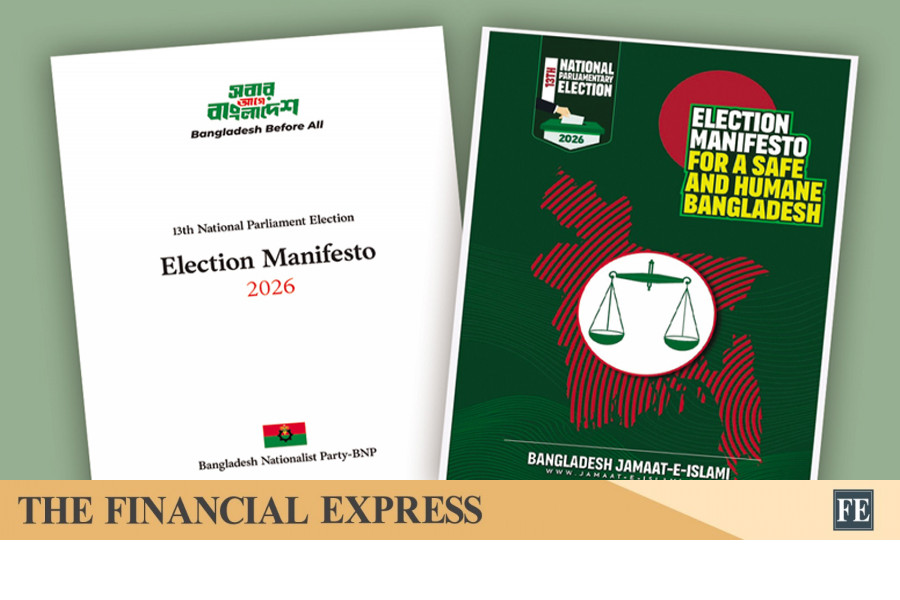
As Bangladesh heads toward the February 12 parliamentary elections, foreign policy has emerged -- at least on paper -- as an important area to focus on by the two main power contenders, the Bangladesh Nationalist Party (BNP) and Jamaat-e-Islami. Both parties have devoted space in their election manifestos to outlining how they once in power would maintain relations with other countries. Yet a closer reading of these documents would reveal what has been skipped, deliberately or otherwise, may be as significant as what is articulated.

At a time of sharpening global rivalries, shifting alliances, and intense regional pressures, both BNP and Jamaat appear careful -- perhaps overly so -- to avoid taking positions that could perturb key global or regional players. The result is a set of foreign policy pledges that are broad, cautious, and in several areas conspicuously vague.

The most striking similarity between the two manifestos is their shared reluctance to adopt any foreign policy stance that might antagonize major powers. Neither party explicitly addresses contentious global fault lines or takes positions that would clearly place Bangladesh within -- or outside -- competing geopolitical camps. This strategic ambiguity may be politically expedient, but it also raises questions about how either party would navigate a world increasingly defined by polarization rather than neutrality.

In this sense, both BNP and Jamaat project a foreign policy of reassurance: reassurance to global powers that if voted to power, they will not rock the boat, and reassurance to domestic audiences that sovereignty and national interest will remain intact. However, reassurance without clarity can easily turn into inertia.

Compared to Jamaat-e-Islami, BNP offers a far more detailed and structured foreign policy vision. Anchored in the slogan "Bangladesh Before All," BNP frames its external engagement around sovereignty, equality, and national interest. The manifesto spans bilateral and multilateral relations, economic diplomacy, regional security, transboundary water sharing, border security, labor migration, soft power, and institutional reform within the Ministry of Foreign Affairs.

One area where BNP clearly differentiates itself is border security. Its explicit commitment to preventing border killings, push-ins, smuggling, human trafficking, and drug trafficking directly addresses a long-standing and emotionally charged issue, particularly in relations with neighboring India. By naming border killings as unacceptable, BNP signals sensitivity to public grievances and a willingness -- at least rhetorically -- to confront a difficult bilateral problem.

Jamaat-e-Islami, by contrast, is silent on border killings. While it speaks of peaceful and cooperative relations with neighboring states, the absence of any reference to border violence is notable. Given how frequently border incidents enter public discourse in Bangladesh, this omission suggests either a deliberate avoidance of sensitive bilateral irritants or a prioritization of broader diplomatic harmony over specific security concerns.

Another key contrast lies in emphasis. BNP's manifesto places strong stress on economic diplomacy -- trade diversification, preferential trade agreements, foreign direct investment, technology transfer, labor migration, and strategic partnerships. It links foreign policy directly to economic transformation, industrial value addition, and integration into global and regional markets, including Africa, South America, and the Bay of Bengal region.

Jamaat-e-Islami, on the other hand, foregrounds the goal of enhancing the global standing of Bangladesh and improving the credibility and mobility of the Bangladeshi passport. While passport strength is indeed an important issue --closely tied to migration, labor rights, and international perception -- it is more an outcome of effective foreign policy than a strategy in itself. Jamaat's focus appears symbolic and reputational, whereas BNP's is more transactional and policy-driven.

This difference reflects two distinct ways of thinking about foreign policy: BNP treats it as an economic and strategic tool, while Jamaat frames it more as a means of restoring dignity and status in the international system.

Jamaat's manifesto explicitly mentions strengthening ties with developed countries such as the United States, the United Kingdom, the European Union, Japan, and Canada. Yet China -- Bangladesh's largest trading partner and a major source of infrastructure financing -- is conspicuously absent.

This omission is difficult to ignore. Whether intentional or accidental, it reflects a careful calibration aimed at avoiding discomfort among Western partners, even at the cost of underplaying a central pillar of Bangladesh's current foreign economic relations. BNP, by contrast, avoids naming specific global powers altogether, opting instead for generalized references to "important global powers" and "international trade partner countries." This allows BNP to keep its options open and maintain balance between competing blocs.

In both cases, the underlying message is clear: neither party wants to be seen as leaning too strongly toward any single power center.

On the Rohingya crisis, both parties strike familiar notes. BNP emphasizes its historical role in resolving the crisis in 1978 and 1992 and promises strong diplomatic initiatives to ensure safe, voluntary, dignified, and sustainable repatriation with full citizenship rights. Jamaat similarly commits to working with the international community for peaceful and sustainable repatriation.

Yet beyond rhetoric, neither manifesto offers new strategies, timelines, or leverage points. There is little discussion of accountability mechanisms, pressure on Myanmar, engagement with ASEAN beyond generalities, or contingency planning if repatriation remains stalled. The language is safe, recycled, and largely indistinguishable from past policy statements -- suggesting caution rather than innovation.

Perhaps the most glaring omission in both manifestos is the absence of any reference to Palestine or the ongoing devastation in Gaza. Given Bangladesh's historical solidarity with the Palestinian cause and the strong public sentiment surrounding the issue, this silence is striking.

It may reflect an attempt to avoid offending powerful global actors or complicating relations with Western partners. But it also underscores how electoral foreign policy platforms are being shaped less by moral positioning and more by strategic restraint. On one of the most defining humanitarian and political crises of the time, both parties choose quiet over conviction.

Taken together, BNP's foreign policy vision is broader, more detailed, and more operational than Jamaat-e-Islami's. Jamaat's objectives, while not insignificant, remain high-level and aspirational, with limited articulation of how goals will be achieved. BNP, meanwhile, presents foreign policy as an integrated extension of economic growth, regional security, and institutional capacity-building.

Yet for all its detail, BNP's manifesto too avoids hard choices. Jamaat's brevity and selectivity do the same in a different way. Ultimately, both documents reflect a shared political calculation: in a fragile global environment, saying less may seem safer than saying more.

The question for voters, however, is whether a foreign policy defined by caution and ambiguity is sufficient for a country navigating one of the most complex international moments in its history.​
 
Analyze

Analyze Post

Add your ideas here:
Highlight Cite Respond
Voting for BNP is going to be a calamity for the country, as BNP party workers and supporters are unhinged and already licking their chops on "rent-seeking" and chandabaaji behavior at every bus-stand and village muhalla - these corrupt elements are still there as BNP has not "cleaned house". It's going to be Sheikh Hasina 2.0 again.

This is not why the July/August revolution in 2024 took place and people don't want the repeat of the same India sycophants making Bangladesh a vassal state of India again. Already leaders in India are super happy at the prospect of BNP and Tarique Rahman coming back to power as they have him "managed" via R.A.W.

Most people with ears to the ground are already predicting of a Jamaat landslide, all the more possible because the US administration has signaled that it wants Jamaat as a "friend".
 
Analyze

Analyze Post

Add your ideas here:
Highlight Cite Respond
Voting for BNP is going to be a calamity for the country, as BNP party workers and supporters are unhinged and already licking their chops on "rent-seeking" and chandabaaji behavior at every bus-stand and village muhalla - these corrupt elements are still there as BNP has not "cleaned house". It's going to be Sheikh Hasina 2.0 again.

This is not why the July/August revolution in 2024 took place and people don't want the repeat of the same India sycophants making Bangladesh a vassal state of India again. Already leaders in India are super happy at the prospect of BNP and Tarique Rahman coming back to power as they have him "managed" via R.A.W.

Most people with ears to the ground are already predicting of a Jamaat landslide, all the more possible because the US administration has signaled that it wants Jamaat as a "friend".
Alternative to BNP is Jamaat. I am reluctant to vote for Jamaat. Whether you like it or not, BNP will win the election and form the government.
 
Analyze

Analyze Post

Add your ideas here:
Highlight Cite Respond
  • Khamenei (+4)
Reactions: Afhan

Members Online

Latest Posts

Back
 
G
O
 
H
O
M
E