[🇧🇩] Budget For 2026-2027

[🇧🇩] Budget For 2026-2027
22
297
More threads by Saif

G Bangladesh Defense

Tax exemptions ‘unlikely’ in FY27 budget: Khasru
Staff Correspondent 29 April, 2026, 23:19
1777510344273.webp


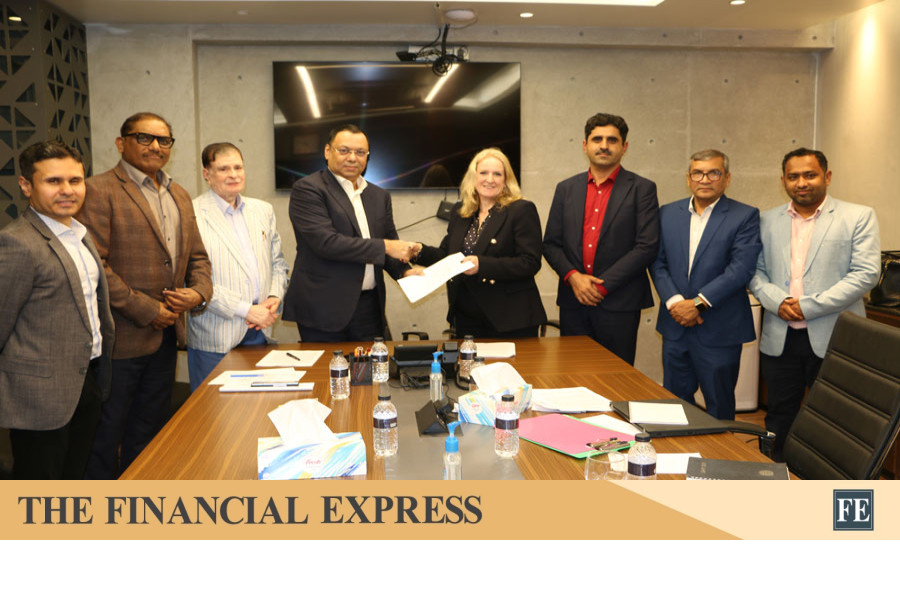
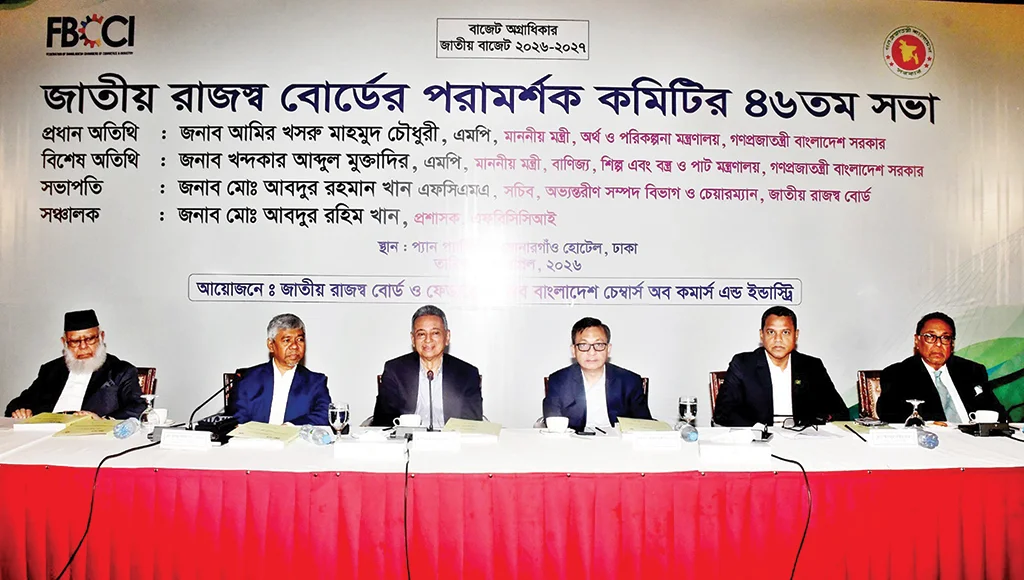
Finance minister Amir Khasru Mahmud Chowdhury and commerce minister Khandakar Abdul Muktadir, among others, are present at a meeting of the National Board of Revenue at a hotel in the capital on Wednesday. | Press release

Finance minister Amir Khasru Mahmud Chowdhury on Wednesday said that the government’s maiden budget would likely fall short of providing tax breaks demanded by business community during these ‘difficult times.’

However, he assured that the legal, institutional and bureaucratic obstacles to doing business and additional costs they impose on business would be removed soon.

He made the remarks at the 46th consultative committee meeting of the National Board of Revenue at a hotel in the capital.

The Federation of Bangladesh Chambers of Commerce and Industry organised the meeting with the presence of major trade bodies of the country. Bangladeshtravel guide

At the meeting, the FBCCI proposed raising the tax-free income threshold to Tk 5 lakh as part of a broader set of recommendations aimed at ensuring macroeconomic stability and to Tk 5.5 lakh for women.

FBCCI administrator Md Abdur Rahim Khan presented the recommendations, highlighting prevailing global and domestic economic challenges, including geopolitical tensions and Bangladesh’s impending graduation from least developed country status.

The apex trade body also called for reducing the corporate tax rate for non-listed companies from 27.5 per cent to 25 per cent, with a long-term target of bringing it down to between 20 and 22 per cent.

It also suggested lowering the minimum tax rate to 0.5 per cent from 1 per cent, with a plan for gradual withdrawal.

It urged the government to reduce advance tax on imported raw materials from 2 per cent to 1 per cent and introducing electronic invoicing systems to enhance transparency and compliance.

The FBCCI emphasised the importance of ensuring the independence of the Bangladesh Bank to strengthen regulatory oversight.

Finance minister Khasru said that while the administration was interested in providing tax benefits, current economic constraints meant such incentives might not be feasible at present.

Instead, he urged businesses to determine specific areas where red tape or rising costs were hindering operations, promising that the government would step in to remove those barriers.

Responding to businesses’ complaint about a 40 per cent rise in port handling charges, the minister said that the claim was correct and that he also opposed the increase.

He questioned the basis for the 40 per cent hike in the charges, saying there was no justification for it.

Khasru also said that corruption at Chattogram Port and other ports added to the cost of doing business, and urged stakeholders to report the issues so that the government could immediately provide solutions, promising within three months.

‘Just inform me where you are being hindered in terms of ease of doing business. I would directly provide solutions within the next three months,’ he added.

The finance minister also said that the economy would need a ‘push on’ for two years to recover from the current situation, including the ongoing conflict in the Middle East.

‘I have told all multilateral bodies, including the International Monetary Fund and the World Bank, that we would need time to recover from where the economy of Bangladesh has been driven today,’ he added.

He said that tax-exemption facilities would be provided to all sectors with export potential, such as the readymade garment sector.

‘Although the RMG sector in Bangladesh is very successful, other sectors such as gold and diamond industries are lagging behind. From now on, if any potential export sector is proposed, we would provide facilities equivalent to the garment industry,’ he added.

Regarding the upcoming budget, he said that a larger budget would be presented in the next financial year, with an emphasis on high-quality infrastructure investment.

However, he said that they would give priority to effective and productive investments instead of unnecessary mega projects.

‘Bangladesh’s fragile economy requires time, higher spending and sustained policy support to recover,’ he added, saying that an expansionary budget was essential to accelerate poverty reduction and stimulate investment.

The adviser noted that the current government was only two months into office but had already faced substantial external pressures, particularly due to the Middle East conflict, which has forced an additional expenditure of almost $4 billion.

To stabilise the economy, the government has sought additional time from the International Monetary Fund, requesting what he described as a ‘two-year cushion.’

‘We have told the IMF that we need a two-year cushion. From the third year, the economy will begin to regain momentum,’ he said, explaining that the cushion referred to a buffer period to withstand economic shocks and restore stability.

On revenue mobilisation, he highlighted plans for comprehensive digitalisation, including initiatives such as ‘one citizen, one card’ and a unified digital wallet system.

According to finance ministry officials, the upcoming budget is expected to exceed Tk 9 lakh crore, significantly higher than the Tk 7.90 lakh crore for the current financial year.

At the event, the businesses said that small industries in the country were going through a difficult time due to VAT burden, urging the government to step forward to save these industries.

In his speech as special guest, commerce minister Khandakar Abdul Muktadir said that they would take the initiatives to align with the government’s broader strategy to jumpstart the economy by revitalising struggling industrial sectors through incorporating private sector proposals in the upcoming national budget.

He also said that high bank interest rates and the ongoing energy crisis were major barriers to investment and business sustainability.

He emphasised reducing logistics costs and improving public debt management to strengthen long-term economic stability.

Calling for a change in mindset among business leaders, he also stressed the importance of increasing the country’s tax-to-GDP ratio, noting that taxpayers benefitted from state-provided security and infrastructure.

NBR chairman Abdur Rahman Khan said that Bangladesh’s economic growth was closely tied to the success of its business community, reaffirming the government’s commitment to creating a more enabling environment for private sector expansion. Bangladeshtravel guide

‘Ongoing budgetary measures would focus on rationalising tariffs and taxes to strengthen the competitiveness of local industries,’ he said.

The revenue authority is working to identify and remove specific regulatory barriers that hinder business operations, he said, adding that they would address each issue individually to ensure regulations do not become obstacles.

Businesses from major trade bodies and local chambers also presented their proposals for the upcoming budget at the event.​
 

Ex-NBR member Farid wants tax reform pledge in budget

FE Online Desk

Published :
May 07, 2026 20:32
Updated :
May 07, 2026 20:32

1778196970367.webp


Former National Board of Revenue member (Customs Policy) Farid Uddin has sought a clear announcement from the government on the implementation of tax reforms in the upcoming budget.

He said two important reports had already been prepared on NBR reform, highlighting in detail various problems related to tax policy, tax management, automation, integrated digitalisation, manpower, VAT, customs and income-tax systems, and structural weaknesses in tax administration.

Farid Uddin made the remarks at a pre-budget roundtable jointly organised by The Financial Express and the Institute of Chartered Accountants of Bangladesh at CA Bhaban in the capital’s Karwan Bazar.

He said the interim government had formed two committees on NBR reform. One of the committees submitted its report to the finance adviser on November 21, while the other submitted its report around January 18 or 20.

“I have these two documents,” Farid Uddin said. “The concerns that you have raised here today—everything about the tax system—are in these two documents.”

However, he expressed disappointment that no response had yet been received from the government on the reports. He also said the issue had not been adequately covered by the media.

Calling on business organisations to take the matter forward, he said the parties concerned should review the two reports before submitting budget proposals, as many of the proposals businesses want to place in the budget had already been addressed in the reports.

“I took the initiative and told the FBCCI leaders: come, let us review these two documents,” he said. “The proposals that you will make in the budget are addressed here.”

He said a collective national consensus document could be prepared on the basis of these reports. If such a document is presented to the government, the government can make an announcement on it in the upcoming budget.

“Discuss and decide which of these to accept and which to reject,” he said. “Give a collective national consensus document to the government. The government should announce it in the budget.”

According to Farid Uddin, political commitment is the most important requirement for implementing tax reforms. If the recommendations are consistent with the government’s manifesto and political commitment, there will be an opportunity to implement them.

He said the government’s manifesto sets a target of building a one-trillion-dollar economy and increasing the tax-to-GDP ratio to 15 per cent by 2034. It also includes a commitment to strengthening the economy and simplifying the tax system.

“They want to strengthen the economy. They want to simplify the tax system. This commitment is there,” he said.

Drawing the attention of the finance adviser, he said the relevant document could be vetted by trusted people of the government. If it is found acceptable and consistent with the government’s manifesto and political vision, the implementation of tax reforms should be announced in this year’s budget.

“I will tell the adviser: have this document vetted by your trusted people. If they find it acceptable, if it is consistent with your manifesto and political vision, then make this announcement in this year’s budget—we want to do this,” he said.

He further said that although many discussions, seminars and proposals had been made in the past on various problems of the tax system, no real results had been achieved. Therefore, this time, the process should not remain limited to discussion but move towards implementation.

Farid Uddin said tax reform is not an isolated administrative issue; rather, it is a matter of national economic and political decision-making. A clear announcement in the budget, he said, would create an opportunity to begin long-term reform of the tax system.​
 

Education, health to take 28% of ADP

Planning Division proposes Tk 3 lakh crore development budget for FY27

Rejaul Karim Byron and Ahsan Habib

1778372272375.webp


The government may allocate Tk 83,557 crore for development works in the education and health sectors in the fiscal year 2026-27, accounting for more than one-fourth of the proposed Annual Development Programme (ADP).

The Planning Division placed the proposal yesterday at a meeting to finalise the ADP for FY27, chaired by Finance Minister Amir Khosru Mahmud Chowdhury.

Allocation and implementation of ADP in the two major sectors were almost stagnant at low levels in recent years.

In line with the BNP’s election manifesto, the government intends to gradually raise spending in both sectors to 5 percent of GDP each.

For the upcoming fiscal year, the combined allocation for education and health is nearly double the original budget allocation for the current fiscal year and about four times the revised budget.

In the current fiscal year, the combined allocation for health and education stood at Tk 45,822 crore, which was later revised down to Tk 21,873 crore.

According to the Planning Division’s proposal, the total ADP for FY27 is set to rise to Tk 3 lakh crore, up 50 percent from the revised ADP of Tk 2 lakh crore for the current fiscal year.

Of the total ADP allocation for FY27, the government will finance Tk 1.9 lakh crore, while Tk 1.1 lakh crore is expected to come from development partners.

The ADP will be finalised at a National Economic Council meeting on May 18, to be presided over by Prime Minister Tarique Rahman. Before that, planning and finance ministry officials will meet again on May 16 to refine the draft.

At yesterday’s meeting, the Planning Division was directed to submit a proposal benchmarking allocations against GDP, according to planning ministry officials. It was also directed to assess whether projects are aligned with the BNP’s election manifesto.

This year, a structural change has been introduced by allocating a higher share of funds to new projects. For instance, Tk 1.07 lakh crore has been set aside for unapproved projects and programmes, of which Tk 17,000 crore is designated for social development covering special needs.

Planning ministry officials said the allocation covers spending on family cards, farmer cards, tree plantation, canal digging, and monthly honoraria and festival allowances for religious leaders of different faiths.

For ongoing projects, Tk 1.92 lakh crore may be allocated under the ADP. The government has also decided to review around 1,300 ongoing projects to determine whether they remain necessary, with those found redundant to be removed from the ADP.

Mustafizur Rahman, distinguished fellow at the Centre for Policy Dialogue, described the project review initiative as positive but said the focus should remain on improving managerial efficiency, implementation quality, and institutional oversight -- particularly strengthening the Implementation Monitoring and Evaluation Division (IMED).

He also cautioned that project success should not be measured solely by the amount of money spent, saying emphasis should be placed on whether projects are delivering intended outcomes and ensuring value for public resources.

Rahman warned that expanding the ADP by 50 percent without improving institutional capacity and governance risked falling short of expectations, adding that increasing allocations without reforms in implementation, procurement, and monitoring may fail to deliver expected returns from public investment.

The finance minister said at yesterday’s meeting that a major reform would be brought to the Planning Commission to improve project formulation and implementation. The government will also revise the project director selection policy, as project directors are central to implementation.

In the health sector, the government may allocate Tk 35,252 crore, against an original budget allocation of Tk 17,519 crore this year, revised down to Tk 4,412 crore.

In the education sector, the proposed allocation is Tk 48,305 crore, against an original Tk 28,303 crore, revised to Tk 17,391 crore.

The government may allocate Tk 36,128 crore to the Local Government Division, Tk 31,064 crore to Roads and Highways, and Tk 17,315 crore to the Science and Technology Ministry. In the Power Division, the proposed allocation is Tk 19,285 crore, with Tk 8,000 crore set aside for state-owned enterprises.​
 

NBR plans wealth tax revival

Star Business Report


1778717857799.webp


The National Board of Revenue (NBR) is set to place a series of tax proposals before Prime Minister Tarique Rahman today, including reintroducing a wealth tax, doubling the tax on export cash incentives, and imposing a new advance tax on some vehicles in the upcoming fiscal year.

All three wings of the revenue board -- income tax, customs, and value-added tax (VAT) -- are scheduled to present their respective proposals for fiscal year 2026-27.

As part of the proposed measures for the FY27 budget, the revenue authority is considering replacing the existing wealth surcharge with a revised wealth tax to widen the tax net and boost revenue mobilisation amid mounting fiscal pressure.

Initially, the wealth tax would likely be calculated based on net wealth declared in tax returns, as complexities surrounding asset valuation remain a major challenge, officials said.

The revenue authority plans to gradually develop a mechanism to assess assets at actual market value, according to officials familiar with the proposal.

“It will go up to 1 percent. But definitely there will be a cap,” said a top finance ministry official.

He said net wealth of up to Tk 4 crore may remain exempt from the proposed tax, in line with the current threshold for the wealth surcharge.

Under the initial proposal, net wealth between Tk 4 crore and Tk 6 crore could face a 0.25 percent tax. The next Tk 5 crore of wealth may be taxed at 0.50 percent, while another Tk 5 crore could face a 0.75 percent levy.

Any remaining wealth above Tk 16 crore may be subject to a 1 percent tax, according to the proposal under consideration.

The NBR is also planning to raise the tax deducted at source on export cash incentives from the existing 10 percent to 20 percent, according to officials familiar with the discussions.

Besides, the tax authority is weighing a new advance income tax (AIT) regime targeting high-capacity motorcycles, battery-run rickshaws, as well as raising the limit on high-value vehicles.

At the same time, the revenue authority is preparing a set of business-friendly measures aimed at simplifying the VAT system and improving compliance.

Under the proposed changes, all businesses will be required to obtain online VAT registration from the next fiscal year, making the process fully digital.

To encourage compliance, newly VAT-registered businesses may be allowed to pay VAT at a specific concessional amount or under a package VAT system for a certain period, officials said.

The move is intended to bring small and marginal businesses into the formal VAT framework while reducing procedural complexities and harassment.

Officials said the NBR is focusing on expanding the tax base instead of increasing the burden on existing taxpayers.

Meanwhile, the tax-free income threshold for individual taxpayers is likely to remain unchanged at Tk 375,000 for FY2026-27 and FY2027-28.

The NBR will also place a proposal to raise the excise duty-free deposit limit to Tk 5 lakh from the existing Tk 3 lakh.

“If we get the prime minister’s approval, we will proceed with these proposals,” said another top finance ministry official.

The official said several innovative fiscal measures are being considered for the next fiscal year, with a focus on expanding the tax base by bringing more of the informal sector under taxation.

The proposals come at a time when the NBR is struggling to meet its revenue target. As of March, the revenue shortfall stood at nearly Tk 100,000 crore.

For the upcoming fiscal year, the NBR has been tasked with collecting Tk 6.04 lakh crore in taxes, implying a 21.04 percent growth over the current fiscal year’s original target.

The VAT wing is projected to contribute 51.3 percent of the total NBR target for next year.

The government aims to collect Tk 3.10 lakh crore from VAT in FY27, followed by Tk 2.22 lakh crore from income tax and Tk 67,000 crore from customs duties.​
 

Tax-free income threshold to remain unchanged in FY27

bdnews24.com

Published :
May 14, 2026 22:58
Updated :
May 14, 2026 22:58

1778801462628.webp


The tax-free income ceiling for individual taxpayers is set to remain unchanged in the 2026-27 fiscal year, despite rising inflation and global economic pressures.

The decision came during an eight-hour strategic meeting at the Secretariat on Thursday, where Prime Minister Tarique Rahman reviewed the National Revenue Board's (NBR) proposals.

Finance Minister Amir Khosru Mahmud Chowdhury and NBR Chairman Md Abdur Rahman Khan were also present.

The move marks a continuation of the policy set by the previous interim government, a stance the newly elected BNP administration has decided to uphold to ensure state what it said "ownership" among citizens.

A significant shift in revenue strategy is the introduction of “Package VAT” at the Upazila level.

The premier approved the initiative, emphasising that every citizen -- from the poor to the wealthy -- should contribute to the state.

"The prime minister’s philosophy is that everyone who loves the country should pay taxes. Even if it is Tk 5 or Tk 500 a year, it gives them a sense of ownership of the state," an official said.

Under this plan, small traders in rural areas may pay a monthly VAT ranging from Tk 500 to Tk 1,000.

Additionally, VAT registration will become mandatory for business bank transactions, which will be facilitated through an online system.

Tarique rejected several proposals from the NBR that could have increased the cost of living.

The threshold for imposing excise duty on bank balances or loans will instead be raised from Tk 300,000 to Tk 500,000.

The government also turned down an NBR proposal to increase VAT on essential supplies from 1 per cent to 2 per cent.

In addition, a proposal to impose a flat 15 per cent VAT on different goods was rejected, with the prime minister arguing that regardless of any “rebates”, the ultimate burden would still fall on consumers.

"The motto is clear: make people's lives easier," an official said, noting that Tarique directed the NBR to ignore IMF pressure for revenue hikes and focus instead on trade facilitation and investment.

For the first time, battery-run autorickshaws and motorcycles will be brought under advance income tax (AIT), although at rates lower than those initially proposed by the NBR.

Under the new structure, motorcycles with engine capacities between 111cc and 125cc will pay Tk 1,000 annually, while those between 126cc and 165cc will pay Tk 3,000.

Motorcycles with engine capacities above 165cc will be subject to an annual AIT of Tk 5,000.

The NBR has also proposed a “wealth tax” for individuals with assets exceeding Tk 40 million, calculated based on the market value of those assets.

The proposed tax would range from 0.5 per cent to 2 per cent, although it would not exceed the taxpayer’s total payable income tax.​
 

New budget outlook set out before Tarique
PM pushes stable tax regime to boost investor confidence

Some innovative tax measures envisaged for forthcoming FY

Doulot Akter Mala

Published :
May 14, 2026 23:44
Updated :
May 14, 2026 23:44

1778801839677.webp


Prime Minister Tarique Rahman instructed the revenue authority to pursue predictable tax regime to uphold investor confidence as the new budget outlook was set out Thursday.

"Policy consistency must be maintained in the upcoming national budget," he said during over an eight-hour meeting at the Secretariat with National Board of Revenue (NBR) officials on the nitty-gritty of the new government's maiden budget in the making

Officials say this is the first time they have seen a prime minister intensively scrutinize the tax proposals to check its rationality in public interest.

"It is the longest pre-budget meeting with a PM in Bangladesh's history where the head of government carefully approved the tax proposals for next FY budget," says a senior official of the NBR, who was present at the meeting.

The prime minister approved a slew of tax proposals, including the introduction of 'Wealth Tax' in Bangladesh, he adds.

He, however, says imposing new taxes on low-and fixed-income groups of people has been dropped from the budget proposals.

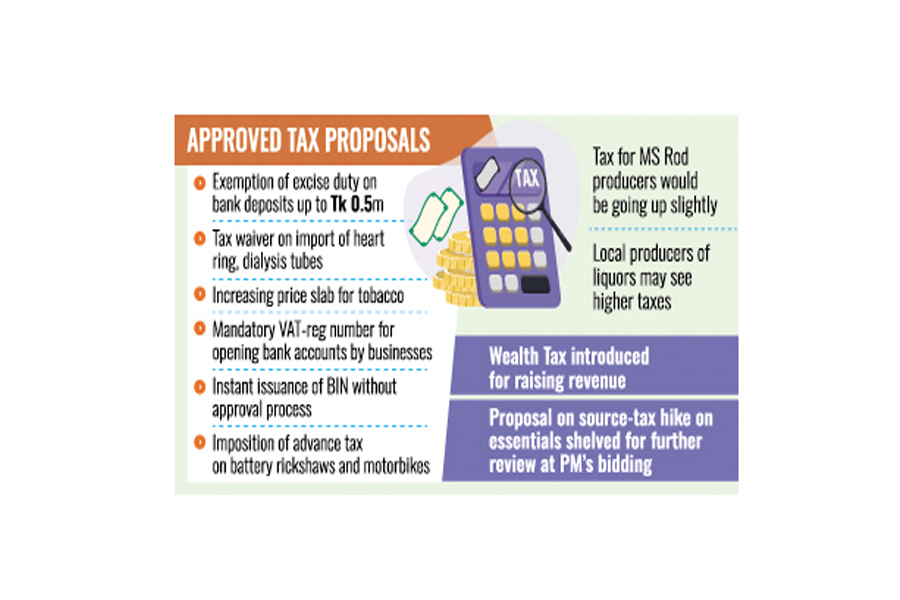
Source tax-hike proposal on essential commodities has been put on hold for further review as per instructions of the PM, he adds.

Among the approved tax proposals, exemption of excise duty on bank deposits up to Tk 0.5 million, tax waiver on import of heart ring, dialysis tubes, increasing price slab for tobacco, mandatory VAT-registration number for opening bank accounts by businesses, instant issuance of BIN without approval process have been approved.

Imposition of advance tax on battery rickshaws and motorbikes has also been approved at the meet.

Value-added tax (VAT) on medicines and mobile-phone users will remain unchanged.

Tax for MS Rod producers would be going up slightly as tax-hike proposal approved by the PM, sources have said.

Local producers of liquors may see higher taxes.

Tax on carbonated beverages would be lowered to facilitate investors.

All three wings of the NBR -- income tax, customs and VAT -- held the meeting and gave a presentation on their respective fiscal proposals for the fiscal year (FY) 2026-27.

Officials say some innovative fiscal measures will come in the next FY focusing on expansion of tax-base to informal sectors.

In the upcoming fiscal year, the NBR will have to collect Tk 6.04 trillion in taxes, expecting a 21.04-percent growth over the current year's original targets.

However, revenue share of the VAT wing has been projected 51.3 per cent of the total NBR target for next year.

The government targets Tk 3.10 trillion worth of VAT in FY 2026-27 followed by Tk 2.22 trillion from income tax and Tk 670 million from customs wing.

Revenue officials say the tax measures would be framed cautiously taking the persistent high inflation into consideration.

The budget, presumably with around Tk 9.0-trillion outlay, is set to be placed in parliament on May 11.​
 

Govt plans tax relief for middle class

Md Asaduz Zaman

1778804998545.webp


The government is planning to ease the tax burden on lower- and middle-income taxpayers in the 2026-27 budget by gradually raising the tax-free income limit and introducing multi-year tax declarations to provide greater certainty for individuals.

It is also considering incentives for electric vehicles and other environment-friendly transport as part of efforts to support climate goals and address the ongoing energy crisis.

In addition, authorities are planning to reintroduce wealth tax and introduce advance income tax for the first time on motorbikes and battery-run rickshaws.

Officials said the proposals received in-principle approval from Prime Minister Tarique Rahman at a high-level meeting at the Secretariat yesterday, where the National Board of Revenue presented several tax measures.

Officials said the tax-free income threshold, currently set at Tk 3.75 lakh for the next two fiscal years for individual taxpayers, may be gradually increased over the coming years.

“There is a plan to increase it further over time to Tk 4 lakh,” a finance ministry official said, adding that the proposal is part of a longer-term roadmap extending up to 2030.

Officials also said the government is considering extending the validity of tax declarations for multiple years to ensure more stability for taxpayers.

FOCUS ON FAIRNESS AND REVENUE BALANCE

Officials said the prime minister has instructed policymakers to ensure that any proposed wealth tax does not unfairly affect people who depend only on regular income, while higher-income groups may face stricter scrutiny.

“The focus is to make sure lower-income groups are affected as little as possible,” a senior official involved in the discussions said.

The discussions also included plans to reduce the tax burden on essential goods by placing more items under a lower tax slab.

Officials said some essential products may be brought under a uniform 0.5 percent source tax to simplify the system and ease pressure on consumers.

“There is no move to increase the turnover tax further. The emphasis is on expanding the tax base instead,” an official said regarding turnover tax policy.

Alongside tax relief measures, environmental issues were also a key focus of the discussions.

Officials said the prime minister stressed that fiscal and taxation policies should be designed to support environmental sustainability.

For motorcycles, the prime minister instructed setting the tax rate at Tk 1,000 for 111cc to 125cc bikes, Tk 3,000 for 126cc to 165cc bikes, and Tk 5,000 annually for motorcycles above 165cc, according to meeting sources.

The government is also reviewing taxation and regulatory policies for motorcycles, electric vehicles, and battery-run vehicles as part of a broader transport tax framework.

Officials said discussions on provisions related to undisclosed money and special investment opportunities are still ongoing, and no final decision has been made.

They added that the proposed measures reflect the government’s effort to balance revenue collection with controlling inflation, expanding social protection, and supporting green transition goals ahead of the next fiscal year.

The prime minister also approved a proposal to raise the excise duty exemption threshold on bank deposits to Tk 500,000 from the next fiscal year.

In addition, prices of tobacco products and foreign liquor may increase as part of efforts to discourage consumption and raise revenue.

The advance income tax on luxury vehicles, including private cars with engine capacities above 3,500cc, is set to rise from Tk 200,000 to Tk 1 million.

However, the existing advance income tax of Tk 25,000 for vehicles with engine capacities of up to 1,500cc will remain unchanged.​
 

Latest Posts

Back