[🇧🇩] Budget For 2026-2027

[🇧🇩] Budget For 2026-2027
27
336
More threads by Saif

G Bangladesh Defense

Big in numbers, tight in choices

Rejaul Karim Byron and Ahsan Habib

1778988304635.webp


Nineteen years ago, BNP finance minister M Saifur Rahman placed a national budget of Tk 69,740 crore for fiscal year 2006-07. Three governments have since come and gone, and BNP has now returned to power through a national election.

This time, Finance Minister Amir Khosru Mahmud Chowdhury is preparing to unveil the country’s 54th budget, which may exceed Tk 9.30 lakh crore for FY2026-27.

Despite the increase in size, the budget-to-GDP ratio has not changed much over the years. In 2006-07, the budget stood at around 12.68 percent of GDP, and is set to be 13.6 percent in FY27.

This suggests that while the economy has grown significantly in size, the government’s fiscal capacity has not strengthened at a comparable pace.

Bangladesh is therefore entering a phase where the scale of public spending is no longer the central issue. The more pressing question is whether the economy can sustain a larger budget amid rising debt, weak revenue mobilisation and institutional constraints.

Over the past two decades, the country’s socio-economic condition has changed noticeably. Electricity access has expanded, rural road connectivity has improved, mobile phone use has surged and internet-based communication has reshaped daily life. Large infrastructure projects such as the Padma Bridge and Dhaka Metro Rail have altered transport patterns and boosted economic activity.

These changes have also raised expectations.

Citizens now expect uninterrupted power supply, better transport systems, modern healthcare, quality education and improved urban services.

Dhaka dwellers want more metro rail lines, while people across the country want improved highways, second bridges across Padma and Jamuna and more industrial investment. As a result, public spending commitments have increased structurally. But, at the same time, fiscal space has tightened.

A growing share of the budget is now being absorbed by just operational expenditure. Interest payments on domestic and external borrowing have risen due to higher debt levels and elevated interest rates. Subsidies in energy, power and food are also high, while the proposed implementation of a new pay commission for public employees is expected to add further recurring pressure.

These factors leave less room for development spending, even as the overall budget size expands.

Weak revenue mobilisation remains a central challenge. Bangladesh continues to have one of the lowest tax-to-GDP ratios in South Asia, which limits the government’s ability to finance development without heavy borrowing.

The financial sector adds another layer of pressure. Non-performing loans have risen due to weak governance, political interference, lending irregularities and poor recovery. A fragile banking system reduces its capacity to support private investment and economic expansion.

Government borrowing from banks has also increased, crowding out credit available to the private sector and pushing up borrowing costs for businesses. The capital market has remained shallow and volatile, offering limited support for long-term financing needs. As a result, the economy remains heavily dependent on the banking sector.

Governance concerns and corruption further complicate fiscal management.

Delays in project implementation, cost overruns and allegations of irregularities in public procurement have reduced the efficiency of public spending.

A White Paper on the State of the Bangladesh Economy under the previous interim government estimated that around $234 billion may have been laundered during the previous Awami League period.

External shocks have also shaped recent economic pressures. The pandemic disrupted trade, employment and production. The Russia-Ukraine war pushed up global food and fuel prices, feeding inflationary pressure in import-dependent Bangladesh.

Inflation has remained above 8 percent since March 2023, eroding real incomes and weakening purchasing power. At the same time, war in the Middle East has added further volatility to global energy markets, increasing risks for inflation and foreign exchange stability.

Against this backdrop, Bangladesh faces a difficult policy balance.

Growth has slowed in recent years while inflation remains elevated. Expansionary fiscal measures could support growth, but they also risk worsening debt and price pressures.

Another important dimension is the role of the International Monetary Fund (IMF) under its ongoing programme. Reform commitments are expected to focus on raising tax revenue, improving banking, reducing subsidies, strengthening fiscal discipline and increasing exchange rate flexibility. While these measures may improve long-term stability, they carry short-term political and social costs.

For the finance minister, the job is not just to present a bigger budget. It is to rebuild trust in how public money is managed while dealing with limited resources and political promises.

He will have to make difficult choices. Money will need to go either to big infrastructure projects or to areas like health, education and skills.

In the end, the budget is not only about numbers. It will show how the government plans to manage a time of high expectations, tight finances, global uncertainty and weak institutions.​
 

Budget should be realistic, focus on employment

Rejaul Karim Byron and Ahsan Habib

1778988496444.webp


Sayema Haque Bidisha, a professor of economics at Dhaka University, suggests strengthening small enterprises in rural areas.

She cited a career preparedness programme recently launched at her university as an example of how universities can help students develop communication skills, interview techniques, and workplace readiness. “These are not expensive reforms,” she said. “Higher education institutions can build stronger industry linkages with relatively modest budgetary support.”
The upcoming national budget should focus on a realistic approach, aiming to bring inflation under control and create jobs by promoting private investment.

In an interview, Sayema Haque Bidisha, a professor at the economics department and also a former pro-vice-chancellor of Dhaka University, said one of the quickest ways to stimulate employment would be to strengthen small enterprises in rural Bangladesh through targeted policy support instead of costly incentives.

REVIVING RURAL SMES

The economist pointed to the struggles of rural entrepreneurs she met during field research in districts such as Kushtia and Tangail.

“We saw entrepreneurs producing goods and surviving through sheer personal effort, but many had little connection with institutional bodies meant to support them,” she said. “The problem is often not just only lack of financing, but also the lack of policy coordination, market linkage and access to information.”

Easier access to small loans, temporary interest waivers for micro-enterprises, and stronger links between entrepreneurs and supply chains could help sustain rural economies even if urban industrial expansion remains slow, the economist suggested.

BRIDGING THE SKILLS GAP

For job creation, the government should also focus on skills and a proper education system, she said, noting that Bangladesh’s education system suffers from a major disconnect with industry needs.

Many graduates leave universities without practical skills or career preparation.

She cited a career preparedness programme recently launched at her university as an example of how universities can help students develop communication skills, interview techniques, and workplace readiness.

“These are not expensive reforms,” she said. “Higher education institutions can build stronger industry linkages with relatively modest budgetary support.”

She urged universities and training institutes to focus more on industry-specific and career-oriented education rather than producing graduates for a narrow range of traditional jobs.

At the same time, she criticised Bangladesh’s broader training culture, saying many programmes remain overly certificate-focused without adequately connecting trainees to real employment opportunities.

“Training should not end with certificates,” she said. “It must be linked with internships, industries and actual job markets.”

WOMEN IN WORKFORCE

She identified caregiving, transport and agro-based industries as sectors with strong employment potential, particularly for women and semi-skilled workers.

Female labour force participation, she said, cannot improve without tackling structural barriers such as access to capital, market linkages and childcare support.

One of her strongest recommendations was the expansion of community-based daycare centres, particularly in urban low-income areas.

“A daycare centre can help one woman join the workforce while also creating employment for another woman running the service,” she said.

She also argued that Bangladesh needs to move beyond its heavy dependence on readymade garments for female employment and explore emerging sectors where women can play larger roles.

Even unconventional sectors such as transport could open new opportunities, she said, citing female drivers as an example of professions rarely discussed in Bangladesh.

A REALISTIC BUDGET

Throughout the interview, Bidisha repeatedly returned to one central point: Bangladesh’s next budget must avoid unrealistic promises and instead focus on practical, targeted interventions that deliver visible relief.

According to her, the biggest challenge facing the government remains revenue generation without increasing pressure on ordinary citizens already struggling with rising living costs.

“The real challenge is to expand direct taxation and bring more people into the tax net without putting additional burdens on lower and middle-income groups,” she said. “That has become even more important now because inflationary pressure is already rising due to fuel and other costs.”

As Bangladesh prepares to unveil its first national budget under a BNP-led government in nearly 17 years, expectations are mounting over whether policymakers can strike a balance between economic stability and public relief.

Bidisha said the answer lies not in grand promises or expensive mega reforms, but in a “realistic budget” built around inflation control, employment generation and targeted policy support for ordinary people.

She argued that Bangladesh no longer has the fiscal space for overly ambitious spending plans. Weak revenue collection, persistent inflationary pressure, sluggish private investment and widening inequality have narrowed the government’s room to manoeuvre, she said.

“Our tax-GDP ratio has declined further, while revenue mobilisation has historically remained weak,” Bidisha said. “The government has to think carefully about priorities and austerity while protecting the most important sectors.”

According to her, inflation should remain the government’s top political and economic concern because the purchasing power of ordinary citizens ultimately determines public confidence in the economy.

“At the end of the day, people care about whether essential commodities remain within their reach,” she said, describing inflation as a political economy issue as much as a macroeconomic one.

REVIVING INVESTMENT AND JOBS

The challenge is more complex than simply tightening expenditure. Bangladesh must also revive private-sector investment and job creation at a time when high borrowing costs and macroeconomic uncertainty continue to discourage businesses.

“If private investment remains weak for a prolonged period, pressure will build on employment generation, industrial performance and inclusive growth,” she said.

Bidisha believes the government should focus on what she calls “low-hanging fruit” instead of waiting for large-scale reforms that may take years to implement.

TAX THE ULTRA-RICH

She also warned that Bangladesh’s widening inequality is becoming increasingly difficult to ignore. To reduce the income gap, she proposed stronger progressive taxation targeting ultra-wealthy individuals who often remain outside the effective tax net.

“For years, the burden has largely fallen on compliant taxpayers,” she said. “Meanwhile, many wealthy individuals remain outside the effective tax net.”

Digitalisation, she argued, could play a major role in expanding the tax base beyond Dhaka and Chattogram, where many affluent individuals in district towns remain outside formal taxation systems.

She even suggested offering temporary incentives or rebates to encourage first-time taxpayers to formally register and enter the tax structure.

WELFARE TARGETING


Another major concern for the professor is the design and implementation of social safety net programmes. She warned that Bangladesh’s welfare system still suffers from “inclusion and exclusion errors”, where many deserving people remain outside support schemes while others receive overlapping benefits.

The government’s plan to expand family cards to millions of households could face similar challenges unless it is integrated with existing welfare databases and programmes, she said.

“There has to be a holistic mapping system based on NID information, so policymakers know who is receiving which benefits,” she said. “Otherwise, the real target groups may still remain excluded.”

Bidisha also stressed that urban poverty deserves far greater policy attention. While rural households often retain some access to basic food and community support, slum dwellers in cities remain highly vulnerable to inflation and income shocks.

She called for stronger urban-focused social safety programmes targeting low-income communities in slums and informal settlements.​
 

NEC approves ADP for FY'27 today
Some major projects claim hefty sums

JAHIDUL ISLAM

Published :
May 18, 2026 00:05
Updated :
May 18, 2026 00:05

1779060827280.webp


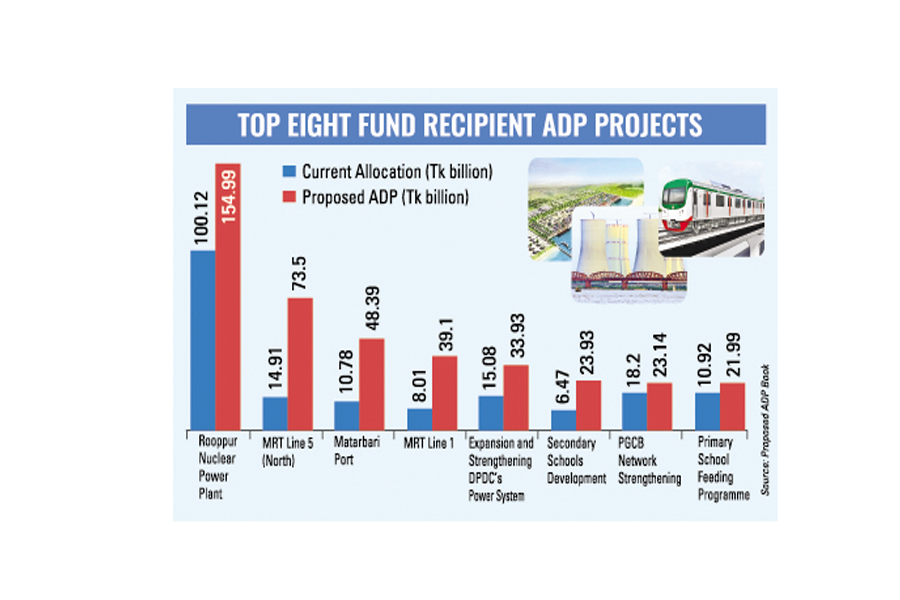
A few projects claim hefty sums in Bangladesh's new development budget, with the Rooppur Nuclear Power Plant project set to receive the highest allocation of Tk 154.99 billion.

The RNPP's allocation in the next fiscal year's Annual Development Programme (ADP) marks a 54.81-percent increase from the revised allocation for the current fiscal year.

Next to it is Dhaka Mass Rapid Transit Development Project Line-5 Northern Route that is expected to receive the second-highest allocation at Tk 73.50 billion, while the Matarbari Port Development Project is set to get Tk 48.387 billion.

A total of Tk 536.22 billion has been allocated for the 15 large projects under the proposed ADP worth Tk 3.0 trillion for the next fiscal year.

The ADP is being placed today before the meeting of the National Economic Council (NEC) for final approval.

The meeting, scheduled to be held at the NEC Auditorium in the capital with Prime Minister Tarique Rahman presiding, will also review a five-year reform and development strategy titled 'Five-Year Reform and Development Strategy (2026-2030)', drafted by the General Economics Division (GED) of the Planning Commission.

Officials say the proposed ADP with Tk 1.9 trillion from government's own fund and Tk 1.1 trillion from external sources is 50-percent higher than the Revised ADP (RADP) of the outgoing fiscal year.

The draft of the ADP book ready for the meeting reveals that "the highest-ever infrastructure project" Rooppur Nuclear Power Plant, scheduled to be completed by June 2028, is to receive 154.99 billion: Tk 146.88 billion from project aid and Tk 8.11 billion from government fund.

The Tk 1.39-trillion project achieved 68.28-percent progress up to June last year with a cumulative disbursement of Tk 946.89 billion.

The Dhaka Mass Rapid Transit Development Project Line-5 Northern Route, a Tk 412.39-billion project that has achieved only 7.70-percent progress over the past seven years, is set to receive Tk 73.50 billion in the next fiscal year.

The allocation for the project is increasing by Tk 58.59 billion, nearly fourfold from the revised allocation of Tk 14.91 billion in the current fiscal year.

The Matarbari Port Development Project, involving an estimated cost of Tk 243.81 billion, is set to receive Tk 48.39 billion in the fiscal year 2026-27 - more than four times higher than the current allocation of Tk 10.78 billion.

A review of the proposed ADP shows that although a few major projects, including the Dhaka Mass Rapid Transit Development Project Line-5 Northern Route and the Matarbari Port Development Project, are receiving large sums of money, overall funding for megaprojects is not being significantly expanded this year.

Instead, midsize projects in power transmission and distribution, health, education, and water-management sectors are getting priority in the ADP allocation.

The Dhaka Mass Rapid Transit Development Project Line-1 is set to receive Tk 39.10 billion in the next fiscal year, marking a 388.10-percent increase from the revised allocation, despite having only 9.29 per cent progress against its total estimated cost of Tk 539.77 billion.

Significant allocation increases are also proposed to increase for the Expansion and Strengthening of Power System Network under DPDC Area at Tk 33.93 billion and the Government Secondary Schools Development Project at Tk 23.93 billion.

The Government Primary School Feeding Programme is set to receive Tk 21.99 billion despite having no recorded progress, while the Learning Acceleration in Secondary Education Project would see a sharp 217.64-percent rise in allocation to Tk 15.59 billion.

In the transport sector, the revised Dhaka Mass Rapid Transit Development Project Line-6 will receive Tk 18.99 billion, as it nears completion with 78.26-percent progress. The SASEC Dhaka-Sylhet Corridor Road Development Project and the Chattogram-Dohazari Dual Gauge Railway Conversion Project are also allocated significant funds.

However, allocations for some ongoing megaprojects are being reduced, including the Dhaka-Ashulia Elevated Expressway Project and the SASEC Road Connectivity Project Elenga-Hatikamrul-Rangpur Highway Four-Laning.

The WECare Phase-1 Jhenidah-Jashore Highway Development Project records one of the highest increases, with allocation rising 6.79 times to Tk 11.45 billion.​
 

NBR plans taxing motorcycles, auto-rickshaws in budget
Saddam Hossain 18 May, 2026, 00:42

1779064711987.webp

Motorcycle users stage a protest in front of the NBR headquarters at Agargaon in Dhaka on Sunday and submit a petition to the NBR chairman, demanding the withdrawal of the proposed advance income tax on motorcycles. | Star Mail photo

The National Board of Revenue is considering imposing advance income tax on motorcycles and battery-run rickshaws in the proposed budget for the 2026–27 fiscal year as part of efforts to widen the country’s tax net and increase revenue collection.

According to NBR officials familiar with the matter, motorcycles might be subject to advance income tax based on engine capacity, with proposed rates ranging from Tk 1,000 to Tk 5,000 per year.

Initially, the NBR planned to impose tax rates ranging from Tk 2,000 to Tk 10,000 annually based on engine capacity, however, the revenue agency then decided to reduce the rate, said one of the officials.

Under the new proposal for motorcycles, bikes up to 110cc capacity would remain exempted from advance income tax, he added.

Motorcycles with engine capacities between 111cc and 125cc might face Tk 1,000 annually, those between 126cc and 165cc Tk 3,000, and motorcycles above 165cc Tk 5,000.

According to the latest data from the Bangladesh Road Transport Authority, the number of registered motorcycles in the country currently stands at 48,70,780.Bangladeshi Culture Course

Battery-run rickshaws might face an advance income tax ranging from Tk 1,000 to Tk 5,000 annually.

However, implementation of the proposed tax on battery-run autorickshaws may take time as it remains unclear whether the vehicles would be registered by local government authorities or the BRTA.

Sector insiders estimated that more than five million battery-run rickshaws are currently operating across the country, including nearly one million to 1.2 million in Dhaka alone.

To bring these vehicles under a regulatory framework, the Road Transport and Highways Division under the Ministry of Road Transport and Bridges drafted the ‘Electric Three-Wheeler Management Policy 2025’ last year.

Under the draft policy, battery-powered autorickshaws would require registration with the BRTA, depending on vehicle type and speed category.

However, in a separate move, the Local Government (City Corporation) Act 2009 was amended through a presidential ordinance on August 28 last year, empowering city corporations to register and approve electric three-wheelers.

NBR officials said that the proposed advance income tax rates for battery-run rickshaws would vary by area, like vehicles registered within city corporation areas would have to pay Tk 5,000 annually, while those registered in municipalities would pay Tk 2,000 and those in union areas Tk 1,000.

Currently, advance income tax already applies to CNG-run autorickshaws, private cars, jeeps, buses, trucks and pickup vans, while CNG autorickshaws pay Tk 2,500 in advance income tax annually, while private cars and jeeps pay between Tk 25,000 and Tk 200,000 depending on engine capacity.

On Sunday, motorcycle riders submitted a memorandum to the NBR chairman, demanding the withdrawal of the proposed advance income tax on motorcycles from the FY27 budget.

They formed a human chain in front of the NBR headquarters, where they said that a motorcycle that costs Tk 1,00,000 in India often costs nearly Tk 3,00,000 in Bangladesh.

Motorcycles are not luxury products for ordinary people, they added, saying that many riders earn between Tk 500 and Tk 1,000 a day through ride-sharing services and delivery work.

Imposing such taxes would adversely affect the livelihoods of many people who rely on motorcycles for income, as well as office-goers, students and small business owners who rely on them to save time and avoid traffic congestion.

NBR chairman Abdur Rahman Khan said at a seminar on Saturday that the government was working to establish a transparent and accountable revenue system, stressing that increasing revenue collection had become unavoidable amid the country’s economic challenges.

‘Wherever we go, the final message is the same — revenue collection must be increased,’ he added.

He also said that if countries around the world spend around 5 per cent of GDP on healthcare, how could Bangladesh manage proper healthcare expenditure when total revenue is below 7 per cent of GDP, he questioned.

According to the NBR, Bangladesh’s revenue collection faced a record shortfall of Tk 97,990 crore in July-March of the current financial year 2025-26, falling to Tk 2,87,863 crore, below the revised target of Tk 3,85,853 crore.​
 

Latest Posts

Back