[🇧🇩] City Buses, Metro Rail, Urban Transport & City Road Infra

[🇧🇩] City Buses, Metro Rail, Urban Transport & City Road Infra
150
10K
More threads by Bilal9

G Bangladesh Defense

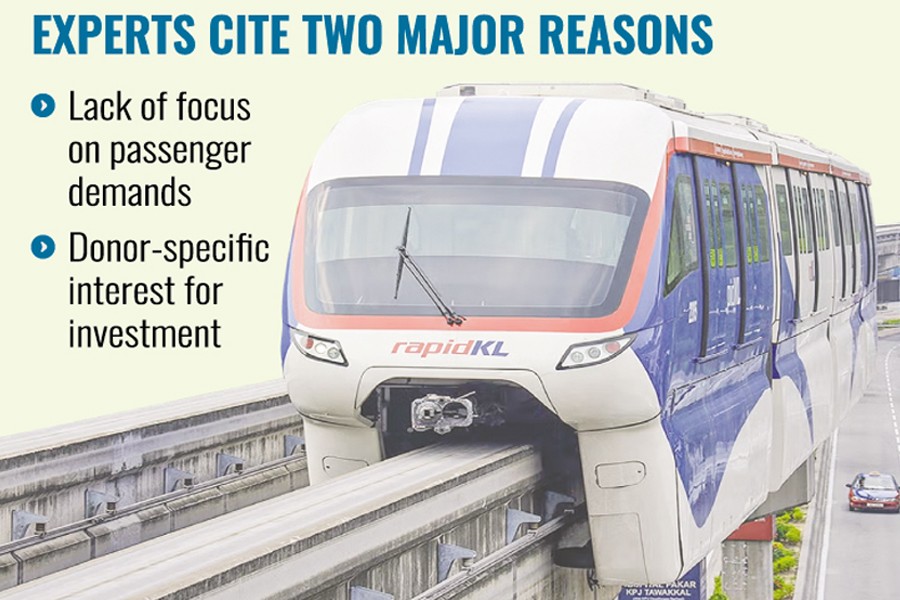
Mono rail, LRT not studied under four major plans

Munima Sultana
Published :
Jan 31, 2026 08:37
Updated :
Jan 31, 2026 11:57

1769905955492.webp


Although at least four major transport plans were taken for the capital city since 1990s, the scope of launching mono rail or light rapid transit (LRT) as a mode of mass transit system was never studied.

Officials and experts termed lack of right focus on local-level passenger demands as well as dominance of donor-funded studies to meet their own mandate of introducing specific transport modes as the causes behind it.

At present, the capital's transport plans are supposed to be taken following guidance of the strategic transport plan (STP), first formulated in 2005. Due to not following options of the plan properly, the 20-year long transport plan was revised twice in 2015 and 2025, shifting only the number of modes.

The STP 2005 proposed three mass rapid transits (MRTs) and three bus rapid transits (BRTs) for the first time for the Dhaka metropolitan. The number of MRTs increased to five and BRTs reduced to two during the first revision of STP in 2015. Of the total, no MRTs have seen the light of implementation after 20 years, except the MRT-6.

The latest RSTP 2025, which is now at the final stage for approval, has updated transport options, focusing on the extension of all proposed MRTs of the RSTP than new corridor development.

Earlier, the Dhaka Integrated Transport Study (DITS) 1994 and the Dhaka Urban Transport Project (DUTP) 1997 focused on bus and circular waterways, and mixing of bus- and rail-based transit as mass transport respectively. Institutional development, traffic management, road network improvement through various infrastructure facilities, etc, were among the focuses of these plans.

The World Bank (WB) funded the first STP, while the Japan International Cooperation Agency (JICA) funded the RSTP, and the Asian Development Bank funded updating of the RTSP. The DITS was funded with cooperation of the UNDP and the WB, and the DUTP by the WB.

In between, the JICA funded the Dhaka Urban Transport Network Development Study (DHUTS) during 2009-2010, which was the pre-feasibility study for the city's first MRT, based on the STP 2005-proposed mass transit options.

Officials connected with the RSTP 2025 said as monorail or LRT was not included in the terms of reference, the latest revision of STP did not focus on it.

BUET Professor Mohammad Shamsul Hoque alleged that the city's transport master plans have been done on donor-specific interest for investment. Despite requiring much lower investment than metro rail, the donors were not interested in other options (monorail or LRT).

If scopes of exploring these were taken into account, the Dhaka city could have mass transit corridors much earlier with low investment than the present, he claimed.

However, some transport experts and analysts said though MRTs require high investment, their passenger transit capacity and scope of coverage are higher than monorail or LRT.

Speed limit, mileage, and frequency of stations are also limited in one rail-based mass transport systems. Monorail or LRT can be used for feeder corridors than prime, they added.

Chief Advisor's Special Assistant on Rail and Road Transport Sheikh Moinuddin said considering the number of commuters and the reality of city roads, combination of different modes of transport should be considered.

"MRT, LRT or monorail - which system would be prime movers for the city - should be reviewed in the country's context," he told the FE.

According to experts, LRT is like a middle ground solution for the lower demand corridors as a way to connect the MRT lines. The highest capacity of monorail is 30,000 passengers per hour per direction (PPHPD), but it is double in the case of MRTs. The densely-populated Dhaka city's passenger demand on one corridor is said to be 60,000 to higher.

The monorail or LRT has been under discussion in the recent days due to slowing down of the planned MRTs and total stoppage of development of BRTs. The cost of the next metro rail corridor is likely to reach Tk 1.0 trillion due to delay and lack of proper review of its study and design. The BRT corridor development project has also been closed recently due to various reasons.​
 

Costs of two MRT projects set to soar
Shahin Akhter 25 February, 2026, 23:59

Costs of two of the upcoming projects for the construction of mass rapid transit lines, popularly known as metro rail, are likely to soar by a huge amount of money due mainly to some engineering conditions added by the Japanese donor.

Expressing concerns, road transport sector experts said that these projects could lead the country to bankruptcy due to the burden of ‘illogical’ expenditures.

Officials of the Dhaka Mass Transit Company Limited, the implementing agency of the metro rail system, said that the government would make decision regarding the cost of these projects.

The work to build a network of about 141 kilometres of six MRT lines, comprising both elevated and underground ones, by 2030 started in 2016 in the Dhaka city to reduce traffic congestion and improve the environment in the capital and its suburbs.

Japan is providing loans for the construction of the first three MRT lines in Bangladesh through the Japan International Cooperation Agency.

Out of the six projects, metro trains are now running on the Uttara–Motijheel portion of the elevated 21.26 kilometres long MRT Line 6 project. The portion took about six years to be completed.

Works on its extension till Kamalapur are now going on while the project costs Tk 33,472 crore.

The 31.241-kilometre MRT Line 1, on the Hazrat Shahjalal International Airport-Kamalapur route, will be the first underground metro rail system in Bangladesh and its construction work started on February 2, 2023, while it was approved in December 2019.

For the MRT Line 1 project, the government estimated the cost at about Tk 52,500 crore with the deadline till December this year.

As per the contractors’ proposal, the estimated cost of the project reached about Tk 96,500 crore.

The construction of the 20-kilometre MRT Line 5’s Northern Route, on Hemayetpur-Bhatara route, started on November 4, 2023, with an estimated cost of Tk 41,200 crore and the December 2028 deadline.

For the project, approved in October 2019, as per the contractors’ proposal the estimated cost of the project now stands at about Tk 88,000 crore.

DMTCL managing director Faruque Ahmed said that the Japanese lending agency JICA had added several engineering conditions to the financing of the two projects.

As a result, competition in hiring contractors has decreased, he said, adding that this was one of the reasons why the current estimated costs were so high.

‘We do not know why the contractors are asking for so much cost,’ Faruque said, adding that now the government would make decision about the projects’ cost.

The managing director added that metro rail system was necessary for the capital while it was also important how cheaply a MRT line could be built instead of putting burden on people.

Professor Shamsul Hoque, who teaches civil engineering at the Bangladesh University of Engineering and Technology, said that there was a grave concern that these projects could lead the state to financial bankruptcy due to burden of ‘illogical’ expenditure.

Since the debt must be repaid in foreign currency, it places an immense pressure on the country and the people, especially as the Awami League government, which was ousted in August 2024 in the wake of a mass uprising, had already left behind a heavy debt load, said Shamsul, also an expert on transport engineering and road safety.

He also alleged that a syndicated tendering process where Japanese contractors and consultants dominated because the experience requirements were tailored to them, prevented competitive bidding, resulting in only a couple of contractors bidding for packages and then splitting the work.

Mentioning the routes of MRL line 1 and 5 (northern route), Shamsul further said that investing heavily in lines towards areas like Purbachal and Bhatara was ‘questionable’ because those areas were not yet fully inhabited.

‘This means the investment may never be recovered through fares, forcing the government into high subsidies,’ he observed.

The government should be visionary and consider international tenders rather than relying solely on one donor to ensure that public money is used for sustainable and cost-effective development, he added.​
 

Will new govt fix the chaotic public transport?

Tanim Asjad
Published :
Mar 06, 2026 22:46
Updated :
Mar 06, 2026 22:46

1772842917173.webp


People in Dhaka and across the country are exasperated by the chaotic, inefficient public transport system. Previous governments failed to develop an efficient system. Abrupt and disjointed measures meant to fix public transport only made things more chaotic. As a result, mobility for regular commuters is costly in time, safety and money. Over the past few decades, various studies have addressed problems such as unbearable traffic congestion and road indiscipline. Short-term and long-term plans were made. Still, except for the introduction of the metro rail service in Dhaka, no effective measure was taken to alleviate the suffering linked to daily commute by millions. Now that the newly elected government has assumed power with a two-thirds majority in parliament, a valid question has come to the fore. Will it prioritise the issue of addressing the chaotic system of public transport?

In its 48-page election manifesto, the Bangladesh Nationalist Party (BNP) outlined measures to make public transport more efficient, acknowledging that the country faces serious obstacles from inefficiency and disorder in the transport sector. In this context, the manifesto stressed special initiatives "to expand and improve the public transport system to alleviate traffic congestion and make public transport more effective and accessible in densely populated cities." The assertion reflects a proper understanding of the problem, which is necessary before taking any measures to fix it.

The manifesto's measures include relocating inter-district bus terminals and illegal truck stands outside the city, freeing footpaths from illegal encroachment, and gradually removing slow-moving, unsafe, and unsuitable vehicles from the roads. If the government takes strong steps to keep footpaths free and well-maintained, it will reduce traffic congestion, as people will walk more easily for short distances. Providing safe walkways can also reduce the need for para-transit, easing street congestion. Currently, para-transits like motorcycles and battery-run rickshaws have increased congestion, making traffic movement chaotic and disorganised. Stringent measures are needed to curb the spread of these para-transits, along with better alternatives to improve daily commuters' mobility.

An important commitment of the party's manifesto is the implementation of the bus route rationalisation programme through coordination of urban planning and transport policy. Though the programme was recognised by the ousted Hasina regime as a critical step towards improving overall traffic movement in Dhaka, no effective action was taken. In the name of route rationalisation and franchisation, deliberations and meetings were held aplenty, along with a trial run of dedicated buses on a few routes. The move did not yield any benefit due to non-cooperation from transport owners and law-enforcement agencies.

It is well known that the public transport sector in the country is heavily criminalised due to rampant illegal toll backed by the political party in power. For more than 15 years, leaders and activists of the Bangladesh Awami League (BAL) controlled the illegal extortion, and it was not unknown to the Hasina-led government. Nevertheless, the BAL did not try to curb the criminalisation.

After the fall of the tyrannical government on August 5, 2024, new extortionists replaced those who had controlled the transport sector. The Yunus-led interim regime was unable to stop them, so chaos in public transport continued. Commuters in Dhaka still struggle daily with ramshackle, unfit, air and sound-polluting buses. The new government needs to crack down on illegal extortion from the start to discipline the public transport sector by gradually implementing the election manifesto.

The new transport minister's recent statement regarding extortion gives a disappointing message. Within three days of taking charge, he publicly stated that money collected from transport operators on the roads through mutual agreement is not extortion, but a contribution. He also added that if someone is forced to pay, it is surely extortion. His remarks drew strong criticism from different quarters for valid reasons, and many interpreted the minister's statement as an endorsement of illegal extortion in the transport sector. The minister needs to be careful in making any comments, especially on issues like extortion in the transport sector, as people are fed up. They are also in no mood to listen to a lecture on the difference between collecting money through mutual understanding and forceful collection or extortion. Instead, the transport minister and his team need to focus on implementing their manifesto to fix chaotic public transport.​
 

Transport minister's claims fall flat as passengers distressed by rampant overcharging

UNB
Published: 19 Mar 2026, 20: 11

1773967498457.webp

Road Transport, Railways and Shipping Minister Sheikh Rabiul Alam speaks file photo

Despite the transport minister''s claim that no extra fares were charged during the Eid rush, passengers have alleged widespread overcharging, with evidence found even on state-run BRTC buses.

Road Transport and Bridges Minister Shaikh Rabiul Alam recently said fares remained fair during Eid, adding that in some cases passengers were even charged less than the fixed rates.

However, visits to major bus terminals in the Dhaka including Sayedabad, Gulistan, Gabtoli and Mohakhali between Tuesday and Wednesday revealed a different scenario.

Passengers alleged that both private operators and Bangladesh Road Transport Corporation (BRTC) buses charged fares higher than the approved rates.

On Thursday evening, Faisal Hossain bought a ticket from the BRTC counter at Gulistan for Barishal. While the usual fare is Tk 600, he was charged Tk 1,000. Similar complaints were reported by many passengers travelling on BRTC buses to Barishal since afternoon.

Responding to the issue, Barishal BRTC depot manager Julfikar Ali said two special buses had been deployed for Eid, which have fewer seats, allowing slightly higher fares but not as high as Tk 1,000.

He alleged that a syndicate involving drivers, helpers and others at ticket counters was attempting to raise fares ahead of Eid.

Visits to several BRTC buses also found overcrowding, with passengers being carried beyond seat capacity. In some cases, additional passengers were seated using stools. Zulfikar admitted that drivers and helpers were responsible, driven by the hope of earning extra income during Eid.

BRTC Chairman Abdul Latif Mollah acknowledged the irregularities, saying, "This should not have happened. Taking extra fare is unjust. I have instructed that the excess fare be refunded."

Although some buses reportedly refunded extra fares following the directive, the issue of carrying extra passengers remains unresolved.

Meanwhile, after visiting different bus terminals, the transport minister reiterated that fair fares were being maintained, even claiming that in some cases fares were lower than fixed rates remarks that drew sharp criticism from passengers.

Mozammel Haque, Secretary General of the Jatri Kalyan Samity, termed the minister''s remarks "rhetoric," alleging that he was being influenced by bus owners.

"Bus owners are dictating what the minister says in front of the media. This Eid, fares have doubled or even tripled in some cases, yet the minister claims fares are below fixed rates," he said.

Mozammel also alleged a lack of passenger representation during ministerial inspections and expressed concern that the association might be sidelined in favour of bus owners.

According to a report by the association, passengers may have to pay an additional Tk 1.48 billion in fares this Eid, potentially the highest in two decades as overcharging has been reported on nearly all routes from Dhaka.

However, State Minister for Road Transport Habibur Rashid dismissed the report, claiming no complaints of overcharging had been received. "Action will be taken if any complaint is found."

Passengers, however, said otherwise. Mehedi Hasan Sabuj, who bought a ticket on a private bus to Patuakhali, said that previously passengers could pay reduced fares if they got down earlier, but this time they were forced to pay full fares regardless of destination.

Another passenger, Mardia Maria, criticised the authorities, saying, "There is no real monitoring. What the ministers are doing is nothing but a show. It is not improving discipline; rather, the situation is worsening."

Passengers urged the authorities to acknowledge the problems and take effective measures instead of relying on "showdowns" and outdated approaches to ensure discipline in the transport sector during peak travel periods.​
 
Ashulia Elevated Expressway - AKA how to build a world class across-town expressway on a non-descript swamp in Dhaka.


Metro rail: Govt to build second one, questions over cost

Anowar Hossain
Dhaka
Updated: 18 Apr 2026, 08: 46

1776561118640.webp

Metro rail File Photo

The incumbent government wants to restart the process of appointing a contractor for constructing a metro rail line from Kamalapur to the airport in Dhaka. The interim government had decided to cancel this contractor appointment process due to the much higher cost proposals.

For the new route, Japanese contractors are demanding nearly 97 per cent more per kilometre than the government’s estimate. During the interim government’s tenure, analysis based on the contractors’ cost proposals showed that the cost would stand at about Tk 36.18 billion per kilometre, while the government had estimated it at Tk 18.39 billion. By contrast, the metro rail from Uttara to Motijheel in Dhaka cost around Tk 15 billion per kilometre.

During the interim government’s tenure, Faruque Ahmed was appointed managing director of Dhaka Mass Transit Company Limited (DMTCL), which operates the metro rail. He has experience working on metro rail and large infrastructure projects in different countries. After analysing costs in various countries, he raised questions about the proposed cost of Dhaka’s new metro rail.

DMTCL then informed Japan’s development partner agency JICA through a letter, based on government decisions, that the contractors’ bids could not be accepted. The government was interested in calling for fresh tenders.

However, JICA, the lending agency for the project, did not agree. It said that cancelling the contractor appointment process at the final stage and calling for fresh tenders would conflict with the terms of the loan agreement. As a result, work on the metro rail project stalled.

After the BNP government came to power, changes were made in various institutions. Faruque Ahmed was also removed from his position as managing director of DMTCL.

According to sources at the road transport ministry after the new government took office, JICA representatives met with Road Transport, Rail and Shipping Minister Robiul Alam. Following this, the ministry instructed officials to hold discussions with JICA to move forward with work on Metro Rail Line-1.

Most recently, on 10 March, a joint meeting was held at the Economic Relations Division (ERD) involving JICA, metro rail authorities, and ERD. Sources at the meeting said JICA remained firm on appointing contractors by approving proposals with cost increases of 170 per cent and 25 per cent in two packages of the metro rail project. The agency cited expansion of work scope, depreciation of the taka against the dollar, and rising commodity prices as reasons. It even objected to media reports about the contractor appointment process.

Meeting sources also said that project authorities suggested continuing work on the two packages that had been cancelled during the interim government. However, they advised considering the overall increase in project costs.

The meeting decided that the ministry, project authorities, and JICA would continue discussions on the project. A detailed review would be conducted to reduce costs. Steps would be taken to revise the project proposal. It was also decided to ensure that information about the contractor appointment process does not leak outside.

Mohammad Ziaul Haque, secretary of the road transport ministry and chairman of DMTCL’s board, told Prothom Alo that the metro rail is very important for Dhaka. The government is very positive about moving the project forward.

He also said that he and the minister hold weekly meetings on the matter. He added that a review is underway to understand why project costs are rising and that they expect to have a clearer idea soon. After that, they will look for ways to reduce costs.

Experts, however, said that while discussions may reduce costs somewhat, significant reductions would require increasing competition. Contractors beyond Japanese firms must be allowed to participate in tenders, and that is not happening.

The metro rail line from Kamalapur to the airport is named MRT Line-1. It will run from Kamalapur to the airport, then to Narda and Purbachal. The total length is a little over 31 kilometres. The section from Kamalapur to the airport will be underground, while the Narda to Purbachal section will be elevated.

DMTCL sources said the project is being implemented in 12 packages. It was approved in December 2019 with an estimated cost of Tk 525.61 billion. So far, cost proposals from contractors have been received for 8 of the 12 packages. Based on these, DMTCL’s analysis shows that the project cost would rise to Tk 965 billion on average contractor bids.

According to DMTCL sources, work on one package for depot development in Purbachal is in its final stage. The contractor appointment process for two more packages was at the final stage. In one package, the proposed cost is 170 per cent higher than the estimate, while in another it is 25 per cent higher. Overall progress of the project is only 6 per cent.

The project is financed by JICA, and two loan agreements have already been signed. Due to slow progress, funds from one tranche have not been disbursed, while only a small portion has been released from the other. According to the agreement, the disbursement period will end in September next year. Loan repayment will begin from 2029.

These loan agreements were made during the Awami League government, which was ousted in the July mass uprising. The current government is now in a difficult position. There is public expectation regarding metro rail, while Japan is a long-standing development partner of Bangladesh. Cancelling the loan agreement could affect bilateral relations.

According to road transport ministry sources, JICA is urging the continuation of contractor appointment processes for the two packages that had been halted by the interim government. It also wants discussions to continue on how to reduce costs in other packages currently under evaluation.

A senior official of the ministry, speaking on condition of anonymity, told Prothom Alo that the terms of JICA loans offer limited scope for cost negotiation. For packages at the early stage of tendering, some costs can be reduced by scaling down work or modifying designs, but this cannot be considered a real reduction in overall costs.

Lack of competition

According to ministry sources and experts, the main disagreement between JICA and the interim government was over loan conditions and the tendering process. There has been no fundamental change in JICA’s policy in discussions with the new government. As a result, opportunities to significantly reduce costs remain limited.

JICA loan conditions tend to favour Japanese companies in contractor selection, limiting competition in tenders. In most JICA-funded projects, contractors and consultants are from Japan, with local or other international firms participating only as partners in some cases. Japanese dominance exists in feasibility studies, design, tender preparation, and implementation stages. All procurement decisions require JICA’s approval before execution.

Sources said tender documents often include methods and technologies that are difficult for non-Japanese firms to meet. For example, the MRT Line-1 tender requires tunnel construction using the “one-pass joint” method, which favours Japanese contractors.

A DMTCL official, speaking anonymously, said that despite open tenders, non-Japanese contractors rarely participate. Usually, two or three Japanese firms submit final bids, and their proposals must be accepted. Especially in underground work, opportunities for others are very limited.

In a written response on 7 April, JICA told Prothom Alo that it is aware of public interest in MRT Line-1 and MRT Line-5 (North). It said it continues constructive dialogue with the government of Bangladesh to advance these important urban transport projects.

JICA stated that the projects are being implemented according to its procurement guidelines. Under these rules, evaluation and related information cannot be disclosed after bid opening until contract completion. Therefore, it cannot comment on specific tenders at this stage. However, it supports transparency after contracts are finalised.

JICA also said its loans are part of a long-term commitment to sustainable urban transport in Bangladesh. Despite rising costs due to global inflation, supply chain disruptions, and exchange rate fluctuations, the importance of these projects remains unchanged. It will continue working with the government and stakeholders to advance them.

Another project stalled

Like MRT Line-1, another JICA-funded metro rail project—MRT Line-5 (North)—is also ongoing. It will run from Hemayetpur in Savar through Gabtoli, Mirpur, and Gulshan to Bhatara. The Hemayetpur–Gabtoli section will be elevated, while the rest will be underground. The total length is about 20 kilometres.

This project was approved in October 2019 with an estimated cost of Tk 412.38 billion. Analysis of contractor bids for five packages shows the cost could increase to Tk 880 billion. Work on the depot in Hemayetpur is nearing completion, but contractor appointments for the remaining work have stalled due to increased costs.

Ministry sources said discussions on the next steps for Line-5 (North) have not yet gained momentum, and its future depends largely on decisions regarding Line-1.

JICA is also the lender for the Uttara–Motijheel metro rail, which will be extended to Kamalapur. The total length is 21.26 kilometres, and work on the Motijheel–Kamalapur section is ongoing. The total cost is Tk 334.72 billion, or Tk 15.74 billion per kilometre—also a subject of debate.

If projects proceed based on contractor bids, the combined cost of the two new lines (Line-1 and Line-5) will reach Tk 1.85 trillion. DMTCL’s analysis of metro projects in other Asian countries shows that excluding land acquisition and salaries, metro construction costs in India range from Tk 1.50 billion to Tk 4.50 billion per kilometre. India also uses foreign loans but does not impose conditions that restrict competition in contractor selection.

Professor Shamsul Haque of the Department of Civil Engineering at Bangladesh University of Engineering and Technology (BUET) said the main issue is the lack of real competition due to Japanese loan conditions. Ensuring competitive bidding would reduce costs significantly.

He raised two key questions: whether JICA will relax its conditions to allow competition, and if not, whether the government will proceed with higher costs and increased debt burden.

The depreciation of the currency and the increase in commodity prices are not issues limited to Japanese or any specific country’s contractors; they apply to all. The government would accept the bid that emerges through effective competition. But in a controlled tender process, the government cannot determine the true price, Shamsul Haque added.​
 

Latest Posts

Back