Home Watch Videos Wars Movies Login

[🇧🇩] Civilian/Military Nuclear Program in Bangladesh

[🇧🇩] Civilian/Military Nuclear Program in Bangladesh
109
6K
More threads by Saif

G Bangladesh Defense

BPDB still clueless about Rooppur N power plant tariff as test run begins

M Azizur Rahman

Published :
Jun 17, 2026 09:53
Updated :
Jun 17, 2026 09:53
1781669855134.webp


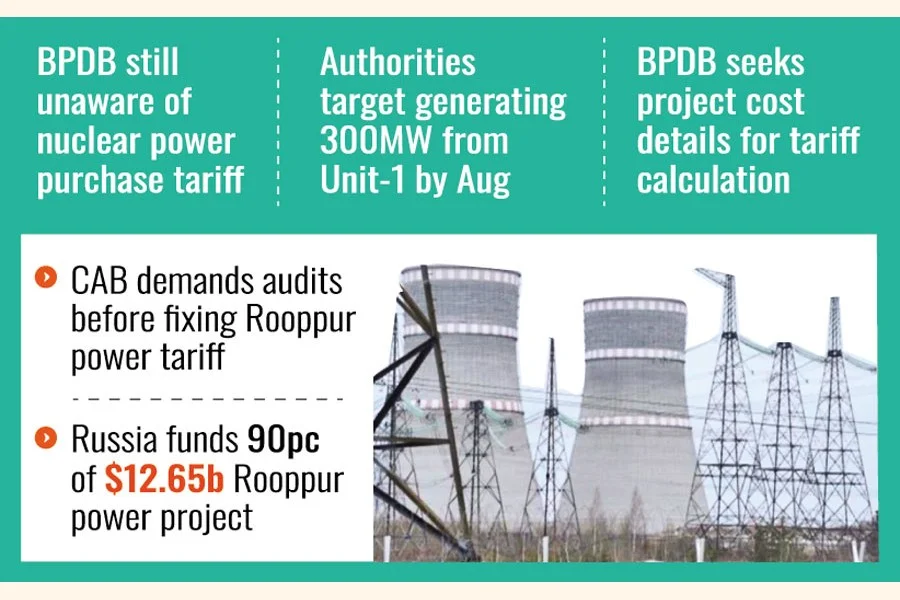
The lone buyer of electricity from the Rooppur Nuclear Power Plant (RNPP) is still unaware of the tariff it will have to pay for purchasing power from the country's first nuclear power facility.

"I don't have any information about how much the tariff of the RNPP will be," Chairman of the state-run Bangladesh Power Development Board (BPDB), Md Rezaul Karim, told The Financial Express (FE) on Tuesday.

The BPDB will be the sole purchaser of electricity generated by the Rooppur plant and will subsequently sell the power to different state-owned distribution companies.

Although the RNPP tariff has yet to be fixed and the overall costs remain undisclosed, authorities have started test operations of the plant after completing fuel loading on May 13.

The authorities aim to generate around 300 MW of electricity from Unit-1 of the RNPP by August.

"Despite repeated letters and queries to the Rooppur power plant authorities, we are yet to receive any information regarding the total project cost, operation and maintenance (O&M) expenses and other related costs, if any," the BPDB chairman alleged.

According to him, the BPDB has been trying for the past one and a half years to obtain information on the RNPP's costs to assess the tariff and determine whether the government will need to provide subsidies, as it does for many other power plants.

The RNPP tariff will be fixed as a bulk tariff, as the BPDB will purchase electricity directly from the plant authorities, he said.

"We also have not heard anything about the tariff of the RNPP," Chairman of the Bangladesh Energy Regulatory Commission (BERC) Jalal Ahmed told the FE on Tuesday.

He said the RNPP authorities have not yet submitted any proposal for fixing the nuclear power tariff. A public hearing may not be required to determine the tariff rate, according to the BERC chairman.

The BPDB chairman echoed the same view, saying that a public hearing may not be necessary because the RNPP is a cost-based project.

The tariff should be determined considering the plant's lifespan of around 60 years, he said.

Calculating the tariff based on a shorter lifespan could increase the tariff rate and place an additional subsidy burden on the government, he warned. The project director of the RNPP could not be reached for comment despite repeated attempts over the telephone.

When contacted, Consumers Association of Bangladesh (CAB) Energy Adviser Prof M Shamsul Alam called for forensic, technical and energy audits of the RNPP to uncover any irregularities and determine the project's actual cost before fixing the tariff. He also demanded that a detailed cost analysis of the RNPP be made public.

Alleging large-scale corruption in the project, he called for a proper investigation to identify and punish those responsible.

Only standard costs comparable to those of other nuclear power plants around the world should be considered when determining the tariff, he added.

Officials said Russia will supply fuel for the first three years under the existing contract. Thereafter, Bangladesh will have to import uranium to operate the Rooppur plant.

The RNPP has a design lifespan of 60 years, which can be extended by another 30 years through proper maintenance.

Financially, Rooppur is Bangladesh's largest single infrastructure project.

The plant's first unit is expected to enter commercial operation in January 2027, while full generation capacity of 2,400 MW from both units will be achieved after the second unit becomes operational.

The construction cost of the Rooppur project stands at US$12.65 billion, with Russia providing 90 per cent of the funding through a loan.

Construction of Unit-1 began on November 30, 2017, while work on Unit-2 started on July 14, 2018. Unit-1 was originally scheduled to begin operations in December 2022 and Unit-2 in October 2023.

However, the Covid-19 pandemic and payment-related complications arising from the Russia-Ukraine war delayed the commissioning of the project.​
 
Analyze

Analyze Post

Add your ideas here:
Highlight Cite Respond

IMED flags readiness gaps at RNPP
Faster coordination urged

JAHIDUL ISLAM

Published :
Jun 24, 2026 08:46
Updated :
Jun 24, 2026 08:46

1782276259164.webp


The Implementation Monitoring and Evaluation Division (IMED) has called for urgent coordination between the main Rooppur Nuclear Power Plant (RNPP) project and its four supporting projects, alongside faster procurement planning and the settlement of long-pending audit objections.

The planning ministry's monitoring agency has also recommended strengthening manpower deployment planning to ensure the timely commissioning and safe operation of the country's first nuclear power plant.

The recommendations were made in an IMED report following an inspection of the mega project.

Copies of the report were sent to the Ministry of Science and Technology, the Bangladesh Atomic Energy Commission (BAEC) and other relevant authorities, along with a set of observations and recommendations.

The inspection found that although the project had achieved 78.80 per cent physical progress and 74.29 per cent financial progress as of March 2026, several critical readiness gaps remain.

According to the Preliminary Safety Analysis Report (PSAR), the RNPP requires 2,090 personnel for the operation, maintenance and management of its two units.

However, the current staffing framework does not include personnel for the on-site fire station, security and physical protection division, and several service departments.

So far, 1,734 personnel have been recruited, including 1,636 technical staff. Of them, 1,290 have received training under the Russian general contractor framework, while 1,155 have been assigned to designated positions.

The report noted that the Russian contractor, Atomstroyexport, has not consistently provided the mandatory Level-2 annual work schedule since 2012, despite contractual obligations.

IMED observed that the absence of a detailed, time-bound work plan has hampered the monitoring of critical activities, procurement coordination and overall readiness planning for both units.

It recommended that the project office and the Ministry of Science and Technology take urgent steps to obtain a comprehensive manpower deployment plan, procurement schedule and materials supply plan from the contractor.

The inspection noted that Unit-1 has entered the advanced commissioning stage following fuel loading and is now progressing through phased start-up activities.

However, delays in earlier milestones have already pushed back the original commissioning target of December 2025.

The IMED review also assessed four supporting infrastructure projects linked to the RNPP, including off-site water supply, nuclear regulatory infrastructure, physical protection systems and external telecommunications networks.

Progress in these projects ranges from 40 per cent to 82 per cent, the report said, warning that uneven implementation of the support projects could affect operational readiness once the plant becomes fully operational.

The report also flagged 230 unresolved audit objections involving financial claims worth about Tk 295.6 billion, identified between 2017 and 2025. None of the objections has been fully resolved.

IMED urged the authorities to expedite the settlement process to ensure financial discipline and accountability in the project.

The monitoring agency further directed the project director to prepare a time-bound manpower deployment and procurement plan in coordination with Atomstroyexport, while ensuring stronger coordination between the main plant and its supporting projects.

The Ministry of Science and Technology has been asked to inform IMED within one month about the actions taken to implement the recommendations.​
 
Analyze

Analyze Post

Add your ideas here:
Highlight Cite Respond

US proposes civil nuke deal with Bangladesh
Diplomatic Correspondent 02 August, 2026, 23:55

1785714666901.webp

The United States has proposed a memorandum of understanding on civil nuclear cooperation with Bangladesh as an agreement to the effect expired much earlier.

The US made the proposal in meetings between the two sides during the three-day visit of US Special Envoy for South and Central Asia Sergio Gor to Bangladesh that concluded on Saturday, according to foreign ministry officials.

During the talks in Dhaka, Bangladesh also raised concerns over barriers to implementing the Agreement on Reciprocal Trade, urging Washington to address the challenges to facilitate smoother execution of the agreement signed between Bangladesh and the US just days before the end of the interim government’s tenure in February.

Speaking on condition of anonymity, a foreign ministry official said that the US proposed a MoU on civil nuclear cooperation during Sergio Gor’s meeting with foreign minister Khalilur Rahman.

The proposal was also raised during Sergio’s courtesy call on prime minister Tarique Rahman at the Prime Minister’s Office on Saturday, according to the official.

Despite repeated attempts, Khalilur Rahman could not be reached over phone for comment. He even did not respond to a text message over the matter.

The foreign ministry has not disclosed details of the proposed MoU.

Another official, however, described the initiative as ‘nothing new,’ noting that Dhaka and Washington signed a civil nuclear cooperation agreement in 1981, which was renewed in 1991.

Asked why a new MoU was necessary, the official said the renewed agreement had expired many years ago.

The proposed framework would provide a new legal mechanism to continue bilateral cooperation in the civil nuclear sector, the official explained, adding that the scope of civil nuclear cooperation could be broad, but its application would be strictly limited to peaceful civilian purposes.

According to the US State Department, a civil nuclear cooperation agreement provides the legal framework for countries to engage in the peaceful use of nuclear technology.

Such deals allow partners to transfer nuclear materials, equipment, reactors and technical information for electricity generation, scientific research and other civilian applications, while requiring compliance with stringent nuclear non-proliferation safeguards.

In the US, these accords are commonly known as ‘123 agreements,’ referring to Section 123 of the US Atomic Energy Act.

According to the US Department of Energy, as of July 11, 2025, the US had 26 civil nuclear cooperation agreements in force, governing ‘peaceful nuclear cooperation’ with 50 countries.

During the meeting with Sergio, Bangladesh raised concerns over barriers to implementing the ART, urging Washington to address the challenges to ensure smoother implementation of the agreement.

Speaking on condition of anonymity, a foreign ministry official said that Bangladesh was fully implementing its commitments under the ART but continued to face several obstacles.

According to the official, Bangladesh told the US side that the primary objective of the ART was to reduce the bilateral trade imbalance.

The requirement for B1 and B2 visa applicants to post a US$20,000 bond was, however, raised to the US side as a barrier to the execution of the agreement, foreign ministry officials said.

‘We said this requirement effectively acts as a para-tariff measure. It discourages Bangladeshi businesspeople and tourists from travelling to the United States, which could disrupt trade and commercial ties. We requested the US side to reconsider the visa bond requirement,’ the official said.

Sergio’s visit was primarily aimed at strengthening bilateral trade and business relations, according to the officials.​
 
Analyze

Analyze Post

Add your ideas here:
Highlight Cite Respond

Rooppur Nuclear Power Plant: Faulty safety valves delay electricity supply to national grid, says Minister

Staff Correspondent
Dhaka

1788478528981.webp

Science and Technology Minister Fakir Mahbub Anam briefs journalists at ICT Tower on 3 September Prothom Alo

Science and Technology Minister Fakir Mahbub Anam has said the timeline for starting power supply from the first unit of the Rooppur Nuclear Power Plant to the national grid is being pushed back due to problems with safety valves.

The minister could not provide a specific timeline for when the safety valve problems would be repaired or when the first unit would begin supplying electricity to the national grid.

He made the remarks at a press conference at ICT Tower in Agargaon, Dhaka, on Thursday afternoon. The press conference was organised to highlight the major achievements of the Ministry of Posts, Telecommunications and Information Technology and the Ministry of Science and Technology during the BNP government’s first 180 days.

Fakir Mahbub Anam said preparatory tests began on 28 April at the plant’s first unit ahead of fuel loading. At that stage, the target was to begin supplying electricity to the national grid within four to six months. Tests have now been completed through several stages, with Stage B completed. However, the plant cannot proceed to Stage C because of problems with two safety valves.

Asked when repairs to the safety valves would be completed and when commissioning of the first unit would begin, the minister could not provide a specific date.

“We cannot say anything specific at this moment. A team of experts will come from Russia to determine why the safety valves are not working. The actual cause of the problem will be known after their examination and assessment,” he said.

The minister said the project designer’s assessment indicated that the two safety valves might need to be completely replaced. Two options are being considered. One is to take the valves allocated for the second unit and install them in the first unit. The other is to ask the Russian vendor to manufacture and supply new valves as quickly as possible.

The minister said whichever option is faster and more practical would be chosen.

At the press conference, Fakir Mahbub Anam also said discussions were under way with mobile operators on allowing customers to use the value of unused mobile data even after a data package expires.

He said they had discussed with operators whether customers could be given an additional one or two days to use their remaining data after the package expires.

Also present at the press conference were Prime Minister’s Adviser for Posts, Telecommunications and Information Technology Rehan Asif Asad and ICT Division Secretary Md Mamunur Rashid Bhuiyan.​
 
Analyze

Analyze Post

Add your ideas here:
Highlight Cite Respond

Bangladesh seeks IAEA support for Rooppur power supply
Bilateral meeting held between Bangladesh’s minister for Science and Technology and IAEA director general

1789701804472.webp


A bilateral meeting was held between the Director General of the International Atomic Energy Agency (IAEA), Rafael Mariano Grossi, and a Bangladesh delegation led by the Minister for Science and Technology, Faqir Mahbub Anam, MP, in Vienna, Austria.

The meeting took place on Thursday at the IAEA Headquarters in Vienna.

During the meeting, Science and Technology minister sought the cooperation of the IAEA director general to expedite the supply of electricity generated by the Rooppur Nuclear Power Plant in Bangladesh to the national grid.

Discussions also covered various issues related to expanding the peaceful uses of nuclear technology, strengthening nuclear safety, and enhancing international cooperation.

Minister Faqir Mahbub Anam expressed his sincere gratitude to IAEA Director General Rafael Mariano Grossi for his role in promoting the peaceful uses of nuclear technology and strengthening international cooperation.

Bilateral meeting also focused on enhancing mutual cooperation between Bangladesh and the IAEA and further strengthening Bangladesh’s capacity in the peaceful applications of nuclear science and technology through human resource development.

Science minister said that Bangladesh has been benefiting from the IAEA’s technical cooperation programme for more than five decades in various important sectors, including health, agriculture, food, water management, industry, and energy.

He noted that Bangladesh had recently signed the Country Programme Framework (CPF) for 2026–2032, which would create new opportunities for technical cooperation in the coming years.

Referring to the Rooppur Nuclear Power Plant as a historic milestone in Bangladesh’s energy security, minister said that Bangladesh had achieved significant progress towards carbon-free electricity generation through fuel loading in Unit-1. This development has opened up new opportunities to meet the country’s growing electricity demand, ensure energy security, and address climate change.

He stated that Bangladesh remains committed to maintaining the highest international standards in nuclear safety, security, and responsible management.

He noted that Bangladesh’s accession to the Joint Convention on the Safety of Spent Fuel Management and on the Safety of Radioactive Waste Management as the first country in South Asia reflects the country’s commitment to implementing a safe and responsible nuclear programme.

During the meeting, minister Anam expressed his sincere gratitude to IAEA Director General Rafael Mariano Grossi and the leadership of the IAEA Secretariat for their efforts in advancing the “Rays of Hope: Cancer Care for All” initiative.

He said that Bangladesh joined the “Rays of Hope” initiative in 2025 and has been working closely with the IAEA to translate this partnership into effective programmes at the national level. One of the key priorities is the establishment of an integrated, one-stop cancer care centre, which would facilitate more coordinated, accessible, and patient-centred healthcare services.

Faqir Mahbub Anam said that IAEA technical cooperation is of immense importance to Bangladesh in strengthening capacity, facilitating knowledge exchange, and developing a sustainable cancer care system. He emphasised the need to further strengthen cooperation under the “Rays of Hope” initiative to expand access to cancer treatment in Bangladesh.

Faqir Mahbub Anam stated that Bangladesh is looking forward to the IAEA–WHO–IMPACT Review Mission, scheduled to take place in November 2026.

He said that the mission would provide an important opportunity for an evidence-based assessment of Bangladesh’s national cancer control capacity and for identifying practical priorities in various areas of cancer care.

Emphasising the importance of bringing the benefits of science and technology to the doorsteps of the people, Minister said that the application of nuclear technology should not be limited to technological advancement alone but should also contribute to improving people’s quality of life, enhancing climate resilience, increasing agricultural and food productivity, and expanding healthcare services.

He further stated that creating new opportunities for young researchers and scientists, promoting research and innovation, and enhancing knowledge and technological capacity through international cooperation are among Bangladesh’s priorities. Minister called upon the IAEA Director General to expand opportunities for international education, training, fellowships, and joint research for students, scientists, and researchers.

The Minister for Science and Technology said that the government’s goal is to establish a more integrated, equitable, and sustainable cancer care system in Bangladesh so that the benefits of nuclear science and technology can reach those who need them most. He expressed his firm commitment to working closely with the IAEA and its partners to translate the commitments of the “Rays of Hope” initiative into tangible and lasting benefits for the people of Bangladesh.

Minister called for further deepening international cooperation through the IAEA in promoting the peaceful uses of nuclear technology, strengthening nuclear safety, and advancing sustainable development.

Among those present at the meeting were Md. Anowar Hossain, Secretary, Ministry of Science and Technology; Tofique Hasan, Ambassador and Permanent Representative of Bangladesh to the United Nations and other international organisations in Vienna; Dr. M. Moinul Islam, Chairman, Bangladesh Atomic Energy Commission; and Sheikh Mohammad Towhidul Islam, Joint Secretary of the science ministry.​
 
Analyze

Analyze Post

Add your ideas here:
Highlight Cite Respond

Work underway to supply 300MW to national grid within next month: Russian Ambassador

Staff Correspondent
Dhaka

1789704812018.webp

Russian Ambassador to Bangladesh Alexander Khozin made the remarks during a courtesy meeting with FBCCI administrator Fazlul Hoque. 16 September, 2026. Courtesy of FBCCI

Work is progressing with the target of supplying 300 megawatts of electricity from the Rooppur Nuclear Power Plant to the national grid within the next month, said the Russian Ambassador to Bangladesh Alexander Khozin.

He made the remarks on Wednesday during a courtesy meeting with Fazlul Hoque, administrator of the Federation of Bangladesh Chambers of Commerce and Industry (FBCCI) at the organisation’s Gulshan office in Dhaka, according to an FBCCI press release.

The meeting also discussed progress on the Rooppur Nuclear Power Plant project.

Khozin said that around 4,000 Russian specialists and engineers are working tirelessly to resolve the project’s technical issues as quickly as possible.

He further stated that the Moscow Chamber of Commerce and Industry has expressed interest in forming a joint "Russia-Bangladesh Business Council" to further intensify and expand trade, investment and economic cooperation between Bangladesh and Russia.

They also have plans to organise a Russia-Bangladesh Business Forum in Moscow, he said.

The Russian ambassador said that an official announcement on this matter may come during the inter-governmental commission meeting scheduled to be held in Dhaka early November.

He said the forum is being organised in Moscow to facilitate direct communication between entrepreneurs from the two countries. Various sessions, including direct business-to-business (B2B) meetings will be arranged based on the profiles of participating businessmen from Bangladesh.

At the meeting, FBCCI Administrator Fazlul Hoque called for greater focus on new and promising sectors alongside the readymade garment sector to boost bilateral trade.

He placed particular emphasis on exporting human resources to Russia, along with pharmaceuticals, leather and leather goods, jute and jute products and ceramics.

The Russian ambassador said the Russian Ministry of Health is already reviewing procedural and legal issues concerning the import of generic medicines from Bangladesh.

He added that there are also strong demand for heavy footwear and leather goods suitable for Russia’s severe winter.

Khozin further said Russia had issued visas to around 3,000 Bangladeshi workers in recent months as employment opportunities had emerged in agriculture, fisheries, shipbuilding and service sector.​
 
Analyze

Analyze Post

Add your ideas here:
Highlight Cite Respond

Latest Posts

Back
 
G
O
 
H
O
M
E