Home Watch Videos Wars Movies Login

[🇧🇩] Corruption Watch

[🇧🇩] Corruption Watch
348
12K
More threads by Saif

G Bangladesh Defense

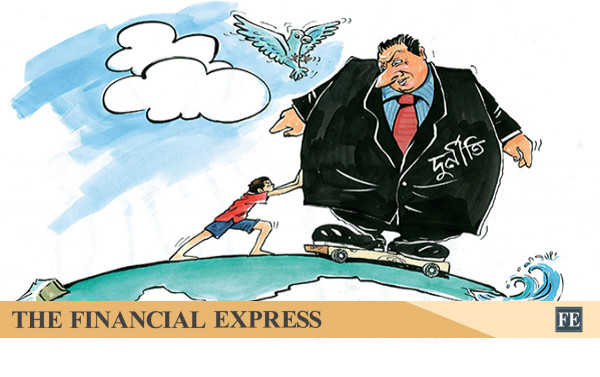
Loan defaulters should be in jail, not parliament

Atiqul Kabir Tuhin
Published :
Jan 21, 2026 23:58
Updated :
Jan 21, 2026 23:58

1769042913041.webp


The remark of an election commissioner that the loan-defaulting candidates were being validated ‘with a heavy heart’ speaks volumes for the Commission’s predicament in the absence of a robust legal mechanism and decisive political backing, writes Atiqul Kabir Tuhin

Non-performing loans (NPLs) in the country’s banking sector have surged to an unprecedented Tk 6.44 trillion as of November 2025, accounting for a staggering 35.7 per cent of total outstanding loans. This is the highest NPL ratio recorded in the country in the past 25 years. Reports also suggest that Bangladesh now has the highest NPL ratio in the world. No other country, not even economies battered by war or prolonged recession, is currently reporting an NPL ratio above 30 per cent.

This colossal accumulation of bad loans, and their continued rise, is exerting heavy pressure on the entire financial sector and raising concerns about the overall health of the economy. A number of banks are grappling with huge deficit in their balance sheets, which have severely weakened their lending capacity and pushed up borrowing costs. The situation is also undermining investor confidence and, more worryingly, exposing depositors and the broader macro-economy to heightened risk. The current NPL crisis is therefore not merely a banking sector problem; it is fast becoming a threat to economic stability that demands urgent attention.

Against this backdrop, it is disheartening that at least 45 loan defaulters are going to contest in the upcoming elections, scheduled for February 12. Under the Representation of the People Order (RPO), a loan defaulter is not eligible to contest in the election. Although the Election Commission had initially scrapped the nominations of 82 parliamentary election aspirants for loan default, 45 of them have managed to stay in the race after securing court stay orders on their default status.

It is evident that loan defaulters are approaching the High Court without repaying their dues and filing writ petitions that drag on for years. A stay order then allows them to enjoy the same privileges as any other citizen until the case is finally disposed of.

Earlier, the high-ups of government had spoken of taking a tough stance against allowing loan defaulters to contest elections. Bangladesh Bank Governor Dr Ahsan H Mansur said that steps would be taken to ensure that even those who obtained stay orders would not be allowed to participate. Finance Adviser Dr Salehuddin Ahmed also said loan defaulters would not be given the opportunity to run. But in reality these commitments have not been reflected in practice. The Election Commission, too, has appeared helpless. The remark of an election commissioner that the loan-defaulting candidates were being validated ‘with a heavy heart’ speaks volumes for the Commission’s predicament in the absence of a robust legal mechanism and decisive political backing.

In the case of a Chattogram-based candidate who reportedly defaulted on a loan amounting Tk 11.42 billion from 19 banks and financial institutions, the Commission merely requested that he repay the loans. The question, however, is whether such ‘requests’ will carry any weight, or whether these candidates, once elected, will be further emboldened to evade repayment and shield themselves from accountability.

Given the scale of bad loans in the financial sector, a strong and effective Artha Rin Adalat system is imperative. Regrettably, however, the law ministry has recently turned down the central bank’s proposal to prepare a new Artha Rin Adalat. The Ministry instead suggested updating the existing law through necessary amendments. It is worth mentioning that successive political governments have not strengthened the money loan courts for various reasons. It was therefore hoped that the interim government would take a decisive action, but it too has failed to live up to that expectation.

Money Loan Courts have for long been suffering due to acute manpower shortages, resulting in a massive backlog of cases involving billions of taka. According to the report of the Task Force on Economic Reforms, as of February 2024 more than Tk 1.78 trillion was stuck in over 72,500 cases pending before money loan courts. The report identified the huge backlog under the Money Loan Court Act and the Bankruptcy Act as a major obstacle to loan recovery. Structural flaws in the Artha Rin Adalat Ain 2003, a low judge-to-population ratio and inadequate courtroom facilities continue to hinder the timely disposal of NPL-related cases.

Experts have therefore called for reforms to enable Money Loan Courts to function effectively. They suggest increasing the number of courts, appointing more judges, lawyers and support staff, and ensuring their regular presence. At the same time, many called for introducing a specific timeframe for disposing of cases. When defaulters see that even writ petitions are resolved within two to three months, they will no longer be able to exploit delays as a strategy.

Then again, the Artha Rin Adalat Ain itself requires reform to make recovery efforts more efficient. Defaulters routinely exploit legal loopholes to stall repayment. It has repeatedly been observed that they obtain stay orders from Higher Courts against the verdict of Money Loan Court only to keep the cases suspended for years. Experts have suggested introducing a provision requiring borrowers to deposit a certain portion of their outstanding loan before filing writ petitions against Money Loan Court orders. Such a measure could help curb abuse of the legal process and strengthen the culture of repayment.

The banking sector is the backbone of Bangladesh’s economy, and the country can no longer afford to carry the burden of mounting defaulted loans. Strengthening the Money Loan Courts and closing loopholes in the legal framework are now paramount for restoring discipline, credibility and public trust in the banking sector. As Bangladesh moves towards LDC graduation, the resilience and credibility of its banking system will determine its future growth trajectory.​
 
Analyze

Analyze Post

Add your ideas here:
Highlight Cite Respond

Bankers push for travel bans, public shaming of loan defaulters

Published :
Jan 28, 2026 21:00
Updated :
Jan 28, 2026 21:00

1769646518326.webp


Bangladesh’s top bankers have urged regulators to impose tougher restrictions on chronic loan defaulters, including overseas travel bans, public disclosure of identities and exclusion from trade body elections, as the country struggles with a mounting bad-loan crisis.

The Association of Bankers, Bangladesh (ABB), which represents managing directors of commercial banks, has submitted a set of proposals to Bangladesh Bank aimed at accelerating cash recovery and curbing what it described as a growing ‘default culture’, UNB reports.

The recommendations were conveyed to the central bank following a meeting with Governor Dr Ahsan H Mansur on November 12, according to a letter signed by ABB Chairman and City Bank Managing Director Mashrur Arefin.

Under the proposal, habitual defaulters would be barred from travelling abroad without explicit permission from a court or the lending bank.

Banks would also be authorised to publish the names and photographs of defaulters in mass media, while individuals with unpaid loans would be disqualified from contesting elections of business and trade associations.

The measures are part of what the ABB described as ‘shaming’ and restrictive tactics designed to force delinquent borrowers to repay outstanding loans in cash.

To speed up balance-sheet clean-ups, the bankers also proposed simplifying the loan write-off process in line with international standards and easing conditions for interest waivers in cases involving death, terminal illness or natural disasters.

The ABB further outlined a series of incentives to facilitate faster disposal of mortgaged assets through auctions.

These include withdrawing income tax and VAT on properties sold or purchased through bank auctions, removing the requirement for Deputy Commissioner’s approval and ensuring full cooperation from Sub-Registrars’ offices.

The bankers also called for automatic, cost-free mutation of land ownership in favour of banks following court orders under Section 33(7) of the Money Loan Court Act.

Turning to legal issues, the Association suggested that the country’s top court should refrain from issuing stay orders on Credit Information Bureau (CIB) reports unless borrowers make a substantial down payment.

It also recommended extending the maximum period of civil detention for defaulters from six months to as long as seven years, depending on the size of the loan.

“The true picture of defaulted loans is finally emerging since the fall of the previous government,” bankers said, pointing to what they described as a longstanding practice of underreporting bad debts.

As of September, as per banking sector data, the country’s total disbursed loans rose to Tk 18,03,840 crore, of which approximately Tk 6.5 lakh crore were classified as defaulted, representing a default rate of 35.73 percent, according to banking sources.

The ABB’s proposals now await consideration by the central bank, as policymakers weigh tougher enforcement against these concerns over legal safeguards and economic recovery.​
 
Analyze

Analyze Post

Add your ideas here:
Highlight Cite Respond

Sink or swim

Why controlling corruption will decide the fate of the next government


MG Quibria
Published :
Jan 31, 2026 23:51
Updated :
Jan 31, 2026 23:51

1769906781080.webp


Bangladesh has a troubled relationship with corruption. Since independence, it has been an enduring feature of public life-shaping institutions, distorting economic outcomes, and steadily eroding public trust. While corruption has long been widespread, systematic evidence from both domestic and international sources has confirmed its persistence.

Data from Transparency International's Corruption Perceptions Index (CPI) shows that the early 2000s marked the nadir of corruption. Between 2001 and 2005, Bangladesh ranked as the most corrupt country in the world. Corruption during this period was widely described as endemic and all-pervasive, penetrating virtually every arm of the state.

Some improvements in ranking took place in the mid-2000s and early 2010s. Governance reforms and tighter macroeconomic management coincided with modest gains, particularly in financial oversight. The banking sector's non-performing loan ratio, which stood at around 35 per cent in 2000, declined over time, falling to 6.1 per cent by 2011. These trends suggested partial progress, though deep structural weaknesses remained.

Between roughly 2012 and 2022, corruption appeared broadly stable-but at a high plateau. Bangladesh's CPI score hovered between 25 and 28, reaching its highest-ever level of twenty-eight, yet the country still ranked among the more corrupt globally. That stability proved illusory. From 2017 to 2024, corruption indicators deteriorated sharply. In 2024, Bangladesh scored just 23 out of 100-its lowest score in 13 years-and fell to 151st out of 180 countries, ranking near the bottom in South Asia.

Importantly, these indicators capture mainly public-sector corruption. They do not reflect private- and corporate-sector malfeasance-such as money laundering, tax evasion, and illicit financial flows-areas where recent evidence suggests Bangladesh has become disturbingly prominent. In other words, measured corruption, as reflected in CPI indices, understates the true scale of the problem in the country.

These trends matter because corruption in Bangladesh is no longer just a moral issue or a collection of individual abuses. It has become a structural constraint-one that shapes how the economy grows and, more importantly, who benefits from that growth.

This is happening despite Bangladesh's development gains. Over the past two decades, the economy has gradually climbed the development ladder: poverty has decreased, and a segment of the population has moved into the lower middle class. However, alongside these advancements, inequality has widened, institutional trust has eroded, and frustration-particularly among younger, more educated citizens-has intensified. Corruption lies at the heart of these contradictions.

One of the most damaging channels is investment. In Bangladesh, access to bank credit, public contracts, land, licenses, and regulatory leniency has often depended less on economic or commercial viability than on political or bureaucratic proximity. Resources are diverted from the most productive firms to the most connected ones. Entrepreneurs invest in cultivating influence rather than upgrading technology, improving management, or training workers. Corruption, in effect, acts like an unpredictable tax on business, depressing productive investment and long-run growth.

This distortion helps explain why productivity growth outside a few sectors, most notably the garment sector, has remained sluggish. When competition is blunted and inefficient firms are protected, the incentive to innovate disappears. Over time, this lowers Bangladesh's growth potential and blocks diversification into higher-value activities.

Corruption also weakens the state's ability to raise and use public resources. Bangladesh's tax-to-GDP ratio remains among the lowest in the world for a country at its income level, and recent studies suggest it has stagnated or even declined in real terms. Exemptions, under-assessment, negotiated settlements, and selective enforcement allow powerful actors to opt out of the tax system. The burden then shifts to indirect taxes, which fall disproportionately on ordinary consumers.

The consequences are visible. Persistent underinvestment in health, education, and social protection has steadily degraded the quality and reach of public services. Even when budgets increase, leakage and rent-seeking dilute their impact. For poorer households, this means weaker schools, poorer health care, and higher out-of-pocket costs-direct channels through which corruption deepens inequality.

Perhaps most corrosive is the way corruption acts as a gatekeeper to opportunity. In Bangladesh, access to public-sector jobs, subsidized credit, urban land, or regulatory relief often hinges on who one knows rather than what one can do. Families with political or bureaucratic connections secure advantages denied to others. Over time, income and wealth reflect proximity to power rather than effort or skill, eroding social mobility and fueling resentment.

The banking sector illustrates the macroeconomic risks. Newspapers are full of reports that politically connected borrowers have repeatedly received large loans without adequate oversight, contributing to persistently high non-performing loans, especially in state-owned banks. It crowds out credit to small and medium enterprises, weakens financial discipline, and creates fiscal vulnerabilities. Growth built on distorted finance is inherently fragile.

All of this would be serious in any era. But it is becoming more dangerous because the global environment is less forgiving. Official development assistance fell in real terms in 2024, marking a notable reversal after several years of increases. In addition, Bangladesh is facing harsher aid conditions as it moves up the income ladder. Global trade is also facing rising uncertainty and a more demanding compliance environment, with the World Bank and World Trade Organization (WTO) highlighting the risks from escalating trade tensions, trade barriers, and policy uncertainty. And remittances-now one of the most critical external inflows for many developing economies-face headwinds as host countries tighten labor markets and migration regimes, and the specter of artificial intelligence (AI) looms large in receiving countries. Bangladesh can no longer rely on external cushions to offset domestic inefficiencies. Growth will increasingly depend on domestic productivity, credibility, and trust-precisely what corruption erodes.

This context also exposes the emptiness of the familiar refrain from politicians of different stripes that Bangladesh can "become Singapore" by cherry-picking this policy or that. The most relevant lesson from Singapore is not simply technocratic competence, sector-picking, or infrastructure. It is the country's transformation under a hard institutional bargain: corruption was made difficult, risky, and unrewarding.

In 1965, Singapore began as a small, resource-scarce, vulnerable city-state. Yet within a generation, it became one of the world's richest economies on a per capita basis. That transformation was underpinned by credible corruption control: a specialized agency with a deterrent stance, and a system designed to minimize cover-ups and enforce rules predictably. Investors put money into productivity because proximity to power was not the primary path to profit.

Bangladesh does not need to replicate Singapore's political system or scale. But it must internalize the core lesson: growth and equality improve when corruption is credibly constrained. Without that constraint, industrial policy becomes rent distribution, finance becomes patronage, and regulation becomes bargaining-what political economists such as Acemoglu and Robinson describe as extractive institutions.

For Bangladesh's next government, the message is stark. Controlling corruption is not a slogan, nor a peripheral reform. It will determine decisively whether the government swims or sinks. Anti-corruption efforts must focus on reducing discretion, strengthening enforcement, restoring tax compliance, and protecting institutions that investigate and expose wrongdoing.

The clearest test of seriousness is how the anti-corruption agency is wielded. When it chases the misdeeds of past regimes while ignoring corruption unfolding in real time, it stops being an institution of justice and becomes a tool of political score-settling. Corruption is not a historical artifact; it is an active disease. Public trust will be restored only when enforcement is relentless, even-handed, and present-focused-when today's abuses are pursued as aggressively as yesterday's.

Corruption control may not deliver instant results. But failure to act will impose rising economic, fiscal, and political costs in a world that is far less forgiving than before. For the next government, corruption is the defining test-determining whether Bangladesh moves forward or slips back-and Singapore's experience offers the clearest lesson: without credible control of corruption, growth, fairness, and trust cannot last.

M G Quibria is a development economist whose work examines development policy, trade, and institutional reform.​
 
Analyze

Analyze Post

Add your ideas here:
Highlight Cite Respond

Anti-corruption drives fail, not inevitably but deliberately

Iftekharuzzaman

Corruption is too insidious a menace to be controlled by ad hoc, pick-and-choose measures, the way chronic cancer cannot be helped by some selected painkillers. Our successive governments have been high on rhetoric against corruption, but low on delivery, and efficient in enabling and protecting it by piecemeal and frivolous measures, making a mockery of the purpose. In the process, the state was transformed into Kleptocracy during the last sixteen years since 2009. Public expectation was high of the Interim Government (IG) that it would initiate the much-needed strategic, legal, and institutional foundations against corruption that their successor regimes would carry forward. It has been just the opposite.

The IG will be remembered for unprecedented ad hoc-ism in governance, lacking a strategic approach, that created numerous counterproductive legal and operational risks contradictory to the core mandate of state reform in general and anti-corruption in particular. Too often, the IG allowed itself to be held hostage to internal resistance as well as forces that it considered to be its powerbase, and thereby damaged the prospects of unprecedented opportunities created towards fundamental reform against corruption. In whatever reform measures they have picked and chosen, they have created self-defeating loopholes, often by design.

Specifically, in nearly every Ordinance that the IG has enacted, there are clear evidence against the true spirit and objective of the IG’s own mandate of state reform. The Police Commission Ordinance, for instance, is just an eyewash for police reform that will be no more than a rehabilitation resort for retired civil bureaucrats and police officials who will hold the key to sabotaging its stated purpose.

An otherwise excellent National Human Rights Ordinance has been stabbed in the back by conspiratorially inserting a provision to ensure bureaucratic control in its formation, shattering the dream of an independent and effective commission. The Ordinances enacted under the IG related to cyber security, digital space, personal data protection, and data management have ensured mutually reinforcing, unaccountable surveillance power in the hands of the government and relevant agencies to enable targeted violation of the right to privacy, free media, dissent, and civic space. Aspirations of an effective and accountable Anti-Corruption Commission (ACC), parallel with independence, have been sabotaged.

It should be recalled that the transformation of an elected government into authoritarian Kleptocracy during 2009–2024 was primarily an outcome of the regime’s hunger and design to unaccountably abuse power. All forms of abuse of power, including corruption, were facilitated and granted impunity by politically biased, professionally bankrupt, and dysfunctional state institutions. State power was captured by kleptocratic syndication. In order to sustain authoritarian control, various repressive measures were adopted and systems were created not only to plunder public resources, including illicit transfers out of the country, but also for widespread, multi-dimensional, and often ruthless violation of human rights and deprivation of people’s access to justice.

The state itself, in cohort with other state institutions like law-enforcement agencies, civil-military bureaucracy, security agencies, and judiciary, was deeply politicised and used with the same purpose of reinforcing kleptocratic control of the state structure. It was most appropriate, therefore, that the Interim Government (IG), that was entrusted with the responsibility to create the foundations of state reform, the main aspiration of the historic July movement, selected ACC reform among the first six reform commissions to be set up. But just that much.

The IG has not done anything substantive about the recommendations they collected from the ACC-Reform Commission (ACC-RC), as well as from the other 10 Commissions, with a commitment to implement them “urgently” by executive authority and in collaboration with the relevant institutions, ACC in this case. The ACC itself has also been complicit and even catalytic in this failure. Soon after the ACC-RC report was launched, the ACC at its top level confirmed their unqualified endorsement of all 47 recommendations. Both the ACC and the IG also knew that in the national consensus negotiations nearly all political parties endorsed almost every ACC-RC recommendation.

As the only stakeholder formally involved with the IG in the drafting process of the Ordinance to amend the 2004 Act, the ACC colluded with the forces of resistance in the government that took control of the reform process and conspiratorially prevented the inclusion of the provision to create the independent Review Committee to ensure accountability of the ACC. Parallel with ACC’s full independence, including its internal governance and financial autonomy, this provision was proposed to enable ACC’s accountability through periodic review, public hearing, and reporting on which allegations of corruption have been selected for action, on what basis, and which have not, and why.

At an advocacy meeting held on November 19, 2025 involving the relevant Adviser and other stakeholders, including the ACC and relevant senior bureaucrats, everyone was persuaded about the strategic importance of the provision and agreed to retain it. However, subsequently, the joint ACC–bureaucracy forces of resistance prevailed, and the provision was finally dropped. The Cabinet of Advisers gave in, as some influential Advisers acquiesced. This showed that, despite being perceived to have no political bias or ambition, the IG succumbed and in fact upscaled the long-sustained governance deficit for which bureaucracy determines what the Cabinet Ministers (Advisers) approve. This is also just one example of how the reformist government acted against reform and set the precedent for future political governments to undermine the blood-written July Charter.

1770600112032.webp


Just to mention a few more examples of lost opportunity, despite the ACC-RC’s specific recommendation, the ACC has failed to take any initiative yet to cleanse itself of officials who are highly corrupt, by the ACC’s own confession. Similarly, nothing has been done about the proposed independent Internal Discipline Division to ensure accountability and integrity within. Nor has it shown any interest in working with the Government to implement recommendations for its full operational and financial independence, including the proposed package of positive and negative incentives for the ACC staff.

Another strategic and highly important recommendation that has been sidelined is to relieve the ACC from the clutches of deputed bureaucrats as the senior-most officials after the Commission, which has been the dominant factor over the years behind failure to act against corruption of bureaucrats and anyone associated with the ruling authority. Without ensuring the ACC-RC-prescribed upper limit of deputed bureaucrats to senior positions in the ACC, especially from administrative service, the aspiration of an operationally neutral and effective ACC will remain a pipe dream. Equally ignored are a number of other recommendations, like end-to-end automation of the ACC’s overall operations, especially complaint management, investigation, undercover inquiries, and prosecution.

While these are only some of the items that both the Government and the ACC have failed to implement “immediately” as promised after the report was released, furthermore, the Government and the ACC have refrained from taking any initiative regarding the package of recommendations to build the collective strength of the key institutions of democracy and accountable governance, without which even an ideally powerful, independent, and accountable ACC cannot deliver truly effective corruption control. These are related to the corruption-friendly politico-governance eco-system that has evolved over the years, and was taken to a Kleptocratic level during 2009–2024.

A National Anti-Corruption Strategy (NACS) must be adopted through a participatory and inclusive process specifying the anti-corruption roles and responsibilities of various State and non-State institutions. NACS should include the Legislature, Executive, Judiciary, Public sector, Law enforcement, Election Commission, Ombudsman, Audit institution, Anti-corruption Commission, Local Government, Political Parties, Media, Civil society, and Corporate Sector. An Office of Ombudsman should be established, empowered to ensure oversight and reporting, including comparative naming and shaming of the institutions on performance under NACS.

A specific law should be enacted to permanently abolish the practice of legalising black money. A specific legal framework needs to be created to resolve and prevent conflict of interest of power-holders and public-interest-related decision-makers at various levels. To prevent large-scale swindling of public money and property by banks and financial institutions, a beneficial ownership transparency law must be enacted, particularly applicable to ownership of companies, trusts, or foundations. Data on such beneficial ownerships must be publicly accessible through a Beneficial Ownership Register.

1770600131035.webp

VISUAL: SHEIKH SULTANA JAHAN BADHON

Robust and strictly enforceable legal provisions must be created to ensure transparency and integrity in political and electoral financing. It should specifically make it obligatory for public representatives of all levels to submit annually updatable itemised income and asset statements of themselves and their family members soon after taking office, which should be published on the Election Commission website for public scrutiny. Private sector bribery must be criminalised, consistent with Bangladesh’s commitment under the UN Convention against Corruption. To ensure transparency of financial transactions at home and abroad as a means to prevent tax evasion and illicit financial transfers, including money laundering, Bangladesh must accede to the Convention on Mutual Administrative Assistance in Tax Matters and implement the Common Reporting Standard. Bangladesh should join the Open Government Partnership to facilitate adoption of international best practices in transparent governance in the public, private, and non-government sectors. We also need a comprehensive set of preventive measures against corruption, including a short-, medium-, and long-term action plan to creatively and innovatively communicate to the people at large and the new generation the narrative that corruption is not only a punishable crime but also a socially, culturally, and religiously unacceptable, destructive, and discriminatory scourge.

The victory of the July movement marked the fall of the kleptocracy, but whether it will eventually transform into a true exit from kleptocracy and enable a genuine transition towards effective corruption control will depend on the commitment and capacity of reform leaders among the power-holders now and after elections, and their capacity to overcome ad hoc-ism and forces of resistance. It will depend on whether the true spirit of the July Movement is mainstreamed in the political and governance eco-system of Bangladesh. Much will depend on whether the political forces, the key power-holders, and bureaucracy, the prime agent of the executive authority, can overcome the state of being hostage to the “our turn” syndrome.

Iftekharuzzaman is the Executive Director of Transparency International Bangladesh (TIB).​
 
Analyze

Analyze Post

Add your ideas here:
Highlight Cite Respond

Tax terrorism

Unless taxpayers and tax collectors work together to achieve the goal of revenue for the development, tax terrorism will continue to thrive, writes Ahmed Munirus Saleheen

THIS is for perhaps for the first time we have heard a new expression with regard to taxation in Bangladesh: tax terrorism. Recently, in an investment dialogue organised by the Bangladesh Investment Development Authority, a prominent business leader raised his voice against ‘tax terrorism.’Bangladesh cultural tours

Although various elements of tax terrorism encourage corruption in the tax system, tax corruption and ‘tax terrorism’ are not synonymous. ‘Tax terrorism’ is a bureaucratic process within a legal framework, which is characterised by the abuse of power, especially excessive discretionary power of tax officials, policy unpredictability, discriminatory application of law, and overly aggressive enforcement of the rules. In this, there is a shift from a supportive regulatory environment to one characterised by fear and coercion.

While it is generally detested by taxpayers, for the tax authorities, it may mean a tool for better tax compliance and, hence more revenue. ‘Tax terrorism’ thus may be seen as a ‘reaction’ rather than an ‘action’. For, the tax authorities appear to use the process in response to problems such as reluctance to comply with tax obligations, tax evasion and tax avoidance. In Bangladesh, one trigger for ‘tax terrorism’ is the pressure to achieve higher tax revenue targets compared to the existing revenue potential and capacity.

It is a big paradox in the tax system of Bangladesh that on one side there are allegations of tax terrorism and on the other side there is a pathetic picture of tax-GDP ratio. According to the chairman of the National Board of Revenue, the tax-GDP ratio has decreased from 7.4 per cent in the previous year to 6.6 per cent this year. Narrow tax base compared to GDP, unsatisfactory tax compliance situation, tax evasion, widespread tax exemption, weakness of tax-revenue management and corruption, etc are broadly identified as the reasons for the low tax-GDP ratio.

Persons with the knowledge of Bangladesh taxation system would admit that the elements of ‘tax terrorism’ are strongly present in the tax system of Bangladesh. One example of policy driven-discrimination is the provision for whitening black money in the Income Tax Act. This scheme allows an individual to legalise undeclared assets by paying a nominal 15 per cent tax, while honest taxpayers have to face a rate of up to 30 per cent. Many, including the World Bank and Transparency International Bangladesh, have called it a corruption-enhancing and discriminatory provision. Another such provision is the Minimum Tax Provision for Companies. On August 26, 2025, at a roundtable discussion at the Centre for Policy Dialogue, keynote speaker Tamim Ahmed commented that while the provision of minimum tax for companies, regardless of profit or loss, ensures their contribution to government revenue, it hinders the objective of fairness in the tax system. At the same event, the NBR chairman himself admitted, ‘Undoubtedly, this is a black law’. He also frankly admitted that repealing such ‘black laws’ would further reduce the country’s tax revenue collection.

The excessive discretionary power of the tax authorities in Bangladesh is another worrisome issue which also paves the way for tax terrorism. Determining the notional tariff value of imported goods instead of the actual transaction value in the Customs law and imposing presumptive VAT of VAT-paying businesses in the VAT law are just a couple of examples of discretionary power vested on the NBR or individual officers of Customs and VAT.

Here too, in defence of the discretionary powers, it is widely argued that many importers resort to under-invoicing and VAT registered traders do not report their actual sales.

Whether an ‘action’ or a ‘reaction’, tax-terrorism activities at the end of the day often create discriminatory sufferings for honest taxpayers, create unhealthy competition in business and discourage investment, thus making it an unwanted burden on the country’s business and economy.

The government must take the first initiative to reduce tax terrorism. In this case, the tax administration must come out of the one-sided focus of achieving revenue targets by coercibly enforcing the law without paying little or no heed to the basic principles of taxation — certainty, transparency and fairness. We must not forget that tax compliance — obligatory or voluntary — presupposes trust and respect. And, to gain the trust and respect of the taxpayer, the accountability of the tax administration must be ensured in the first place.

However, imposing the responsibility for the alleged tax terror solely on the government is tantamount to presenting a matter in a fragmented manner without understanding the entirety of the issue. In this case, the taxpayers and the business community also have a lot of responsibilities at the backdrop of the context, mentioned earlier, in which tax terrorism flourishes. Given the urgency of maximising revenue in a poor-tax GDP ratio scenario, taxpayers in general and business community in particular must cooperate with tax authorities, especially in the areas of tax compliance, fair implementation of tax laws and rules, tax base expansion and the prevention of tax evasion. Sccording to CPD estimates, the amount of tax evaded in 2023 is two and a half lakh crore takas. Instead of keeping themselves preoccupied only with their demands for reduced tax or easier compliance mechanism, they also must come up with clear and unambiguous proposals on what to do in the government’s policies and policy implementation to raise the country’s tax-GDP ratio to the desired level.

Unless both taxpayers and tax-collectors work together to achieve this essential goal of ‘revenue for the development of the country’, tax terrorism will continue to thrive and we will continue to revolve in the circle of blame-game. A win-win approach is essential for curbing tax terrorism. And suppressing ‘tax terrorism’ is necessary not only to alleviate business hardship, but also to build a fair, transparent and self-reliant economy.

Dr Ahmed Munirus Saleheen, a former senior secretary, is a tax researcher.​
 
Analyze

Analyze Post

Add your ideas here:
Highlight Cite Respond

Members Online

Latest Posts

Back
 
G
O
 
H
O
M
E