Home Watch Videos Wars Login

[🇧🇩] DGFI and Ayna Ghor

[🇧🇩] DGFI and Ayna Ghor
56
2K
More threads by Saif

G Bangladesh Defense

Where are our loved ones?
Families of the victims of enforced disappearances speak freely for first time, demand probe and justice

1725060494936.webp

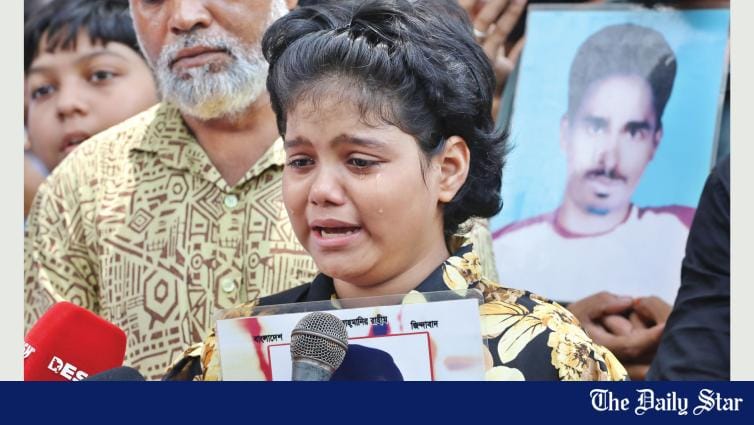
Overcome with emotion, a distraught Sadika Sarkar Safa, 10, speaks about her missing father Mahfuzur Rahman Sohel at a human chain in the Central Shaheed Minar area yesterday. Mahfuzur, a Chhatra Dal leader, has been missing since December 2013 when he was picked up by some plainclothes men in Dhaka. Mayer Daak, a platform of the families of the victims of enforced disappearances, organised the human chain marking the International Day of the Victims of Enforced Disappearances. Photo: Prabir Das

Ayesha Ali has been praying every day for over 10 years to see her son.

As several people emerged from secret detention centres known as Aynaghar after the fall of the Sheikh Hasina-led government early this month, Ayesha started hoping that her son Abdul Quader, who was 23 when he disappeared in December 2013, would knock on the door any moment.

"I touch his clothes everyday and I tell myself that he will come back. I keep looking out of the window, expecting to see him on the street," she said, breaking down in tears at a human chain at Central Shaheed Minar.

"Everyone says the country is now independent. Is the country not independent for my son?"

Other participants at the event then embraced Ayesha and tried to soothe her.

Quader, a student of finance at Jagannath University, was picked up by men claiming to be Rab members from the capital's Bashundhara area, family members said. He was a supporter of the BNP.

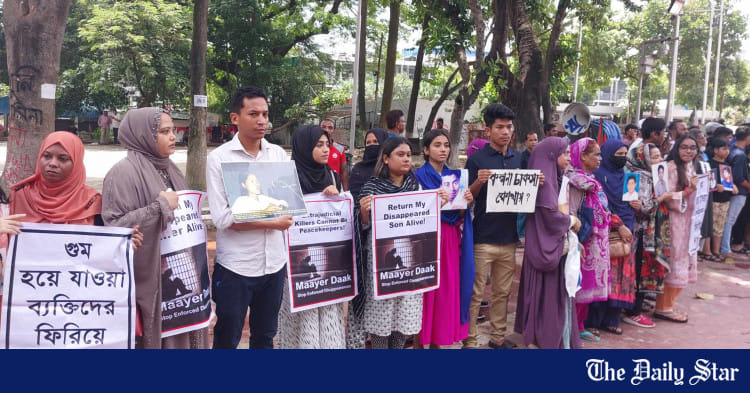
Many other family members of the victims of enforced disappearance were at the event, marking the International Day of the Victims of Enforced Disappearances.

Mayer Daak, a platform for the families, has been commemorating this day since 2013.

Speaking about her brother Mazharul Russel who has been missing since 2013, another participant named Nusrat Jahan also broke down.

"I want to touch my brother's hands. He used to take me to the school on his bicycle. I have nightmares of him being locked in a dark room alone. 'Find me,' he says to me," Nusrat said.

She then urged Chief Adviser Prof Muhammad Yunus to take steps to investigate the secret prisons.

She said there must be Aynaghar at the facilities of law enforcers where "my brother and others are probably detained".

"We want to know whether our loved ones are alive or dead," she added.

Twenty-two family members spoke at the human chain. Rights activists, politicians and lawyers expressed solidarity and demanded justice. Many held photographs of their missing loved ones.

Rina Alam, whose husband Noor Alam has been missing for more than nine years, said, "I want my husband back. If he is dead, I want to know for sure. I appeal to the chief adviser to do something to bring him back.

"Please tell us something; we can't go on waiting like this. Return my husband so that my children can call him baba."

Mikel Changma, a leader of a regional group based in the hill tracts, who was released this month from detention after over five years, said, "I urge all writers, poets, intellectuals, and students to support our struggle.

"If we cannot ensure the punishment of Hasina and those involved [in running secret prisons] right now, this system will continue to exist," he added.

Supreme Court Lawyer Sara Hossain said, "Our higher courts remained silent on this issue. We have seen no intervention from the courts about this matter."

Sadika Sarkar Safa, aged less than 11, was holding a photo of her father Mahfuzur Rahman Sohel who went missing 10 years ago.

"I want my father back. This is my only request to the new government," she said.

Maruf Zaman, a former diplomat, who was in detention for over a year, described the harrowing details of the conditions at DGFI Joint Interrogation Cell.

"Hundreds of people have used fish bones to cut their hands and write their names and phone numbers with blood inside the rooms. There are hundreds of names inside each cell. Where are they?" he asked.

Mayer Daak coordinator Sanjida Islam Tulee demanded that the detained persons be released and information about them be made public.

NEED LAW TO ENSURE JUSTICE

Mayer Daak organised a photo exhibition and discussion at the National Museum yesterday evening.

Environment Adviser Rizwana Hasan said the interim government was genuinely willing to find every disappeared individual.

"We are not part of the government responsible for these enforced disappearances. We want to stand beside the families that endured grief and ensure that the perpetrators behind face justice," she said.

Supreme Court lawyer Jyotirmoy Barua said the previous government's actions made it evident that it was behind these disappearances.

The previous administration repeatedly gave the excuse that there was no law to try those involved in enforced disappearance.

"We need a specific law. The president has the authority to pass laws through ordinances, which can later be approved by the elected government…. A special tribunal could define how this law should be formulated. Alternatively, the government could amend sections 363 and 364 of the CrPC to facilitate investigations into these cases," he said.

"Since Bangladesh is now a signatory [to the International Convention for the Protection of All Persons from Enforced Disappearance], the National Human Rights Commission can now independently investigate these cases. In addition, our commission [on enforced disappearance] can also investigate. Reports from both commissions can be sent to the International Criminal Court, because these are instances of crimes against humanity."

Fisheries ministry Adviser Farida Akhter SPOKE​
 
Analyze

Analyze Post

Add your ideas here:
Highlight Cite Respond
  • Sad (0)
Reactions: Bilal9

'We want you to die. We won’t have to kill you then.'
Never did I imagine that I would be a victim of enforced disappearance one day

1725061649384.webp

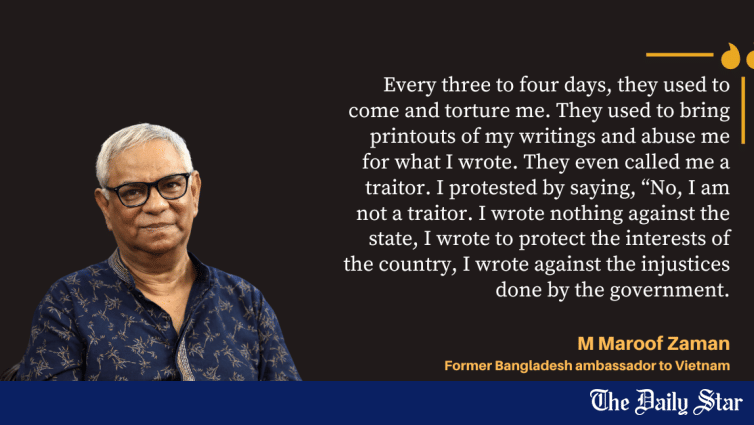
M Maroof Zaman

On December 4, 2017, around 6:45pm, I left my home and took my car to go to the airport to receive my younger daughter. As I started driving, I saw two motorcycles following me. I was aware that I was being monitored for the past year. I used to write a lot in the international media about the unequal agreements signed between India and Bangladesh, about the failures of the government and the injustices done by them.

I also wrote against enforced disappearances and extrajudicial killings but never did I imagine that I would be a victim one day.

From the time and turns the microbus took to reach my place of confinement, I could guess that I was taken to some place in the cantonment. First, they took me to a torture cell, beat me up severely, and hurled abuses at me. I told them to stop but they didn't. Then someone asked me, "Are you Maroof Zaman?" I replied, "Yes." He then asked, "Are you 'Banglar Bir'"? I said, "Yes, that's the name I use in the websites." They then beat me up again and took me to another small room.

I was kept there for four and a half months. Every three to four days, they used to come and torture me. They used to bring printouts of my writings and abuse me for what I wrote. They even called me a traitor. I protested by saying, "No, I am not a traitor. I wrote nothing against the state, I wrote to protect the interests of the country, I wrote against the injustices done by the government."

There were different levels of torture, namely grade one, grade two, and grade three. I was subjected to grade two level torture. Grade three torture means severe physical torture. While some young people may survive it, it is difficult for someone my age to survive such tortures. They told me that since I would not survive third-degree torture, they would instead give me injections, which would have severe impacts. They also used a high-powered light bulb and harsh noises to prevent me from sleeping.

On January 29, 2018, I heard a bullet shot and then someone was brought to my next room. Later, I heard someone saying: "He is no more". Another person was tortured through waterboarding. I didn't know what happened to him later.

Sometimes, I heard people saying, "Guard Shabdhan." This is a phrase used in the army by the guards to salute an officer. One day, I asked them to change my water bottles, as they were extremely dirty. A young man came with two water bottles, with the word "Shena" written on them. Also, on the first day of my abduction, when they handcuffed me, I could see that it was made of stainless steel, which is used by the security forces. I became certain that I was confined within the cantonment.

They hit me so much on my face that my teeth were broken. There was puss and blood coming out from my swollen gums. I asked them to take me to a doctor and get an X-ray done, but they rejected my appeal. I still have no sense in my gums and the nerves in one of my arms are severely damaged from the excessive beatings. I told them, "I will die if you don't give me treatment." They replied, "Die, we want you to die. We won't have to kill you then. You will die from your illness."

M Maroof Zaman is a former Bangladesh ambassador to Vietnam.​
 
Analyze

Analyze Post

Add your ideas here:
Highlight Cite Respond
  • Angry (-3)
Reactions: Bilal9

'Is this new independence not for my son?'
Asks mother of a victim of enforced disappearance at human chain

1725062436789.webp

Photo: Prabir Das

Mayer Dak, a platform for family members of the victims of enforced disappearance, today demanded the immediate release of information regarding disappeared individuals.

"On August 5, Sheikh Hasina fled. The remaining evil forces are still in the country. But the families of the disappeared individuals are yet to receive any information," said Sanjida Islam Tuli, the coordinator of Mayer Daak, at a human chain in the Central Shaheed Minar premises this morning on the occasion of the International Day of the Victims of Enforced Disappearances.

From 10:30am to 1:00pm, human rights activists, politicians, lawyers, and relatives of the disappeared participated in the event.

1725062466391.webp

Photo: Prabir Das

Carrying photographs, over 30 speakers spoke during the three-hour-long programme, raising their voices for justice and transparency.

Ayesha Ali, mother of Abdul Kader Masum, who has been missing, said, "The country has become independent again, but my son has yet to return home. Is this new independence not for my son?" she asked, breaking down in tears.

Nagorik Oikya President Mahmudur Rahman Manna expressed solidarity with the movement, saying, "I thank the current interim government for forming a commission and signing the instrument of accession to the International Convention for the Protection of All Persons from Enforced Disappearances within a short time.

"Victory has been achieved through the student- and peoples-led movement. Relatives believe this victory will bring back their loved ones who have disappeared," Manna said.

1725062492604.webp

Photo: Prabir Das

"The truth is that many among them will never return. This pain will have to be borne for a lifetime," he added.

Senior lawyer Sara Hossain, who also spoke at the event, said, "Just because the word 'disappearance' doesn't exist doesn't mean justice cannot be served… Our higher courts remained silent on this issue. We've seen no intervention from the courts on this matter," she said.​
 
Analyze

Analyze Post

Add your ideas here:
Highlight Cite Respond
  • Like (+1)
Reactions: Bilal9

Rights activists, victims call for preserving 'Aynaghor' as museum
BSS
Published :
Aug 30, 2024 19:09
Updated :
Aug 30, 2024 19:09

1725063830955.webp


Rights activists, researchers and victims of forced disappearance have called for preserving secret jails dubbed as 'Aynaghor' and run by different law enforcement or intelligence agencies as museums as proofs of ousted government's crimes.

"So far, we have information of at least 13 such secret jails which were run by different agencies," said researcher and rights activist Rezaur Rahman Lenin at a discussion at RC Majumdar Auditorium of Dhaka University last night (August 29).

Lenin along with other speakers suggested the secret jails be preserved as proof of the crimes of the ousted government, its ministers and leading figures to let people know the actual stories of their heinous acts.

'Rodh,' a youth platform that uses paintings and other artworks for campaign against fascism, staged the discussion titled "Enforced Disappearances: Separation and Dissection".

Researcher and writer Sohul Ahmed said the incidents of forced disappearances or killings in the name of 'encounter' took place during every regime but after 2010, the then government carried out such heinous acts in an intensive manner using the Digital Security Act in a very systematic way to suppress opposition voices.

"The previous government tried to legitimise the crossfire and extrajudicial killings with almost identical press notes, but no one talked about enforced disappearance," he said.

Ahmed said from 2010 to 2024, at least 703 people were victims of forced disappearance and till date 153 remained untraced.

"There have been allegations against all the nine intelligence agencies of the country. They all need to be exposed to justice," he said.

Lenin, meanwhile, accused the Law commission, Anti-Corruption Commission and Human Rights Commission of failure to take any visible step against the enforced disappearance or encounters that took place in the last 53 years.

He said the interim government formed a five-member commission to investigate such incidents in the past 15 years but authorities should have consulted with stakeholders ahead of taking the decision.

Coordinator of Mayer Daak Sanjida Islam Tulee, Journalist of French news agency AFP Mohammad Ali Majed, and anthropologist and documentary photographer Moshfiqur Rahman Johan also addressed the discussion.

Artist and writer Debashish Chakrabarty, art critic Razib Datta, artist and writer Debashish Chakrabarty, and artistic Researcher Faysal Zaman, were among those who attended the discussion.​
 
Analyze

Analyze Post

Add your ideas here:
Highlight Cite Respond
  • Love (+3)
Reactions: Bilal9

Justice for victims of enforced disappearance
Atiqul Kabir Tuhin
Published :
Aug 31, 2024 23:15
Updated :
Aug 31, 2024 23:15

1725150648284.webp


The nation recoiled in horror when it learnt about the horrific, inhumane happenings that befell the victims of enforced disappearance during the Sheikh Hasina led Awami League government. Harrowing nightmarish stories are emerging from those who had been victims of enforced disappearance and have lived to tell the tale of a secret detention centre called Aynaghar (House of Mirrors) or House of Horrors might be more appropriate.

Some earlier victims had indicated that there were notorious secret detention facilities, but couldn't fully describe the horror they experienced because apparently they were warned against speaking about their Aynahhar experience, or risk being re-arrested and returned there. With the fall of Sheikh Hasina and her government, the Aynaghar survivors are now coming forward to share their chilling and harrowing experiences of the horrors they endured.

Victim Michael Chakma - an indigenous rights activist who had been kidnapped and made to forcibly disappear for over five years - was held captive in such a clandestine prison, gives a shocking account of his captivity. Describing his conditions, which are akin to being in a grave, Chakma recounts the psychological and physical torture he endured in dark, confined spaces with little contact with the outside world and not knowing if his next breath was going to be his last.

His story is a frightfully chilling reminder of man's inhumanity to man, and the systemic abuse that characterised the previous government's approach to suppress dissent and opposition at all cost. The government totally denied the allegations at the time, of course, and claimed the victims were hiding to embarrass the government. A more outrageous violation of human rights is incomprehensible when the government and law enforcing agencies become the worst lawbreakers, disrespect human life and trample upon human dignity. How could we have descended to such depravity?

Mayer Daak (Mothers' Call), a group of the families of the victims of enforced disappearance, estimates that at least 750 people were forcibly made to disappear during AL regime. Of them, three victims were released following Sheikh Hasina government's fall, but the fate of the vast majority still remains a mystery. The three victims who were unceremoniously released back into society know nothing about where they were held, or who their captors were.

Against this gruesome backdrop that has appalled the nation, the interim government was quick to form a five-member Inquiry Commission to dig deep and investigate enforced disappearances by various intelligence and law enforcement agencies. In another significant development Bangladesh became a signatory to the International Convention for the Protection of All Persons from Enforced Disappearance on August 29.

It is incumbent upon the interim government to take decisive action to prosecute those involved in the enforced disappearances with the full force of the law. The perpetrators, including state officials who recommended, ordered, or facilitated these scandalous acts, must be brought to justice and made to pay for their acts against humanity. A special tribunal should be established to handle these cases, ensuring that the victims and their families receive the justice they deserve. Additionally, all secret detention centres operated by law enforcement agencies should be exposed, opened for public scrutiny, and like the renowned concentration camp in Auschwitz, Poland, be open to tourists to peer at and learn from one of the darkest periods in the history of Bangladesh.

The excruciating pain experienced by families of the victims must not be prolonged. They deserve to know the truth in every detail, however horrific it may be. They have every right to learn what happened to their loved ones, what state forces were involved in these heinous crimes, and who orchestrated these acts of kidnap, torture, and killing. A transparent, comprehensive investigation with justice will at least provide some answers and some comfort, even if it can never erase the tears, sleepless nights, and pain they have endured.​
 
Analyze

Analyze Post

Add your ideas here:
Highlight Cite Respond
  • Sad (0)
Reactions: Bilal9

Secret prison: Where just staying alive was intolerably painful
The persons who were released from these secret detention facilities before and after Sheikh Hasina's government fell in the face of the student-people's movement, gave such accounts of the cells
Mahmudul HasanDhaka
Updated: 30 Aug 2024, 21: 24

1725237631833.webp


Mayer Dak for long has been organising various events demanding the arrest and trial of persons involved in enforced disappearances and killings. The organisation formed a human chain in front of the National Press Club on 14 AugustFile Photo

A person would be picked up, blindfolded and hands tied. His entire face would be covered and a hat placed over his head. Then it was off to the secret detention facility. This was a small windowless room with a bright light constantly burning. There was no way to distinguish between day and night. Sometimes the light would be switched off and the room would plunge into pitch darkness. The noise of the exhaust fan was deafening and no outside sounds could be heard.

The persons who were released from these secret detention facilities before and after Sheikh Hasina's government fell in the face of the student-people's movement, gave such accounts of these cells.

They said, simply staying alive in those unknown detention cells was intolerably painful. It was a constant waiting for death, expecting them to take us away any minute.

Several of the victims said, they were subject to excessive physical torture after being picked up. Some of them were often taken to torture cells. When taken to the toilet, they would be blindfolded and handcuffed and could hear the screams and cries of others being tortured.

Sources working on enforced disappearances say that the abducted persons who had been in detention for long, would be kept in these cells. There were some who were immediately killed after being picked up or within a few days of being picked up.

In the Narayanganj seven-murder incident of 2014, the abducted persons were suffocated and killed by wrapping polythene around their heads. Then their abdomens were slit open, filled with cement or heavy objects and the bodies flung into the river. The bodies of some were recovered and some were never found.

After Sheikh Hasina came to power, from 2010 a trend began to abduct leaders and activists of the political opposition parties. This increased extensively before the 5 January 2014 election.

After Sheikh Hasina came to power, from 2010 a trend began to abduct leaders and activists of the political opposition parties. This increased extensively before the 5 January 2014 election. From the very outset it was alleged that the government's forces were involved in this, but the government at the time paid no heed. They would make taunting remarks like the person was "hiding from loan collectors because he owed money", and so on.

After the fall of the Sheikh Hasina government on 5 August in face of the student-people's uprising, the demand resounded even louder for the victims of enforced disappearance to be returned, to close down the secret detention cells and to place those involved on trial.

Today, 30 August, the International Day of the Victims of Enforced Disappearance is commemorated in this backdrop.

According to the non-government human rights organisation, Ain O Salish Kendra (ASK), a total of 629 persons were victims of enforced disappearance from 2007 to 2023. Over time since then, the bodies of 78 were recovered and 59 persons were released after abduction. And 73 were later shown to be arrested. No trace of the remaining persons has been found.

Mayer Dak, the organisation of relatives of victims of enforced disappearance, on 18 August handed over to the director general of the Directorate General of Forces Intelligence (DGFI) a list of 158 persons who remain missing. They went missing since after 2009.

While these families have long been holding various programmes in demand that the missing persons be returned, the secret detention facilities first came to light two years ago in 2022 when the Sweden-based media outlet Netra News came up with the report on Aynaghar, DGFI's secret detention centre. Released from detention, a few individuals, including an army officer, have revealed horrifying stories of Aynaghar.

Explaining the name Aynaghar (House of Mirrors), former army officer Lt. Col. Hasinur Rahman, twice a victim of enforced disappearance, said that the guard would sometimes sneeringly say, you are in Aynaghar. Aynaghar was metaphorical in the sense that you saw no one there other than yourself.

The Sheikh Hasina government did not admit to abducting persons or the existence of any secret detention facilities. They ignored the calls made by the United Nations and other international agencies. However, from the top level of the present interim government, it has been said that action is being taken in this regard.

Enforced disappearance and detention in the secret prison was the biggest fear for the movement against the government in power for 15 years, for criticising them in any manner.

The day after Sheikh Hasina left the country, on 6 August three persons were released from the secret detention facilities. They were Brig. Gen. Abdullahhil Amaan Azmi, lawyer Ahmad Bin Quasem (Arman) and Michael Chakma, leader of the Chittagong Hill Tracts organisation United Peoples Democratic Front (UPDF). The first two were almost eight years in the secret prison and the last one over five years.

Speaking to Prothom Alo, Michael Chakma said, "Proper meals were not provided in the airless dark space enclosed by four walls. I was under such tremendous mental agony that I told them to kill me rather than keep me alive like this. I still can't sleep at night because of the horrific torture. I jump at the slightest sound."

Enforced disappearance and detention in the secret prison was the biggest fear for the movement against the government in power for 15 years, for criticising them in any manner. Those who were kept there were more dead than alive. Most of those who have been retrieved from the secret detention facilities are still in trauma.

Prothom Alo spoke to others who had been released from the secret prison earlier. They said that they underwent indescribable sufferings in the prison. There were large exhaust fans in the cells and the sound of these fans were so deafening, nothing from outside could be heard. No one could even sleep properly. And if the exhaust fans were turned off, some of them would hear screams and cries of others. They felt that they were intentionally made to listen to these tortured screams of the other inmates.

The persons who were released from the secret prison say that the rooms they were kept in were very small. Each would contain a 3ft by 7 ft bed, leaving just 3ft to 4ft space. There was no toilet in the rooms.

Most of the rooms were damp and dirty. There were bed bugs and mosquitoes. In the rooms on the sides of the building, a little light would enter through the ventilators. But the inner rooms were pitch dark. One couldn't even see oneself if there was an electricity failure.

The inmates were made to wear old clothes. The bed would be covered with a dirty sheet. There would be one toilet for every four or five rooms. A detainee would be allowed to use the toilet four or five times a day. They would be handcuffed and blindfolded and taken out of the room to go to the toilet. There was a hole in the door so the inmates were watched even when they were in the toilet. They were kept barefoot.

Former army officer Hasinur Rahman was abducted twice and detained for lengthy spans of time. Describing the torture, he said first he would be tightly blindfolded in the room where he was kept. Then he would be taken to the torture cell where his arms and legs would be tied to a chair. Some persons would be hung up from the ceiling. They would tear off the fingernails from some. They would torture however they wished. When anyone would go to the room crying out aloud, I would understand they had been tortured. The detained persons would be tortured once a month.

The persons released from the secret prisons said when they were in detention, most of them had given up hope of survival. Languishing for years in the prison, many thought they would die there. While Sheikh Hasina was in power, some of them were released from these secret facilities. But after the extreme torture they had faced, none of them dared open their mouths in fear.

Location of the secret prison

There is still no definite information about where Aynaghar or the secret detention facility is located. But from those who have been released, it is clear that the prison was run under the management of an institution. Some of them said that they saw the logo of the defence ministry on the medicines, food, books and other items they were given. Also, the behaviour and manner of talking of these guards, the physicians, the barbers and those who served them food, indicated they were working for the armed forces of an intelligence agency.

Former army officer Hasinur Rahman, who had been detained in Aynaghar twice, said during the rule of Pakistan, there had been a joint interrogation cell (JIC) in a building in Kochukhet in the cantonment. During the 1/11 government, many persons were tortured in those abandoned rooms. After Sheikh Hasina came to power, those rooms were used once again as detention and torture cells. Outside of that, RAB had its own secret detention facility to keep persons for a short time. The interrogation cell of the armed forces at times had also been misused as a detention facility.

Concerning the location of Aynaghar or the secret prison, Hasinur Rahman said Aynaghar was located around 30 to 30 yards behind the DGFI office in Kochukhet. From back in Pakistan times, there was a building there, the first floor 18ft high and the second floor 20ft high. Next to this is a mosque. The new building was made in 2009. The new building has 10 rooms and the old one 17 rooms.

Hasinur Rahman said, "After I became active about this matter, the two buildings were covered with a large tarpaulin so pictures could not be taken of the buildings from satellite."

The director of Inter Services Public Relations (ISPR) directorate was contacted yesterday, Thursday, for a statement on the allegations or discussions on the Aynaghar or secret detention centre in the cantonment near the DGFI office.

He said that inquiries must be made to find out about any such structure within the cantonment. Also, he said, DGFI was not a matter under the ISPR.

Others say that there were also torture cells in some branches of RAB and the police. It was said that such a secret detention facility had been set up by the railway tracks near the RAB-1 office in Uttara. Many of the victims of enforced disappearance had been kept there before the 2014 election. This was conjectured from the descriptions of a few of those who had been released.

A description of the RAB-1 prison has been revealed in the deliberations of former member of the armed forces Md. Mukul Hossain who was released from the secret detention facility.

Former corporal Mukul said he went missing on 3 February 2019 from Kalabagan. Later on 8 May he was shown arrested in a narcotics case.
The details of how Mukul was picked up, tortured and locked in a room for a long period of time, match the descriptions of others.

Towards the end, before he was released, he had been kept at the RAB-1secret detention centre. He would hear the sound of trains from there. Later RAB-1 handed him over to the airport police station and he was shown to be arrested in a narcotics case.

When asked about any such detention facilities of RAB here victims of enforced disappearance were kept, the present RAB director of legal and media affairs Lt Col Md Munim Ferdous told Prothom Alo yesterday, Thursday, the officers who were there at the time will best know about this. But RAB has no secret prison now. He said, "If the commission formed for enforced disappearances or the concerned authorities want to investigate these matters, we will extend all cooperation."

Demand to punish those involved and to close the prison
Talking to several sources concerning the secret detention facilities, it was learnt that at present there is no one in any such facilities. The present government is against maintaining any such facilities.

Human rights organisations, however, say that alongside shutting shut facilities down, all those involved must be punished so no one in the future will even think of acting in such a manner.

In his speech delivered to the nation of 25 August, chief advisor Dr Muhammad Yunus said, "The patriotic armed forces, the police, BGB, and RAB were used for enforced disappearances and torture, tarnishing the image of these institutions. We want to identify the criminal and punish them. He said that justice will be ensure for all the extrajudicial killings, the enforced disappearances, killings, abductions and the ultimate despicable misdeeds like running Aynaghar."

Yesterday, Thursday, Bangladesh signed the international convention against enforced disappearances. Earlier on 27 August an inquiry commission was formed to look into the incidents of enforced disappearances carried out by the law enforcement agencies during the rule of the Awami League government.

The circular regarding this commission said, this inquiry commission has been formed to search for persons who fell victim to enforced disappearance at the hands of the any members of the police, the Rapid Action Battalion (RAB), Border Guard Bangladesh (BGB), the Criminal Investigation Department (CID), the Special Branch, the Detective Branch, Ansar Battalion, National Security Intelligence, the defence forces, DGFI, Coast Guard and other law enforcement agencies.

Md Noor Khan has for long been working on the issues of enforced disappearance and extrajudicial killings.

He told Prothom Alo, "We have learnt that the joint interrogation cell, Aynaghar or the secret prison whatever we may call it, is not just one place, but in many places. It must be found where these facilities existed and whether anyone is still there."

He further said detailed investigations must also be made into who ordered the enforced disappearances, at what level the decisions for enforced disappearances were taken, whether any individual or any agency or force took the decision, what the process of decision-making was and all details. All those involved must be brought under the law.

* The report, originally published in the print and online editions of Prothom Alo, has been rewritten in English by Ayesha Kabir​
 
Analyze

Analyze Post

Add your ideas here:
Highlight Cite Respond
  • Sad (0)
Reactions: Bilal9

The need for a clear charter for the intelligence agencies
The catch-all definition of national security must not be used as a cloak to hide abuses

1725407632883.webp

VISUAL: ANWAR SOHEL

That the law enforcement officials including those in the intelligence agencies had dangerously overstepped their jurisdiction and went beyond their charter, if there is any, is a manifest reality. The heart-rending wailings of the victims of enforced disappearance sadly bring to light the arbitrary and predatory activities of a section of public servants. The compounding tragedy is that while the victims' families were complaining and seeking justice for a painfully long time, the government of the day was consistently in denial mode, thus making light a grave human rights violation.

The undeniable facts of enforced disappearance and torture in unauthorised custody like the Aynaghar, now in public view, surely dent our credentials as an orderly and law-bound society. How have we descended into such a deplorable state, and where are the fault lines? Also, what was the apportionment between political executives and the executers on the ground in the wrongdoers' culpability?

It is no secret that intelligence agencies play a leading role in providing political-analytical inputs to the ruling party and its government. However, there are tales of political skulduggery on behalf of successive political regimes. The agencies are known to have undertaken strategic exercises during elections and conduct election forecasts and analysis to oblige the party in power. In doing so, they have become an instrument of partisan politics. The accompanying politicisation or lack of impartiality and objectivity distorted the policy process and damaged the credibility and political legitimacy of the state.

There is credible suspicion that our intelligence agencies lack an acceptable legal framework and a well-honed charter of duties. Consequently, the allegation of its functioning in a thoroughly political manner cannot be brushed aside. We do not have adequate safeguards and constant vigilance against likely misuse of the powers of intelligence personnel. This requirement assumes greater significance since intelligence activities are carried out in secrecy and the average citizen may not be aware that his rights are infringed.

The undeniable facts of enforced disappearance and torture in unauthorised custody like the Aynaghar, now in public view, surely dent our credentials as an orderly and law-bound society. How have we descended into such a deplorable state, and where are the fault lines?

Our intelligence agencies collect a great deal of information about the activities of various political parties and in the process keep a watch over the activities of all persons who oppose the policies of the government in position. Curiously, they do not usually collect information about the party in power. While subversion of the constitution or deliberate disruption of public order through violent means should be matters of concern to the agency, issues like power, politics, factionalism within a political party, and defections must be kept outside the gambit of the tasks of intelligence agencies.

As such, the intelligence agencies should not be the judge of their own operations with regard to the necessity and propriety thereof, nor should they be allowed to operate as politicians' agency or instrument, or degenerate into an institution for controlling the opponents of the ruling party. The agencies must not be engaged in assessing the election prospects of the ruling party and be used as an instrument for political spying either by the government or an individual in the government.

There has to be a charter of duties, putting responsibilities beyond doubt and indicating what is permitted and what is not. The legitimate purpose of intelligence has to be the anticipation of developments that may imperil national interests and security, to enable appropriate action with the imperative that any tendency that equates national interest with the interest of the party in power must be guarded against. Besides, the ruling party must not be allowed to watch the activities of other political parties and even members of its own party.

The catch-all definition of national security must not be used as a cloak to hide abuses. The definition has to exclude from its purview anything that smacks of denial of human rights and basic freedoms. There should be clear and firm guidelines on the limits to the agency's authority, the areas of coverage, the manner of functioning, and the methods they are permitted to use. The heads of agencies must be accountable to the executive and the legislature. They have to be subjected to parliamentary oversight regularly as is done in mature democracies.

A detailed and precisely honed charter for intelligence agencies in consonance with the spirit of the constitution needs to be prepared. These are tall orders, no doubt, but we have to make a start however humble it may be. We will not achieve anything if politicians in our perilously polarised scenario fail to accept each other as contestants and not as enemies.

Muhammad Nurul Huda is former IGP of Bangladesh Police.​
 
Analyze

Analyze Post

Add your ideas here:
Highlight Cite Respond
  • Love (+3)
Reactions: Bilal9

Public notice to be issued in search of victims of enforced disappearances
FE Online Desk
Published :
Sep 08, 2024 21:08
Updated :
Sep 08, 2024 21:08

Public notice will be issued to trace the persons who have been forcibly disappeared by members of any law enforcement agency in the country.

The decision was taken on Sunday in the first meeting of the inquiry commission formed to trace and identify the forcibly disappeared persons by members of any law enforcement agencies, BSS reports citing a press release.

With commission Chief Justice Moinul Islam Chowdhury in the chair, all members of the commission were present at the meeting held at its Gulshan Avenue office here.

The meeting decided that the commission will run its activities as usual from 10am to 6pm every day except public holidays.

The government formed the 5-member Inquiry Commission to trace the persons who have been forcibly disappeared by the members of the country's law enforcement agencies, including Bangladesh Police, Rapid Action Battalion (RAB), Border Guard Bangladesh (BGB), Criminal Investigation Department (CID), Special Branch, Intelligence Branch, Ansar Battalion, National Intelligence Agency (NSI), Defense Forces, and the Directorate General of Defense Intelligence (DGFI).​
 
Analyze

Analyze Post

Add your ideas here:
Highlight Cite Respond
  • Sad (0)
Reactions: Bilal9

Posts you haven't read yet..

Members Online

Latest Posts

Back
 
G
O
 
H
O
M
E